

New Point of Contact Introduction Email Templates That Actually Get Replies
It's Monday morning. Your predecessor left Friday. You've inherited 100+ accounts, a half-updated CRM, and a Slack message that says "good luck!" That first email you send sets the tone for every relationship going forward - and 33% of customers will consider switching after a single bad experience. A strong introduction email is the difference between keeping an account and losing one.
What You Need Before Writing
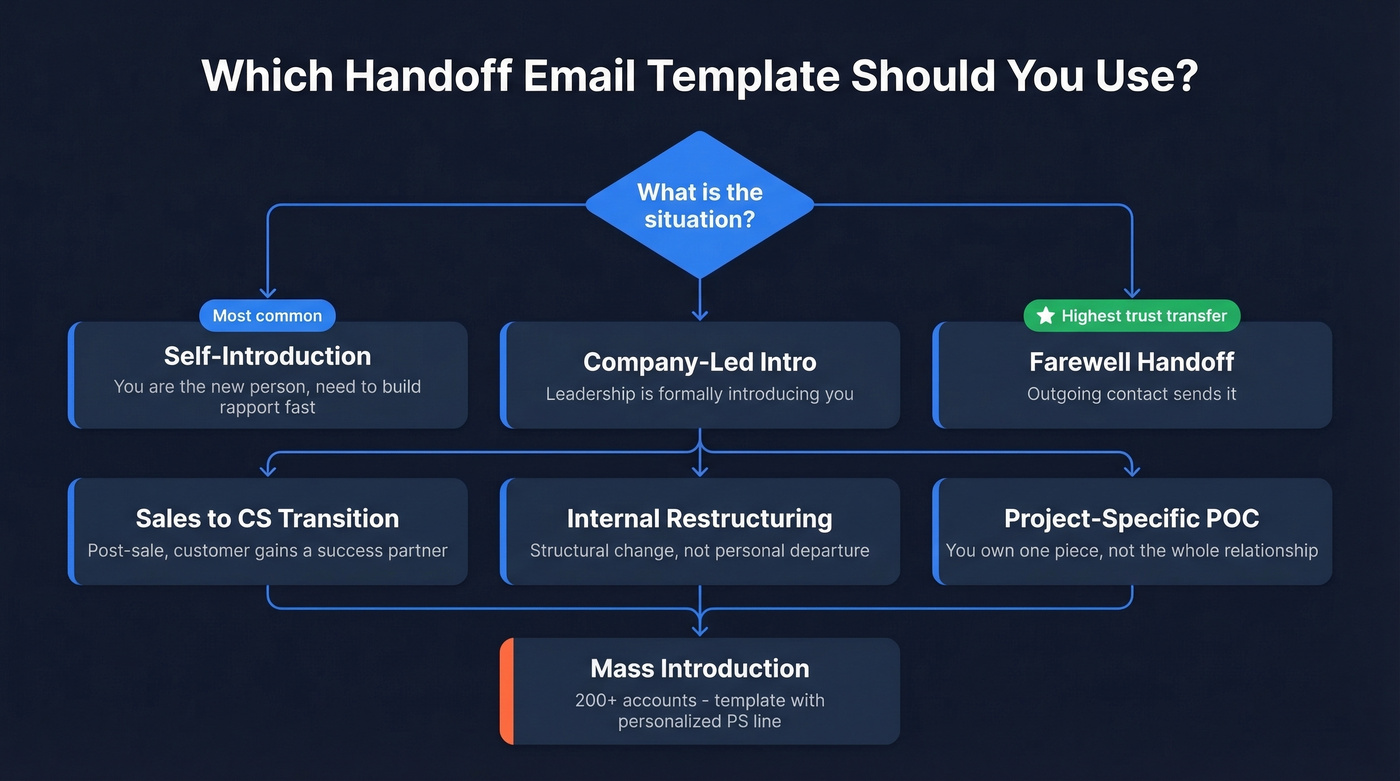
Three rules before you write anything: lead with your purpose (not your resume), always include a meeting link, and get the outgoing contact to co-sign the handoff whenever possible. The three templates that cover most scenarios are the self-introduction, the company-led intro, and the farewell handoff - all below. Before you send a single email, verify your contact list. Bouncing on your first outreach is a terrible first impression.
Why Handoff Emails Matter More Than You Think
A well-executed handoff makes a customer 3.5x more likely to continue with your company. A sloppy one - or worse, no handoff at all - accelerates churn during the most vulnerable moment in the customer lifecycle.
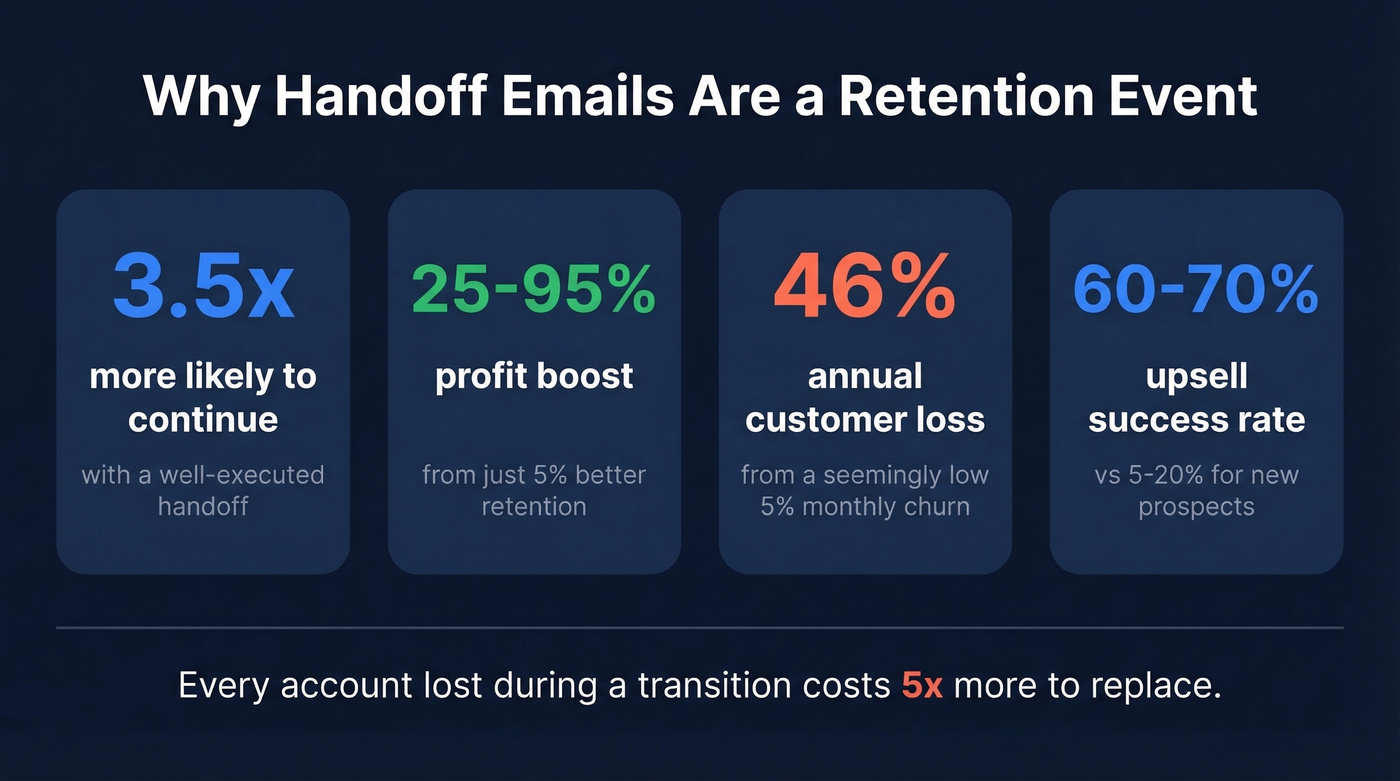
A 5% increase in retention boosts profits 25-95% per Bain & Company. On the flip side, a seemingly low 5% monthly churn rate compounds to 46% annual customer loss. And 44% of churned customers say they left because they didn't achieve their desired outcomes - a botched handoff is often where that failure starts. Selling to existing customers succeeds 60-70% of the time versus 5-20% for new prospects, so every account you lose during a transition is revenue you'll spend five times more to replace.
Your introduction email isn't a formality. It's a retention event.
Before You Write - The Handoff Checklist
Don't open a blank email yet. Gather what you need so your introduction actually sounds informed.
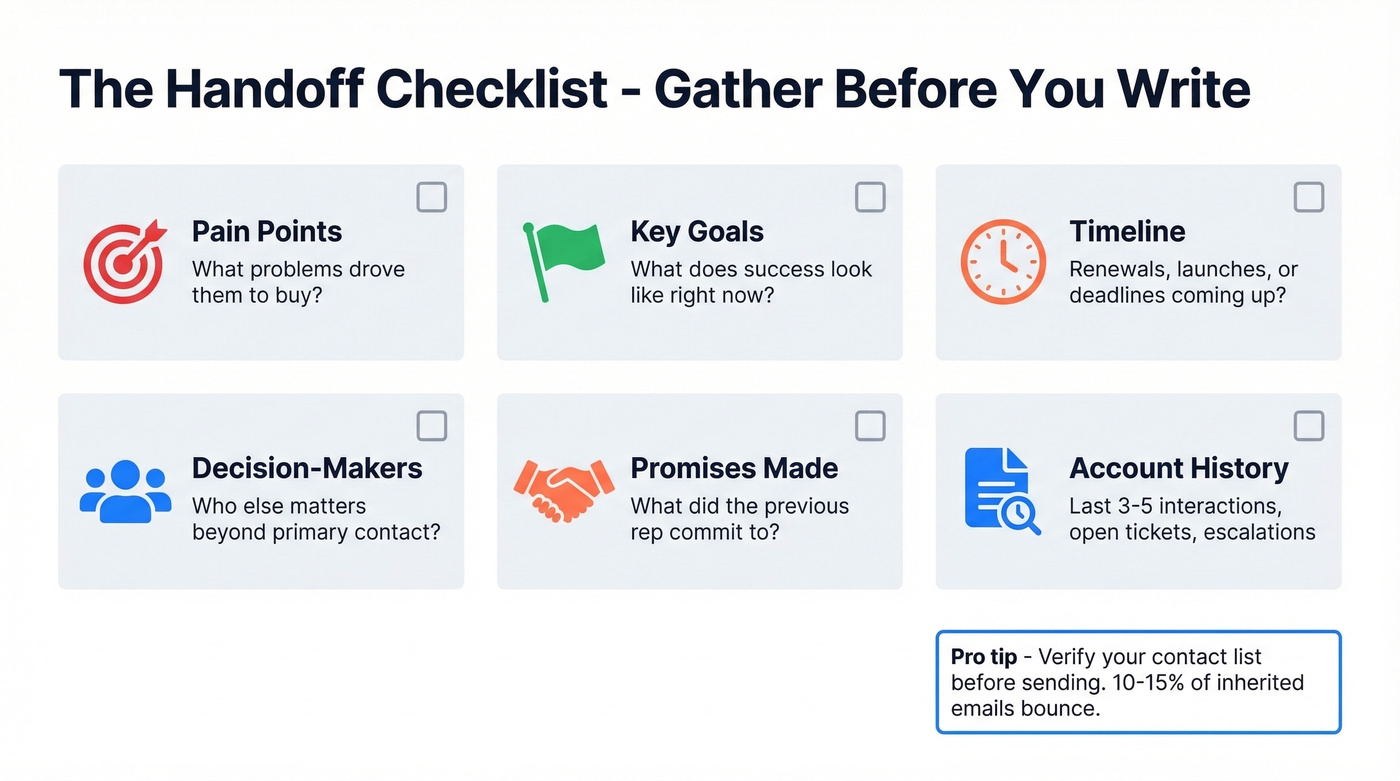
- Pain points: What problems drove this customer to buy?
- Key goals: What does success look like for them right now?
- Timeline: Any upcoming renewals, launches, or deadlines?
- Decision-makers: Who else matters beyond your primary contact?
- Promises made: What did the previous rep or CSM commit to?
- Account history: Last 3-5 interactions, open tickets, recent escalations
This framework comes from RevPartners' handoff playbook, and it's the most practical pre-email checklist we've found.
One more step most people skip: verify your contact data. We've seen teams inherit account lists where 10-15% of emails bounce on the first send. That's not a great look when you're trying to build trust. Run your CSV through Prospeo's enrichment tool before you hit send - it catches bad addresses and returns 50+ data points per contact so you can fill in the gaps your CRM missed. If you’re comparing vendors, start with these data enrichment services.
Anatomy of a Great Introduction Email
Every effective handoff introduction has seven elements. Miss one and you create friction.
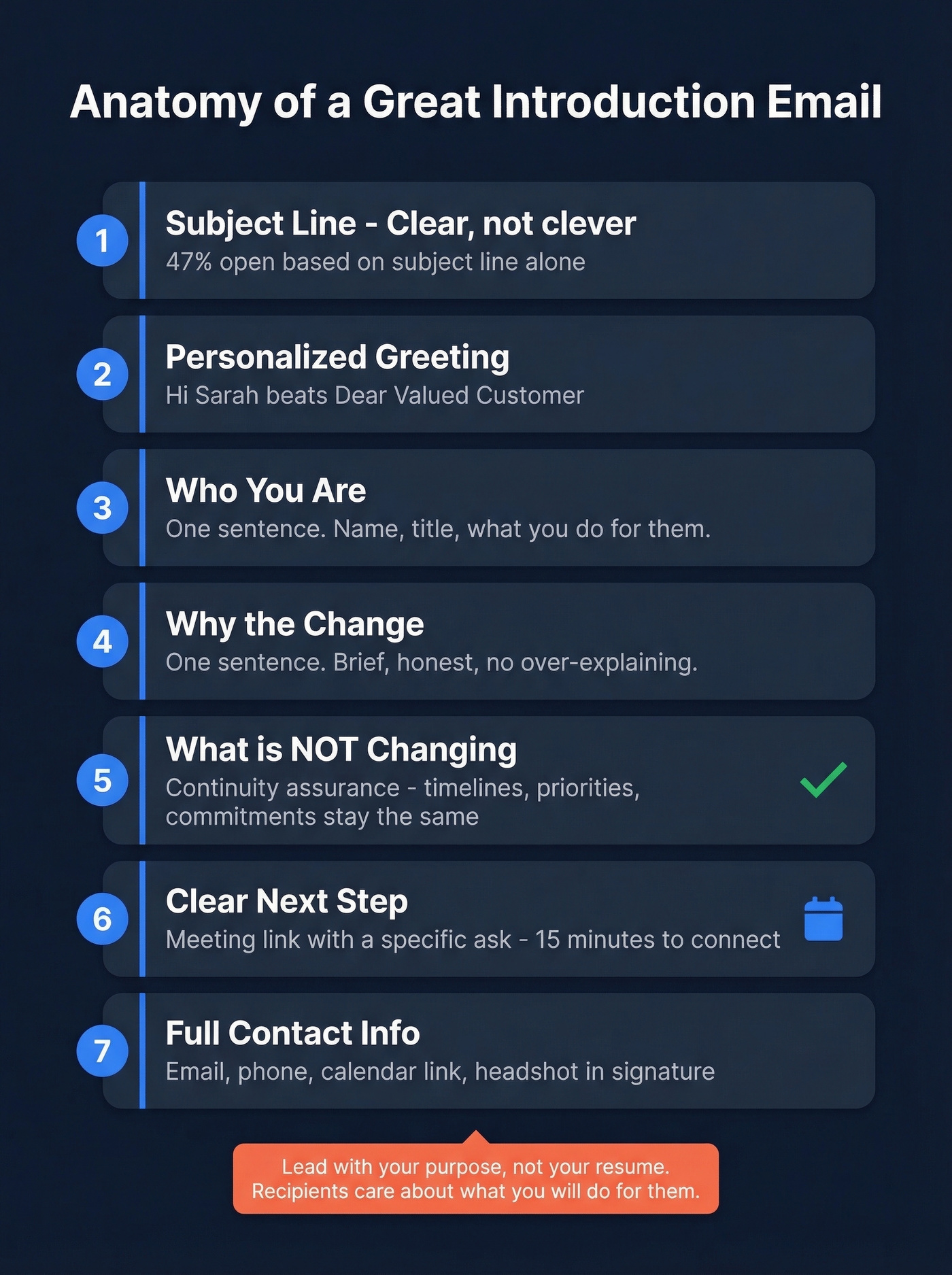
- Subject line - 47% of recipients decide whether to open based on the subject line alone. Make it clear, not clever. If you need more ideas, pull from these email subject line examples.
- Personalized greeting - Use their name. "Hi Sarah" beats "Dear Valued Customer" every time.
- Who you are - One sentence. Name, title, and what you do for them.
- Why the change - One sentence. Don't over-explain, but don't leave them guessing. Whether you're writing an introduction email replacing someone who left or covering a restructuring, keep this brief.
- What's NOT changing - Continuity assurance. "Your project timeline, priorities, and commitments remain the same."
- Clear next step - A meeting link with a specific ask. "I'd love 15 minutes to introduce myself and hear what's top of mind." (More on writing a strong email call to action.)
- Full contact info - Email, phone, calendar link. Consider including a headshot in your signature to help clients put a face to the name.
Here's the thing: most people lead with their resume. Don't. A common theme in r/CustomerSuccess is that recipients care about your purpose, not your background. Lead with what you're going to do for them, not where you went to school.

Bouncing on your first handoff email kills trust before you've built it. Prospeo's enrichment tool verifies your inherited contact list at 98% accuracy and returns 50+ data points per contact - so your CRM gaps get filled before you hit send.
Clean your account list in minutes, not hours. Start free today.
10 Subject Lines That Get Opened
Self-introduction:
- Introducing [Your Name], Your New [Title]
- New Point of Contact for [Company/Project]
- Quick Intro - [Your Name] from [Your Company]
- Your New [Title] - Let's Connect
Company-led introduction: 5. Update from [Company]: New Contact for [Service] 6. Meet [Name], Your New Account Manager 7. Team Update: [Name] Is Taking Over Your Account
Farewell handoff: 8. [Outgoing Name]'s Replacement - Let's Connect 9. Passing the Baton: [Name] Will Take Great Care of You 10. A Quick Note Before I Go + Your New Contact
Keep subject lines under 50 characters when possible. Personalized subject lines get 26% more opens. Avoid anything like "URGENT: New Contact!!!" - it reads like spam and tanks your credibility before you've said a word.
7 Copy-Paste Introduction Email Templates
Self-Introduction as New POC
This is the master template. It works for most situations - you're the new person, you need to build rapport fast, and you want a meeting on the calendar. (If you want more variations, see these handoff email templates.)
Subject: Introducing [Your Name], Your New [Title]
Hi [First Name],
I'm [Your Name], your new [title] at [Company]. I'm taking over from [Previous Name] and I'll be your primary point of contact going forward - my job is to make sure you're taken care of and to be your advocate internally.
I've reviewed your account and I'm up to speed on [specific project or goal]. I'd love to set up a quick 15-minute call to:
- Hear what's working well and what isn't
- Understand your priorities for the next quarter
- Make sure nothing falls through the cracks during this transition
[Calendar link] - grab any time that works.
Looking forward to connecting, [Full name, title, phone, email]
PS - Congrats on [recent news from their website or company page]. Exciting stuff.
The PS line is where personalization lives. Even one sentence shows you did your homework. For a more formal tone, swap "I'd love to set up a quick 15-minute call" for "I'd welcome the opportunity to schedule a brief introductory call at your convenience."
Company-Led Introduction
Use this when leadership or a manager is formally introducing your colleague on email to a client. The tone is slightly more polished, and the credibility comes from the sender's authority rather than the new contact's self-promotion.
Subject: Meet [Name], Your New Account Manager
Hi [First Name],
I'm writing to introduce [New Contact Name], who will be your account manager effective [date]. [Name] brings [brief credibility line - e.g., "8 years of experience in SaaS customer success"] and is fully briefed on your account.
[Name] and I would like to arrange a brief introductory call at your convenience to ensure a smooth transition. You can reach [Name] directly at [email] or [phone].
Thank you for your continued partnership.
Best, [Manager/Leader Name, Title]
This format works well when you want a formal, company-led introduction around the change.
Farewell + Replacement Handoff
The outgoing contact sends this one. It transfers trust in a way a cold self-intro never will. If you can only send one email during a transition, make it this one - the warm handoff from someone the customer already trusts is worth ten self-introductions.
Subject: A Quick Note Before I Go + Your New Contact
Hi [First Name],
I wanted to let you know that I'm moving on from [Company], and [New Contact Name] will be taking over your account. I've briefed [Name] on everything - your goals, your timeline, and where things stand with [specific project].
[Name] is excellent, and I'm confident you're in great hands. You can reach them at [email/phone].
It's been a pleasure working with you. Thank you for the partnership.
Warm regards, [Outgoing Name]
Sales-to-Customer Success Transition
The trickiest handoff. Customers often feel "dumped" after the sale closes. Reframe it: they're not being handed off, they're gaining a dedicated success partner.
Subject: Your Dedicated Success Partner at [Company]
Hi [First Name],
Now that you're officially onboard, I want to introduce [CSM Name], your dedicated Customer Success Manager. [Name] is going to be your go-to for everything from onboarding to renewals.
I've shared your goals, timeline, and everything we discussed during the sales process - so you won't have to repeat yourself. [Name] will be reaching out shortly to schedule your kickoff call.
I'll still be here if you need anything, but [Name] is your primary contact from here on.
Cheers, [Sales Rep Name]
Internal Restructuring Notification
When the change is structural, not personal, address the "why" head-on. Silence breeds speculation - a single sentence explaining the transition prevents the customer from assuming the worst.
Subject: Team Update: New Contact for Your Account
Hi [First Name],
We've recently restructured our team to better serve accounts like yours. As part of that change, I'll be your new point of contact going forward. Nothing about your service, timeline, or commitments is changing - just who you'll be hearing from.
I'd love to schedule a quick intro call. [Calendar link]
Best, [Your Name, Title, Contact Info]
New POC for a Specific Project
When you're not replacing someone entirely - just owning one piece of the relationship.
Subject: New Point of Contact for [Project Name]
Hi [First Name],
I'm [Your Name], and I'll be your contact for [Project X] going forward. [Original Contact Name] remains your primary contact for everything else - I'm here specifically to make sure [Project X] stays on track.
Let's find 15 minutes to align. [Calendar link]
Best, [Your Name, Title, Contact Info]
Mass Introduction to Inherited Accounts
Look, when you inherit 200+ accounts, you can't hand-craft every email. Don't pretend otherwise. Use a template, but personalize the PS line for each recipient - and focus your deep outreach on the top 20% of accounts by revenue.
Subject: Introducing [Your Name], Your New [Title]
Hi [First Name],
I'm [Your Name], your new [title] at [Company]. I'm reaching out to introduce myself and make sure your experience stays smooth during this transition.
I'd love to learn more about your goals and how we can best support you. If you're open to a quick call, here's my calendar: [link]
Looking forward to connecting, [Full Name, Title, Phone, Email]
PS - [Personalized line: recent company news, milestone, or specific account detail]
Before you send 200 introduction emails, verify your list. We've watched teams torch their sender reputation on day one because 12% of their inherited contacts were dead addresses. A quick bulk verification pass saves you from that headache entirely. If you’re diagnosing deliverability, start with email bounce rate benchmarks and fixes.
What to Do After You Hit Send
Sending the email is step one. Here's what separates good transitions from great ones.
Timing matters. Send your introduction email during business hours in the recipient's time zone. Handoff emails are operational, not cold outreach - you'll often see 40-60% open rates if your subject line is clear. If you want a data-backed send window, use this guide on the best time to send cold emails.
Follow up with non-responders 3-5 business days later:
Subject: Re: Introducing [Your Name], Your New [Title]
Hi [First Name],
Just circling back on my note from [day]. I'd love to connect for a quick 15 minutes - does [specific day/time] work?
[Calendar link]
Best, [Your Name]
Notice the shift: the follow-up includes a specific time suggestion, not an open-ended "let me know." That small change usually improves response rates. If you need more options, borrow from these sales follow up templates.
For those who book a call, run this kickoff agenda:
Start by reconfirming their goals - don't assume the CRM notes are current. Ask the question that CSMs on Reddit swear by: "What does a wildly successful first 90 days look like for you?" Then draft success plan milestones together in real time. Show only the platform area that maps to their primary goal - don't demo everything. End by assigning one small "homework" task to create early momentum.
86% of people say they'd stay more loyal to a business that invests in onboarding content that welcomes and educates them. Your kickoff call is that investment.
5 Mistakes That Kill the Relationship
Leading with your resume instead of your purpose. Nobody cares about your 12 years of experience in the first email. They care about what you're going to do for them. Save the credentials for the call.
No meeting link or clear CTA. "Feel free to reach out" isn't a call to action. Include a calendar link and a specific ask. Every time.
Generic mass-blast tone with zero personalization. Even one personalized PS line - a mention of their recent product launch, a congratulations on a funding round - signals you've done your homework. I once watched a colleague send 150 identical handoff emails with "[Company Name]" still in brackets. Three accounts escalated to leadership that same afternoon.
Not addressing why the change happened. A single sentence explaining the transition prevents the customer from assuming the worst. Skip it and they'll fill the silence with their own (usually negative) narrative.
Sending to unverified or outdated contacts. You've crafted the perfect introduction and it bounces. Or worse, it lands in the inbox of someone who left six months ago. Verify before you send. If you’re building a repeatable process, use an email deliverability guide to keep future handoffs clean.
Let's be honest about something: the handoff email gets all the attention, but the kickoff call is where accounts are actually saved or lost. A perfect email followed by a generic "so tell me about your business" call undoes all the trust you just built. Prepare for the call like it's a first date - know their history, have specific questions, and never make them repeat what they've already told your predecessor.
That handoff checklist above is useless if 15% of your inherited emails bounce. Prospeo catches bad addresses, finds updated contacts, and enriches every record with job titles, direct dials, and company data - all at $0.01 per email with a 92% match rate.
Don't let stale data sabotage your first impression as the new POC.
Get the handoff right and you keep the account. Get it wrong and you're starting from scratch. These templates give you the foundation - now make them yours.
FAQ
How long should a handoff introduction email be?
Five to eight sentences max. Lead with your purpose, include two or three meeting agenda bullets, and close with a calendar link. Anything longer gets skimmed - your goal is a reply, not a novel.
Should the outgoing or incoming contact send the email?
Ideally both. The outgoing contact sends a warm handoff that transfers trust, then the new POC follows up with a self-introduction. This two-email sequence outperforms either message alone because it gives the customer social proof from someone they already trust.
How do I introduce myself to 100+ accounts at once?
Use a template with a personalized PS line for each recipient. Verify all email addresses first, then prioritize deep outreach for your top 20% of accounts by revenue. The rest get the template with a personal touch - that's realistic, and it's enough.
What if the previous contact left abruptly?
Acknowledge the transition honestly without oversharing. Focus on continuity: "I've reviewed your account history and I'm fully up to speed on [specific project or goal]." Customers don't need the backstory - they need confidence that nothing's falling through the cracks.
When should I send the follow-up if I don't hear back?
Wait three to five business days, then send a shorter follow-up referencing your first email. Include a specific time suggestion - "Does Thursday at 2pm work?" - instead of an open-ended "let me know when you're free." This small change typically doubles response rates on handoff sequences.