

How to Build a New Product Go-to-Market Strategy That Actually Works
95% of new products fail. That stat gets thrown around so much it's lost its punch, but sit with it - the default outcome for your launch is failure. The median SaaS company now spends $2.00 in sales and marketing for every $1 of new ARR, a ratio that climbed 14% in 2024. CAC is rising, attention is fragmenting, and most teams still treat their new product go-to-market strategy like a 20-page deck that nobody executes.
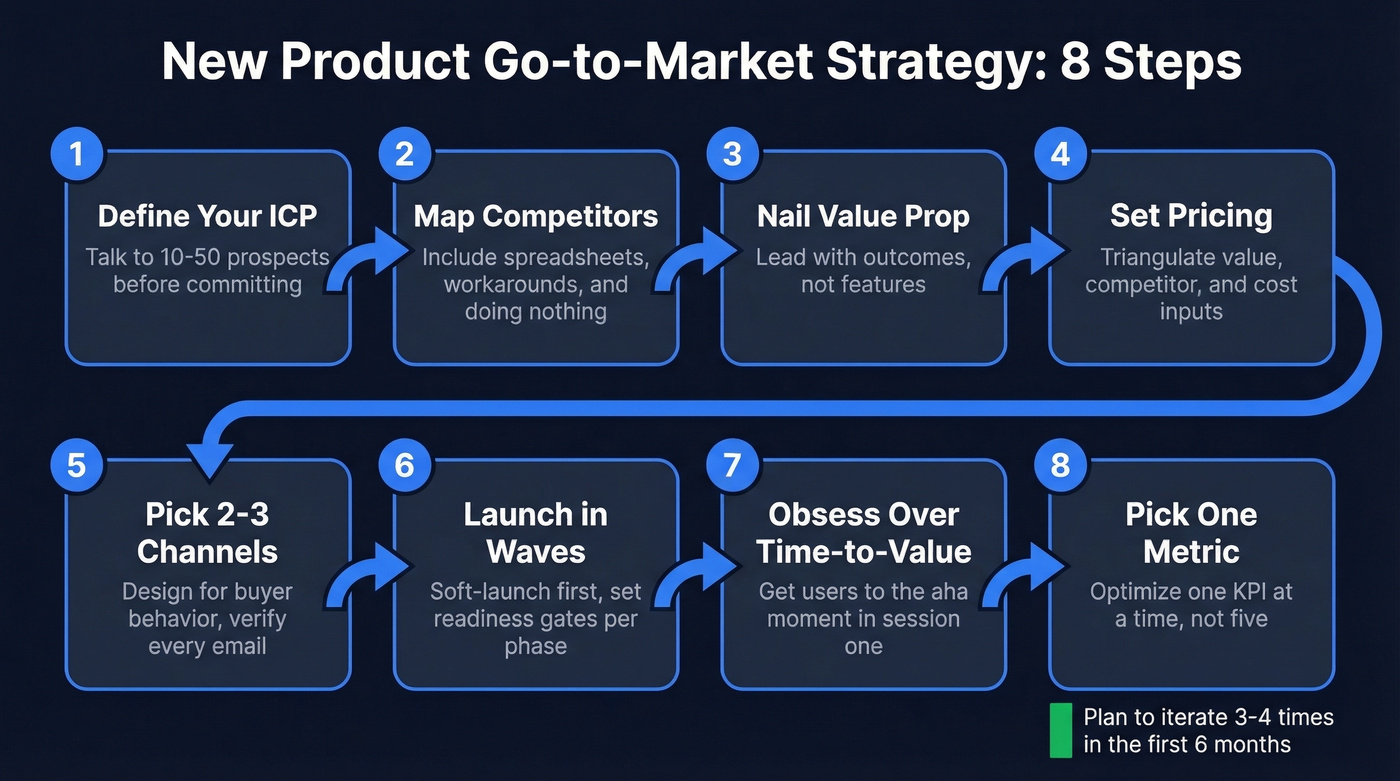
Here's the thing: a GTM strategy isn't a document. It's 8 decisions. Define your ICP, pick your motion, nail positioning, choose 2-3 channels, set one north-star metric, and launch in waves. Below you'll find frameworks, benchmarks, and a copy-paste template to do it in under two weeks.
What a GTM Strategy Is (and Isn't)
A go-to-market strategy for a new product answers four questions: What exact problem are you solving? Who has that problem and are there enough of them? Why are you better than the alternatives? How will those people find you?
It's not a marketing plan - that's one component focused on demand gen. A GTM strategy is the cross-functional launch blueprint covering product, pricing, sales, marketing, and CS alignment for a specific product entering a specific market. A popular r/SaaS checklist frames it around the same core questions: ICP, differentiation, channels, metrics. No fluff.
Choose Your GTM Motion First
Before you write a single positioning statement, decide how you're going to sell. Your average contract value dictates the motion, and getting this wrong wastes months.
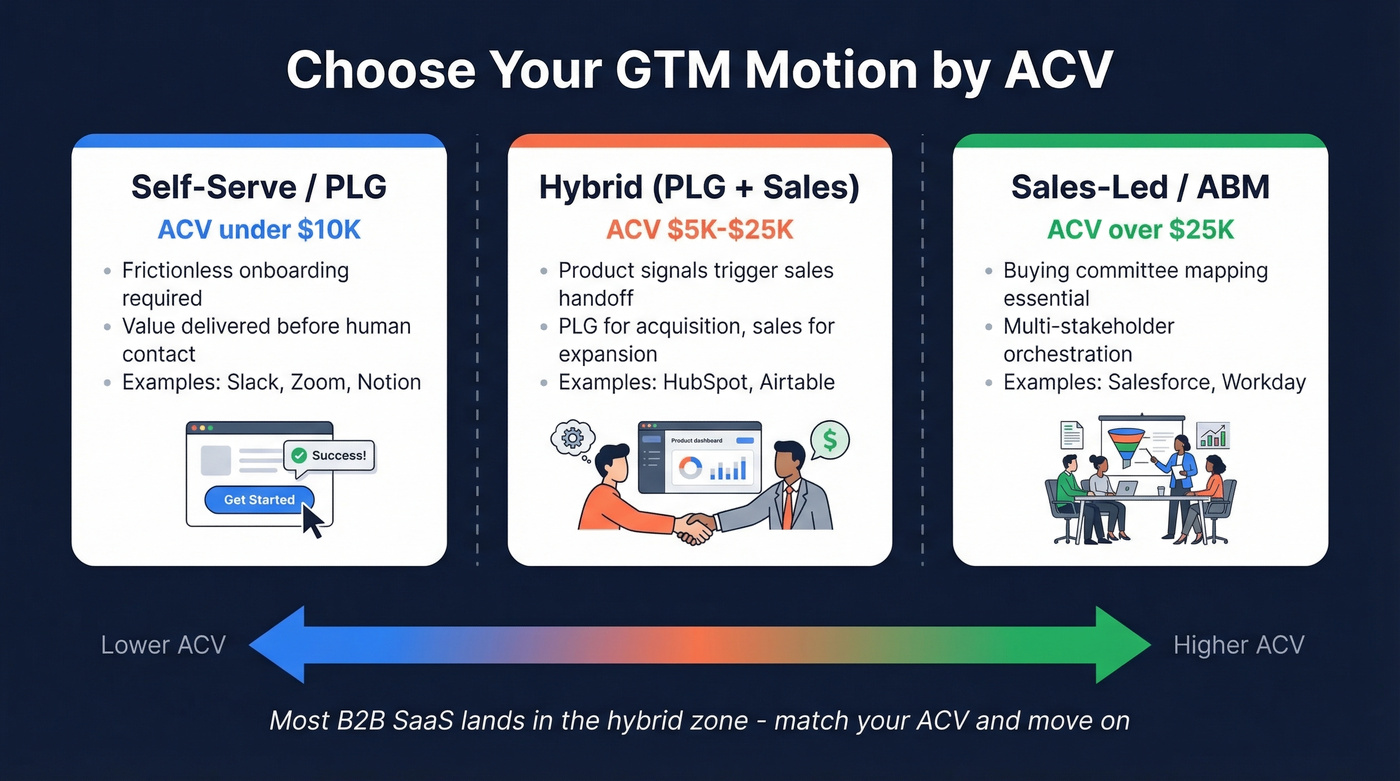
| ACV Range | Motion | Examples | Key Requirement |
|---|---|---|---|
| < $10K | Self-serve / PLG | Slack, Zoom, Notion | Frictionless onboarding |
| $5K-$25K | Hybrid (PLG + sales) | HubSpot, Airtable | Product signals to sales handoff |
| > $25K | Sales-led / ABM | Salesforce, Workday | Buying committee mapping |
PLG gets the headlines, but it only works when the product delivers value before a human intervenes. Slack pulled 8,000 signups in 24 hours during its beta - that's PLG at its best. If you're selling a $30K platform to a buying committee of five, self-serve isn't a motion. It's a fantasy. Most B2B SaaS lands in the hybrid zone: PLG for acquisition, sales-led expansion when usage signals appear. Enterprise deals increasingly layer in account-based marketing to orchestrate multi-stakeholder cycles through a flywheel of content, events, and targeted outbound.
Don't overthink this. Match your ACV to the table above and move on.
8 Steps to Build Your Launch Plan
1. Define Your ICP (Not Your TAM)
The single most common GTM mistake is confusing your total addressable market with your ideal customer. A GrowthX case study nails this: a SaaS company selling livestreaming to schools initially targeted "high schools" - millions of them. Months of wasted outbound. When they narrowed to roughly 200 schools with big stadiums in rural areas far from pro sports, the motion worked. Talk to at least 10 ICP-matching prospects before you commit. Fifty if you can. The more conversations, the fewer wrong doors you'll knock on later.
2. Map Competitors at the Workflow Level
Your real competition isn't just the other SaaS tool in your category. It's the spreadsheet, the manual workaround, and the decision to do nothing. If your messaging only differentiates against direct competitors, you'll sound interchangeable to buyers who haven't decided they need a tool yet.
3. Nail Your Value Proposition
Features don't sell. Outcomes do.
A cybersecurity company that leads with "AI-powered threat detection" loses to one that says "prevent the breach that costs you $4M." Frame every value prop around what the buyer avoids or gains - not what your engineering team built.
4. Set Pricing Using Triangulation
Triangulate three inputs:
- Value-based - what's the outcome worth to the buyer?
- Competitor-based - what are alternatives charging?
- Cost-based - what do you need to sustain the business?
Build in a free tier or trial. Prospects need to experience value before committing. Expect trial-to-paid conversion rates between 8-20% depending on your onboarding friction.
5. Pick 2-3 Channels and Go Outbound
Design for buyer behavior, not defaults. If your ICP lives in Slack communities and reads niche newsletters, that's where you show up - not LinkedIn ads because "everyone does LinkedIn ads."
When outbound is part of your motion, data quality determines whether it works. We've seen teams build a perfect GTM strategy and then tank their domain reputation in week one because their emails bounce. Multi-thread your accounts - email multiple contacts per company, not just one champion - and verify every address before you send. Prospeo's 98% email accuracy and 7-day data refresh cycle exist for exactly this scenario, with 30+ search filters for buyer intent, technographics, and job changes so your list actually matches your ICP.

6. Launch in Waves
If you launch everything at once, you're not confident - you're gambling. Soft-launch to a limited audience first: beta users, a single segment, one geography. Set readiness gates for each phase. One team we worked with went from a 38% bounce rate to under 4% after switching their data source mid-launch, and pipeline jumped 140%. Waves give you room to catch problems like that before they scale into real damage.
7. Obsess Over Time-to-Value
If a new user can't experience the core benefit within their first session, you'll lose them before onboarding email #3 lands. Companies with strong journey mapping programs enjoy 54% greater ROI on their marketing investments. Map the path from signup to "aha moment" and remove every unnecessary step.
Plan to iterate your GTM 3-4 times in the first six months. The first version is always wrong; the third is where traction starts.
8. Pick One Metric and Optimize
Choose 3-5 KPIs, but optimize for ONE at a time. Trying to improve activation rate, demo conversion, and churn simultaneously means you're improving none of them. Snyk's AE-sourced pipeline increased 180% after aligning execution around a single number - because when a team commits to one metric, decisions get simpler fast.

Your GTM launch lives or dies on data quality. One team switched mid-launch and went from a 38% bounce rate to under 4% - pipeline jumped 140%. Prospeo gives you 98% email accuracy, 125M+ verified mobiles, and 30+ filters for buyer intent, technographics, and job changes so your outbound matches your ICP from day one.
Don't let bad data kill your launch before it starts.
GTM Benchmarks That Matter
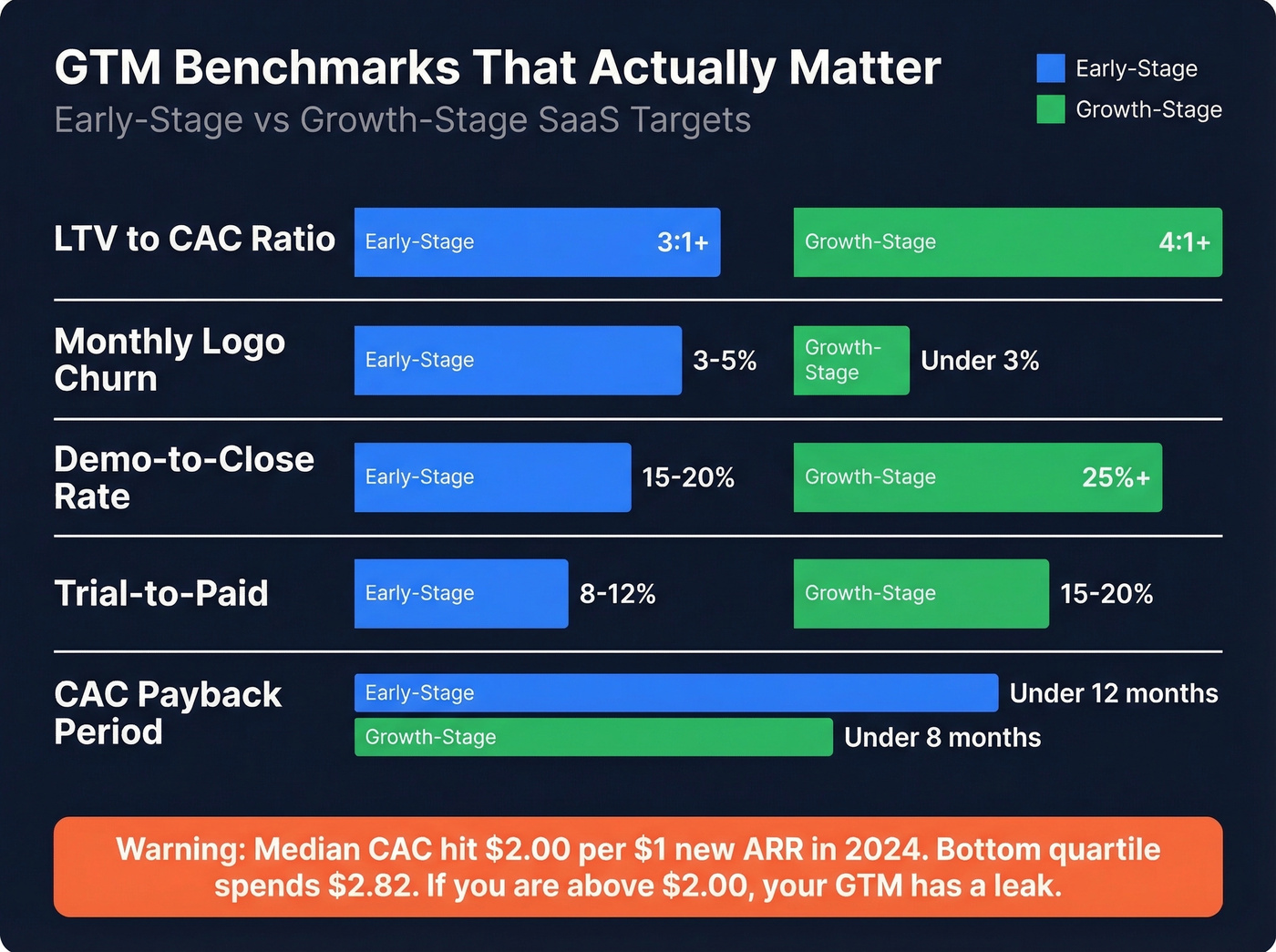
Numbers keep you honest. Here's what early and growth-stage SaaS companies should target:
| Metric | Early-Stage | Growth-Stage |
|---|---|---|
| LTV:CAC | > 3:1 | > 4:1 |
| Monthly Logo Churn | 3-5% | < 3% |
| Demo-to-Close | 15-20% | > 25% |
| Trial-to-Paid | 8-12% | 15-20% |
| CAC Payback | < 12 months | < 8 months |
The median CAC ratio hit $2.00 per $1 of new ARR in 2024; bottom-quartile companies spend $2.82. If you're above $2.00, your GTM motion has a leak somewhere. Budget heuristic: most SaaS companies reinvest 40-60% of revenue into sales and marketing during growth phases. Bootstrapped teams should plan $0-$5K/month, funded teams $10K-$50K/month.
Why GTM Strategies Fail
Five failure modes account for most of the wreckage.
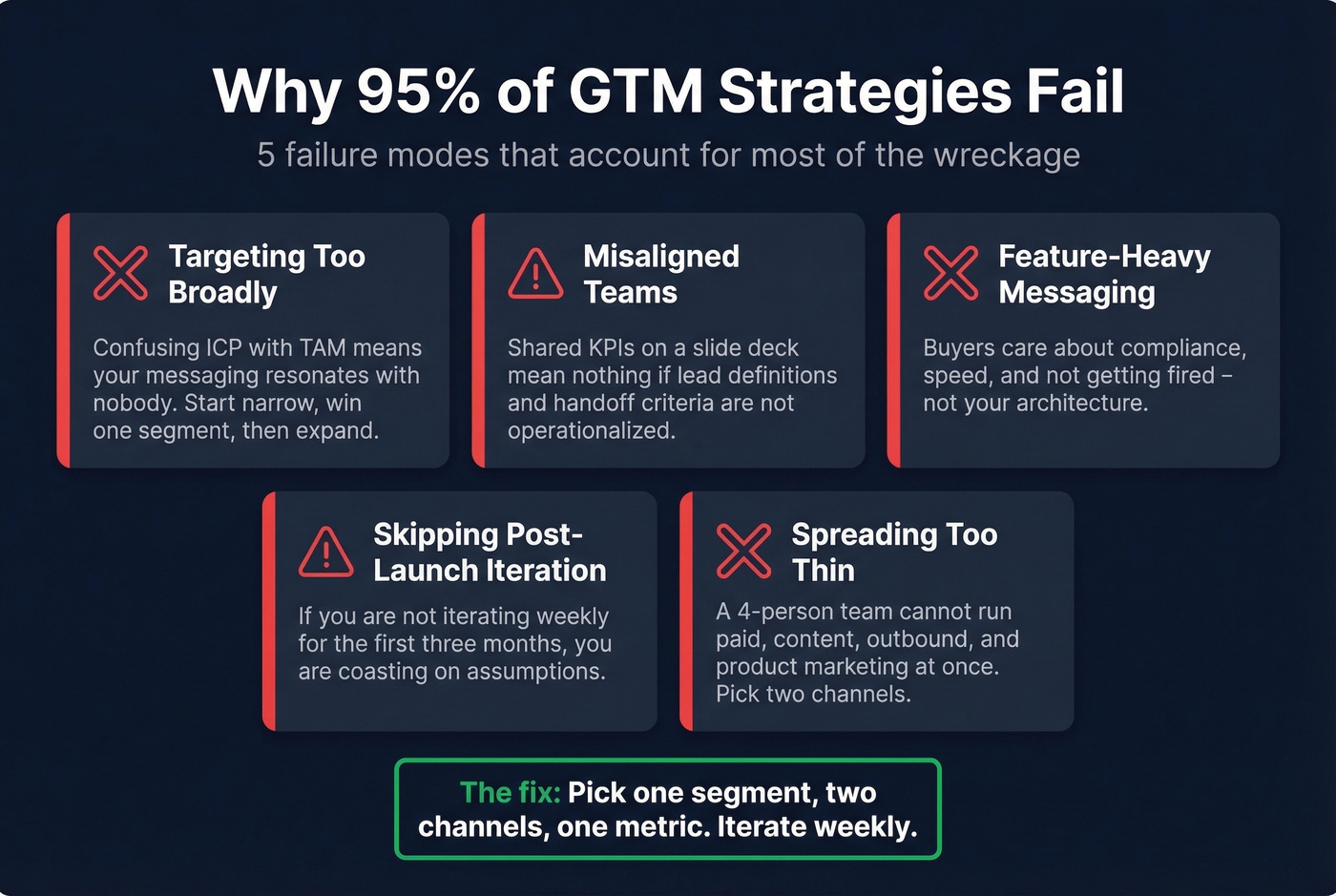
Targeting too broadly. Confusing ICP with TAM means your messaging resonates with nobody specifically. Start narrow, win one segment, then expand.
Misaligned teams. Shared KPIs on a slide deck mean nothing if lead definitions, handoff criteria, and funnel-stage accountability aren't operationalized. I've watched two teams argue for a month over what "qualified" meant while pipeline dried up.
Feature-heavy messaging. Buyers care about compliance, speed, and not getting fired - not your architecture. Lead with outcomes.
Skipping post-launch iteration. The vast majority of launches require post-launch adjustments. If you aren't iterating weekly for the first three months, you're coasting on assumptions.
Spreading too thin. A 4-person team can't run paid, content, outbound, and product marketing simultaneously. Pick two channels and do them well. Skip the rest until you've earned the right to expand.
AI-Augmented GTM in 2026
"You can do more with less than ever before," GTMfund GP Max Altschuler told TechCrunch. The concrete use cases are already here: AI builds more sophisticated lead lists than simple database queries, personalizes outbound at scale without sounding like a mail merge, and scores inbound leads with more precision than static rules. Google Cloud's Alison Wagonfeld notes teams are shipping "so many more messages faster" and hiring for curiosity over narrow specialization.
Let's be honest, though - AI can personalize 1,000 emails, but if your list quality is bad, your domain is toast. Verify first. Always.
Step 5 says pick 2-3 channels and go outbound. Step zero is making sure your emails actually land. Prospeo's 7-day data refresh cycle means you're never sending to stale contacts, and at $0.01 per email, you can multi-thread every target account without blowing your launch budget.
Verified contacts for every account in your GTM plan - starting free.
Go-to-Market Plan Template
Copy this structure and fill in the blanks. A GTM plan doesn't need to be 30 pages - it needs to be actionable.
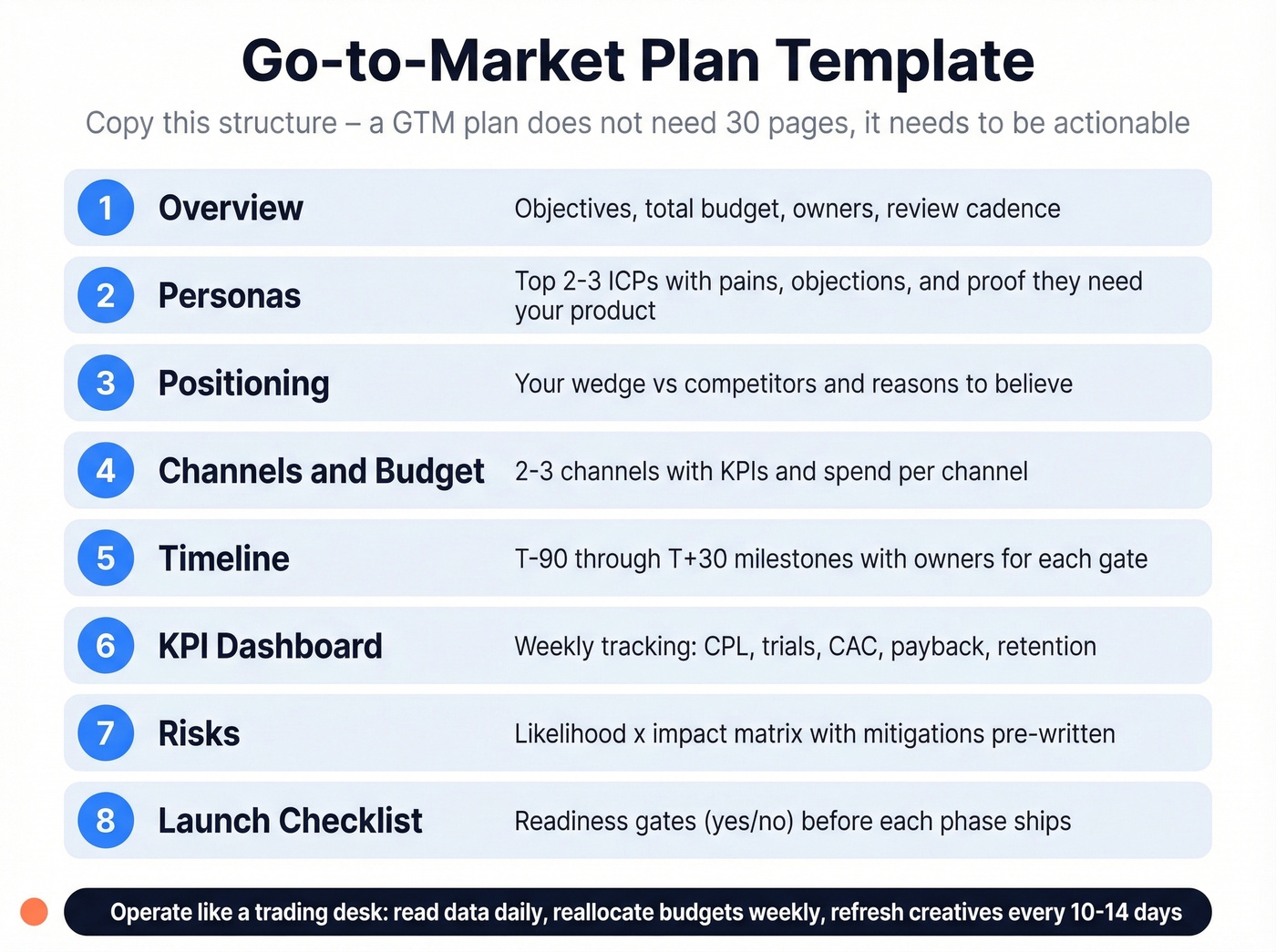
- Overview - Objectives, total budget, owners, review cadence
- Personas - Top 2-3 ICPs with pains, objections, and proof they need
- Positioning - Your wedge vs. competitors, reasons to believe
- Channels & Budget - 2-3 channels with KPIs and spend per channel
- Timeline - T-90 through T+30 milestones with owners for each gate
- KPI Dashboard - Weekly tracking: CPL, trials, CAC, payback, retention
- Risks - Likelihood x impact matrix with mitigations pre-written
- Launch Checklist - Readiness gates (yes/no) before each phase ships
Operate like a trading desk: read data daily, reallocate budgets weekly, refresh creatives every 10-14 days. The teams that treat their go-to-market strategy as a living system outperform the ones that launch and hope.
If you need a deeper breakdown of TAM vs ICP before you lock targeting, see total addressable market.
If your launch includes cold email, it’s worth skimming an email deliverability checklist before you scale volume.
If you’re building lists from multiple sources, data enrichment can help fill gaps fast.
If you’re planning outbound execution, use proven sales prospecting techniques instead of guessing.
To keep outbound from leaking, track your email bounce rate weekly during launch waves.
FAQ
What's the difference between a GTM strategy and a marketing plan?
A GTM strategy covers the full cross-functional launch - product, pricing, sales, marketing, and CS alignment for a specific product entering a specific market. A marketing plan is one component focused on demand generation and awareness channels. The GTM strategy is the umbrella; marketing executes one piece of it.
How long does it take to build a go-to-market strategy?
For early-stage SaaS, plan 8-16 weeks pre-launch for validation and planning, then a 12-week post-launch iteration cycle. Successful teams iterate their GTM 3-4 times in the first six months. The first version is a hypothesis, not a finished plan.
How do I build a prospect list for outbound GTM?
Define your ICP with narrow criteria - industry, headcount, tech stack, geography - then use a B2B database to filter and export verified contacts. Quality beats volume every time in early outbound, so verify before you send and multi-thread across multiple contacts per account.
What are the key components of a new product go-to-market strategy?
Eight components: ICP definition, competitive mapping, value proposition, pricing, channel selection, phased launch plan, time-to-value optimization, and a single north-star metric. Miss any one and the others compensate poorly. The template section above gives you the exact structure to fill in.