

New Year Sales Email Templates That Get Replies (2026)
January's inbox is a warzone. Reply rates drop by half compared to Q4, and every rep on the planet is sending some version of "Happy New Year! Let's connect!" The average B2B decision-maker gets 120+ emails daily, and you've got about 2.7 seconds before they decide to read or delete. A strong new year sales email template looks nothing like a holiday card - it's short, specific, and tied to a problem your prospect actually has.
You don't need 25 templates. You need a handful of good ones, a follow-up cadence, and a clean list. Below: six copy-paste templates, a four-touch January sequence, and the infrastructure checklist that keeps your domain alive.
Why January Outreach Is Different
Budgets reset. Priorities shift. Prospects who were "interested" in November are suddenly re-evaluating everything. That's actually good news if you frame your outreach around Q1 planning instead of leftover holiday cheer.
Email still delivers a 36:1 ROI, but the "New Year" angle has a roughly two-week shelf life. After mid-January, drop the resolution language and pivot to Q1 goals. And don't obsess over open rates - Apple Mail Privacy Protection inflates them across the board. Track replies and meetings booked instead.
Rules for Emails That Get Replies
58% of adults check email first thing in the morning. Send between 7-9:30 AM in your prospect's timezone. Then follow these rules:
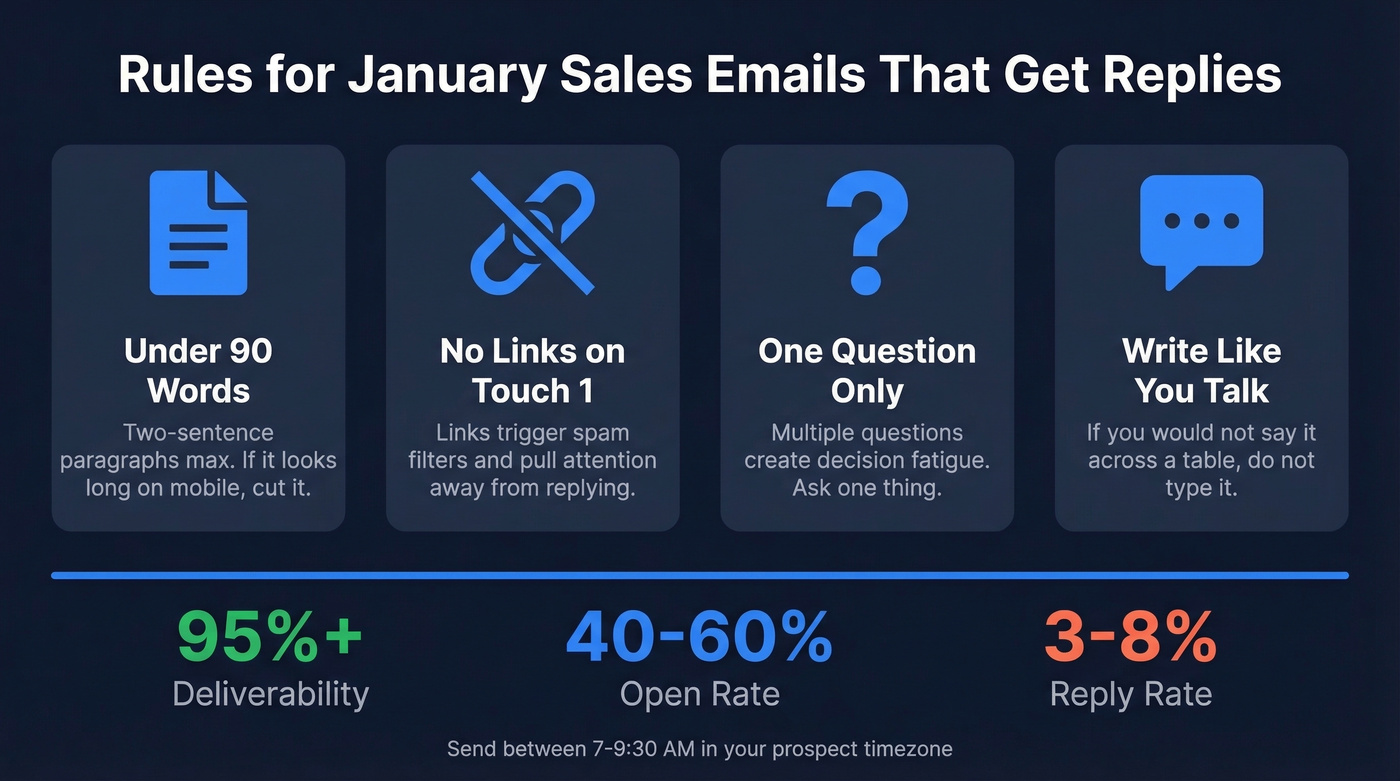
- Under 90 words. Two-sentence paragraphs max. If it looks long on a phone screen, it's too long.
- No links on the first touch. Links trigger spam filters and give prospects a reason to click away instead of replying.
- One question only. Multiple questions create decision fatigue. Ask one thing. Make it easy to answer.
- Write like you talk. If you wouldn't say it across a table, don't type it.
Aim for 95%+ deliverability, 40-60% open rate, and 3-8% reply rate. Hit those and your January pipeline will be fine.
6 New Year Sales Email Templates
Template 1: Cold Prospect - New Year + Pain
Subject: Q1 [pain point] plan, [First Name]?
Hi [First Name],
New year, same [specific pain point] - unless something changes. [Company] helps [role/team] fix [problem] by [one-line value prop]. [Client name] cut their [metric] by [X%] in the first quarter after switching.
Worth a 15-minute call this week?
About 40% of under-30 professionals make New Year's resolutions, so tying outreach to a fresh-start mindset makes the timing feel intentional rather than random.
Template 2: Re-Engagement - The Q4 Ghost
This is the template we'd send first if we had any open conversations from Q4. It consistently outperforms cold opens because the prospect already knows your name.
Subject: Picking this back up, [First Name]
Hi [First Name],
We were talking in [month] about [topic]. Then Q4 happened to both of us. No guilt - just checking if [original problem] is still on your radar for Q1.
If priorities shifted, totally fine. One word either way works.
Giving permission to say "no" actually increases reply rates. People respond when they don't feel cornered.
Template 3: Value-First - Feedback Ask
Subject: Quick feedback before I publish this?
Hi [First Name],
I'm putting together a short guide on [topic relevant to their role] and want to sanity-check it with someone in the trenches before it goes live.
Would you be open to a quick look? Just reply YES or NO - either helps.
Asking for feedback is a low-friction CTA that earns a reply without asking for a meeting. Once they engage, the conversation starts naturally.
Template 4: Resolution Hook
Subject: [Company]'s Q1 [metric] target
Hi [First Name],
Most [role]s I talk to are resetting [metric] targets right now. The teams hitting theirs fastest in 2026 did [one specific thing].
If [Company] is planning something similar for Q1, I've got a framework that takes 15 minutes to walk through. Interested?
Template 5: Breakup Email - Last Touch
Use this as the final bookend in your sequence. It often outperforms mid-sequence nudges because scarcity plus permission to walk away removes pressure - and that's exactly when people reply.
Subject: Should I close your file?
Hi [First Name],
I've reached out a few times and haven't heard back - totally understand. I'll assume the timing isn't right and close the loop on my end.
If anything changes, just reply to this thread. No hard feelings either way.
Template 6: Follow-Up After Holiday Meeting
Subject: Following up from [event/call] - next steps
Hi [First Name],
Great connecting at [event] / on our [date] call. You mentioned [specific thing they said] - that stuck with me over the break.
I put together [one specific resource/next step]. Want to pick it back up this week with a quick call?
Referencing something specific they said proves you were listening. Warm context plus fresh-start framing is a strong combination in January.

Your January templates are ready - but a 35% bounce rate will torch your domain before February. Prospeo's 5-step email verification delivers 98% accuracy, so every New Year outreach actually lands in the inbox. At $0.01 per email, cleaning your Q1 list costs less than a coffee.
Stop burning domains. Start January with verified contacts.
Subject Line Swipe File
Personalized subject lines outperform generic ones by 15-25% on opens, and adding a deadline lifts that another 30-40%. Eight B2B-ready lines:
- Q1 [metric] plan, [First Name]?
- [Company]'s 2026 priorities - quick question
- Picking this back up for January
- Before your Q1 budget locks - [First Name]
- [Mutual connection] suggested I reach out
- Quick idea for [Company]'s [department] team
- Last chance: [offer/resource] ends Jan 10
- 15 min this week, [First Name]?
If you want more options, pull from these subject lines and adapt them to your ICP.
January Follow-Up Cadence
44% of reps give up after a single follow-up. Meanwhile, 80% of meetings come from follow-ups 2-4. Here's the 3-7-7 framework we recommend:
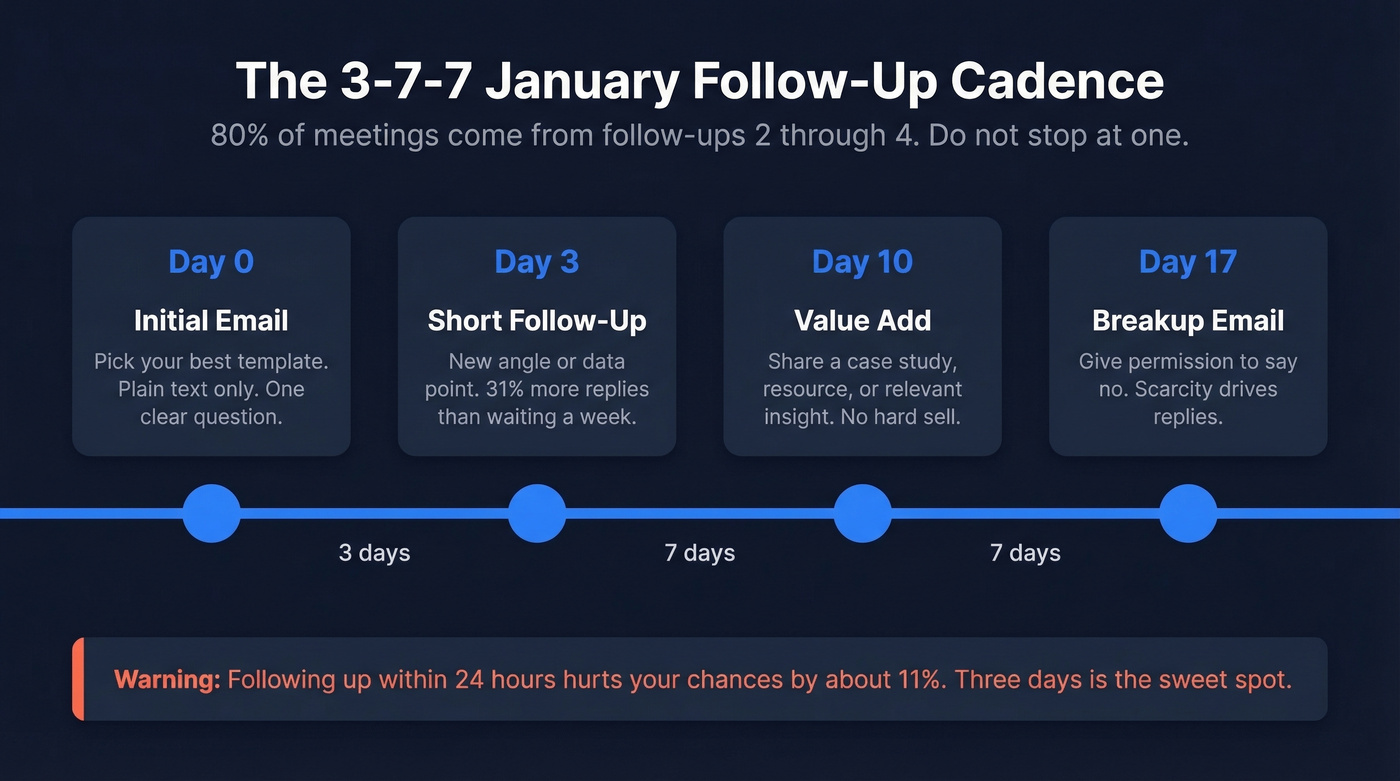
- Day 0: Initial email - pick a template above.
- Day 3: Short follow-up with one new angle or data point. Following up at three days yields ~31% more replies than waiting a week.
- Day 10: Value-add - share a relevant resource, case study, or insight.
- Day 17: Breakup email - give them permission to say no.
Don't follow up within 24 hours. That hurts your chances by ~11%. Three days is the sweet spot for the first touch, then space out from there.
If you need more sequences beyond January, use these sales follow-up templates as your baseline.
Before You Send: Infrastructure Checklist
Here's the thing - your copy doesn't matter if emails never reach the inbox. We've seen reps burn entire domains by skipping this step in January.
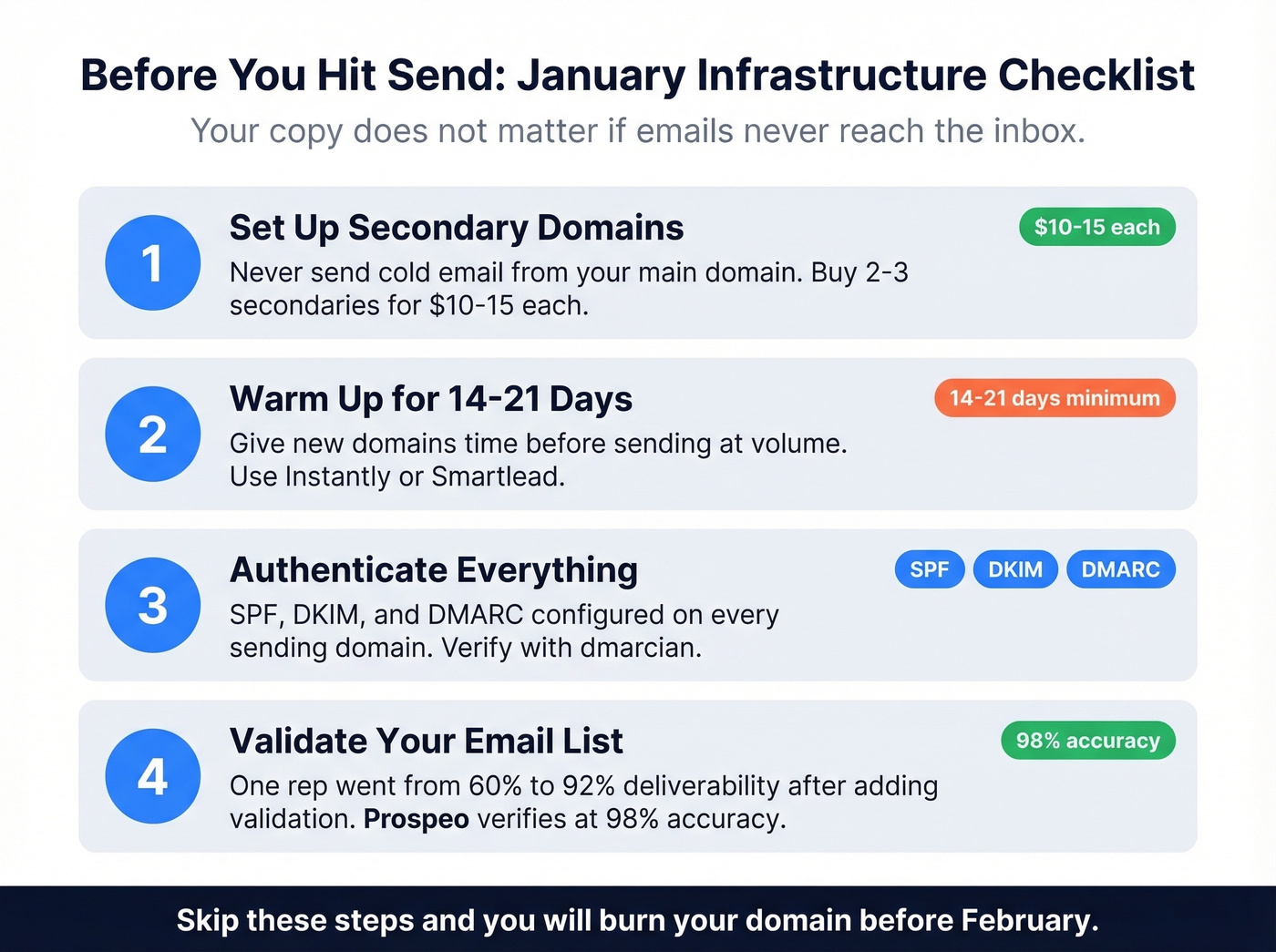
Secondary domains. Never send cold email from your main domain. Buy two or three secondaries for $10-15 each and set up separate mailboxes.
Warmup. Give new domains 14-21 days before sending at volume. Tools like Instantly or Smartlead handle this automatically for $30-100/mo.
Authentication. SPF, DKIM, and DMARC configured on every sending domain. Use dmarcian to verify. If you're troubleshooting alignment issues, this DMARC alignment guide helps.
Validate your list. This is the step most reps skip - and it's the one that wrecks everything. One practitioner on r/sales reported deliverability jumping from 60% to 92% after adding validation. Prospeo verifies emails in real time with 98% accuracy across 143M+ verified addresses, and the free tier covers 75 verifications per month - enough to test before you commit. If you're diagnosing failures, start with email bounce rate benchmarks and fixes.
That 3-7-7 cadence only works if you're emailing real people at real addresses. Prospeo refreshes 300M+ profiles every 7 days - so the Q4 contacts you're re-engaging haven't bounced, changed roles, or gone stale. Teams using Prospeo book 35% more meetings than Apollo users.
Fresh data every week means your January follow-ups actually connect.
Mistakes That Kill January Outreach
The biggest January killer is the Hallmark card - generic "Happy New Year, hope you had a great holiday!" emails with no ask and no value. Reps on r/sales consistently call these out as reputation-damaging busywork that drives zero revenue.
If you're building a repeatable outbound motion, these sales prospecting techniques help you avoid spray-and-pray outreach.
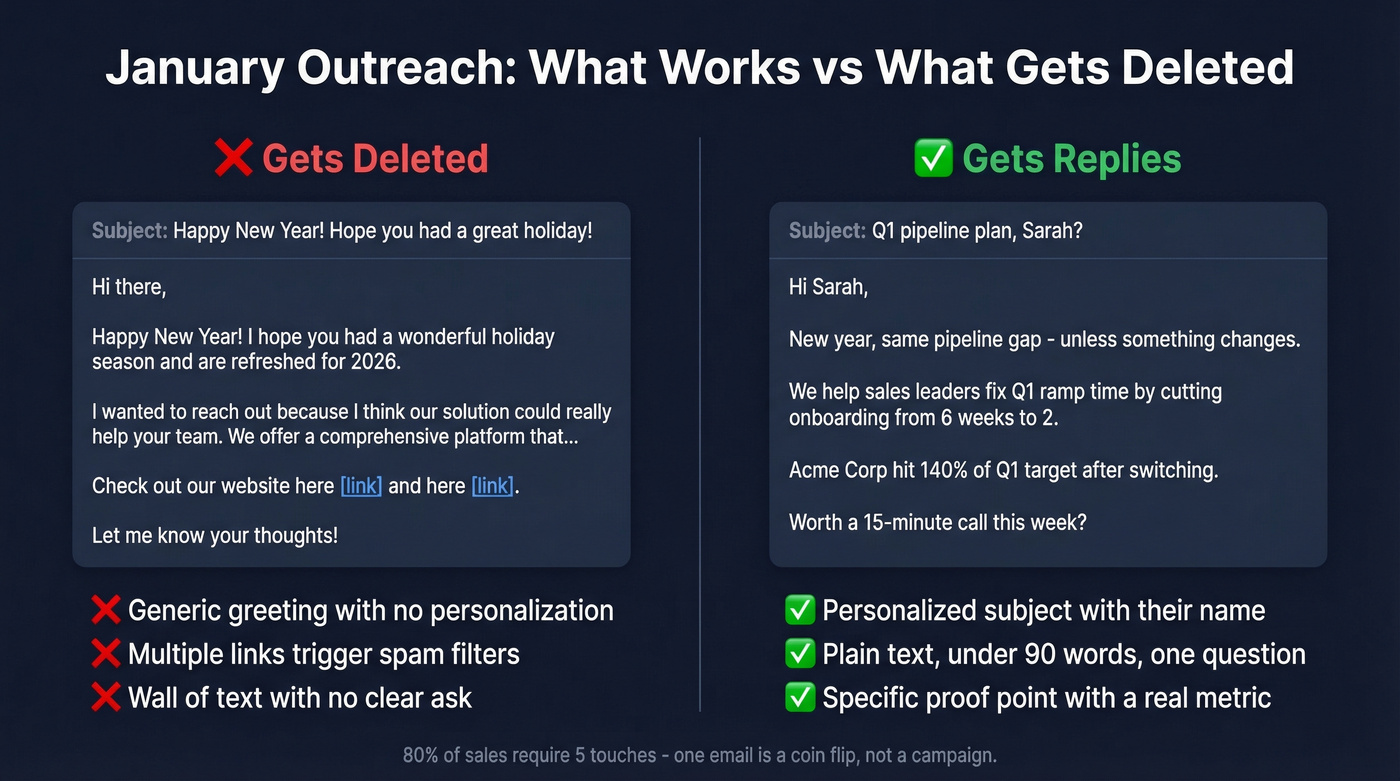
Too many links and images on first touch is another common one. Spam filters flag them, and they distract from the one thing you want: a reply. Keep the first email plain text.
Then there's the one-and-done problem. 80% of sales require five touches. One email isn't a campaign - it's a coin flip. And if you're sending those five touches to an unvalidated list, you're compounding the damage with every send. Data goes stale fast with job changes, company pivots, and abandoned inboxes. Run your list through a verification tool before every campaign. For a deeper system-level fix, follow an email deliverability guide and monitor your sender reputation.
Let's be honest: if you're running deals under $10k ACV, you probably don't need a 12-step automated sequence. Three good emails to verified contacts will outperform a bloated cadence sent to garbage data every single time. If you're scaling volume, keep an eye on email velocity so you don't spike sending limits.
FAQ
When does the "New Year" angle stop working?
First two weeks of January. After that, shift to Q1 planning and budget language. The "fresh start" framing expires fast - pivot or your emails sound stale.
How many follow-ups should I send in January?
Three to four after your initial email. Use the 3-7-7 cadence: Day 3, Day 10, Day 17. 44% of reps quit after one follow-up, but 80% of meetings come from touches 2-4.
What's a good reply rate for January cold emails?
3-8% for B2B cold outreach. January trends toward the lower end due to inbox noise. Track replies and meetings booked - open rates aren't reliable with Apple Mail Privacy Protection.
Should I verify my list before sending January campaigns?
Always. Stale Q4 data means bounces, which damage your sender reputation during the most competitive inbox period of the year. Prospeo's free tier lets you verify 75 emails per month at 98% accuracy - enough to validate a test batch before scaling.