

Nextiva vs RingCentral: The Comparison Neither Vendor Wants You to Read
Every Nextiva vs RingCentral comparison you'll find online is written by one of the two vendors. Nextiva says Nextiva wins. RingCentral says RingCentral wins. What neither tells you is what the add-ons actually cost, how hard it is to cancel, or what happens when the "99.999% uptime" promise falls apart during a multi-hour outage.
This is the comparison they'd rather you didn't read.
What We're Actually Comparing
Both vendors sell multiple products, and the naming trips up even experienced buyers. RingCentral sells RingEX - their UCaaS phone system - and RingCX, their contact center platform. Nextiva sells Small Business CX plans and also offers enterprise-grade contact center options.
This article compares RingEX vs Nextiva Small Business CX, the plans most teams under 200 people are actually evaluating. If you're shopping for a full contact center with omnichannel routing, that's a different comparison entirely.
30-Second Verdict
Pick Nextiva if: You're a sub-50-person team, support quality matters, and you want straightforward pricing without a maze of add-ons.
Pick RingCentral if: You're 50+ seats, need deep Salesforce/HubSpot/Teams integrations, or require complex call routing and IVR trees.
Skip both if: Your real problem is outbound - reps dialing dead numbers and emailing bounced addresses. Fix your contact data first, then pick a phone system. The best VoIP platform in the world can't help you if 40% of your dials go to voicemail on disconnected lines. (If this is your reality, start with data enrichment services.)
Pricing Breakdown
Base Plan Costs
| Plan | RingCentral (Annual) | RingCentral (Monthly) | Nextiva (Annual) | Nextiva (Monthly) |
|---|---|---|---|---|
| Core | $20/user/mo | $30/user/mo | Nextiva (Annual) | $15/user/mo | $23/user/mo |
| Mid-tier | $25/user/mo | $35/user/mo | $25/user/mo | $50/user/mo |
| Top-tier | $35/user/mo | $45/user/mo | $75/user/mo | $75/user/mo |
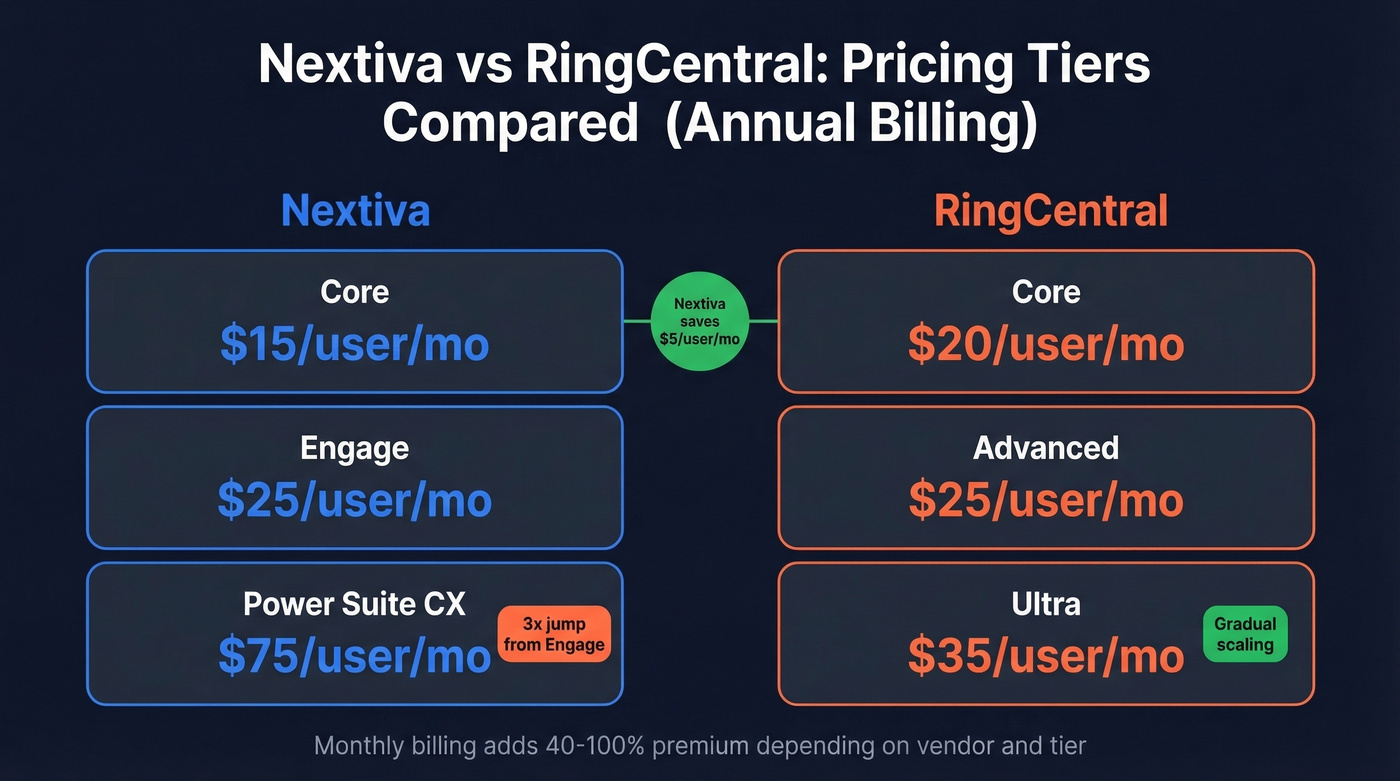
Nextiva's Core plan undercuts RingCentral by $5/user/month on annual billing. That's $1,500/year on a 25-person team - real money. But Nextiva's jump from Engage at $25/user/mo annually to Power Suite CX at $75/user/mo is brutal, and RingCentral's tiers scale more gradually.
One pricing gotcha worth flagging: Nextiva's monthly-to-annual gap on Engage is a 100% premium - $50/user monthly vs. $25/user annually. That's the steepest monthly penalty we've seen in VoIP. If you aren't ready to commit annually, RingCentral's 50% monthly markup at the entry tier is more predictable.
The Add-Ons Nobody Mentions
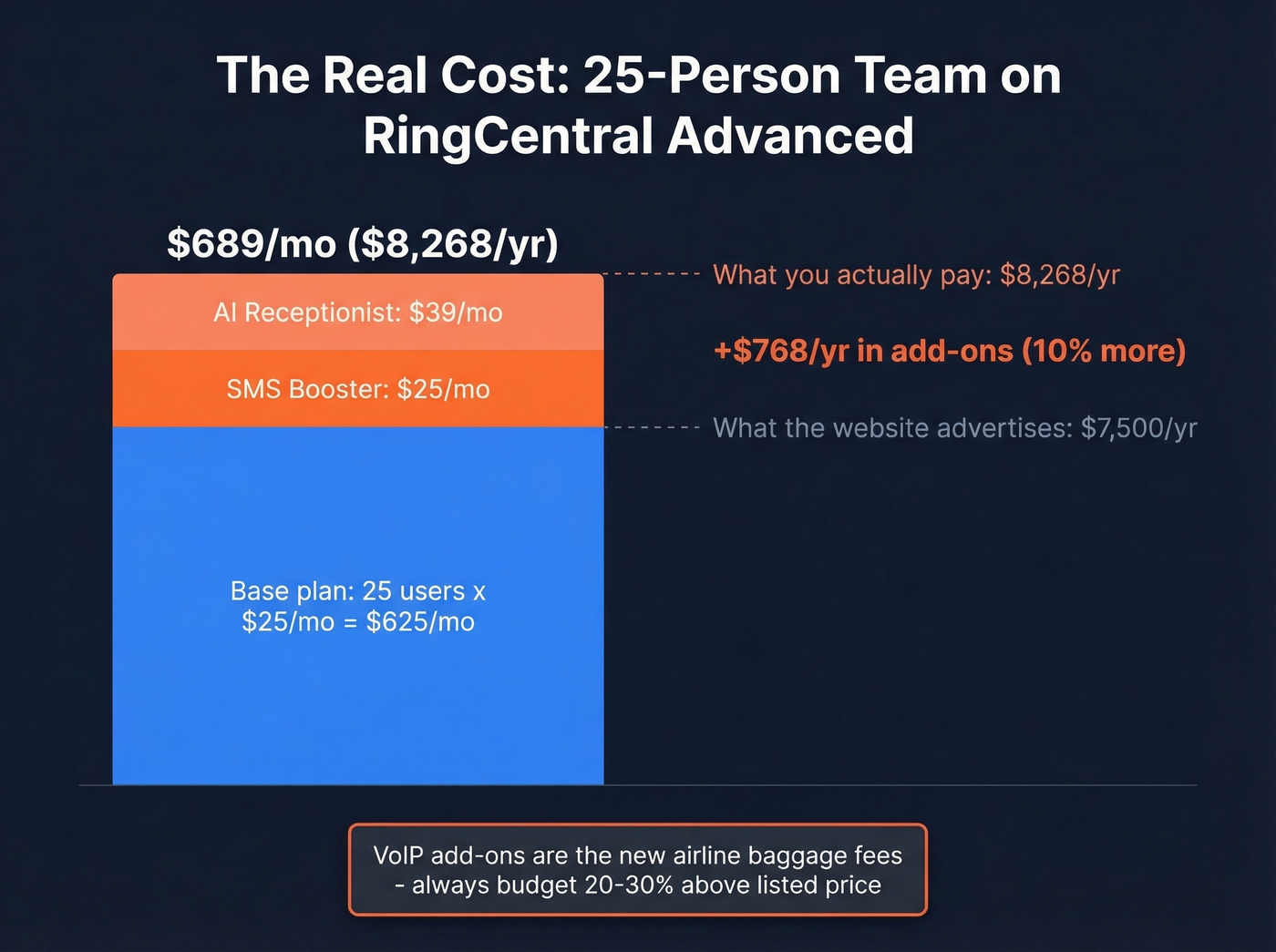
Here's where RingCentral's pricing gets creative. These are per-account add-ons stacked on top of your per-user fees:
| RingCentral Add-On | Price |
|---|---|
| AI Receptionist | From $39/mo |
| SMS Booster | $25/mo |
| Call Queues Booster | $35/mo |
| AI Conversation Expert | From $60/mo |
Nextiva's equivalent? XBert AI Receptionist runs $99/mo, which includes 100 interactions. After that, it's $0.99 per interaction.
Let's do the math. A 25-person team on RingCentral Advanced at $25/user/mo annual with the SMS Booster and AI Receptionist pays $625 + $25 + $39 = $689/month before taxes. That's $8,268/year - not the $7,500 the base pricing suggests. RingCentral advertising "$20/user/month" while charging $39 for an AI receptionist is the VoIP equivalent of airline baggage fees.
Feature-by-Feature Breakdown
Calling, SMS & Video
RingCentral has the edge on advanced call routing and multi-level IVR. If you're running a support team with complex queue logic, it's the stronger platform. Nextiva's setup is simpler and faster - in our testing, most teams are live in a day or two.
Call quality is a mixed bag on RingCentral. Users on Reddit describe persistent issues with echo, low volume, and calls breaking up across different connection types. We've evaluated both platforms across multiple client deployments, and Nextiva's call quality has been more consistent out of the box, though neither is immune to network-dependent issues.
Shared-number texting is a pain point on both platforms. A sysadmin running a 4-person team described trying both and called them "horribly unreliable" for shared text threads. RingCentral's SMS registration process adds friction and fees - users describe multiple registration fees and repeated rejections even after following the same website/verbiage requirements.
If you're evaluating VoIP primarily for outbound, you'll get more leverage by fixing your sales prospecting techniques and list quality first.
AI Features: Included vs. Extra
| Feature | RingCentral | Nextiva |
|---|---|---|
| Call transcription | RingSense AI | Available on higher tiers |
| AI summaries | RingSense AI | Available on higher tiers |
| AI receptionist | $39/mo add-on | $99/mo + $0.99/interaction |
| Advanced AI assistant | $60/mo add-on | Not available separately |
Neither vendor includes their full AI stack in base plans - budget accordingly. RingCentral's a la carte approach gives you more control over AI spend, but the add-ons pile up fast. Nextiva bundles more into higher tiers, which is simpler but forces you into expensive plans to access features you only partially need.
Integrations
RingCentral wins this category outright. Their marketplace sits around 300-400+ integrations, covering Salesforce, HubSpot, Microsoft Teams, Slack, and Zendesk. For teams with complex tech stacks, RingCentral is the safer bet.
Nextiva offers dozens of core integrations plus API access, but the marketplace is noticeably smaller. If your workflow depends on a niche tool connecting to your phone system, check Nextiva's integration directory before committing. We've seen teams sign up only to discover their CRM or helpdesk tool isn't supported. (If you're still deciding what should be the system of record, see examples of a CRM.)
Head-to-Head Summary
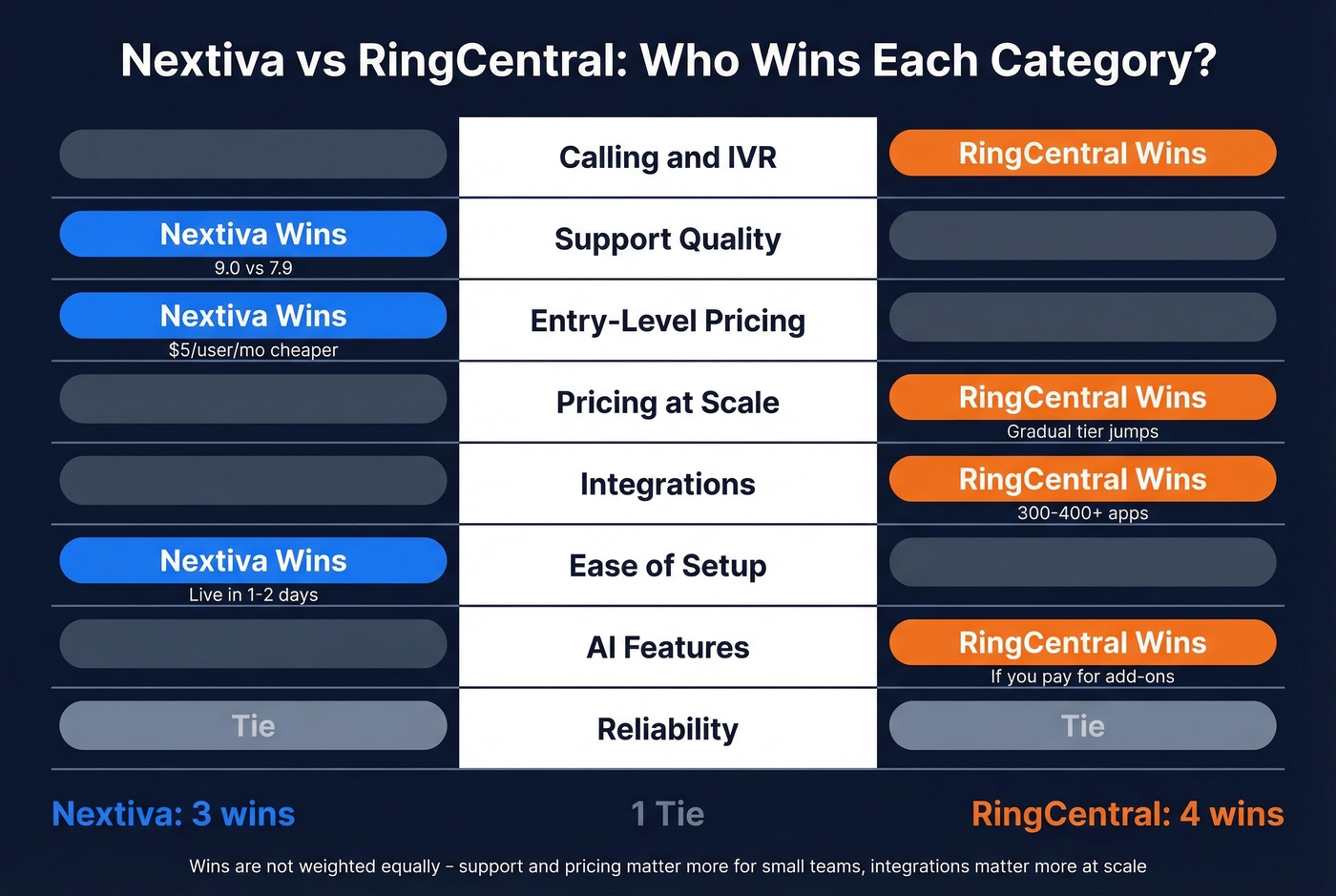
| Category | Winner | Why |
|---|---|---|
| Calling & IVR | RingCentral | Multi-level IVR, advanced queue logic |
| Support quality | Nextiva | G2 Quality of Support: 9.0 vs 7.9 |
| Entry-level pricing | Nextiva | $5/user/mo cheaper at Core tier |
| Pricing at scale | RingCentral | More gradual tier jumps |
| Integrations | RingCentral | 300-400+ apps vs. dozens |
| Ease of setup | Nextiva | Live in 1-2 days, simpler admin |
| AI features | RingCentral (if you'll pay) | More granular AI options, but nothing's free |
| Reliability | Tie | Both claim five nines; both have had incidents |
| Ease of cancellation | Neither | See the contracts section below |

You're comparing phone systems, but the real revenue leak is upstream. If 40% of your reps' dials hit disconnected lines, even the best IVR won't save your pipeline. Prospeo gives you 125M+ verified mobile numbers with a 30% pickup rate - so every call your team makes actually reaches a human.
Fix the data before you fix the dialer. Start free today.
Reliability & Uptime
Both vendors claim 99.999% uptime. That translates to roughly 6 minutes of downtime per year.
In early 2025, RingCentral experienced a confirmed outage affecting inbound and outbound calling. Their own community post acknowledged the issue, and a fix wasn't implemented until the following evening. A multi-hour calling outage blows through the entire annual "five nines" budget in a single incident.
Nextiva hasn't had a comparable public incident recently, but no VoIP provider is immune to outages. The difference is transparency - RingCentral at least posted about it publicly and promised a root cause analysis.
Our take: The 99.999% uptime number is marketing, not a guarantee. SLA credits (if you even qualify) won't make you whole operationally. Build your phone system with the assumption that it will go down at some point, and have a backup plan - even if that's just cell phones and a shared Google Voice number.
Support Quality
| Metric | Nextiva | RingCentral Contact Center* |
|---|---|---|
| G2 Rating | 4.5/5 across 3,449 reviews | 4.1/5 across 185 reviews |
| Quality of Support | 9.0 across 2,758 responses | 7.9 across 129 responses |
| Ease of Use | 8.7 across 2,808 responses | 8.5 across 148 responses |
| Gartner Peer Insights | 4.7/5 across 70 reviews | 4.3/5 across 52 reviews |
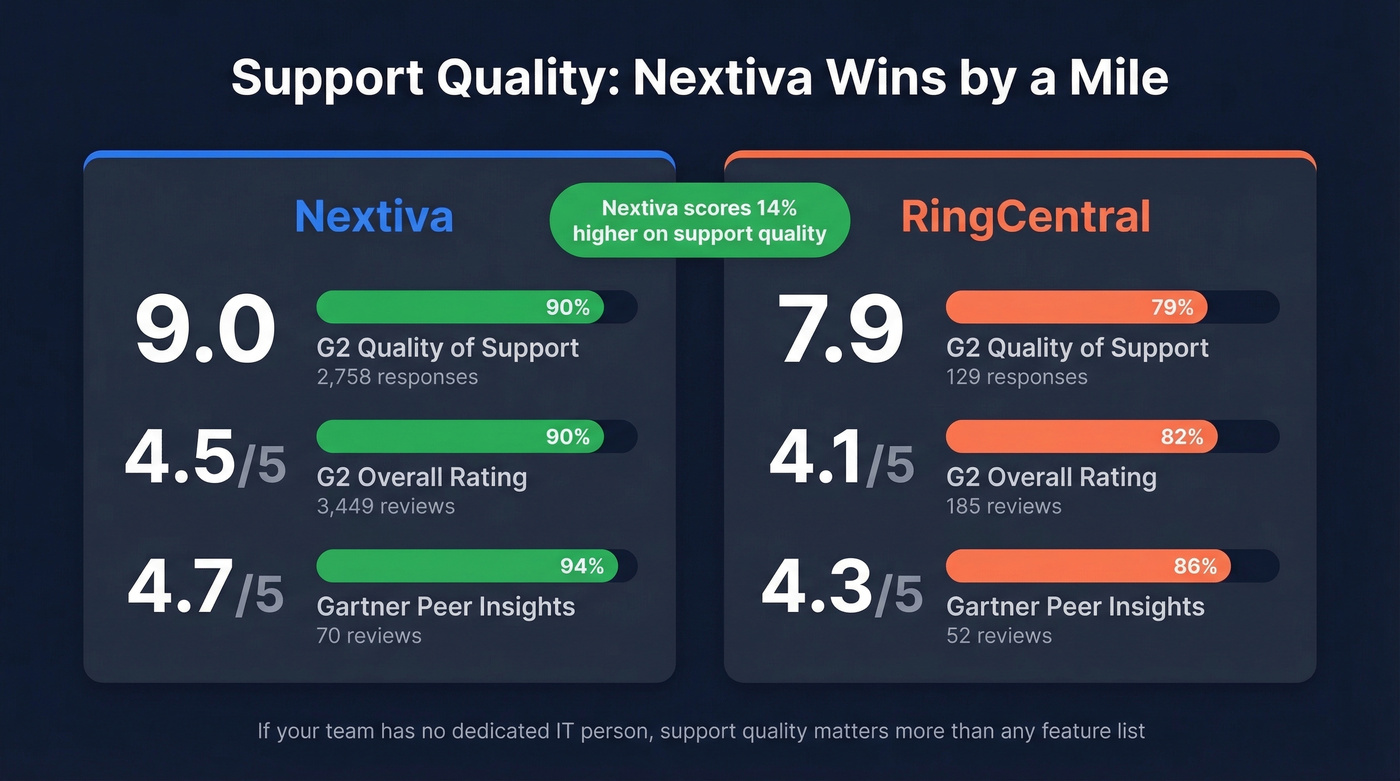
\G2 compares Nextiva against RingCentral Contact Center specifically, not RingEX. RingEX-specific review data is limited, but the support quality gap - 9.0 vs. 7.9 - is consistent with what we hear from teams who've used both.*
Nextiva wins on support, and it isn't particularly close. If your team doesn't have a dedicated IT person managing the phone system, this matters more than any feature comparison. It also impacts rep productivity and sales communication consistency when issues hit.
Contracts & Cancellation
Here's the section no other comparison article writes.
Both vendors lock you into contracts, and getting out is painful. RingCentral has 570 BBB complaints over the last three years, with 184 closed in just the last 12 months. The complaint categories span billing, service, and cancellation disputes. That's not a rounding error - it's a pattern.
One Reddit user described spending over 60 hours on hold trying to cancel, saying the cancellation and retention teams "don't seem to exist." They ultimately filed FCC and FTC complaints - and got a call back the next day both times, plus a sizable refund.
Here's the thing: neither vendor makes leaving easy. Port your numbers out before initiating cancellation. Document every request in writing. And assume the process will take weeks, not days. The switching cost isn't just financial - it's operational disruption and lost productivity while your team adjusts. If you want a framework for quantifying that risk, map it to your sales pipeline challenges and where downtime/cancellation friction hits hardest.
Final Verdict
Teams under 50 people: Nextiva. Better support scores, simpler pricing, and $5/user/month savings at the entry tier add up fast.
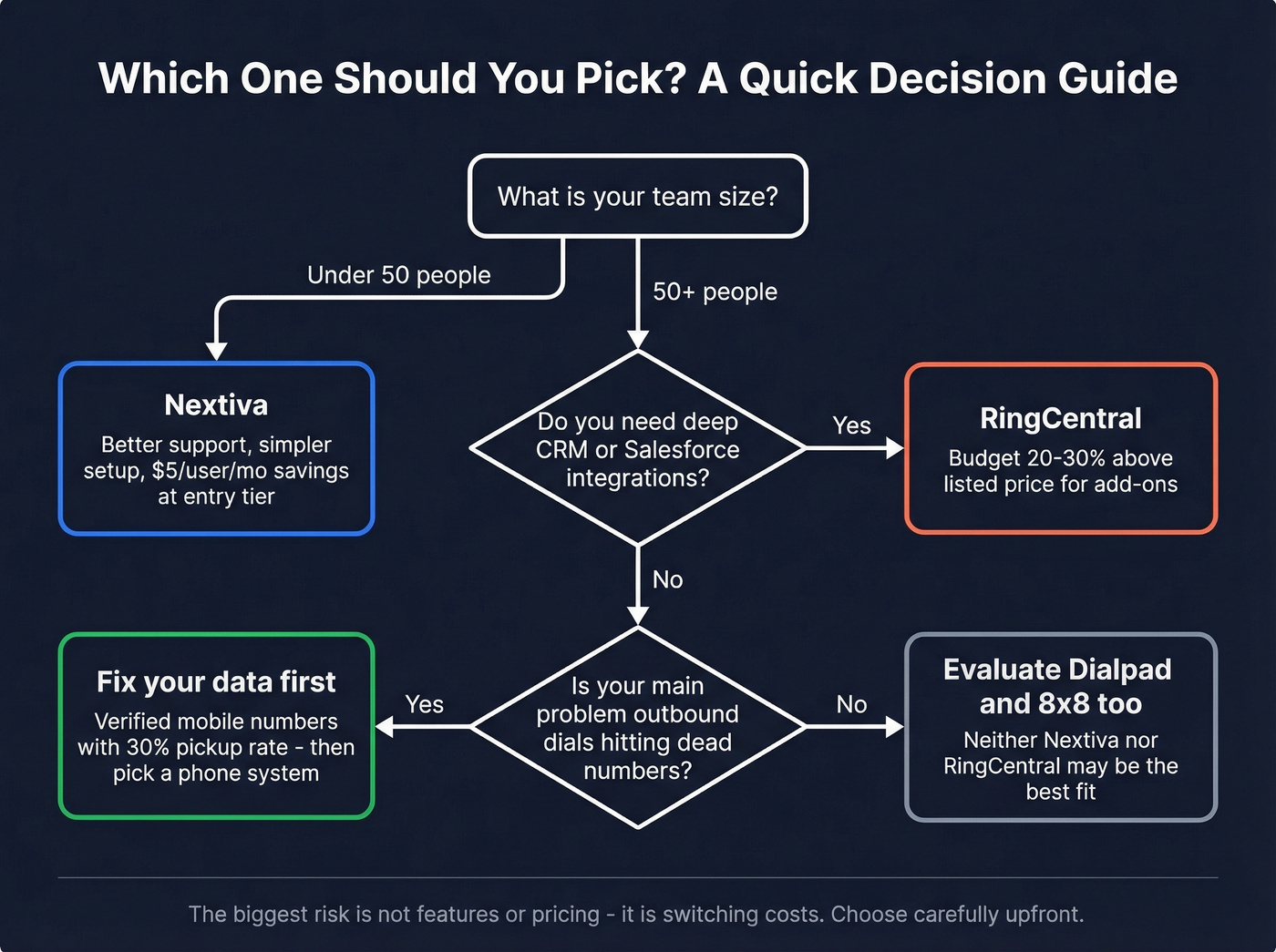
Teams 50+ with integration needs: RingCentral - but budget 20-30% above the listed per-user price once you factor in add-ons, boosters, and the inevitable "you need the Advanced tier for that feature" conversation.
Outbound sales teams: Here's the contrarian take - neither platform is optimized for outbound. They're communication infrastructure, not prospecting tools. The phone system is the delivery mechanism; the contact data is the fuel. If your reps are burning hours dialing wrong numbers, the VoIP platform isn't your bottleneck. Prospeo's verified mobile numbers deliver a 30% pickup rate - roughly 3x what most B2B data providers manage - which means your reps spend time in conversations instead of listening to disconnected-number recordings. (For a broader stack view, compare outbound lead generation tools.)
The biggest risk in the Nextiva vs RingCentral decision isn't features or pricing. It's switching costs. Once you've ported numbers, trained the team, and integrated your CRM, you're locked in regardless of what the contract says. Choose carefully upfront. Dialpad and 8x8 are worth evaluating if neither option fits - Dialpad for AI-native calling features at ~$15-25/user/mo, 8x8 for international calling needs at ~$24-44/user/mo. If you're going down that route, start with Dialpad alternatives to sanity-check the shortlist.
Fix Your Contact Data First
You're about to invest $20-45/user/month in a phone system. Make sure the numbers you're dialing actually ring.
Prospeo covers 125M+ verified mobile numbers with a 30% pickup rate - roughly 3x what most B2B data providers deliver. Emails verify at 98% accuracy, data refreshes every 7 days, and you can start free with no contracts. That's a sharp contrast to the VoIP lock-in we just covered. Pair it with whichever phone system you choose, and your reps spend time talking to prospects instead of listening to "this number is no longer in service." If you're building lists from scratch, pair verification with a sales prospecting database.
Nextiva or RingCentral - either way, your reps need accurate contact data to fill the pipe. Prospeo delivers 98% email accuracy and verified direct dials at $0.01/lead, refreshed every 7 days. Teams using Prospeo book 35% more meetings than Apollo users and 26% more than ZoomInfo.
Stop paying $35/user/month to call dead numbers.
FAQ
Is Nextiva cheaper than RingCentral?
At the base tier, yes - Nextiva Core starts at $15/user/month annually versus RingCentral's $20. But Nextiva's jump to Power Suite CX at $75/user/mo is steep, and RingCentral's add-ons for SMS, AI, and call queues can inflate costs 20-30% beyond the listed per-user price. For most mid-size teams, total cost of ownership ends up comparable.
Which has better customer support?
Nextiva, decisively. G2 scores Nextiva's support quality at 9.0 across 2,758 responses versus RingCentral Contact Center at 7.9 across 129 responses. Gartner Peer Insights tells the same story: 4.7 versus 4.3. If you don't have a dedicated IT admin, Nextiva is the safer pick.
Can I cancel RingCentral easily?
No. Users report significant difficulty cancelling RingCentral contracts. Port your numbers out first, document your cancellation request in writing, and be prepared to escalate - potentially to the FCC or FTC if standard channels don't respond. Budget for early termination fees: users report being quoted 50-100% of remaining contract value.
Which is better for small businesses?
Nextiva for most sub-50-person teams. Simpler pricing, stronger support scores, and fewer hidden add-on costs make it the safer choice. RingCentral's 300+ integrations only matter if your workflows actually depend on them.
What if my real problem is bad contact data?
Neither VoIP platform solves that. Prospeo verifies mobile numbers with a 30% pickup rate and emails at 98% accuracy, refreshing all records every 7 days. Pair it with whichever phone system you choose - the best dialer in the world can't fix a list full of disconnected numbers.