

7 "Nice to Meet You" Email Templates That Actually Get Replies
You're back at your desk after a conference, riding the high of a great conversation. You pull out the business card - and the handwriting is illegible. No email, no way to follow up. That connection evaporates into your stack of unread Slack messages.
Even when you can read the card, your follow-up is competing with 392.5 billion emails sent daily. And if it opens with "Nice to e-meet you!" - a phrase Reddit has collectively decided is the professional equivalent of nails on a chalkboard - you've already lost.
Seven templates below, the data behind what works, and what to do when you don't have the address.
What Every Follow-Up Email Needs
Every effective follow-up hits four beats:
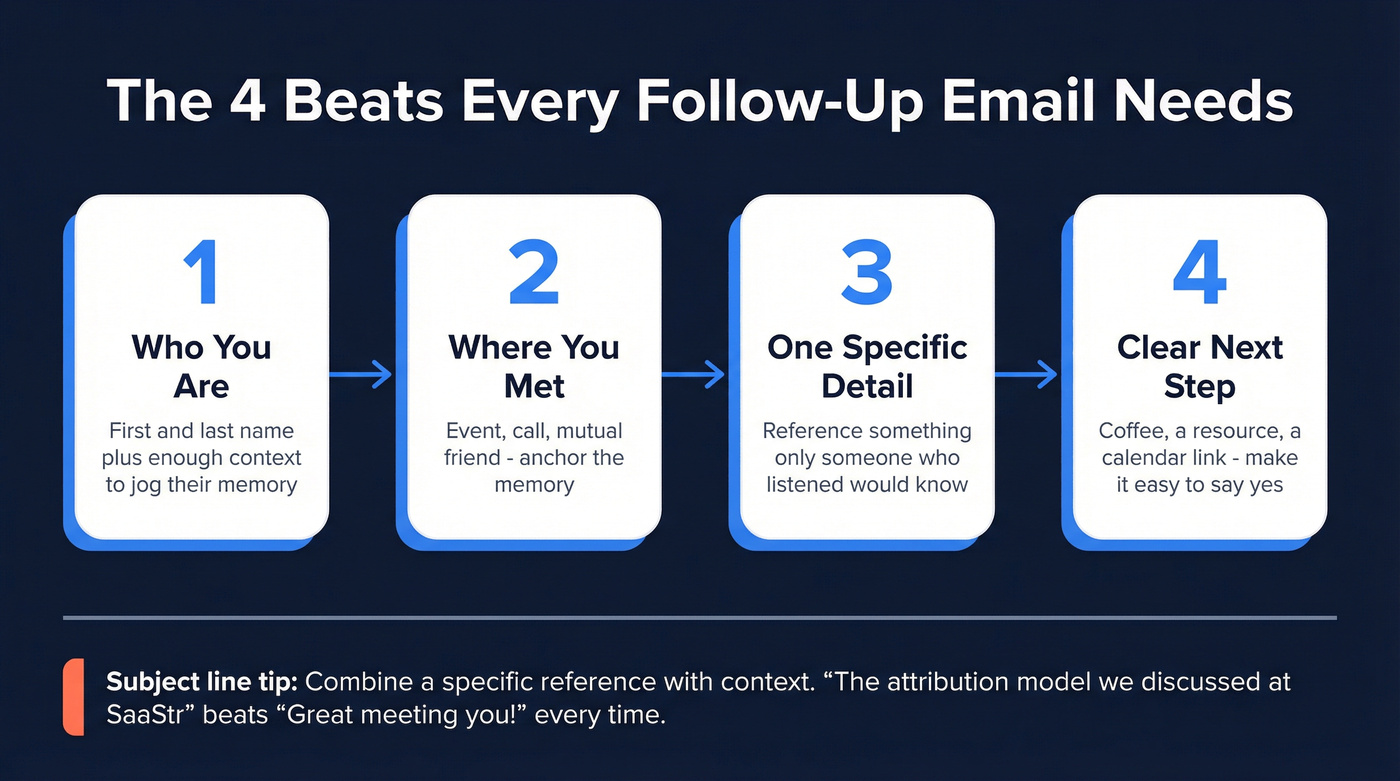
- Who you are - first and last name, enough context to jog their memory
- Where you met - event, call, mutual friend's dinner
- One specific detail from the conversation - this separates you from the 50 other people they met that day
- A clear next step - coffee, a resource you promised, a calendar link
For subject lines, combine a specific reference with context: "The attribution model we discussed at SaaStr" beats "Great meeting you!" every time. And if your follow-up reads like ChatGPT wrote it, it'll get treated like ChatGPT wrote it. Keep it imperfect and human.
If you want more options beyond “nice to meet you,” keep a swipe file of subject lines and rotate them based on context.
7 Templates for Every Scenario
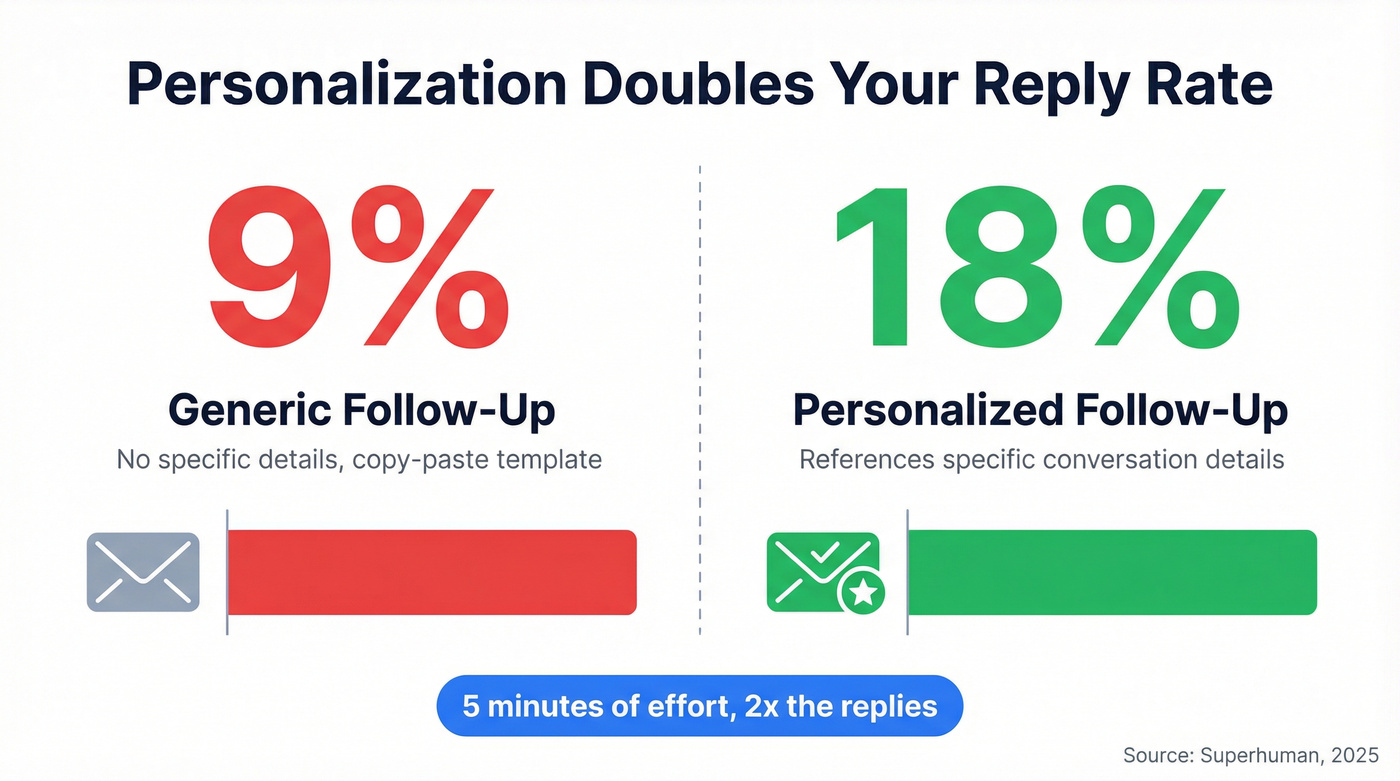
We've seen personalized follow-ups pull roughly 18% response rates versus 9% for generic ones. That's double the replies for five minutes of effort. Customize the bracketed sections and you're set.
If you're building a repeatable process, these sales follow-up templates can help you standardize without sounding robotic.
Networking Event Follow-Up
Subject: [Topic you discussed] - [Event name]
Hi [First name],
Great talking with you at [event] about [specific topic]. Your point about [detail] stuck with me - I've been thinking about it since.
Would love to continue the conversation over coffee. Free [day] or [day]?
[Signature]
The specific detail proves you were actually listening, not just collecting cards.
Job Interview Thank-You
Only 24-57% of candidates send thank-you notes after interviews. Meanwhile, 80% of hiring managers say these notes influence their decisions. The math is obvious.
This is the single easiest edge you can give yourself in a job search, and it takes maybe ten minutes to write well.
Subject: Thank you - [Role title] conversation
Hi [Interviewer name],
Thank you for walking me through the [role/team]. Your advice about [specific thing they said] was especially helpful - I've already [action you took based on their advice].
I'm excited about [specific aspect of the role]. Please don't hesitate to reach out if you need anything else from me.
[Signature]
Business Meeting / Client Follow-Up
Subject: Next steps from our [day] meeting
Hi [First name],
Great meeting today. To recap, we agreed on [one key action item]. I've attached [promised materials] as discussed.
I'll [next step] by [date]. Let me know if anything shifts on your end.
[Signature]
Short, action-oriented, zero fluff. That's what busy people want in their inbox.
If you’re doing this at scale, pairing follow-ups with contact management software keeps details from slipping through the cracks.
Conference or Trade Show
Subject: [Session/booth name] at [Conference]
Hi [First name],
Enjoyed our conversation at the [specific booth/session] during [conference]. Your take on [topic] was refreshing - especially [specific detail].
I'd love to share [relevant resource]. Worth a 15-minute call next week?
[Signature]
Common mistake: Sending the same template to everyone you met at the booth. If you can't reference one specific thing they said, you didn't listen - and they'll know.
Account Handoff (New Client Intro)
Skip the career history. Practitioners on r/CustomerSuccess call lengthy self-introductions "tacky peacocking." Lead with purpose.
Subject: Your new point of contact at [Company]
Hi [First name],
I'm [Your name], your primary contact for [product/service]. My job is to make sure you're getting full value from [what they bought] and to advocate for you internally.
Here's what happens next: [one concrete next step]. I'll send a calendar invite for [date].
[Signature]
If you need more variations for this scenario, borrow a few lines from a proven handoff email template.
Virtual Introduction (No Prior Meeting)
Whatever you do, don't write "nice to e-meet you." Just don't.
Subject: [Mutual connection]'s introduction - [topic]
Hi [First name],
Thanks for the introduction from [mutual contact] - great connecting with you. [One sentence about why you're reaching out and what you have in common.]
Would [specific ask] be useful? Happy to [proposed next step].
[Signature]
For more examples that work when you’ve never met, see this guide on writing a connection email.
Casual / Social Encounter
Subject: [Shared context reference] - let's grab coffee
Hey [First name],
Really enjoyed our chat at [party/gym/mutual friend's place] about [topic]. Turns out we're both [shared interest].
Want to grab coffee this week? I'm around [days].
[Signature]
Phrases That Work (and Three to Drop)
Use these: Great connecting with you. Thanks for the conversation. Glad we got to talk. Enjoyed our chat about [topic]. Appreciate you making time.
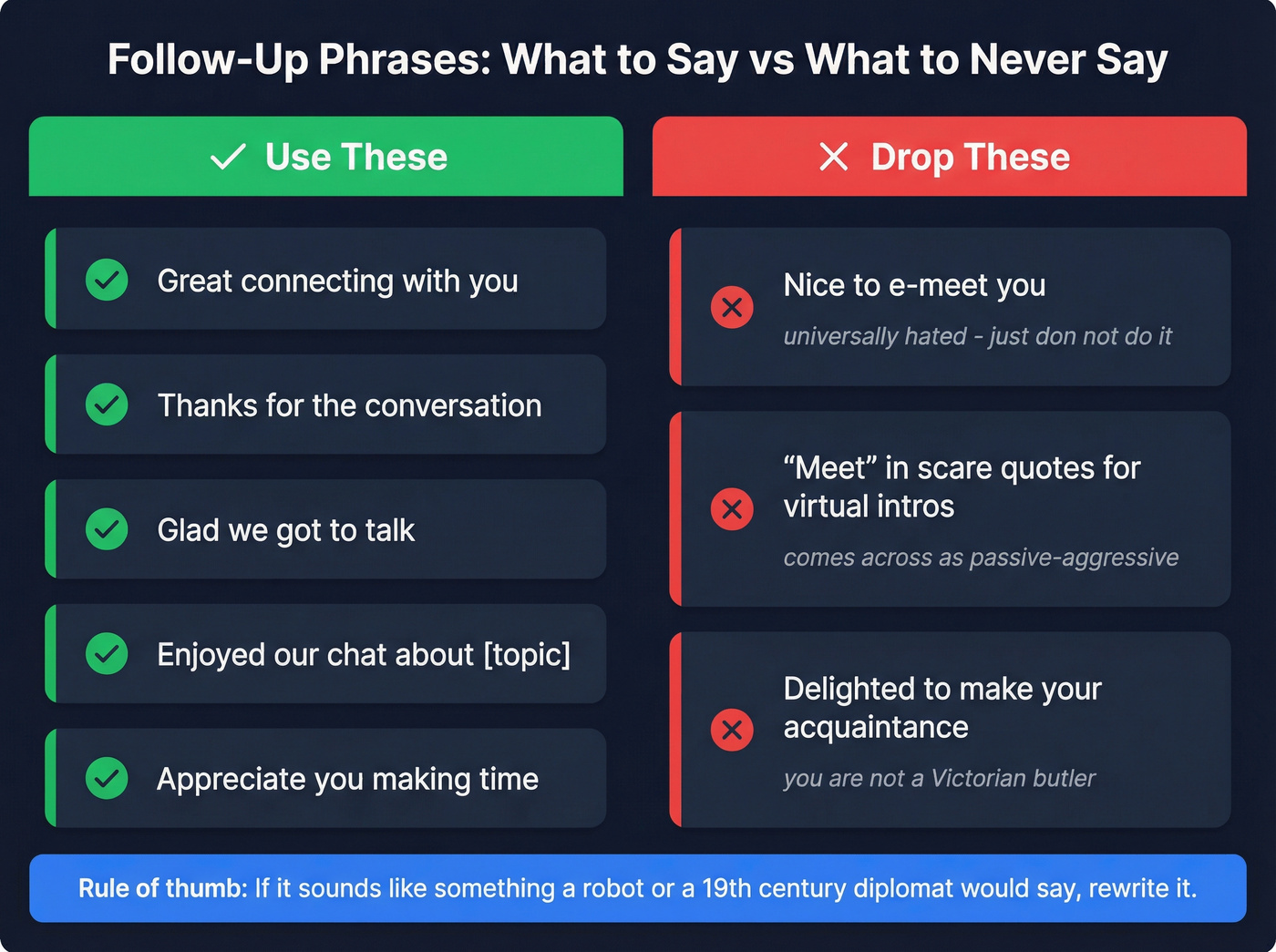
Drop these: "Nice to e-meet you" (universally hated). "Meet" in scare quotes for virtual intros (passive-aggressive). "Delighted to make your acquaintance" in casual settings - you're not a Victorian butler. Grammarly's guide covers more alternatives, but these handle 90% of situations.

Your follow-up template is ready. But what about the email address you can't read on that business card? Prospeo finds and verifies professional emails with 98% accuracy across 300M+ profiles - so your perfectly crafted "nice to meet you" actually lands.
Stop losing connections to illegible business cards.
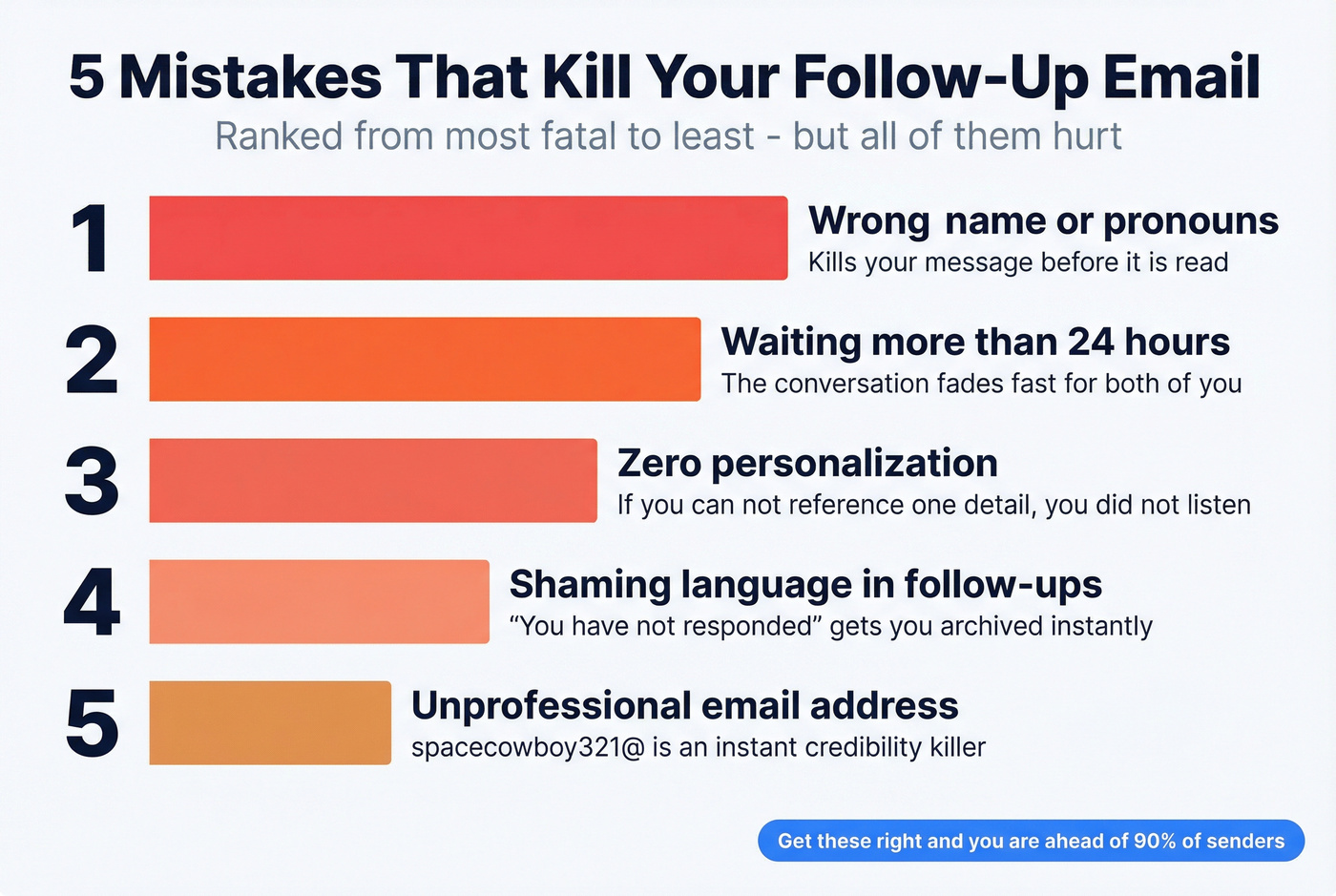
Five Mistakes That Kill Your Follow-Up
- Getting their name or pronouns wrong. Per HubSpot, this kills your message before it's read. In our experience, it's the most common mistake and the most fatal.
- Waiting more than 24 hours. The conversation fades fast for both of you. (If you’re unsure about timing, this guide on when should you follow up on an email breaks it down.)
- Sending a zero-personalization template. If you can't reference one specific detail, you didn't listen.
- Shaming language in follow-ups. "You haven't responded..." is a surefire way to get archived.
- Sending from an unprofessional email address. Mailchimp flags addresses like "spacecowboy321@" as instant credibility killers.
If you’re sending a lot of follow-ups, it’s also worth understanding email deliverability basics so good messages don’t land in spam.
No Reply? Here's What to Do
A Belkins study of 16.5M cold emails found the highest reply rate - 8.4% - comes from the first email. Sending four or more follow-ups more than triples your spam complaint risk. Practitioner benchmarks from r/b2b_sales put typical reply rates at 5-6%, with 10%+ considered good.
If you want to benchmark your own performance, compare against a typical follow-up email reply rate and adjust your approach.
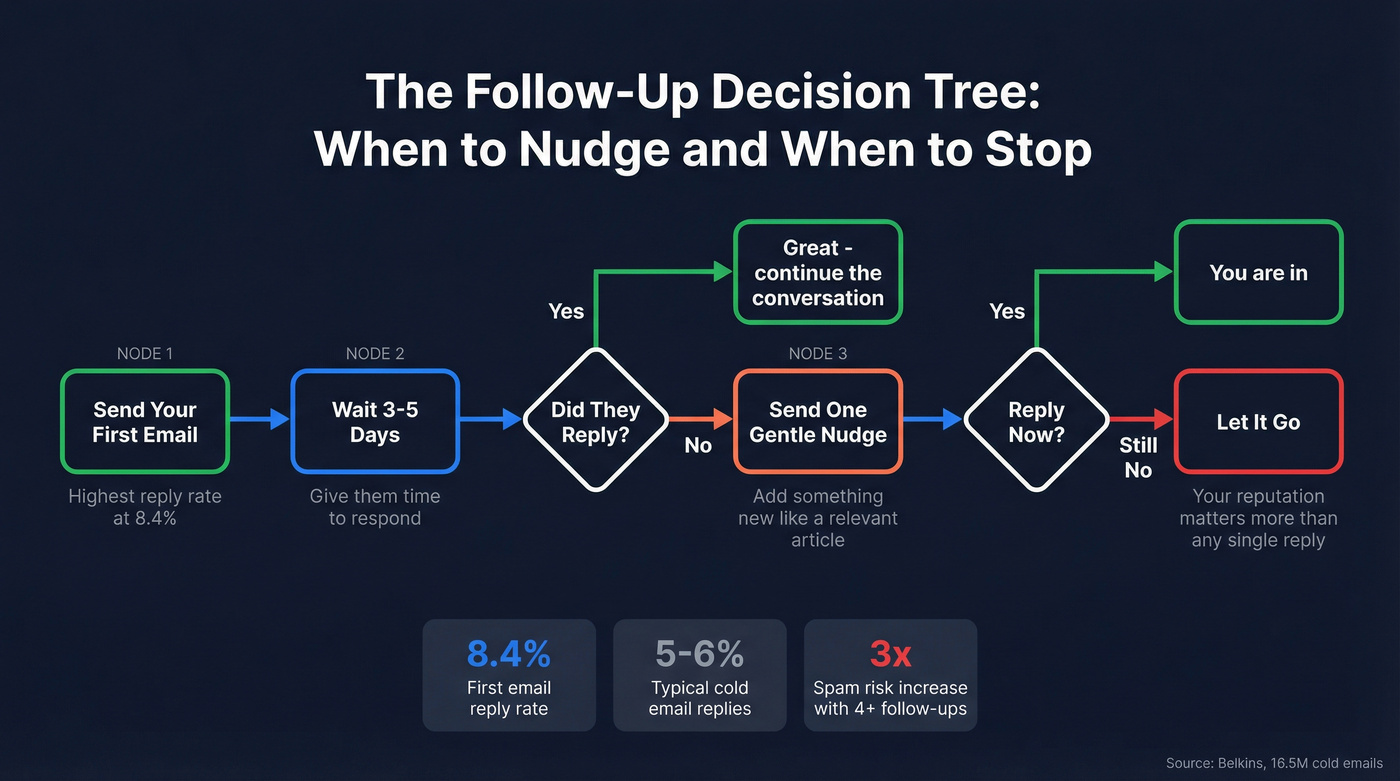
Look, most people over-follow-up. One nudge after 3-5 days is fine. After that, let it go. Your reputation matters more than any single reply.
Subject: Re: [Original subject]
Hi [First name], just circling back on my note from [day]. I came across [relevant article] and thought of our conversation about [topic]. Worth a quick look - happy to chat if it sparks anything.
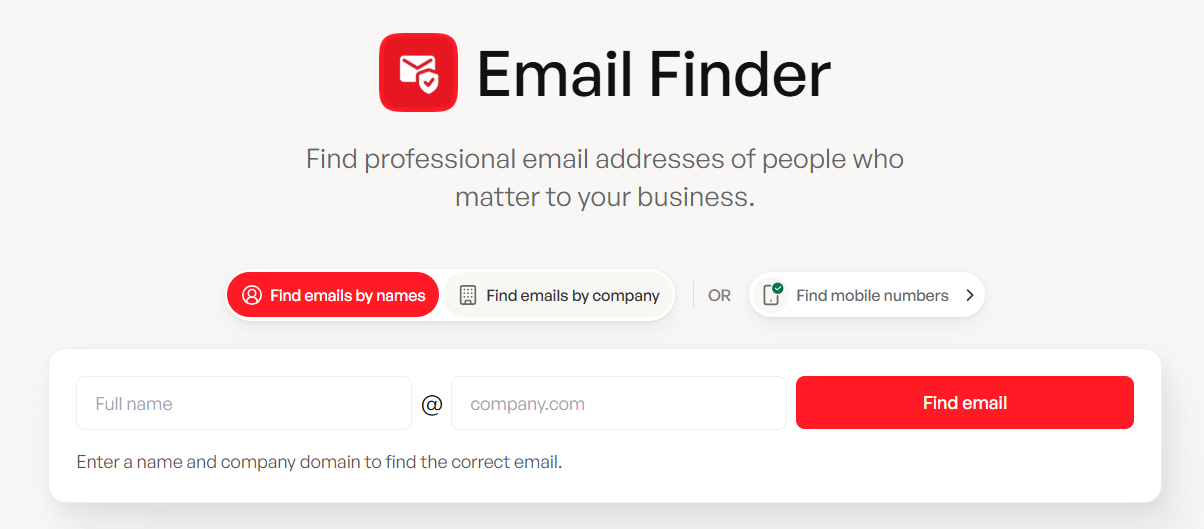
Of course, none of this matters if you don't have a valid email address. If all you walked away with is a name and company, Prospeo's Email Finder pulls verified addresses with 98% accuracy across 143M+ verified emails. Beats guessing formats or hunting through "Contact Us" pages.
If you’re stuck at “name + company,” this walkthrough on name to email methods can help you find the right format faster.
You just wrote a personalized follow-up that beats 90% of inboxes. Now imagine sending it to every decision-maker you met - not just the ones who handed you a card. Prospeo's Chrome extension lets 40,000+ users find verified contact data from any LinkedIn profile or company site in one click.
Turn every conversation into a connection for $0.01 per email.
Emailing International Contacts
Default to the highest level of formality until the recipient's tone tells you otherwise. Use last name + "-san" in Japan (Tanaka-san). Use Herr/Frau + surname in Germany - titles matter there. For Saudi Arabia, consider opening with "As-salamu alaykum" when culturally appropriate.
Mirror their reply style from there. If they sign off with their first name, you can relax. When in doubt, err formal. Nobody's ever been offended by too much respect in a first email.
FAQ
How soon should I send a follow-up after meeting someone?
Within 24 hours - same day is ideal while the conversation is fresh. Waiting longer than 48 hours makes the email feel like an afterthought, and the recipient won't remember the specific details you reference.
Is "nice to meet you" too formal for email?
The phrase itself is fine - generic, impersonal emails are the real problem. "Nice to meet you" works as long as you follow it with a specific detail from your conversation. If it feels stiff, swap in "Great connecting with you" instead.
Should I send a follow-up if they don't reply?
One gentle nudge after 3-5 days is the sweet spot. Reference your original email, add something new like a relevant article, and keep it short. Data from 16.5M cold emails shows four or more follow-ups more than triples your spam complaint risk.
What if I don't have their email address?
Use an email finder tool like Prospeo - plug in their name and company to pull a verified address. It's far more reliable than guessing name@company.com formats, and you avoid the embarrassment of emailing the wrong person entirely.