


NinjaPear vs Pubrio: Which B2B Data Tool Is Worth Your Money?
If you're weighing NinjaPear against Pubrio, you're comparing two tools most sales teams have never heard of. There's a reason for that. NinjaPear pivoted back into B2B data in 2026 after its v1 AI live chat product flopped. Pubrio was founded in 2024 and currently has exactly 2 G2 reviews. Here's what each offers and whether either one deserves a spot in your stack.
30-Second Verdict
Pick NinjaPear if you specifically need customer-relationship mapping - which company buys from which company - and you're building a data product, not running outbound. (If you're doing outbound, start with sales prospecting fundamentals first.)
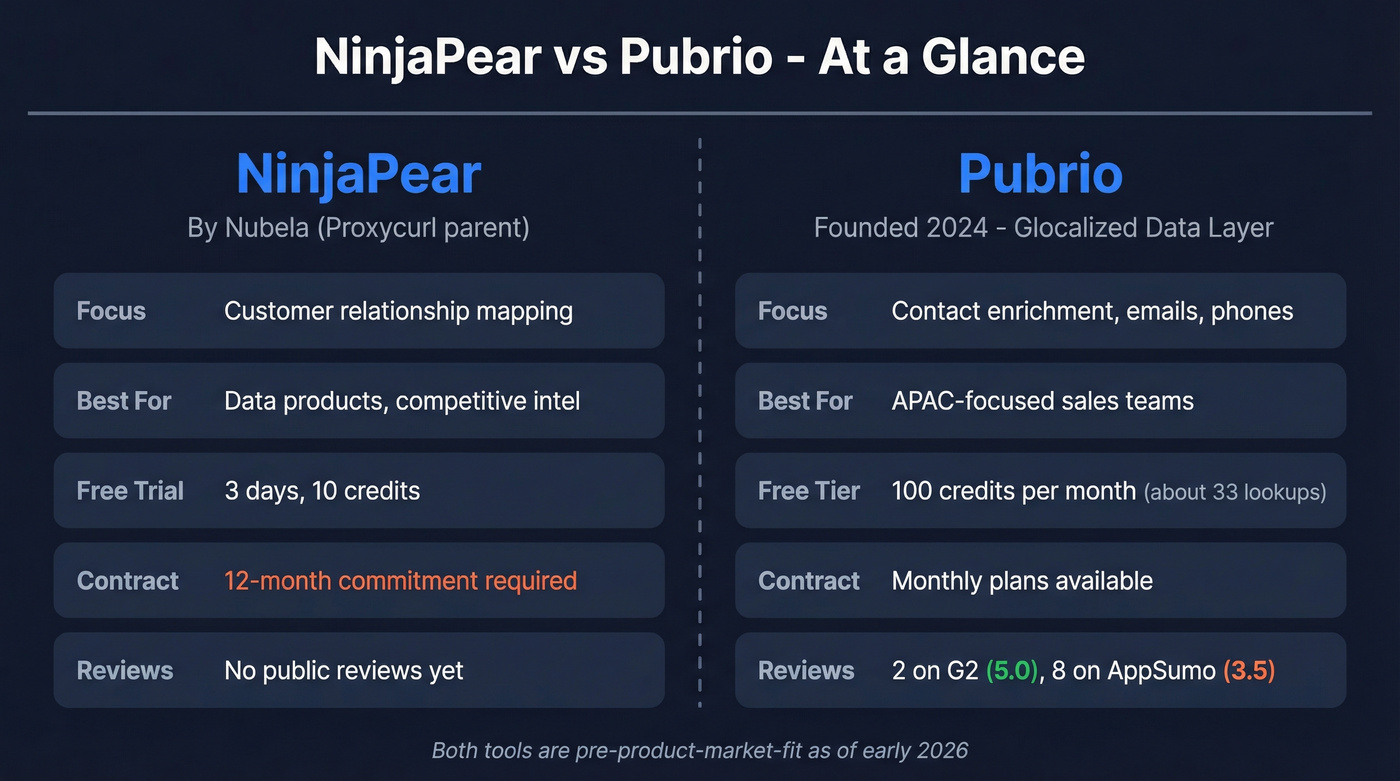
Pick Pubrio if you want contact enrichment with APAC coverage and don't mind a credit system that burns faster than you'd expect.
What Is NinjaPear?
NinjaPear is a product of Nubela, the same parent company behind Proxycurl. Its flagship offering is the Customer Listing API - feed it a company, and it returns a list of that company's B2B customers. That's a genuinely unique data angle for competitive intelligence and market mapping, and we haven't seen another tool do exactly this.
Here's the context that matters: NinjaPear v1 was an AI live chat tool. It reached 163 registered users, built no integrations, and was shut down. The team pivoted back to data in 2026, leaning on Nubela's existing infrastructure. The vision is ambitious - a "Yellow Pages for the post-AI world" - but the product has no independent reviews or case studies as of this writing. That's not necessarily damning for a brand-new tool, but it means you're buying a promise, not a track record.
What Is Pubrio?
Pubrio positions itself as a "glocalized business data layer" - global coverage with deep local context, pulling from 50+ localized sources like registries, directories, marketplaces, and other web-native data. Founded in 2024, it targets revenue teams needing structured data beyond US-centric databases like ZoomInfo and Apollo.
The product is broader than NinjaPear: a REST API with search and enrichment, plus sequence management workflows. A third-party martech publisher also describes Pubrio as offering intent analytics, automated sequences, managed services, and a Chrome extension.
That same publisher lists big scale and performance numbers - 1B+ company profiles, 275M contacts, 90% data accuracy, and 75% less research time. Treat those as Pubrio's marketing metrics, not independent verification. The two G2 reviewers praise its APAC coverage specifically: Hong Kong, Singapore, India, Vietnam, Korea, and Japan. If APAC is your primary market, that's worth noting. If it isn't, the value proposition gets thinner fast.
Feature-by-Feature Comparison
| Feature | NinjaPear | Pubrio | Edge |
|---|---|---|---|
| Core data type | Customer relationships | Contacts, emails, phones | Pubrio (broader) |
| Database scale | Undisclosed | 275M contacts (publisher-cited) | Pubrio |
| API access | Yes | Yes (plan-dependent) | Tie |
| Chrome extension | No | Yes | Pubrio |
| Email sequences | No | Yes | Pubrio |
| Intent signals | No | Yes | Pubrio |
| Data freshness | Unknown | Unknown | Neither |
| Free trial/tier | 3-day trial, 10 credits | 100 credits/month | Pubrio |
| Integrations | REST API + dashboard | API + Chrome + sequences | Pubrio |
The gap is significant. NinjaPear does one thing - customer listing - and doesn't pretend to be a full prospecting platform. Pubrio tries to be an all-in-one. Whether Pubrio actually delivers on all those promises is worth investigating before you commit any budget. (If you're evaluating vendors, it helps to benchmark against other B2B data providers.)

Both NinjaPear and Pubrio are pre-product-market-fit tools with thin review footprints and questionable credit mechanics. Prospeo gives you 300M+ profiles, 98% email accuracy, and a 7-day data refresh - backed by 15,000+ companies already in production.
Skip the gamble. Use the data platform that's already proven.
Pricing Breakdown
Pubrio
Pubrio's tiers as listed on G2:
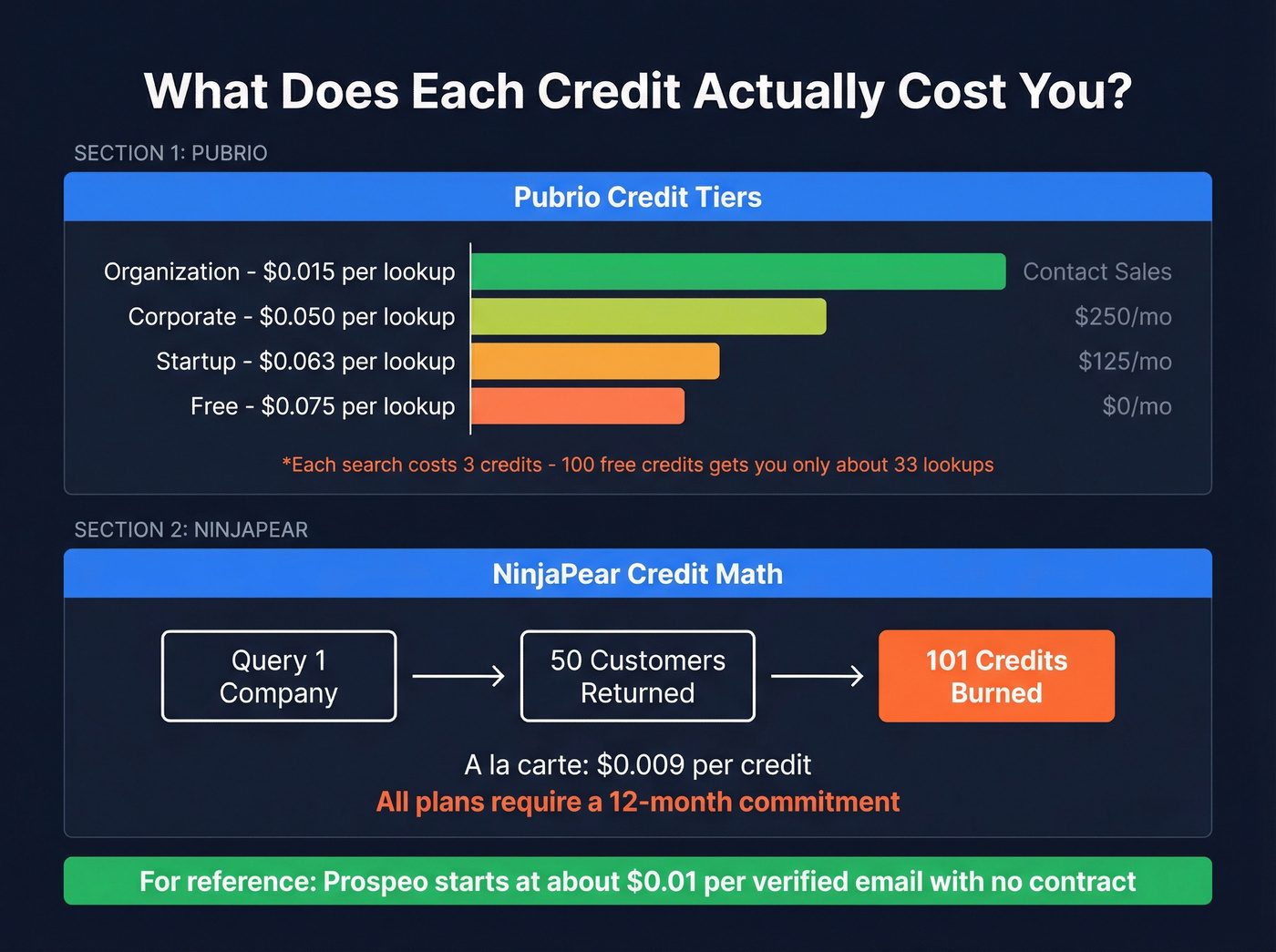
| Plan | Monthly Cost | Credits | Top-Up Rate | Cost per Lookup* |
|---|---|---|---|---|
| Free | $0 | 100 | $0.025/credit | ~$0.075 |
| Startup | $125 | 6,000 | $0.02/credit | ~$0.063 |
| Corporate | $250 | 15,000 | $0.015/credit | ~$0.050 |
| Organization | Contact sales | 100,000 | ~$0.005/credit | ~$0.015 |
*Based on 3 credits per search query, which is a common AppSumo complaint. The Free plan's 100 credits get you roughly 33 lookups. Not generous.
NinjaPear
NinjaPear's Customer Listing endpoint charges 1 credit per request plus 2 credits per customer returned. Pull 50 customers for one company and you've burned 101 credits. Their pricing page shows a $1,899/month plan pegging a la carte credits at $0.009 each.
The bigger gotcha is contracting: every plan - including monthly - comes with a 12-month commitment. Cancel early and you owe the remaining months. NinjaPear does offer a 3-day trial with 10 credits, and PAYG credits stay valid for 18 months. But for a product with zero public track record, that annual lock-in is a steep ask.
Here's the thing: if a tool requires a 12-month contract before it's proven product-market fit, you're subsidizing their R&D, not buying a solution.
What Users Actually Say
Pubrio has a split personality. On G2, it's a perfect 5.0/5 - from exactly 2 reviews. Both praise APAC data coverage and the team's willingness to do tailored manual research. On AppSumo, the picture is rougher: 3.5/5 from 8 ratings. The loudest complaints center on credits draining faster than expected, dead websites and 404 errors in the data, and support that goes quiet when you need it most.
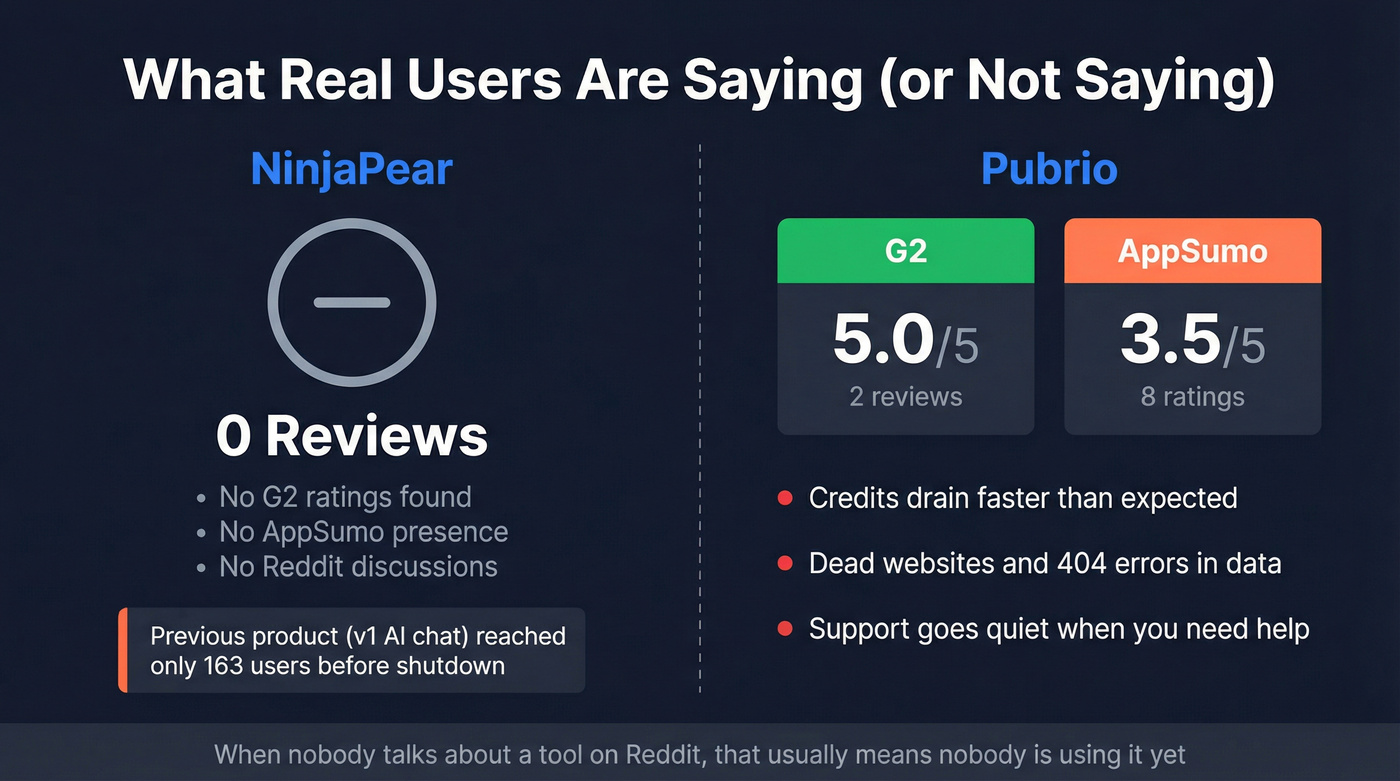
For NinjaPear, we couldn't find any meaningful third-party review footprint - no G2 ratings, no AppSumo signals, no case studies. We also didn't find relevant Reddit discussion for either product, which tells you something about how early-stage both are. When nobody's talking about a tool on r/sales or r/b2bmarketing, that's usually because nobody's using it yet.
The Honest Take
Both tools are pre-product-market-fit. NinjaPear pivoted back to data in 2026 from a product that attracted 163 users. Pubrio has 10 public reviews across two platforms, with real complaints about data quality and credit mechanics. Locking into a 12-month contract with either one is a gamble most revenue teams shouldn't take. (If you're building a stack, map this to your lead generation workflow so the data actually gets used.)
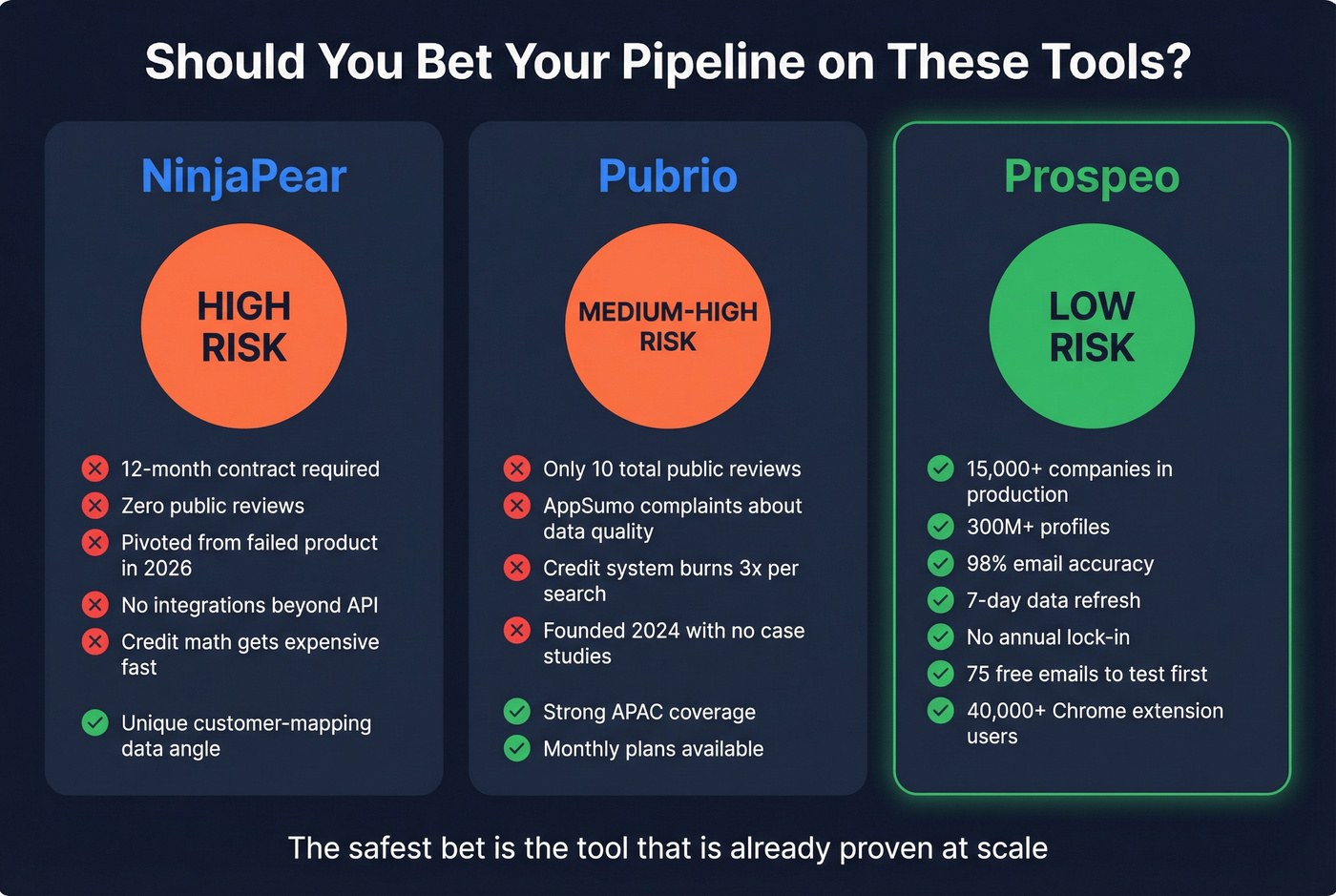
Let's be direct: the real question when comparing NinjaPear vs Pubrio isn't which is better. It's whether either belongs in a production sales stack today.
A Proven Alternative
The Chrome extension has 40,000+ users - a direct contrast to NinjaPear's API-only approach. No 12-month lock-in, no ambiguous credit drain. Credit-based pricing starts around $0.01 per email, and the free tier gives you 75 verified emails per month to test before committing a dollar. In our experience, teams that switch from early-stage tools to established platforms like this see bounce rates drop from 30%+ to under 5% almost immediately. (If bounce is a recurring issue, use email bounce rate benchmarks to sanity-check your list quality.)

No 12-month contracts. No ambiguous credit drain. Prospeo starts at ~$0.01/email with 75 free verified emails per month - plus a Chrome extension used by 40,000+ prospectors daily.
Get verified B2B data without subsidizing someone else's R&D.
FAQ
Is NinjaPear the same as Proxycurl?
No. Both are Nubela products, but Proxycurl pulls professional profile data while NinjaPear maps customer relationships - which companies buy from which companies - via its Customer Listing API. Different use cases entirely.
Does Pubrio have a free plan?
Yes - 100 credits per month. But each search costs 3 credits, so you get roughly 33 lookups before you need top-ups at $0.025 per credit. It's enough to kick the tires, not enough to run a real campaign.
What's a reliable alternative to both NinjaPear and Pubrio?
Prospeo offers 300M+ profiles with 98% email accuracy, a 7-day data refresh cycle, and a free tier with 75 verified emails per month. No contracts, no 12-month commitments - and 15,000+ companies already use it in production.