

How to Handle Every Objection of Sale: The Complete 2026 Playbook
The average sales win rate sits at roughly 21%. Four out of five deals die somewhere between "interested" and "signed." What makes every objection of sale harder to navigate now is that nearly 70% of the buyer's journey is complete before a prospect ever talks to a rep. By the time you hear pushback, the buyer has already formed opinions, compared alternatives, and built internal resistance you can't see.
The gap between persistence and quitting is where revenue disappears. 80% of sales require five or more follow-ups, but 92% of reps quit after four. Almost always, it's an unresolved concern that makes a rep stop calling.
By the Numbers
- 21% - average B2B sales win rate
- 70% - of the buyer's journey happens before a rep is contacted
- 80% - of sales need 5+ follow-ups; 92% of reps quit after 4
- 61% - of B2B buyers now prefer a rep-free experience
What Is a Sales Objection?
An objection of sale is a specific, workable concern a prospect raises about why they can't or won't buy - rooted in budget, authority, need, or timing. It signals engagement, not rejection. A buyer is telling you exactly what stands between them and a yes.
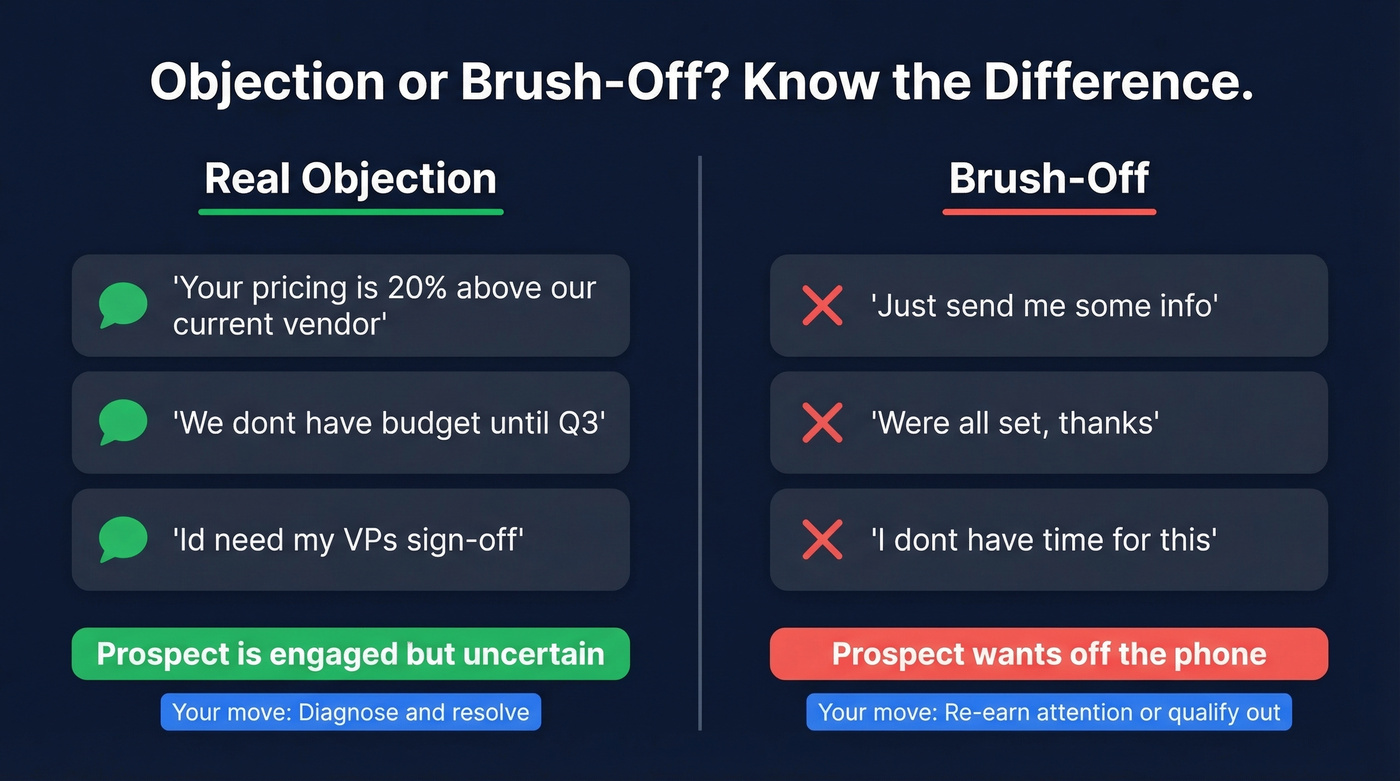
That distinction changes everything. An objection is someone telling you why they're hesitant. A brush-off is someone trying to end the conversation. Confusing the two is one of the fastest ways to lose a deal you could've won, and we've watched it happen on dozens of recorded calls during team reviews.
| Objection (workable) | Brush-off (excuse) | |
|---|---|---|
| Sounds like | "Your pricing is 20% above our current vendor" | "Just send me some info" |
| "We don't have budget until Q3" | "We're all set, thanks" | |
| "I'd need my VP's sign-off" | "I don't have time for this" | |
| Means | Prospect is engaged but uncertain | Prospect wants off the phone |
| Your move | Diagnose and resolve | Re-earn attention or qualify out |
Types of Objections in Sales
Most articles lump objections into four categories. Too simple. Outreach's research identifies nine main types, and the distinction matters because each demands a different response. Knowing buyer concerns at a granular level - beyond the basic BANT buckets - is what separates average reps from top performers.
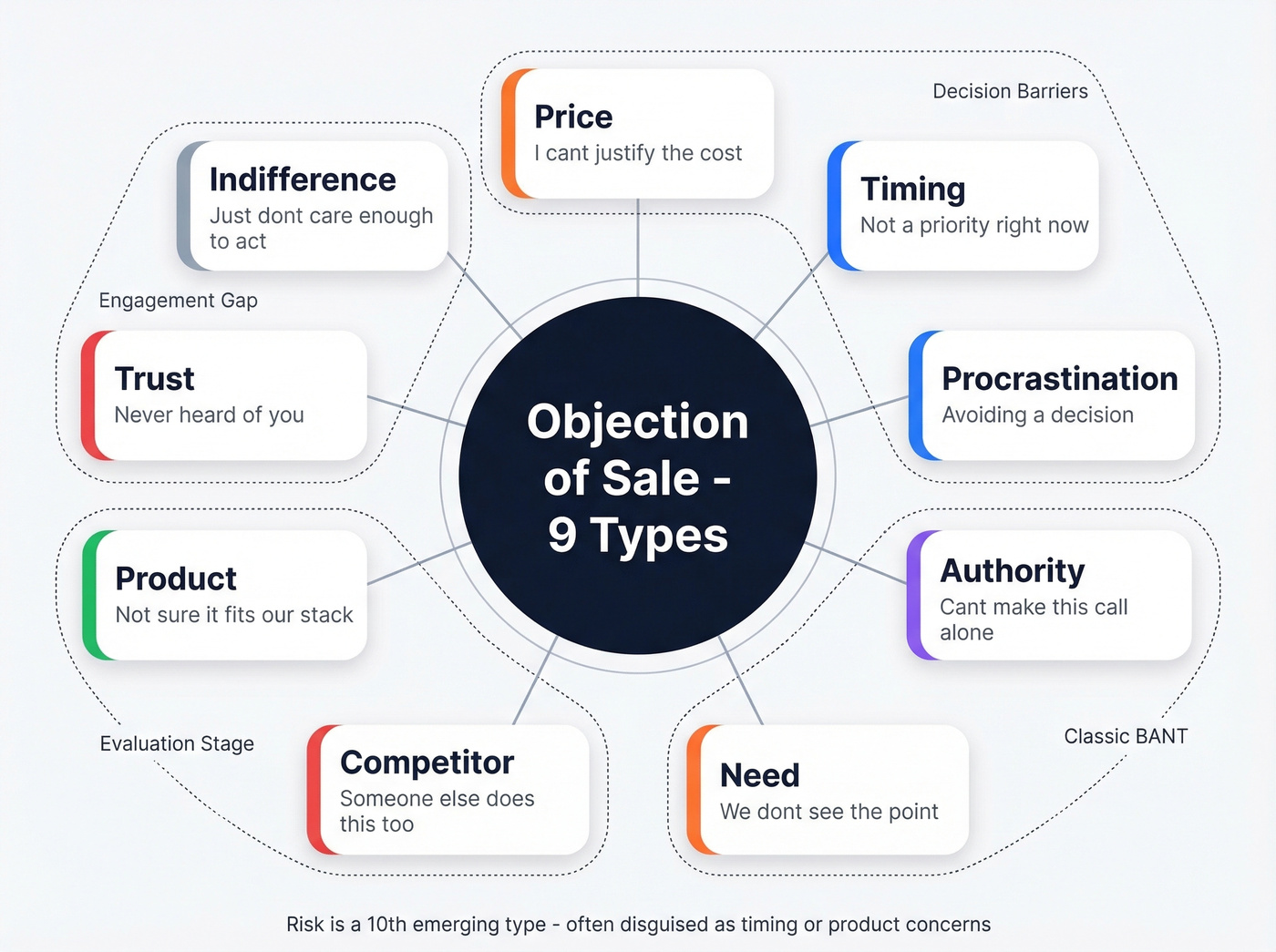
| Type | What they're really saying | Example phrase |
|---|---|---|
| Price | "I'm not sure the ROI justifies the cost" | "That's way over our budget" |
| Timing | "This isn't a priority right now" | "Maybe next quarter" |
| Procrastination | "I'm avoiding a decision" | "Let me think about it and circle back" |
| Authority | "I can't make this call alone" | "I'd need to loop in my boss" |
| Need | "I don't see why we need this" | "We're fine with our current process" |
| Competitor | "Someone else does this too" | "We're already evaluating [rival]" |
| Product | "I'm not sure it does what we need" | "Does it integrate with Salesforce?" |
| Trust | "I don't know your company" | "I've never heard of you" |
| Indifference | "I just don't care enough to act" | "It's not really on our radar" |
| Risk | "What if this doesn't work out?" | "What's the implementation timeline?" |
With 61% of B2B buyers now preferring a rep-free experience, trust and indifference objections are surging. Buyers have more information and less patience. Knowing which type you're facing determines your entire response strategy.
Common Sales Objections and Responses
Every objection-handling article gives you scripts. Scripts are training wheels. The reasoning behind each response matters more than the exact words.
Price and Budget Objections
"It's too expensive."
Two words will save you here: "Compared to what?" This single question, recommended by multiple sales practitioners, forces the prospect to reveal their benchmark - a competitor, doing nothing, or an internal project. Each comparison demands a different reframe.
"Your competitor is cheaper."
Acknowledge it: "They might be. Let's look at what you're actually getting for that price." Then shift to total cost of ownership. Cheaper tools that require twice the manual work aren't actually cheaper - switching costs, implementation time, and internal change management are where "cheap" deals go to die.
Timing and Priority
"Now isn't a good time."
Most reps hear this and book a follow-up for "next quarter." Wrong move. The right question: "What would make this the right time?" If they articulate specific conditions - next quarter's budget cycle, after a product launch - you've got a real timeline. If they can't, it's a brush-off, and you need a sharper value prop, not a calendar invite.
"I don't have time for this call."
Morgan J. Ingram's fairness frame works here: "Totally fair. All I'm asking for is 30 seconds to explain why I called. If it doesn't resonate, you can hang up on me. Does that sound fair?" It's disarming because it gives the prospect control while buying you a window.
Authority and Process
"I need to run this by my team."
Don't fight it - enable it. The average B2B purchase involves 7.4 decision-makers. Your prospect should be looping in others. The move: "When you take this back to your team, who's most likely to be skeptical, and what will they push back on?" Now you're coaching your champion instead of waiting for a vague "we'll get back to you."
Need and Status Quo
"We're fine with what we have."
Here's the thing: this objection kills more pipeline than any pricing conversation. Behavioral economists call it status quo bias - the tendency to prefer the current state simply because it's familiar, not because it's better. Don't attack their current solution. Ask about outcomes: "What's your current bounce rate on outbound emails?" or "How long does it take your team to build a qualified list?" Specific performance questions expose gaps that "we're fine" papers over.
"Just send me some info" / "I'm not interested."
Both are brush-offs, not real objections. For "send me info," try: "Happy to - what specifically would you want to see?" If they can't answer, they're not interested. For "I'm not interested," ask one question: "Is that because you've solved this problem already, or because it's not a priority right now?" The answer tells you whether to qualify out or reframe.

Half of sales objections die when you reach the right person. Prospeo gives you 98% verified emails and 125M+ direct dials so you skip gatekeepers and talk to actual decision-makers - the ones who don't say "I need to run this by my team."
Fewer objections start with better data. Try Prospeo free.
Objection Handling: A Framework for Any Concern
Stop memorizing scripts. Start diagnosing causes. Objection handling is a structured process for uncovering and resolving the real reason a buyer hesitates. The five-step framework below is the simplest process that actually works:
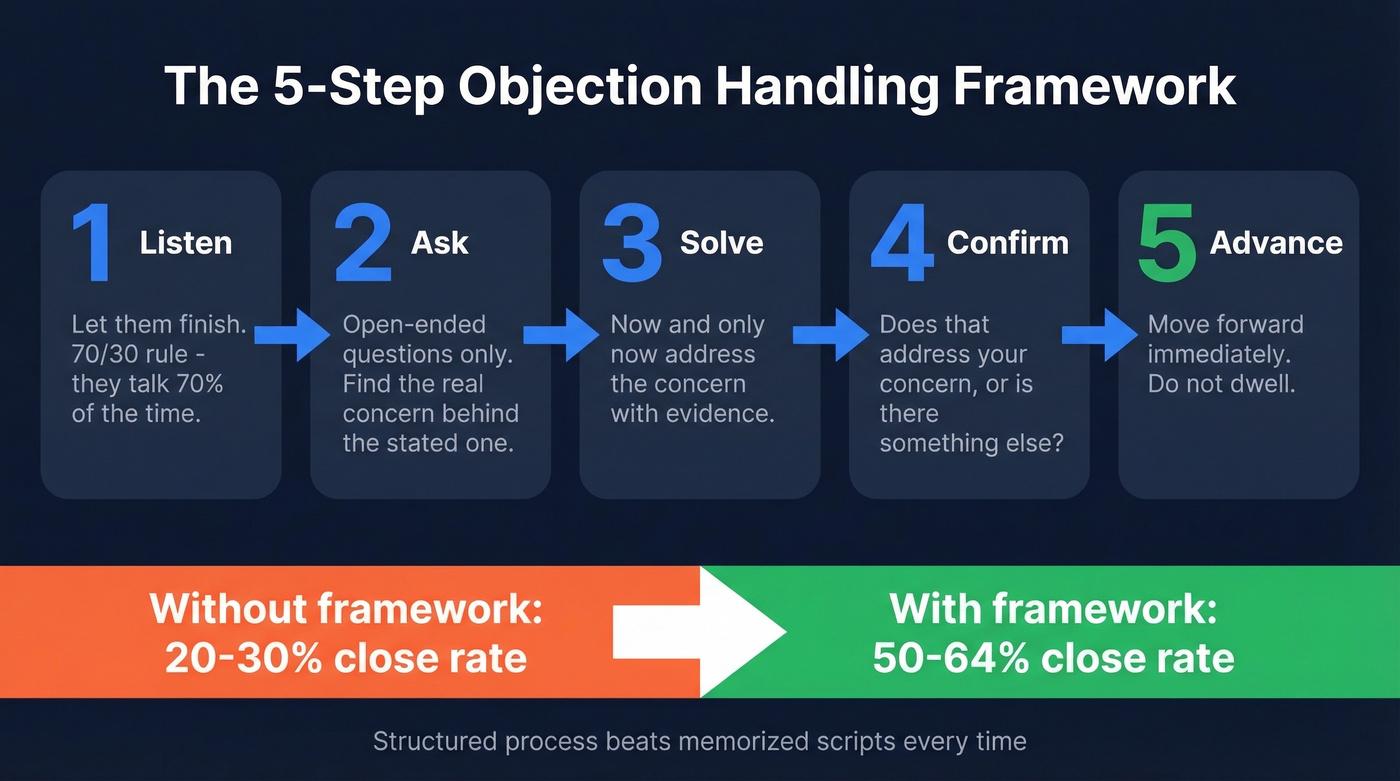
- Listen. Let the prospect finish. The 70/30 rule says your prospect should talk 70% of the time. Most reps violate this within 30 seconds.
- Ask. Open-ended questions only. "Can you tell me more about that?" Your goal: find the real concern behind the stated one. (If you want a deeper bank, use these good discovery questions.)
- Solve. Now - and only now - address the concern.
- Confirm. "Does that address your concern, or is there something else?"
- Advance. Once confirmed, move forward immediately. Don't dwell.
Organizations using structured objection handling frameworks see close rates improve from 20-30% to 50-64% within six months. The framework matters more than any individual script.
| Framework | Core idea | Best for |
|---|---|---|
| 5-Step (Listen-Advance) | Diagnose before solving | All reps, all stages |
| BANT | Qualify by Budget/Authority/Need/Timing | Early discovery calls |
| MEDDIC | Map decision process + pain | Enterprise, complex deals |
| 3 Fs (Feel/Felt/Found) | Empathy-first reframe | Relationship-heavy sales |
| Boomerang | Turn objection into reason to buy | Experienced closers |
No single framework is "right." The 5-step process is the most versatile starting point. MEDDIC shines in enterprise deals where you need to map complex decision processes across large buying committees - often 8-13+ stakeholders. The Boomerang technique is powerful but requires confidence. Not a beginner move.
Mistakes That Kill Deals
Richard Harris put it best: "Nobody wants to be handled." The moment a prospect feels like you're running a playbook on them, trust evaporates.
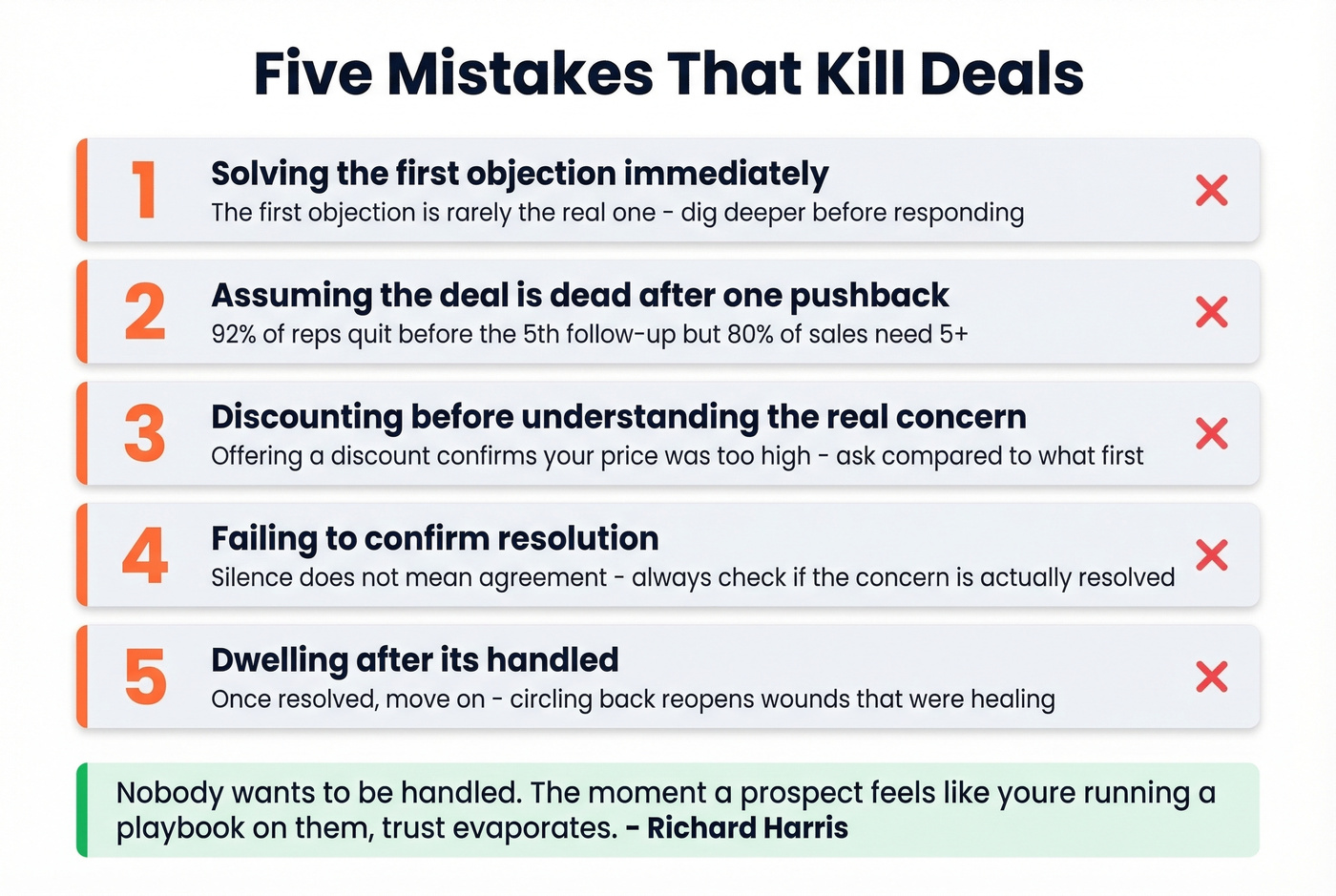
1. Solving the first objection immediately. The first objection is rarely the real one. "It's too expensive" usually means "I don't see enough value" or "I can't justify this to my boss." Jump straight to discounting and you've solved the wrong problem.
2. Assuming the deal is dead after one pushback. This is the emotional mistake. A single concern doesn't mean no - it means "convince me." Reps who internalize objections as rejection stop following up, and that's how 92% of them quit before the fifth touch.
3. Discounting before understanding the real concern. The moment you offer a discount, you've confirmed your price was too high. And you still haven't addressed the actual hesitation. Ask "compared to what?" before you touch pricing.
4. Failing to confirm resolution. You deliver a brilliant response. The prospect goes quiet. You assume silence means agreement and barrel forward. It doesn't. Always check: "Did that address what you were thinking?" Skipping this step is how "resolved" objections resurface at contract stage and blow up deals that felt done.
5. Dwelling after it's handled. Once a concern is genuinely resolved, move on. Reps who keep circling back reopen wounds that were already healing.
Prevent Objections Before They Start
The best objection is the one that never comes up. And half the pushback reps face is preventable with better preparation.
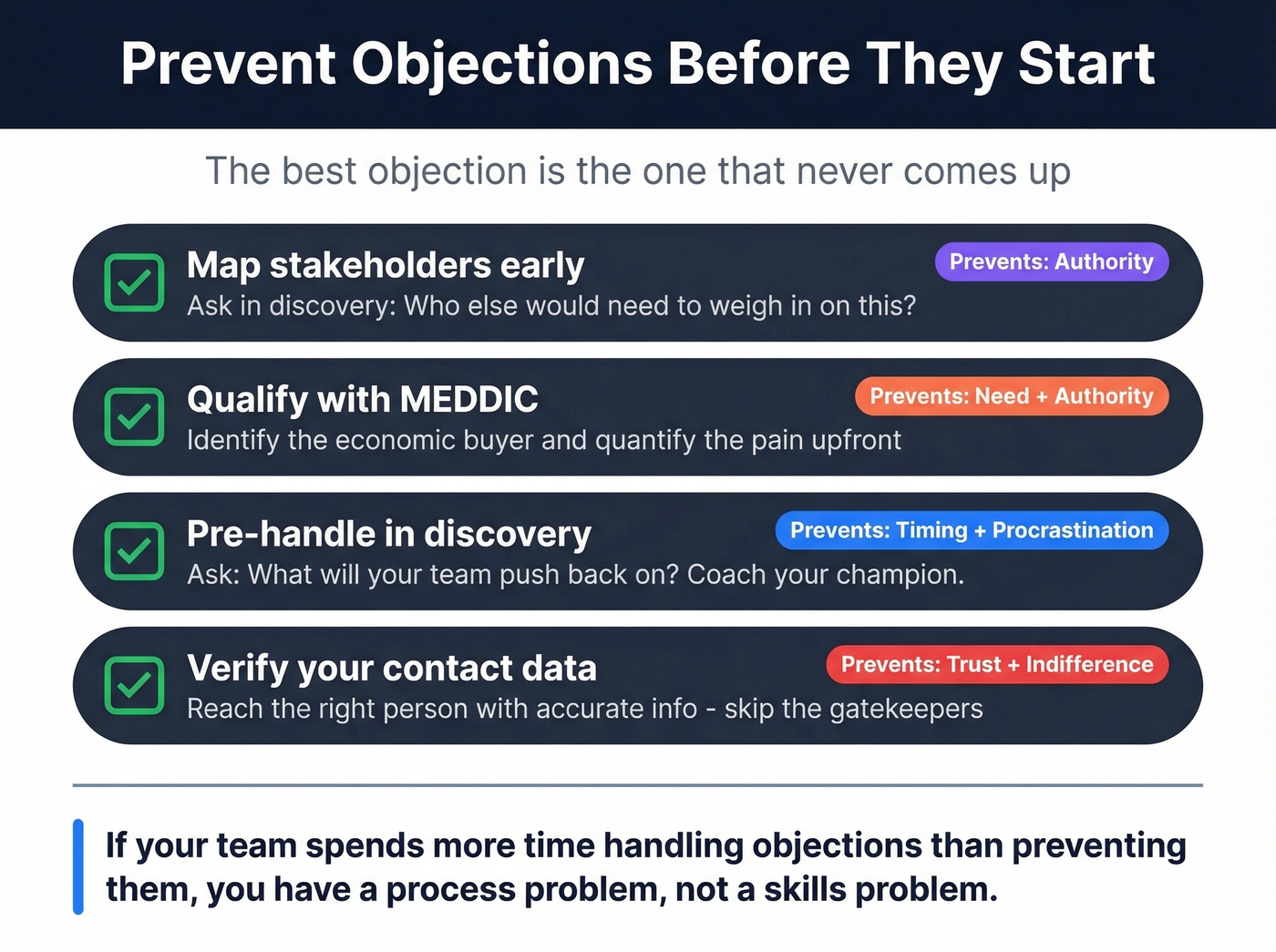
I'll say it bluntly: if your team spends more time handling objections than preventing them, you have a process problem, not a skills problem. Most "objection handling" training is a band-aid over bad targeting and weak discovery.
Here's a pre-call checklist that eliminates entire categories of pushback:
- Map stakeholders early. In discovery, ask: "Who else would need to weigh in on this?" Surface authority objections before they become roadblocks. (This is also basic stakeholder mapping.)
- Qualify with MEDDIC. If you've identified the economic buyer and quantified the pain, most need and authority objections dissolve before they form. (More detail: MEDDIC sales qualification.)
- Pre-handle in discovery. Ask: "When you take this back to your team, what will they push back on?" Now you're coaching your champion.
- Verify your contact data. Many objections exist because reps reach the wrong person with outdated information. "I don't handle that" isn't an objection - it's a data failure. Prospeo's 98% email accuracy and 7-day data refresh cycle means you're reaching the right decision-maker with current information from the first touch. (If you want to operationalize this, start with a BDR contact data workflow.)

Better qualification combined with better data doesn't just reduce objections - it changes the quality of the objections you face. Instead of fighting through "who are you?" and "I don't handle purchasing," you're having real conversations about value, timing, and fit. Those are objections worth having.
Train Your Team
With 80% of B2B sales interactions now conducted virtually, handling objections over video and phone is the skill that separates quota-crushers from quota-missers. Reading about it doesn't help. Repetition does.
Rapid-fire drill (5-10 min). One person throws objections nonstop. The other responds immediately - no pausing, no "um." The goal isn't perfect answers; it's comfort under pressure. In our experience, reps who do this drill twice a week for a month sound like completely different sellers on real calls.
"Why behind the objection" drill (10 min). The responder can only ask clarifying questions. No rebuttals allowed. This trains the hardest part of the 5-step framework - staying in diagnostic mode when every instinct screams "answer now." (Use a library of probing questions to keep it fresh.)
Call review workshop (20-30 min). Pull a recorded call. Pause at each objection. Workshop better responses as a team. This is the highest-ROI training exercise because it uses real conversations, not hypotheticals. The consensus on r/sales is that call reviews do more for ramp time than any formal training program.
Scenario roleplay rotation. Cycle through these weekly:
- Price objection from a CFO
- Skeptical technical buyer
- Gatekeeper blocking access
- "Just send me info" brush-off
- "We're going with [competitor]"
Skip the roleplay if your team already has a strong call review habit and limited time - doubling down on real call analysis beats simulated scenarios for experienced reps.
Companies that run structured roleplay consistently see measurably higher conversion rates. The reps who sound natural handling objections aren't naturally gifted - they've practiced more. If you want more examples and drills, start with a dedicated guide to sales handling objections.
"We're fine with what we have" hits different when your bounce rate is 35% and your lists are stale. Prospeo refreshes every 7 days - not 6 weeks - so you're reaching real people at real companies. When your data connects, your objection-handling frameworks actually get used.
Stop losing deals before the conversation even starts.
Every objection of sale is a signal, not a stop sign. The reps who win aren't the ones with the best scripts - they're the ones who diagnose faster, prepare better, and never confuse a workable concern with a dead deal. Stop memorizing. Start diagnosing.
FAQ
What is an objection of sale?
An objection of sale is a specific concern a prospect raises about why they can't or won't buy - typically rooted in budget, authority, need, or timing. It signals engagement, not rejection. The critical distinction: objections are workable concerns from engaged buyers, while brush-offs like "just send me info" are attempts to end the conversation entirely.
What are the main types of sales objections?
The classic four are Budget, Authority, Need, and Timing (BANT). Modern methodologies expand this to ten types - adding competitor, product-fit, trust, indifference, risk, and procrastination. BANT is a useful starting point for discovery calls, but limiting your diagnosis to four categories means missing the real concern behind what a prospect actually says.
How do you overcome price objections?
Ask "compared to what?" to uncover the prospect's actual benchmark - a competitor, the cost of doing nothing, or an internal project. Once you know the reference point, reframe your value against their specific comparison. Never offer a discount before understanding the real hesitation behind the stated price concern.
What's the difference between an objection and a rejection?
An objection is a workable concern from an engaged prospect; a rejection is a firm no. Most apparent "rejections" are actually undiagnosed objections. Before accepting a no, ask one diagnostic question - "Is that because you've solved this already, or because it's not a priority?" - to confirm whether a real concern is hiding underneath.
How can verified data reduce sales objections?
Reaching the right decision-maker with accurate contact information eliminates "wrong person" objections entirely. When your first conversation is with someone who has the authority and context to evaluate your solution, you skip the gatekeepers and outdated records that generate most early-stage pushback - and get straight to the objections that actually matter.