

14 Good Discovery Questions That Separate Closers From Order-Takers
You're 3 minutes into a discovery call. The prospect just said "We're exploring options." You've got 12 minutes left. What you ask next determines whether this deal moves forward or dies in a follow-up email no one reads.
Here's the problem: 42% of sales teams cite discovery and questioning as their biggest skill gap, and 96% of buyers have already researched your product before picking up the phone. They don't need a feature walkthrough. They need someone who asks good discovery questions - the kind that surface pain no competitor bothered to uncover.
If you remember nothing else: ask 11-14 questions, in SPIN order, and talk less than 46% of the time.
What Makes a Discovery Question Actually Work
Not all open-ended questions earn their keep. Gong's research across thousands of sales calls shows the sweet spot is 11-14 targeted questions. Fewer leaves pain unexplored. More than 15 feels like an interrogation, and your prospect starts giving one-word answers just to escape.
An effective discovery question does four things: it's open-ended, forcing a narrative instead of a yes/no; it's sequenced, building on the previous answer rather than jumping a checklist; it reveals something you can't Google - pain, urgency, internal politics - and it advances the deal by qualifying or disqualifying in real time. Top reps ask 39% more questions than average performers, and their discovery calls run 76% longer. But more questions isn't the goal. Better questions, in the right order, is.
14 Sales Discovery Questions That Close Deals
These follow the SPIN framework - Situation, Problem, Implication, Need-Payoff - a sequencing method built from analysis of 35,000 sales calls. SPIN isn't a script. It's a sequence that moves the prospect from "here's our situation" to "we need to fix this now."
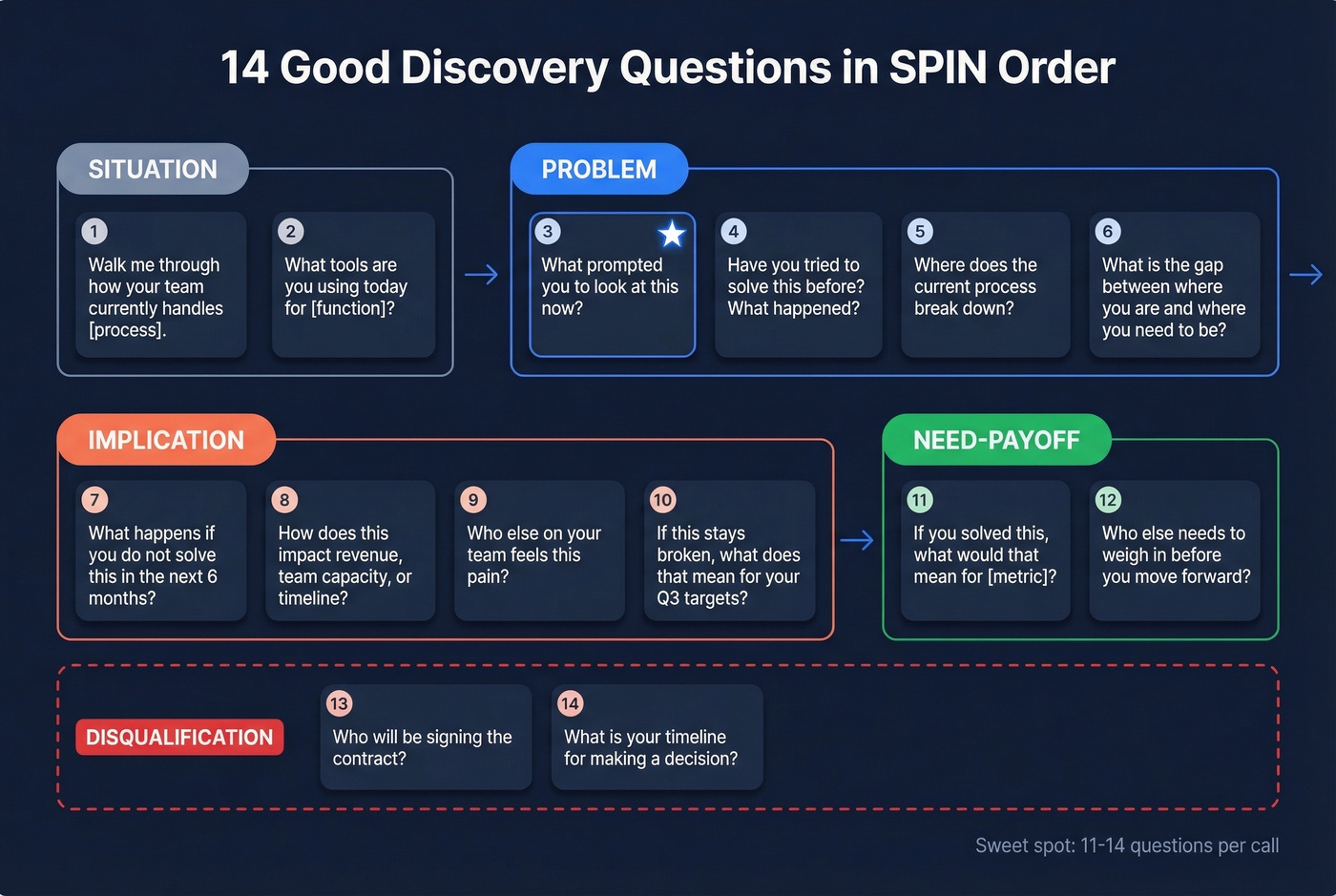
Situation Questions
Keep these short. You should already know the basics from pre-call research.
"Walk me through how your team currently handles [process]." - Reveals workflow reality, not the org chart version.
"What tools are you using today for [function]?" - Maps the tech stack and surfaces integration needs early.
Problem Questions
This is where you earn the right to go deeper. Asking great questions here means resisting the urge to pitch and letting the prospect articulate what's broken.
"What prompted you to look at this now?" - The single most important discovery question. "Now" reveals urgency. No trigger event usually means no deal.
"Have you tried to solve this before? What happened?" - Uncovers failed initiatives and internal skepticism you'll need to address later.
"Where does the current process break down?" - Gets specific. "It's not great" becomes "we lose 3 days every month reconciling data manually."
"What's the gap between where you are and where you need to be?" - Forces the prospect to describe the gap in their own words. That language becomes your proposal copy.
Implication Questions
Here's where average reps bail out. Implication questions are uncomfortable because they force the prospect to confront consequences. We've watched reps nail the first six questions and then pivot to a demo because they're afraid of making the conversation tense. Don't do that. Use a permission bridge - "Can I ask you a direct question?" - then go in.
"What happens if you don't solve this in the next 6 months?" - The "do nothing" scenario. If the answer is "honestly, not much," you've just saved yourself 10 hours of follow-up.
"How does this impact [revenue / team capacity / timeline]?" - Ties the problem to a metric their boss cares about. Quantified pain gets budget. Abstract pain doesn't.
"Who else on your team feels this pain?" - Maps the buying committee without asking "who's the decision-maker" point-blank.
"If this stays broken, what does that mean for your [Q3 targets / hiring plan / product launch]?" - Connects the problem to a specific business event. This question alone has changed the trajectory of deals in our experience, because it forces the prospect to think beyond their own frustration and into organizational consequences.
Need-Payoff Questions
Flip the conversation from pain to possibility. Let the prospect sell themselves.
"If you solved this, what would that mean for [metric]?" - The prospect describes their ideal future state. That's your ROI story.
"Who else needs to weigh in before you move forward?" - Surfaces stakeholders, legal reviews, and procurement timelines before they become week-6 surprises.
Disqualification Questions
The consensus on r/sales is pretty clear: the real goal of discovery is to "filter out tire kickers and disqualify fast." These two questions do exactly that.
"Who will be signing the contract?" - If they don't know, or it's three levels above them, your timeline just tripled.
"What's your timeline for making a decision?" - Vague answers like "sometime this quarter" mean there's no internal deadline. Real deals have dates.

Question #2 asks about their tech stack. Question #1 asks about their process. But the best reps already know the answers before the call starts. Prospeo gives you 30+ filters - technographics, headcount growth, funding, intent data - so you walk into discovery with context, not guesses.
Stop wasting situation questions on things you should already know.
Tailor Questions by Persona
71% of buyers expect you to understand their specific needs, but only 29% think companies deliver. Good discovery questions sound different depending on who you're talking to - same underlying intent, different framing:
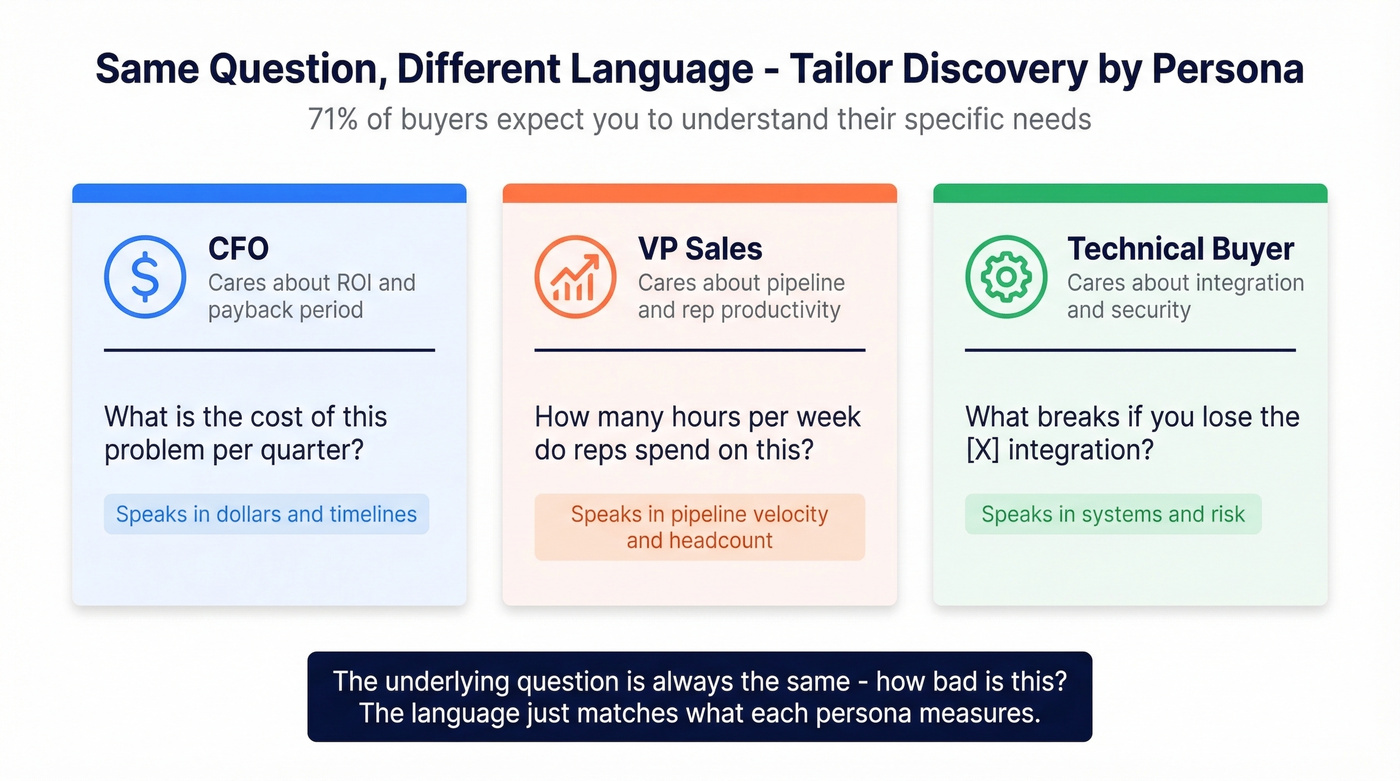
| Persona | What They Care About | Question Variant |
|---|---|---|
| CFO | ROI, payback period | "Cost of this problem per quarter?" |
| VP Sales | Pipeline, rep productivity | "Hours/week reps spend on this?" |
| Technical Buyer | Integration, security | "What breaks without [X] integration?" |
The underlying question is always "how bad is this?" The language just matches what each persona actually measures.
The 30-Minute Call Structure
| Stage | Time | Purpose |
|---|---|---|
| Opening | 3 min | Set agenda, build rapport |
| Situation | 5 min | Confirm what you researched |
| Problem | 8 min | Surface pain and triggers |
| Implication | 5 min | Quantify consequences |
| Need-Payoff | 4 min | Let them describe the win |
| Next Steps | 5 min | Lock the follow-up |
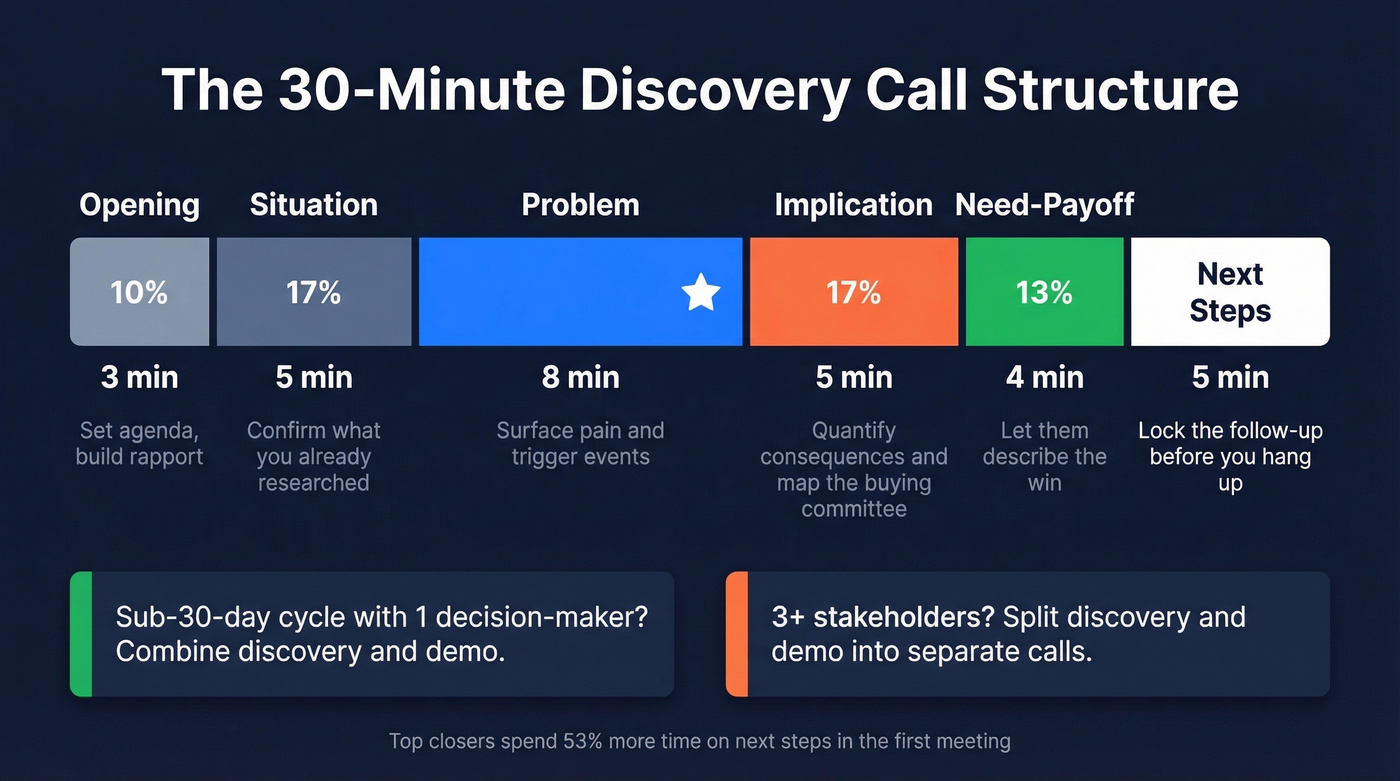
Should you combine discovery and demo into one call? For deals with a sub-30-day cycle and one decision-maker, yes. Once you're dealing with 3+ stakeholders, split them. A separate discovery call lets you personalize the demo to the pain you actually uncovered instead of running a generic walkthrough. (If you want a tighter demo flow, use a product demo checklist.)
5 Rules That Separate Discovery From Interrogation
1. Talk less than 46% of the time. Top reps hover around a 46:54 talk-to-listen ratio. Average reps talk in the high 60s. If you're talking more than half the call, you're pitching, not discovering.
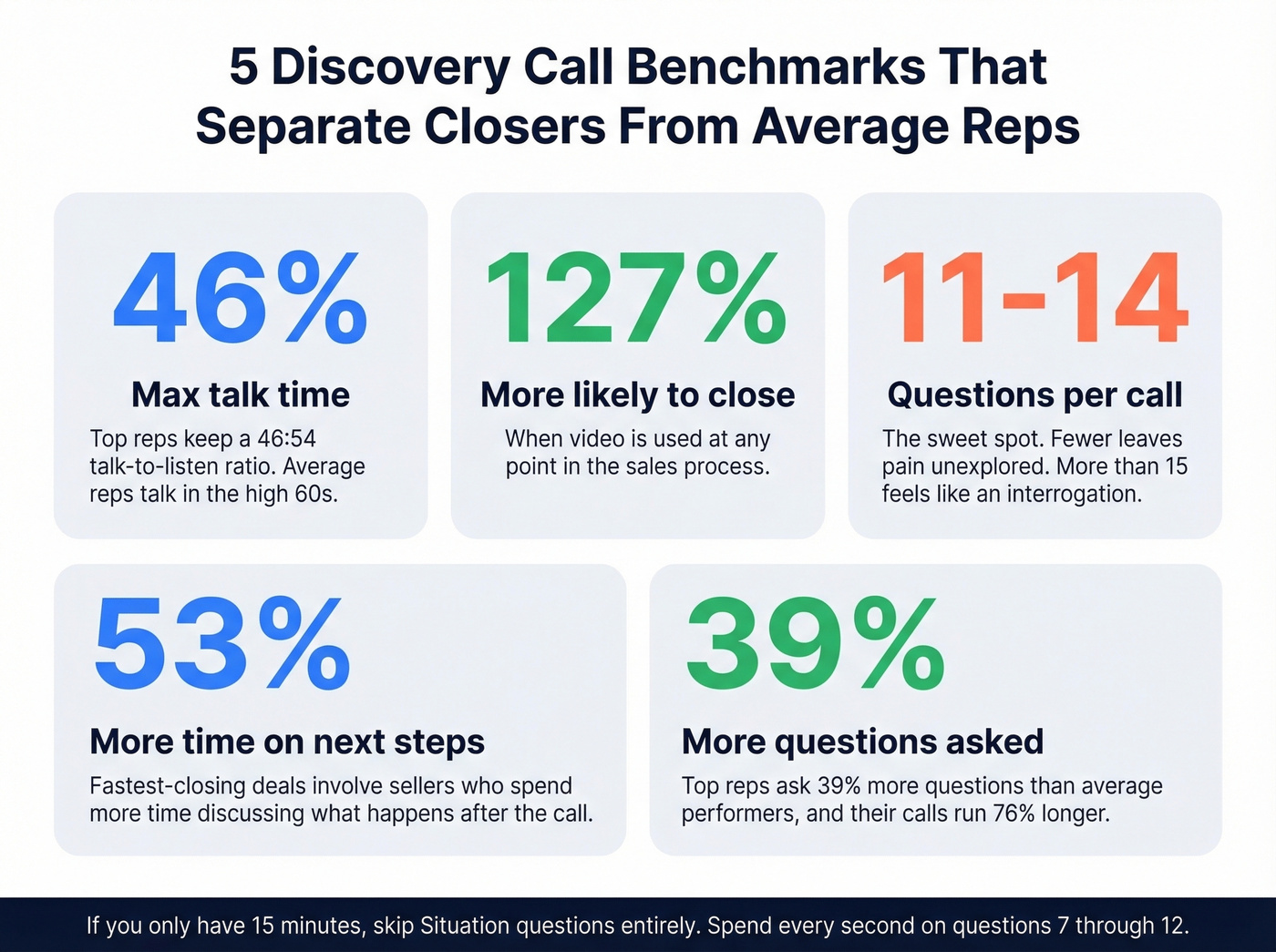
2. Turn your camera on. Deals are 127% more likely to close when video is used at any point in the sales process. It's the easiest lever you're not pulling.
3. Ask follow-ups, not just your list. The best discovery question is often "Tell me more about that." If you're reading questions off a doc, the prospect can tell. Great follow-ups come from genuine curiosity about the answer you just heard, not from a spreadsheet. Let's be honest - most reps treat discovery like a form to fill out. The ones who close treat it like a conversation. (For more examples, steal from these probing questions and sales probing questions.)
4. Do your pre-call research, but be realistic. The "60 minutes of research per call" standard is performative nonsense for anyone running more than 5 calls a day. Five to 15 minutes for SMB accounts, 20-45 for enterprise. And verify your prospect's data before the call - B2B contact data decays 2.1% per month. We've seen reps prep for 30 minutes only to discover the email bounced and the prospect left the company two months ago. Prospeo refreshes records every 7 days and verifies emails at 98% accuracy, so your discovery call actually happens instead of bouncing to a dead inbox. (If you need a deeper workflow, follow this how to prepare for a discovery call guide.)
5. Spend more time on next steps. The fastest-closing deals involve sellers who spend 53% more time discussing next steps in the first meeting. Lock the follow-up meeting and send a calendar invite before you hang up. If you leave the call without a confirmed next step, the deal is already cooling. (If your follow-ups are weak, build a repeatable sales follow-up process.)
Look - most reps over-invest in clever Situation questions and under-invest in Implication questions. If you only have 15 minutes, skip Situation entirely. You can Google their tech stack. Spend every second on questions 7 through 12. That's where deals are won or lost. If you want more variations, start with these pain point discovery questions and pain point examples.
FAQ
How many discovery questions should I ask per call?
Aim for 11-14. Gong's data shows fewer leaves pain unexplored, while more than 15 triggers prospect fatigue. For C-suite conversations, lead with 4-6 high-impact questions and let their answers guide follow-ups organically.
What's the difference between discovery and qualification?
Discovery uncovers pain, context, and urgency. Qualification determines whether the deal is worth pursuing. The best reps do both simultaneously - every question should advance your understanding of the problem AND filter for fit, budget, and timeline.
How do I improve my discovery call performance?
Record your calls and review them against the 46:54 talk-to-listen benchmark. Count your questions, note where you defaulted to pitching instead of probing, and practice follow-up questions. Reps who deliberately audit their own calls close at measurably higher rates within 30 days.
How much pre-call research is enough?
Five to 15 minutes for deals under $25K, 20-45 for enterprise. The goal is knowing enough to skip Situation questions and jump straight into problems. Start by confirming your contact data is current - stale data means wasted prep time, and Prospeo's free tier lets you verify 75 emails per month so you're not prepping for a call that never connects.
You just mapped the buying committee with question #9. Now you need verified contact data for every stakeholder. Prospeo delivers 98% accurate emails and 125M+ verified mobile numbers - so your multi-threaded follow-up actually lands.
Turn discovery intel into direct lines to every decision-maker.