

How to Run a Discovery Meeting That Actually Converts
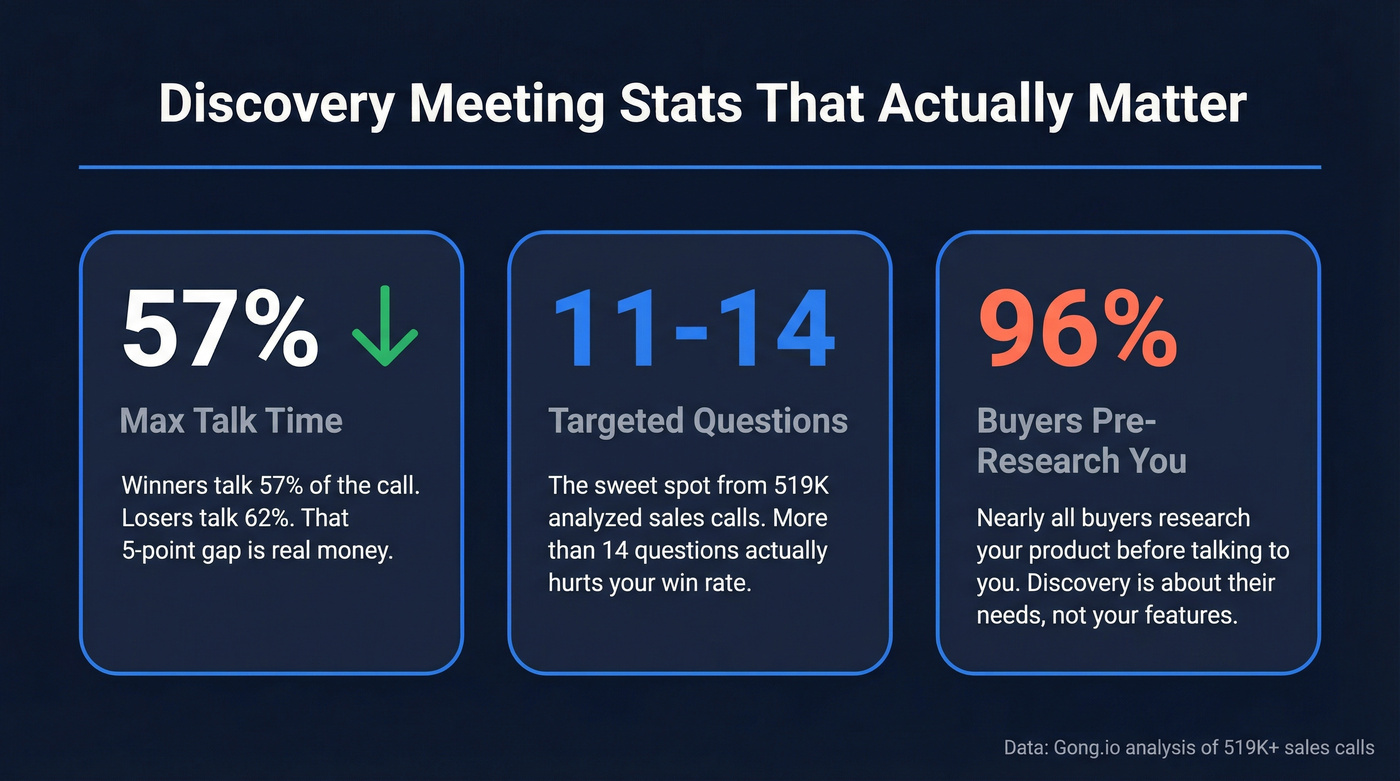
Stop memorizing 50 discovery questions. You need 11 to 14 good ones. An analysis of 519K sales calls makes it clear: more questions past 14 actually hurt your win rate. Every sales blog tells you to "ask open-ended questions" and "listen more." What they don't tell you is exactly how many questions, how to distribute them, and what ratio of talking to listening actually correlates with winning.
Discovery meetings aren't exclusive to sales, either. Instructional designers, consultants, and financial advisors all run versions of this conversation to scope needs before proposing solutions. The principles are the same.
The Numbers That Matter
- Talk less than 57% of the time. An analysis of 326K sales calls found that closed-won reps talk 57% of the call. Lost deals? 62%. That 5-point gap is real money.
- Ask 11-14 targeted questions, spread throughout the conversation - not front-loaded like a checklist.
- Research the prospect before the meeting so you never open with "So, tell me about your company." (If you need a system, borrow a few sales prospecting techniques that work before the call is booked.)
What Is a Discovery Meeting?
A discovery meeting is a structured conversation where you uncover a prospect's problems, priorities, and decision-making process before proposing a solution. It happens after initial interest but before any demo, proposal, or pitch (use a simple product demo checklist so discovery feeds the demo, not the other way around).
Here's the thing: 96% of buyers research your product before they ever talk to you. They already know your features. Discovery isn't about educating them on what you do - it's about understanding what they need and whether you're the right fit.
Discovery Meeting vs. Call vs. Kickoff
These three get confused constantly.
| Meeting Type | When It Happens | Goal |
|---|---|---|
| Discovery call | After initial interest | Uncover needs, qualify fit |
| Sales discovery meeting | Same stage, longer format | Deeper needs assessment |
| Kickoff meeting | After contract is signed | Align on deliverables, timeline |
A Kickoff meeting happens post-contract. You should already understand the client's needs by then. If you're asking "What are your goals?" in a kickoff, something went wrong earlier.
Why Most Discovery Meetings Fail
Most discovery meetings fail for one of three reasons, and all three have data behind them.
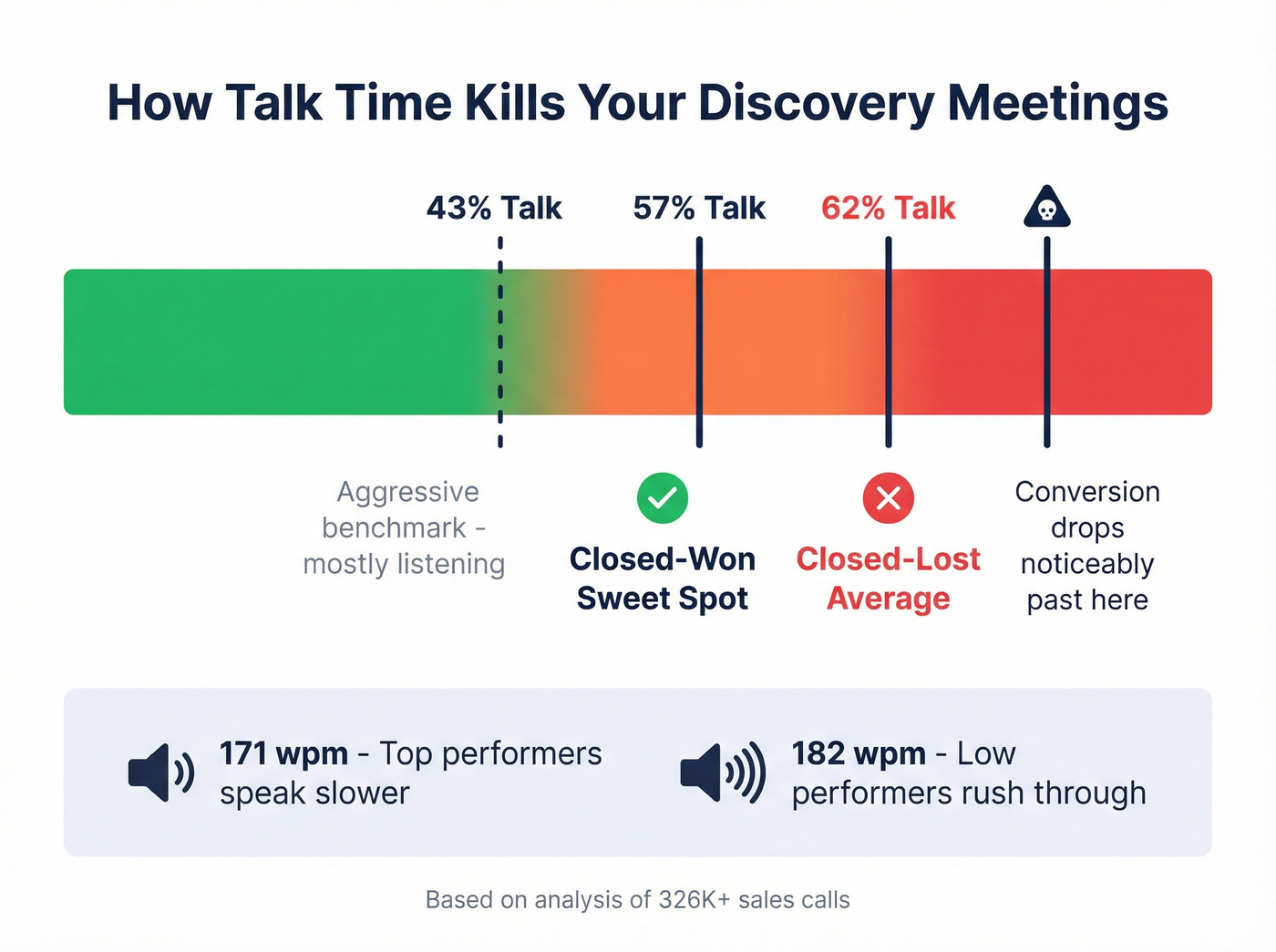
You're talking too much. Reps on closed-won deals talk 57% of the time. Reps who lost? 62%. The earlier "golden ratio" benchmark was even more aggressive - 43% talking, 57% listening. Once you cross 65% talk time, conversion drops noticeably. Top-performing reps also speak slower: 171 words per minute vs. 182 for low performers. (If your team needs coaching here, build a repeatable sales communication standard.)
You're asking too many questions. This one surprises people. The 519K-call analysis found that 11-14 targeted questions is the sweet spot, and a separate 326K-call study confirmed the pattern - winners asked roughly 15-16 questions while losers asked around 20. More questions doesn't mean better discovery. It means interrogation. The prospect goes quiet after your third rapid-fire question. Arms crossed. You've lost the conversation.
You're not going deep enough. Nearly 25% of sellers say discovery questions are a top weakness. In our experience, the reps who struggle most aren't the ones asking bad questions - they're the ones who don't follow up on good answers. "What's your biggest challenge?" gets a surface-level response. The follow-up is where the real insight lives. (A tighter discovery questions framework helps here.)

The data says top reps research prospects before discovery meetings - never opening with "tell me about your company." Prospeo gives you 50+ data points per contact, including tech stack, funding, and headcount growth, so you walk into every discovery call already knowing the situation.
Stop wasting your 11-14 questions on things you should already know.
30-Minute Agenda Template
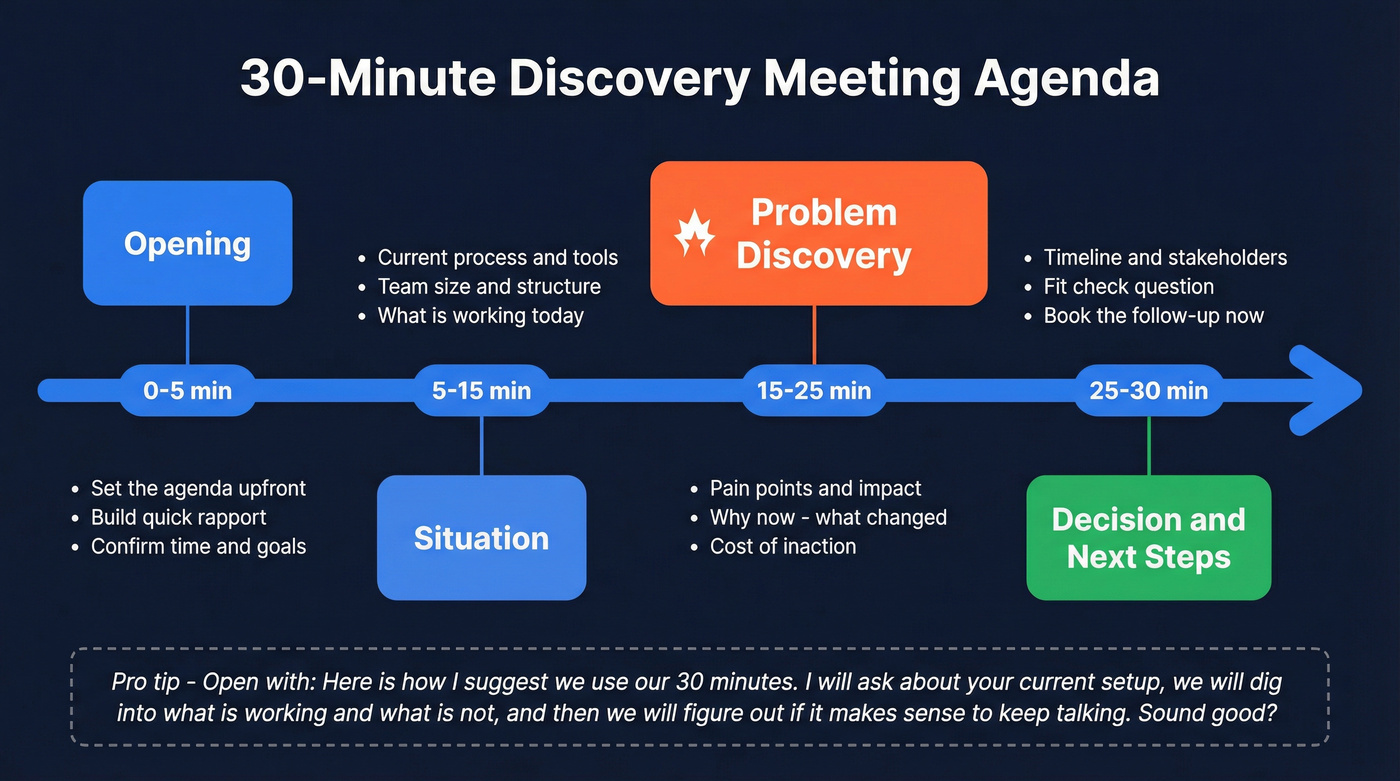
You need a structure and a question bank, not a word-for-word script. Here's a time-blocked framework that works for most B2B sales conversations.
| Block | Time | Focus |
|---|---|---|
| Opening | 0-5 min | Set agenda, build rapport |
| Situation | 5-15 min | Current process, tools, team |
| Problem discovery | 15-25 min | Pain, impact, urgency |
| Decision & next steps | 25-30 min | Timeline, stakeholders, fit |
Open with something like: "Here's how I'd suggest we use our 30 minutes - I'll ask about your current setup, we'll dig into what's working and what isn't, and then we'll figure out if it makes sense to keep talking. Sound good?"
Some coaches advocate a single broad opening question to let the prospect narrate freely. That works for experienced reps who can steer a conversation on the fly, but most teams need the structure of 11-14 targeted questions to consistently qualify.
One question that consistently moves deals forward: "On a scale of 1-10, how important is solving this right now?" If they say 7 or below, follow up with "What would need to change for this to become a 9 or 10?" That answer tells you whether this deal is real or just a tire-kick.
For financial advisors, consultants, or anyone running deeper needs assessments, plan for 60-90 minutes. A longer session differs from sales discovery in one critical way: you're uncovering the values and emotions behind the goals, not just the business pain. A client who says "I want to retire at 55" is giving you a surface answer. The real question is why 55 - and what they're afraid of if it doesn't happen.
Discovery Questions That Work
We've seen reps memorize 40 questions and still bomb discovery calls. The issue isn't volume - it's knowing which questions to deploy at each stage.
Rapport & Context
- "What prompted you to take this meeting?"
- "What does your day-to-day look like right now?"
Situation
- "Walk me through how you're currently handling [process] today."
- "What tools are you using? What's working, what isn't?"
- "How big is the team involved in this?"
Problem & Impact
- "Why now? What changed?"
- "How long has this been a problem?"
- "What have you tried in the past to solve it?"
- "If you didn't solve this, could you live with it?"
That last one shows up constantly in r/sales threads for good reason. It forces the prospect to articulate the cost of inaction. If they can live with it, you don't have a deal.
Decision Process
- "Who else needs to be involved in this decision?"
- "Walk me through your decision-making process."
- "What does your timeline look like?"
Next Steps & Fit Check
- "Before we go into plans and pricing - do you feel this is what you're looking for? If not, it may not make sense to go further."
This "fit check" question also comes up frequently on r/sales. It saves everyone time and is direct without being pushy.
Which Framework Should You Use?
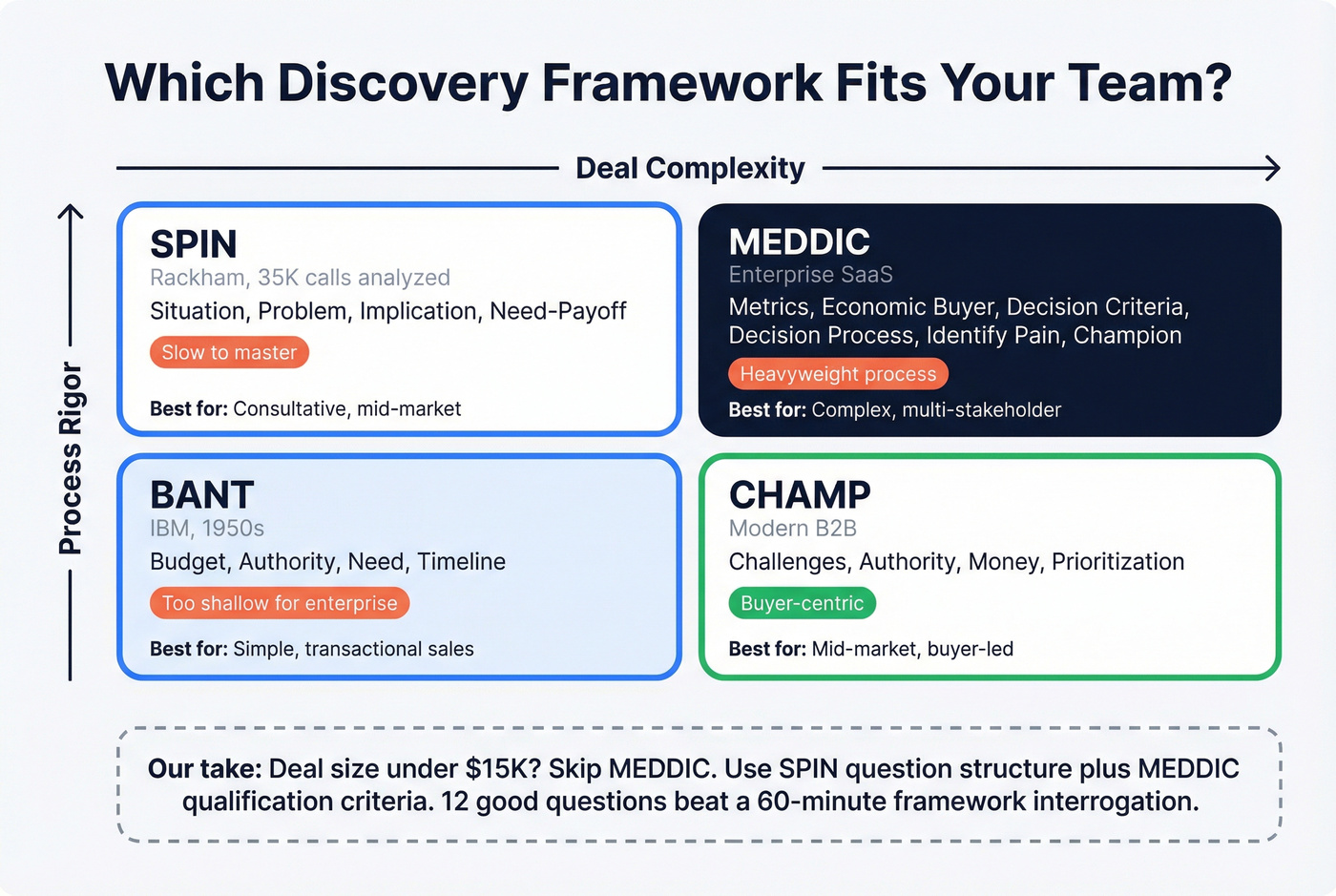
BANT is a 70-year-old checklist, not a discovery framework. IBM built it in the 1950s when a single buyer made the decision. Today, buying committees run 8-12 stakeholders deep, and sales cycles stretch 6-9 months.
| Framework | Origin | Best For | Weakness |
|---|---|---|---|
| BANT | IBM, 1950s | Transactional, simple sales | Too shallow for enterprise |
| SPIN | Rackham, 35K calls | Consultative, mid-market | Slow to master |
| MEDDIC | Enterprise SaaS | Complex, multi-stakeholder | Heavyweight process |
| CHAMP | Modern B2B | Buyer-centric discovery | Less structured |
Let's be honest: most teams don't need to pick one framework and live in it. Use SPIN's question structure for the conversation itself, and MEDDIC's qualification criteria to decide whether the deal is real. BANT alone isn't enough for modern B2B - but "do they have budget and authority?" is still a question worth answering. (If you want a deeper set of prompts, pull from MEDDIC discovery questions.)
Here's my take: if your average deal size is under $15K, you probably don't need MEDDIC-level rigor. A tight 30-minute session with 12 good questions will outperform a bloated 60-minute interrogation run through a framework your reps half-remember. Match the process to the deal size.
Pre-Meeting Prep Checklist
"So, what do you know about us?" You fumbled. Pre-meeting research isn't optional - it's the difference between a productive conversation and a wasted 30 minutes.
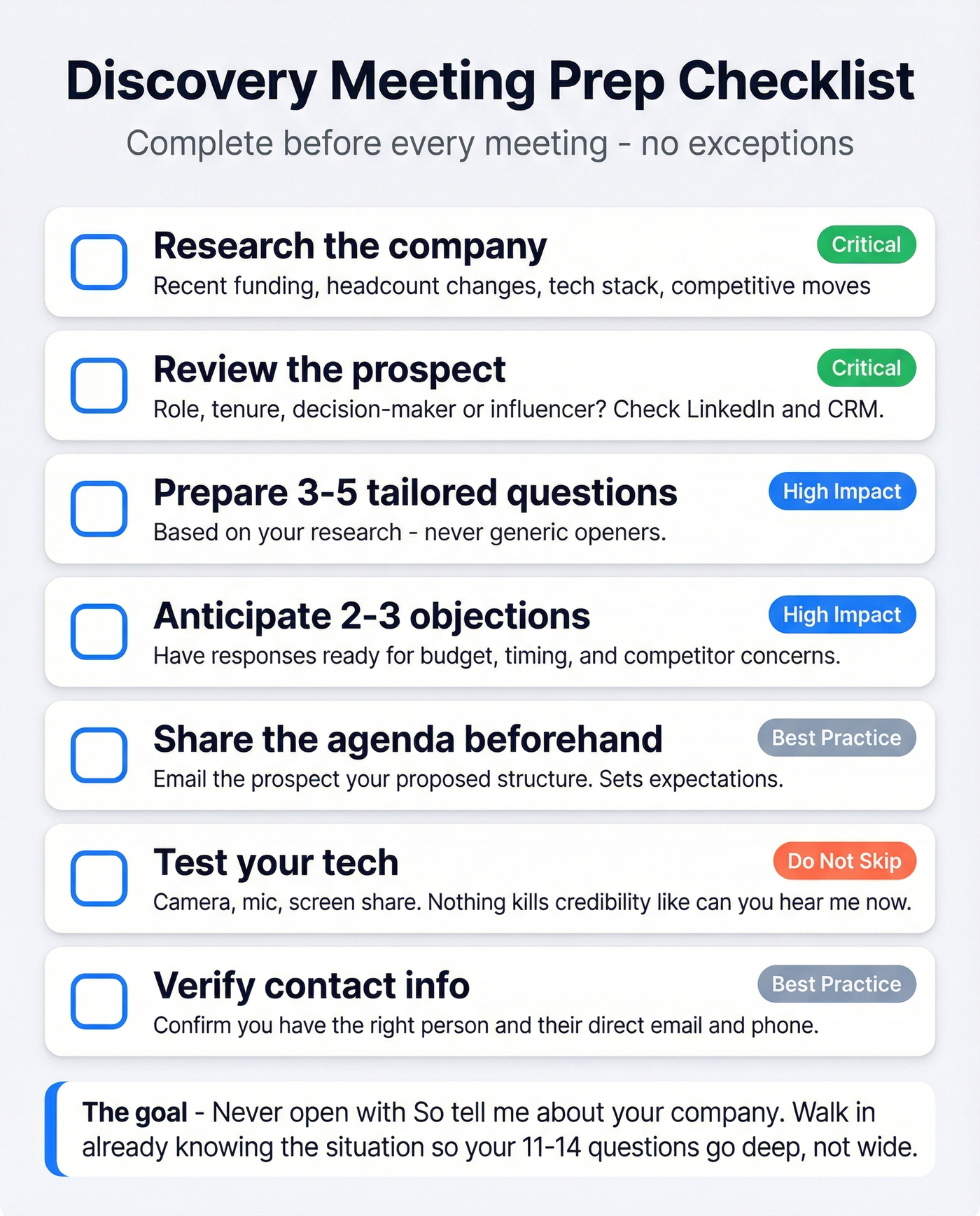
- Research the company: recent funding, headcount changes, tech stack, competitive moves (use firmographic and technographic data to make this fast)
- Review the prospect's role and tenure - are they the decision-maker or an influencer?
- Prepare 3-5 tailored questions based on what you've found
- Anticipate 2-3 likely objections and have responses ready (this is easier with sales battle cards)
- Share the agenda with the prospect beforehand
- Test your tech - nothing kills credibility like "can you hear me now?"
- Confirm you have the right person's direct contact info; tools like Prospeo surface verified emails, technographics, headcount growth, and funding signals you can reference in the call (if you're missing emails, start with name to email)
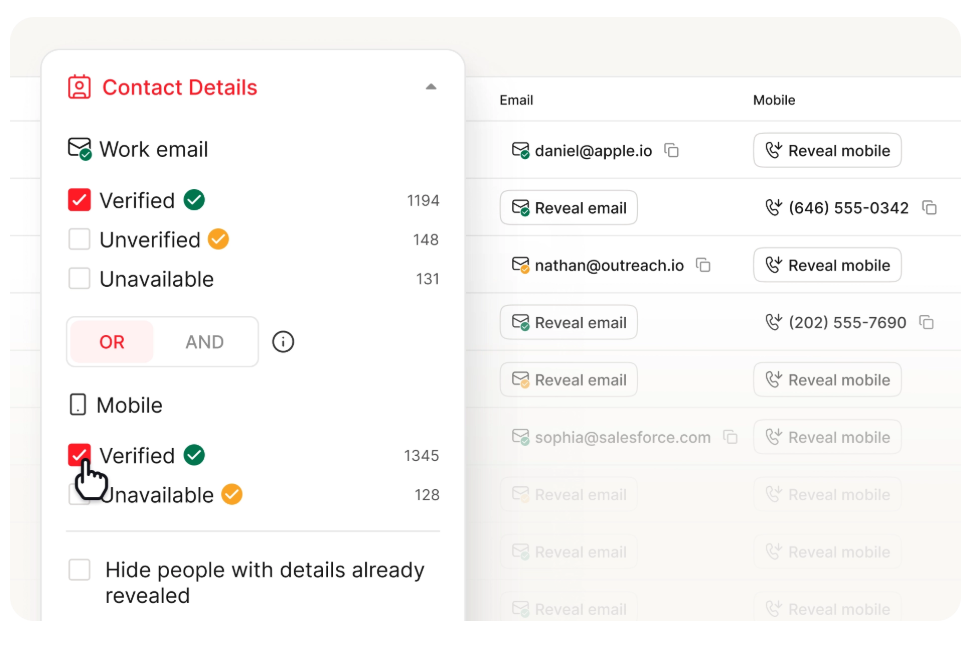
Discovery meetings fail when you're talking to the wrong person. Prospeo's 300M+ profiles and 30+ filters - including buyer intent data across 15,000 topics - help you find the actual decision-makers before you ever book the call. At $0.01 per email with 98% accuracy, bad data never burns another meeting.
Find the right stakeholders before discovery, not during it.
Follow-Up That Closes
The meeting went well. Now don't let it die in your inbox. Follow up within 24 hours - not 48, not "early next week." (If you want copy you can paste, use these sales follow-up templates.)
Update your CRM immediately with notes, next steps, stakeholders identified, and deal stage. Send a recap email summarizing what you discussed, what they said their priorities were, and the agreed next step. Reference something specific the prospect said - not just "Great chatting." A recap that mirrors their language builds trust and shows you were actually listening.
Assign action items with deadlines for both sides. And if you can, schedule the follow-up meeting before you hang up.
Record your discovery calls with permission and review them. The data cited throughout this article didn't come from theory - it came from analyzing what top reps actually do differently. You can do the same with your own calls using conversation intelligence tools.
FAQ
How long should a discovery meeting be?
Thirty minutes is the standard for B2B sales. Financial advisors and consultants typically run 60-90 minutes because the needs assessment covers personal goals and values, not just business pain. Match the length to the complexity of what you're selling.
How many questions should I ask?
Eleven to fourteen targeted questions, spread throughout the conversation. The 519K-call analysis found that exceeding 14 questions drops success rates back to average. Quality and distribution matter more than volume.
What tools help you prepare?
A CRM for account history, a conversation intelligence tool for post-call review, and a B2B data platform for verified contact info and company intelligence before the call. Prospeo's 30+ search filters surface technographics, funding, and headcount growth - the kind of specifics that turn generic openers into tailored questions.
Is BANT still useful in 2026?
BANT works as a basic qualification check for transactional deals under $10K. For enterprise or multi-stakeholder sales, pair it with MEDDIC or SPIN - BANT alone can't map a buying committee of 8-12 people or a 6-month procurement cycle.
Discovery isn't a phase you rush through to get to the demo. It's the phase that determines whether the demo matters at all. Nail the structure, ask 11-14 sharp questions, and talk less than 57% of the time - the data says the rest takes care of itself.