

How to Build a Sales Follow-Up Process That Gets Replies
It's Thursday afternoon. You had a great demo at 10 AM - the prospect was nodding, asking about integrations, even mentioned their renewal timeline. Now it's 4 PM and you're staring at a blank email, trying to remember what they said about their current vendor. The details are gone. You type "Just wanting to follow up on our call earlier..." and hit send.
That email won't get a reply. And it's not because the prospect lost interest - it's because your sales follow-up process doesn't exist. 48% of sales teams never follow up at all. The ones that do usually send one generic email and call it a day. The gap between "had a great conversation" and "closed the deal" is almost entirely a follow-up problem.
What You Actually Need
Three things determine whether your follow-up cadence works or dies quietly in someone's inbox:
Speed. Respond within 5 minutes of an inbound lead showing interest. Between 5 and 10 minutes, your odds of qualifying that lead drop by 80%. This is the easiest win in sales - and most teams blow it.
Structure. You need 3-5 multi-channel touches spread over roughly 17 days. Not 12 emails in a row. Not one call and a prayer. A deliberate sequence across email, phone, and social that gives the prospect multiple chances to engage on their terms.
Data quality. None of this matters if 20% of your emails bounce. Before you build a cadence, verify your contact list. Garbage data kills good cadences before they start.
Get those three right and you're ahead of most sales teams.
Why Persistent Follow-Up Matters
The stats on follow-up persistence are almost comically lopsided. 80% of sales require roughly five follow-up touches after the initial meeting. Yet 70% of salespeople stop after a single email. Only 12% make three or more follow-ups.
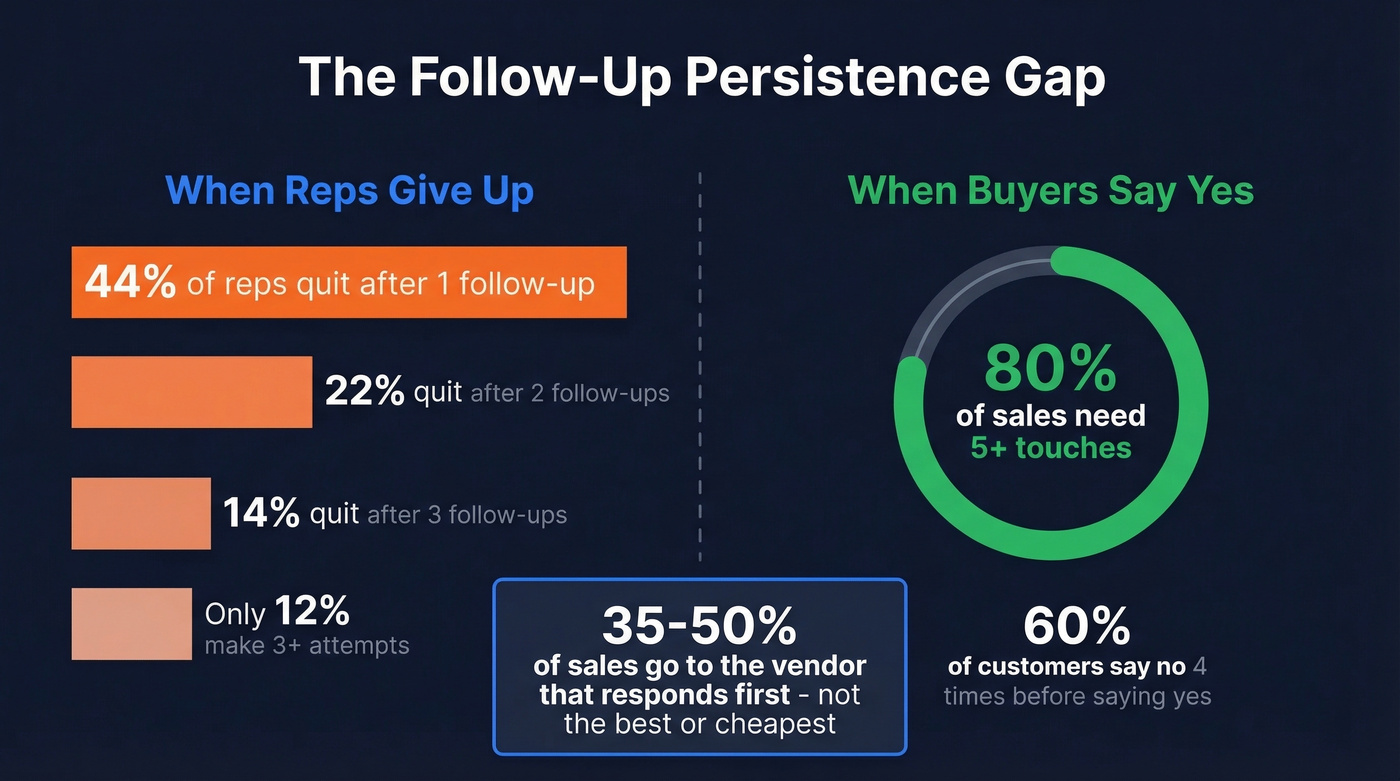
That means the vast majority of reps quit right before the deal would've started moving. Every demo, every discovery call, every inbound lead that doesn't get proper follow-up is money you already spent to generate - thrown away.
35-50% of sales go to the vendor that responds first. Not the best vendor. Not the cheapest. The first one to show up with a relevant response. Speed and persistence aren't soft skills - they're the two variables most correlated with closed revenue. 60% of customers say "no" four times before saying yes. Your job is to still be there on attempt five.
Build a "five nos" rule into your CRM. Don't abandon a lead until they've explicitly declined five times.
The 5-Minute Rule
The most cited study in speed-to-lead comes from Dr. James Oldroyd's 2011 Lead Response Management Study: leads contacted within 5 minutes are 21x more likely to enter the sales process than those contacted after 30 minutes. Not twice as likely. Twenty-one times.
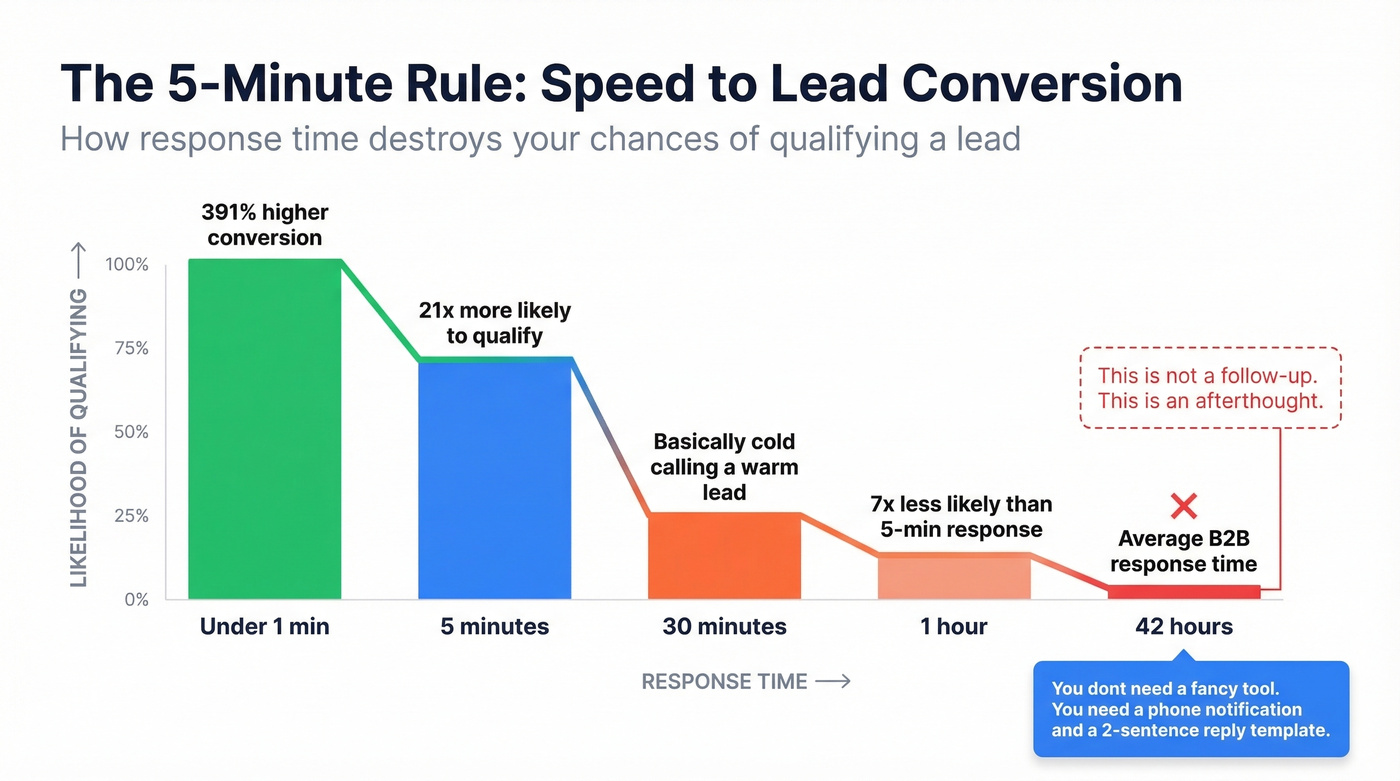
The numbers get more dramatic the faster you go. Velocify found that responding under 1 minute yields a 391% higher conversion rate. HBR reported that reps who respond within an hour are 7x more likely to qualify a lead than those who wait even two hours - and 60x more likely than those who wait a full day.
The drop-off is brutal. After 30 minutes, you're essentially cold-calling someone who was warm five minutes ago. The average B2B lead response time? Forty-two hours. That's not a follow-up - that's an afterthought.
Here's the thing: you don't need a fancy tool to respond in 5 minutes. You need a notification on your phone and a two-sentence reply template. "Got your request. Let's find 15 minutes this week - here's my calendar link." Speed beats polish every time.
2026 Follow-Up Benchmarks From 16.5M Emails
Belkins published the most useful cold outreach study we've seen, analyzing 16.5 million cold emails across 93 business domains. The headline finding: your first email is your best shot, and every follow-up after that delivers diminishing returns.
| Follow-Up # | Reply Rate (Approx.) | Spam/Unsub Risk |
|---|---|---|
| 1st email | ~8.4% | Low |
| 2nd email | ~6-7% | Low |
| 3rd email | ~4-5% | Moderate |
| 4+ emails | Declining | 3x higher |
| LinkedIn msg + visit | ~11.87% | Low |
Four emails is the danger zone. Beyond that, you're actively damaging your sender reputation - unsubscribe and spam complaints more than triple.
Company size matters too. SMB prospects (2-50 employees) start around a 9.2% reply rate and can rebound on a second follow-up. Enterprise contacts (1,000+) ghost quickly - if they don't reply to email one or two, they probably won't.
The social data is the real story. A message-plus-profile-visit combo hit an 11.87% reply rate - higher than any email-only sequence. Multiple social touches (3-5) raised reply rates from 1.07% to over 5%. This is why multi-channel cadences crush email-only blasts, and why any team still running email-only sequences in 2026 is leaving meetings on the table.
The 17-Day Multi-Channel Cadence
The Full Cadence
Based on Cognism's framework, here's a 17-day cadence that balances persistence with professionalism. The core principle: rotate channels so you're not hammering the same inbox.
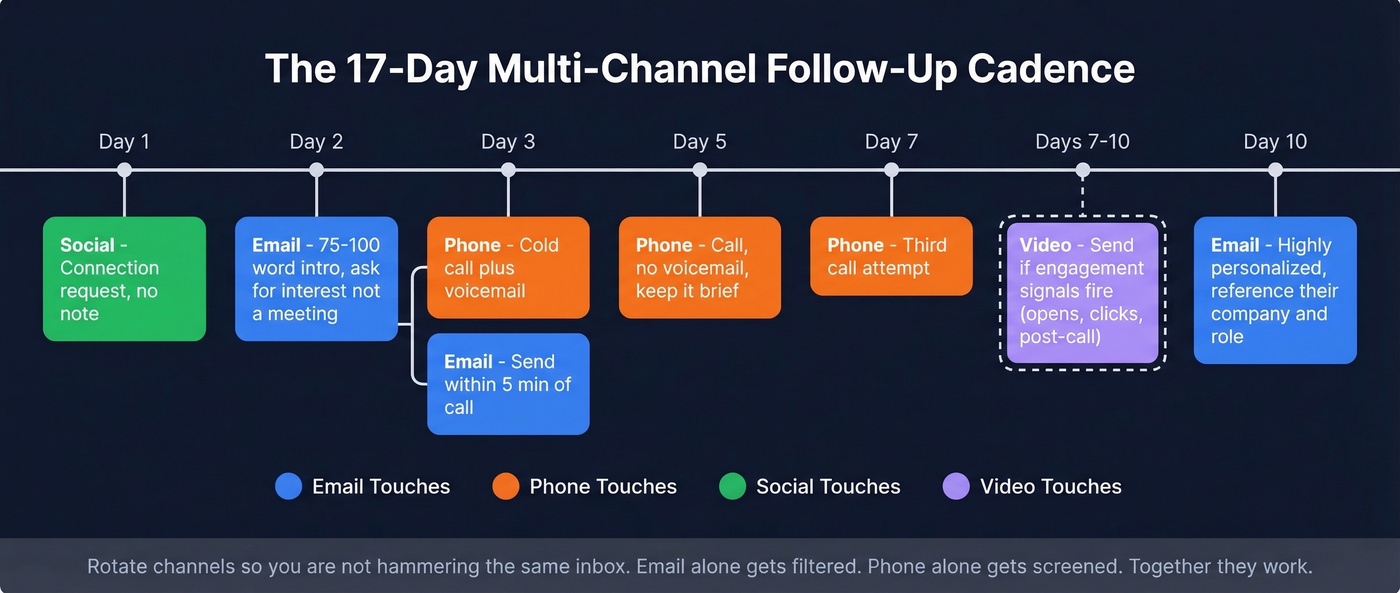
| Day | Channel | Action | Notes |
|---|---|---|---|
| 1 | Social | Connection request (no note) | Blank request converts better |
| 2 | 75-100 word intro | Ask for interest, not a meeting | |
| 3 | Phone + Email | Cold call, voicemail, then email | Send email within 5 min of call |
| 5 | Phone | Call (no voicemail) | Keep it brief if they answer |
| 7 | Phone | Call (no voicemail) | Third call attempt |
| 7-10 | Video | Send if engagement signals fire | Opens, clicks, or post-call |
| 10 | Highly personalized | Reference their company/role |
The channel rotation is the whole point. Email alone gets you filtered. Phone alone gets you screened. Social alone gets you ignored. Together, they create the impression of a real human who's genuinely trying to connect - because you are.
Watch for behavioral triggers. If a prospect opens your email three times in an hour, that's a buying signal - call them immediately, don't wait for Day 7. Same with link clicks and page visits. Most sequencing tools surface these signals. A prospect downloading your pricing PDF at 9 PM is telling you something. Act on it the next morning.
When you use a qualification framework like MEDDIC or SPIN, align each follow-up touch to a different qualification criterion. This gives every email a distinct purpose beyond "checking in."
Regional Adjustments
This cadence assumes a North American audience. Selling into DACH? The triple-touch on Day 1 feels intrusive - spread those across the first week. APAC and broader EMEA markets generally respond better to fewer, higher-quality touchpoints. Cold calling is expected in the US; it's borderline rude in some European markets without prior email contact.
Simplified Cadence for Small Teams
If you don't have the bandwidth for 8-12 touches, here's a stripped-down version that still works. This borrows from Adapted Growth's rhythm and a practitioner cadence shared on r/salestechniques:
- Day 1: Follow-up email with one key takeaway from your conversation
- Day 3: Value-add - a case study, relevant article, or industry insight
- Day 7: Friendly reminder framed as a question ("Still evaluating options for Q2?")
- Day 14: Direct ask or break-up email with explicit opt-out
- Monthly after that: New value touchpoint (not "checking in")
Four touches over two weeks, then a monthly drip. Not aggressive, but it keeps you in the conversation without burning the relationship.

You just read it: 20% bounce rates kill follow-up cadences before they start. Prospeo's 5-step verification delivers 98% email accuracy with a 7-day refresh cycle - so every touchpoint in your 17-day cadence reaches a real inbox, not a dead end.
Stop following up with ghosts. Start with verified contacts.
Techniques That Get Replies
Keep subject lines under 7 words, make them specific to the prospect's situation, and avoid spam triggers like "free," "urgent," or all caps. The best subject lines reference something the prospect actually said (if you need ideas, pull from a swipe file of email subject lines).
Post-Demo Follow-Up
Subject: [Specific thing they mentioned] - next steps
Record a 90-second voice dump immediately after the call. Capture the prospect's exact words, their pain points, the competitor they mentioned, the timeline they gave you. This trick comes from a workflow shared on r/sales - it solves the "I forgot what they said by 4 PM" problem that kills most post-demo follow-ups. We've used this on our own team and it's night-and-day for personalization quality. Then use that raw material to write this:
Hi [Name], great conversation today. You mentioned [specific pain point] is costing your team roughly [X hours/dollars] per quarter - that stuck with me. I've attached [relevant resource]. Want to lock in [specific next step] for [date]?
No-Response Value-Add
Subject: [New data point] for [their company]
Never send "just checking in." Every follow-up needs new information - a case study, a stat, an insight they haven't seen. Include specific numbers. "We helped a similar team add 10-15 warm leads per week in January" beats "We've helped companies like yours" by a mile.
Hi [Name], saw this [case study/stat/article] and thought of your [specific situation]. [One-sentence summary of the value]. Worth a 10-minute call this week?
Rotating Objections to Close Stalled Deals
Instead of sending the same pitch three times, map the five core objections and rotate through them. Each follow-up addresses a different concern:
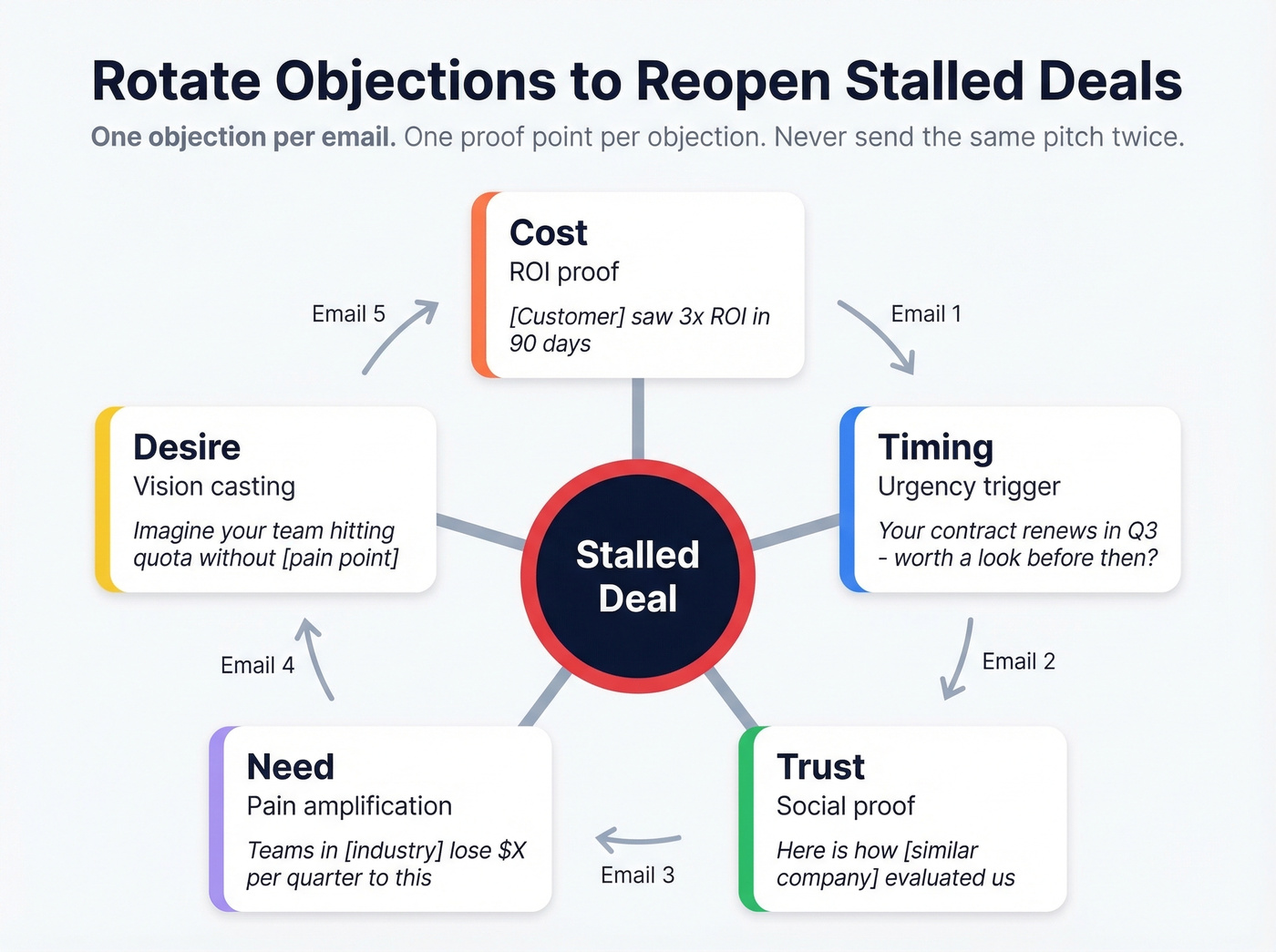
| Objection | Email Angle | Example Line |
|---|---|---|
| Cost | ROI proof | "[Customer] saw 3x ROI in 90 days" |
| Timing | Urgency trigger | "Your contract renews in Q3 - worth a look before then?" |
| Trust | Social proof | "Here's how [similar company] evaluated us" |
| Need | Pain amplification | "Teams in [their industry] lose $X/quarter to this" |
| Desire | Vision casting | "Imagine your team hitting quota without [pain point]" |
Reply in the original thread so they have context. One objection per email, one proof point per objection. This objection-rotation approach is one of the most effective ways to move stalled deals forward - we've seen it reopen conversations that had been dead for weeks.
The Break-Up Email
Break-up emails get surprisingly high response rates - precisely because they remove all pressure. Send this after your third attempt or around Day 14.
Subject: Should I close your file?
Hi [Name], I've reached out a few times and haven't heard back - totally understand if the timing isn't right. If you'd like me to stop, just reply "no" and I'll get out of your inbox. Otherwise, I'll check back in [timeframe] with something useful.
The explicit opt-out is what makes this work. People respond because there's no ask - just a graceful exit.
Five Mistakes Killing Your Follow-Up
1. "Just checking in" with no new information. Every touch needs a reason to exist. A case study, a stat, a relevant insight. If you can't articulate why this email is different from the last one, don't send it.
2. Single-channel sequences. Email-only cadences cap out fast. The Belkins data shows message-plus-profile-visit combos outperform email at every stage. At minimum, combine email, phone, and one social channel.
3. Too many emails, wrong frequency. Sending 4+ emails in a sequence more than triples your spam complaint rate. Three to five touches is the sweet spot. For longer sequences, most of those extra touches should be calls or social - not emails.
4. Waiting too long after calls. If you write your follow-up four hours after a demo, you'll produce a generic email because you've forgotten the details. Use the voice-note workflow: 90-second dump immediately after hanging up, transcribe it, send a personalized follow-up within two hours.
5. Bad contact data. This is the silent killer. You build a beautiful cadence, write thoughtful templates, nail the timing - and 20% of your emails bounce because the data was stale. Bounces don't just waste your effort; they destroy your domain reputation, which tanks deliverability for every future email you send.
The Data Quality Prerequisite
Let's be honest: your cadence is irrelevant if a fifth of your emails never reach an inbox. We've seen this pattern repeatedly - a team invests weeks building sequences, only to watch their sender score crater because their contact list was full of dead addresses.
The Meritt case study makes the point clearly. Their bounce rate was 35% - more than a third of every sequence was hitting dead ends. After switching to Prospeo's verified data, bounces dropped under 4% and their pipeline tripled from $100K to $300K per week. That's what a 5-step verification process with catch-all handling, spam-trap removal, and honeypot filtering does in practice - 98% email accuracy on a 7-day refresh cycle, compared to the 6-week industry average.
Before you build a single cadence, run your list through verification. It takes minutes and saves months of domain reputation damage (and if you're troubleshooting, start with email bounce rate benchmarks and fixes).
Multi-channel cadences only work when you have the phone number. Prospeo gives you 125M+ verified mobile numbers with a 30% pickup rate - so Day 3's cold call actually connects instead of hitting a generic switchboard.
Every call in your cadence deserves a direct dial behind it.
Tools to Automate Your Follow-Up
A unified CRM eliminates the context-switching that kills follow-up consistency - your sequence, contact data, and engagement history live in one place. Here's what's worth considering at each price point:
| Tool | Category | Starting Price | Best For |
|---|---|---|---|
| Prospeo | Data & verification | Free; ~$0.01/email | Verified contacts pre-sequence |
| HubSpot Sales Hub | CRM + sequences | Free; paid ~$20+/user/mo | CRM + follow-up in one |
| Instantly | Email sequencing | ~$30-$100/mo | High-volume cold email |
| Smartlead | Email sequencing | ~$39-$100/mo | Unlimited mailboxes, agencies |
| Lemlist | Multi-channel | ~$39-$160/user/mo | Personalization at scale |
| Outreach | Sales engagement | Custom pricing | Mid-market multi-channel |
| Salesloft | Sales engagement | Custom pricing | Enterprise engagement |
| Apollo | Intelligence + sequences | Free; ~$49-$119/user/mo | All-in-one prospecting |
If your average deal size is under $10K, you probably don't need a $150/seat engagement platform. Skip Outreach and Salesloft - they're built for teams running complex, multi-threaded enterprise deals. Starting from scratch? Instantly plus a verified data layer gets you sequencing with accurate contacts for under $100/month. Mid-market teams running multi-channel cadences should look at Outreach or Salesloft, with verified data feeding the pipeline. The key integration points are Salesforce, HubSpot, Smartlead, Instantly, and Lemlist - make sure your data source connects natively to whatever sequencer you're already using (more options: follow up email software and broader SDR tools).
Measuring What Works
Track these five metrics to know if your sales follow-up process is delivering:
Reply rate should sit at 5-10% for cold outreach. Warm follow-ups should hit 20%+. Below 5% means your messaging or targeting needs work (tighten your sales prospecting techniques before you blame the copy).
Bounce rate needs to stay under 5%. Above that, your data quality is the problem, not your copy.
Touches to conversion tells you how many touchpoints a prospect needs before booking a meeting. If it's consistently above 7, you're either targeting wrong or your value prop isn't landing.
Spam/unsubscribe rate deserves close attention after the third email. If it spikes, you've crossed the line from persistent to annoying.
Time-to-first-response matters most for inbound leads. Measure the gap between their action and your reply. Every minute past five costs you conversions.
Principles Worth Locking In
Across everything we've covered, a few things separate teams that consistently close from those that let deals slip:
Respond to inbound interest within 5 minutes. Speed is the single highest-leverage variable, and it's free.
Cap email-only touches at three and fill the rest of your cadence with calls, video, and social. The data on this is unambiguous - multi-channel wins.
Add new value with every touch. If an email doesn't teach the prospect something, delete it before hitting send (use a simple rubric for how to add value in sales).
Verify your contact data before launching any sequence. A 5% bounce ceiling protects your domain and keeps your deliverability intact for every campaign that follows (see the full email deliverability guide if you're repairing damage).
Use deal-stage tracking inside your CRM so no opportunity falls through the cracks between reps or stages. I've watched teams lose six-figure deals simply because a handoff between SDR and AE had no system behind it.
FAQ
How many follow-ups should I send?
Three to five touches is the sweet spot for cold outreach. Belkins' 16.5M-email study shows four or more emails in a sequence more than triples spam and unsubscribe rates. After your third email attempt, send a break-up with an explicit opt-out, then move non-responders to a monthly nurture drip.
What's the best time to send a follow-up email?
For inbound leads, respond within 5 minutes - the Oldroyd study found a 21x qualification advantage at that speed. For cold outreach, Day 2 after your initial touch is the standard first follow-up window. Tuesday through Thursday mornings consistently outperform other slots across most industries.
How do I follow up without sounding pushy?
Add new value with every touch - a case study, a relevant stat, an insight specific to their business. Address a different objection each time instead of repeating the same pitch. Always offer an explicit opt-out. If an email doesn't teach the prospect something new, it shouldn't exist.
What tools help automate the follow-up process?
Sequencing platforms like Instantly, Smartlead, or Outreach handle cadence timing and channel rotation. Pair them with a verified data source to keep bounce rates under 5%. Most sequencers integrate natively with Salesforce, HubSpot, and major data providers.