

Sales Objections: What 300M+ Calls Reveal About Handling Them
Every guide on sales objections tells you to "listen and empathize." None of them tell you how fast to talk, how long to pause, or what to say in the first three seconds after a prospect pushes back. That's the gap between advice and data - and it's where most reps lose deals they should've won.
Here's the uncomfortable truth: 61% of B2B buyers now prefer a rep-free experience. So when they do pick up, they're already predisposed to push back. The average B2B purchase involves 7.4 decision-makers, 80% of sales require five or more follow-ups, but 92% of reps quit after four. Stop collecting scripts. Start understanding the patterns behind what prospects actually say - and fixing the targeting that creates half your objections in the first place.
The Quick Version
The top five objections account for 74% of all cold call pushback, based on an analysis of 300M+ calls. Nearly half are dismissive - "not interested," "send me an email," or just hanging up. Master those five first and you've covered three-quarters of what you'll face.
When you hear pushback: slow down (stay at or below 173 words per minute), ask a question before responding, and never offer a discount as your first move .
What 300M+ Cold Calls Actually Show
Gong analyzed 300M+ cold calls and sorted every objection into three categories. The distribution isn't what most reps expect.
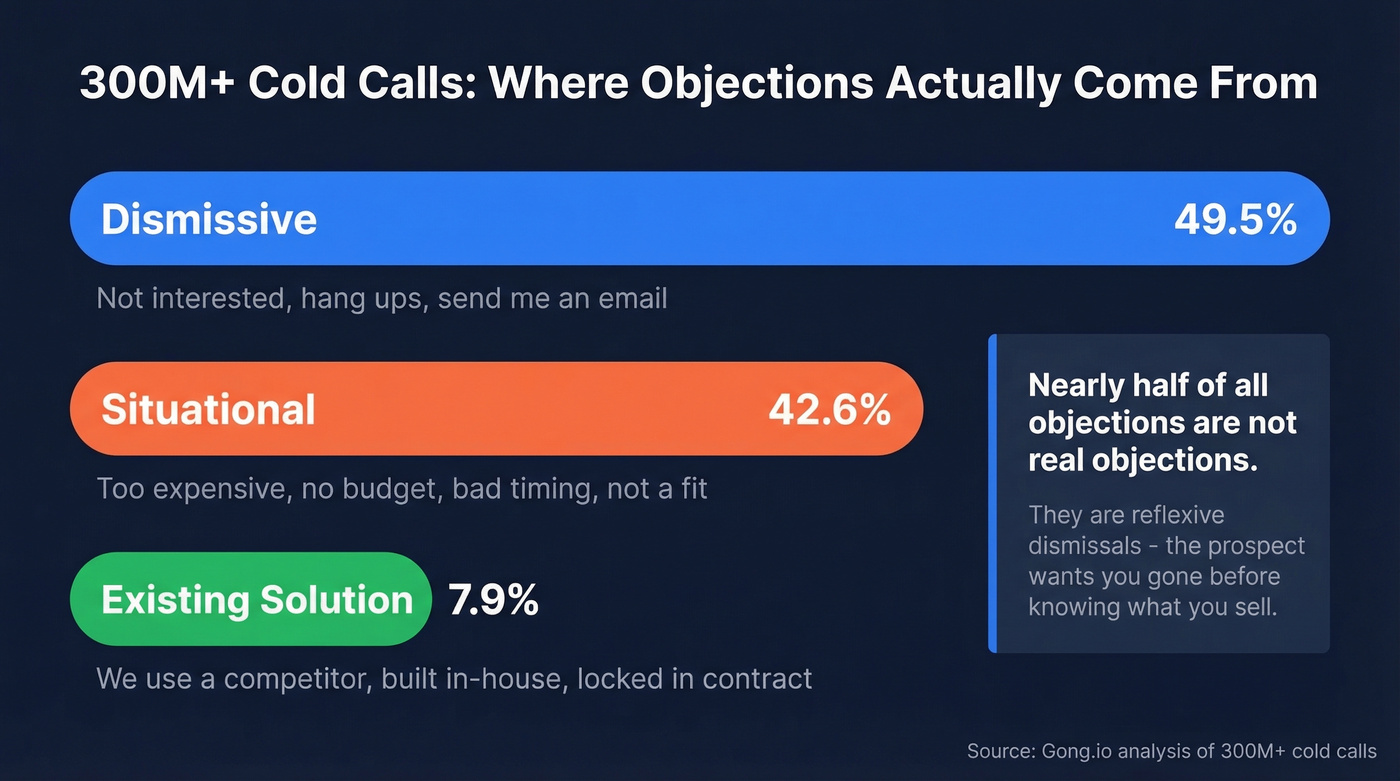
| Category | Share of All Objections | Examples |
|---|---|---|
| Dismissive | 49.5% | "Not interested," hang up, "send info" |
| Situational | 42.6% | "Too expensive," "no budget," "bad timing" |
| Existing Solution | 7.9% | "We use [competitor]," "built in-house" |
Almost half of all objections aren't real objections. They're reflexive dismissals - the prospect's way of saying "you interrupted me and I want you gone." That's a completely different problem than "your product costs too much," and it requires a different response.
The top five specific objections - "not interested," "too expensive," "send me an email," "no budget," and "we already have a solution" - cover 74% of everything you'll hear. Master those five and you've handled the vast majority of cold call resistance before you ever encounter an edge case.
Common Objections + How to Respond
Dismissive Objections (49.5%)
It's 9:02 AM. You dial a VP of Marketing. She picks up, and before you finish your first sentence: "Not interested." This isn't an objection about your product. She doesn't know what your product does. She's objecting to the interruption.
The move is disarming transparency. Don't pitch harder - acknowledge reality.
- "Not interested" - "Totally fair - you don't know what I'm calling about yet. Can I take 15 seconds to tell you, and you can hang up after?"
- "Send me an email" - "Happy to. So I don't waste your time with a generic one - what's the one thing that'd make it worth opening?"
- "Is this a cold call?" - "It is. I'll be quick. [One sentence of value.] Worth 30 more seconds?"
- "I'm in a meeting" - "Got it. When's a less terrible time - tomorrow morning or Thursday afternoon?"
- Hang up - Call back in 48 hours. Don't leave a voicemail on the first attempt. On the second call, lead with "I called Tuesday and got cut off - wanted to try again."
Don't fight the dismissal. Agree with it, then earn a few more seconds with a single question.
Situational Objections (42.6%)
These are the objections that feel real - and usually are. Picture this: you ran a great demo last week, the champion was nodding along, and now the follow-up email comes back: "We love it, but the timing isn't right." The deal's gone dark. The prospect has a specific constraint - budget, timing, bandwidth, or fit - and your job isn't to overcome it. It's to understand whether it's a hard wall or a soft preference.
- "Too expensive" - "Compared to what? Are you benchmarking against another tool, or is this a budget ceiling?" Clarify before you defend price.
- "No budget right now" - "When does your next budget cycle open? I'd rather time this right than push you into something that doesn't work."
- "We don't have bandwidth" - "What would need to change for this to move up the priority list? I'm trying to understand if this is a 'not now' or a 'not ever.'"
- "Not a fit for us" - "Help me understand - what specifically doesn't fit? I might agree with you, and I'd rather not waste your time."
- "We need to hire first" - "Makes sense. When you do hire, what's the first problem they'll need to solve? That's usually where we come in."
How you handle these concerns during the sales process affects post-sale churn, too. When you dig into the real concern instead of steamrolling past it, you set accurate expectations - and that pays off long after the contract is signed.
Existing-Solution Objections (7.9%)
Only 7.9% of objections fall here, but they're the hardest to handle because the prospect has already committed - emotionally and contractually - to something else. Never attack their current solution. Use the agree, trap question, test drive pattern.
- "We already use [competitor]" - "Good - that means you already see the value in solving this. What's the one thing you wish [competitor] did better?" Now you're competing on the gap, not the whole product.
- "We built it in-house" - "That's impressive. How much engineering time goes into maintaining it? Most teams I talk to underestimate that number by 3-4x."
- "We're locked into a contract" - "When does it renew? I'd love to run a side-by-side comparison 60 days before so you have real data when the decision comes up."
- "We're happy with what we have" - "That's great - I wouldn't want you to switch something that's working. Out of curiosity, if you could change one thing about your current setup, what would it be?"
- "Our team built a workflow around [competitor]" - "Switching costs are real. What if we ran parallel for two weeks so your team could compare without disrupting anything?"
- "We just renewed our contract" - "No rush at all. Mind if I check back 90 days before your next renewal? That gives you time to evaluate without pressure."
What Top Reps Do Differently
An analysis of 67,149 sales meetings found that the behavioral differences between top performers and everyone else are measurable - and surprisingly small.
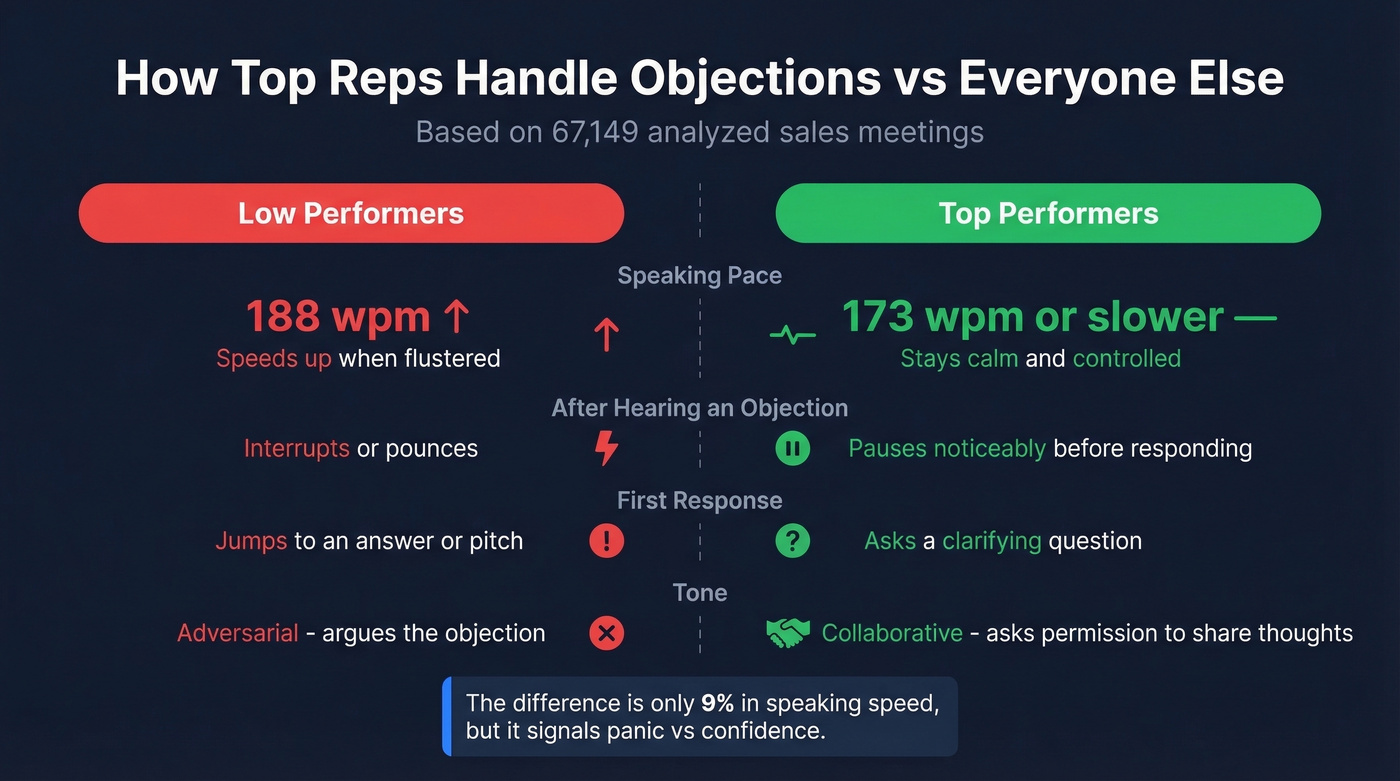
The average conversation pace is 173 words per minute. Low performers speed up to 188 wpm when flustered by pushback - only a 9% difference, but it signals panic. When you speed up, the prospect hears someone who's rattled. When you slow down, they hear someone who's been here before.
The pause matters even more than the pace. After hearing an objection, top reps pause noticeably before responding. Low performers interrupt or "pounce" - jumping in before the prospect finishes. That interruption kills trust faster than a bad answer does.
Here's the thing: the best reps don't start with an answer at all. They start with a question. Mirroring - repeating the prospect's last few words with an upward inflection - is one of the most effective techniques in the data. "You're saying the timing isn't right?" prompts the prospect to elaborate, and that elaboration usually reveals the real concern behind the stated one. One permission phrase that works consistently: "Can I bounce a few thoughts off you?" It positions the rep as collaborative rather than adversarial, reducing resistance because you're asking for permission, not demanding attention.

49.5% of objections are dismissive - "not interested" before you even pitch. That's not a sales skills problem. It's a targeting problem. Prospeo's 30+ filters (buyer intent, technographics, job changes, headcount growth) let you reach prospects who actually have the problem you solve. Teams using Prospeo book 26% more meetings than ZoomInfo users.
Stop getting hung up on. Start calling prospects who want to listen.
5 Objection Mistakes That Kill Deals
1. Treating the first objection as the real one. Most initial objections are smoke screens. "Price is too high" often masks concerns about implementation risk, internal buy-in, or whether the product actually works. Dig before you respond.
If you want a system for lowering pushback upstream, start with how to reduce sales objection rate.
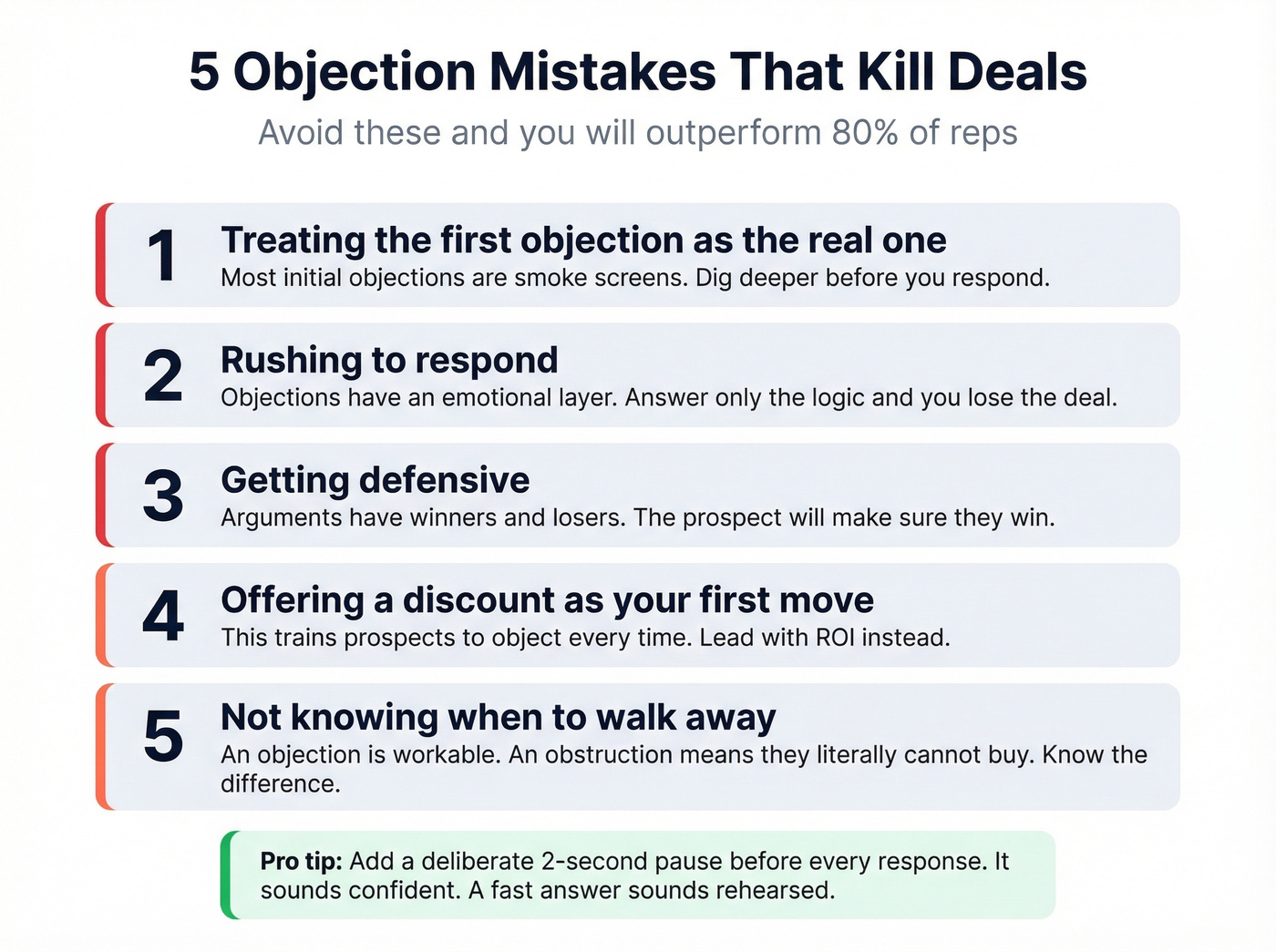
2. Rushing to respond. Objections have an emotional component - fear of change, fear of making the wrong decision, fear of looking bad internally. If you answer the logical objection without addressing the emotional one, you'll "win" the argument and lose the deal.
3. Getting defensive. The moment you argue, you've turned a conversation into a debate. Debates have winners and losers, and the prospect will make sure they're the winner. Agree first, then redirect.
4. Offering a discount as your first move. This trains the prospect to object every time, because objecting gets them a lower price. Lead with ROI and unique value. Discounts are a last resort, not a first response.
5. Not knowing when to walk away. There's a difference between an objection and an obstruction. An objection is "the timing isn't great" - that's workable. An obstruction is "we literally don't have the authority or budget to buy this." Reps who can't tell the difference waste months nurturing dead deals. If the prospect can't buy, qualify out and move on.
We've seen this play out on our own team: reps who add a deliberate two-second pause before every response consistently see higher conversion rates. It sounds confident. A fast answer sounds rehearsed.
Which Framework Should You Use?
Let's be honest - BANT isn't a methodology. It's a checklist IBM created, and it shows. Here's how the major frameworks compare for the objections teams encounter most often.
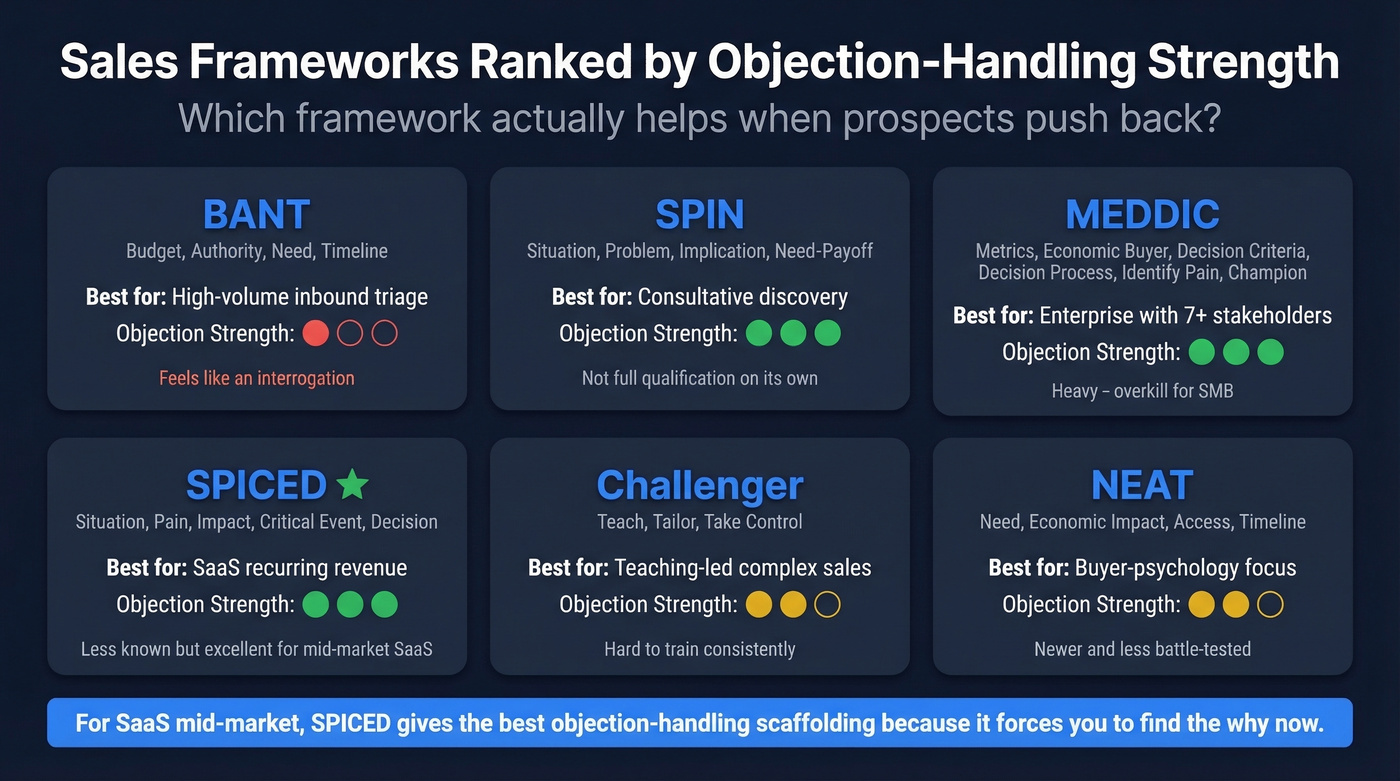
| Framework | Stands For | Best For | Limitation | Objection Strength |
|---|---|---|---|---|
| BANT | Budget, Authority, Need, Timeline | High-volume inbound triage | Feels like interrogation | Weak |
| SPIN | Situation, Problem, Implication, Need-Payoff | Consultative discovery | Not full qualification | Strong |
| MEDDIC | Metrics, Economic Buyer, Decision Criteria, Decision Process, Identify Pain, Champion | Enterprise (7+ stakeholders) | Heavy; overkill for SMB | Strong |
| SPICED | Situation, Pain, Impact, Critical Event, Decision | SaaS recurring revenue | Less known; fewer resources | Strong |
| Challenger | Teach, Tailor, Take Control | Teaching-led complex sales | Hard to train consistently | Medium |
| NEAT | Need, Economic Impact, Access, Timeline | Buyer-psychology focus | Newer; less battle-tested | Medium |
For SaaS mid-market, SPICED gives you the best objection-handling scaffolding because it forces you to understand the prospect's critical event - the "why now" that makes timing objections dissolve. For enterprise, MEDDIC/MEDDPICC is table stakes. BANT is fine for qualifying inbound leads quickly, but if it's your only framework, you're bringing a checklist to a chess match.
Handling Objections in Email
Email objections hit differently than phone objections. You don't get tone of voice, you can't pause strategically, and you've got about three sentences before they stop reading. Here's how to handle common email pushbacks using the Context, Challenge, Solution, Invitation structure.
"Not interested" - "Totally get it - [Name] at [similar company] said the same thing before they saw how we cut [specific metric] by 30%. Worth a 10-minute look, or should I check back next quarter?"
"We already have a vendor" - "Good - means you already budget for this. Most teams I work with keep their current tool and run a two-week comparison. Want me to send the setup?"
"Bad timing" - "No problem. When does your next planning cycle start? I'll send one relevant case study now and follow up then - no strings."
"Too expensive" - "Fair concern. [Customer name] felt the same way until they calculated the cost of [problem your product solves] - it was 4x what we charge. Want me to run those numbers for your team?"
Skip the follow-up if the reply is hostile or explicitly asks to be removed. Pushing past a hard no in email damages your sending reputation and your brand. Move on.
Before any of this works, though, you need to be emailing the right person at a valid address. Prospeo verifies emails in real time, so you're not sending follow-ups to addresses that bounced months ago. High bounce rates don't just waste sequences - they hurt deliverability and make every future email harder to land. If you're tightening sequences, keep a set of sales follow-up templates and a deliverability baseline like email bounce rate.
The Objection Nobody Talks About
Your biggest objection problem might not be what happens during the conversation. It might be what happens before it.
If you're calling wrong numbers, reaching people who left the company six months ago, or emailing addresses that bounce, you're generating an entire category of dismissive pushback - "who is this?", "wrong person," hang up - that no amount of training will fix. You're not losing on technique. You're losing on targeting.
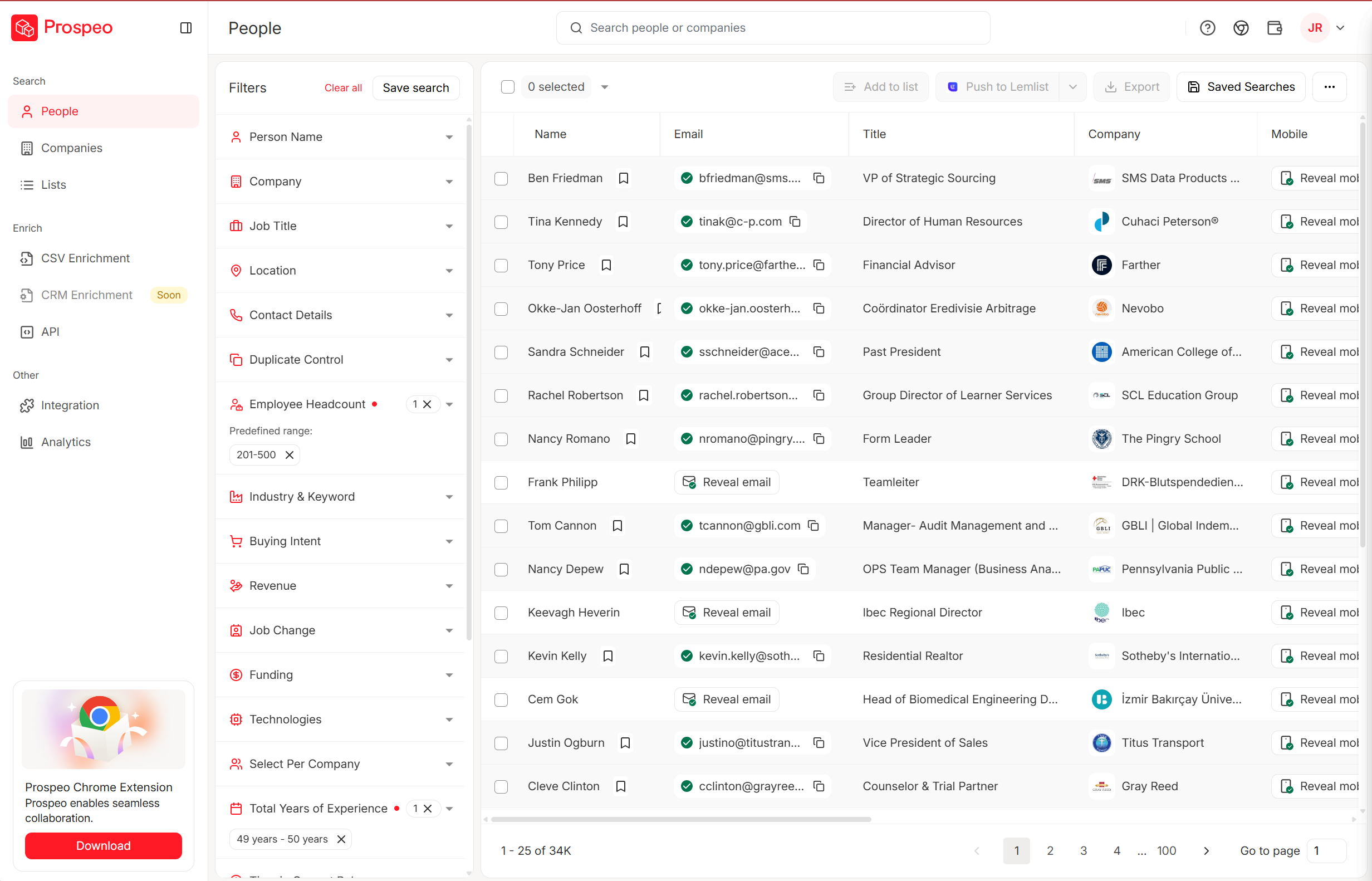
In our experience, teams that fix their data quality first see objection rates drop before they change a single word in their scripts. Meritt switched to Prospeo and saw their bounce rate drop from 35% to under 4%, with pipeline tripling from $100K to $300K per week. That's not a training win - it's a data win.
Hot take: If your deal sizes are under $15K, you probably don't need a $30-50K/year conversation intelligence platform. You need accurate contact data and 30 minutes of weekly roleplay. Fix the inputs before you optimize the conversation.
If you're rebuilding your outbound motion, start with sales prospecting techniques and a clean ideal customer profile.
AI Roleplay Tools for Practice
Structured sales enablement drives up to 15% higher win rates. AI roleplay tools let reps practice objection handling without burning real prospects - and McKinsey's research shows AI-powered coaching can improve productivity 20-30%.
| Tool | Starting Price | Best For |
|---|---|---|
| Yoodli | $11/mo | Budget-friendly entry point |
| Kendo AI | $55/mo ($0.33/min overage) | Mid-market teams |
| Mindtickle | ~$30-50/user/mo | Enablement-heavy orgs |
| Quantified | $100K+/year | Enterprise only |
Yoodli at $11/mo is the obvious starting point for individual reps. It won't replace live coaching, but it gives reps a low-stakes environment to practice the pause, the mirror, and the permission phrase before they're on a real call.
For managers: pair these tools with call recordings from your conversation intelligence platform. Identify which objections your team struggles with most, then build targeted roleplay scenarios around those specific moments. That's how you coach at scale instead of hoping reps figure it out alone. To operationalize it, map practice to sales activities and track impact with sales conversion rate.
"We already use a solution" only covers 7.9% of objections - but bad contact data creates objections you never even hear. When 35% of your emails bounce, you never get the conversation. Prospeo delivers 98% email accuracy and 125M+ verified mobile numbers with a 30% pickup rate, so you actually reach the decision-makers worth selling to.
Eliminate the objection you can't overcome: never reaching them at all.
FAQ
What are the most common sales objections?
The top five - "not interested," "too expensive," "send me an email," "no budget," and "we already have a solution" - account for 74% of all cold call pushback. Nearly half (49.5%) are dismissive, 42.6% are situational, and 7.9% involve existing solutions.
How do you handle a "not interested" objection?
Acknowledge the interruption, name your reason for calling in one sentence, and ask a single question to earn 30 more seconds. Top reps start with a question, not a monologue. The goal is earning time, not winning an argument.
What's the best framework for handling objections?
SPIN works best for consultative discovery. MEDDIC/MEDDPICC is essential for enterprise deals with seven-plus stakeholders. SPICED fits SaaS recurring-revenue models. BANT is fine for inbound triage but shouldn't be your only framework.
What's the difference between an objection and an obstruction?
An objection is a concern that can be addressed - "the timing isn't great" or "price seems high." An obstruction means the prospect literally can't buy: no budget authority, no use case, no decision-making power. Recognize obstructions early and qualify out. No script fixes a structural impossibility.
How does bad contact data create more objections?
Calling wrong numbers or emailing bounced addresses generates dismissive pushback - "wrong person," hang ups - that no training fixes. Teams that switch to verified, frequently refreshed data see this category of resistance drop immediately, often before changing anything else about their approach.