

Outbound Conversion Rate: 2026 Benchmarks, Formulas, and How to Improve Yours
A RevOps lead on r/b2bmarketing shared their cold-calling numbers: 3.5% conversion and 60% connect rates collapsed to 0.8% conversion and 15% connect rates over 18 months. That's not a dip. That's structural decline. Cognism's data backs it up - the average cold-calling success rate hit 2.3%, down from 4.82% the year before. Your outbound conversion rate still matters, but every wasted dial and bounced email costs more than it did a year ago.
Current Outbound Benchmarks
Here's where things stand heading into 2026:
- Cold calls: 2.3% average conversion (dial to warm lead). Top performers hit 6-10%.
- Cold email: 3-5.1% reply rate average. Top-tier campaigns push 15-25%.
- Full funnel (lead to closed-won): 1-3% for most B2B teams.
Below these numbers? Fix your data quality first, then your messaging.
How to Calculate Conversion Rate
The core formula is simple:
Conversion Rate = (Conversions / Total Attempts) x 100
The tricky part is the denominator. A team logging 1,000 dials with 80 connects and 3 meetings booked has a 0.3% dial-to-meeting rate but a 3.75% connect-to-meeting rate. Both are "conversion rates." They tell completely different stories.
For stage-to-stage analysis, use (later stage / earlier stage) x 100. If your team booked 200 meetings and 134 prospects showed up, that's a 67% show rate. Define your stages before you start measuring, or you'll end up with numbers that don't compare across teams or quarters.
Benchmarks by Channel
Cold Calling
| Metric | Average | Top Performers |
|---|---|---|
| Dial to Connect | 3-10% | 10%+ |
| Connect to Meeting | 2-3% | 6-10% |
| Overall (dial to lead) | 2.3% | 6%+ |
Calling between 4-5 PM is 71% more effective than the 11 AM-12 PM slot, and Wednesday consistently outperforms other days. It takes an average of 8 call attempts to reach a prospect. If your reps give up after two dials, they're leaving meetings on the table.
Cold Email
| Metric | Average | Top Performers |
|---|---|---|
| Open Rate | 20-30% | 40%+ |
| Reply Rate | 3-5.1% | 15-25% |
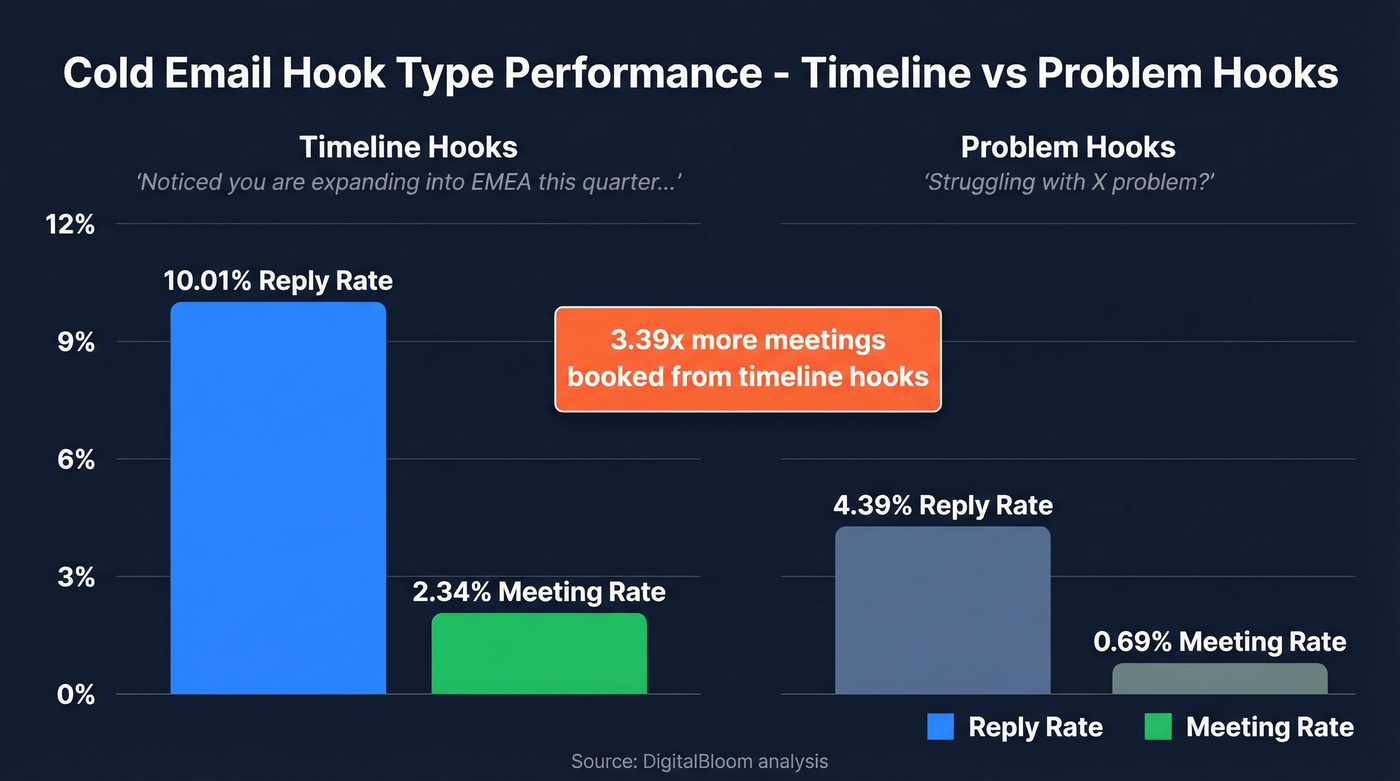
What you say matters more than most teams realize. DigitalBloom's analysis found timeline-based hooks pull a 10.01% reply rate and 2.34% meeting rate, while problem hooks land at just 4.39% and 0.69%. That's a 3.39x difference in meetings booked - from the hook alone.
If you want a repeatable system, start with a B2B cold email sequence and iterate from there.
Social Outreach
B2B social outreach typically converts below 1%. Use it as a supporting channel in a multi-touch cadence, not a standalone play.
If you're building a stack, compare SDR tools that support multi-channel touches.

The MQL-to-SQL drop-off you just read about? It's a data problem. Prospeo's 30+ filters - buyer intent, technographics, headcount growth, job changes - let you target so precisely that your pipeline stops leaking at qualification. 98% email accuracy means sub-4% bounce rates, and 125M+ verified mobiles mean your reps actually connect.
Meritt tripled pipeline to $300K/week after switching. Your funnel is next.
Benchmarks by Funnel Stage
The biggest drop-off in any outbound funnel is almost always MQL to SQL. That's where loose targeting and bad data show up as wasted pipeline. Threads across r/sales and r/salesdevelopment echo this constantly - reps report that the leads they're handed simply don't match their ICP.
If you need a tighter definition, use an Ideal Customer Profile scoring rubric before you measure.
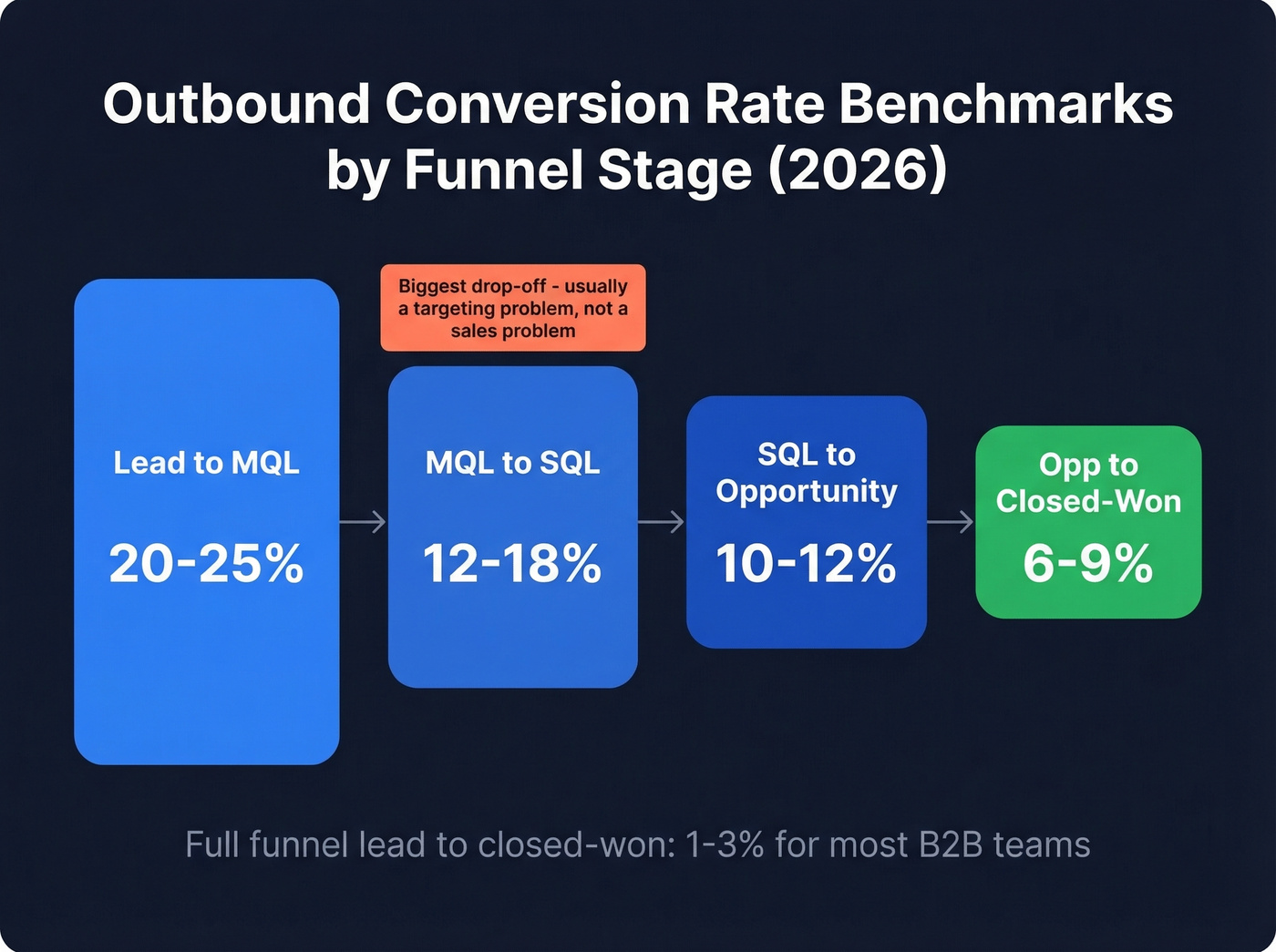
| Stage | Benchmark Range |
|---|---|
| Lead to MQL | 20-25% |
| MQL to SQL | 12-18% |
| SQL to Opportunity | 10-12% |
| Opportunity to Closed-Won | 6-9% |
Let's be honest about something: the MQL-to-SQL drop-off is overdiagnosed as a "sales problem" when it's almost always a targeting problem. EngageTech's outbound funnel data tells a similar story - 67% of booked meetings get attended, 46% of SALs convert to opportunities, and 33% of opportunities convert to deals. If your show rate is below 60%, the issue is qualification at booking, not your closer's pitch.
To standardize reporting, track funnel metrics consistently across teams.
Benchmarks by Industry
"Lead to Close Rate" and "Opp to Won Rate" below measure different conversion windows - don't compare across columns. Outbound win rates vary dramatically depending on deal size and buying committee complexity.
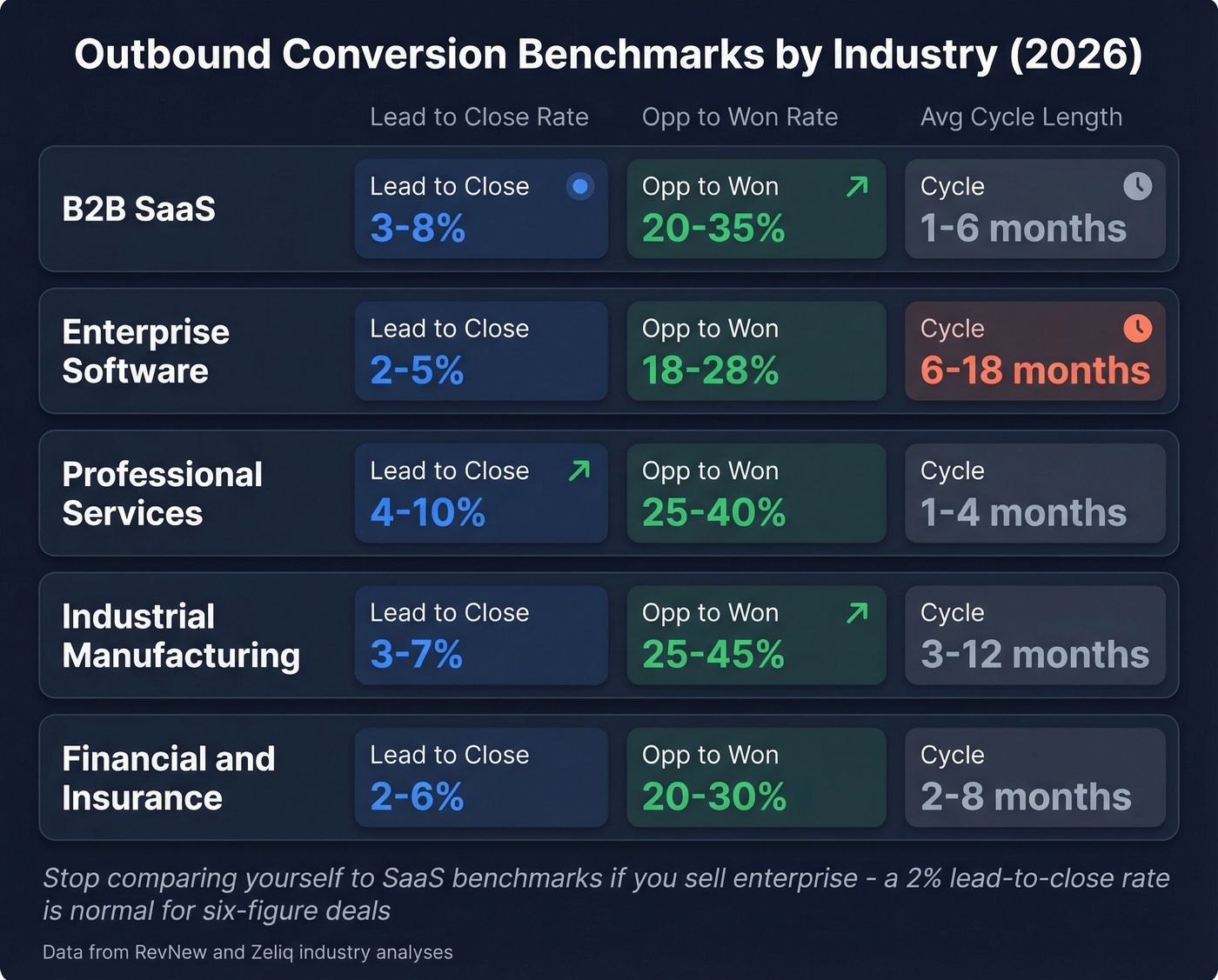
| Industry | Lead to Close Rate | Opp to Won Rate | Cycle Length |
|---|---|---|---|
| B2B SaaS | 3-8% | 20-35% | 1-6 months |
| Enterprise Software | 2-5% | 18-28% | 6-18 months |
| Professional Services | 4-10% | 25-40% | 1-4 months |
| Industrial Mfg | 3-7% | 25-45% | 3-12 months |
| Financial/Insurance | 2-6% | 20-30% | 2-8 months |
Data compiled from RevNew and Zeliq industry analyses.
If you're in enterprise software, stop comparing yourself to SaaS benchmarks. A 2% lead-to-close rate is normal when you're selling a six-figure deal into a multi-person buying committee. That converts fundamentally differently than a $5K deal with one decision-maker.
For a broader baseline, compare against the average B2B lead conversion rate too.
Why Rates Are Declining
Three forces are compressing outbound results at once.
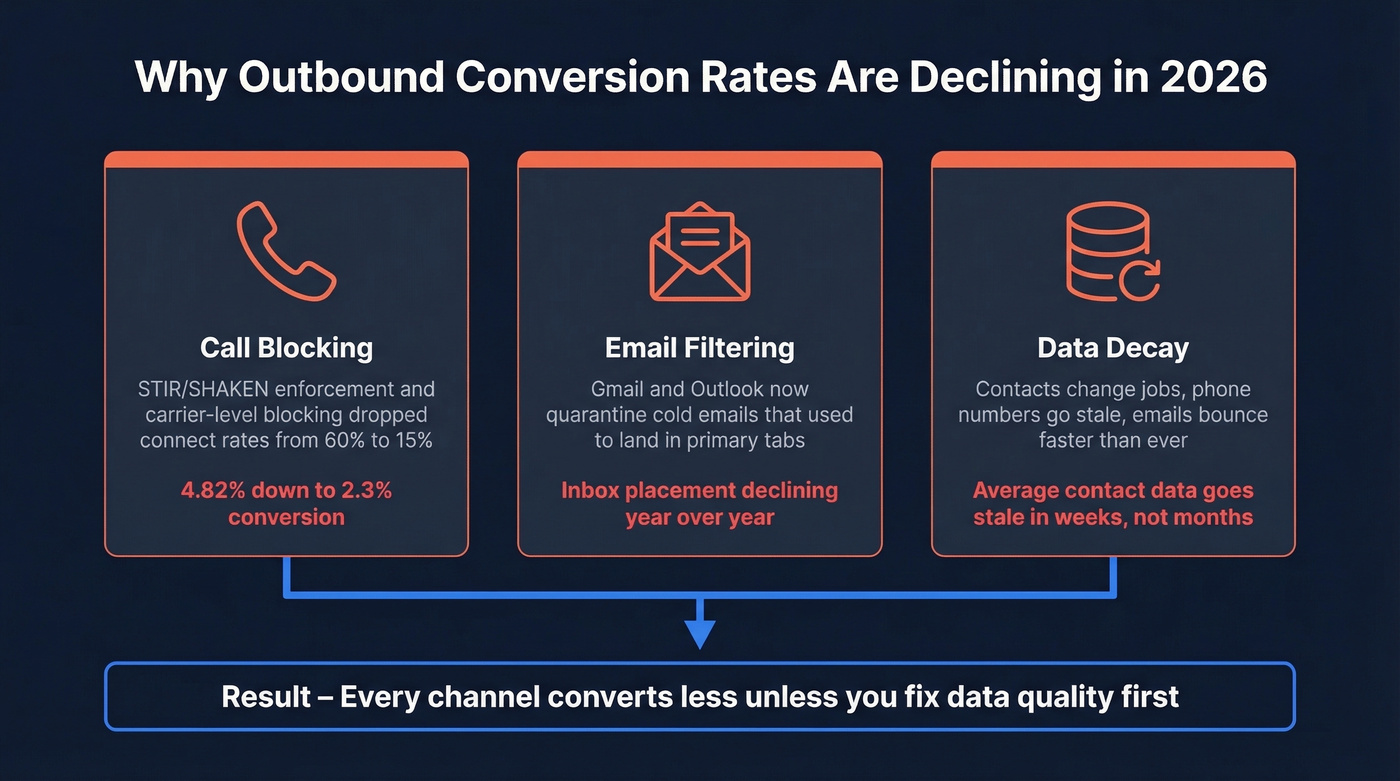
STIR/SHAKEN enforcement and carrier-level call blocking have cratered connect rates. That Reddit operator's experience - 60% reach dropping to 15% - isn't an outlier. It's the new normal for teams dialing without verified numbers. On the email side, Gmail and Outlook are quarantining cold emails that would've landed in primary tabs two years ago.
Underneath both channels sits data decay. Contacts change jobs, phone numbers go stale, emails bounce. When the data shows a drop from 4.82% to 2.3% in a single year, the structural headwinds are undeniable.
If email is your primary channel, prioritize email deliverability before you scale volume.
How to Improve Outbound Conversion
Fix Your Data First
No amount of copywriting or cadence optimization matters if your bounce rate is above 5% or half your phone numbers are disconnected. In our experience, data quality accounts for more conversion lift than any messaging change. Verify every contact before launching.
This is exactly why we built Prospeo around a 7-day data refresh cycle - because stale data is the silent killer of outbound campaigns. Meritt cut bounces from 35% to under 4% and tripled pipeline from $100K to $300K/week after switching. When your data refreshes weekly instead of every six weeks, you're reaching people at current roles with current numbers, and that alone moves every downstream metric.
If you're diagnosing issues, start with email bounce rate benchmarks and root causes.
Use Timeline Hooks in Cold Email
Timeline-based hooks ("noticed you're expanding into EMEA this quarter") pull a 10.01% reply rate vs. 4.39% for problem hooks. That's the single highest-leverage copywriting change you can make. Pair it with clean data so those emails actually land.
To improve opens alongside replies, test against proven cold email subject line examples.
Call at the Right Time
Wednesday between 4-5 PM is the sweet spot. A 71% uplift over midday calls is too large to ignore - build your dialing blocks around it.
If your team needs a repeatable process, build a cold calling system instead of relying on rep preference.
Front-Load Your Follow-Up
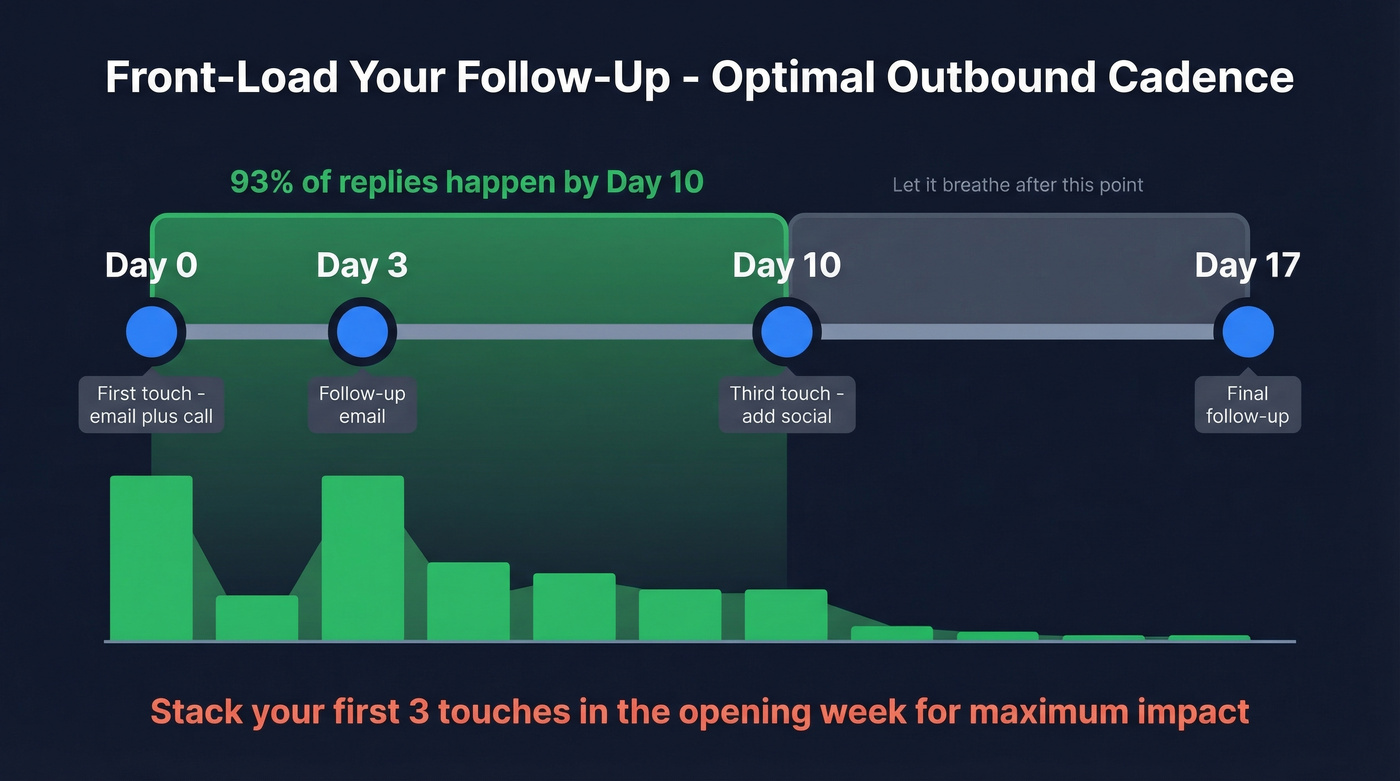
Use a Day 0 / Day 3 / Day 10 / Day 17 follow-up cadence. DigitalBloom's data shows 93% of replies come by Day 10. Front-load, then let it breathe.
Go Multi-Channel With Clean Data
Email plus phone plus social consistently delivers 2-4x the conversion of any single channel. But here's the thing: skip multi-channel if your data isn't clean. You'll just burn three channels instead of one. We've seen teams torch their domain reputation and caller ID trust simultaneously because they scaled volume before fixing accuracy - don't be that team.
Every benchmark in this article gets worse with stale data. Prospeo refreshes all 300M+ profiles every 7 days - not the 6-week industry average that's dragging your connect rates down. At ~$0.01/email, you stop paying for bounces and start paying for conversations.
Clean data is the only hack that moves every conversion rate at once.
FAQ
What's a good outbound conversion rate?
For cold calls, 2-3% dial-to-lead is average and 6-10% is top-tier. Cold email reply rates above 5% are strong; elite campaigns hit 15-25%. Full-funnel lead-to-close typically lands between 1-3% for B2B teams.
How many touchpoints to convert an outbound lead?
Eight call attempts on average to reach a prospect, and 80% of sales require 5+ follow-up touches. Front-load your cadence - 93% of email replies arrive by Day 10, so stack your first three touches within the opening week.
What's the fastest way to improve outbound conversion rates?
Verify your contact data before launching. Bad emails destroy domain reputation, bad numbers waste dials. Snyk cut bounce rates from 35-40% to under 5% and grew AE-sourced pipeline 180% after switching to verified data with a weekly refresh cycle. Clean data consistently delivers more lift than any messaging tweak.
Why are outbound conversion rates dropping in 2026?
STIR/SHAKEN call blocking, stricter email filtering by Gmail and Outlook, and accelerating data decay are compressing results across every channel. Average cold-call conversion fell from 4.82% to 2.3% in a single year. Teams that don't verify data weekly are hit hardest.