

Outbound Sales Automation That Actually Works in 2026
You built the sequences. You loaded 5,000 contacts. You hit send - and 34% bounced. Your domain reputation cratered in 48 hours, and now even your legitimate customer emails land in spam. That's not a sequencing problem. It's a data problem, and it's where most outbound sales automation dies before it ever gets a chance.
Here's the uncomfortable truth: roughly 20% of cold emails get flagged as spam before a human ever sees them. Meanwhile, 61% of B2B buyers prefer a rep-free buying experience (per Gartner) - which means the emails that do land need to be sharp, relevant, and timely. The margin for error has never been smaller. Automation amplifies whatever you feed it. Feed it bad data, and you'll automate your way into a blacklist.
The teams winning at B2B outbound right now aren't the ones with the fanciest AI copywriter or the most complex branching sequences. They're the ones who nailed the boring stuff first: clean data, proper infrastructure, disciplined sending, and signal-based targeting.
The Stack That Works
Most automated outbound fails because of bad data, not bad tools. The system that works has four layers - get any of them wrong and the whole thing breaks.
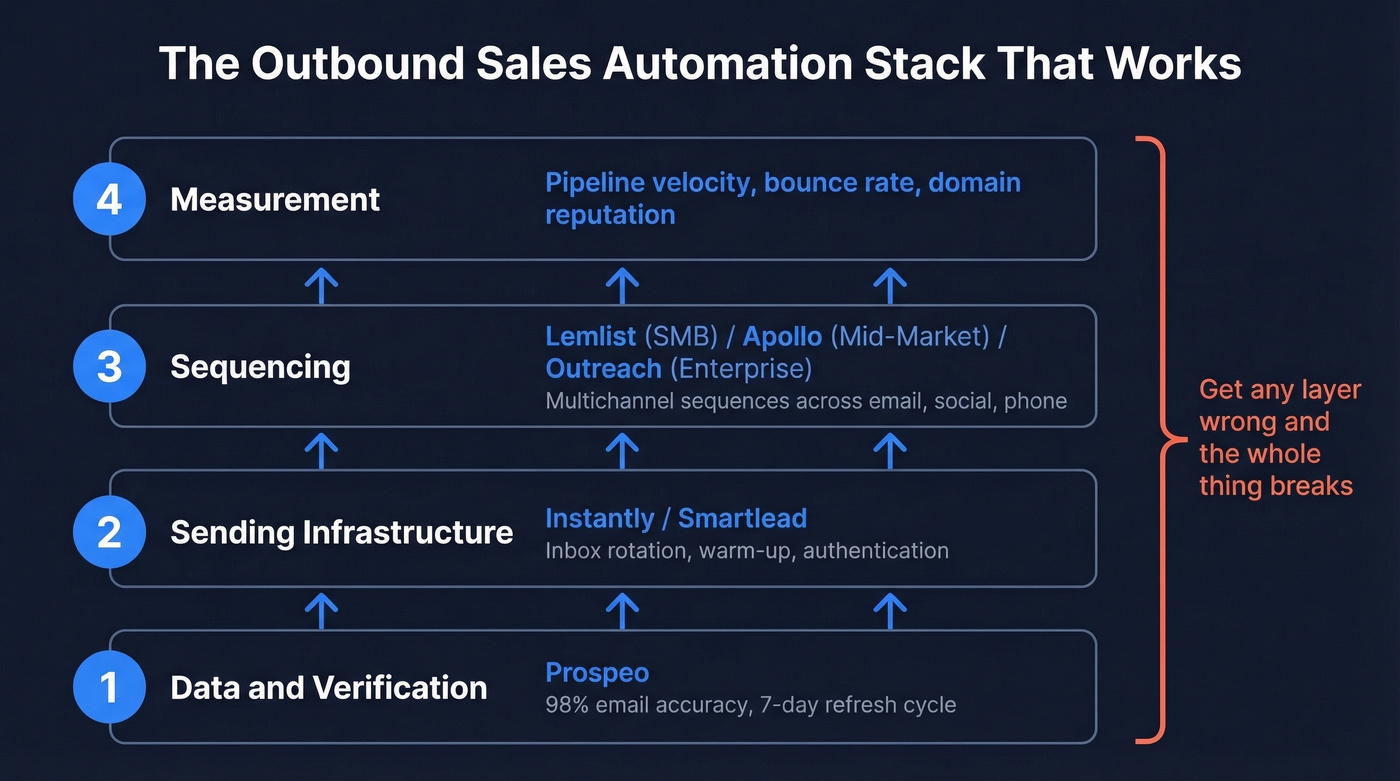
- Data & verification - Prospeo for 98% email accuracy on a 7-day refresh cycle
- Sending infrastructure - Instantly or Smartlead for inbox rotation and warm-up
- Sequencing - Lemlist for SMB, Apollo for mid-market, Outreach for enterprise
- Measurement - Pipeline velocity, bounce rate, domain reputation
Starting from scratch, this stack can get you live in under a week without spending enterprise money. Rebuilding after a domain burn, the same stack fixes the root cause.
Benchmarks You Should Know
Before you optimize anything, you need to know what "good" looks like. These ranges draw from RevenueHero's benchmark data and SoPro's analysis of 151 million outreach points:
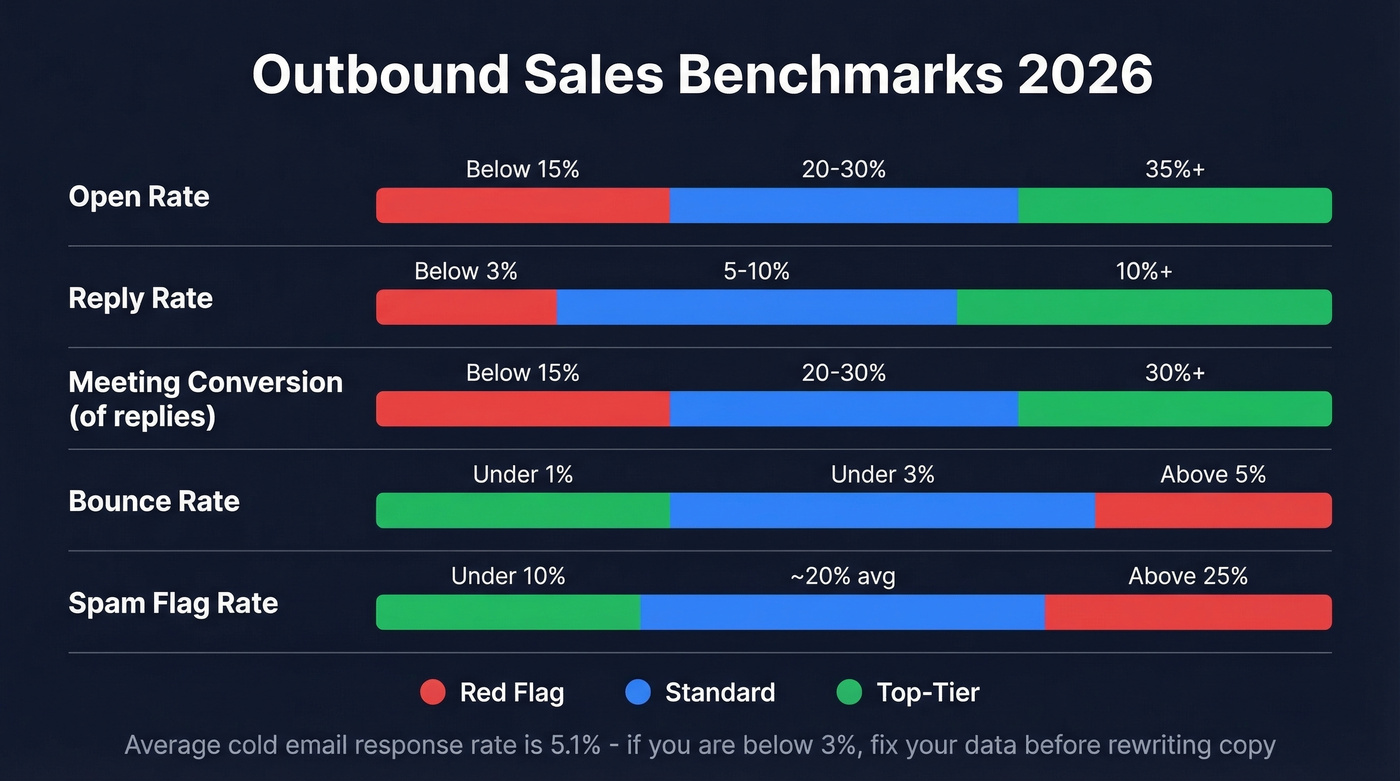
| Metric | Standard | Top-Tier | Red Flag |
|---|---|---|---|
| Open rate | 20-30% | 35%+ | Below 15% |
| Reply rate | 5-10% | 10%+ | Below 3% |
| Meeting conversion | 20-30% of replies | 30%+ | Below 15% |
| Bounce rate | Under 3% | Under 1% | Above 5% |
| Spam flag rate | ~20% average | Under 10% | Above 25% |
The average cold email response rate sits at 5.1%, with most campaigns landing between 1-5%. If you're below 3% reply rate, don't rewrite your copy - check your data quality and deliverability setup first. Those two variables explain the gap between mediocre and top-tier performance far more than subject lines ever will.
Step 1: Data Sourcing & Verification
Bad data is the single most expensive mistake in B2B outbound. Not because the data itself costs much - because the downstream damage compounds. One batch of unverified emails can burn a domain you've spent months warming, pollute your CRM with dead contacts, and tank your sender reputation across every inbox you own.
We've seen this pattern repeatedly: a team loads 10,000 contacts from a cheap provider, skips verification, and watches their bounce rate spike past 30%. Two weeks later, they're buying new domains and starting warm-up from zero. The cost of skipping verification isn't the $200 you saved - it's the 6-8 weeks of lost pipeline while you rebuild.
Prospeo's database covers 300M+ professional profiles with 143M+ verified emails and 125M+ verified mobile numbers. The 98% email accuracy comes from a proprietary 5-step verification process that includes catch-all handling, spam-trap removal, and honeypot filtering - the stuff that actually prevents domain burns. Every record refreshes on a 7-day cycle, compared to the 6-week industry average.

The 30+ search filters - buyer intent, technographics, job changes, headcount growth, funding, revenue - mean you're not just getting clean data, you're getting targeted data. Native integrations with Instantly, Smartlead, Lemlist, Clay, HubSpot, and Salesforce push verified contacts directly into your sending tools without manual CSV gymnastics.
The proof points tell the story. Meritt dropped their bounce rate from 35% to under 4% after switching. Stack Optimize built from $0 to $1M ARR while maintaining 94%+ deliverability and zero domain flags across all clients.
Step 2: Deliverability Infrastructure
Clean data gets you to the inbox. Proper infrastructure keeps you there. Here's the operational checklist that practitioners on r/coldemail actually follow:
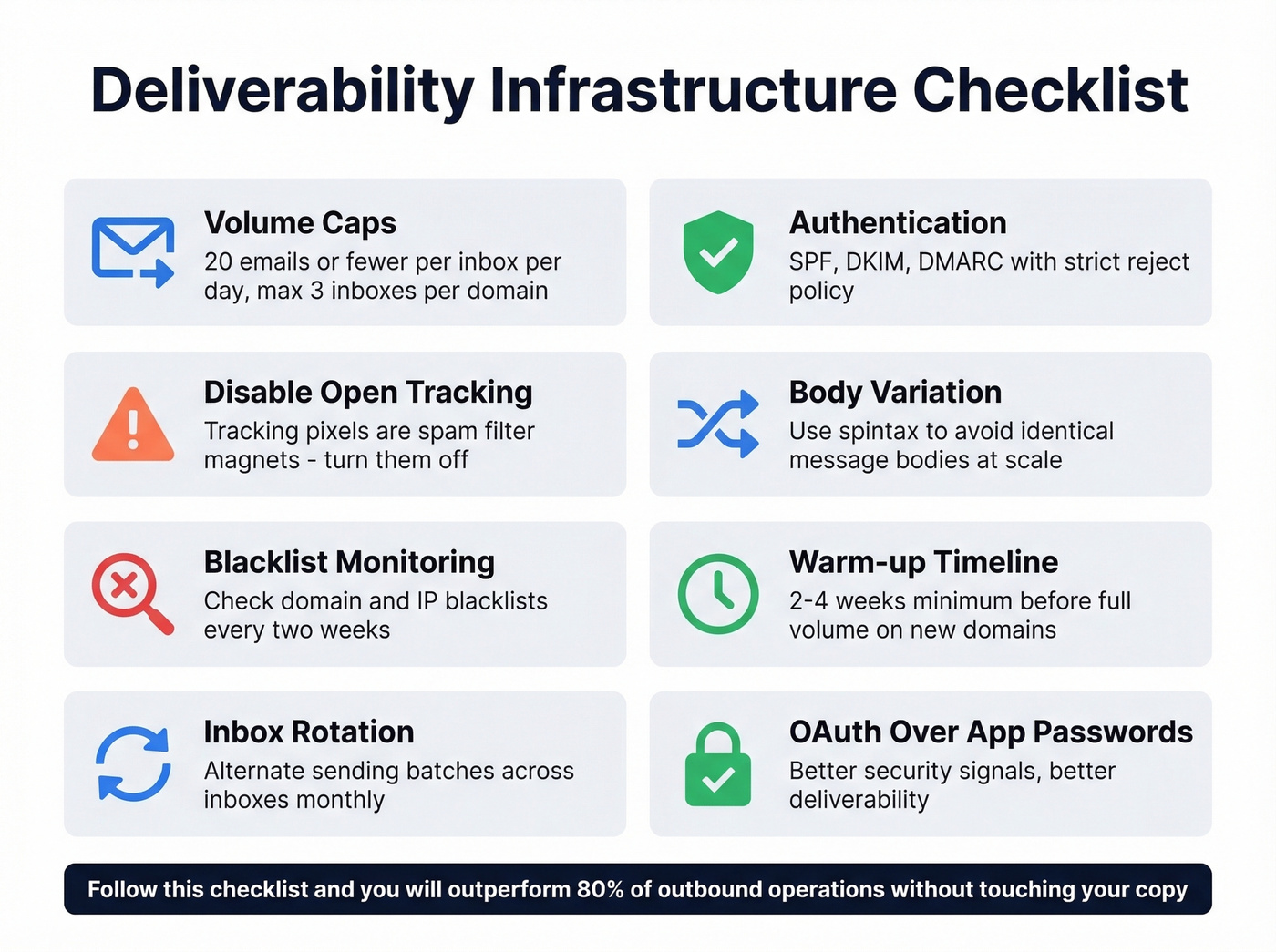
- Volume caps: 20 emails or fewer per inbox per day, max 3 inboxes per domain (see email velocity limits)
- Authentication: SPF, DKIM, and DMARC with strict enforcement - reject unauthenticated mail (more on DMARC alignment)
- Tracking: Disable open tracking entirely. Tracking pixels are spam filter magnets. (Deep dive: email tracking pixels.)
- Body variation: Use spintax to avoid identical message bodies at scale
- Blacklist monitoring: Check domain and IP blacklists biweekly (if you get hit, start with Spamhaus blacklist removal)
- Warm-up timeline: 2-4 weeks minimum before hitting full volume on new domains
- Inbox rotation: Alternate sending batches across inboxes monthly to distribute reputation risk
- OAuth over app passwords: Better security, better deliverability signals
Look, most deliverability problems aren't mysterious. They're teams sending 50+ emails per inbox, skipping DMARC, and wondering why Gmail flags them. Follow the checklist above and you'll outperform 80% of outbound operations without touching your copy.
Sending Tools Worth Using
Instantly is a common choice for dedicated cold email infrastructure: inbox rotation, warm-up, and a clean UI that doesn't try to be a CRM. It does one thing well - get cold emails delivered - and that focus is exactly why teams pick it over all-in-one platforms.
Smartlead covers similar ground, starting at $39/month. The edge over Instantly is slightly more flexible inbox management for agencies running multiple client domains. Both tools are solid; pick based on which UI you prefer and whether you need multi-client workspace management.
Apollo users on Reddit report emails landing in spam despite warm-up, with open rates improving immediately after switching to Instantly. When your data provider is also your sender, deliverability issues get tangled with data issues. Separate the two.

Every bounced email chips away at your domain reputation - and your pipeline. Prospeo's 5-step verification delivers 98% email accuracy with catch-all handling, spam-trap removal, and honeypot filtering. Meritt cut their bounce rate from 35% to under 4%. Stack Optimize hit $1M ARR with zero domain flags.
Stop automating your way into a blacklist. Start with clean data.
Step 3: Multichannel Sequencing
The best sequences in 2026 run 6-10 touchpoints across email, social, and phone. Social outreach delivers roughly double the response rate of cold email alone, and advanced personalization can double response rates again - which is why the best sequences aren't email-only. Branching logic matters too: a prospect who opens three emails but never replies needs a different path than one who clicks a link on touch two. (If you need a baseline, start with a B2B cold email sequence.)
Apollo.io
Apollo is the Swiss Army knife of outbound - 275M+ contacts, built-in sequencing, and a free tier that lets small teams start without a credit card. For mid-market teams that want data and sequencing in one platform, it's the obvious starting point.
Pricing scales through tiers: Basic from $49/month, Professional from $79/month, and Organization from $119/month with a minimum 3-seat requirement. The catch is the credit system - credits don't roll over month to month, and they burn faster than you'd expect. Mobile number reveals, data exports, and waterfall enrichment queries all consume credits at different rates. A team of five can easily blow through their allocation by week three.
Our take: use Apollo for sequencing if you want simplicity, but source your data from a dedicated verification provider. Apollo's email accuracy hovers around 79%, and the deliverability concerns are real enough that separating your data layer from your sending layer is worth the extra setup.
Lemlist
Lemlist hits the SMB multichannel sweet spot - email, social touches, and phone steps in one sequence with a single inbox view. The Chrome extension handles enrichment on the fly, which is handy for reps who prospect in real time. Just watch the credit-based pricing creep. What starts as a reasonable monthly bill can quietly double as your team scales volume.
HeyReach
Use this if you're an agency managing outreach across multiple client accounts, or a team scaling social selling across 5+ profiles. HeyReach centralizes sequence management and is built for running multiple accounts from one place, starting at $49/month.
Skip this if you need native email sending - HeyReach is social-first with no built-in email. You'll need a separate tool for email sequences.
Other Tools Worth Evaluating
Clay handles waterfall enrichment workflows starting at $134/month for 2,000 credits - powerful for complex data orchestration but gets expensive fast at scale. Amplemarket is worth a look for all-in-one prospecting with strong social capture. Waalaxy and Dripify serve agency multi-client management and solo founders respectively.
For enterprise, Outreach and Salesloft own the market. Both run custom pricing, typically ~$1,000-$2,500+ per user/year depending on seats and modules. Neither publishes pricing - you'll spend two weeks in a sales cycle just to learn what it costs. For AI-generated sequencing at scale, Regie.ai runs ~$35,000/year, a bet that makes sense at 50+ reps, not at 5.
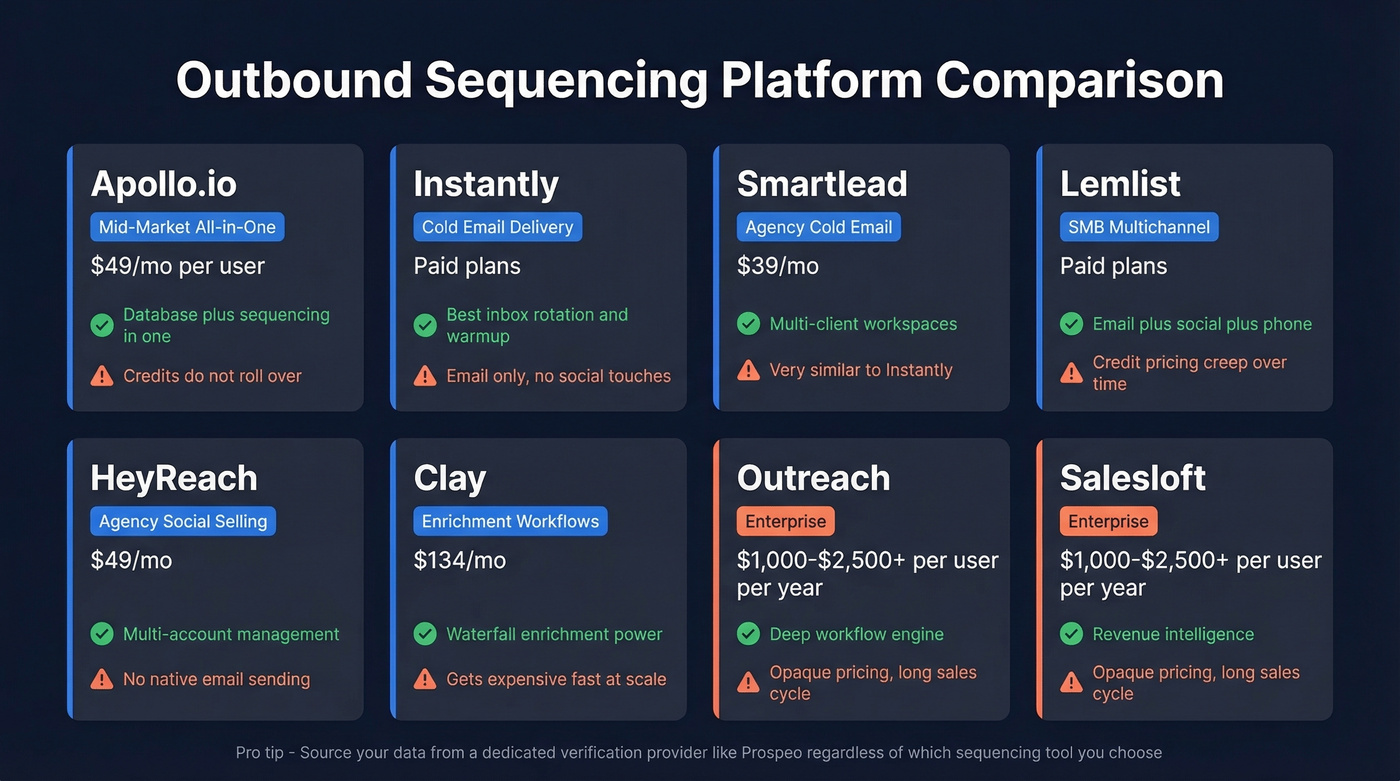
Sequencing Platform Comparison
| Tool | Best For | Starting Price | Key Strength | Watch Out For |
|---|---|---|---|---|
| Apollo.io | Mid-market all-in-one | $49/mo/user | Database + sequencing | Credits don't roll over |
| Instantly | Cold email delivery | Paid plans | Inbox rotation + warmup | Email only, no social |
| Smartlead | Agency cold email | $39/mo | Multi-client workspaces | Similar to Instantly |
| Lemlist | SMB multichannel | Paid plans | Email + social + phone | Credit pricing creep |
| HeyReach | Agency social selling | $49/mo | Multi-account management | No native email |
| Clay | Enrichment workflows | $134/mo | Waterfall enrichment | Gets expensive fast |
| Outreach | Enterprise | ~$1,000-$2,500+/user/yr | Deep workflow engine | Opaque pricing |
| Salesloft | Enterprise | ~$1,000-$2,500+/user/yr | Revenue intelligence | Opaque pricing |
Step 4: Signal-Based Targeting
Volume-based outbound is a race to the bottom. The teams booking the most meetings in 2026 reach prospects at the right moment - when they're actively researching solutions, changing jobs, or sitting on fresh funding.
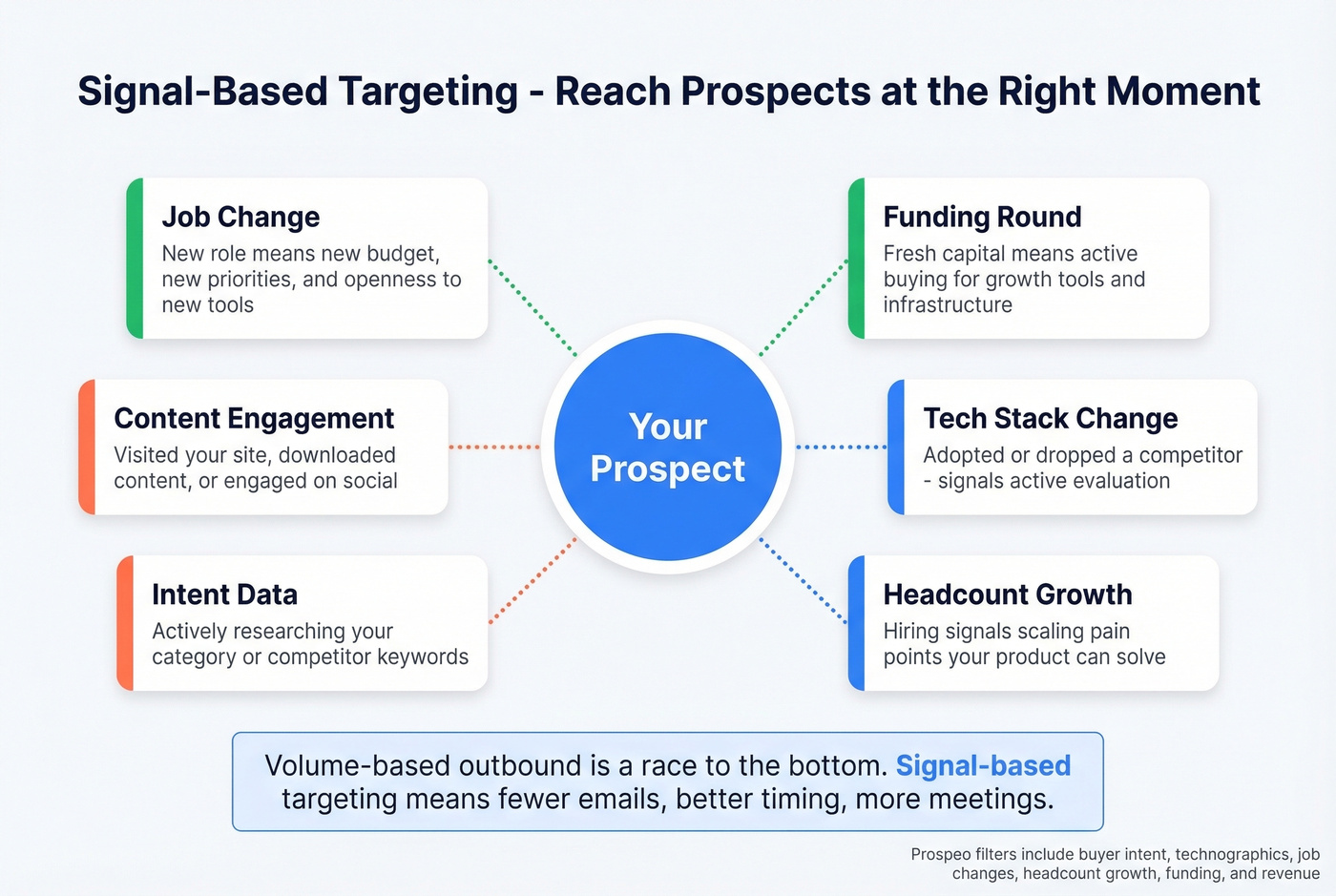
The B2B Playbook nails the core problem: "We started optimizing for calendar slots instead of customers." Outbound should function as a market intelligence system, not just a meeting-booking machine. Signals tell you who to contact and when. Everything else is noise.
Prospeo's intent data tracks 15,000 topics via Bombora, layered directly on top of verified contact data. That means you're not just seeing that a company is researching "sales engagement platforms" - you're getting the verified email and direct dial for the VP of Sales at that company, with data refreshed in the last 7 days. Combine in-market signals with job change triggers and funding events, and you're reaching the right person at the right company at the right time. (More frameworks: identifying buying signals.)
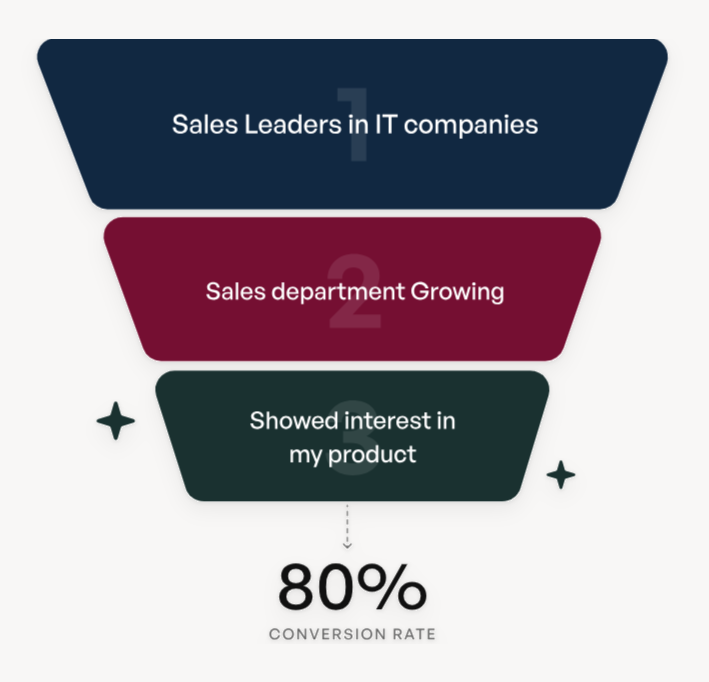
Automated Plays You Can Copy
Here are four signal-based workflows that top teams run right now.
Play 1: Job Change Trigger. New VP of Sales starts at target account. Auto-enrich via API to get their verified email. Day 1 congrats email. Day 3 value prop tied to their new role. Day 7 phone call using verified direct dial. This play converts at 3-4x the rate of cold outreach because the timing is perfect and the context is genuine.
Play 2: Intent Spike + Outbound. Bombora intent signal fires for "sales engagement platforms." Filter by ICP company size and industry. Pull verified contacts for the buying committee. Route to rep with a context card showing intent topics and scores. Rep sends personalized sequence within 24 hours.
Play 3: Funding Event Blitz. Company raises Series B. Auto-enrich the leadership team. Trigger a 5-touch sequence to CRO, VP Sales, and Head of RevOps. Reference the funding round and growth hiring in messaging. Funded companies buy faster because they have budget and urgency.
Play 4: Ghost Account Reactivation. Closed-Lost deal from 90+ days ago. Monitor for new intent signals or job changes at that account. Re-enrich contacts because people leave and new buyers arrive. Trigger a fresh sequence to the new stakeholder. Half of your "dead" pipeline is just bad timing.
Compliance in 2026
The FCC's $225M fine for illegal robocalls should be all the motivation you need to take compliance seriously.
The biggest change: the FCC One-to-One Consent Rule (effective January 27, 2026) requires explicit consent per individual seller. Shared consent from lead gen forms is dead. Beyond that, Texas SB 140 now classifies text messages as telephone solicitations with potential treble damages, and Virginia SB 1339 mandates honoring text opt-out requests for 10 years at $500 per violation.
Register for A2P 10DLC through TCR before scaling any SMS outreach - unregistered traffic gets blocked by carriers. If you're using AI voice agents, disclose at the start of every call in two-party consent states (CA, CT, FL, IL, MD, MA, MT, NH, PA, WA). The "Revocation-ALL" rule is delayed to January 2027, but start planning now - a single STOP will opt out across all channels.
Cold email remains governed by CAN-SPAM's opt-out model, but state laws add layers. When in doubt, get explicit consent. The penalties aren't theoretical anymore.
What to Automate vs. Keep Human
Not everything should be automated. Here's the thing: if your average deal size is under $10k, you can automate the entire outbound motion and close deals over email. Deals north of $50k? Automation is just the research and reach layer - humans close those. The "uncanny valley" problem is real in between, where AI-perfect outreach is now suspicious to savvy buyers who've seen the same ChatGPT-flavored opener forty times this month.
| Automate | Keep Human |
|---|---|
| Data enrichment & verification | Deal qualification calls |
| Sequence scheduling & sends | Proposal customization |
| Intent signal routing | Sensitive follow-ups |
| CRM sync & field updates | Relationship-building touches |
| Blacklist monitoring | Objection handling |
The pattern we see across teams: automate the first 3-4 touches, then hand off to a human when a prospect shows buying intent. Automate the research and the reach; keep humans for the relationship and the close.
Measuring What Matters
Pipeline velocity beats vanity metrics every time. Reps spend 19% of their time updating CRMs - make sure what they're logging actually matters.
Focus on four KPIs that drive decisions. Bounce rate should stay under 3% or you have a data problem (see email bounce rate). Reply rate between 5-10% is standard; below 3% means something's broken upstream. Meeting conversion should hit 20-30% of positive replies. And domain reputation needs weekly monitoring, not monthly.
One tactical move worth stealing from The B2B Playbook: replace "Closed Lost" with "Closed Lost - Nurture" in your CRM. Maintain a separate nurture pipeline view so timing-based losses don't disappear into a black hole. Half of today's "Closed Lost" deals are next quarter's pipeline - if you track them.
Reply classification matters too. Only sync buying-intent replies to your CRM. Auto-replies, out-of-office messages, and "not interested" responses shouldn't inflate your pipeline metrics or clutter your reps' dashboards.
30-Day Rollout Plan
- Week 1: Set up domains, configure SPF/DKIM/DMARC, begin warm-up. Source and verify your first 500 contacts.
- Week 2: Build your first 3 sequences (cold intro, intent-triggered, job change trigger). Load 200 verified contacts into warm inboxes at 10/day.
- Week 3: Scale to 20/inbox/day across 3 inboxes. Activate intent signal monitoring. Begin A/B testing subject lines and opening hooks (use proven cold email subject line examples).
- Week 4: Review benchmarks against the table above. Cut underperforming sequences. Double down on what's booking meetings. Add phone and social touches to top-performing flows.
Outbound sales automation in 2026 isn't about sending more - it's about sending smarter. Nail the data layer, respect deliverability limits, layer in buying signals, and let humans handle the conversations that actually close revenue.
Signal-based outbound needs signal-rich data. Prospeo's 30+ filters - buyer intent, technographics, job changes, headcount growth, funding - feed directly into Instantly, Smartlead, and Lemlist. No CSV exports. No stale contacts. Every record refreshes in 7 days, not 6 weeks.
Build targeted lists at $0.01 per email and start sending today.
FAQ
What's a good reply rate for automated outbound in 2026?
A 5-10% reply rate is standard for well-executed campaigns, and 10%+ puts you in top-tier territory. If you're consistently below 3%, the problem is almost certainly data quality or deliverability infrastructure - not your copy. Fix bounce rates and authentication before rewriting subject lines.
How many emails should I send per inbox per day?
Cap at 20 emails per inbox per day with a maximum of 3 inboxes per domain. Scale by adding domains and inboxes, not by increasing volume per inbox - going higher triggers spam filters regardless of warm-up quality.
Do I need separate tools for data and sending?
Yes. All-in-one platforms that handle both data sourcing and email sending often compromise on deliverability. Use a dedicated verification provider for contacts and a dedicated sender like Instantly or Smartlead for inbox management. Keeping these layers separate makes it far easier to diagnose problems when something breaks.
Is cold email still legal in 2026?
Cold email remains legal under CAN-SPAM's opt-out model. The FCC's one-to-one consent rule effective January 2026 eliminated shared consent for phone and text outreach, but email isn't affected by that change. State laws like Virginia SB 1339 ($500/violation) add penalties that make sloppy compliance expensive, so don't treat CAN-SPAM as your only obligation.
How do I prevent my domain from getting burned?
Verify every email before sending - a 5-step verification process that catches spam traps and honeypots is non-negotiable. Use SPF, DKIM, and DMARC with strict enforcement. Disable open tracking, keep volume under 20/inbox/day, and check blacklists biweekly. If you're already burned, buy fresh domains and budget 2-4 weeks of warm-up before sending anything.