Outbound vs Inbound Lead Generation: The Numbers Behind the Debate
Your SDR team sent 5,000 cold emails last month. 1,800 bounced. Your domain reputation tanked, and now even the good emails land in spam. Meanwhile, marketing's blog posts from six months ago are quietly generating demo requests at a fraction of the cost.
The outbound vs inbound lead generation debate isn't about philosophy - it's about math, timing, and data quality.
Outbound if you need pipeline this quarter and you're selling deals above $25k. Inbound if you want compounding ROI over 6-12 months. Both if you want to grow fastest - companies running a hybrid approach see 2x faster revenue growth than teams relying on a single motion.
What Is Inbound Lead Generation?
Inbound pulls prospects toward you through content they're already searching for - SEO, content marketing, social media, webinars. The unit economics favor inbound over time: inbound leads cost 62% less than outbound on average, and SEO-driven leads close at 14.6%. The catch? Three to six months of ramp time and consistent content investment before you see meaningful results.
What Is Outbound Lead Generation?
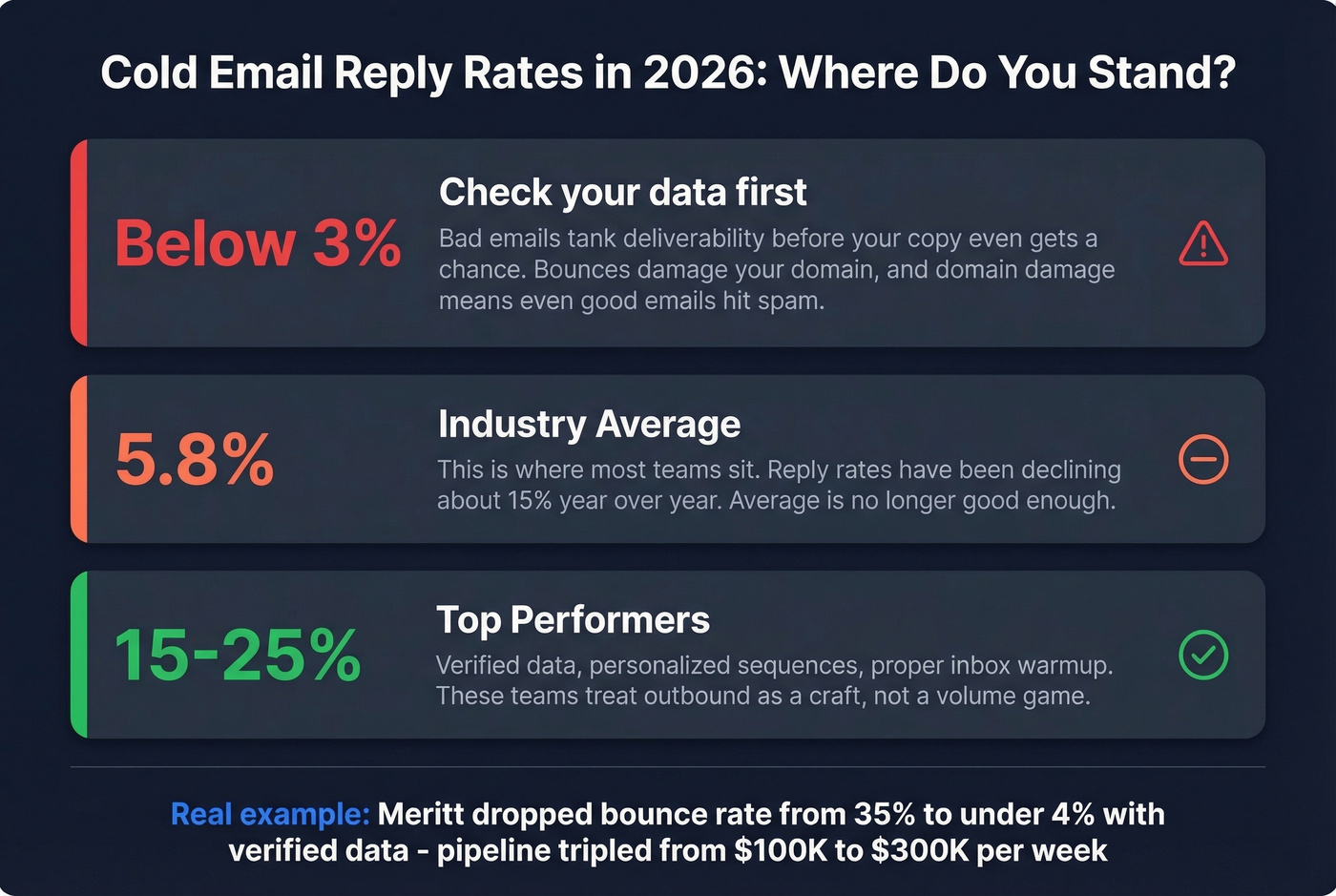
Outbound means you go to the buyer - cold email, cold calling, direct mail, ABM campaigns. You control who you talk to and when. The average cold email reply rate has fallen to 5.8%, down 15% year-over-year.
But outbound isn't dying. It's getting harder for lazy teams.
Outbound-sourced deals run roughly 50% larger than inbound deals. Enterprise buyers don't fill out forms - you have to reach them directly, and that requires verified contact data and a real sequencing strategy, not a 5,000-email blast to an unverified list.
The Real Numbers Compared
Most guides give you definitions and hand-wave at "it depends." Here are actual benchmarks for both motions side by side.
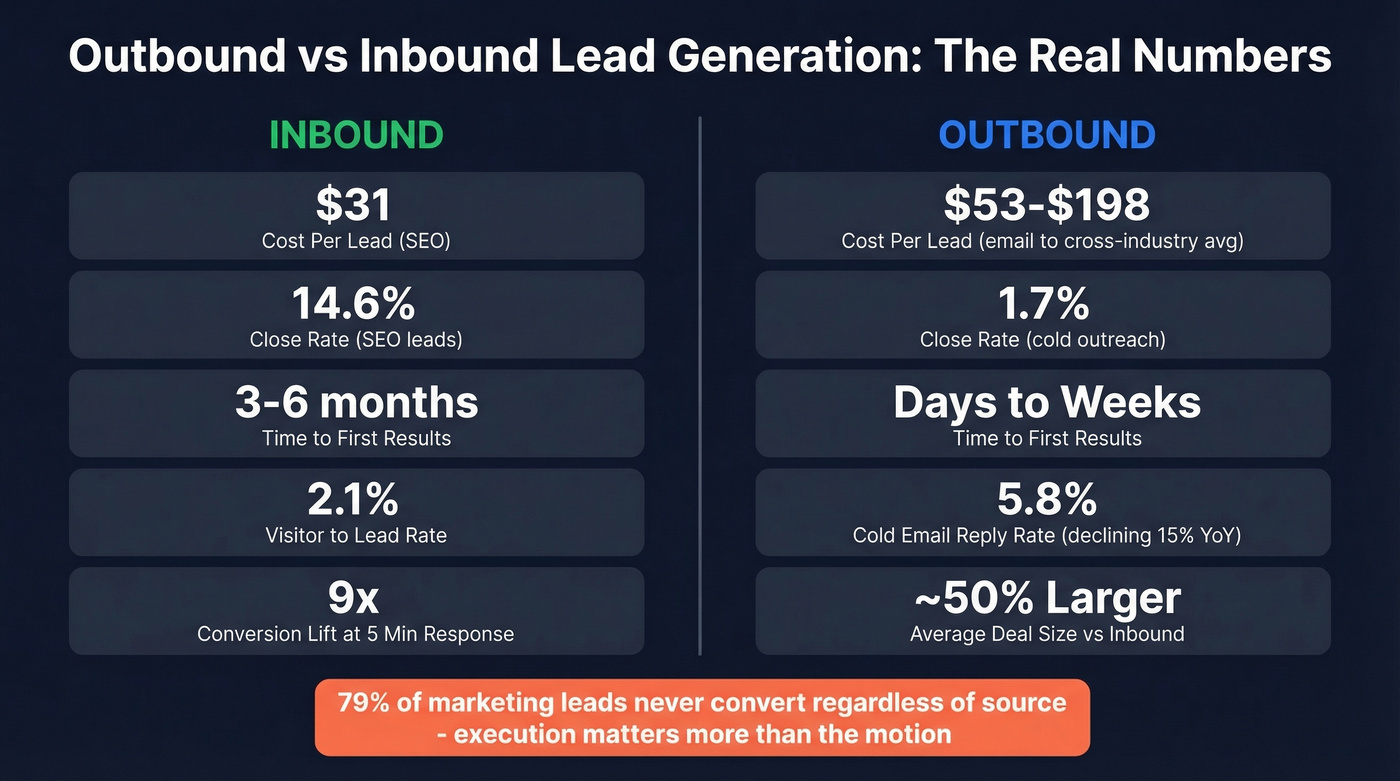
| Metric | Inbound | Outbound |
|---|---|---|
| Metric | Inbound | Outbound |
| CPL (SEO) | $31 | - |
| CPL (email) | - | $53 |
| CPL (cross-industry avg) | - | ~$198 |
| Close rate | 14.6% (SEO) | 1.7% |
| Time to results | 3-6 months | Days to weeks |
| Cold email open rate | - | 15-25% |
| Cold email reply rate | - | 5.8% avg |
| Cold call to meeting | - | ~2% |
| Visitor to lead (SEO vs PPC) | 2.1% vs 0.7% | - |
| Speed-to-lead impact | 9x at 5 min | - |
Inbound is cheaper per lead. Outbound produces larger deals. But 79% of marketing leads never convert into sales regardless of source, and 48% of reps stop after one touch when 80% of sales require five or more follow-ups. We've watched teams obsess over which motion is "better" while ignoring that their follow-up cadence is completely broken. The motion matters less than the execution.

Bad data is why outbound gets a bad reputation. 1,800 bounced emails out of 5,000 isn't an outbound problem - it's a data problem. Prospeo's 5-step verification delivers 98% email accuracy, and every record refreshes every 7 days, not the 6-week industry average.
Stop blaming outbound for what bad data broke.
Which Should You Choose?
Here's the thing: stop debating which is "better." It's a resource allocation problem. Inbound prospects have already identified their pain; outbound prospects may not know they have one yet - your messaging has to do different work.
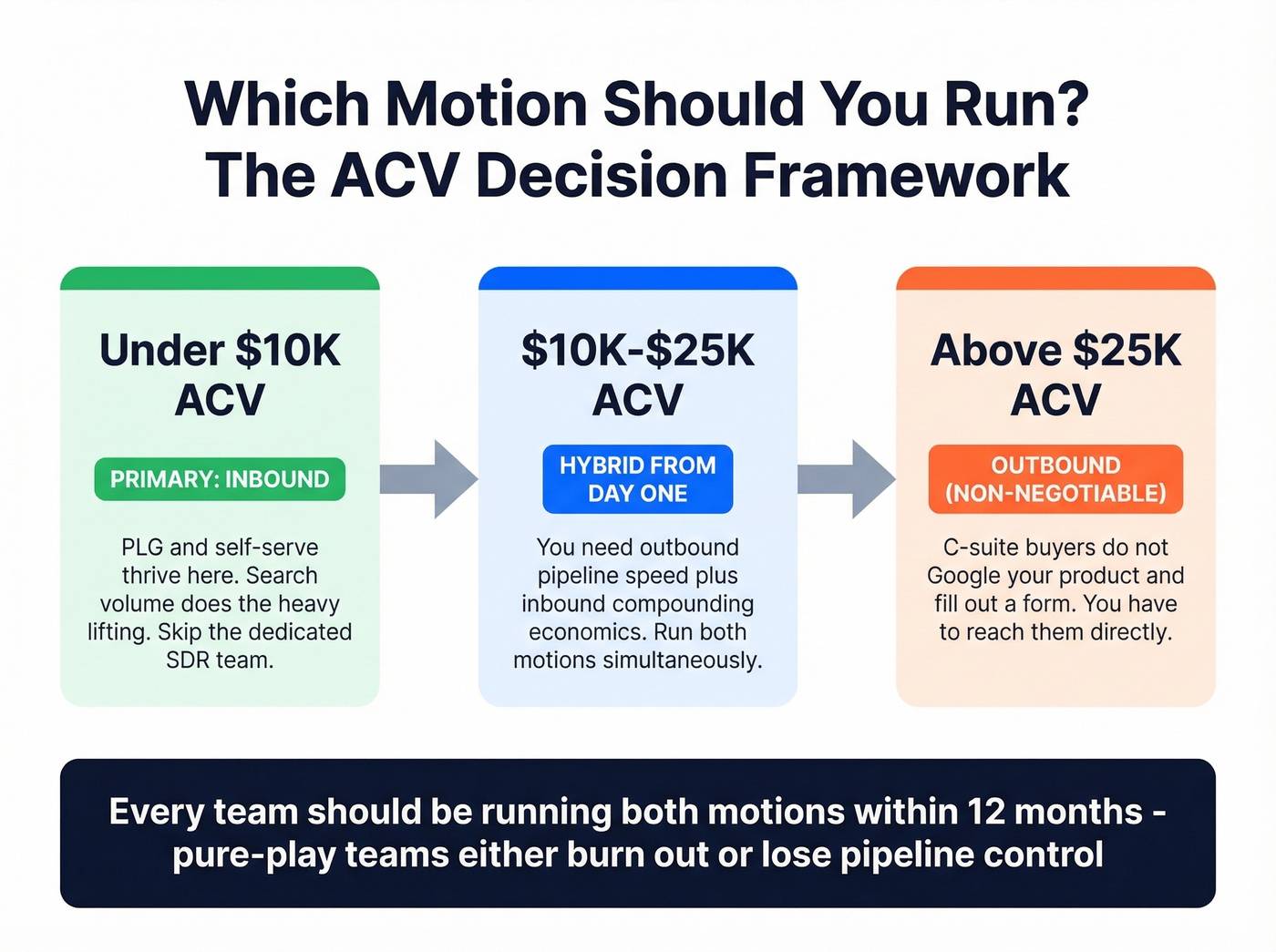
| Deal Size | Primary Motion | Why |
|---|---|---|
| Under $10k | Inbound | PLG and self-serve thrive here. Search volume does the work. |
| $10-25k | Hybrid from day one | You need outbound's pipeline speed and inbound's compounding economics. |
| Above $25k | Outbound (non-negotiable) | C-suite buyers don't Google your product and fill out a form. |
If your average deal is in the low four figures, you probably don't need a dedicated SDR team at all. Put that budget into content and let outbound be surgical - 50 hyper-personalized emails per week instead of 500 spray-and-pray.
In our experience, teams that start outbound-first get to product-market fit faster because they're having real conversations, not waiting for traffic. But every team should be running both motions within 12 months. The consensus on r/sales backs this up - pure-play outbound teams burn out, and pure-play inbound teams can't control their pipeline.
The Hybrid Playbook
Inbound cadence: 2-4 blog posts per month, one gated asset per quarter. Track time-on-page and conversion weekly. Month six looks nothing like month one.
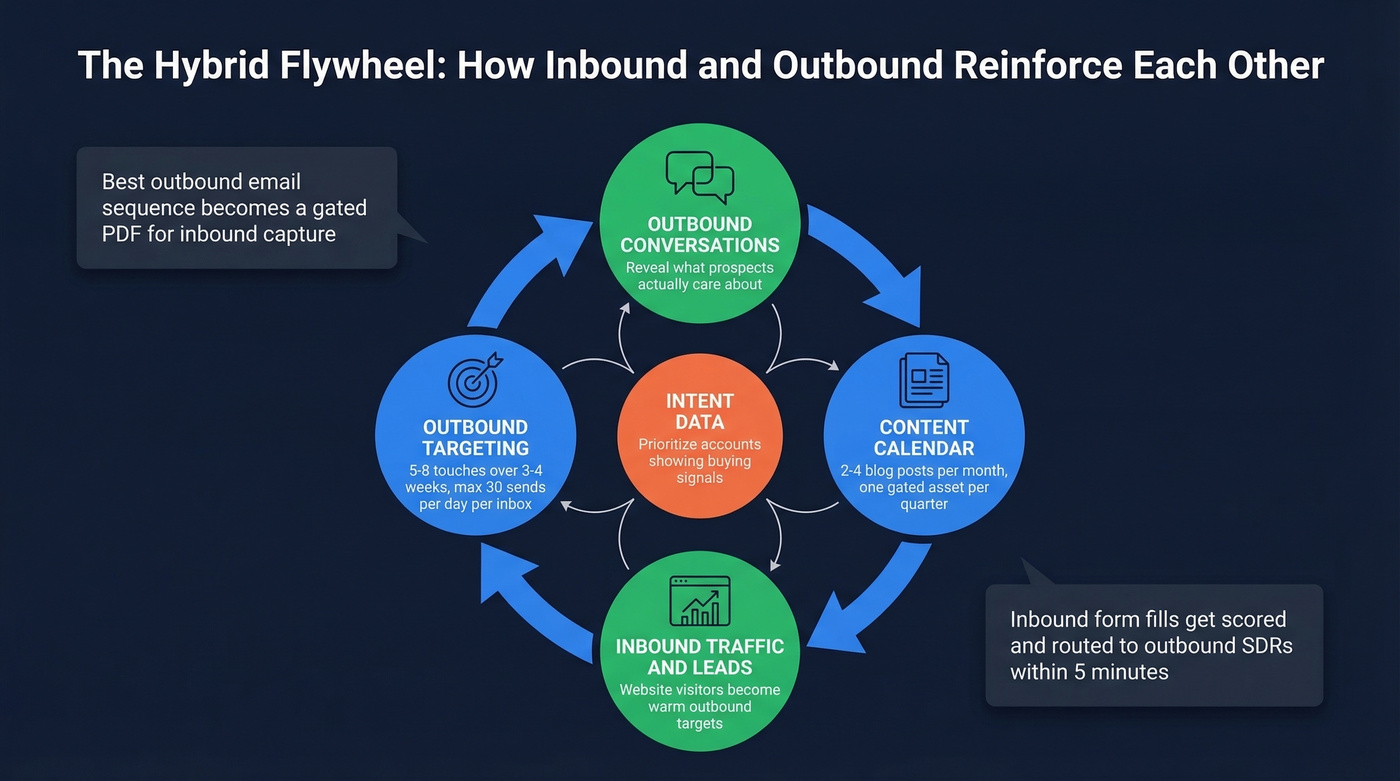
Outbound cadence: 5-8 touches over 3-4 weeks per prospect. Warm new inboxes for 30 days, ramping from 5 to 15 to 30 sends per day. Never exceed 30/day per inbox. Target bounce rate under 1%. (If you're consistently above that, start with email bounce rate diagnostics.)
The feedback loop is what makes hybrid work. Outbound conversations reveal what prospects actually care about, and that feeds your content calendar directly. Inbound website visitors become warm outbound targets. Turn your best-performing outbound email sequence into a gated PDF - now your outbound research fuels inbound lead capture. Layer in intent data to prioritize accounts showing buying signals, and you've got a flywheel.
Inbound lead quality varies wildly - contact form submissions often include tire-kickers and competitors. That's why the outbound layer matters: you choose who enters your pipeline. But none of it works if your data is garbage. Bad emails mean bounces, bounces mean domain damage, and domain damage means even your good emails hit spam. One of our customers, Meritt, saw their bounce rate drop from 35% to under 4% after switching to verified data - their pipeline tripled from $100K to $300K per week.
Compliance Basics
Skip this section if you're only running inbound. For outbound teams, these aren't optional:
- CAN-SPAM: Accurate sender info, physical address, opt-out honored within 30 days.
- GDPR: B2B cold email can rely on Article 6(1)(f) legitimate interest - document your Legitimate Interest Assessment. The ICO's guidance on direct marketing is the clearest resource we've found.
- Email auth: SPF, DKIM, and DMARC are mandatory. Google and Yahoo enforce pass/fail for bulk senders at 5,000+/day. (If you need a quick checklist, start with DMARC alignment.)
- Spam complaints: Stay under 0.1%. At 0.3%, Google withdraws mitigation support.
Tools You Need
CRM: HubSpot (free tier; paid from $15-$3,600/mo) or Salesforce ($25-500/user/mo). For teams under $25k ACV, HubSpot's free CRM is genuinely enough - don't overspend here. If you're evaluating options, see a few examples of a CRM.
Sequencing: Outreach (~$100-150/user/mo) for enterprise. Instantly (~$30-97/mo) or Lemlist (~$32-129/user/mo) for SMB and agencies. We've tested all three extensively, and the right pick depends entirely on your sending volume and how many inboxes you're managing. (More stack ideas: SDR tools.)
Data and verification: Prospeo - 300M+ professional profiles, 143M+ verified emails, 98% accuracy on a 7-day refresh cycle. The free tier gives you 75 verified emails per month, enough to test your first outbound sequences without risking your domain. Paid plans start at ~$0.01 per email with no contracts. If you're comparing vendors, start with data enrichment services.
Prospecting: Apollo.io (free to ~$99/user/mo) for broader search and sequencing in one platform, though we've found its email accuracy sits closer to 79% - fine for volume plays, less ideal when domain reputation is on the line. If you're building a stack, compare sales prospecting databases.
Running hybrid means your outbound list needs to be surgical, not spray-and-pray. Prospeo gives you 30+ filters - buyer intent, technographics, funding, headcount growth - so you target the right accounts while inbound compounds. At $0.01 per email, your outbound CPL stays closer to inbound economics.
Build outbound lists that actually convert at inbound prices.
FAQ
Is inbound or outbound lead generation cheaper?
Inbound wins long-term - SEO leads cost ~$31 vs. a $198 cross-industry outbound average. But inbound takes 3-6 months to ramp. Outbound email CPL sits around $53 and delivers pipeline immediately, making it the better short-term play for teams with revenue targets this quarter.
Can you run both motions simultaneously?
Yes, and you should. Hybrid teams see 2x faster revenue growth. Start with whichever matches your current constraints - usually outbound for speed - then layer in the second motion within a few months. The two channels reinforce each other through shared prospect intelligence.
What's a good cold email reply rate in 2026?
The average sits at 5.8% and has been declining ~15% year-over-year. Top teams with verified data, personalized sequences, and proper warmup hit 15-25%. If you're below 3%, check your data quality first - bad emails tank deliverability before your copy even gets a chance.