

7 Outreach Methods That Actually Work in 2026 (With Benchmarks and a Ready-to-Use Cadence)
You sent 5,000 emails last month and booked four meetings. Your domain reputation is tanking, your sequences are landing in spam, and your SDR manager wants to know why the "verified" list you bought bounced at 23%. Here's the thing: the problem isn't your outreach methods - it's how most teams execute them. At least 50% of prospects aren't even a good fit for your product, which means targeting matters more than channel selection.
What follows: benchmarks for every major channel, a 14-day multichannel cadence you can steal today, the cost math nobody publishes, and the deliverability infrastructure that separates teams booking 100 meetings a month from teams burning domains.
The Short Answer
The three approaches with the highest ROI right now are multichannel email+LinkedIn sequences, signal-based cold email, and referral outreach. None of them work without verified data and proper deliverability infrastructure. Cold email's average reply rate has dropped to 3.43%. Decision-makers receive 120+ sales emails per week. You're not competing with other cold emailers - you're competing with everyone who's ever hit "send" to that inbox.
Google and Microsoft have made SPF, DKIM, and DMARC table stakes for bulk sending. Miss any of those and your emails get filtered before a human ever sees them.
The gap between teams that struggle and teams that thrive isn't creativity or copywriting. It's infrastructure: secondary domains, warmed-up inboxes, verified contacts, and a multichannel cadence that doesn't lean on a single channel.
What Are Outreach Methods?
Outreach methods are the channels and tactics you use to initiate contact with someone who hasn't asked to hear from you. In marketing, that might mean PR pitches or influencer partnerships. In community work, it's engagement programs. This article focuses on B2B sales outreach - the channels reps and founders use to start conversations with potential buyers - though the principles of personalization, persistence, and multichannel apply broadly.
The 7 Core Sales Outreach Channels
Here's how each channel performs in 2026 based on the latest benchmarks. The table gives you the snapshot; the breakdowns below give you the context.
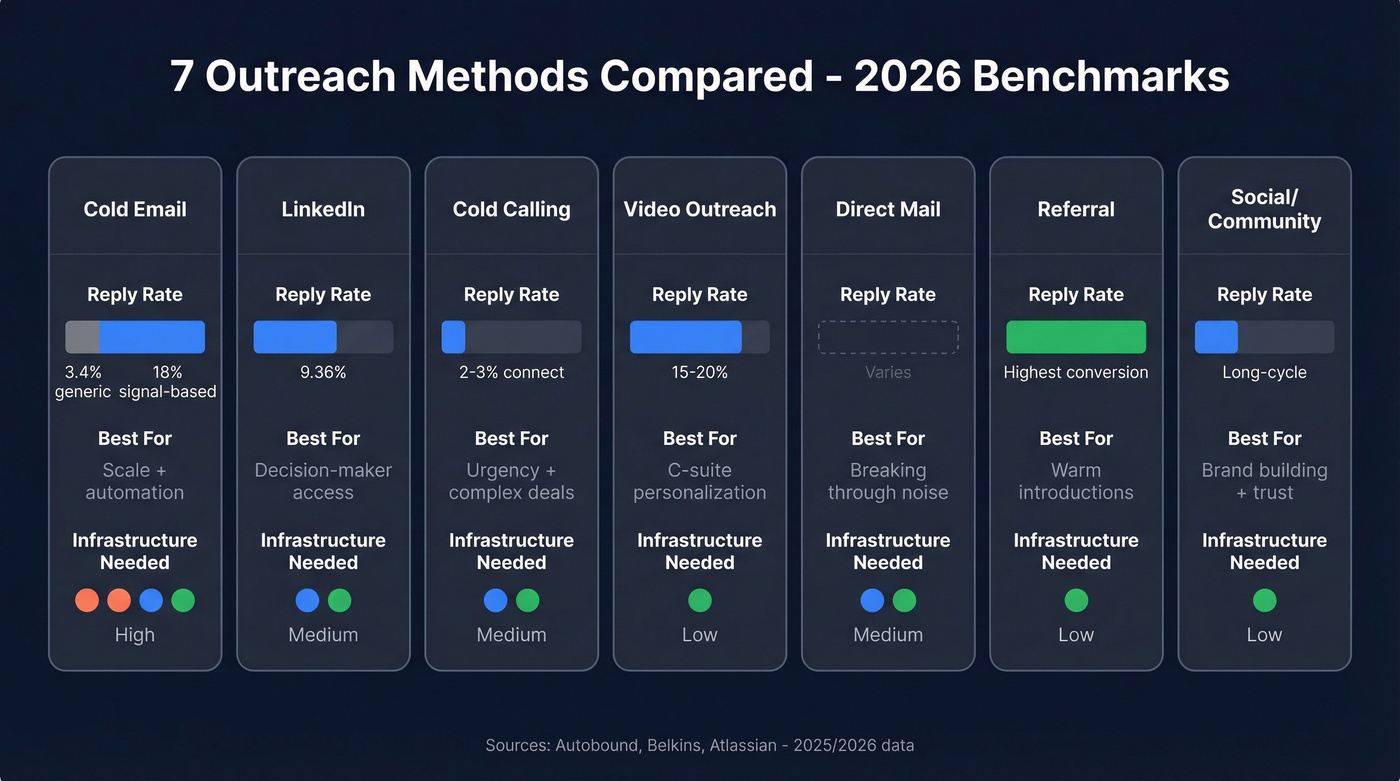
| Channel | Avg Reply Rate | Best For | Infrastructure Needed |
|---|---|---|---|
| Cold email | 3.4% (generic) / 18% (signal-based) | Scale + automation | High |
| 9.36% (w/ message) | Decision-maker access | Low-medium | |
| Cold calling | ~2-3% connect | Urgency + complex deals | Medium |
| Video outreach | ~15-20% (high-value targets) | C-suite personalization | Low |
| Direct mail | Varies widely | Breaking through noise | Medium |
| Referral | Highest conversion | Warm introductions | Low |
| Social/community | Long-cycle | Brand building + trust | Low |
Cold Email
Cold email isn't dead - lazy cold email is dead. The average reply rate sits at 3.43% for generic sends. Teams using signal-based personalization - referencing a trigger event, a recent hire, a tech stack change - hit 18% response rates. That's a 5x multiplier for doing 10 minutes of research. Only 5% of senders personalize every email, and they see 2-3x the replies.
The mechanics matter too. Cold emails between 50-125 words get the highest response rates. And here's the stat that should change your cadence design: 70% of salespeople stop after one email, yet 42% of replies arrive on follow-ups. If you're sending one email and moving on, you're leaving almost half your potential replies on the table.
We've tested this ourselves across client campaigns. The difference between a one-touch email blast and a proper 5-touch sequence isn't incremental - it's the difference between "outbound doesn't work for us" and a full pipeline. (If you want a plug-and-play structure, start with these cold email follow-up templates.)
LinkedIn Outreach
LinkedIn pulls roughly 3x cold email's average reply rate, and most teams still treat it as an afterthought. A study of 20M+ outreach attempts found that connection requests with a personalized message generate a 9.36% reply rate versus 5.44% without one. Acceptance rates barely change either way (~26.4%), so the message doesn't hurt your connection rate - it just dramatically improves what happens after.
AI-generated first messages pull a 4.19% reply rate vs 2.60% for manual, though follow-up performance is roughly equal. Use AI for the first touch, then write your own follow-ups.
Timing matters: Tuesday pulls the highest reply rates at 6.90%. Industry variance is significant - legal and professional services hit 10.42%, while SaaS sits at 4.77%. If you're selling into regulated industries, LinkedIn should be your primary channel, not a secondary one.
Cold Calling
The connect rate on cold calls hovers around 2-3%. Sounds terrible until you realize that a live conversation converts at multiples of any written channel. Best times are 8-9am and 4-5pm local time - catch people before they're buried in meetings or as they're wrapping up.
The real unlock is sequencing calls after email and LinkedIn touches. Calling someone who's already seen your name twice converts meaningfully higher than a pure cold dial. It takes about 8 touchpoints to get a meeting - the phone should be touchpoint 3 or 4, not touchpoint 1. (For a repeatable approach, build a cold calling system your team can run weekly.)
Video Outreach
Personalized video works best as a Tier 2 touchpoint for high-value targets. Recording a 45-second Loom referencing a prospect's specific challenge gets attention in a way text can't. It's particularly effective for C-suite outreach where generic templates get instantly deleted.
The tradeoff is scalability. You can't record 200 personalized videos a day. Use video selectively for your top 20% of prospects where the deal size justifies the time investment.
Direct Mail
Handwritten notes, relevant books, even podcast guest invitations - these tactics work precisely because nobody does them anymore. Targeting people in their first months at a new role is especially effective; they're actively building their vendor stack and more receptive to contact. A ~$15 book with a handwritten note gets more attention than 50 emails.
Skip this if your average deal size is under $10k. The unit economics don't make sense for smaller contracts. (If you want to go deeper, see direct mail for lead generation.)
Referral Outreach
Here's the biggest missed opportunity in B2B sales: more than 90% of customers are willing to give a referral, but only 11% of salespeople actually ask. Referral outreach has the highest conversion rate of any channel - and it costs nothing.
Build referral asks into your post-sale process. Don't leave the highest-converting channel to chance and occasional memory.
Social Selling and Community
Engaging on prospects' content before reaching out - commenting thoughtfully, sharing their posts - builds familiarity that makes every subsequent touchpoint warmer. Gartner found that 70% of buyers are through their evaluation before engaging sales, and 96% of prospects do their own research before talking to a rep. If they've already seen your name adding value in their feed, you're ahead of every competitor who shows up cold.
A word from the trenches: Twitter DMs are essentially useless for B2B. One founder reported 50 DMs and zero responses. Reddit DMs can work but carry ban risk. Stick to public engagement and save the direct messages for LinkedIn.
A 14-Day Multichannel Cadence
Here's a ready-to-use sequence based on the 8-12 touchpoints most teams need before a prospect engages. Steal it, adapt it, run it.
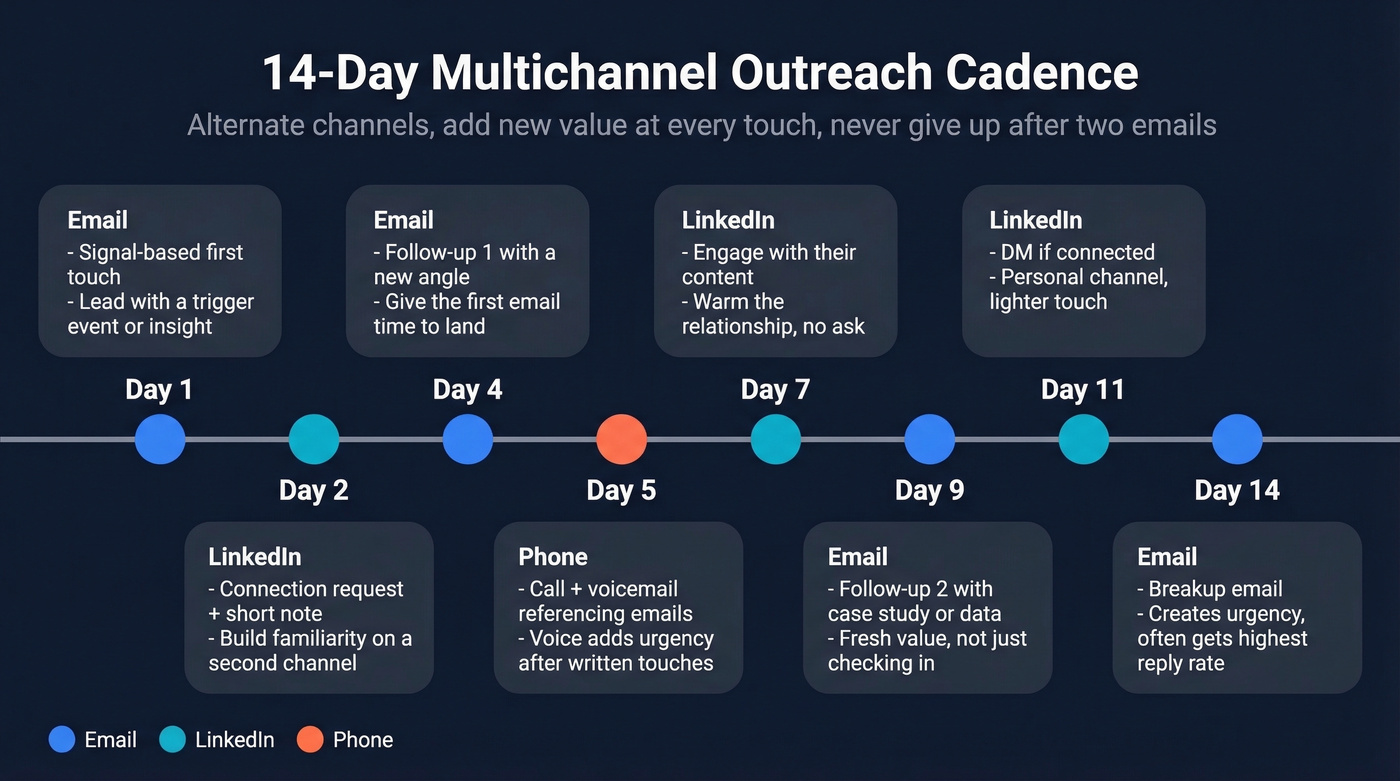
| Day | Channel | Action | Why This Day |
|---|---|---|---|
| 1 | Signal-based initial outreach | Lead with value; establish context | |
| 2 | Connection request + short note | Second channel, builds familiarity | |
| 4 | Follow-up #1 (new angle) | Space for first email to land | |
| 5 | Phone | Call + voicemail referencing emails | Voice adds urgency after written touches |
| 7 | Engage with their content | Warm the relationship without asking | |
| 9 | Follow-up #2 (case study or data) | Fresh value, not "just checking in" | |
| 11 | DM if connected | Personal channel, lighter touch | |
| 14 | Breakup email | Creates urgency; often gets highest reply |
Enterprise deals may need 21+ days with more touchpoints. SMB cycles can compress to 10 days. The principle stays the same: alternate channels, add new value at every touch, and don't give up after two emails.

Signal-based outreach hits 18% reply rates - but only if you're reaching real inboxes. Prospeo's 98% email accuracy and 7-day data refresh mean your multichannel cadences land where they should, not in bounce logs.
Stop burning domains on bad data. Start every sequence with verified contacts.
The Math Behind 100 Meetings
Let's break this down, because we haven't seen another guide actually show the math.
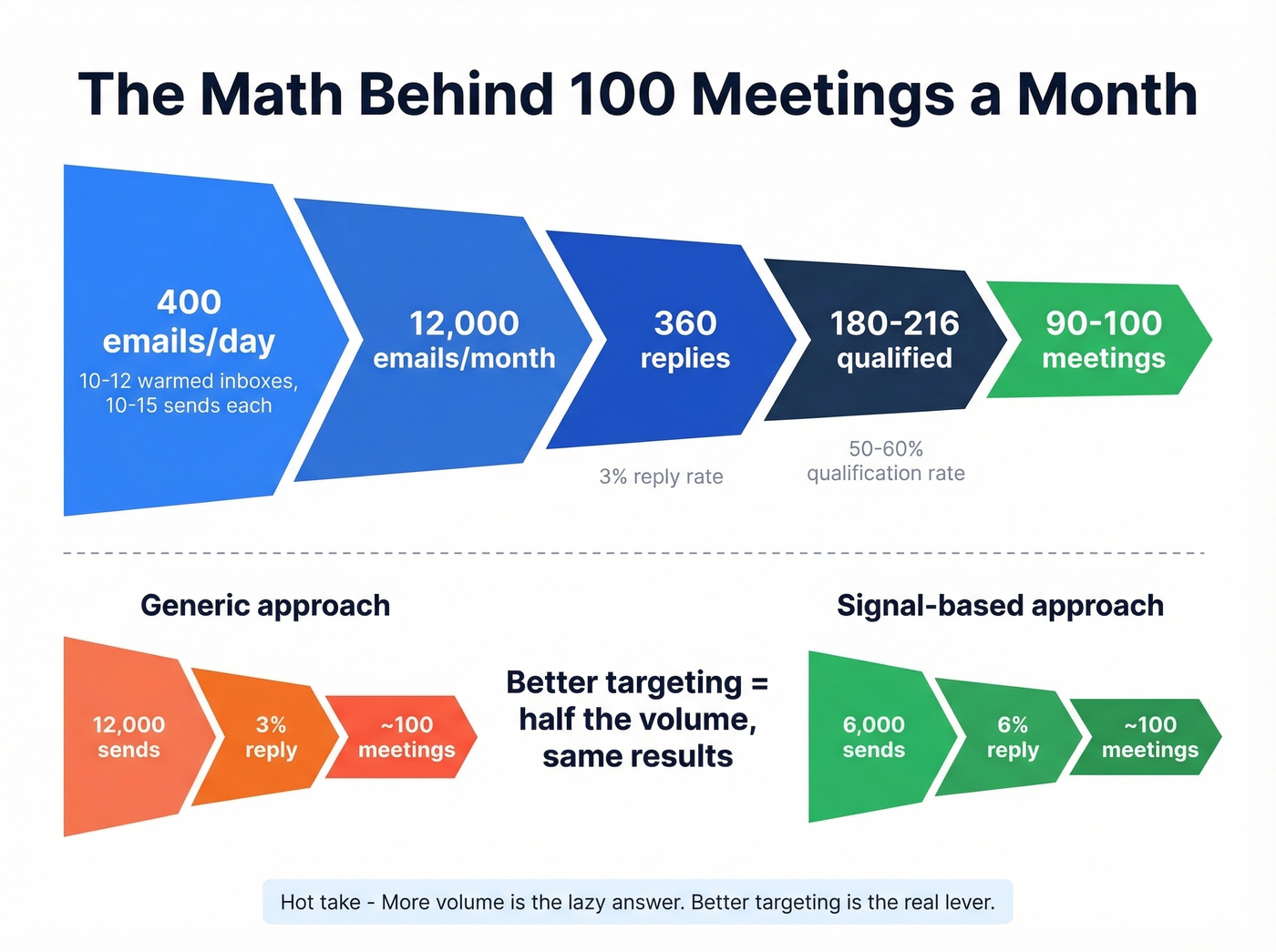
400 emails/day -> 12,000/month -> 3% reply rate -> 360 replies -> ~50-60% qualified -> 90-100 meetings/month.
That's 10-12 warmed-up inboxes sending about 10-15 emails each per day. Adjust the inputs for your reply rate and close rate. When signal-based personalization pushes reply rates to 5-6%, you need half the volume for the same output.
For teams closing deals under $15k, you probably don't need this kind of volume. A tighter list of 2,000 highly targeted contacts with 10%+ reply rates will outperform 12,000 generic sends every time. That's the hot take most guides won't give you: more volume is the lazy answer. Better targeting is the real lever. (If you need a framework for that, use an ideal customer profile scorecard.)
Infrastructure Nobody Talks About
The best cadence in the world fails if your emails land in spam. This is where almost everyone screws up, and it's the part most guides skip entirely.
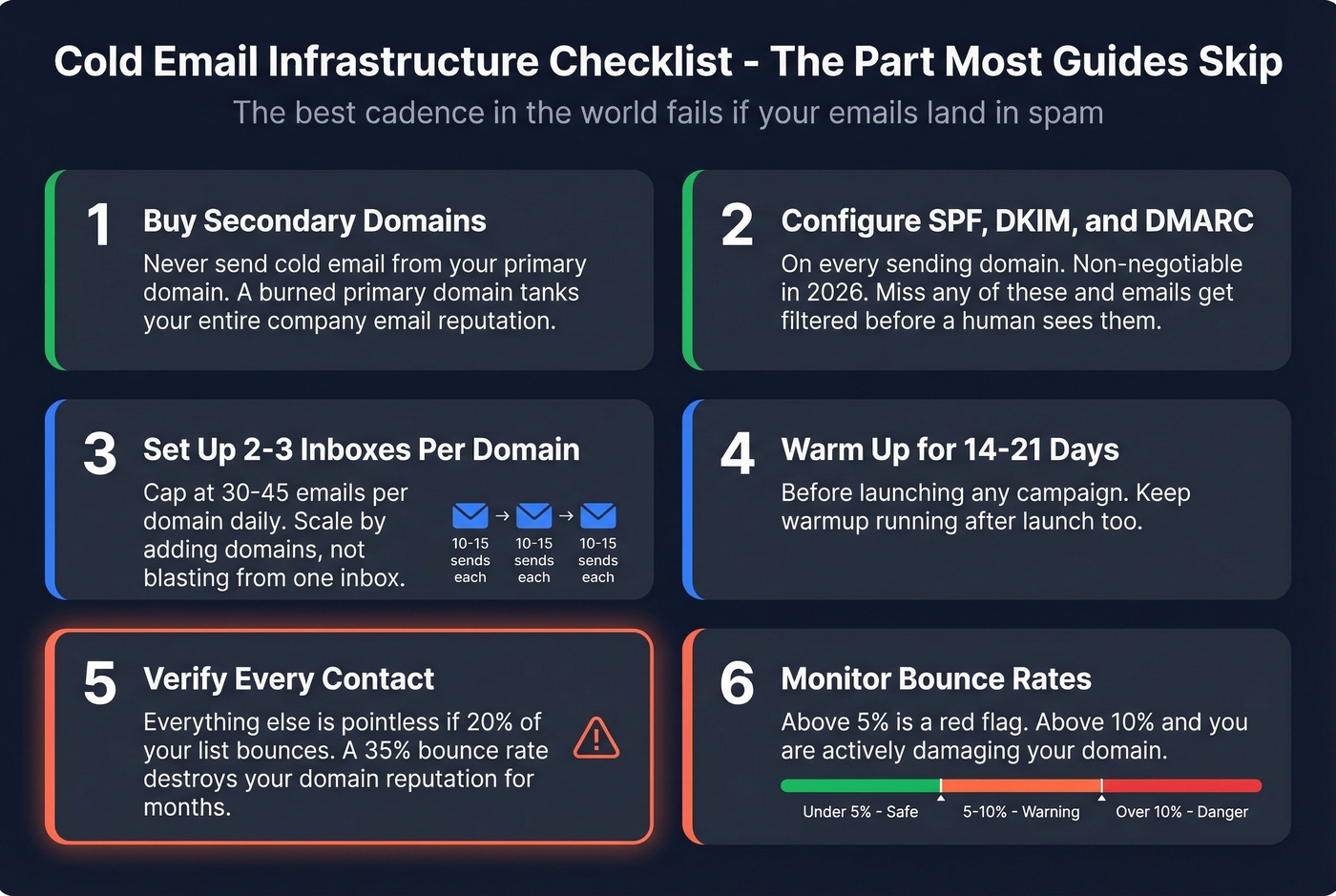
Your pre-launch checklist:
- Buy secondary domains. Never send cold email from your primary domain. A burned primary domain tanks your entire company's email reputation.
- Configure SPF, DKIM, and DMARC on every sending domain. Non-negotiable in 2026.
- Set up 2-3 inboxes per domain, capped at 30-45 emails per domain daily (about 10-15 per inbox per day). Scale by adding domains, not by blasting from one inbox.
- Warm up for 14-21 days before launching any campaign. Keep warmup running after launch.
- Verify every contact before loading into your sequencer. Everything else is pointless if 20% of your list bounces.
- Monitor bounce rates continuously. Above 5% is a red flag. Above 10% and you're actively damaging your domain.
That fifth step is where we've seen the most teams fail. A 35% bounce rate doesn't just waste sends - it destroys your domain reputation for months. Prospeo's 5-step verification catches bad addresses in real-time with 98% accuracy, including catch-all handling, spam-trap removal, and honeypot filtering. Data refreshes every 7 days instead of the industry-standard 6 weeks, so you're not sending to addresses that went stale last month. (For the full playbook, see our email deliverability guide.)
One of our customers, Meritt, went from a 35% bounce rate to under 4% and tripled their pipeline from $100K to $300K per week. The copy didn't change. The targeting didn't change. The data did.
What Outreach Actually Costs
Most teams have no idea what their campaigns cost per prospect. Here's the math for 1,000 contacts, based on a MarketOwl cost model:
| Line Item | Est. Cost (per 1,000 contacts) |
|---|---|
| Contact sourcing & verification | $530-$2,000 |
| Personalization / message prep | $800-$1,000 |
| Sending infrastructure | ~$480 |
| Follow-up labor | ~$200 |
| Response processing | ~$200 |
| Total (in-house) | ~$2,200 |
| Total (outsourced) | $1,500-$3,000 |
Contact sourcing is the biggest variable. Enterprise platforms charge $1+ per lead. At ~$0.01 per verified email, Prospeo cuts that largest line item by 90% - a difference that compounds fast when you're running campaigns against 10,000+ contacts per month. (If you're comparing vendors, start with these data enrichment services.)
The hidden cost most teams miss is infrastructure time. Between domain setup, warmup periods, and inbox management, expect 3-4 weeks before your first campaign even launches. Budget for that ramp.
Tools You Need
You need a data source, a sequencer, and a CRM. That's it. Practitioners stacking 8 tools and wondering why nothing works are solving the wrong problem. The consensus on r/salesdevelopment is that deliverability infrastructure and running lists through verification matter more than adding more software.
Data & Verification
Prospeo covers 300M+ professional profiles with built-in email and mobile verification, 30+ search filters including buyer intent signals across 15,000 topics, and native integrations with Instantly, Smartlead, Lemlist, HubSpot, and Salesforce so verified contacts flow directly into your sequences. Free tier gives you 75 emails and 100 Chrome extension credits per month - enough to test before committing.
Apollo ($49-99/mo per user) is budget-friendly with a solid free tier, good for smaller teams getting started. ZoomInfo ($15,000-40,000+/year) is enterprise-grade with the deepest US database but typically comes with annual contracts and long sales cycles.
Sequencing & Sending
Instantly ($30-97/mo) handles high-volume cold email with built-in warmup. Smartlead ($39-94/mo) specializes in multi-inbox sending infrastructure. Lemlist ($39-159/mo per user) adds personalization features. Salesloft and Outreach ($100-150/user/mo) serve enterprise sales engagement needs. (If you're building a stack, compare options in our roundup of SDR tools.)
CRM
HubSpot (free CRM tier; paid from $20/user/mo) or Salesforce ($25-300/user/mo). Pick whichever your team already uses. (If you’re still deciding, here are examples of a CRM with real pricing.)
6 Mistakes That Kill Reply Rates
- Sending from your primary domain. Buy secondary domains. Non-negotiable.
- Skipping email verification. A 35% bounce rate tanks every subsequent campaign you run from that domain.
- Fake personalization. "Hi {first_name}, I noticed you work at {company}" isn't personalization. Reference a trigger event, a tech stack detail, or recent company news.
- Stopping after one email. 42% of replies come on follow-ups. Run the full cadence.
- Misleading subject lines. Opens mean nothing if the reader feels tricked. Trust dies instantly and doesn't come back. (If you need ideas, use these cold email subject line examples.)
- Blasting one channel. Multichannel sequences get 2-3x more responses than single-channel. If you're only emailing, you're leaving meetings on the table.
You need 8 touchpoints across email, LinkedIn, and phone to book a meeting. Prospeo gives you verified emails, direct dials (125M+ mobiles, 30% pickup rate), and 30+ filters to target prospects showing real buying signals.
Every channel in your cadence deserves data that actually connects.
FAQ
What's the most effective outreach method for B2B in 2026?
Multichannel sequences combining email, LinkedIn, and phone outperform any single channel by 2-3x. Cold email averages a 3.43% reply rate alone, but LinkedIn with a personalized message hits 9.36%. The real multiplier is coordinating all three - prospects need 8+ touchpoints before booking a meeting.
How many follow-ups should I send?
At least 4-5 follow-ups across multiple channels over 14 days. 70% of salespeople stop after one email, yet 42% of replies arrive on subsequent touches. A structured cadence with a breakup email on day 14 consistently outperforms ad-hoc follow-ups.
How do I keep cold emails out of spam?
Send from secondary domains with SPF, DKIM, and DMARC configured, warm up inboxes for 14-21 days, and verify every email address before sending. Keeping bounce rates under 4% is what protects your sender reputation long-term.
What does a solid outreach process look like end to end?
Start by building a verified prospect list, then run a multichannel cadence of 8-12 touchpoints over 14-21 days across email, LinkedIn, and phone. Track reply rates and meeting conversions weekly, then iterate on messaging and targeting based on what the data shows. Teams that treat this as a repeatable system - not a one-off blast - consistently hit quota.