

How to Outsource Sales Prospecting Without Burning Money or Your Domain
Your SDR just quit. Pipeline coverage is dropping, the VP of Sales wants meetings booked yesterday, and HR says a replacement hire will take 10 weeks minimum. Meanwhile, sales pros spend 70% of their time on non-selling activities, average cold email reply rates have slid to 5.8%, and 80% of leads never convert. The math on doing everything in-house is getting worse every quarter.
You can outsource sales prospecting and make it work - but only if you avoid the traps that burn most teams' budgets and domains.
Three Paths (Quick Version)
An outsourced SDR or agency at $3K-$6.5K/mo gets you a dedicated rep, managed infrastructure, and the fastest route to pipeline. Freelancers at $5-$10/hr through Upwork handle data gathering and sequence execution - it's the most common budget entry point for micro-outsourcing. DIY with tools gives you maximum control at the highest time cost.
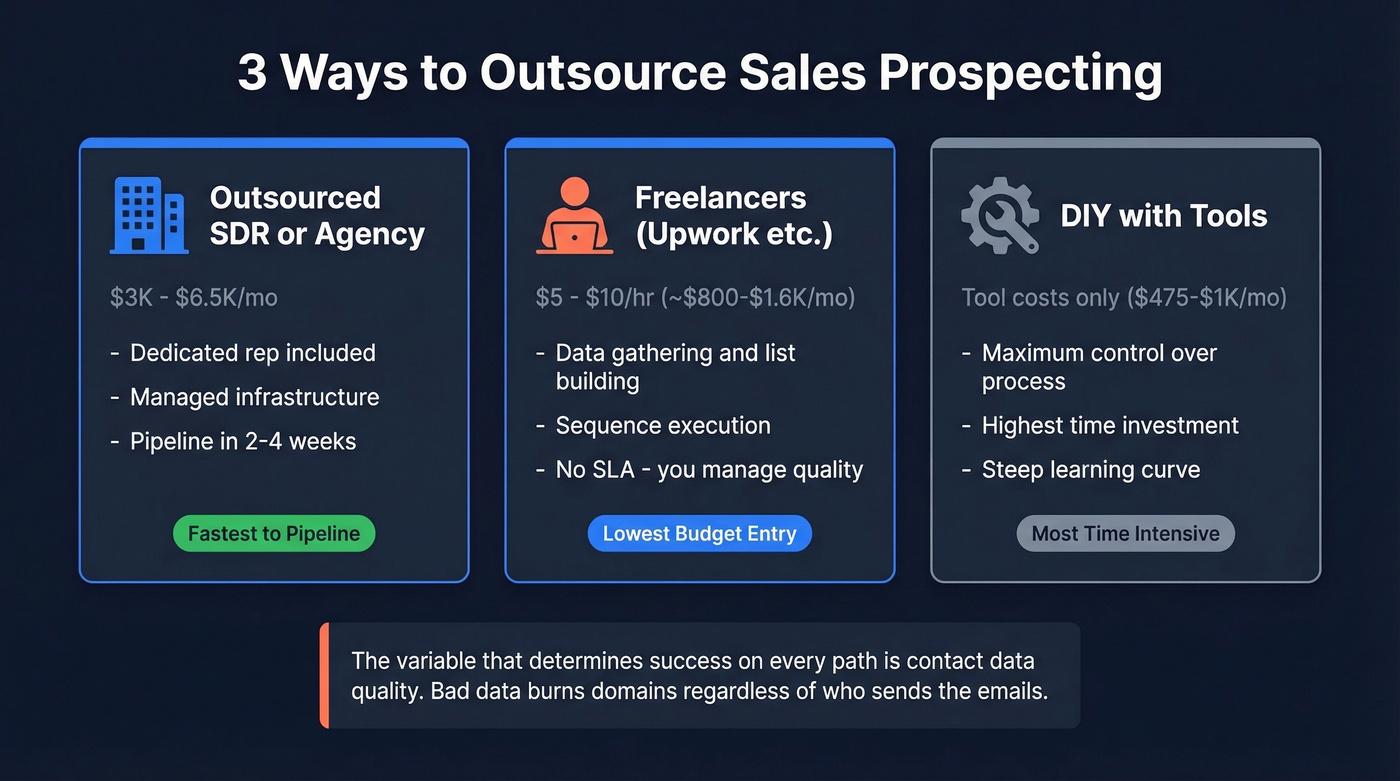
Here's the thing: the variable that determines success regardless of path is contact data quality. An agency running sequences on stale data will torch your domain just as fast as a junior SDR would.
What Outsourced Prospecting Costs in 2026
| Model | Monthly Cost | Per-Meeting Cost | Best For |
|---|---|---|---|
| Retainer | $3K-$12K/mo | Varies by volume | Predictable pipeline |
| Performance | 15-25% commission | $200-$500/meeting | Pay-for-results |
| Hybrid | $2.5K-$5K + $150-$300/mtg | Blended | Balanced risk |
| Freelancer | ~$800-$1.6K/mo | No SLA - estimate $400-$800 | Budget-constrained |
Performance models sound attractive, but vendors cherry-pick the easiest accounts and ignore harder verticals. Hybrid splits the risk, which is why it works best in practice.
Cost-Per-Meeting Reality
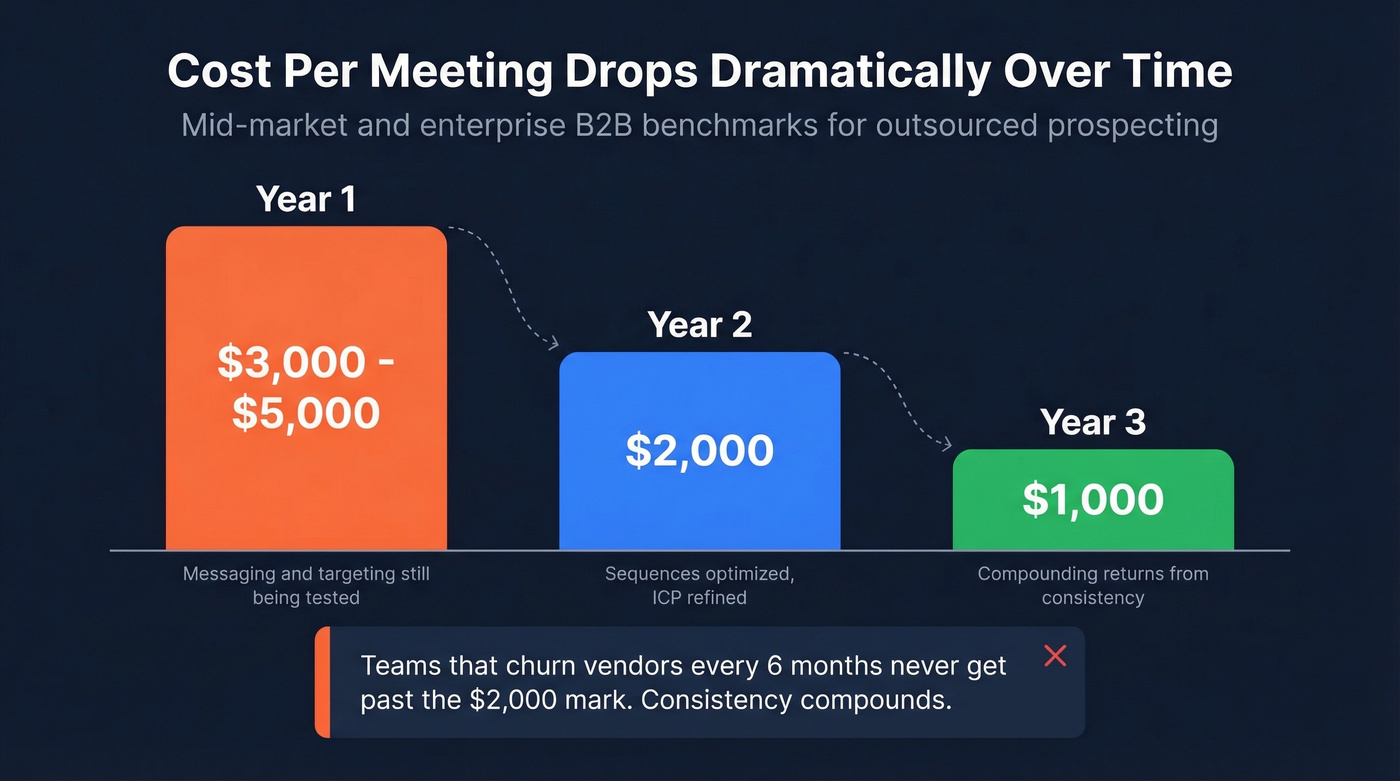
For mid-market and enterprise B2B, expect $3,000-$5,000 per meeting booked in year one. That drops to roughly $2,000 in year two and $1,000 in year three as messaging and targeting optimize. In our experience, teams that churn vendors every six months never get past the $2,000 mark - consistency compounds. If leadership expects $500 meetings from day one, reset that expectation before you sign anything.
Hidden Line Items
Watch for setup fees of $500-$5,000, tech stack pass-throughs of $50-$300/mo, and commission kickers that trigger at thresholds you didn't negotiate carefully. Always get a fully-loaded monthly cost estimate before signing.
The retainer number on the proposal is never the whole story.
In-House vs. Outsourced - The Real Math
| Factor | In-House SDR | Outsourced |
|---|---|---|
| Monthly cost | $9,750-$14,425 | $3,000-$6,500 |
| Tool stack | $475-$1,000/mo extra | Usually included |
| Time to pipeline | 3-6 months | 2-4 weeks |
| Control | Full | Partial |
| Ramp risk | You absorb it | Vendor absorbs it |
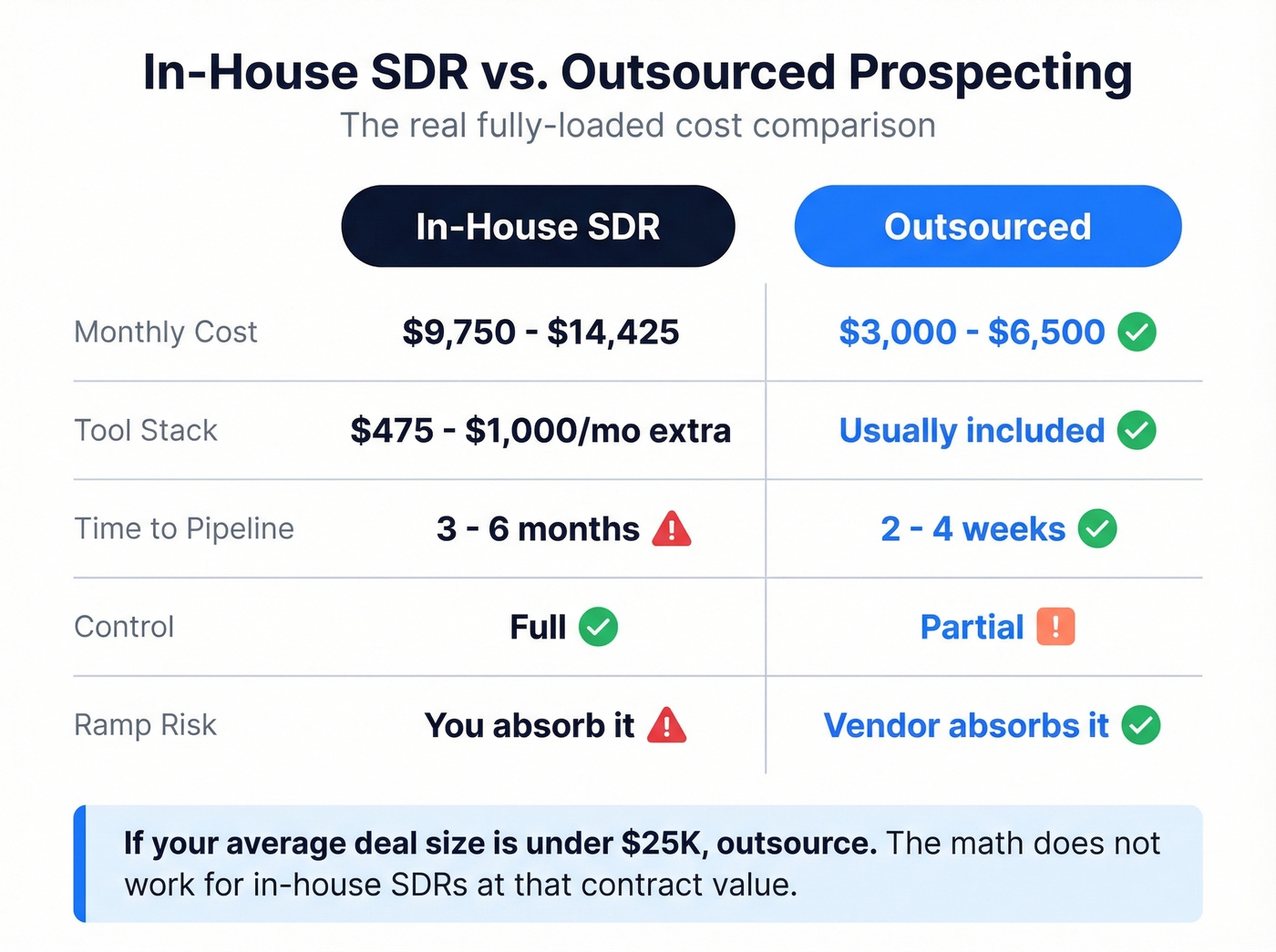
A fully loaded in-house SDR - salary, benefits, employer burden, tools, manager allocation - runs $9,750 to $14,425 per month before they book a single meeting. Outsourced equivalents start at $3,000/mo and deliver pipeline in weeks, not quarters.
If your average deal size is under $25K, outsource. The math doesn't work for in-house SDRs at that contract value. You'll spend more ramping a rep than you'll close in their first two quarters.
What Goes Wrong
Five failure modes kill outsourced prospecting programs:
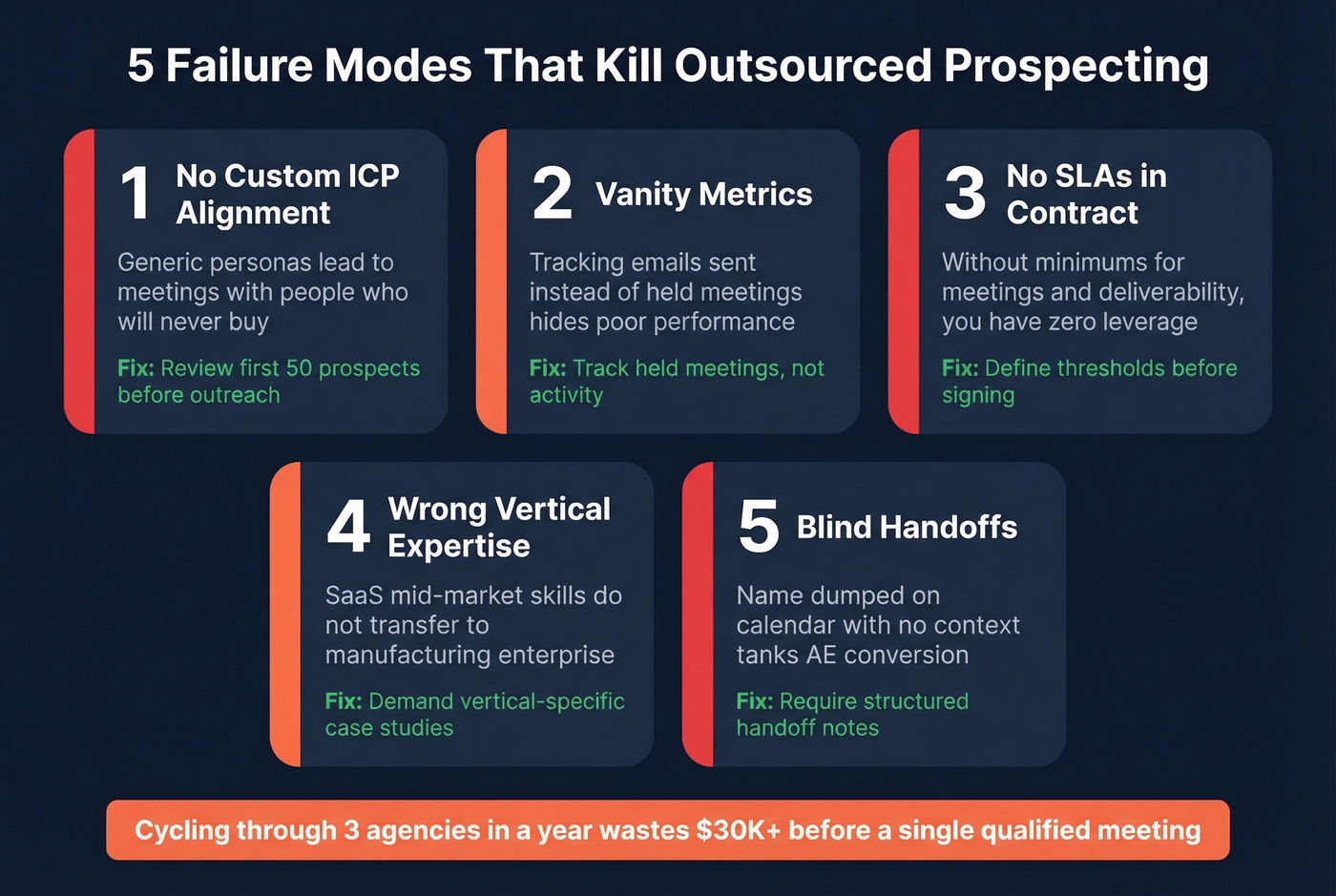
- No custom ICP alignment. Vendor uses a generic persona; meetings get booked with people who'll never buy. Review the first 50 prospects before outreach begins. (Use an Ideal Customer Profile scoring rubric, not gut feel.)
- Vanity metrics. Track held meetings, not emails sent. The gap between "booked" and "held" is where vendors hide. A Deloitte survey of 500+ leaders found that lack of benefit tracking is the top outsourcing drawback.
- No SLAs. Without minimum meetings, response times, and deliverability thresholds in the contract, you've got zero leverage. Tie deliverability to an email deliverability baseline.
- Wrong vertical expertise. A vendor great at selling SaaS to mid-market may be terrible at manufacturing-to-enterprise. Demand vertical-specific case studies.
- Blind handoffs. Meeting booked, name dumped in your calendar, no context. AE conversion tanks. Skip any vendor that won't sign a DPA early in the process.
We've watched teams cycle through three agencies in a year because they didn't nail ICP alignment upfront. That's $30K+ wasted before a single qualified meeting lands on the calendar.

Every outsourced prospecting failure in this article traces back to one root cause: bad data. Agencies can't book meetings when 25-35% of emails bounce. Prospeo's 7-day refresh cycle and 98% email accuracy keep your sequences landing in inboxes - whether you run them in-house or hand them to a vendor. At ~$0.01/email, verification costs less than a single wasted agency hour.
Fix the data layer before you sign another agency retainer.
How to Evaluate Outbound Agencies
Not all vendors are created equal. When vetting outbound prospecting agencies, start by asking how they build target lists. The best firms delegate SDR research to specialized data teams or use verified databases rather than scraping professional profiles blindly. Ask for a sample list of 50 contacts before you commit - if more than 5% bounce, their data pipeline is broken. (If you need a benchmark, start with email bounce rate targets.)
Next, evaluate their tech stack. Agencies that bundle domain warming, inbox rotation, and deliverability monitoring into their offering are far less likely to torch your sender reputation. Agencies that hand you a Mailshake login and wish you luck are selling labor, not expertise. If you're comparing stacks, use a shortlist of SDR tools and email reputation tools.
Check contract flexibility last. The best agencies offer 90-day pilots with clear exit clauses. If a vendor demands a 12-month commitment before you've seen a single held meeting, walk away. The consensus on r/sales is pretty clear on this: short pilots protect buyers, and vendors who resist them usually have retention problems they don't want you to see.
The Data Quality Variable

Contact data decays at 2-3% per month. The industry average refresh cycle is six weeks, meaning around 3-5% of records are dead before most databases update. We've seen teams launch outbound programs with 25-35% bounce rates because the vendor's data was garbage - and once your sending domain hits a blocklist, every email you send starts landing in spam. Fixing a burned domain takes weeks. Sometimes months.
This is where your data layer matters more than your agency choice. Prospeo's 7-day refresh cycle and 98% email accuracy across 143M+ verified emails directly addresses this problem. Snyk's sales team went from 35-40% bounce rates to under 5% after switching their data layer, and their AE-sourced pipeline jumped 180%. At roughly $0.01 per email, verification is trivial compared to the cost of a burned domain.
Whether you run outreach in-house or outsource sales prospecting to an agency, the data underneath determines whether those sequences actually land. (If you're building lists yourself, see data enrichment services and sales prospecting databases.)
Stack Optimize built a $1M agency with under 3% bounce rates across every client. Snyk's 50 AEs cut bounces from 35% to under 5% and grew AE-sourced pipeline 180%. The difference wasn't the outreach - it was 143M+ verified emails refreshed every 7 days underneath it. No contracts, no sales calls, free tier included.
Outsource the outreach. Own the data quality.
Compliance - You're Still Liable
Outsourcing doesn't shift legal accountability. GDPR fines reach EUR20M or 4% of global annual turnover, and regulators don't care that a third party sent the email.
| Your Responsibility | Vendor's Responsibility |
|---|---|
| Legally obtained data | Execute per local laws |
| Compliance SLAs in contract | Process opt-outs within 48 hrs |
| Audit rights + DPA in place | Share logs and secure data |
If a vendor pushes back on a Data Processing Agreement or sending log access, that's your exit signal. This applies whether you're working with a full-service agency or using a freelancer for outsourced sales development - you own the compliance risk either way. The ICO's guidance on data processors spells this out clearly. (Also align on ethics in sales so "compliance" isn't just legalese.)
When to Bring It Back In-House
Let's be honest - outsourcing isn't a permanent solution for every team. Once you've validated your ICP, dialed in messaging that converts, and built a repeatable playbook through an outsourced partner, hiring an in-house SDR starts making financial sense. The break-even point usually hits around month 8-10 of a successful outsourced engagement, assuming your deal sizes justify the fully loaded cost of a hire. A structured 30-60-90 day plan helps you de-risk that transition.
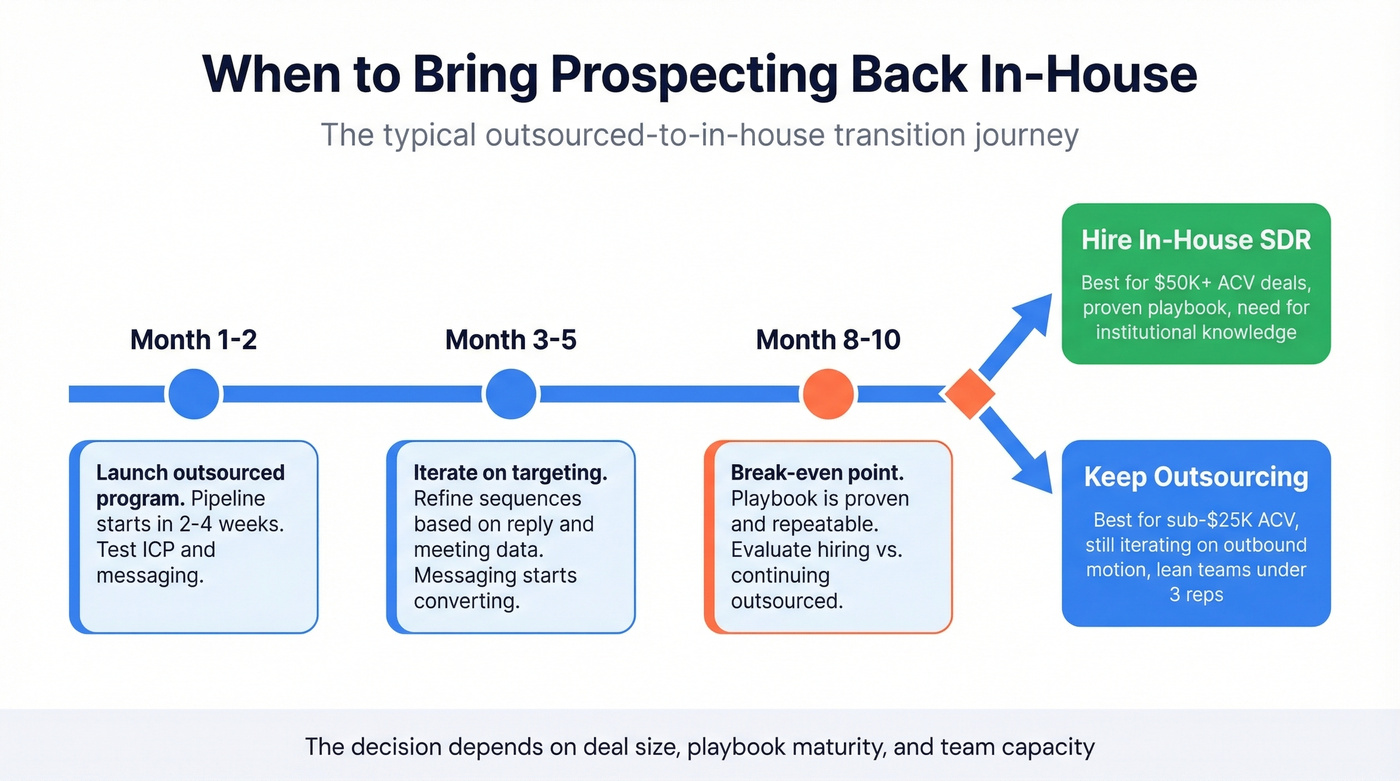
For teams running $50K+ ACV deals with a proven playbook, the control and institutional knowledge of an in-house rep outweighs the cost savings of outsourcing. For everyone else - especially teams still iterating on their outbound motion - outsourcing remains the smarter bet.
FAQ
When should I outsource prospecting instead of hiring?
When you need meetings in 30 days, not 6 months. Outsourced teams deliver pipeline in 2-4 weeks at $3K-$6.5K/month, while a new SDR hire takes 3-6 months to ramp. Hire in-house once you've validated the playbook and need long-term capacity.
What KPIs belong in an outsourced SDR contract?
Held meetings, meeting-to-opportunity conversion rate, cost per held meeting, and email deliverability above 95%. Define these before you sign. Lack of benefit tracking is the #1 outsourcing drawback across Deloitte's survey of 500+ leaders.
How do I verify my vendor's contact data accuracy?
Benchmark independently with a verification tool before launching sequences. If bounce rates exceed 5%, the data is stale. Bad data burns domains and makes good vendors look incompetent.
Is prospecting as a service worth it for small teams?
For teams with fewer than three reps, it's often the most cost-effective path to pipeline. You skip the overhead of hiring, training, and tooling an in-house SDR while still getting qualified meetings on your calendar within weeks.