

Partner Enablement: A Data-Backed Playbook for Channel Leaders in 2026
Your VP of Partnerships just told the board you'll hit 25% partner-sourced revenue by Q4. You've got a Slack channel, a shared Google Drive, and exactly zero partners who've closed a deal this quarter. That gap between the board slide and reality is where partner enablement lives - or dies.
Forrester's ecosystem report found 67% of B2B partner ecosystem leaders plan for indirect revenue to grow above or significantly above last year. The ambition is there. The infrastructure usually isn't.
What you need before buying any software: a 30-60-90 onboarding plan, a partner-facing pitch deck, and a deal registration process. The rest is optimization.
What Partner Enablement Actually Is
Partner enablement is two workstreams running in parallel. The external workstream equips your channel partners - resellers, referral partners, affiliates, MSPs, system integrators - with the training, content, and tools to sell your product. The internal workstream enables your own team to support those partners effectively. Most companies only think about the first one and wonder why things break.
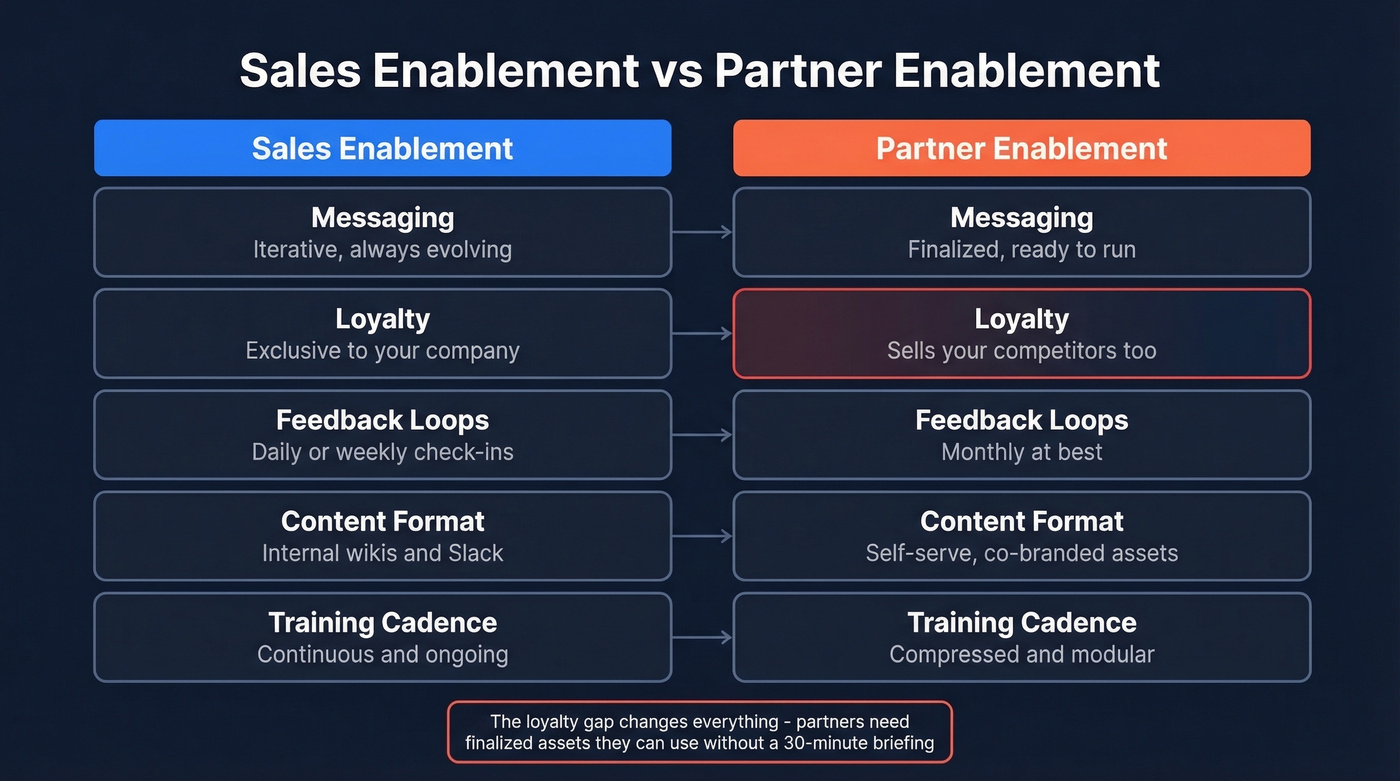
The distinction from sales enablement is structural, not semantic. Your internal reps get weekly pipeline reviews, Slack access to product managers, and real-time competitive intel. Partners get a PDF and a quarterly check-in.
| Dimension | Sales Enablement | Partner Enablement |
|---|---|---|
| Messaging | Iterative, evolving | Finalized, ready-to-run |
| Loyalty | Exclusive to you | Sells competitors too |
| Feedback loops | Daily/weekly | Monthly at best |
| Content format | Internal wikis, Slack | Self-serve, co-branded |
| Training cadence | Continuous | Compressed, modular |
That "sells competitors too" row changes everything. As Highspot's research notes, partners need clear, finalized messaging they can position without a 30-minute briefing. If your battlecard requires context your partner doesn't have, it won't get used.
Enablement needs also differ by partner type. A co-sell partner needs joint account planning and AE introductions. A referral partner needs a one-pager and a deal registration link. An MSP needs API documentation and technical certification. Treating all partners identically is the fastest way to under-serve everyone.
Why Channel Partners Need Enablement Now
The numbers behind partner ecosystems aren't incremental - they're structural. McKinsey projects partner ecosystems will drive $80T in annual revenue by 2030. That's not a growth channel. That's the growth channel.
At the deal level, the data is even more compelling. Crossbeam found partner-influenced deals are 53% more likely to close and close 46% faster. Introw's data shows partner-involved deals run 32% larger with a 2.8x win rate. Certified partners close deals 38% faster and earn 6x more than untrained ones. Glide grew partner-sourced revenue to 30% of total company revenue. Enablement also reduces customer acquisition cost by roughly 15%, which makes the internal business case almost trivially easy to build.
Here's the thing, though: the Sales Enablement Collective's landscape benchmarks tracked pipeline growth rates climbing from 23.2% to 36.2% after organizations tightened their enablement programs. But 24.2% of enablement leaders say 80%+ of their content goes completely unused. Building assets nobody uses is worse than building nothing, because it creates the illusion of progress.
The 5-Stage Framework
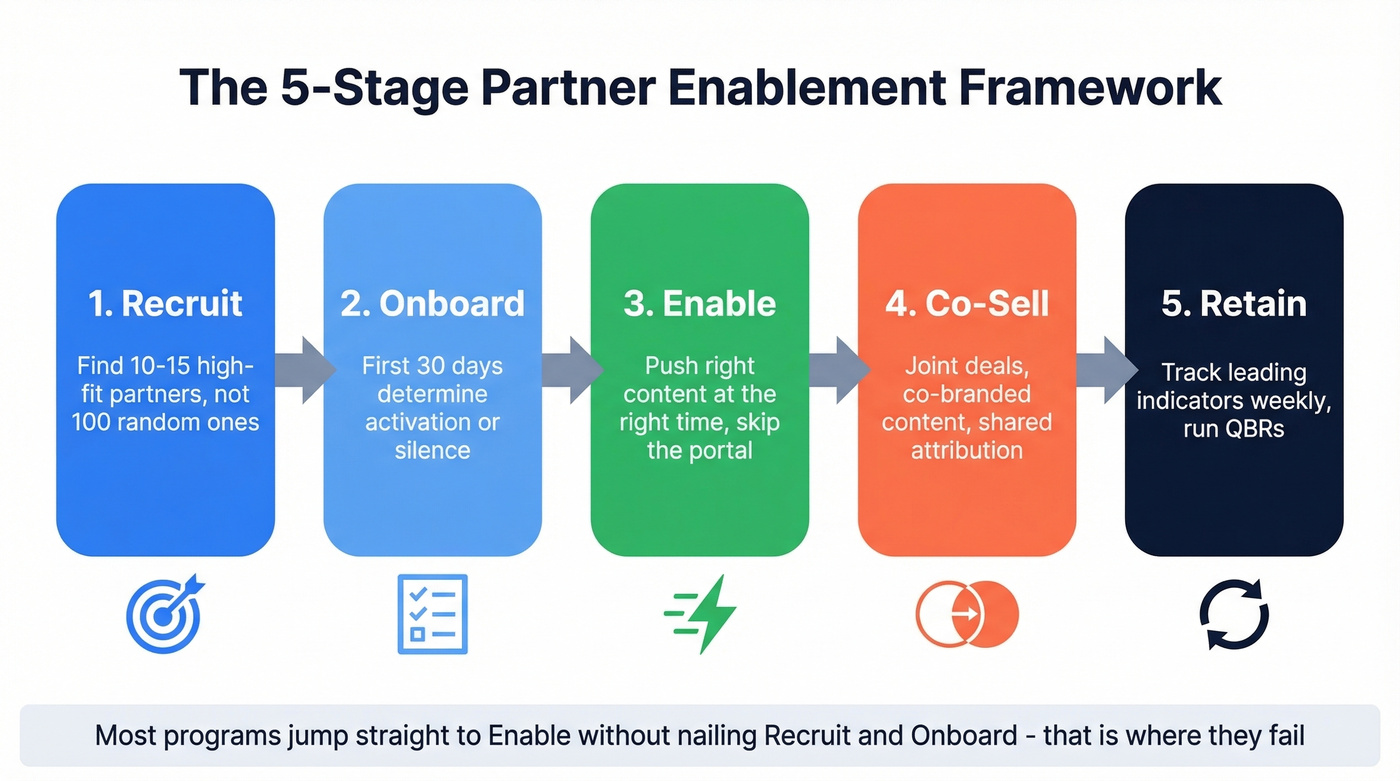
Every partner relationship follows the same arc: recruit, onboard, enable, co-sell, retain. The mistake most programs make is jumping straight to "enable" without nailing the first two stages.
Recruit
Recruitment isn't about volume - it's about fit. Define your ideal partner profile the same way you'd define an ICP: market overlap, technical capability, customer base alignment, and willingness to invest. Start with 10-15 high-fit partners, not 100 random ones. Use a B2B data platform like Prospeo to find verified contact info for decision-makers at target partner organizations - you need direct lines to partnership leads, not info@ addresses.
Onboard
The first 30 days determine whether a partner activates or goes dark. Your onboarding kit needs a product overview, competitive positioning, a co-branded pitch deck, and a clear deal registration process. Kiflo's research found that adding a 30-day post-onboarding email sequence improved partner activity by 42%. That's not a drip campaign - it's a structured nudge sequence with specific asks at each touchpoint. Budget for at least one in-person kickoff or workshop if your deal sizes support it; the relationship ROI compounds for months.
Enable at Scale
Stop building a partner portal. Build a partner inbox.
Portal engagement drops fast after the initial onboarding burst. What works is pushing the right content to the right partner at the right time - battlecards before a competitive deal, case studies before a QBR, pricing updates before renewal season. The cadence question that comes up constantly on r/techsales - weekly webinars? Monthly? - misses the point. Cadence matters less than relevance. AI-powered role-play tools are also gaining traction for partner training, letting reps practice objection handling without burning real prospect conversations.
Co-Sell and Co-Market
This is where enablement translates to revenue. Co-selling means your AEs join partner-led deals when the deal size or complexity warrants it. Co-marketing means joint webinars, co-branded content, and shared lead lists. The key asset is a co-sell playbook that defines when to engage, who owns the relationship, and how indirect revenue gets attributed.
Retain and Grow
Partner churn is silent. Nobody sends a breakup email - they just stop registering deals.
Track leading indicators weekly and flag any partner whose engagement drops below baseline for two consecutive weeks. QBRs aren't optional. Neither is a tiered incentive structure that rewards growth, not just existence. We've found that running mystery shopper tests - sending a dummy lead through your partner's funnel to verify follow-up quality - catches problems that no dashboard will surface, including partners quietly diverting leads to competitors.
The 30-60-90 Day Onboarding Plan
If your partner hasn't closed a deal within 90 days, the relationship is at high risk of stalling permanently.
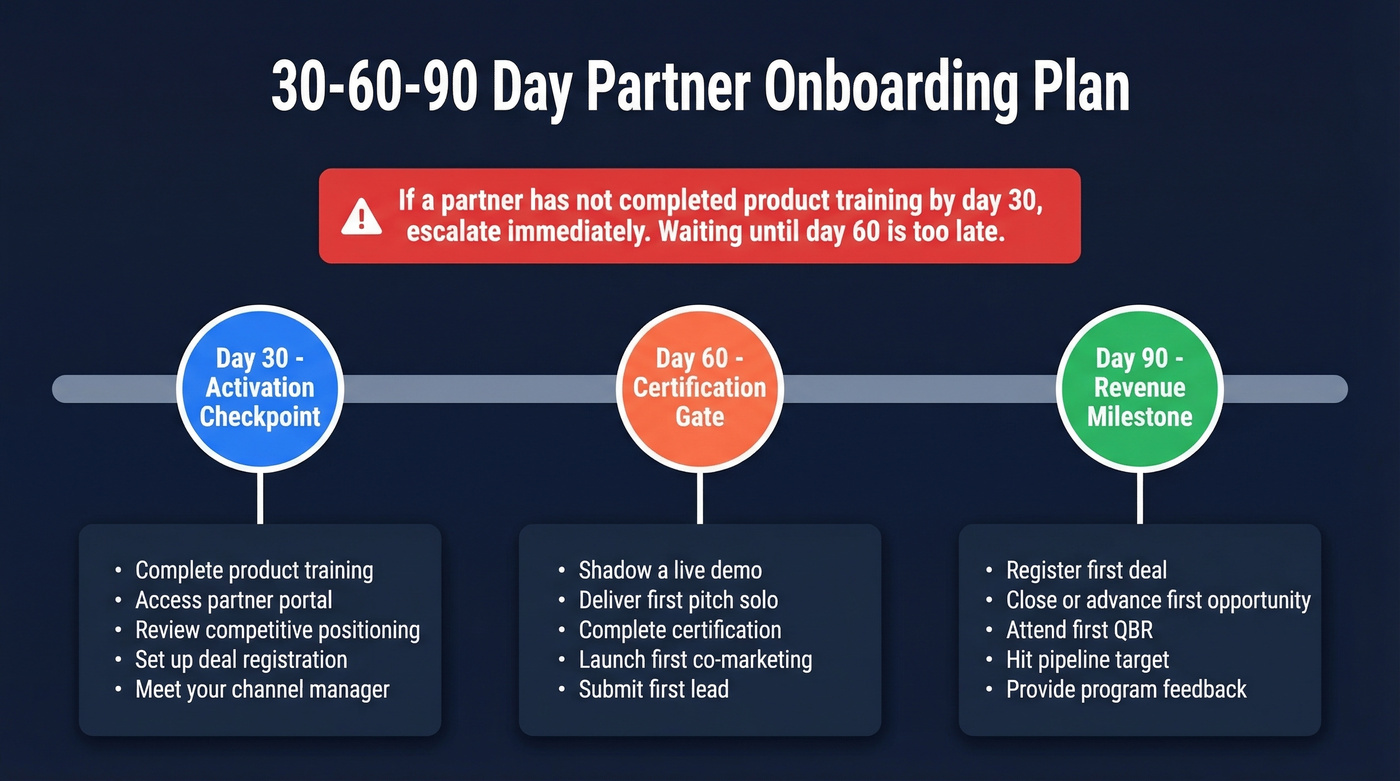
| Day 1-30 | Day 31-60 | Day 61-90 |
|---|---|---|
| Complete product training | Shadow a live demo | Register first deal |
| Access partner portal | Deliver first pitch solo | Close or advance first opp |
| Review competitive positioning | Complete certification | Attend first QBR |
| Set up deal registration | Launch first co-marketing | Hit pipeline target |
| Meet assigned channel manager | Submit first lead | Provide program feedback |
The 30-day mark is your activation checkpoint. If a partner hasn't completed product training by day 30, escalate immediately. Waiting until day 60 to notice disengagement is too late.

Your partner recruitment stage lives or dies on reaching the right decision-makers. Prospeo gives you verified emails and direct dials for partnership leads across 300M+ professional profiles - with 30+ filters to match your ideal partner profile by tech stack, headcount growth, and market overlap.
Stop emailing info@ addresses. Reach partnership leads directly.
Building Your Content Library
The best partner content libraries we've worked with share one pattern: they're organized by sales stage, not by asset type. Partners don't think "I need a battlecard." They think "I'm going into a competitive deal against Palo Alto and I need ammo."
Essential assets, ranked by impact:
- Battlecards - Netskope battlecards are a widely referenced example of concise competitive positioning
- Co-branded pitch decks - Dell's partner collateral is a commonly cited model in asset roundups
- Product playbooks with objection handling - keep these under 5 pages or they won't get read
- Demo videos partners can share without scheduling your SE
- ROI calculators - these consistently shorten deal cycles when included in partner toolkits
Remember that 24.2% content waste stat? A practitioner thread on partner/reseller ops highlights that maintaining partner-specific versions of decks in Google Slides creates a brutal customization burden. Tools like Gamma can regenerate segmented partner decks from a base version, and the practitioner who tested it reported significant time savings on the first few partner decks. The fix isn't more content - it's fewer, better assets that any rep can adapt in 10 minutes.
How to Measure Program Success
Most partner programs track lagging indicators and wonder why they can't course-correct. The Introw KPI framework gets this right by separating leading indicators from lagging ones.
| KPI | Type | Frequency | Target |
|---|---|---|---|
| Onboarding completion | Leading | Weekly | 85%+ within 30 days |
| Training/cert completion | Leading | Weekly | 70%+ within 60 days |
| Content adoption rate | Leading | Weekly | 40%+ of active partners |
| Portal engagement | Leading | Weekly | 3+ logins/month |
| Deal registration volume | Lagging | Monthly | 2+ per partner/quarter |
| Time to first deal | Lagging | Quarterly | Under 90 days (median) |
| Partner-sourced revenue | Lagging | Quarterly | 15-25% of total |
| Partner satisfaction (NPS) | Lagging | Quarterly | 40+ |
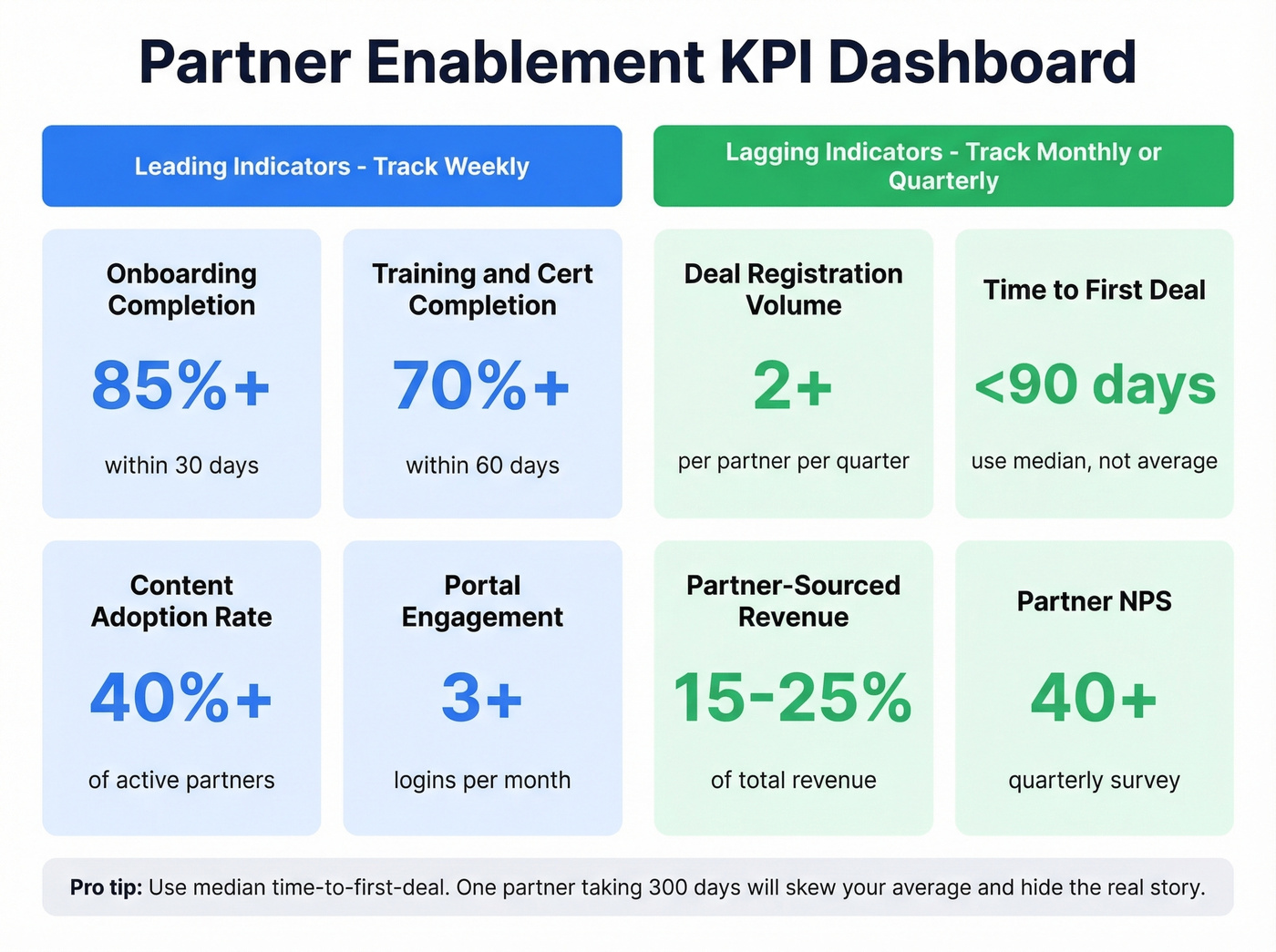
Use median time-to-first-deal, not average. One partner who takes 300 days will skew your average and hide the fact that most partners activate in 60-75 days. Track leading indicators weekly in your CRM - if you're reviewing them quarterly, you're doing post-mortems, not enablement.
Why Partner Programs Fail
In our experience, five failure modes kill partner programs repeatedly. They're predictable, and they're almost never about the technology.
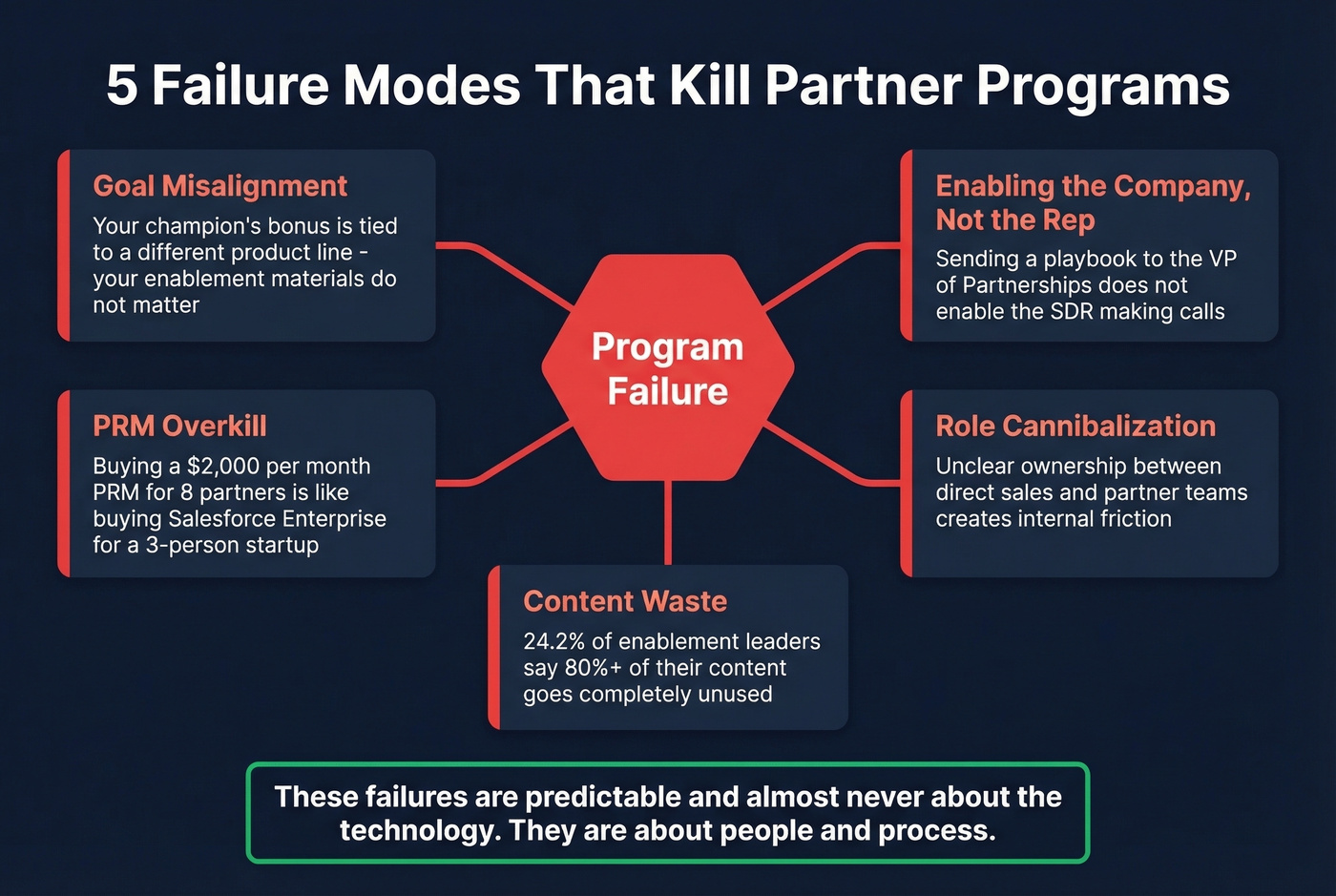
Goal misalignment at the individual level. Company-level alignment is easy - both sides want revenue. But as Federico Presicci points out, the individual partner manager has their own priorities. If your champion's bonus is tied to a different product line, your enablement materials don't matter.
Enabling the company, not the rep. Sending a partner playbook to the VP of Partnerships doesn't enable the SDR who's actually making calls. Content needs to reach the person doing the work.
PRM overkill for early-stage programs. Buying a $2,000/month PRM when you have 8 partners is like buying Salesforce Enterprise for a 3-person startup. Skip this if you're under 20 partners - a shared Notion workspace and a weekly Zoom call will outperform any portal at that scale.
Role cannibalization. The r/salesengineers thread about "Channel Sales Engineer" roles secretly meaning L1 support is painfully common. When your channel SE spends 80% of their time on support tickets, you don't have an enablement problem - you have a headcount problem.
No feedback loops. Partners won't proactively tell you what's broken. Monthly pulse surveys and quarterly QBRs are the minimum. Skip them and you're flying blind.
Let's be honest: if your average deal size is under $10K, you probably don't need a formal enablement program at all. A referral bonus and a one-pager will outperform a six-figure PRM investment at that price point. Save the infrastructure for when partner-sourced deals justify the overhead.
Partner Enablement Tech Stack
The PRM market is crowded and pricing is all over the map. We've mapped the landscape so you don't have to sit through six demo calls.
| Tool | Starting Price | Best For |
|---|---|---|
| Kiflo | Free; $249-$799/mo | Early-stage programs |
| PartnerPortal.io | Free; $599-$1,199/mo | Self-serve partner portals |
| PartnerStack | Custom (often revenue-share) | Scaling SaaS marketplaces |
| Crossbeam | From ~$150/mo (billed annually) | Account mapping / overlap |
| Channeltivity | From $1,399/mo | Mid-market channel mgmt |
| Salesforce PRM | From $25/user/mo | Existing SF customers |
| Impartner | From $2,000+/mo | Enterprise (100+ partners) |
For early-stage programs under 20 partners, Kiflo's free tier is the obvious starting point. PartnerStack handles payouts and marketplace distribution well for scaling SaaS companies. Enterprise programs with 100+ partners typically land on Impartner or Salesforce PRM.
Beyond PRMs, you'll want an LMS for certification like Docebo and a content platform for asset distribution like Highspot. The lever most programs overlook is prospect data quality - if you're handing partners a target account list with 30% bounced emails, you're setting them up to fail before they send a single outreach. If you need a deeper benchmark-driven approach to list quality, start with lead enrichment. Enriching partner lists with Prospeo before handoff removes that friction point entirely, since its 7-day data refresh cycle means the contacts your partners receive are actually current.
Partner Enablement Plan Template
Adapt this structure to your program size. A 10-partner program needs monthly check-ins, not quarterly QBRs with every partner. A 100-partner program needs automation at every stage.
- Objectives: Revenue target, partner activation rate, time-to-first-deal goal
- Ideal Partner Profile: Industry, customer overlap, technical capability, geographic coverage
- Essential Training: Mandatory (product, competitive positioning, deal registration) + Optional (advanced integrations, vertical-specific)
- Key Resources: Pitch deck, battlecards, demo environment access, ROI calculator, co-branded templates
- Communication Cadence: Weekly async updates, biweekly syncs, monthly pipeline reviews, quarterly QBRs
- Incentivization: Tiered MDF, SPIFs for first deal, certification bonuses, annual partner awards
- Risks and Blockers: Champion turnover, competing vendor priorities, support capacity constraints, content staleness
Co-sell and co-market campaigns need accurate contact data on both sides of the table. Prospeo's CRM enrichment fills in 50+ data points per contact at a 92% match rate - so your shared lead lists actually convert and your partners never blame bad data for missed pipeline targets.
Enrich your shared lead lists at $0.01 per email. Zero bad data excuses.
FAQ
How is partner enablement different from channel enablement?
They're functionally identical. "Channel enablement" is the older term from the reseller era; "partner enablement" reflects the shift toward ecosystem partnerships - referral, affiliate, co-sell, and technology integrations - that go beyond traditional reseller channels. Use whichever term your organization prefers; the playbook is the same.
How long does it take to see ROI from a partner program?
Most structured programs see measurable pipeline impact within 90-180 days. Apollo grew partner revenue to 10% of total company revenue in two years starting from a one-person team and nearly 4,000 partners. Programs with a structured 30-60-90 onboarding plan activate partners 2-3x faster than those relying on a kickoff call and a PDF.
What does a partner enablement manager do?
A partner enablement manager owns the content, training, and processes that help channel partners sell your product independently. Day-to-day, that means building onboarding sequences, maintaining the content library, running certification programs, tracking activation KPIs, and bridging your product team and partner ecosystem.
What's the best free tool for building partner prospect lists?
Prospeo's free tier includes 75 email credits and 100 Chrome extension credits per month - enough to source verified contacts at 15-20 target partner organizations. Crossbeam also offers a free plan for account mapping, and Kiflo's free PRM handles basic partner management for early-stage programs.