

PathFactory Pricing, Reviews, Pros and Cons (2026)
You just got the PathFactory renewal quote. $43,000. Your CMO wants to know if the content tracks are actually driving pipeline or just making PDFs look prettier. Fair question.
This breakdown covers what PathFactory actually costs, what real users say about it, and whether it's worth the spend - so you can make that call with data, not vendor marketing.
30-Second Verdict
PathFactory is a strong content experience platform, but at a median $43,000/year, it's really built for enterprise marketing teams with a serious content engine and someone who can own the platform day-to-day. If you're a startup or SMB, skip it. And here's the thing - if your real problem is prospect data quality (emails bouncing, phone numbers going nowhere), no content platform fixes that. You need clean data first.
What PathFactory Actually Costs
PathFactory doesn't publish pricing. You'll talk to sales, sit through a demo, and get a custom quote. But based on Vendr's benchmark data across 41 actual purchases, we've got real numbers to work with.
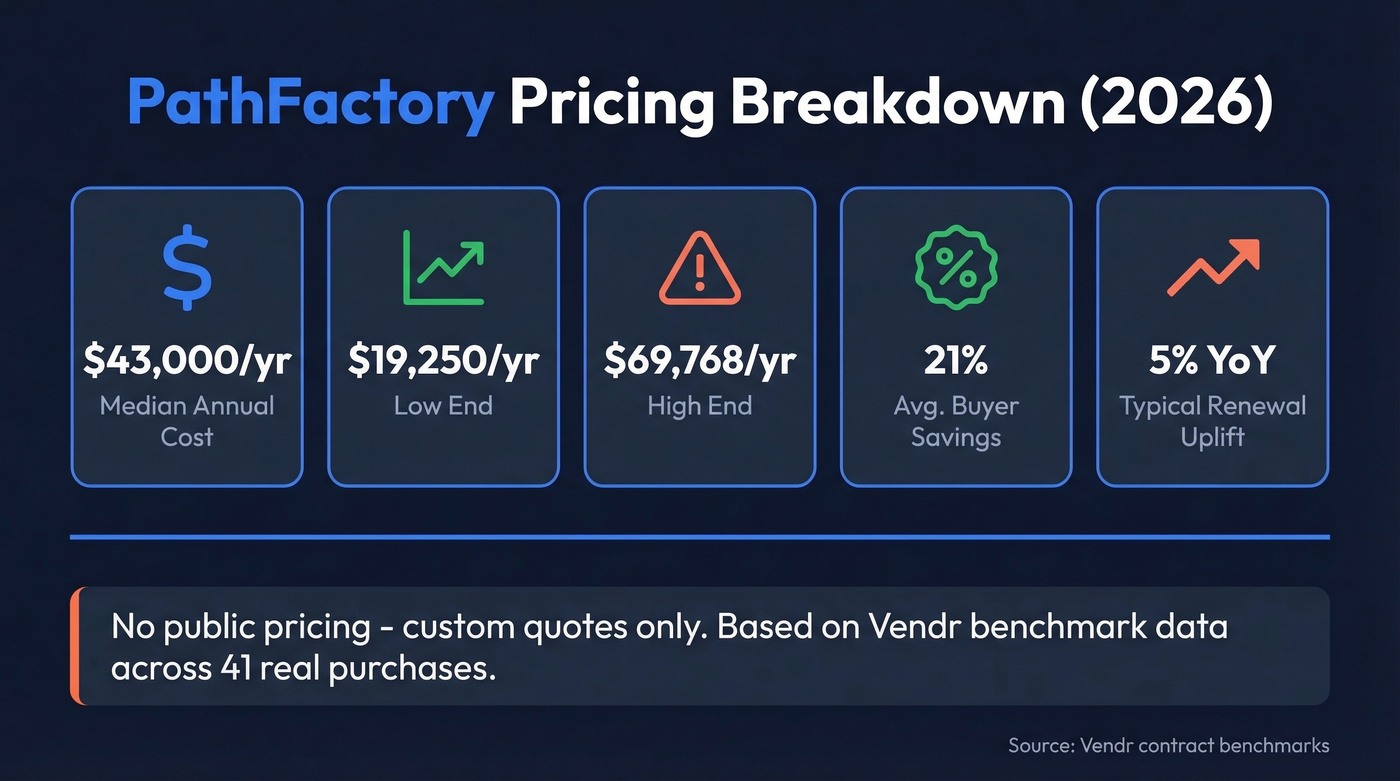
| Metric | Amount |
|---|---|
| Median annual cost | $43,000 |
| Low end | $19,250/yr |
| High end | $69,768/yr |
| Avg. buyer savings | 21% |
| Typical uplift at renewal | 5% YoY |
You're paying based on the modules you buy and how much you use the platform, not a simple per-seat price. That's good news for large marketing teams, but the sticker price is high regardless of headcount. A secondary benchmark puts the median closer to $49,900/year. Either way, expect $40-50K/year before you've trained anyone.
How to Negotiate
Don't accept the first quote. Here's what actually works:
- Implementation fees ($5K-$20K) are often waived on new purchases. Push for it.
- The 5% annual uplift shows up in contracts, but at least one buyer negotiated it down to 3%.
- Vendr benchmarks show 21% average savings across purchases - use that as your anchor.
- Bring competitive quotes from Folloze or Hushly. Nothing moves a sales rep like a real alternative sitting on the table. (If you want a framework, use an anchor and set a clear walk away point.)
What PathFactory Does
PathFactory builds personalized content experiences - curated playlists, resource hubs, and ABM microsites that match content to where each buyer is in their journey. It captures first-party engagement data (time spent, topics consumed, journey paths) and rolls it up to the account level.

The platform lists 13 integrations on G2, including 6sense, Adobe Experience Manager, Marketo Engage, HubSpot Marketing Hub, Oracle Eloqua, Google Analytics, Snowflake, and ZoomInfo. ChatFactory, their AI chatbot layer, guides buyers through content recommendations. It carries a 4.4/5 on G2 from 201 reviews, and average implementation takes about 2 months.

PathFactory tracks content engagement - but engagement means nothing if your emails never land. Meritt cut their bounce rate from 35% to under 4% and tripled pipeline to $300K/week by fixing their data foundation with Prospeo. At $0.01 per verified email vs $43K/year, the ROI math isn't close.
Fix your data before you optimize your content tracks.
PathFactory Pros
The most consistent praise across G2 reviews: teams go from weeks to hours when building new content experiences. Content quality was the #1 cited strength with 12 mentions, followed by ease of use at 11 and customer engagement at 9.
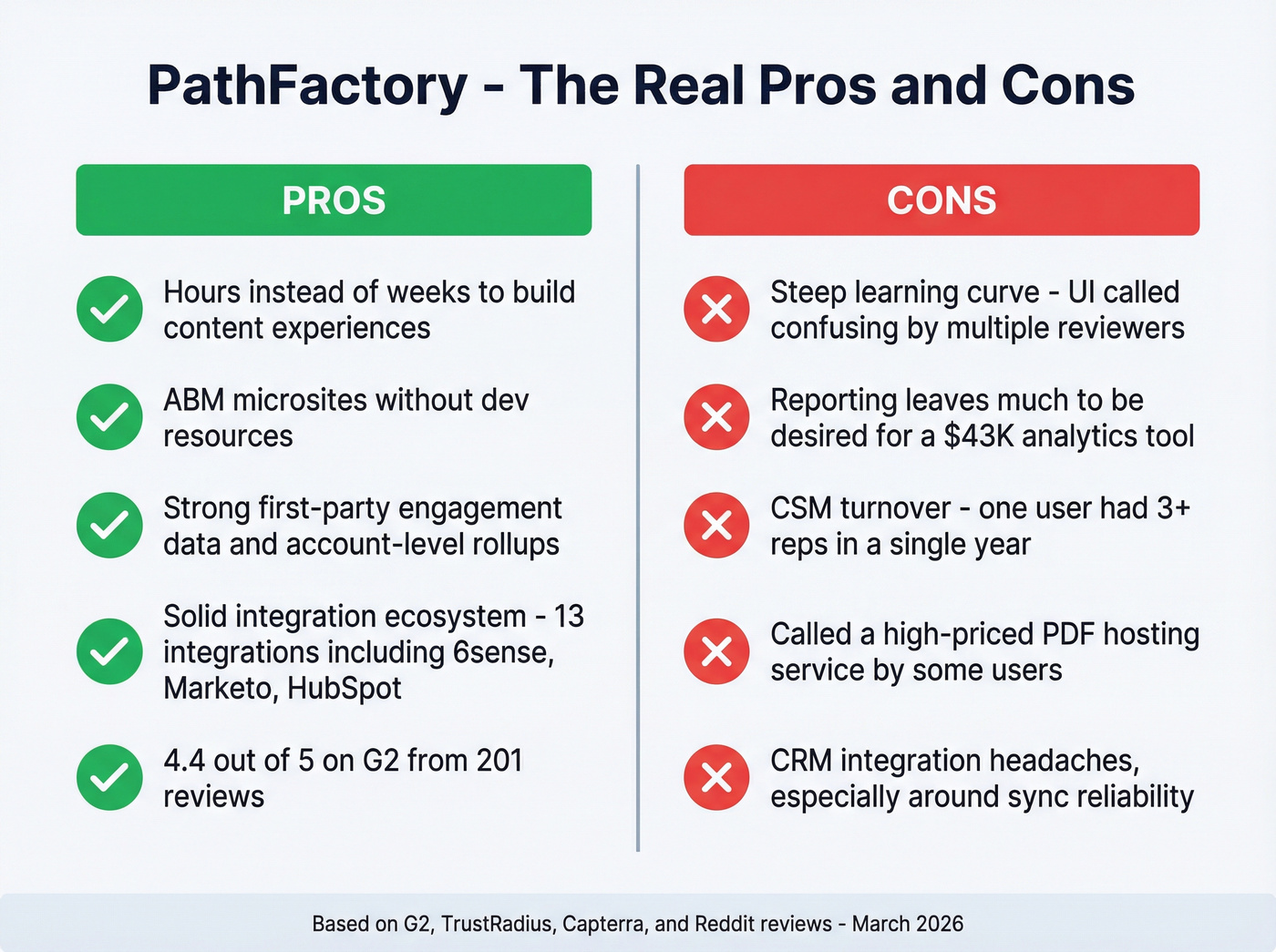
TrustRadius reviewers highlight the ability to spin up personalized ABM microsites without dev resources, cutting launch time from weeks to days. Analytics was called out in 8 reviews as a standout - it gives marketing ops teams something concrete to show leadership beyond "we published 12 blog posts this month."
PathFactory publishes impressive case studies: CallMiner saw a 250% increase in MQLs, Fiix reported a 70% higher win rate, and Cisco hit 3.5X customer adoption. These are vendor-published numbers, so treat them directionally. The actual user review sentiment is more mixed, which tells you the platform delivers for well-resourced teams but isn't magic.
PathFactory Cons
Steep learning curve. Five G2 reviewers flagged this, and Capterra reviews back it up - the UI is "confusing at first" and multiple users have asked for a redesign. For a $43K tool, that's a rough first impression.
Reporting falls short. For a platform that sells on content intelligence, the reporting gets surprisingly mediocre reviews. A February 2026 G2 reviewer said it "leaves much to be desired." We've seen this pattern before - the data collection is solid, but the out-of-the-box dashboards don't do it justice.
CSM turnover. One TrustRadius reviewer reported going through 3+ customer success managers in a single year. Support inconsistency is a recurring theme across reviews.
The "expensive PDF hosting" problem. A TrustRadius reviewer called PathFactory a "high-priced PDF hosting service," citing a clunky, dated UX. On Reddit, practitioners call it "incredibly expensive" and question whether IP-based account identification - a limitation shared across tools like 6sense and Demandbase - even hits 30% accuracy.
Integration headaches. Four G2 reviewers cited issues, particularly around CRM sync. When you're paying enterprise pricing, CRM integration should just work.
Who Should (and Shouldn't) Buy
Buy PathFactory if you're an enterprise B2B marketing team with a complex content library, a Salesforce/Marketo-style stack, and a dedicated marketing ops person. PathFactory's benchmark data shows 83% of marketers gate content and 65% say gating drives a significant portion of leads. If that's your world, the platform earns its keep.

Let's be honest: PathFactory is still the strongest content experience platform for enterprise teams. But most B2B companies don't have a content experience problem - they have a data quality problem. One of our customers, Meritt, dropped their bounce rate from 35% to under 4% and tripled pipeline from $100K to $300K/week just by fixing their data foundation. That kind of impact is hard to match with content tracks alone. (If you're seeing bounces, start with email bounce rate and then work through an email deliverability guide.)
Alternatives at a Glance
| Tool | Best For | Starting Price |
|---|---|---|
| Prospeo | Verified prospect data | Free; ~$0.01/email |
| Folloze | Mid-market ABM experiences | ~$24K-$48K/yr |
| Hushly | Lead conversion + personalization | ~$20K-$40K/yr |
| Paperflite | Sales collateral management | $50/user/mo |
| Content Camel | Budget-conscious teams | $15/user/mo |
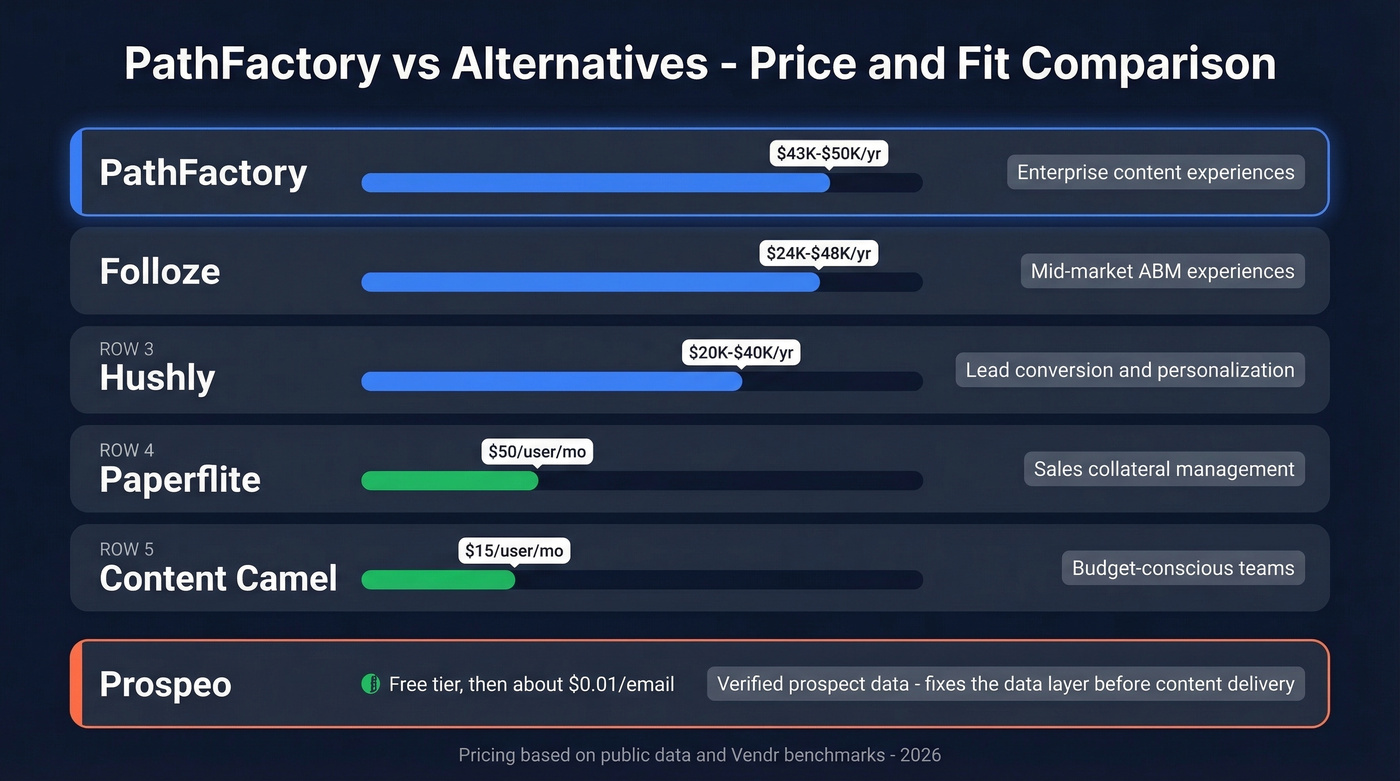
Folloze and Hushly are the closest head-to-head competitors with similar enterprise pricing and content experience focus. Paperflite and Content Camel serve a different need - sales content management - at a fraction of the cost. For teams where the real gap is data quality rather than content delivery, Prospeo fills a fundamentally different role at a fundamentally different price point. (If you're evaluating data vendors, start with data enrichment services and best sales prospecting databases.)
Every G2 reviewer praising PathFactory's analytics is still measuring engagement on contacts that may never convert - because the underlying email and phone data is wrong. Prospeo's 300M+ profiles are refreshed every 7 days with 98% email accuracy, so your ABM content actually reaches real buyers.
Content experiences don't fix a 35% bounce rate. Clean data does.
FAQ
Does PathFactory offer a free trial?
No. There's no self-serve signup - you'll book a demo, go through sales, and sign an annual contract. Average implementation takes about 2 months before your team is live.
Can you negotiate PathFactory pricing?
Yes. Buyers save 21% on average according to Vendr benchmarks. Implementation fees ($5K-$20K) are often waived on new deals, and the standard 5% annual uplift is negotiable down to 3%. Bring competitive quotes from Folloze or Hushly - that's the fastest way to move the needle.
What if my problem is bad prospect data, not content delivery?
Then PathFactory isn't your fix. No content experience platform matters if 30%+ of your emails bounce. Tools like Prospeo - 98% email accuracy, free tier with 75 credits, 7-day data refresh - fix the data foundation first. Then invest in content delivery once your outbound actually lands.