

Pay Per Appointment Lead Generation: What It Costs and How to Make It Work
A vendor promises qualified meetings for a flat fee. No hiring, no ramp time. In the best versions of pay per appointment lead generation, you pay when a real prospect actually joins the call. In worse versions, you pay the moment a meeting is merely scheduled - and whether anyone shows up is your problem.
If you've browsed r/LeadGeneration, you've seen the recurring question: "Is anything legit out there like a pay-per-appointment service?" The skepticism is earned. Outbound conversion from contact to meeting runs 2-5%, so someone's doing a lot of grinding before you get that calendar invite.
Quick version: Pay-per-qualified-held is the PPA tier with the strongest quality control and risk transfer - expect $600-$900 per meeting. Anything below $150/appointment is almost always junk. And the highest-leverage move you can make is bringing your own verified prospect list instead of relying on whatever recycled database your vendor happens to have.
How PPA Setting Works: Three Tiers
Not all appointment-based models are created equal. The differences come down to when you pay and what counts as a meeting. Belkins breaks this into three tiers, and the distinction matters more than most buyers realize.
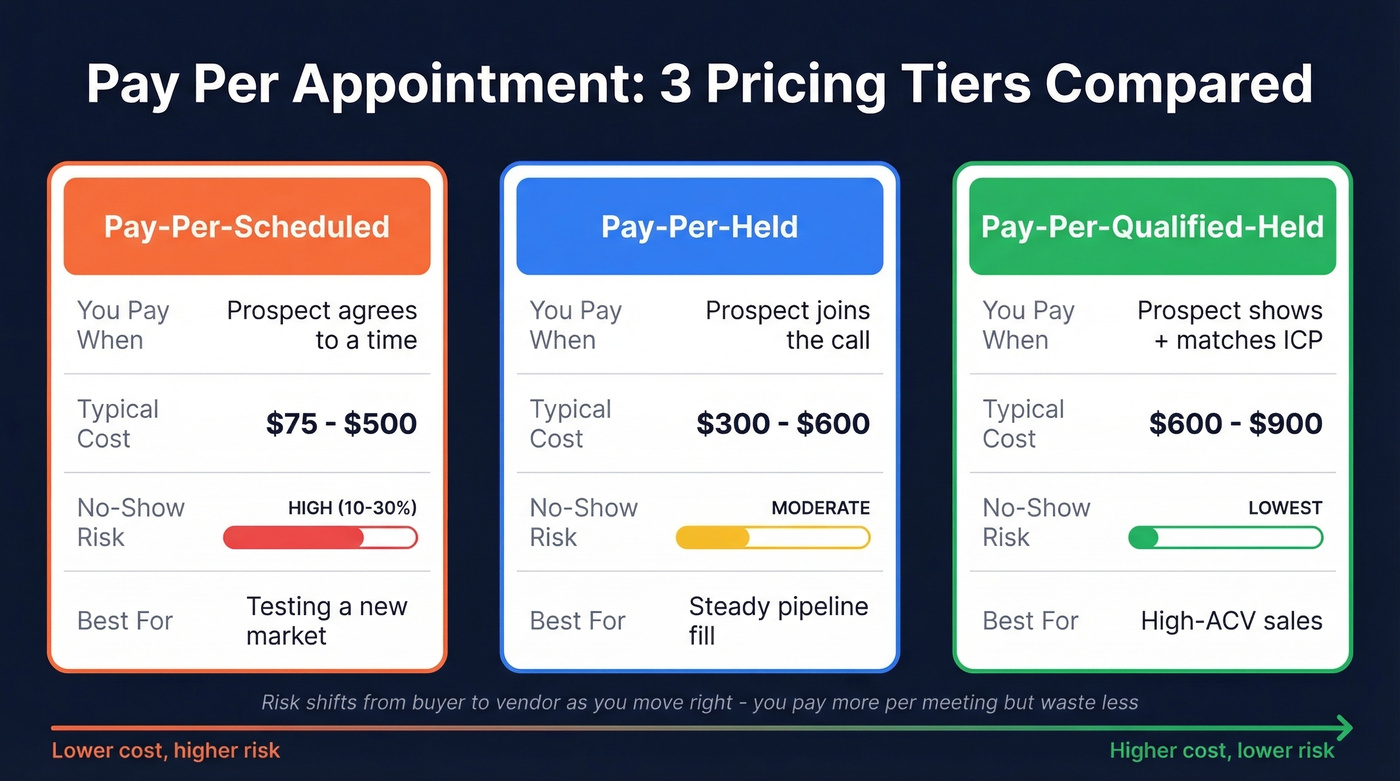
| Tier | You Pay When... | Typical Cost | No-Show Risk | Best For |
|---|---|---|---|---|
| Pay-per-scheduled | Prospect agrees to a time | $75-$500 | High (10-30%) | Testing a new market |
| Pay-per-held | Prospect joins the call | $300-$600 | Lower | Steady pipeline fill |
| Pay-per-qualified-held | Prospect shows + matches ICP | $600-$900 | Lowest | High-ACV sales |
The gap between "scheduled" and "qualified-held" is enormous. With pay-per-scheduled, you absorb no-show rates of 10-30%. That means up to a third of your spend evaporates before anyone picks up a Zoom link. Pay-per-qualified-held shifts that risk to the vendor, which is exactly why it costs more - and why we recommend it when meeting quality matters more than volume.
2026 Pricing Benchmarks
| Provider / Model | Pricing | Model Type |
|---|---|---|
| PPA (scheduled) | $75-$500/meeting | Per appointment |
| PPA (held) | $300-$600/meeting | Per appointment |
| PPA (qualified-held) | $600-$900/meeting | Per appointment |
| SalesBread | ~$3K/mo + setup | Retainer |
| SalesRoads | $5.4-$9.5K/mo | Retainer |
| EBQ | $5-$10K/mo | Retainer |
| Belkins | $5-$14.8K/mo | Retainer |
| Callbox | $50-$200K/yr | Retainer |
| In-house SDR (loaded) | $8-$12K/mo | Internal |
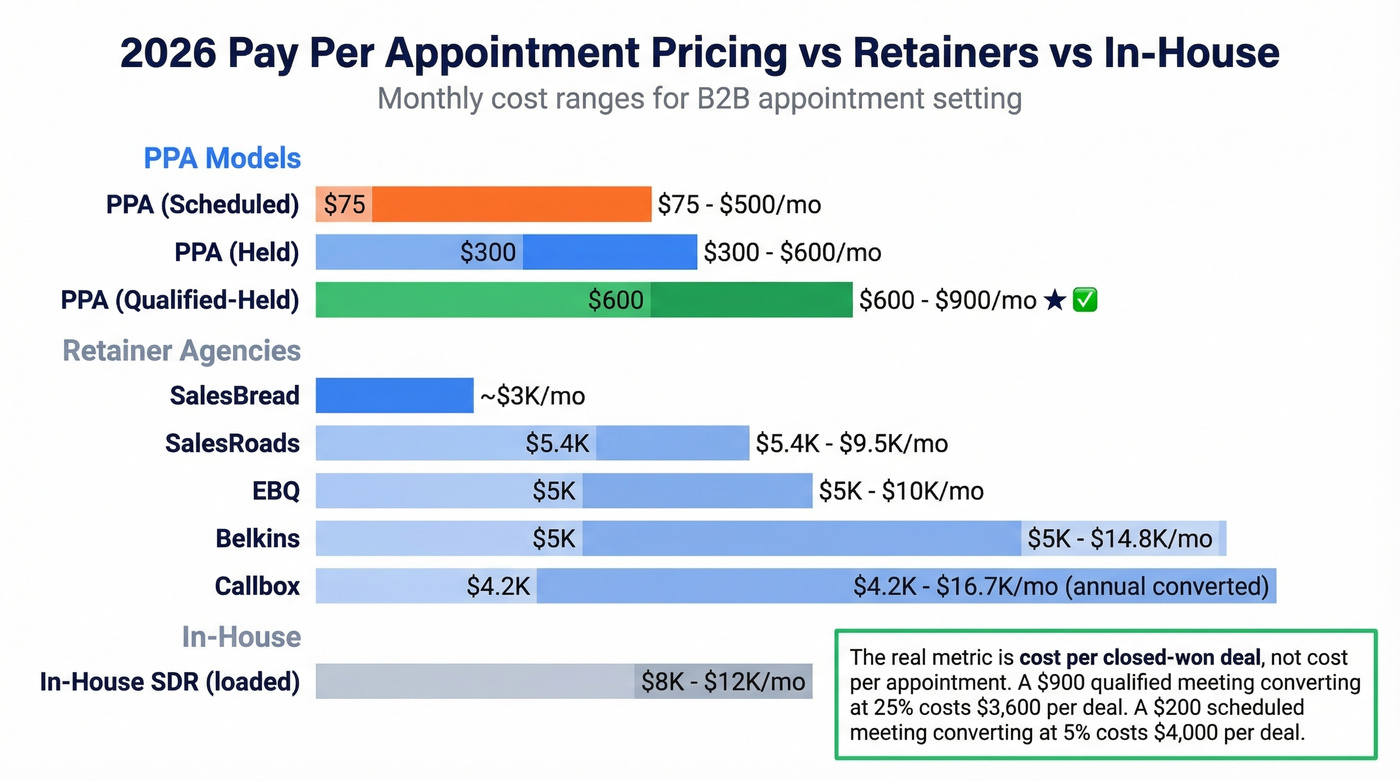
A fully loaded in-house SDR producing 8 qualified meetings per month costs roughly $1,250 per meeting. A quality PPA agency at $600-$900 per qualified-held meeting looks cheaper on paper - until you factor in the retainer floor most agencies require alongside their per-meeting pricing. A $6,000 retainer producing 20 meetings works out to $300/meeting. At $400 PPA for the same volume, you'd spend $8,000, a 33% premium for variable-cost flexibility.
Here's the thing most vendors won't tell you: the real metric isn't cost per appointment - it's cost per closed-won deal. If a $900 qualified-held meeting converts at 25%, that's $3,600 per deal. If a $200 scheduled meeting converts at 5%, that's $4,000 per deal. The "expensive" meeting is actually cheaper. Stop optimizing for the wrong number.
And don't forget shadow costs. Low-cost appointments create hidden expenses: your AE's wasted hours on unqualified calls, domain reputation damage from spam outreach, and team morale erosion from meetings that go nowhere. We've seen teams burn through three cheap PPA vendors in a year and spend more than they would've on one good one.
When PPA Fits (and When It Doesn't)
Use PPA if:
- Your average deal value sits in the $15K-$75K range - enough margin to absorb $600-$900 per meeting
- You need fewer than 10 meetings per month and can't justify a full-time SDR
- You're testing a new vertical or persona before committing headcount
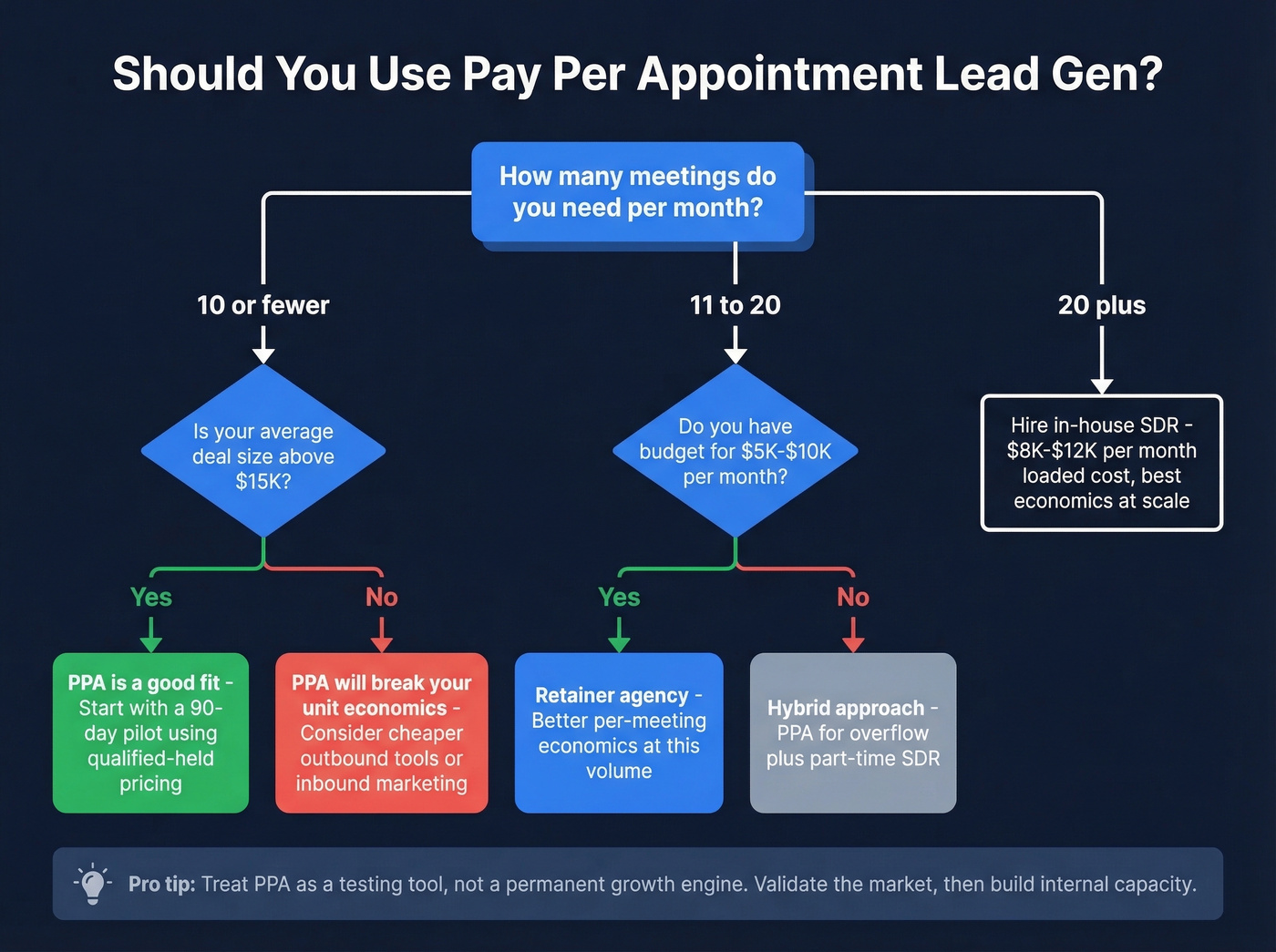
Skip PPA if you need 20+ meetings per month. A retainer or in-house hire is almost always cheaper at that volume. Same goes if your deal size stays below five figures - the unit economics collapse fast. And if you don't have a clear ICP definition to hand the vendor, you're paying them to guess.
Let's be honest: pay per appointment setting is a testing tool, not a growth engine. It validates whether a market segment converts before you build internal capacity. Treating it as your permanent pipeline source is how teams overpay for mediocre meetings quarter after quarter. Start with a 90-day pilot, measure cost per closed-won (not cost per meeting), and decide from there.

The fastest way to cut your pay-per-appointment costs? Stop letting vendors use recycled databases. Prospeo gives you 300M+ profiles with 30+ filters - intent signals, job title, company size - and 98% verified emails refreshed every 7 days. Teams that bring their own verified lists see show rates jump 15-20 points. At $0.01 per email, one list pays for itself in avoided no-shows.
Own your prospect data. Stop renting someone else's leftovers.
The PPA Contract Checklist
Before you sign anything, nail down these seven items in writing.
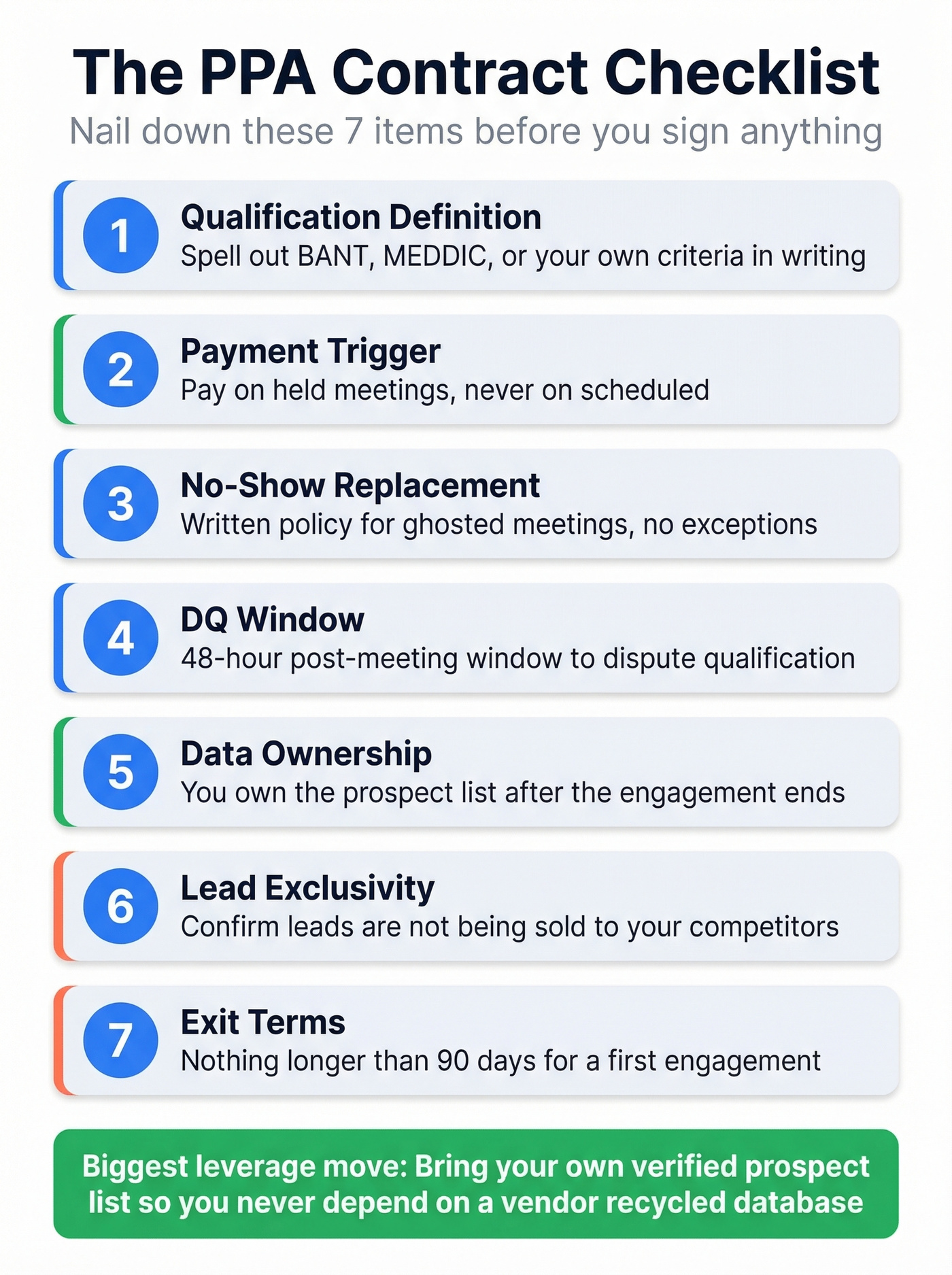
- Qualification definition. Spell out "qualified" - BANT, MEDDIC, or your own criteria. If you're using MEDDIC, align on the same sales qualification language before you start. If the vendor resists defining this, walk away.
- Payment trigger. Held, not booked. Never pay on "scheduled."
- No-show replacement. Written replacement policy for ghosted meetings.
- DQ window. Set a 48-hour post-meeting window to dispute qualification.
- Data ownership. Who owns the prospect list after the engagement? Bring your own verified list so you're never dependent on a vendor's recycled database.
- Lead exclusivity. Confirm appointment leads aren't being sold to competitors simultaneously.
- Exit terms. Avoid anything longer than 90 days for a first engagement.
Red Flags to Watch For
Below $150 per appointment, you're buying garbage. At that price, the vendor can't afford real research, personalized outreach, or proper qualification. They're running spray-and-pray automation and hoping a few meetings stick.
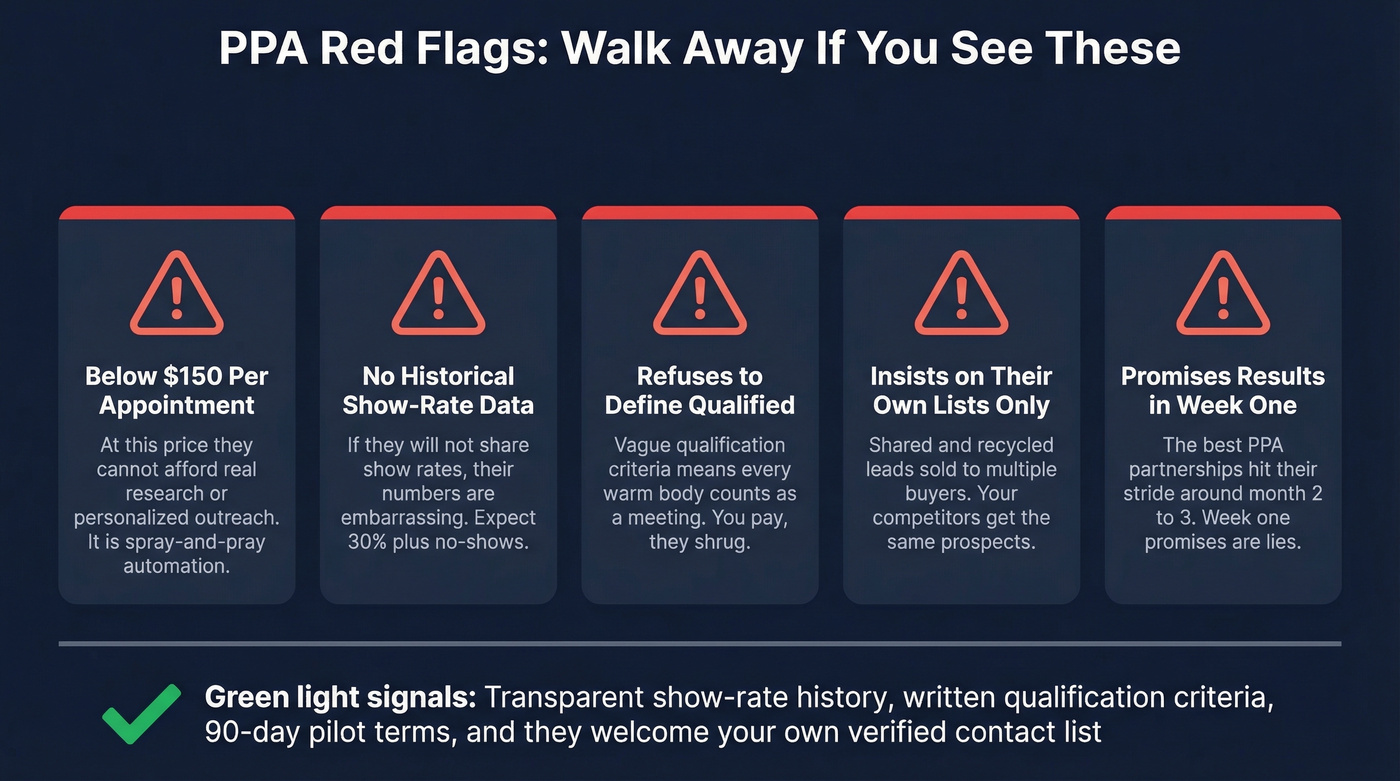
Other warning signs: the vendor won't share historical show-rate data, they resist defining "qualified" in writing, or they insist on using their own contact lists exclusively. Shared and recycled leads sold to multiple buyers are the dirty secret of cheap PPA providers. If a vendor can't explain their CAN-SPAM and GDPR compliance process, they're putting your domain at risk alongside theirs (and you should be tracking email deliverability from day one). And if they promise pre-set appointments in week one, they're lying - the best PPA partnerships hit their stride around month 2-3.
How to Maximize PPA ROI
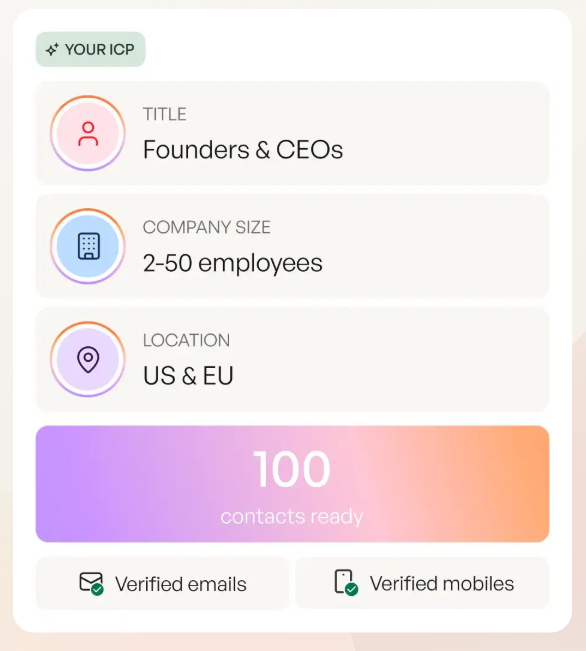
Build your own target list first. This is the single highest-leverage move you can make. Prospeo's B2B database lets you filter by job title, company size, and intent signals across 15,000 topics, then verify every email at 98% accuracy on a 7-day refresh cycle - all for roughly $0.01 per verified email. Your vendor starts with clean, current contacts instead of recycled databases, which cuts no-show rates and improves meeting quality dramatically. If you want to go deeper on list quality, pair it with data enrichment and a clear lead scoring model. In our experience, teams that bring their own verified lists see show rates jump 15-20 percentage points compared to relying on vendor-sourced data.
Follow up fast. Leads contacted within 5 minutes convert 21x more often than those contacted after 30 minutes. When a PPA vendor books a meeting, your AE should confirm within hours, not days - and use a consistent sales follow-up process so nothing slips.
Run weekly feedback loops. Feed back on meeting quality every single week - objections heard, personas that convert, dead ends to avoid. Push your vendor toward multi-channel outreach combining phone, email, and social, which consistently outperforms single-channel approaches. The vendors who resist feedback loops are the ones who don't want you looking too closely at their process. If you're tightening outbound execution, borrow a few modern sales prospecting techniques and standardize your sequence management.
Your PPA vendor is only as good as the contacts they're working. Prospeo's 7-day data refresh means your list never goes stale - compared to the 6-week industry average that causes bounces, no-shows, and wasted meetings. Layer in Bombora intent data across 15,000 topics so your vendor reaches prospects who are actually in-market. That's how you turn a $600 meeting into a closed deal.
Fresh data, real intent signals, fewer ghosted meetings.
FAQ
Is pay-per-appointment lead generation legit?
Yes - with qualified-held pricing, explicit qualification criteria in the contract, and a no-show replacement policy. Below $150/appointment, expect low-quality leads and weak qualification. Always demand historical show-rate data before signing.
What's a good cost per appointment in B2B?
$300-$600 for held meetings, $600-$900 for qualified-held. A loaded in-house SDR costs roughly $1,250 per meeting. PPA wins on unit economics until volume exceeds 15-20 meetings monthly, at which point retainers or internal hires become more cost-effective.
How can I improve my PPA show rate?
Bring a verified prospect list (98% email accuracy at $0.01/lead beats any vendor database), confirm meetings 24 hours before, and follow up within 5 minutes of any signal. Speed-to-lead is the single biggest lever for show rates.
Should I use PPA or hire an in-house SDR?
For teams needing fewer than 10 meetings per month with deal sizes above $15K, PPA is more cost-efficient. Above 15-20 meetings monthly, a dedicated SDR at $8-$12K/month loaded cost delivers better per-meeting economics and tighter feedback loops.
Control the inputs - your ICP, your data, your contract terms - and pay per appointment lead generation works. Let the vendor control everything, and you're just paying for someone else's pipeline.