


Pearl Diver Pricing, Reviews, Pros and Cons: The Full Breakdown
You saw $198/mo on Capterra. Then $1,818/mo on G2. Then "custom pricing" on Pearl Diver's actual website. Three different numbers from three different sources for the same product - that's not a pricing page, it's a scavenger hunt.
We pulled data from multiple sources to reconcile what Pearl Diver actually costs in 2026, whether the reviews hold up under scrutiny, and who should genuinely consider it.
30-Second Verdict
Pearl Diver is a solid website visitor identification tool that's heavily U.S.-oriented. Pricing depends on which "version" you're looking at: directories show tiers from $198-$1,367/mo, Pearl Diver's own materials reference pricing starting from $387/mo, and G2 lists the Individual plan at $1,818/mo with Agency starting at $5,000/mo. G2 reviews are overwhelmingly positive (4.9/5), but the 100% five-star distribution across 31 reviews is statistically unusual. If your actual need is verified B2B emails for outbound - not identifying anonymous site visitors - skip Pearl Diver entirely and look at a dedicated email finding tool instead.
What Does Pearl Diver Cost?
Here's the thing: Pearl Diver's pricing is genuinely confusing. Different sources show different numbers, and none of them agree.
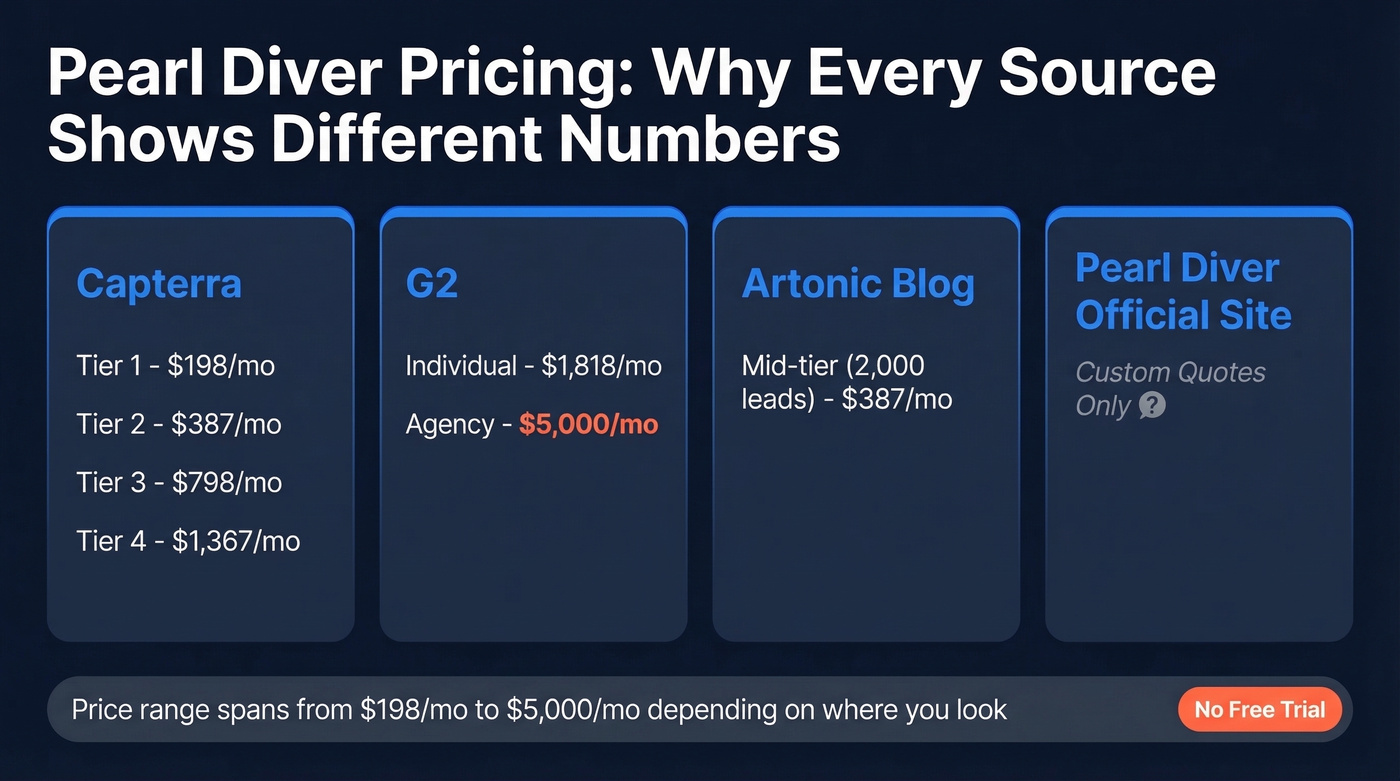
| Source | Tiers / Plans | Price |
|---|---|---|
| Capterra | Tier 1 / 2 / 3 / 4 | $198 / $387 / $798 / $1,367/mo |
| G2 | Individual / Agency | $1,818 / $5,000/mo |
| Artonic blog | Mid-tier (2,000 leads) | $387/mo |
| Official site | Individual / Agency / DaaS / Enterprise | Custom quotes (no fixed prices shown) |
The most likely explanation: the lower directory tiers ($198-$387/mo) map to a lighter-weight package, while G2's $1,818/mo "Individual" plan reflects the higher-end intent + resolution offering. Pearl Diver's own site now pushes Custom quotes, so these directory prices may shift depending on traffic volume and feature needs.

Now the cost-per-lead math. At the $387/mo tier delivering roughly 2,000 identified leads, you're paying about $0.19 per lead. That's competitive for person-level identification - but only if those leads convert at a meaningful rate. If you want to sanity-check conversion assumptions, start with average B2B lead conversion rate benchmarks. At the $1,818/mo tier, you'd need significantly higher volume or conversion rates to justify the spend.
No free trial on Capterra's listing, either. You're committing before you see results.
What Pearl Diver Does
Pearl Diver identifies anonymous website visitors and enriches them with contact and firmographic data. The platform targets a 20-25% identification rate for "real" visitors - which sounds low until you understand the math. Pearl Diver filters out bot traffic, which it says accounts for around 50-75% of all site visits. So that 20-25% is against actual humans, not inflated analytics totals. For context, person-level identification benchmarks across the industry run 5-20%.
On the B2B side, enrichment includes job title, industry, company name, revenue, employee count, and business phone. If you're comparing vendors, it helps to understand the difference between firmographic and technographic data (and when each matters). The B2C data goes unusually deep: full name, phone, home address, age, gender, estimated household income, marital status, presence of children, and homeownership status - rare for a visitor ID tool.
For integrations, Pearl Diver supports Zapier, a REST API, and Amazon S3, and it plugs into common marketing and CRM workflows including Salesforce, HubSpot, and Klaviyo. There's also a built-in audience builder for ad-platform retargeting. If you're building a repeatable outbound motion alongside inbound, these sales prospecting techniques can help you pressure-test the workflow.

Pearl Diver enriches visitors who already found you. But at $0.19-$0.91 per lead, you're paying a premium to react. Prospeo gives you 98% accurate emails for $0.01 each - for any prospect, whether they visited your site or not. 300M+ profiles, 30+ filters, no scavenger hunt pricing.
Stop waiting for prospects to come to you. Go find them.
Pros and Cons
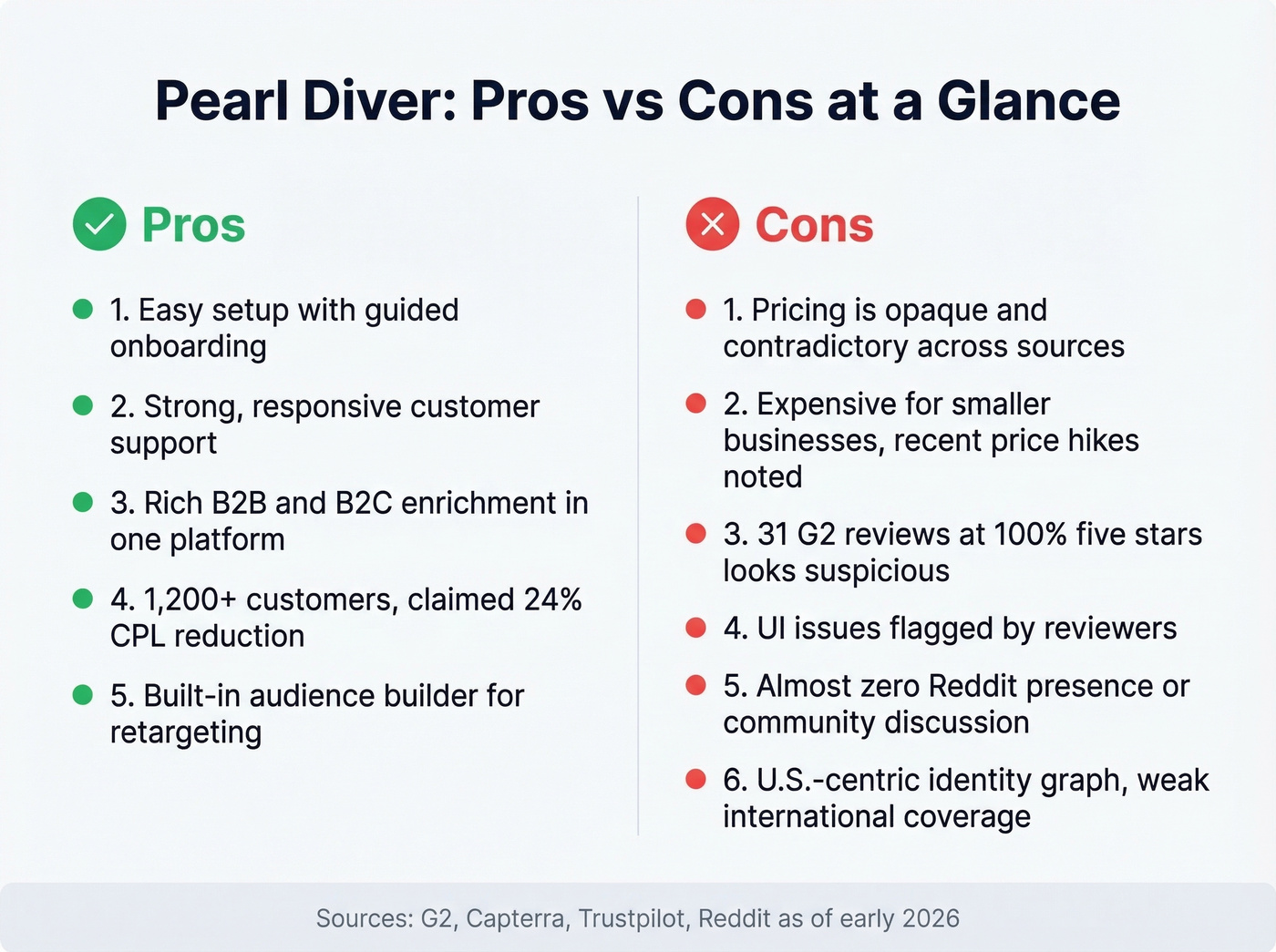
Pros:
- Easy setup with guided onboarding - consistent praise on G2 and echoed in the May 2024 Trustpilot review
- Strong customer support, a dominant theme across G2's review summary
- Rich B2B and B2C enrichment fields in a single platform
- 1,200+ customers with a claimed 24% average CPL reduction
- Built-in audience building for retargeting workflows
Cons:
- Pricing is opaque and contradictory across directories - you won't know your real cost without a sales conversation
- Expensive for smaller businesses; "Expensive" is a tagged con theme on G2, and at least one reviewer flagged a recent price increase
- 31 G2 reviews at 100% five-star is statistically unusual, suggesting curated or incentivized reviews
- UI issues flagged in a G2 review (may have been addressed since)
- Very limited Reddit presence - the main thread we found was an unanswered question asking if anyone had experience with Pearl Diver, which tells you something about market penetration
- U.S.-centric identity graph limits international coverage
Is Pearl Diver Legit?
A Trustpilot reviewer in September 2023 called Pearl Diver a "total scam," claiming undelivered emails and a refused refund. Pearl Diver responded months later saying they couldn't find an account under that name and clarified the company is operated by Blackpearl Group, a publicly listed company in New Zealand. A second Trustpilot review from May 2024 is positive, praising the setup process. That's the entire Trustpilot sample - two reviews, 3.6 average.
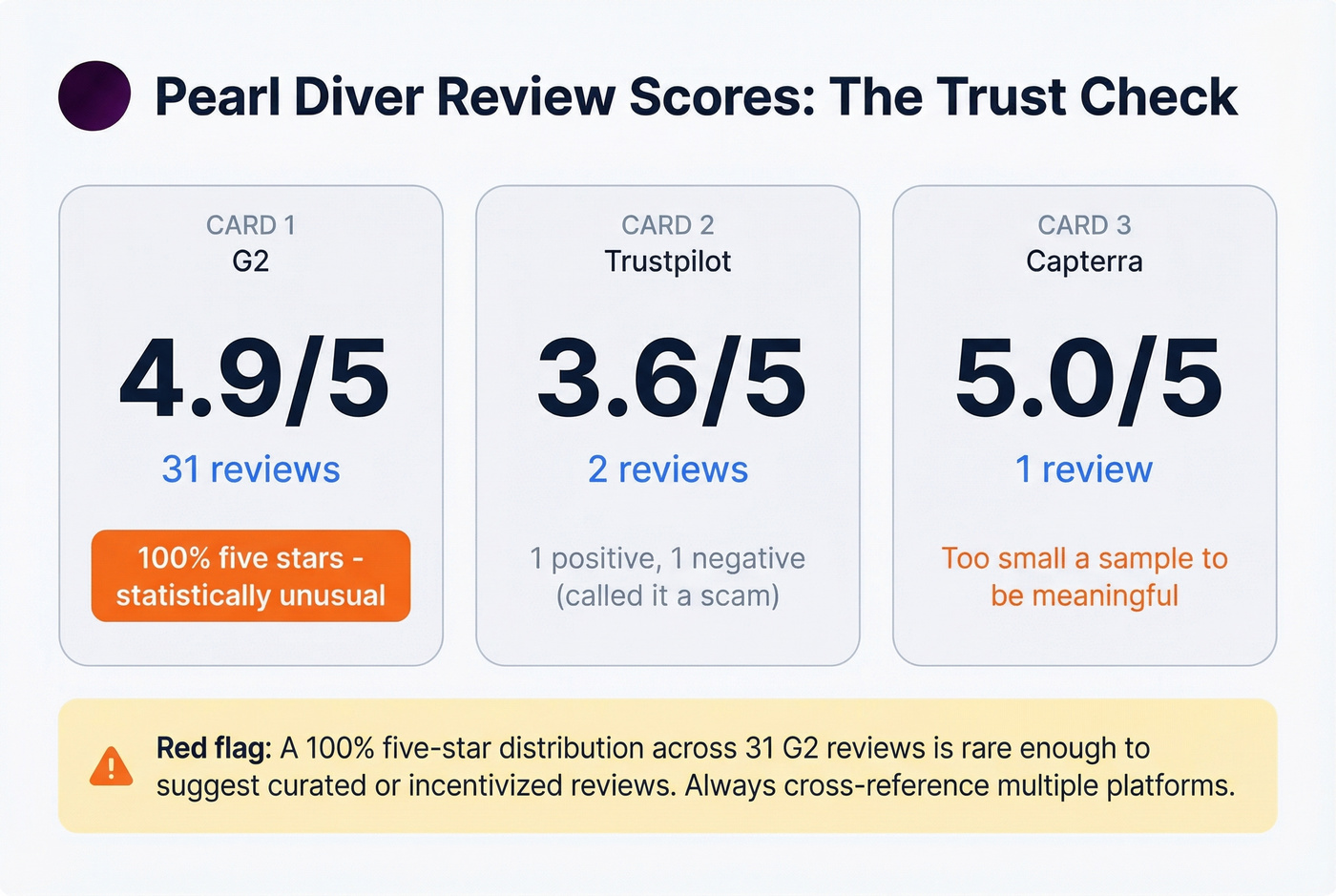
The G2 picture is rosier but suspicious. We've reviewed hundreds of G2 profiles over the years, and 31 reviews at 100% five stars is uncommon enough to warrant skepticism. We've seen this pattern before with tools that selectively invite happy customers to review.
One compliance note you shouldn't skip: Pearl Diver's Terms of Service require you to add specific privacy policy language to your site about third-party pixels/cookies associating browsing activity with information including email addresses and phone numbers, plus opt-out language. Miss this step and you're out of compliance. If you're tightening your outbound stack, pair this with a deliverability-first checklist like our email deliverability guide.
How Pearl Diver Compares
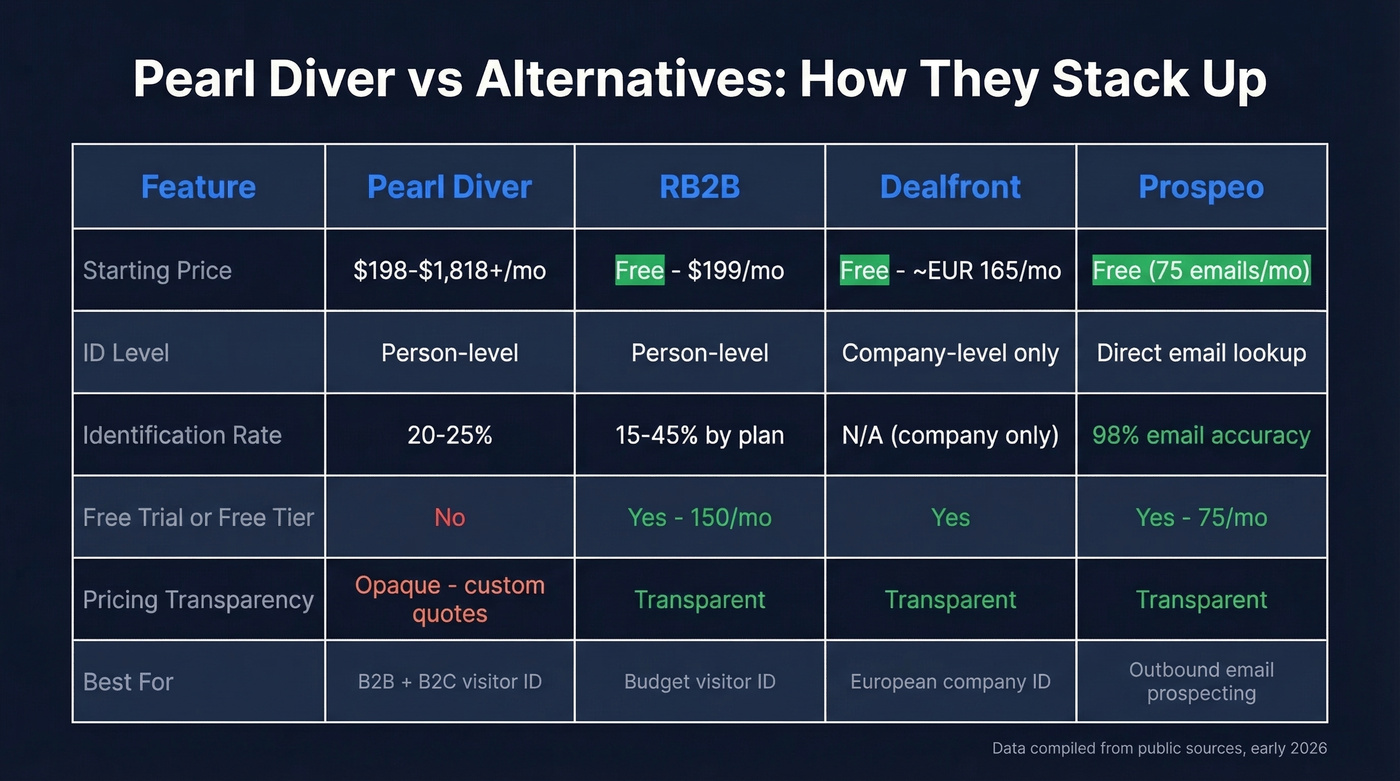
Let's be honest: Pearl Diver is a good tool solving a real problem. But most teams buying visitor identification software actually need outbound email data - and they're spending 10x more than they should to get it indirectly. If you're evaluating vendors broadly, start with these data enrichment services and then narrow down by use case.
Visitor Identification Tools
| Tool | Starting Price | Person-Level ID | Best For |
|---|---|---|---|
| Pearl Diver | $198-$1,818+/mo | 20-25% (claimed) | B2B + B2C site visitor ID + audiences |
| RB2B | Free - $199/mo | 15-45% (by plan) | Transparent pricing + strong entry point |
| Dealfront | Free - ~EUR139-165/mo | Company-level only | European traffic + company-level ID |
| Snitcher | From $39/mo | Company-level | Budget-friendly company-level ID |
Outbound Email Alternative
| Tool | Starting Price | Best For |
|---|
RB2B is the most direct competitor, offering a free tier (150 monthly resolutions), transparent pricing, and person-level identification rates from 15-20% on Starter/Pro to 35-45% on Pro+. If pricing transparency matters to you - and it should - RB2B is easier to evaluate. Dealfront and Snitcher both operate at the company level, not person level. They're cheaper but solve a different problem.
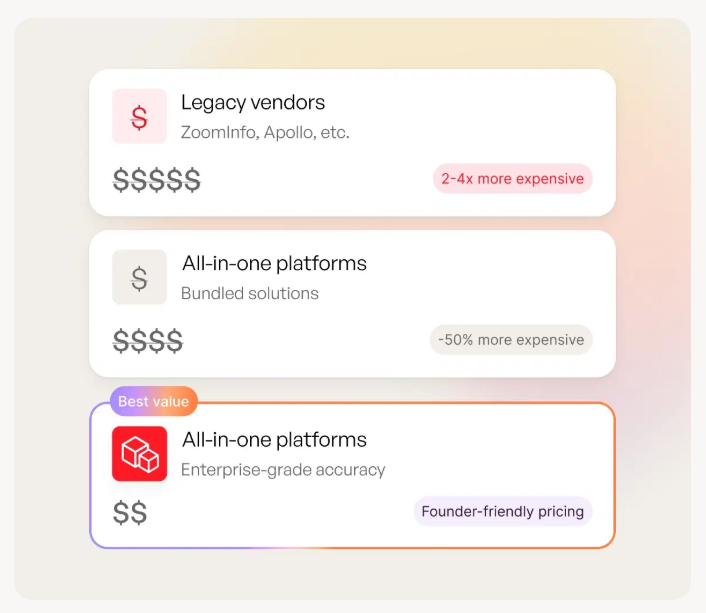
Pearl Diver identifies who visits your site. Prospeo finds verified emails for anyone you want to reach - whether they've visited your site or not. Its database covers 300M+ professional profiles with 98% email accuracy and a 7-day data refresh cycle, which is dramatically faster than the 6-week industry average. It starts free (75 emails/month), scales at roughly $0.01 per email, and requires zero sales calls. For teams whose pipeline depends on reaching specific decision-makers rather than waiting for them to land on your website, that's a fundamentally different - and often more efficient - approach. If you're building lists at scale, see our guide to how to generate an email list.
Pearl Diver's 20-25% identification rate means 75%+ of your real visitors stay anonymous. Instead of paying $387-$1,818/mo to identify a fraction of inbound traffic, use Prospeo to build targeted lists of your exact ICP - with verified emails at 98% accuracy and 125M+ direct dials.
Reach 100% of your target market, not 25% of your website traffic.
Frequently Asked Questions
How much does Pearl Diver cost per month?
Pearl Diver's cost ranges from $198/mo (Tier 1 on Capterra) to $1,818/mo (Individual plan on G2) and $5,000/mo for Agency. The official site now requires custom quotes, so your actual price depends on traffic volume and features needed. Expect a sales conversation before getting a firm number.
Are Pearl Diver's G2 reviews trustworthy?
Pearl Diver holds a 4.9/5 on G2 across 31 reviews - all five stars. While the feedback highlights easy setup and strong support, a 100% five-star distribution is statistically rare and suggests selective review solicitation. Cross-reference with Trustpilot (3.6/5, only two reviews) for a more balanced picture.
What's a cheaper alternative to Pearl Diver for finding B2B emails?
RB2B offers a free tier for visitor identification (150 resolutions/month). For direct outbound email prospecting, Prospeo starts free with 75 verified emails per month and scales at ~$0.01/email - significantly cheaper than Pearl Diver's minimum $198/mo, with 98% email accuracy and no sales calls required.
Does Pearl Diver work outside the U.S.?
Pearl Diver's identity graph is heavily U.S.-centric. If your website traffic is primarily international, expect lower identification rates. For European company-level identification, Dealfront is a stronger fit. For global B2B contact data, tools with broader databases will serve you better.
Bottom Line
Use Pearl Diver if: you want to identify and enrich anonymous visitors, you want retargeting audiences built from identified visitors, and you're comfortable with custom pricing conversations. If your priority is outbound execution, build a repeatable cadence with these sales follow-up templates and track the right lead generation metrics.