

How to Write a Personalized Cold Email That Actually Gets Replies
A sales rep on r/coldemail shared their process: scrape 10 posts per prospect, read 40-50 pages of their company's website, send 30-50 deeply personalized emails a day. Result? Three replies. Two positive - both ghosted. The personalization was excellent. The strategy was broken.
That's the core tension with personalized cold email that nobody talks about. Personalization isn't a magic word you bolt onto a bad process. It's a multiplier - and multiplying zero still gives you zero. The difference between teams averaging 3% reply rates and those hitting 6%+ isn't better adjectives in the opener. It's cleaner data, tighter signals, and knowing when deep personalization isn't worth the effort.
What You Need (Quick Version)
- One strong signal, 40-60 words, soft CTA. That's the format getting replies in 2026. Not three paragraphs of flattery. One relevant observation, one clear outcome, one low-friction ask.
- Match depth to deal size. Segment-level personalization for deals under $5K. Account-level for $5K-$25K. Contact-level research only when you're chasing $25K+ opportunities where the time investment pays off.
2026 Cold Email Benchmarks
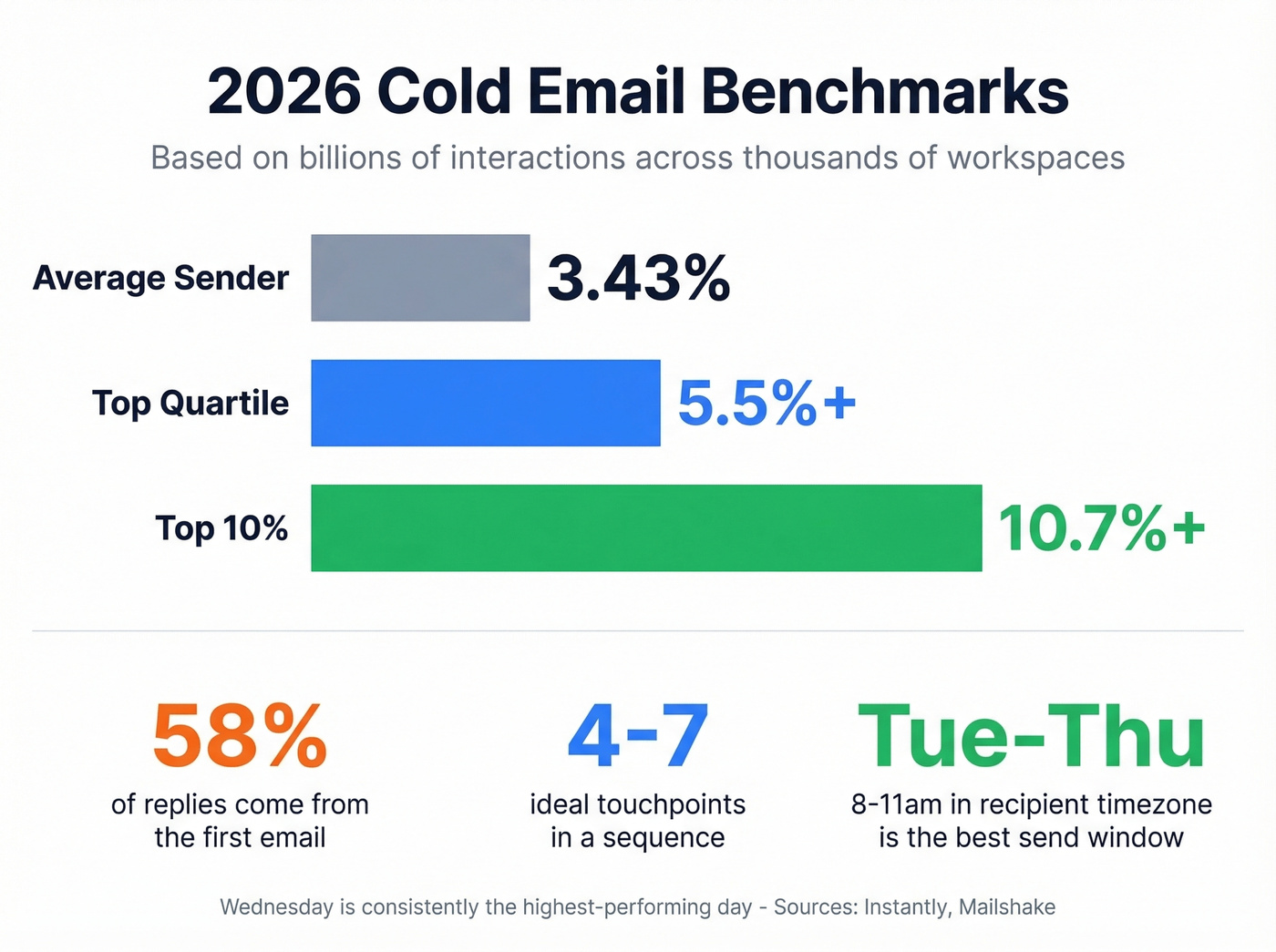
Let's ground this in real numbers. Instantly analyzed billions of cold email interactions across thousands of workspaces and published their 2026 benchmark report:
| Tier | Reply Rate | What It Means |
|---|---|---|
| Average | 3.43% | Most senders land here |
| Top quartile | 5.5%+ | Good ops + decent copy |
| Top 10% | 10.7%+ | Elite data + signal + offer |
Mailshake's State of Cold Email survey - based on 508 outbound professionals - puts the average even lower at 1-4%. The exact number matters less than where you sit relative to peers. Only 5% of senders personalize every send, but those who do see 2-3x better results.
One stat that should change how you think about sequences: 58% of all replies come from the first email. Follow-ups matter, but if your first touch doesn't land, you're fighting uphill the rest of the way. The sweet spot for sequence length is 4-7 touchpoints.
Timing matters more than most people think. Tue-Thu, 8-11am in the recipient's timezone is a proven operator window. In Instantly's data, Wednesday is consistently the best day. Monday works for launching sequences. Friday is an auto-reply graveyard. One operator saw a 16% lift in opens from timing alone.
Three Levels of Personalization
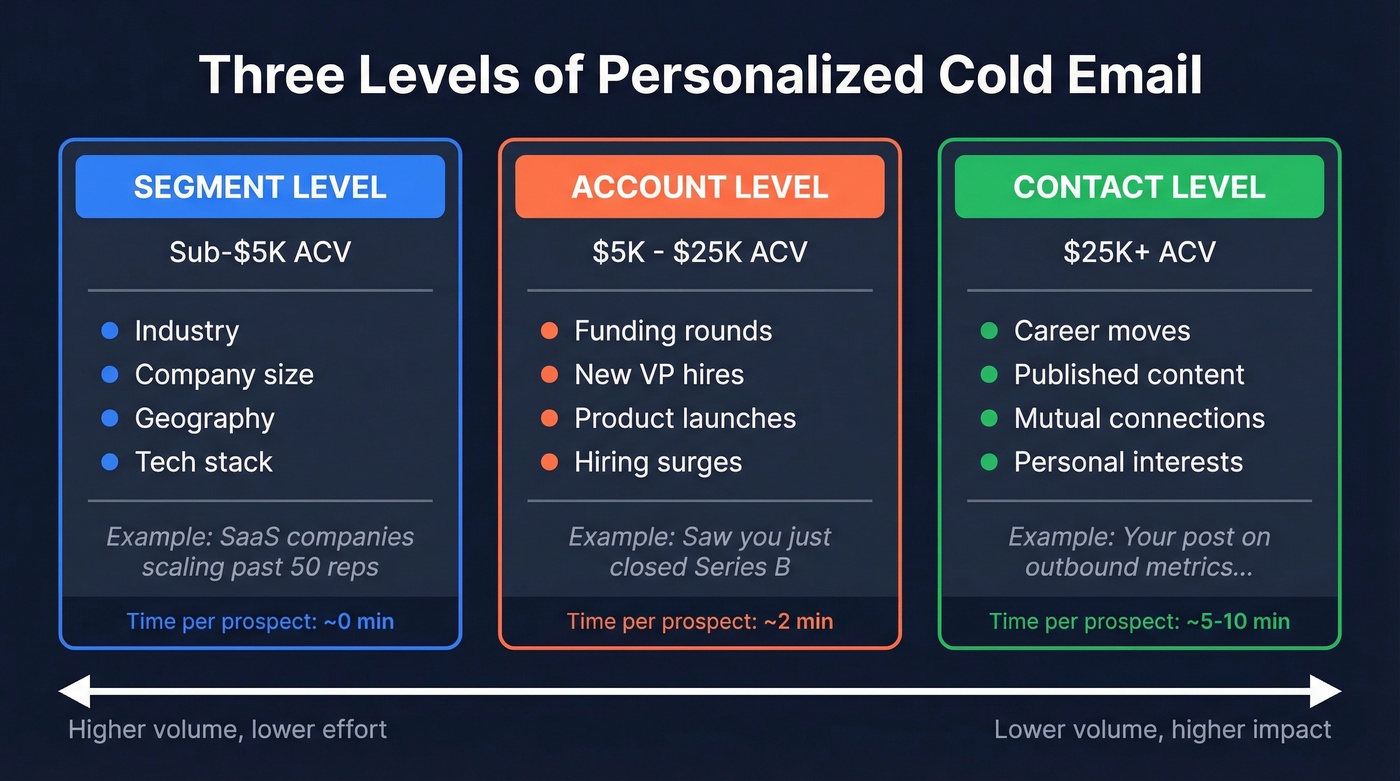
Not all personalization is created equal. ZoomInfo's personalization framework breaks it into three tiers, and it's the most useful taxonomy we've found:
| Level | Signals | Example | Best For |
|---|---|---|---|
| Segment | Industry, size, geo, tech | "SaaS companies scaling past 50 reps" | Sub-$5K ACV |
| Account | Funding, hiring, news, leadership | "Saw you just closed Series B" | $5K-$25K ACV |
| Contact | Career move, content, mutual connections | "Your post on outbound metrics..." | $25K+ ACV |
Segment-level is where most teams should start. Lifesize partnered with Adobe to classify 300,000 leads into just 7 categories and personalized sequences for each - across 5 languages. That's segment-level personalization at serious scale, and it works because the relevance comes from tight targeting, not individual research.
Account-level adds a trigger event. A funding round, a new VP hire, a product launch. These signals are public and scalable - you can pull them from data enrichment tools without spending 20 minutes per prospect.
Contact-level is where the ROI math gets tricky. Reading someone's posts, referencing their career history, connecting personal dots. Powerful when it lands, but the time cost is brutal at volume.
Here's the thing: one strong signal beats five weak ones. Mentioning someone's industry, company size, AND tech stack in the same email doesn't feel personalized - it feels like a mail merge. Pick the single most relevant signal and build the email around it.
How to Write the Email
Structure and Length
Top operators run 40-60 word cold emails. Instantly's benchmark data shows the best-performing campaigns keep emails under 80 words. The structure:
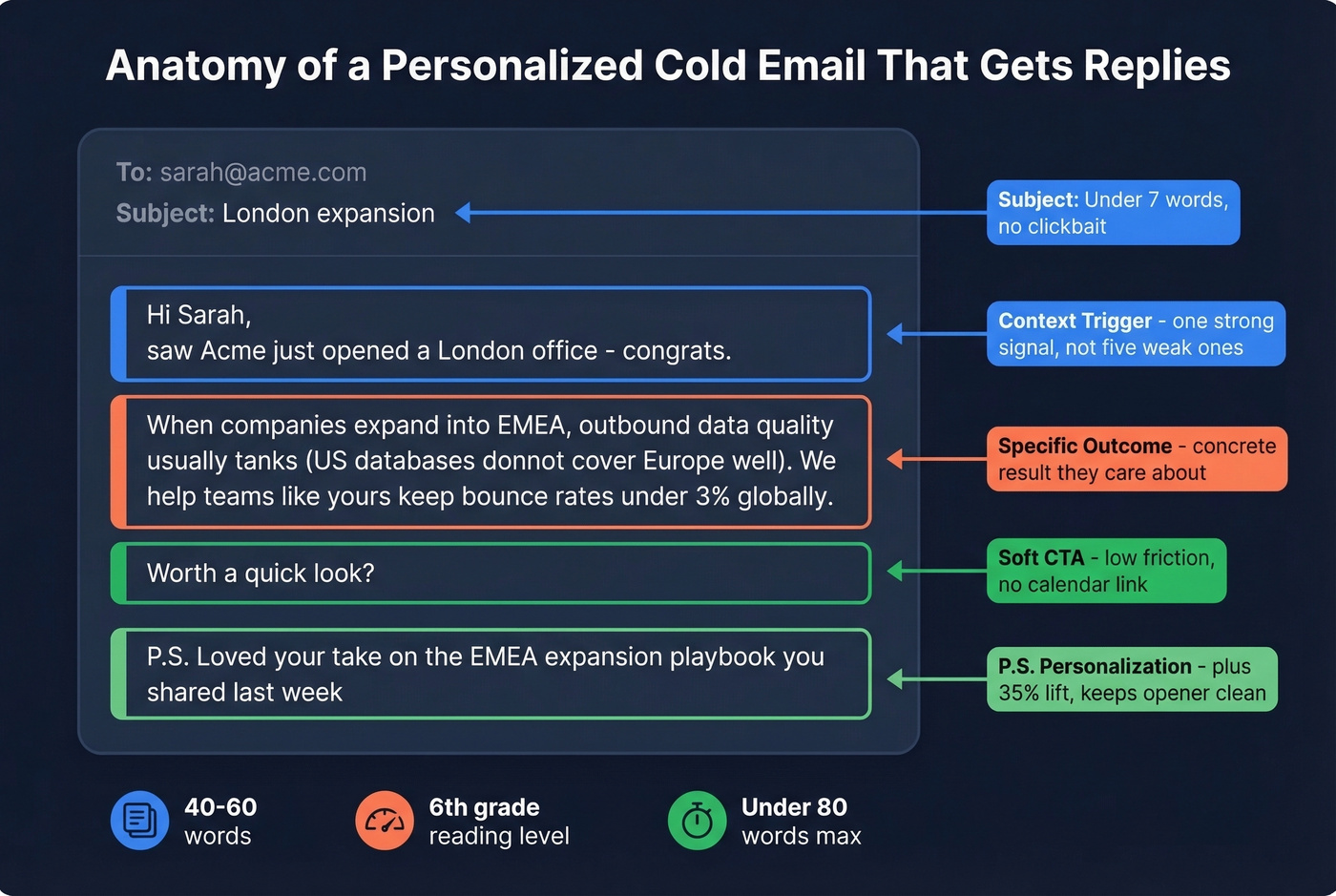
Context trigger -> Specific outcome -> Soft ask.
A 47-word example:
Hi Sarah, saw Acme just opened a London office - congrats. When companies expand into EMEA, outbound data quality usually tanks (US databases don't cover Europe well). We help teams like yours keep bounce rates under 3% globally. Worth a quick look?
No preamble, no "hope this finds you well," no three-paragraph company bio.
Subject Lines That Get Opens
Keep subject lines under 7 words. One practitioner who doubled their reply rate from 3% to 6% tracked their subject line performance closely: "Quick question" pulled 39% opens, company-name subjects hit 33%, and "Partnership opportunity" cratered below 19%.
Write at a 6th-grade reading level. An operator running 176 meetings per month found that simpler language drove +67% performance. Busy executives skim. Simple words skim faster.
If you want more tested options, pull from a swipe file of cold email subject line examples and iterate from there.
The P.S. Personalization Tactic
This tactic doesn't get enough attention: put your personalization in the P.S. line instead of the opener. That same 176-meetings operator saw a +35% lift from this approach.
Your opener stays clean and outcome-focused - no awkward "I noticed you liked a post about..." lead-in. The personalization lands at the end, where it sticks. It also lets you template the body while keeping the P.S. genuinely custom, which is a massive efficiency win at scale.
Soft CTAs Win
The consensus across r/coldemail and r/copywriting is clear: soft CTAs outperform hard meeting requests. "Interested?" or "Worth a conversation?" beats "Book 30 minutes on my calendar" almost every time. A calendar link in a cold email feels presumptuous - you're asking a stranger to commit 30 minutes before they've decided you're worth 30 seconds.
For more options, keep a few sales follow-up templates ready for replies and non-replies.
Embrace Imperfection
One emerging counter-move in 2026: deliberately leave slight imperfections in AI-generated copy. When every email sounds polished and templated, a slightly rough edge signals authenticity. Drop a dash instead of a semicolon. Start a sentence with "And." The goal is to sound like a human who typed fast, not a language model that optimized every syllable.

Deep personalization is wasted on bounced emails. Prospeo's 98% email accuracy and 7-day data refresh mean your carefully crafted cold emails actually reach real inboxes - not dead addresses that tank your domain reputation.
Stop personalizing emails that bounce. Start with data you can trust.
Personalized Cold Email Examples
Bad: Shallow merge tags
Hi {{first_name}}, I see you work at {{company}} in the {{industry}} space. We help companies like yours grow revenue. Want to chat?
This isn't personalization. It's a mail merge wearing a costume. Every field could apply to 10,000 other people. Delete.
Good: Segment-level (SaaS, 50-200 employees)
Hi Marcus, most mid-stage SaaS teams we talk to are burning 15+ hours a week on manual prospecting. We cut that to 3. Interested in seeing how?
No individual research required. The relevance comes from a tight ICP definition. This scales to hundreds of sends per day.
Good: Account-level (funding trigger)
Hi Priya, congrats on the Series B. Scaling outbound with a fresh round usually means hiring reps faster than you can build pipeline infrastructure. We help post-funding teams get outbound running in weeks, not quarters. Worth a look?
The trigger event is public and easy to pull from enrichment tools. It signals timing - they've got budget and urgency.
Good: Contact-level (career move)
Hi James, saw you just moved from Datadog to lead revenue at Vanta - big move. The first 90 days in a new CRO seat usually means inheriting a pipeline you didn't build. Happy to share what other new CROs are doing to stand up outbound fast. Want me to send it over?
This took 3 minutes of research. It's only worth it if James represents a $25K+ deal. For a $3K ACV product, this level of effort doesn't pencil out.
Personalization as a Deliverability Strategy
Most guides treat personalization as a copywriting exercise. It's actually a deliverability strategy - and the deliverability piece starts before you write a single word.
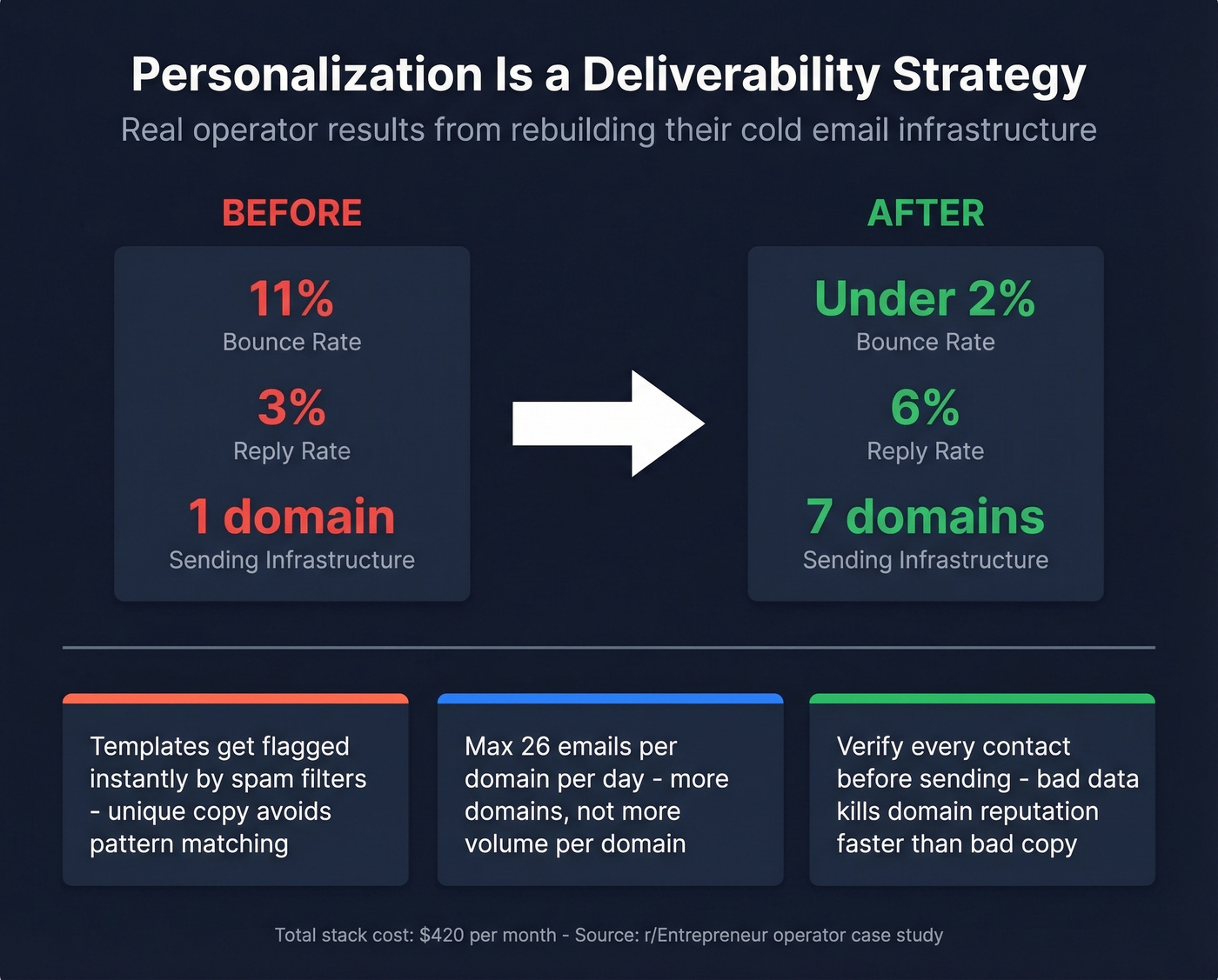
The consensus on r/SaaS is blunt: templates get flagged instantly, new domains get crushed, and email providers are getting smarter at detecting mass outreach. Sending unique copy in each message is harder for spam filters to pattern-match, which means better inbox placement.
But personalization built on bad data actively hurts you. If the email bounces, your domain reputation takes a hit. If the job title is wrong, your "personalized" opener makes you look careless. Nearly half of senders don't even track bounce rates. That's a problem hiding in plain sight.
One operator on r/Entrepreneur documented their rebuild: 7 domains, max 26 emails per day each, manual verification on every contact. Bounce rate dropped from 11% to under 2%. Reply rate doubled from 3% to 6%. Total stack cost: $420/month.
Before you personalize a single line, make sure the email address is real and the job title is current. Prospeo's 5-step verification process catches invalid addresses, spam traps, and honeypots before they torch your sender reputation - 98% email accuracy with a 7-day refresh cycle. Stack Optimize built their agency to $1M ARR using that data layer, with clients maintaining 94%+ deliverability, bounce rates under 3%, and zero domain flags. That's the foundation personalization needs to work.
If you want the deeper mechanics, start with an email deliverability guide and track your email bounce rate like a core KPI.
GDPR note: If you're emailing EU-based prospects, make sure your outreach is compliant. Use a GDPR-compliant data provider with opt-out enforcement and DPAs available - non-compliance can mean fines that dwarf your entire outbound budget.
How to Personalize at Scale
The Five-Step Workflow
Personalization at scale isn't about writing 500 custom emails. It's about building a pipeline where the right signals flow into the right templates automatically.
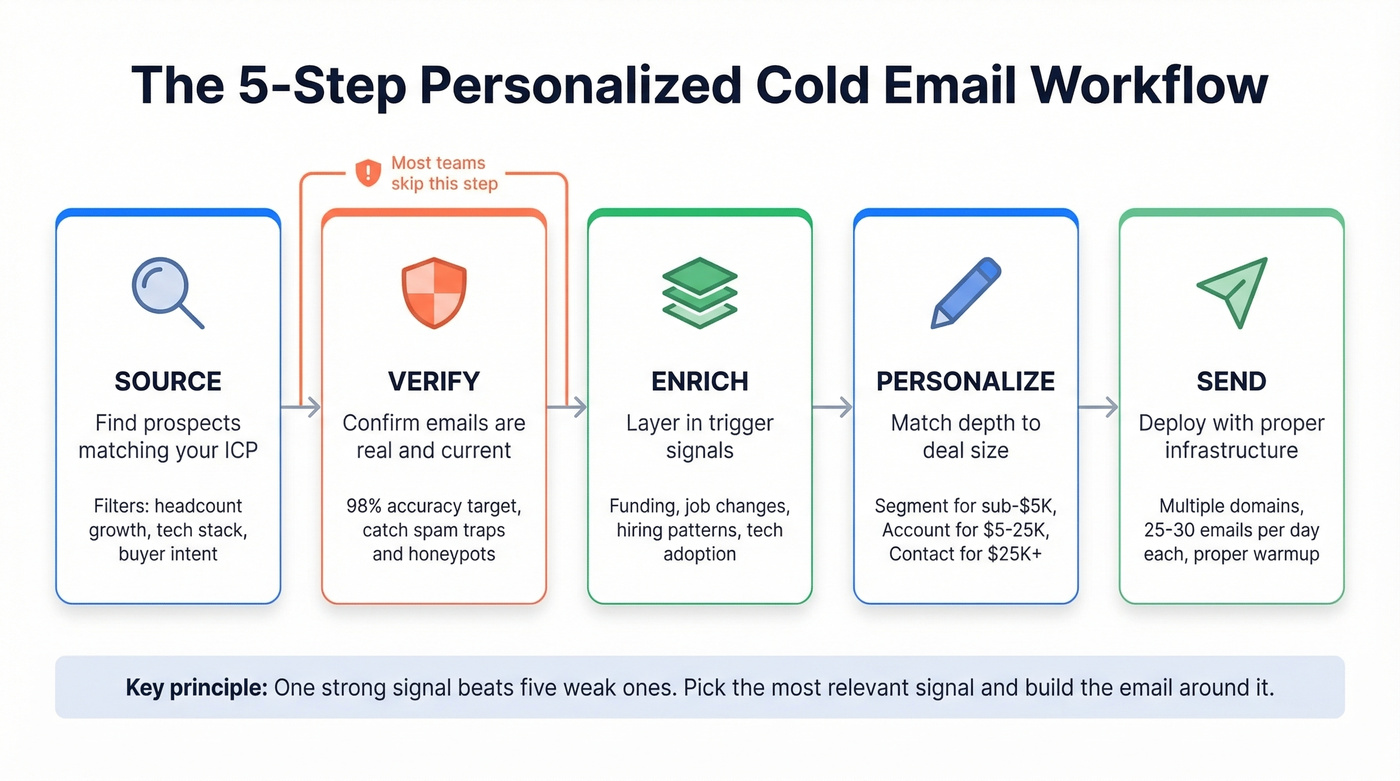
Source -> Verify -> Enrich -> Personalize -> Send.
Start by sourcing prospects that match your ICP using filters like headcount growth, tech stack, or buyer intent. Then verify and enrich your list - this is the step most teams skip, and the step that determines whether everything downstream works or fails.
Next, layer in trigger signals: funding events, job changes, hiring patterns, tech adoption. Clay is the go-to enrichment engine here. It pulls from multiple data sources and lets you build tables that feed directly into personalized outreach without manual research on every prospect.
In Clay-based GTM workflows, teams typically run three motions: AI-led outbound that generates copy from enrichment data, intent-signal sequences triggered by buying behavior, and inbound-led outbound based on website visitor de-anonymization.
The practical recipe: build your ICP template, score and prioritize, test on 10-50 prospects before scaling, then add intent signals as you optimize. Expect $300-$1,500/month on the full stack depending on volume.
When Deep Research Isn't Worth It
If your average deal is under $10K, you probably don't need contact-level personalization at all. Most teams over-invest in research and under-invest in volume and targeting. Selling a $2K/year tool? Spending 15 minutes researching each prospect means you need a reply rate north of 20% to justify the time. That math never works.
The framework is simple: time per email x daily volume x reply rate = meetings. If segment-level personalization at 2 minutes per email gets you 80% of the meetings that contact-level at 15 minutes would, the segment approach wins on ROI every time. Save the deep research for enterprise deals where one meeting can be worth $50K+ in pipeline.
If you're building a full system, map this into a B2B cold email sequence and keep an eye on safe email velocity as you scale.
Tools for Personalized Outreach
| Tool | Best For | Starting Price |
|---|---|---|
| Prospeo | Verified data + enrichment | Free (75 emails/mo) |
| Clay | Signal enrichment + AI copy | ~$149/mo |
| Instantly | Sending + warmup | ~$30/mo |
| SmartWriter | AI first-line generation | ~$49/mo |
| Saleshandy | Budget sending + sequences | ~$25/mo |
| Reply.io | Agentic AI SDR | ~$500/mo |
Prospeo is the data quality layer that makes everything else work. 300M+ professional profiles, 143M+ verified emails, all refreshed every 7 days while the industry average sits at 6 weeks. The Chrome extension lets you find verified contacts from any website in one click, and native integrations with Instantly, Smartlead, Lemlist, Clay, Zapier, Make, Salesforce, and HubSpot mean verified data flows directly into your sending tools. At roughly $0.01 per email, it's 90% cheaper than ZoomInfo's per-lead cost.
Clay is the enrichment brain. Pair it with a verification layer for data quality and Instantly for sending - that's the stack most teams we've talked to are running in 2026. ~$149/month.
Skip SmartWriter if you're already using Clay's AI features - there's significant overlap. But if you want a standalone tool that generates personalized first lines from prospect data without building workflows, it does the job for ~$49/month.
Instantly handles sending infrastructure: inbox rotation, warmup, deliverability monitoring. Their benchmark data is the best public dataset on cold email performance. ~$30/month.
Saleshandy is the budget pick. Unified inbox, A/B testing, solid sequences. If you're spending under $50/month on sending, start here.
Reply.io's Jason AI is the most ambitious play - an agentic AI SDR that researches leads, personalizes outreach, handles replies, and books meetings autonomously. At ~$500/month, it's a bet on the future. I haven't tested it deeply enough to recommend it over a human SDR, but it's the tool we're watching closest.
If you’re comparing stacks, start with a shortlist of SDR tools and a broader set of free lead generation tools.

Account-level personalization needs real signals - funding rounds, hiring surges, tech stack changes. Prospeo's 30+ search filters and Bombora intent data across 15,000 topics surface the exact triggers that make your cold emails feel relevant, not researched.
Find the signal. Write the email. Book the meeting.
FAQ
How many cold emails should I personalize per day?
Most successful operators send 25-50 per domain per day. Keeping volume low protects deliverability - which matters more than raw send count. Scale by adding domains (the r/Entrepreneur operator used 7), not by cranking up volume on a single one.
Does AI personalization actually work?
Yes, but it's commoditized. Everyone's using similar AI tools to generate first lines, so the differentiator isn't the tool - it's the signal you feed it. A funding trigger processed through AI beats a generic company description every time.
What's the biggest mistake in cold email personalization?
Personalizing on bad data. If the email bounces or the job title is stale, your carefully crafted opener actively hurts you. Verification before personalization isn't optional.
Is personalized cold email worth it for low-ACV products?
Yes, but at the segment level. Group prospects by industry, company size, or tech stack and write one strong email per segment. Save contact-level research for deals above $10K-$25K where the time investment generates meaningful ROI.
Do I need to worry about GDPR with cold email?
If you're emailing EU-based prospects, yes. Use a GDPR-compliant data provider, include an easy opt-out in every message, and make sure you have a legitimate interest basis for outreach. Fines for non-compliance can reach 4% of annual revenue - not worth the risk.