

Best Playbook Builder Tools for 2026
"Playbook builder" means three completely different things depending on who's searching. A youth football coach wants to draw Cover 3 variations. A VP of Operations wants to document onboarding SOPs. A sales leader wants a repeatable outbound motion backed by real data.
The tools that serve each group have almost zero overlap - and most articles only cover one category while ignoring the other two.
Nearly 40% of sales teams lack a playbook, and football coaches on Reddit are explicitly asking for affordable options because "bang-for-buck matters." Whatever type of playbook you're building, here are the actual tools worth your time.
Our Picks (TL;DR)
| Category | Best For | Tool | Price | Why |
|---|---|---|---|---|
| Football | Budget-friendly play design | Playmaker X | $7/mo | Simple, collaborative, prints clean |
| Business/Process | Structured knowledge playbooks | PlaybookBuilder | $279/mo | 4.7/5 on G2, 101 reviews |
| Sales/GTM | Accurate prospect data | Prospeo | Free tier, ~$0.01/email | 300M+ profiles, 98% email accuracy |
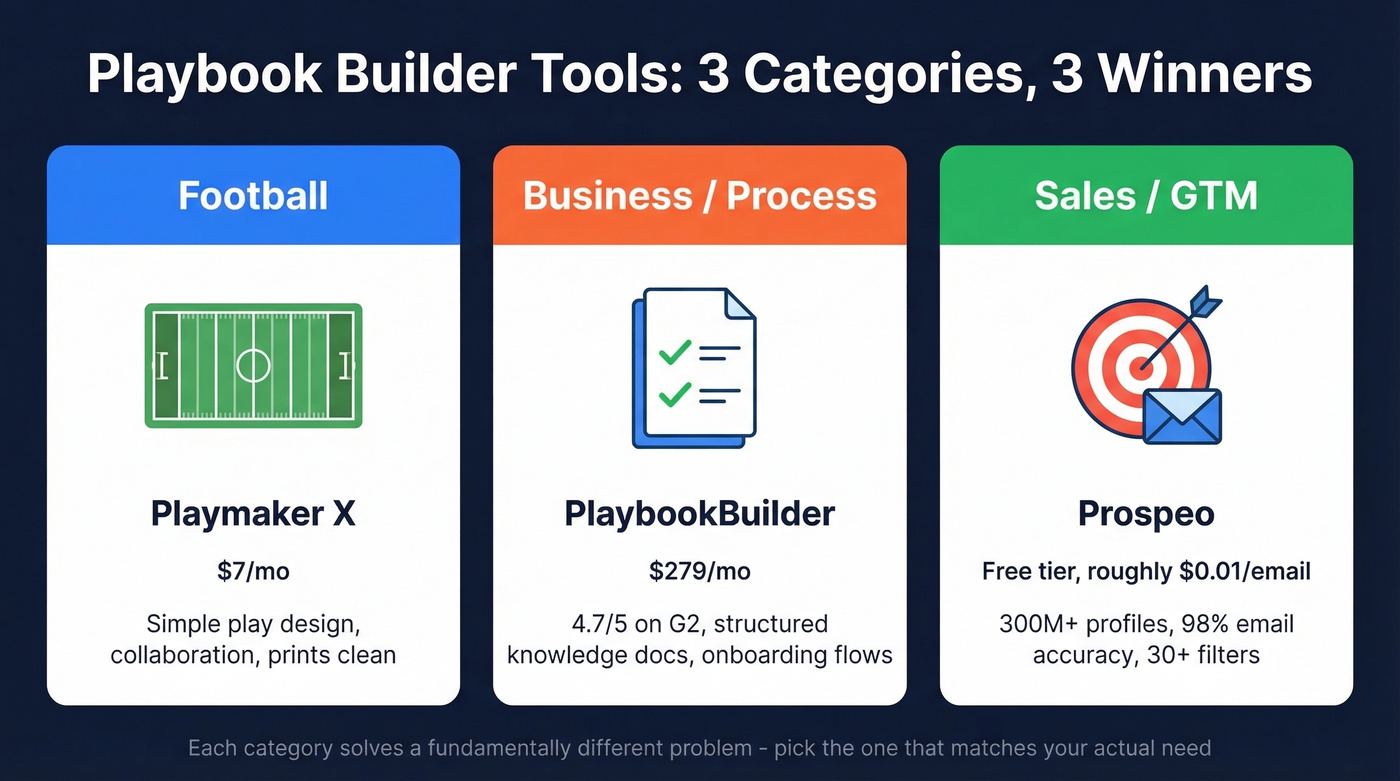
If you already know which category you need, jump to Football, [Business](#best-business - process-playbook-builders), or Sales/GTM. Not sure? The decision framework at the end will sort you out in 60 seconds.
Best Football Playbook Builders
Football coaches have the most mature market for play design software - and the widest price range. Youth coaches care about ease of use and cost. High school and college programs need install management and game-day adjustment tools. Here's what's actually worth it at each level.
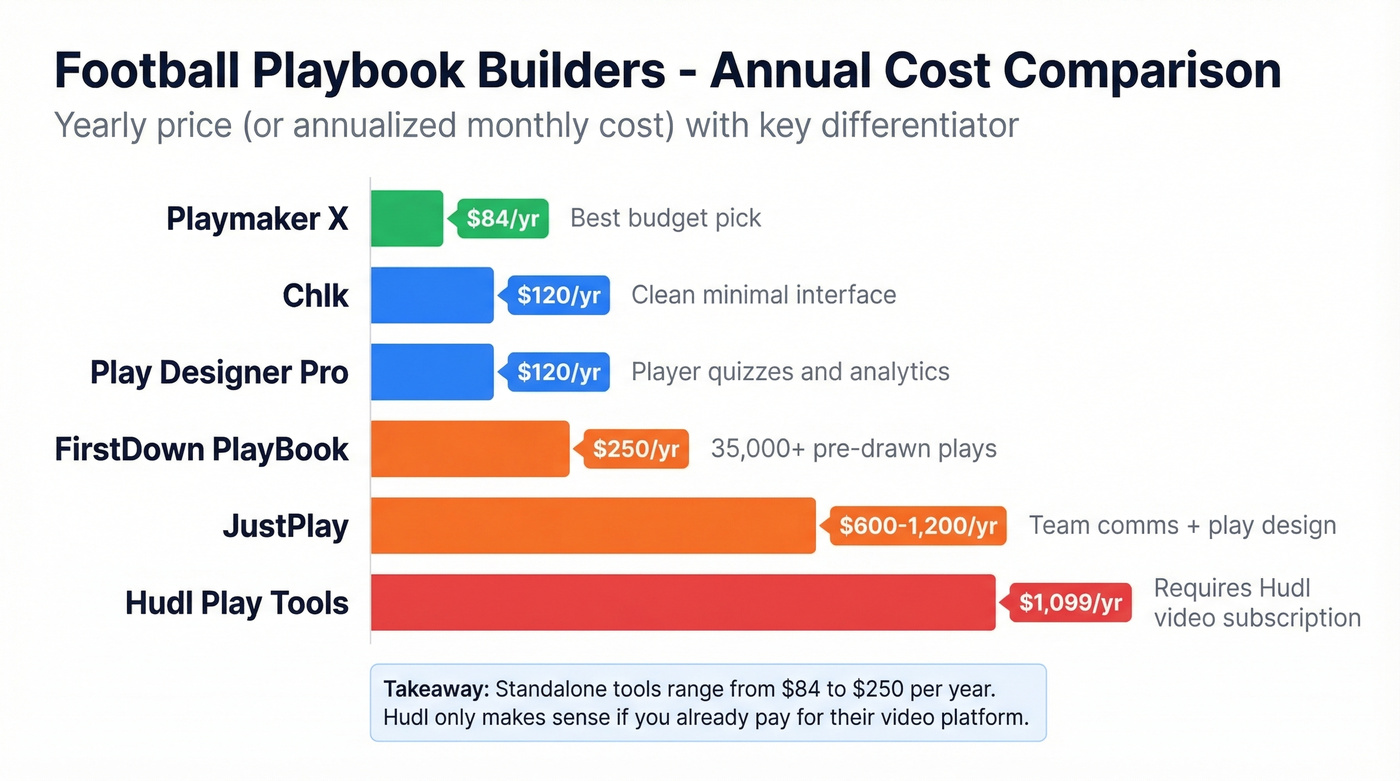
| Tool | Price | Free Trial | Best For | Standalone? |
|---|---|---|---|---|
| Play Designer Pro | $20/mo or $120/yr | 14-day | All-around coaching | Yes |
| Playmaker X | $7/mo | Not listed | Budget-conscious coaches | Yes |
| Chlk | $12.99/mo or $120/yr | - | Clean, simple drawing | Yes |
| FirstDown PlayBook | $125/90 days or $250/yr | - | Pre-drawn play library | Yes |
| Hudl Play Tools | $199 add-on ($1,099 total) | - | Hudl video users only | No |
| JustPlay | ~$50-$100/mo (varies) | - | Team communication + plays | Yes |
Play Designer Pro - Best All-Around
Play Designer Pro hits the sweet spot between simplicity and depth. At $20/month or $120/year, you get play drawing, install management, and - this is the differentiator - auto-generated quizzes for players. That quiz feature matters more than most coaches realize: you can assign plays, track which players actually studied them, and pull comprehension analytics before game day.
The 14-day free trial gives you full access, enough time to build out a few installs and see if the workflow clicks. We've seen this tool recommended most often by coaches who want play design and player learning in one place rather than juggling a drawing tool plus a separate communication app. If you're coaching at the high school or college level and want a single platform, this is the obvious starting point.
Playmaker X - Best Budget Pick
At $7/month, Playmaker X is one of the cheapest standalone options worth recommending. It handles online play design, collaboration, and printing across multiple formation formats. The interface won't win design awards, but it's functional and fast.
This is the tool for youth and high school coaches who need to draw plays, share them with staff, and print wristcoach sheets without spending $20+ a month. Based on the Reddit threads we've read, budget sensitivity is the primary constraint for most coaches. Playmaker X solves that.
Chlk
Chlk runs $12.99/month or $120/year and emphasizes a clean, minimal interface. Field dimension toggles let you switch between high school, college, and NFL field specs - a small detail that matters when you're drawing plays to scale. Export options include PNG and JPG. More polished than Playmaker X, less feature-rich than Play Designer Pro.
FirstDown PlayBook
Instead of starting from scratch, FirstDown PlayBook gives you access to 35,000+ pre-drawn plays across youth, high school, college, and flag football. Video pairing, wristcoach sheets, and play card generation round out the package. At $125 for 90 days or $250/year, it's pricier than drawing-first tools, but the library saves enormous time if you're building an install from existing concepts rather than inventing new ones.
Hudl Play Tools
Hudl's Play Tools is a $199 add-on to their video subscription, which starts at $900 for high school teams - putting the total at roughly $1,099. If you're already paying for Hudl video and want play design in the same ecosystem, it makes sense. If you're not already a Hudl customer, skip it. The play tools haven't evolved much in over a decade, and standalone alternatives offer more for less.
Here's the thing: JustPlay, which several coaches mentioned in that Reddit thread, bundles team communication with play design. It's worth a look if you want messaging and playbooks in one app, but dedicated drawing tools like Play Designer Pro give you better diagramming depth. Pro Quick Draw (a Visio/PowerPoint plugin) still exists, but a play-drawing tool that requires a sales call for pricing in 2026 isn't worth your time when competitors are transparent at $7-20/month.

Football coaches have play design tools. Business teams have process docs. But a sales playbook without accurate prospect data is just a strategy deck collecting dust. Prospeo gives you 300M+ profiles, 30+ filters, and 98% verified emails - the foundation every GTM playbook needs.
Stop building sales playbooks on bad data. Start with Prospeo free.
Best Business & Process Playbook Builders
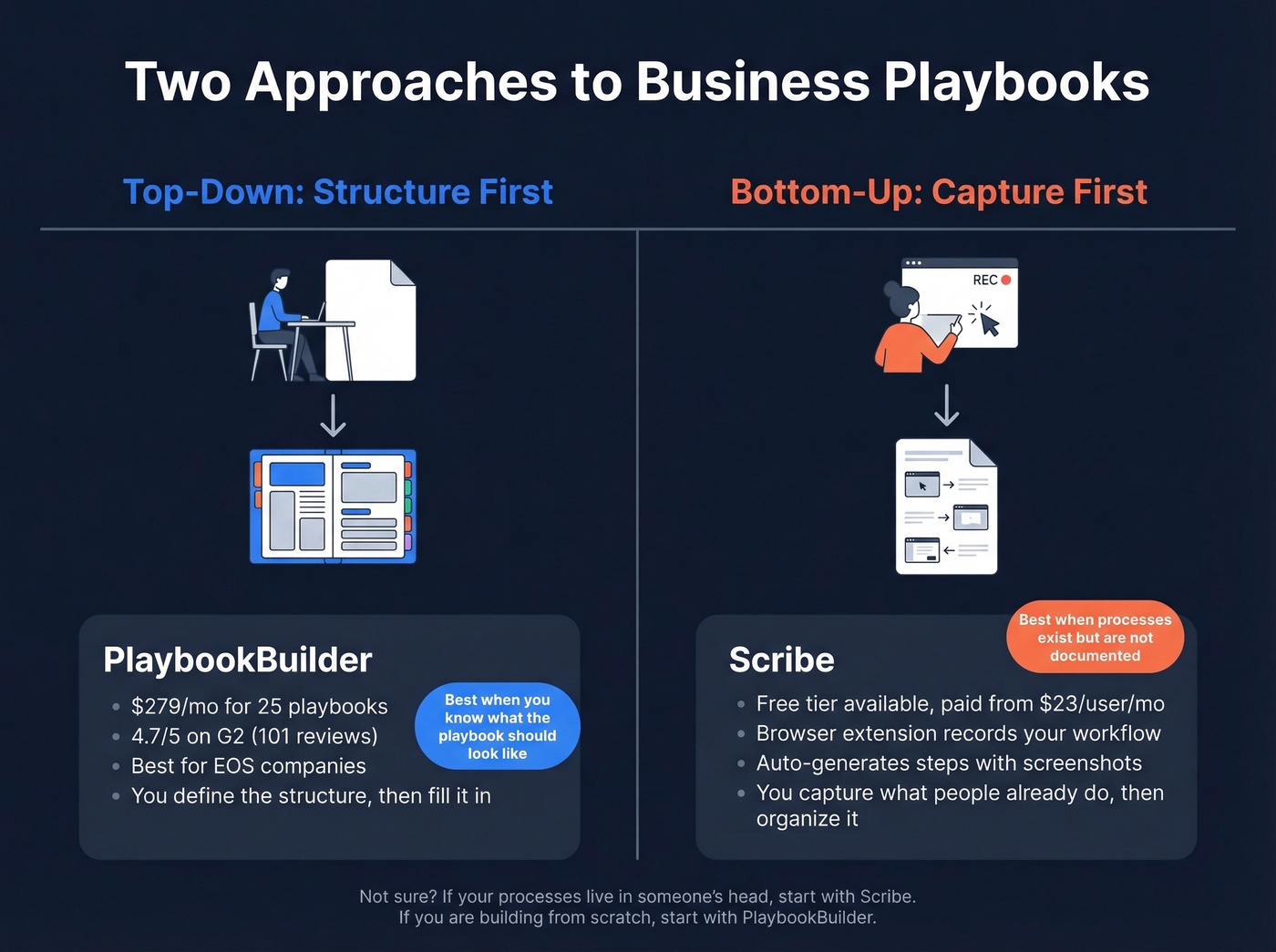
Business playbook builders solve a different problem entirely: documenting processes, onboarding flows, and institutional knowledge so it doesn't live in one person's head. The market splits into "top-down" builders where you structure the playbook intentionally, and "bottom-up" capture tools that record what people already do.
PlaybookBuilder - Best for EOS Companies
PlaybookBuilder runs $279/month for 25 playbooks, 50 users, and 1TB of storage. Additional users cost $1/month each. A 14-day free trial unlocks all features, and your content is retained after the trial ends.
The G2 rating sits at 4.7/5 across 101 reviews, which is strong for this category. Implementation averages 4 months with ROI typically realized around 11 months - and G2 data shows an average negotiated discount of 9%, so don't pay sticker price. Ask.
Use this if you're running EOS (Entrepreneurial Operating System) or need structured knowledge playbooks for onboarding, training, or role-based documentation. The platform organizes information around job functions and activities - think "Sales Rep Playbook" or "New Hire Onboarding Playbook" - with built-in user reporting, texting, and automated emailing.
Skip this if you just need basic SOPs. A Google Doc or Notion workspace handles simple process documentation without a $279/month commitment.
Scribe - Best for Capturing Workflows
Scribe takes the opposite approach. Instead of building playbooks from scratch, you install a browser extension that captures your screen as you work, then auto-generates step-by-step documentation with screenshots and annotations. Record what people actually do, then compile those captures into a playbook.
A free tier covers individual use. Paid plans start around $23/user/month and unlock team features, sharing controls, and export options including PDF, HTML, and Markdown. This is the right tool for teams that already have processes running but haven't documented them - if your best rep's workflow lives entirely in their muscle memory, Scribe turns it into something transferable.
For teams that want something even lighter, Trainual and Notion templates can handle basic needs at lower price points, though neither offers Scribe's automatic capture or PlaybookBuilder's structured organization.
Best Sales Playbook Tools for GTM Teams
Organizations with a formalized sales playbook are 33% more likely to be high performers, and companies that document methodologies see an 18% revenue growth advantage over those that don't. Yet nearly 40% of sales teams still don't have one.
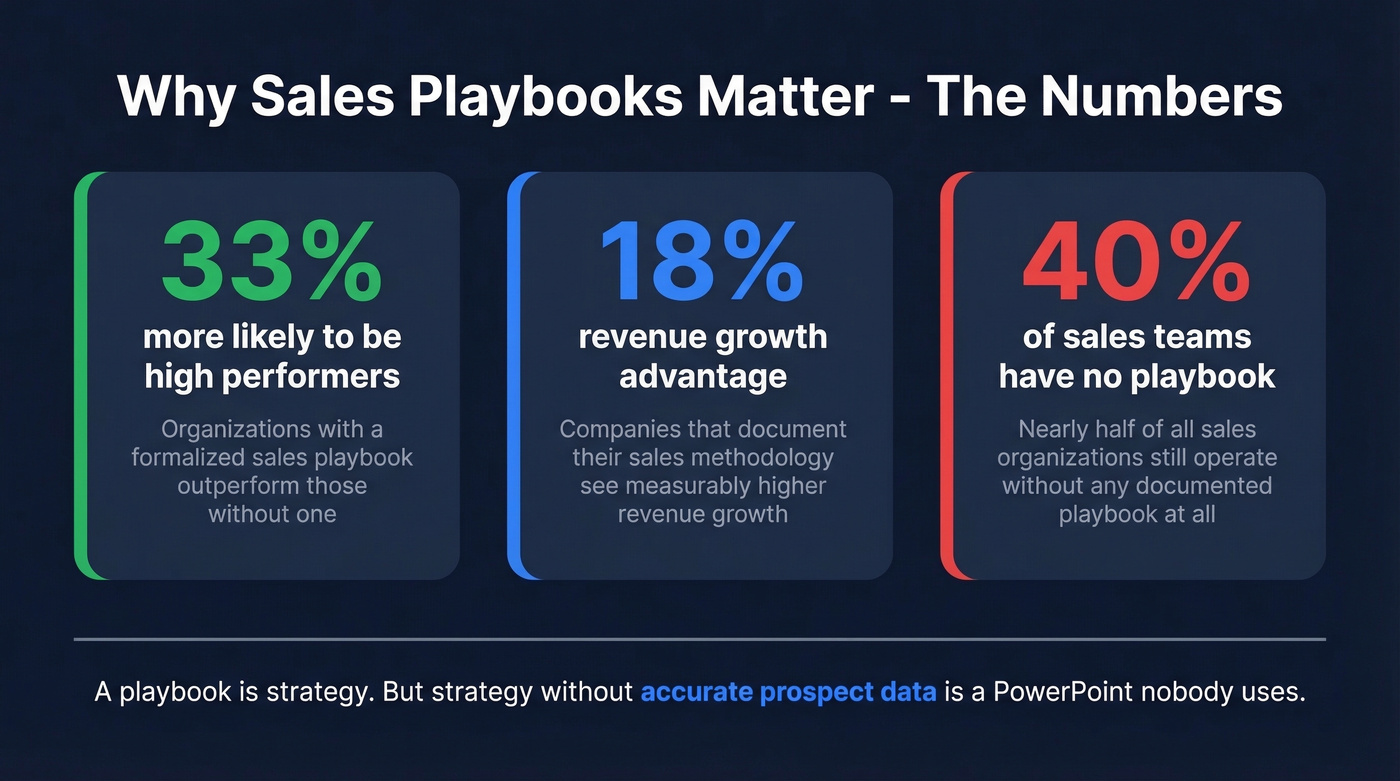
A sales playbook is strategy. But strategy without accurate data is a PowerPoint nobody uses. The tools below solve different parts of the problem: one ensures your reps can actually reach the people the playbook tells them to target, one handles workflow automation by turning signals into triggered sequences, and one builds the playbook document itself.
Prospeo - Best for Prospect Data
Your outreach playbooks tell reps who to target - Prospeo makes sure they can actually reach those people. The platform covers 300M+ professional profiles, 143M+ verified emails at 98% accuracy, and 125M+ verified mobile numbers with a 30% pickup rate. Every record refreshes on a 7-day cycle, roughly six times faster than the industry average.

The 30+ search filters go beyond basic firmographics. You can layer buyer intent signals across 15,000 Bombora topics, technographics, job changes, headcount growth, and funding data to build lists that match your playbook's ICP definition precisely. The Chrome extension lets reps prospect from any website or CRM without switching tabs.
If you’re tightening your ICP definition, start with an Ideal Customer Profile scoring rubric before you build lists.
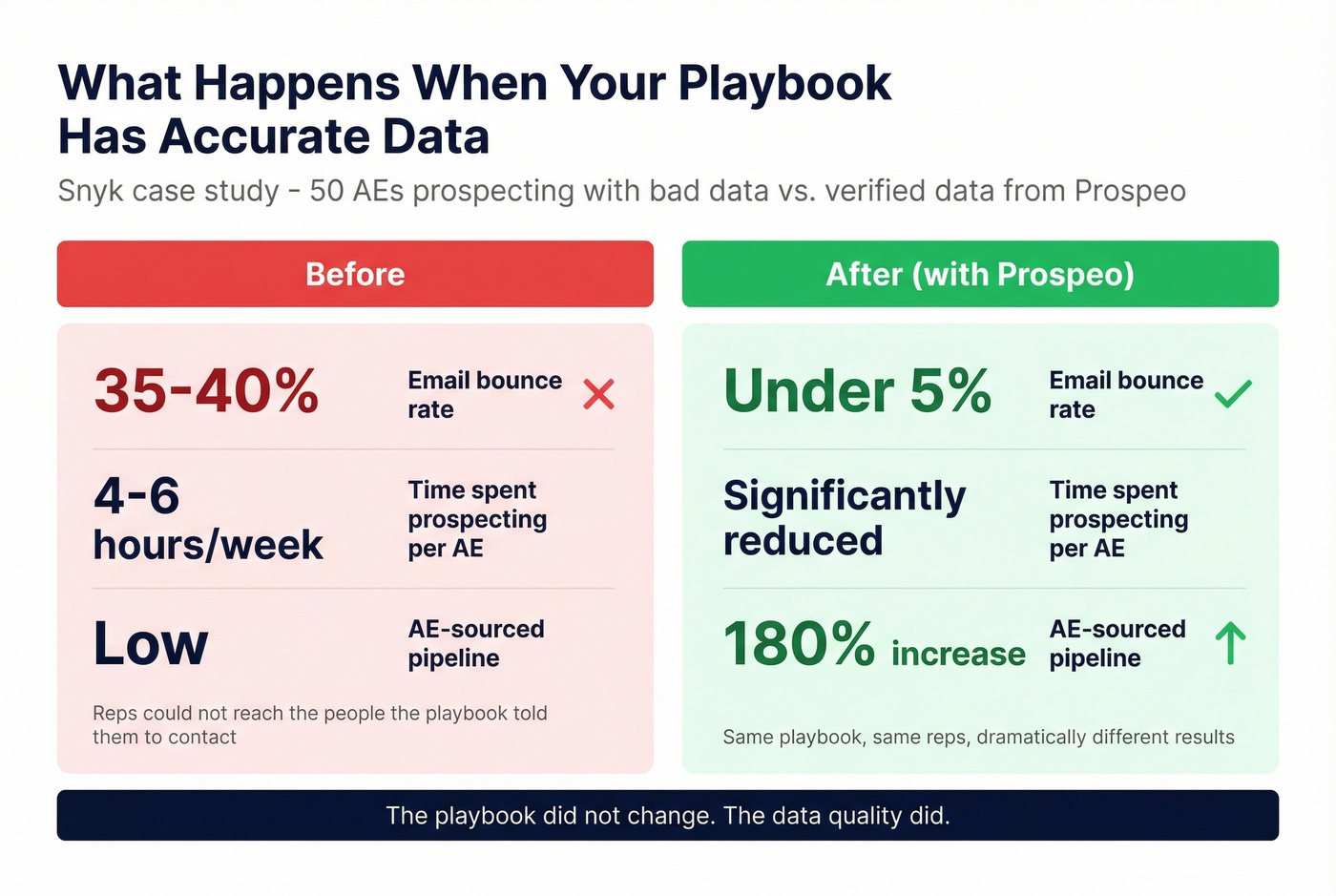
The biggest reason sales playbooks fail isn't bad strategy. It's that reps can't reach the people the playbook tells them to contact. Snyk ran into exactly this - 50 AEs were prospecting 4-6 hours per week with bounce rates hitting 35-40%. After switching, bounces dropped under 5%, and AE-sourced pipeline jumped 180%.
If bounce rates are your bottleneck, fix deliverability basics like email bounce rate before scaling volume.
Pricing starts free with 75 emails/month plus 100 Chrome extension credits/month, and paid plans run roughly $0.01 per email. No contracts, no sales calls required.

Pocus - Best for Automated Workflows
Pocus reimagines playbooks as automated GTM workflows. Instead of a static document, you build visual playbooks with a drag-and-drop editor that triggers actions based on intent signals, product usage data, and CRM events. Conditional branching lets you route leads differently - automate SMB outreach, but surface enterprise accounts with funding events directly to reps. The team is also building a library of 100+ battle-tested playbooks and native A/B testing.
At $30K/year for 20 seats, this is enterprise territory. G2 reviews give it a 4.4/5 across 134 reviews, with users consistently praising the integrations with Outreach and HubSpot and calling out the time savings. Teams already using HubSpot playbooks for sales enablement will find Pocus extends that foundation with signal-based automation a CRM alone can't handle.
If you’re building around intent signals, it helps to formalize your intent based segmentation rules first.
The tradeoff we've noticed in user reviews: company and employee data within Pocus can be inaccurate, requiring manual qualification before outreach. That's a meaningful gap when you're paying $1,500 per seat annually.
Use this if you're an enterprise GTM team with budget and need workflow automation across the full go-to-market motion. For SMB teams, $30K/year isn't realistic, and the data accuracy complaints mean you'll likely need a separate verification layer anyway.
Sales Playbook Builder AI - Done-for-You
Sales Playbook Builder AI takes a service approach rather than a software one. Instead of giving you a tool, they build the playbook for you. Expect to pay $1K-$5K+ per project depending on scope and complexity. Transparency on deliverables is limited, so ask for samples before committing. This makes sense for teams that want a finished playbook document without dedicating internal resources - but it's not a tool you'll use ongoing.
If you’re operationalizing the finished doc, turn it into repeatable sequence management so reps actually run it.
The best sales playbooks combine a repeatable process with reliable contact data. Prospeo delivers 143M+ verified emails at ~$0.01 each, refreshed every 7 days - so every play in your outbound motion reaches a real inbox. Teams using Prospeo book 26% more meetings than ZoomInfo users.
Your outbound playbook deserves data that actually connects.
How to Choose the Right Tool
Let's keep this simple. Three questions get you to the right playbook builder in under a minute.
What Are You Building?
Football plays and formations? Start with Play Designer Pro or Playmaker X. Process documentation and SOPs? Look at PlaybookBuilder or Scribe. Sales or GTM motion? Keep reading.
If you’re building a repeatable outbound motion, borrow from proven sales prospecting techniques before you lock the playbook.
What's Your Budget?
Football tools range from $7/month up to about $250/year. Business tools run $279/month and up. Sales/GTM tools span from free to $30K/year. Match the tool to what you can actually spend, not what looks impressive in a demo.
If you’re comparing data costs across vendors, use a benchmark list of data enrichment services to sanity-check pricing and coverage.
Do You Also Need Data?
This is the question most teams skip. A sales playbook that says "target VP of Engineering at Series B SaaS companies" is useless if your reps can't find verified contact info for those people. If your bottleneck is data quality rather than strategy, solve that first and build the playbook around what you can actually execute.
If you need more sources, compare sales prospecting databases before committing to a long-term stack.
FAQ
Is there a free playbook builder?
Scribe offers a genuinely free tier for capturing business processes. For sales prospecting data, Prospeo provides 75 free email lookups per month plus 100 Chrome extension credits - no credit card required. Football-specific tools start at $7/month with Playmaker X; there's no fully free standalone option worth recommending there.
What's the cheapest football playbook software?
Playmaker X at $7/month. Play Designer Pro at $20/month is the best value if you want player quizzes and install analytics - the extra $13/month buys meaningful coaching features that justify the price difference.
Do I need a sales playbook tool or just a template?
Most teams under 10 reps can start with a Google Doc template. You need dedicated software when you're scaling past 10 reps, automating signal-based workflows, or managing conditional logic a static document can't handle.
What's the difference between a sales playbook and a GTM playbook?
A sales playbook documents methodology, talk tracks, and objection handling for reps. A GTM playbook - the kind Pocus builds - automates signal-to-action workflows across the entire go-to-market motion, including marketing handoffs and product-led triggers.
How often should I update my sales playbook?
Quarterly at minimum. Only 31% of teams update annually, and 12% never update at all. Stale playbooks lead to outdated messaging and reps who stop consulting the document entirely.