

"Please Forward to the Appropriate Person" - Templates & Better Alternatives
You sent a proposal to your contact. They said they'd forward it to the right person. That was 10 days ago, and you haven't heard a word.
The phrase "please forward to the appropriate person" is perfectly professional - but relying on someone else to route your email is one of the least reliable moves in business communication. Your message sits in someone else's inbox, competing with their own priorities, and you've got zero visibility into whether it actually went anywhere.
The quick version: The phrase is grammatically correct and widely used. The real problem isn't the wording - it's that forwarding chains fail more often than they work. Your best move is to find the right person's email yourself instead of hoping someone routes your message.
What This Phrase Actually Means
"Please forward to the appropriate person" is a standard professional request asking the recipient to route your message to whoever handles the topic at hand. Ludwig confirms the phrase is grammatically correct and commonly appears in professional contexts, with examples from sources like Nature and TechCrunch. One Nature example nails the real advice: "do the homework to find out who that person is."
That last part is the key. Use this phrase as a fallback when you genuinely don't know who handles something - not as a substitute for doing the research yourself. If you can identify the right person before you hit send, the forwarding step becomes unnecessary.
Better Ways to Phrase It
You don't need 35 synonyms. You need a few solid options matched to the right tone.
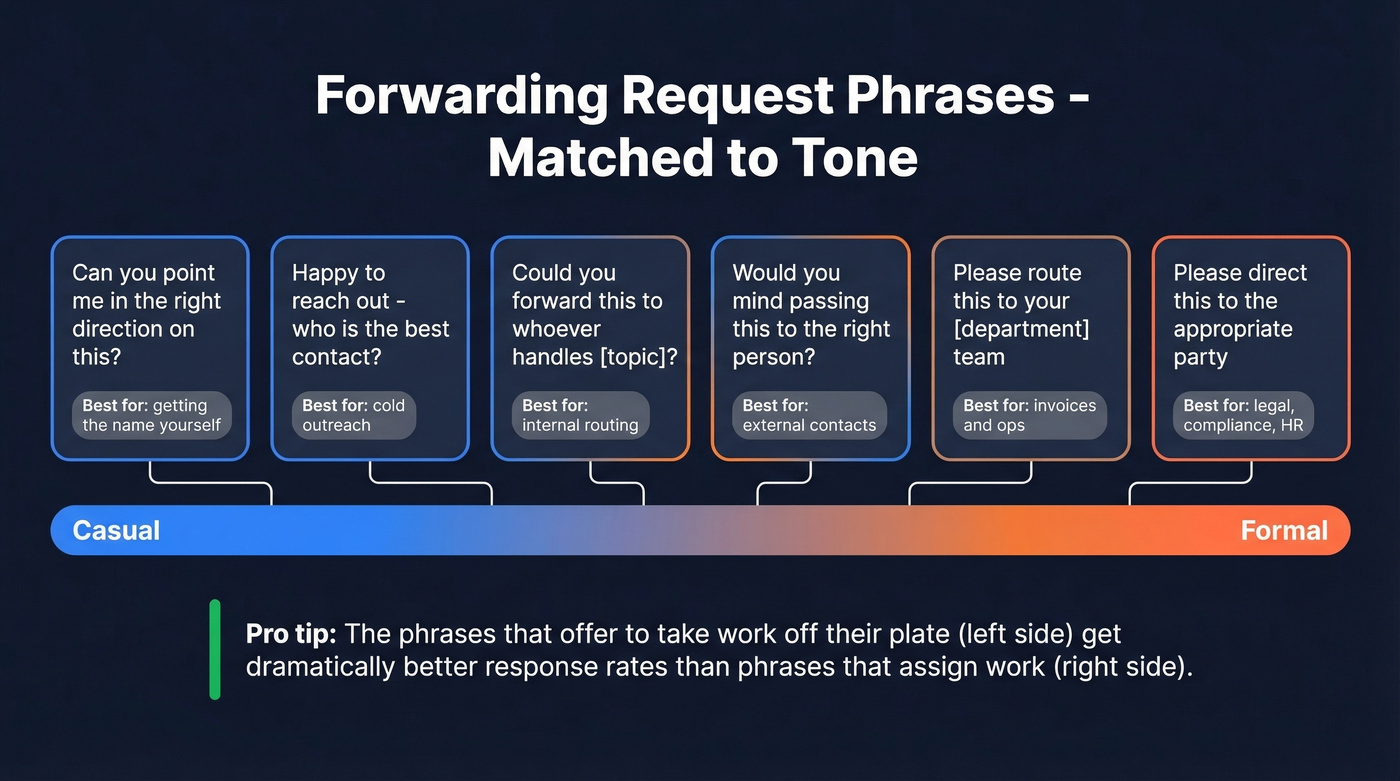
A good forwarding request follows a simple structure: reference the email, make the explicit ask, give a quick justification, and specify who it should go to.
| Phrase | Tone | Best For |
|---|---|---|
| Could you forward this to whoever handles [topic]? | Neutral | Internal routing |
| Would you mind passing this to the right person? | Polite | External contacts |
| Please route this to your [department] team | Direct | Invoice/ops requests |
| I'd appreciate you sharing this with [Name/role] | Warm | When you know the role |
| Can you point me in the right direction on this? | Casual | When you'd rather get the name |
| Please direct this to the appropriate party | Formal | Legal, compliance, HR |
| Happy to reach out - who's the best contact? | Collaborative | Cold outreach |
| If someone's better suited, happy to reach out directly | Deferential | Payment follow-ups |
The last two are underrated. Instead of asking someone to do work for you, you're offering to take the work off their plate. That subtle shift gets dramatically better results.
If you're building a repeatable outbound process, these sales prospecting techniques help you avoid dead-end routing requests in the first place.

Every forwarding request is a coin flip. Instead of hoping a gatekeeper routes your message, use Prospeo to pull verified emails for the exact decision-maker - filtered by title, department, and company. 98% email accuracy, 300M+ profiles, no forwarding chain required.
Skip the middleman. Reach decision-makers directly for $0.01 per email.
Copy-Paste Email Templates
Misdirected Email
Hi [Name], I think this landed with the wrong person - could you forward this to whoever handles [topic]? For context, I'm reaching out about [one-sentence summary]. Happy to connect with them directly if you can share their info.
Cold Outreach to a Gatekeeper
Hi [Name], I help [type of company] [achieve specific result]. I put together a quick breakdown for [Company] - would you mind pointing me to the right person on your [sales/marketing/ops] team? Even just a name works.
Keep this under 60 words. A r/copywriting breakdown recommends 40-60 word cold emails with a soft CTA like "Even just a name works" instead of a longer pitch. We've seen the same pattern across our own outreach - brevity wins.
If you want more follow-up options after this opener, use these sales follow-up templates.
"Please Direct Me to the Right Person" Email
Hi [Name], I'm not sure I have the right contact for this - could you please direct me to the right person who handles [topic/department]? I'd love to reach out to them directly so this doesn't create extra steps for you. A name or email address would be great.
This one works well when you're emailing a general inbox or someone you suspect isn't the decision-maker. It's polite, specific, and takes the burden off the recipient.
Following Up After "I Forwarded It"
Hi [Name], thanks for passing that along. Could you share the name of the person you sent it to? I'd love to reach out directly so it doesn't create extra back-and-forth for you.
This is a common dead end in sales. The prospect says they forwarded your info but won't name who they sent it to. Frame your ask as reducing their workload, not increasing it.
If you're unsure about timing, this guide on When Should You Follow Up on an Email? can help.
Invoice or Payment Routing
Hi [Name], I'm following up on invoice #[number], originally sent on [date]. If there's a better contact in accounts payable, I'm happy to reach out directly - just let me know who.
This matters for freelancers and vendors chasing payments across departments. Don't keep emailing the same unresponsive contact - ask for the handoff explicitly.
Mistakes That Kill Your Request
Being vague about "appropriate." Specify the department, role, or subject area. A forwarding request with zero context gets ignored.
If you need help making the ask clearer, start with these email subject line examples and keep the body tight.
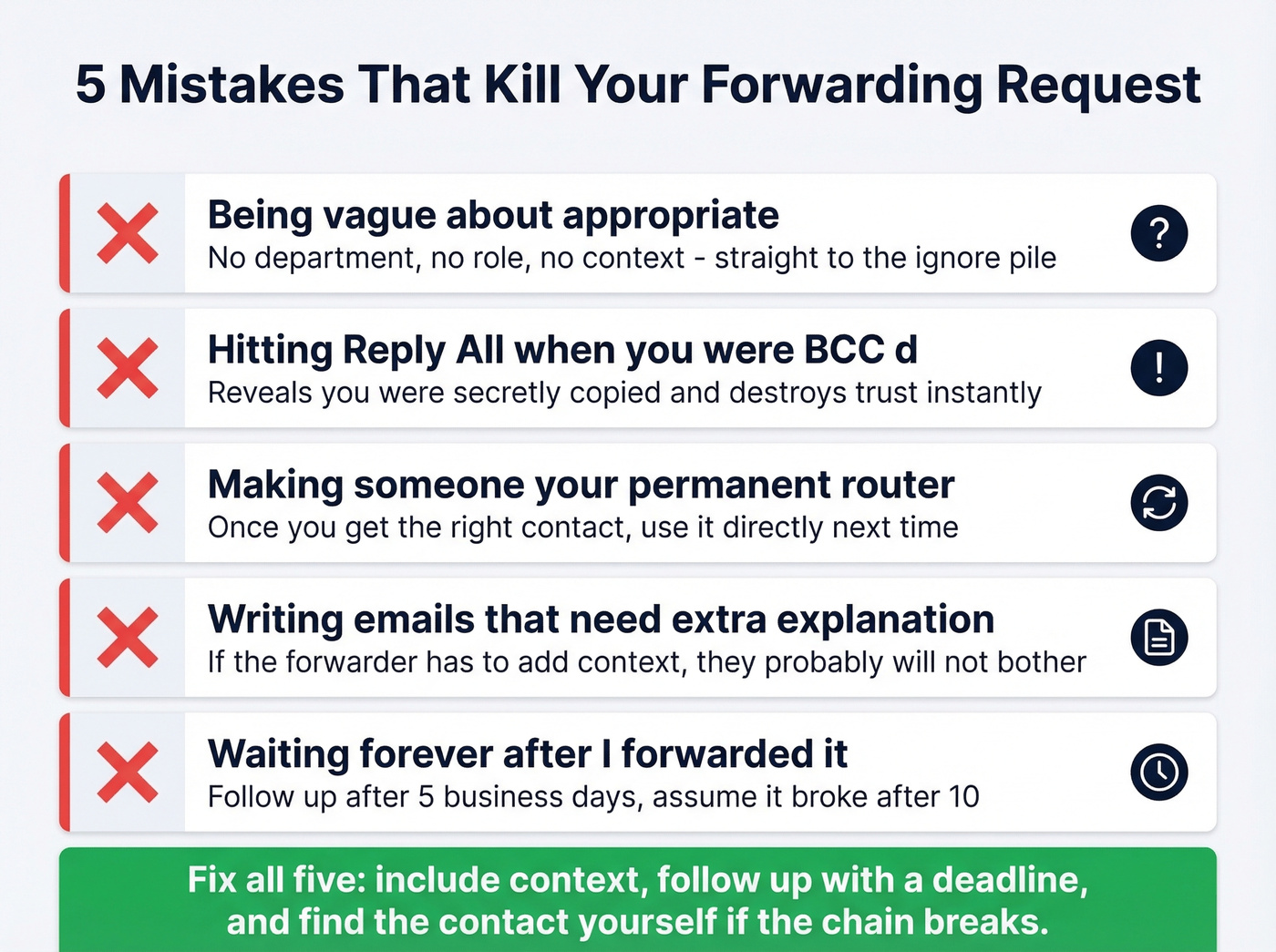
Hitting Reply All when you were BCC'd. If someone BCC'd you on a thread, never Reply All - it reveals you were secretly copied and creates an instant trust breach.
Making someone your permanent router. A Workplace Stack Exchange thread explains why people tell you to "contact X directly" - they don't want every future message flowing through them. Once you get the right contact, use it.
Writing emails that can't be forwarded cleanly. Include full context in the body: a clear subject line, what you need, and why. If the forwarder has to add explanation before passing it along, they probably won't bother. For a deeper framework, see our guide to email copywriting.
Waiting indefinitely after "I forwarded it." Follow up after five business days. After ten, assume the chain broke and find the contact yourself.
Skip Forwarding Entirely
Here's the thing: if your deals are under five figures, you absolutely can't afford to lose a week waiting for someone to maybe forward your email. Forwarding chains fail because the forwarder has no incentive to follow through. Your email isn't their priority. Email-only outreach already averages roughly a 3% response rate - adding a forwarding hop makes those odds worse.
If you're trying to lift reply rates, these emails that get responses are a better model than anything that depends on internal routing.
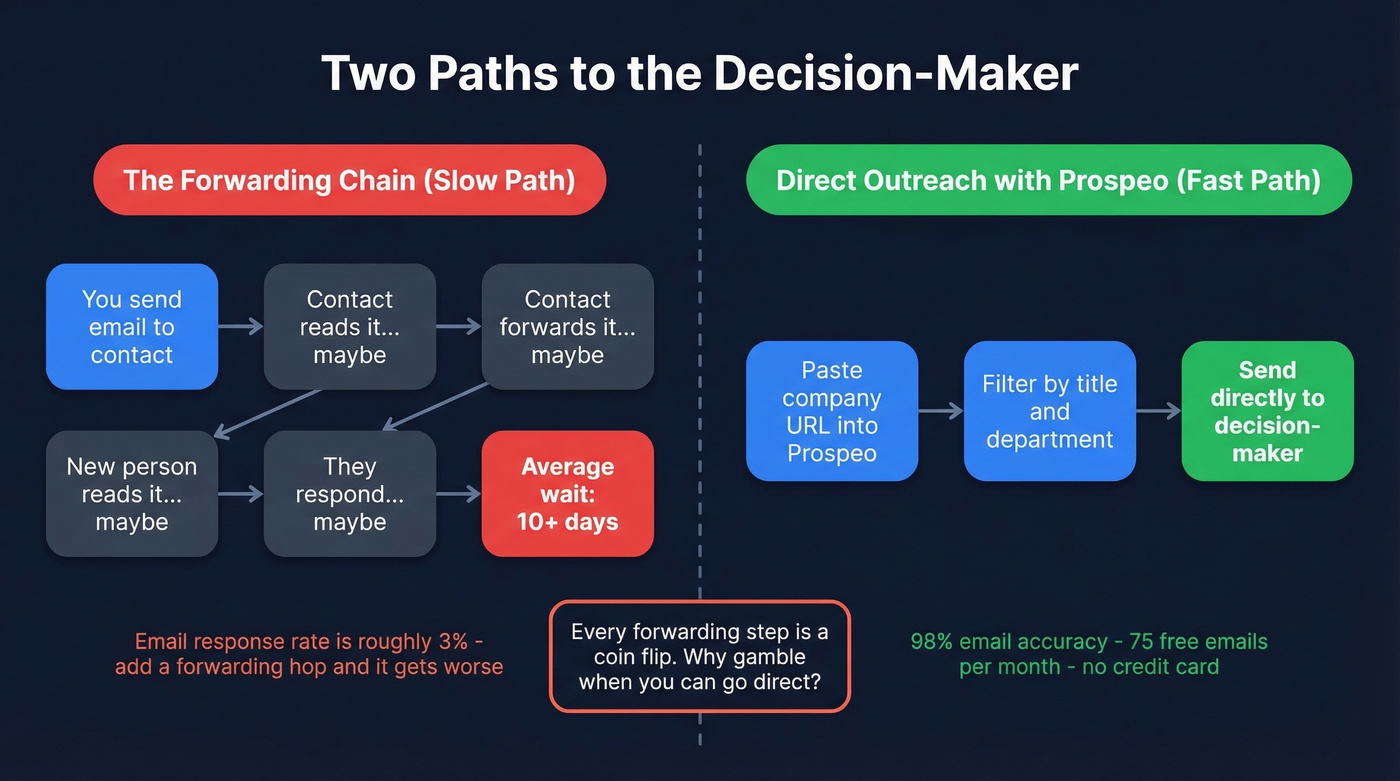
Let's be honest about what's happening when you write "please forward to the appropriate person." You're outsourcing the most critical step of your outreach - reaching the decision-maker - to someone who has no stake in the outcome. We've watched deals stall for weeks in this exact limbo, and it's maddening.
Instead of writing a "point me in the right direction" email and hoping for the best, go find the contact yourself. Prospeo lets you paste a company URL, filter by department and title, and pull verified emails for the actual decision-maker - no forwarding chain required. The free tier gives you 75 emails per month, no credit card needed.
If you’re doing this at scale, a sales prospecting database can save hours per week.
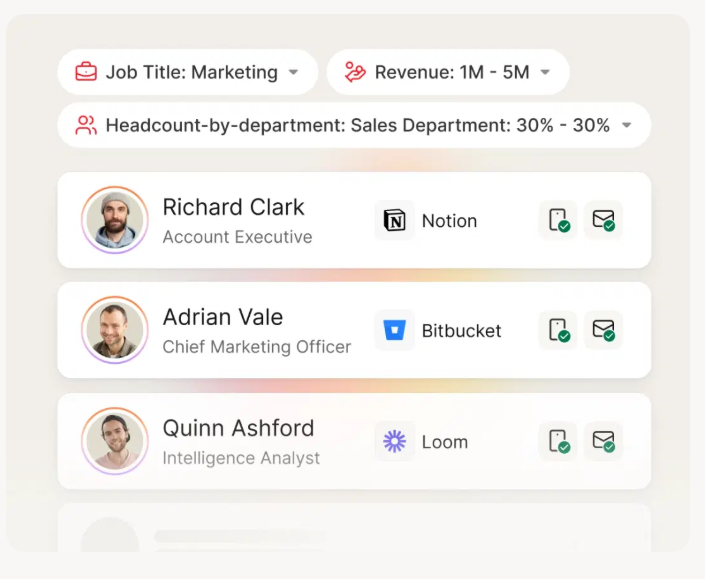
You just read six templates for asking someone to forward your email. Here's a faster path: paste any company URL into Prospeo, filter by role, and get a verified email in seconds. 75 free emails/month, no credit card, no waiting 10 days for a maybe.
Forwarding chains break. Direct, verified contact data doesn't.
FAQ
Is it rude to ask someone to forward your email?
Not at all - it's a standard professional request. Provide context like the department, topic, or a specific role so they can route it quickly. Vague requests get deprioritized; specific ones get acted on within hours.
What should I do if they said they forwarded it but nothing happened?
Wait three to five business days, then follow up asking for the recipient's name. Frame it as reducing their workload. If they won't share it after a second ask, find the right contact yourself through a B2B database rather than continuing the chain.
Is there a faster alternative to asking someone to forward my email?
Yes - skip the forwarding step entirely. Tools like Prospeo's email finder let you search by company, department, and job title to surface verified contact details for decision-makers directly. At 98% email accuracy, it's more reliable than a forwarding chain.