

The POC Sales Playbook: How to Run Proof-of-Concept Deals That Actually Close
A sales engineer I know lost a job offer last year because of three letters: P-O-C. The interviewer meant a presales proof of concept - a structured trial to validate technical fit before a deal closes. The candidate spent 20 minutes describing a postsale reduced-scope trial. Same acronym, completely different process. The interview never recovered.
That confusion is everywhere in POC sales conversations. "POC" means different things depending on who's talking, and the gap between presales technical validation and a postsale pilot is enormous. If you've ever asked what POC means in a business context and gotten three different answers from three different departments, you're not alone. Meanwhile, sales cycles have lengthened 32% since 2021, buying committees keep growing, and the average B2B win rate sits at a brutal 21%. Getting the proof of concept right isn't optional anymore - it's the difference between a deal that closes and one that dies in committee.
The Short Version
A sales POC is a time-boxed, prospect-specific trial that proves your product works in the buyer's environment. Not a demo. Not a free trial. A structured evaluation with clear pass/fail criteria.
The essentials before you launch one:
- Written success criteria agreed with the buyer before day one
- A hard end date - 2 to 4 weeks for most SaaS deals
- Named stakeholders on both sides (champion, technical evaluator, economic buyer)
- A mutual commitment - if criteria pass, the deal moves to contract
Here's why the deadline matters: opportunities closed within 50 days carry a 47% win rate. After 50 days, that drops to 20%. Every week your proof of concept drifts without a decision, your odds crater.
If you take one thing from this article: never run a POC without documented acceptance criteria and a hard end date.
What Is a Proof of Concept in Sales?
A sales POC is a prospect-specific trial where the buyer tests your product using their own data in a sandbox or controlled environment. The goal is to answer one question: Can I make this work here?
That distinction matters. A POC doesn't prove ROI - that's a proof of value. A POC doesn't showcase features - that's a demo. It validates technical feasibility: does this integrate with our stack, handle our data volume, meet our security requirements, and actually work the way the sales team promised?
The best POCs simplify decision-making by removing technical risk, as Dock's POC playbook explains well. The buyer gets hands-on validation. The seller gets a purchase commitment tied to specific outcomes. When it works, both sides win. When it doesn't - when there's no structure, no criteria, no deadline - it becomes free consulting.
POC vs Demo vs POV vs Pilot
These terms get used interchangeably, and that's where deals get messy.
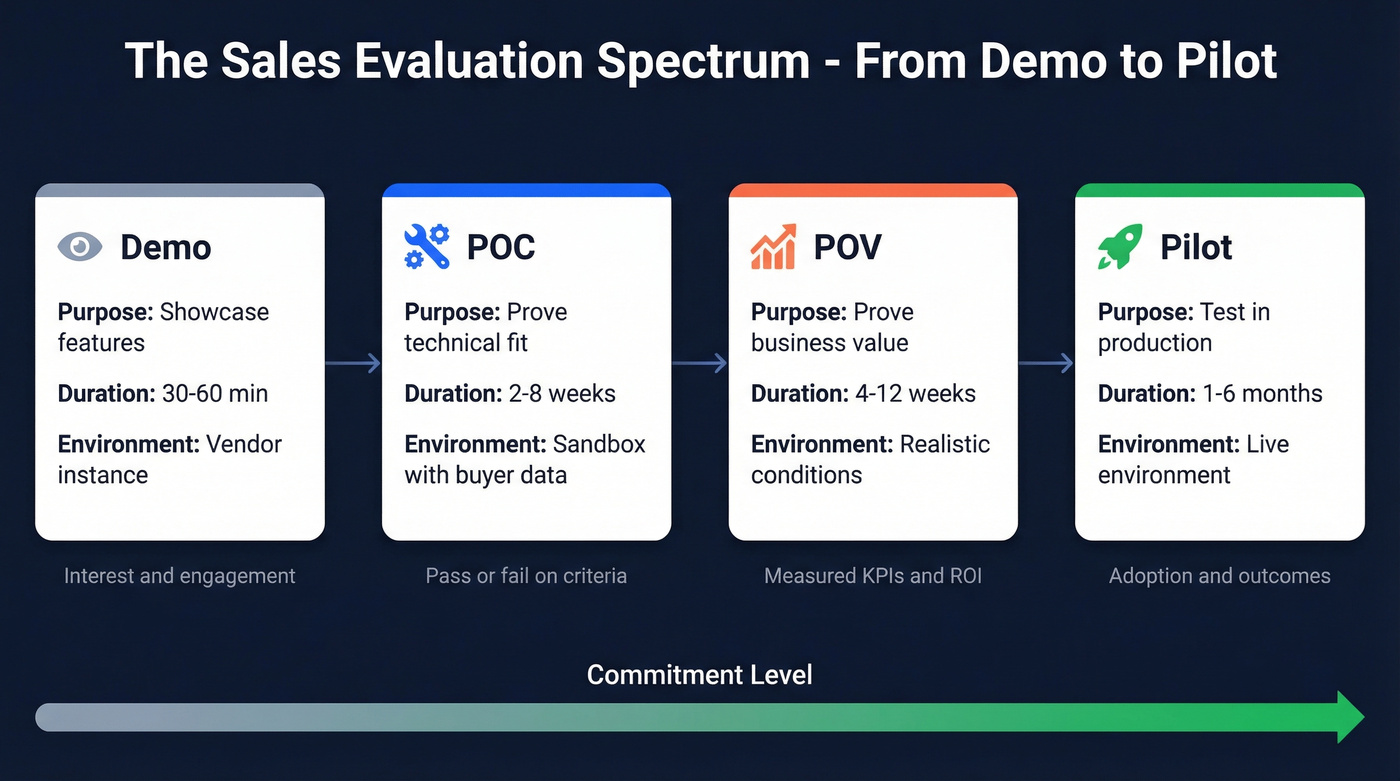
| Type | Purpose | Environment | Duration | Success Metric |
|---|---|---|---|---|
| Demo | Showcase features | Vendor's instance | 30-60 min | Interest/engagement |
| POC | Prove technical fit | Sandbox w/ buyer data | 2-8 weeks | Pass/fail on criteria |
| POV | Prove business value | Realistic conditions | 4-12 weeks | Measured KPIs/ROI |
| Pilot | Test in production | Live environment | 1-6 months | Adoption + outcomes |
The staged approach that works best: demo to generate interest, POC to clear technical risk, then graduate to a POV or pilot rollout if the buyer needs ROI proof or broader team validation before signing.
Duration benchmarks from Bliro's research: most sales POCs take 2 to 8 weeks, with a range of 7 days to 3 months depending on complexity. Default to the shortest timeline that lets the buyer validate their top three criteria.
Here's the thing: if your deal size is under ~$10-15K annually, you probably don't need a formal POC at all. A tight sales demo plus a 14-day free trial closes faster, costs less, and doesn't burn SE hours. Save the structured proof of concept for deals where the technical risk actually justifies the investment.
Why POCs Matter in 2026
Win rates have cratered to 21% across B2B, cycles have stretched by a third since 2021, and buying committees now pack up to 10 people into a decision that used to involve three.
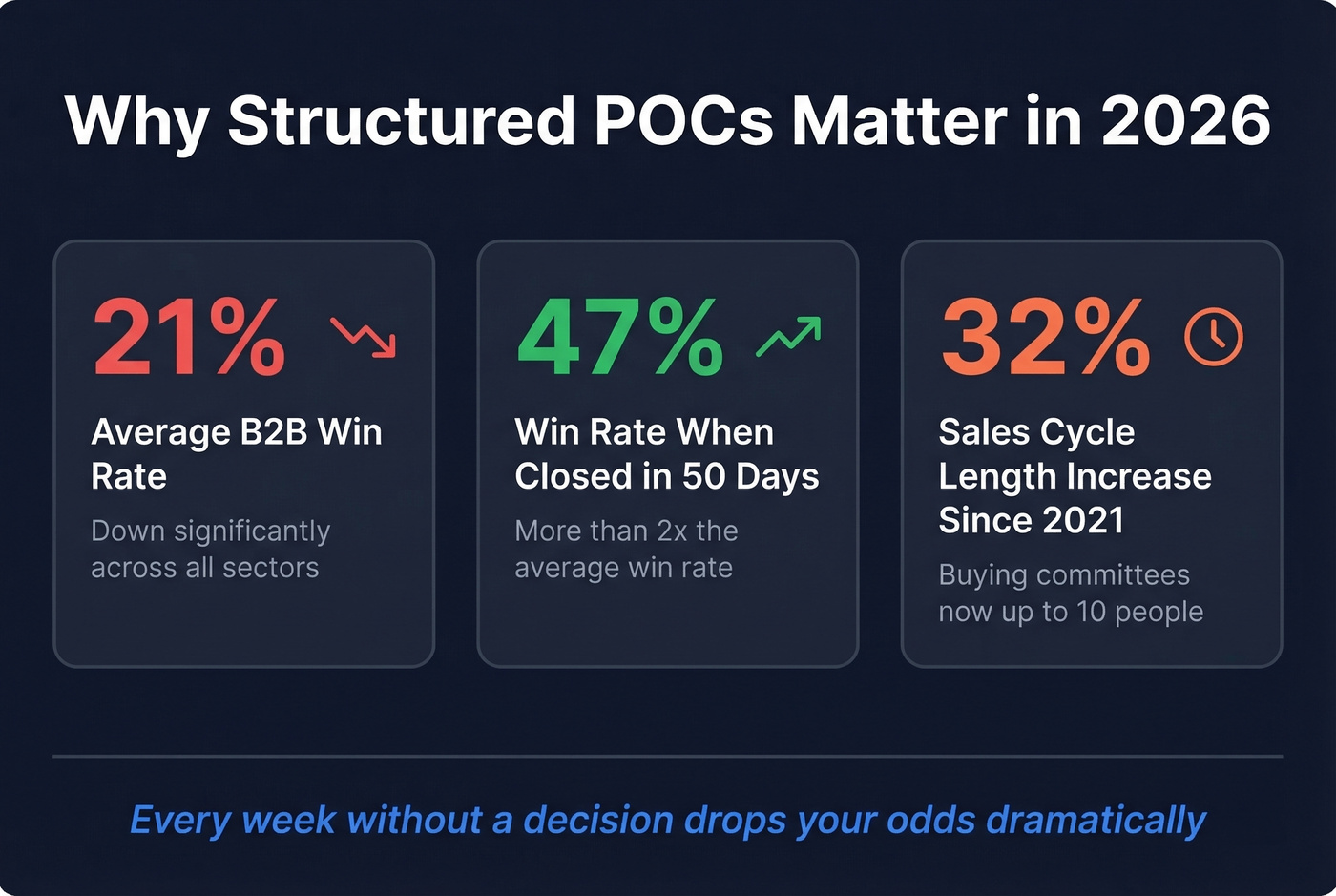
A well-run POC compresses that cycle. It gives the champion internal ammunition ("we tested it - it works"), neutralizes the technical evaluator's objections, and gives the economic buyer a concrete go/no-go framework instead of another slide deck. The time-boxing piece is critical. Deals that close within 50 days hit a 47% win rate; after that threshold, win rates drop to 20% or lower. An open-ended trial is a deal killer disguised as progress.

A POC dies without the right stakeholders at the table. Prospeo gives you verified emails and direct dials for every champion, technical evaluator, and economic buyer on the committee - 98% email accuracy, 125M+ verified mobiles, 30+ filters to pinpoint exact roles.
Map the entire buying committee before your POC kickoff.
When to Run a POC (and When to Say No)
Not every deal needs a proof of concept. Running one when you shouldn't wastes SE time and teaches the buyer that your product needs proving.
Run a POC When
You're in a competitive bake-off or RFP. The buyer is evaluating multiple vendors and needs an apples-to-apples comparison. A structured POC is your chance to win on substance, not slides.
Technical buyers control the decision. If the CTO or VP of Engineering has veto power and cares about integrations, security, or performance at scale, a hands-on trial removes their objections faster than any pitch deck.
You're selling into regulated industries. Healthcare, financial services, government - these buyers can't take your word for it. They need to see the product handle their compliance requirements firsthand.
Your product delivers an "aha" moment quickly. If the value is obvious within days of setup, a POC accelerates the deal instead of slowing it down. For early-stage companies, POCs double as product feedback engines - structured trials surface integration gaps and UX issues that frictionless free trials never reveal. There's a counterintuitive insight from Amplify Partners on this: friction isn't the enemy. Structured POCs generate better feedback than frictionless free trials because the buyer is invested in the outcome. Frictionless signups lead to frictionless exits.
For teams that can't afford SE-intensive trials for every prospect, interactive product simulations and guided demos offer a lighter-weight alternative. Tools like Consensus and Reprise let buyers self-serve through a realistic product experience without tying up your presales team for weeks.
Say No When
The deal is low-ACV and transactional. A $5K/year tool doesn't justify a formal POC - the SE hours alone eat your margin.
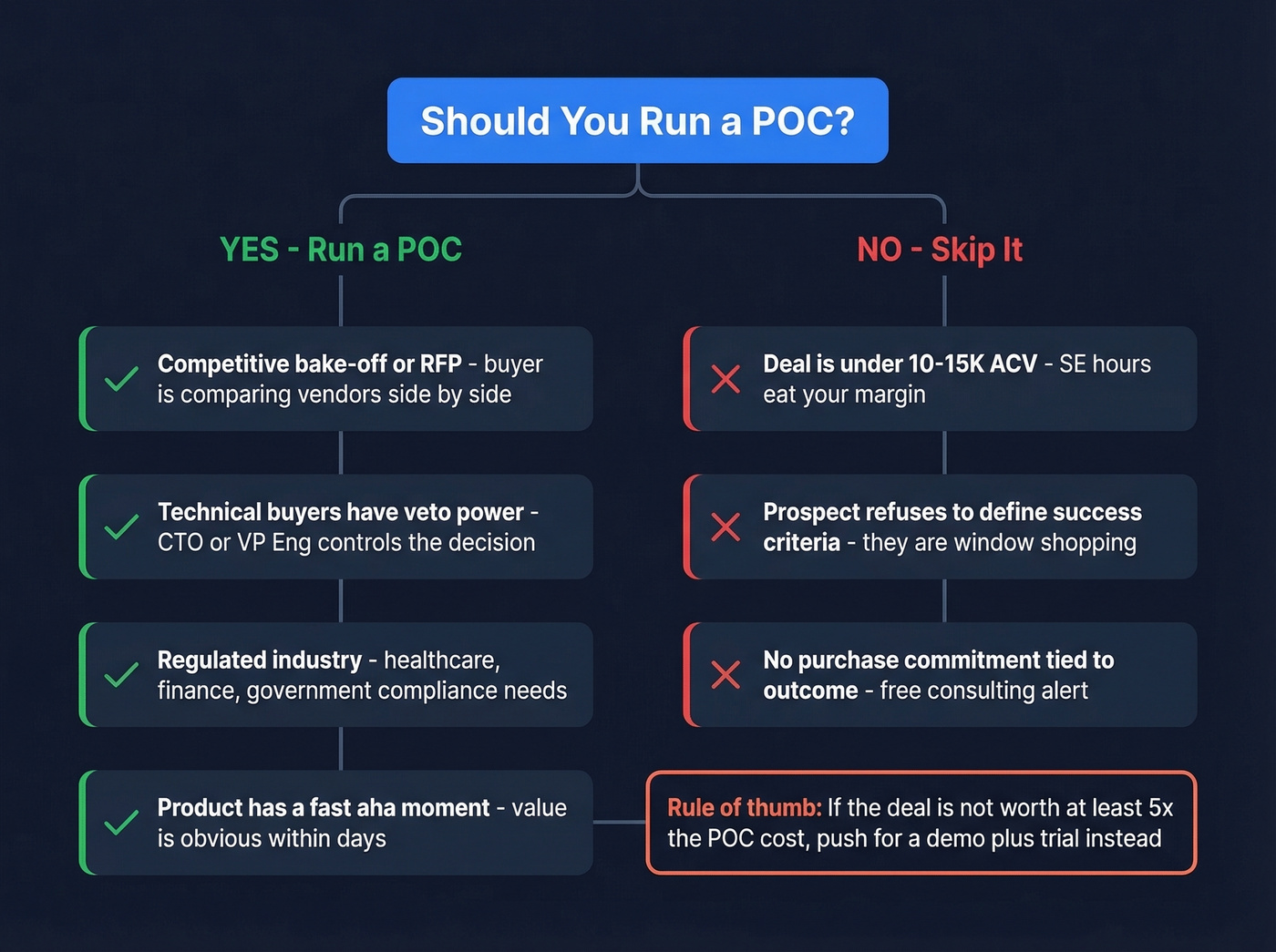
The prospect won't commit to criteria. If they refuse to define what "success" looks like before the trial starts, they're not evaluating. They're window shopping.
There's no contractual commitment tied to the outcome. One practical gating approach: require a capability checklist and a commitment to purchase if the checklist passes. If the prospect won't agree, the POC isn't worth your team's time.
The 7-Phase Framework
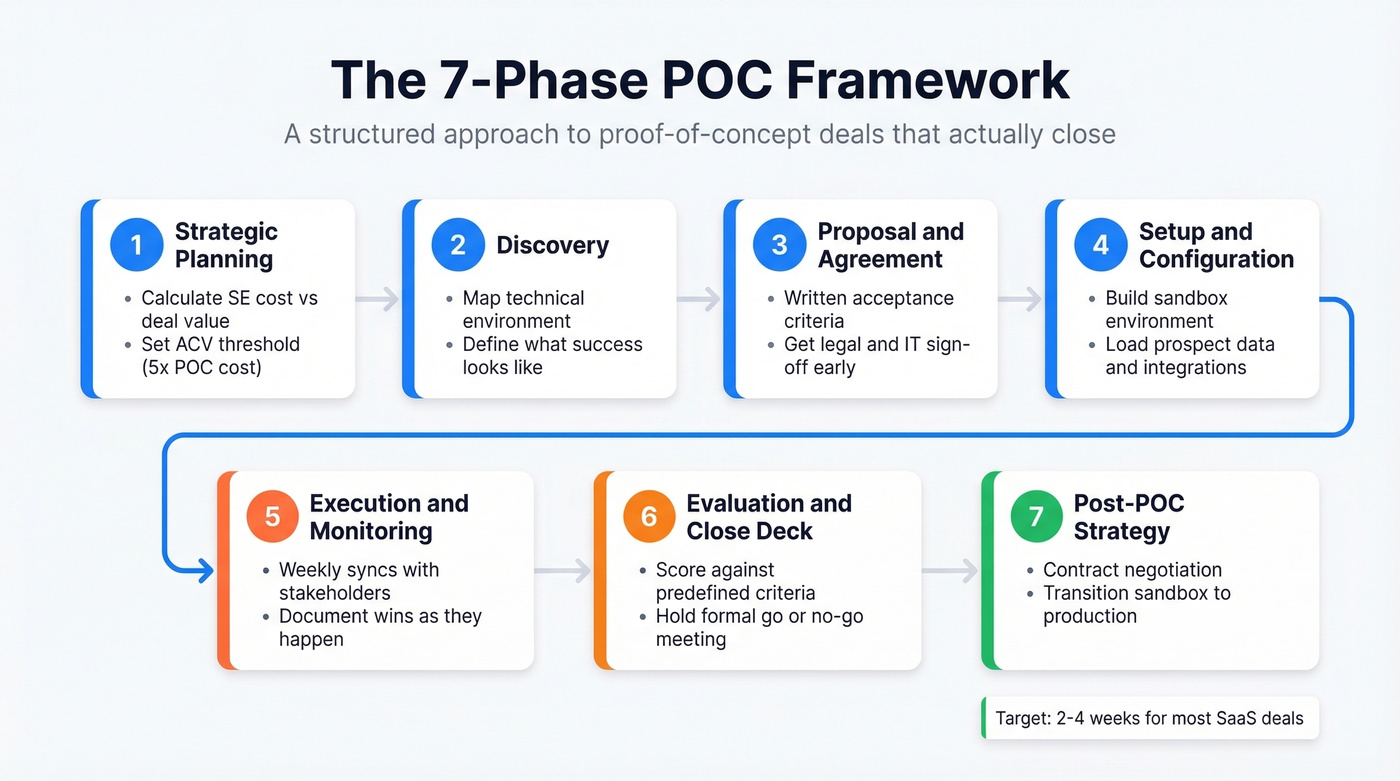
We've seen teams wing POCs with a shared Slack channel and good intentions. It doesn't work. Here's the structured framework that does.
Phase 1 - Strategic Planning
Before you agree to a POC, do the math. A solutions engineer's loaded cost runs $75 to $100 per hour in most US markets. A two-week POC burns $1,500 to $2,000 in SE time alone, and an eight-week enterprise engagement hits $6,000 to $8,000+ before you count infrastructure, project management, and opportunity cost.
Define the hypothesis you're testing, identify all stakeholders, and set an ACV threshold that justifies the investment. If the deal isn't worth at least 5x the POC cost, push for a demo-plus-trial instead.
Phase 2 - Discovery
Map the buyer's technical environment before you build anything. What systems does this need to integrate with? What data formats are in play? What does "success" look like in their specific context?
Push for explicit answers on requirements, even when the buyer seems disengaged - silence usually signals confusion or internal politics, not satisfaction.
Phase 3 - Proposal and Agreement
Put it in writing. A formal POC proposal should include scope, timeline, responsibilities on both sides, and written acceptance criteria with specific, measurable KPIs.
Get legal and IT sign-offs early. We've watched deals stall for weeks because nobody looped in InfoSec until the trial was already running. A mutual action plan that includes legal review as a parallel workstream saves everyone time.
Phase 4 - Setup and Configuration
Build the sandbox environment, load the prospect's data, and configure integrations. Cloud-based environments cut setup time by roughly 50% compared to on-prem deployments.
Phase 5 - Execution and Monitoring
Run a kickoff session with all stakeholders. Set up weekly syncs. Track progress against your predefined criteria - even a shared spreadsheet logging weekly goals, feedback, and bugs works fine. Document wins as they happen. These become your closing ammunition in Phase 6.
Phase 6 - Evaluation and Close Deck
Score results against the predefined criteria. DealHub recommends evaluating across five categories: performance, integration, user-friendliness, adoption potential, and scalability. Use a simple pass/fail or 1-to-5 scale for each.
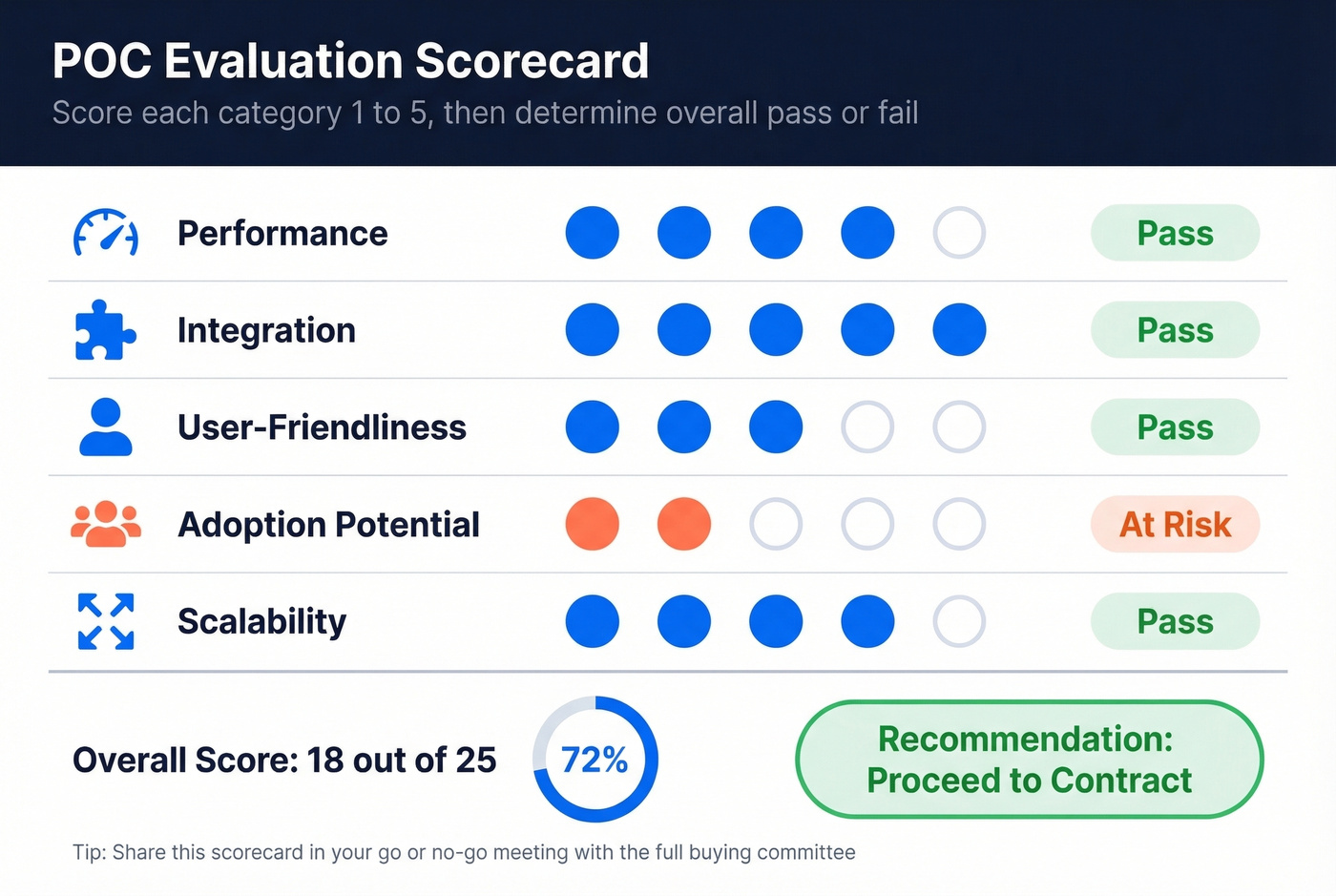
Then hold a formal go/no-go meeting with the buying committee. Build a pilot close deck that summarizes the results, maps each success criterion to its outcome, and presents the commercial next step. This isn't a casual check-in - it's a structured decision point with the criteria results on the table. If you defined success well in Phase 3, this meeting should be straightforward.
Phase 7 - Post-POC Strategy
A successful POC isn't the finish line. It's the starting gun for contract negotiation, expansion planning, and the transition from sandbox to production.
One model worth studying: Champify's CEO describes a 15-month agreement with a 3-month paid opt-out clause. The buyer commits to a full contract but gets an escape hatch if the product doesn't deliver in production. The result? 14 out of 15 POCs converted into long-term customers. That's a conversion rate most teams would kill for.
The Biggest Mistake: Free Production Work
A founder on r/startups described a "POC" that ran for months in near-production conditions. Their team delivered extensive unpaid integration work. 99% of unit tests passed. The system achieved unprecedented computational speed. The buyer still declared the POC a failure.
That's not a proof of concept. That's free consulting with a fancy label.
Large companies use never-ending POCs to extract engineering value without commercial commitment. Sometimes it's intentional. Sometimes it's just organizational dysfunction. Either way, you're the one eating the cost. Protect yourself:
- Written acceptance criteria with KPIs tied to payment - before day one
- A hard end date - two to four weeks for mid-market, six to eight weeks max for enterprise
- A paid pilot model when the POC requires significant engineering resources
- Scope-change clauses - if the buyer adds requirements mid-POC, the timeline and terms get renegotiated
- A contractual commitment - if the criteria pass, the deal moves to contract. If the prospect won't agree, they're not a serious buyer.
Data Quality: The Silent Deal Killer
Let's be honest - most outbound tool POCs fail because of bad data, not bad tools. If your test list has a 35 to 40% bounce rate, you're not evaluating the sequencing platform or the dialer. You're measuring how stale your contact data is. This is the single most overlooked variable in outbound stack evaluations, and it torpedoes more proof-of-concept trials than any feature gap or integration issue.
Snyk saw this firsthand: bounce rates dropped from 35-40% to under 5% across 50 AEs after switching their data layer. That's the difference between a POC that produces meaningful results and one that gets killed by bad inputs.
Tools and Platforms for POC Sales
POC tools fall into two buckets: environment platforms (where the trial runs) and data layers (what goes into the trial). Most teams need something from each.
| Tool | Category | Best For | Est. Pricing |
|---|---|---|---|
| CloudShare | Sandbox environments | Enterprise POCs | ~$30K-100K+/yr |
| Reprise | Interactive demos | Mid-market demo automation | ~$20K-50K/yr |
| Walnut | Interactive demos | Demo personalization at scale | ~$15K-60K/yr |
| Consensus | Async simulations | Scaling demos w/o SEs | ~$30K-80K/yr |
| Vivun | Presales management | Enterprise presales ops | ~$30K-80K/yr |
| Prospeo | Data verification | Clean contacts for POCs | Free tier; ~$0.01/email |
The environment platforms run five to six figures annually. Prospeo operates at a fundamentally different price point because it's solving a different problem - not where the POC runs, but whether the data inside it is accurate enough to produce trustworthy results.
The core takeaway from this entire playbook: a structured POC sales process with clean data and a hard deadline closes deals. An unstructured one with stale contacts and no end date burns your team's time and teaches the buyer you'll work for free.
If you want to pressure-test your POC impact, track it like a pipeline experiment: stage-to-stage conversion, time-in-stage, and win rate deltas. (If you need benchmarks, start with close rates and sales pipeline metrics.)
You just read that deals closing within 50 days hit a 47% win rate. Don't waste that window chasing wrong contacts. Prospeo's 7-day data refresh means every email and phone number is current - not 6 weeks stale like competitor data.
Stop burning POC timelines on bounced emails and dead numbers.
FAQ
How long should a sales POC last?
Most run 2 to 8 weeks. Simple SaaS tools can be evaluated in 7 days; complex enterprise infrastructure needs up to 3 months. Default to the shortest timeline that lets the buyer validate their top three success criteria - anything longer risks the deal dying from inertia.
Should a POC be free or paid?
Paid POCs convert better. Champify's model - a 15-month agreement with a 3-month paid opt-out - converts 14 out of 15 into long-term customers. At minimum, require a signed mutual action plan with defined exit criteria before starting any free trial.
What's the difference between a POC and a POV?
A POC proves technical feasibility: "Can this work in our environment?" A POV proves business value: "Is this worth the investment?" Run the POC first, then graduate to a POV if the technical validation passes and the buyer needs ROI proof before signing.
How do you prevent a POC from becoming free consulting?
Write acceptance criteria with specific KPIs before day one. Set a hard end date. Require a contractual commitment to purchase if criteria are met. If the prospect won't agree to these terms, they're not a serious buyer.
What's a good free tool for verifying POC data quality?
Prospeo offers a free tier with 75 email verifications and 100 Chrome extension credits per month - enough to validate a small test list before loading it into a POC environment. For larger evaluations, credits cost roughly $0.01 per email with 98% accuracy, which prevents bad data from skewing your trial results.