

How to Write a Polite Follow-Up Email That Actually Gets a Reply
You wrote a thoughtful email. Proofread it twice. Hit send with confidence. Then - nothing. Three days pass and you're staring at an empty inbox wondering if following up will make you look desperate.
It won't. A polite follow-up email is the single most underused tool in professional communication, and the data backs that up: 70% of salespeople stop after one email, yet 42% of replies come from follow-ups. The people who follow up win. The trick is doing it without sounding like a robot or a nag.
Why Most Follow-Ups Get Ignored
Before we get to templates, let's diagnose why follow-ups fail. It's almost always one of three things.
You sound like a nag, not a human. "Just following up!" reads like an automated reminder, not a message from a real person. The recipient's brain files it under "deal with later," which means never.
Your tone is accidentally condescending. Phrases you think are polite - "kindly," "per my last email," "as previously mentioned" - land as passive-aggressive. More on this in a moment.
You gave them no new reason to reply. If your follow-up contains zero new information, you're asking them to do the thing they already decided not to do. That's not a follow-up. That's a nudge with nothing behind it, and each message needs to justify opening by adding something - a data point, a deadline, a question that's easy to answer.
Here's the difference in practice:
❌ "Hi Sarah, just following up on my last email. Would love to connect when you get a chance!"
✅ "Hi Sarah, since I wrote last week, [Company X] published a case study on the exact problem we discussed. Thought you'd want to see it - link here. Still up for a quick call Thursday?"
The first gives Sarah nothing. The second gives her a reason.
Phrases That Kill Your Reply Rate
Some of the most common follow-up phrases are quietly sabotaging you. "Touching base" ranks as one of the most irritating phrases recipients encounter. The consensus on r/sales about "just following up" is brutal - it's the email equivalent of tapping someone on the shoulder repeatedly.
About "kindly": in most English-speaking business contexts, it reads as patronizing. The word implies the recipient needs to be reminded to be kind. Drop it entirely.
| Dead Phrase | Why It Fails | Better Alternative |
|---|---|---|
| "Just checking in" | No reason to reply | "Had a thought on [topic]" |
| "Kindly follow up" | Reads as patronizing | "Circle back with [new info]" |
| "Per my last email" | Passive-aggressive | "Building on what I sent Tuesday" |
| "Touching base" | Meaningless filler | "Quick question about [specific thing]" |
| "Circling back" | Vague, overused | "One more thing on [topic]" |
When to Send Your Follow-Up
Timing isn't one-size-fits-all. The right window depends entirely on context.
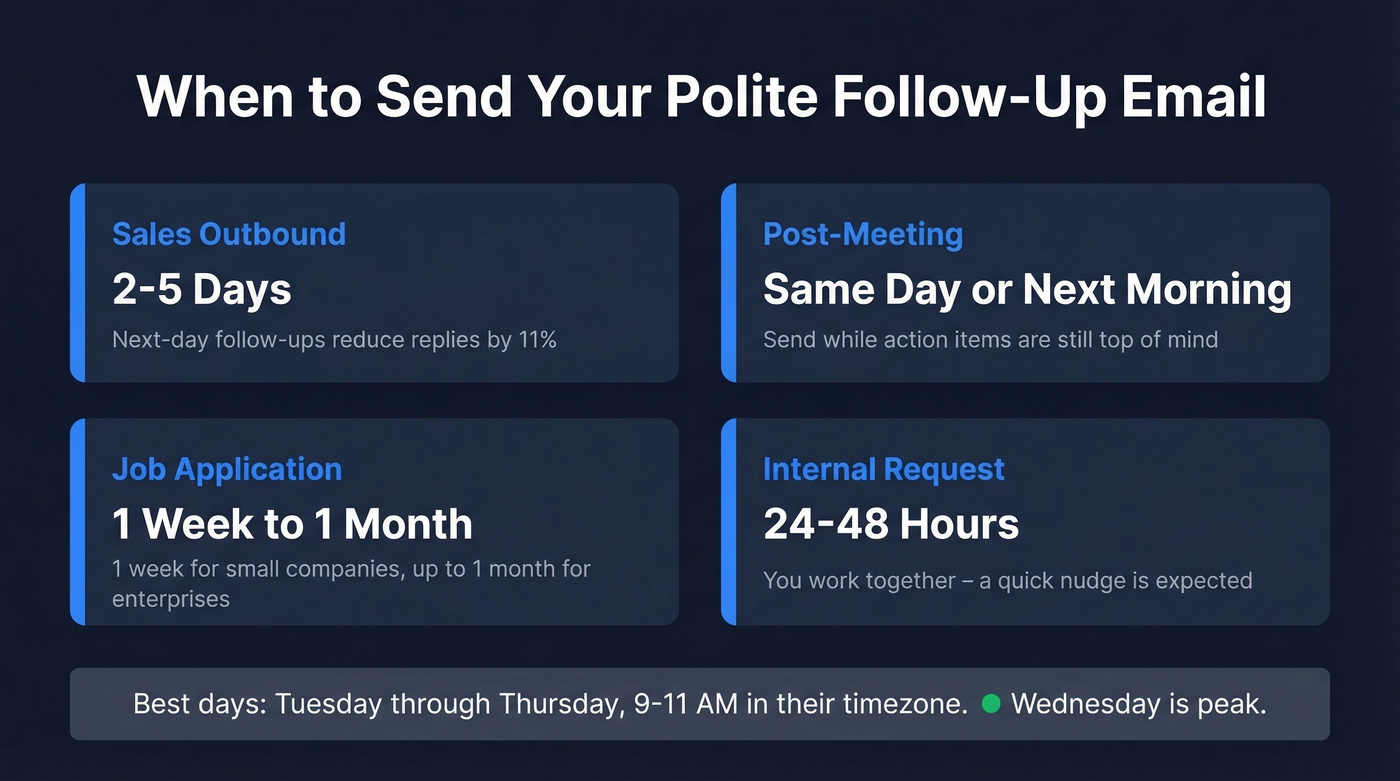
Sales outbound: Wait 2-5 days. Next-day follow-ups reduce replies by 11%, while waiting three days produces a 31% increase. Give people breathing room.
Post-meeting: Same day or next morning. Send while the details are still top of mind and action items haven't been buried. (If you need a dedicated framework, see our meeting follow-up email guide.)
Job application: A recruiter at TurnPoint Search recommends one week for smaller companies (under 200 employees) that said they're moving quickly, and up to a month for large enterprises still finishing interview rounds. If they gave you a decision date and missed it, wait a couple of days - if they said Friday, follow up Monday afternoon.
Internal request to a colleague: 24-48 hours. You work together. A quick nudge is expected, not rude.
For day and time, the data is consistent: Tuesday through Thursday, 9-11 AM in the recipient's timezone. Wednesday is the peak for reply rates. When sending multiple follow-ups, use graduated spacing rather than rigid intervals - a cadence of 2, 4, 7, then 14 days between touches looks human, while sending every 48 hours like clockwork looks automated. (More on cadence in our guide to when to follow up on an email.)
How Many Follow-Ups to Send
80% of sales require at least five follow-ups. The sweet spot is 4-7 touchpoints.
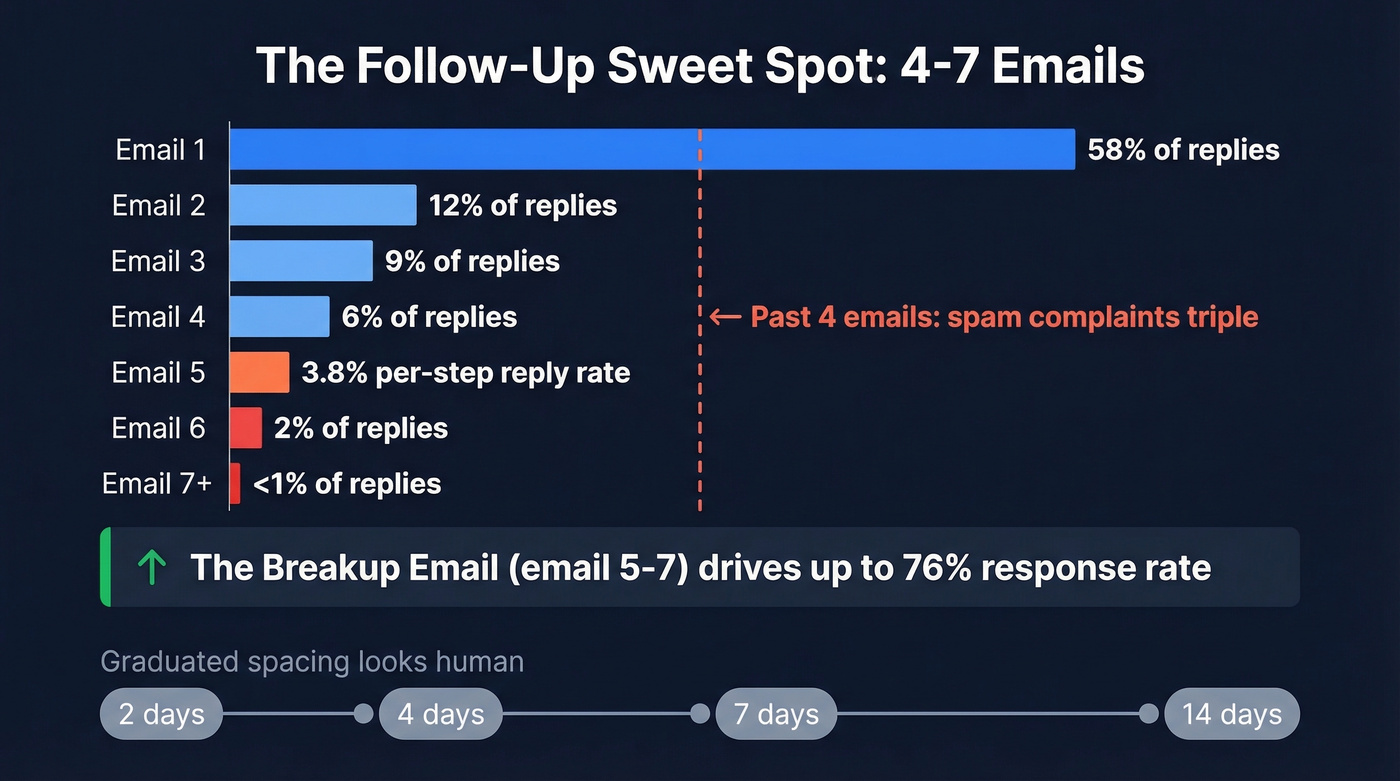
Under four, you're quitting too early. Beyond seven, diminishing returns set in hard. Here's the math: 58% of replies come from the first email in a sequence, and by the fifth email, the per-step reply rate drops to around 3.8%. Past four emails, unsubscribe and spam complaints triple. That's not a risk worth taking for marginal gains. (If you want benchmarks, see follow-up email reply rate.)
The exception is your last email. Your highest-performing follow-up is often the breakup - the one where you signal you're about to stop reaching out. Breakup emails drive response rates as high as 76%. We've got a template for that below.

The perfect follow-up template won't save you if you're emailing the wrong address. 70% of salespeople quit after one email - but even persistent ones fail when 20%+ of their emails bounce. Prospeo's 98% email accuracy and 7-day data refresh mean every follow-up actually lands in a real inbox.
Stop crafting polite follow-ups to dead email addresses.
10 Professional Follow-Up Email Templates
1. No Response to Initial Outreach
Subject: Finalizing my calendar for next week
Hi [Name], I'm locking in my schedule for next week and wanted to see if [Tuesday at 2 PM] works for a quick call about [topic]. If the timing's off, happy to adjust.
Framing around logistics ("finalizing my schedule") gives them a concrete reason to reply now rather than later.
2. Post-Meeting Next Steps
Subject: Next step from our [day] conversation
Hi [Name], great speaking with you about [specific topic discussed]. As a next step, I'll send over [deliverable]. Could you confirm [specific question] so I can tailor it?
Reference something specific from the meeting. Generic "great chat" emails get buried.
3. After Sending a Proposal
Subject: One thing I forgot to include
Hi [Name], after sending the proposal I realized I didn't include [relevant case study / data point]. [Company X] saw [specific result] in a similar setup. Happy to walk through the numbers if helpful.
"One thing I forgot" is a natural reason to re-enter their inbox. Add genuine new value.
4. Job Application Follow-Up
Wait one week for small companies, up to a month for large enterprises.
Subject: Following up on [Role Title] application
Hi [Name], I wanted to check in on my application for the [role] position. I'm still very interested and would love to learn more about the team's priorities for this hire. Let me know if there's anything else I can provide.
Common mistake: Writing "Just wondering if you've had a chance to review my application." This puts the burden on them to explain their process. Express continued interest and offer something instead - a portfolio link, a relevant article, a specific idea.
5. Post-Interview Thank You
Send within 24 hours. This one isn't optional.
Subject: Thank you - [specific topic from interview]
Hi [Name], thank you for discussing [specific project or challenge]. The [detail they mentioned] resonated with me, and I'd love the chance to contribute to that work. Looking forward to next steps.
6. Networking or Event Follow-Up
Subject: Good meeting you at [event]
Hi [Name], enjoyed our conversation about [specific topic] at [event]. You mentioned [specific thing] - I came across [relevant resource] that ties in. Would love to stay in touch.
Anchor to a shared moment. "Nice to meet you" without specifics is forgettable.
7. Overdue Invoice or Payment
Subject: Invoice #[number] - quick update needed
Hi [Name], invoice #[number] from [date] is now [X days] past due. Could you let me know the expected payment date or if there's anything holding this up? Happy to resend if needed.
Firm and factual beats passive. State the facts, ask a direct question, offer to help.
8. Internal Request to a Colleague
Subject: Quick - need your input on [project]
Hey [Name], following up on the [deliverable] I mentioned yesterday. I need [specific thing] by [date] to keep [project] on track. Can you get that to me by EOD Thursday?
Short, direct, deadline-anchored. Skip "kindly" - you're coworkers, not strangers.
9. Document or Approval Request
Subject: [Document name] - need sign-off by [date]
Hi [Name], the [document/contract] I sent on [date] needs approval by [deadline] to keep us on schedule for [milestone]. Could you review and sign off this week?
Tie the deadline to a business consequence, not your personal convenience.
10. The Breakup Email
This is the most important template in the list. In our experience running outbound campaigns, the breakup email outperforms every other message in a sequence. Deploy it after 5+ attempts over 2-3 weeks.
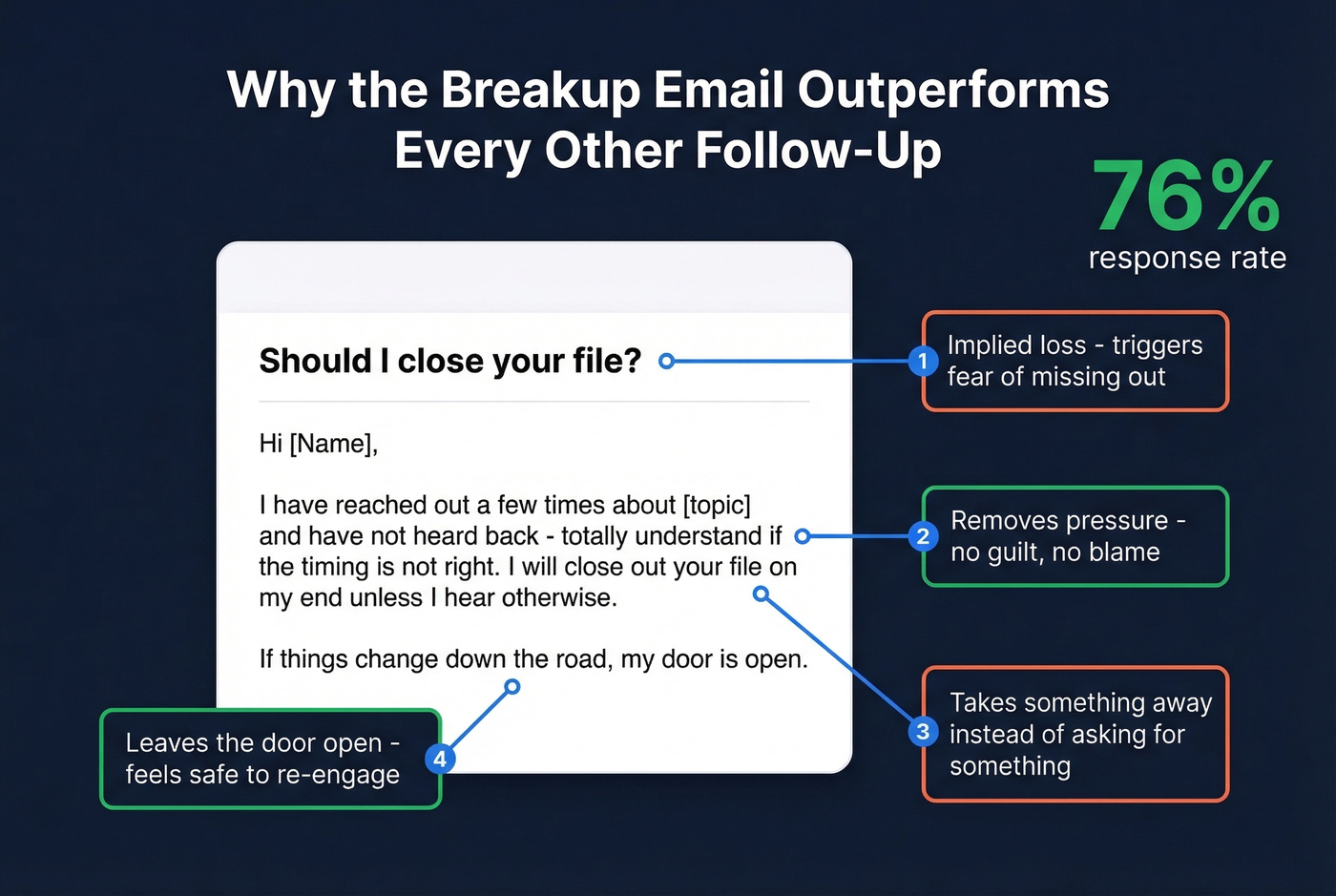
Subject: Should I close your file?
Hi [Name], I've reached out a few times about [topic] and haven't heard back - totally understand if the timing isn't right. I'll close out your file on my end unless I hear otherwise. If things change down the road, my door's open.
Why this works: The implied loss of access flips the dynamic. Every other email in your sequence asks for something. This one takes something away. It removes pressure, which paradoxically creates urgency - and response rates as high as 76% back that up.
Subject Lines That Get Opened
Your follow-up is worthless if it never gets opened. Subject lines between 6-10 words hit a 21% open rate - the sweet spot for mobile visibility and specificity. Personalized subject lines get 50% higher opens than generic ones, and including a number boosts opens by up to 113%. (For more ideas, browse these email subject line examples.)
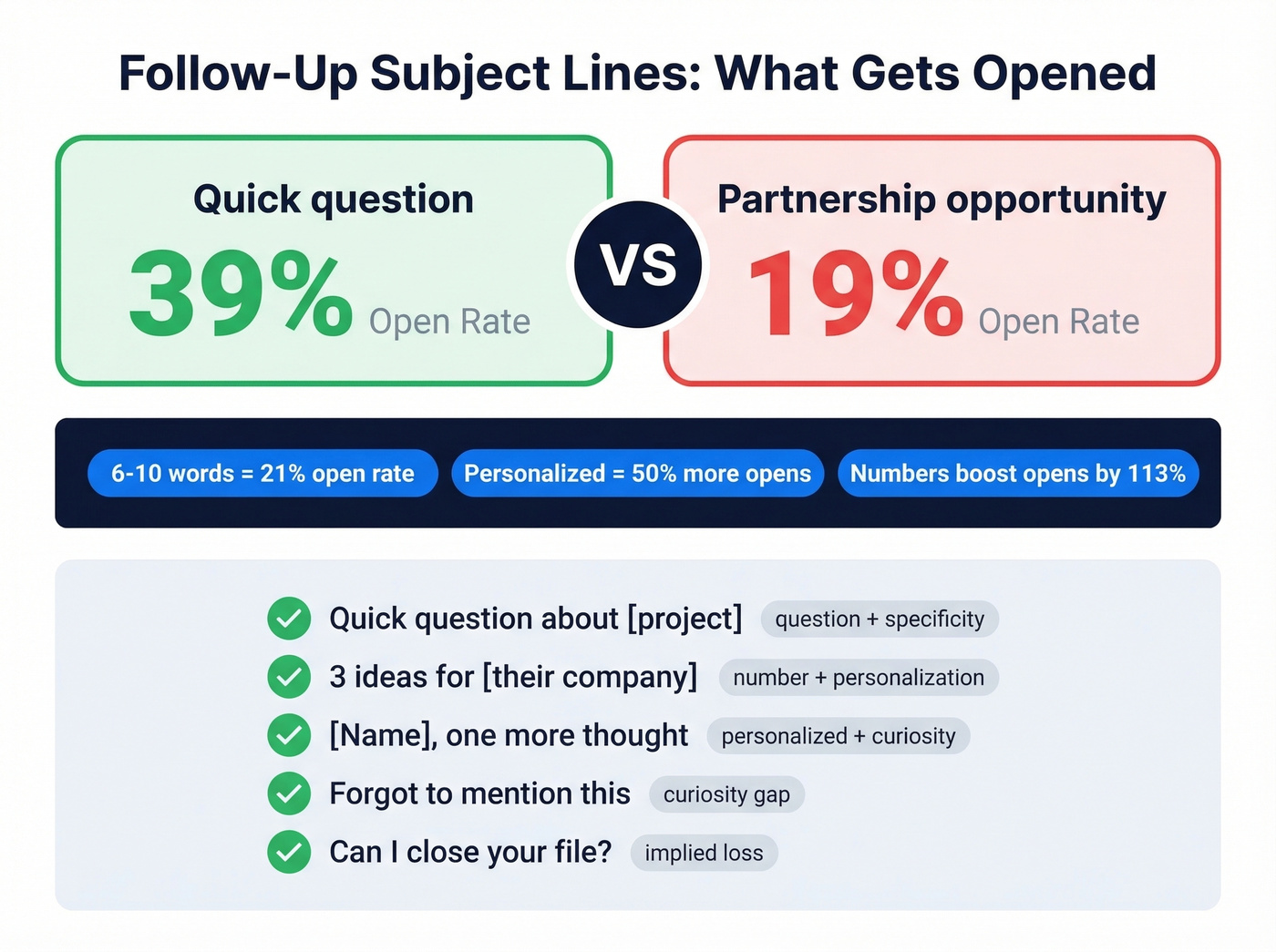
One operator on r/Entrepreneur tested this directly: "Quick question" pulled 39% opens. "Partnership opportunity" got under 19%. That gap is enormous.
Here's the thing: if your average deal is under $15K, subject line optimization matters more than body copy. At that price point, you're playing a volume game, and the difference between 19% and 39% open rates is the difference between a pipeline and a graveyard.
Strong subject lines to steal:
- "Quick question about [project]" - question + specificity
- "3 ideas for [their company]" - number + personalization
- "[Name], one more thought" - personalized + curiosity
- "Forgot to mention this" - curiosity gap
- "Can I close your file?" - implied loss (breakup)
- "[Mutual connection] suggested I reach out" - social proof
- "15 min this week?" - number + low commitment
Why They're Not Replying (and What to Do About It)
Before you send follow-up number four, diagnose the silence. GMass breaks objections into five buckets, and each demands a different response.
No need. They don't have the problem you solve. Reframe the problem with a specific example they haven't considered.
Value unclear. They see the problem but not your solution's fit. Add a concrete result - "added 10-15 warm leads in January" beats "we help with lead gen." (If you want a system for this, see how to add value in sales.)
No urgency. They're interested but it's not a priority. Introduce a deadline or a cost-of-waiting angle.
Don't want it. They've decided no. A breakup email is your best shot - it removes pressure and sometimes flips the dynamic.
Don't trust you. They don't know you well enough. Add social proof, a mutual connection, or a relevant case study.
The principle across all five: each follow-up must bring new information. A bump with no new value isn't a follow-up - it's spam. (For more outreach patterns, see cold email follow-up templates.)
The Deliverability Problem Nobody Talks About
Here's a frustrating scenario we see constantly: someone crafts the perfect follow-up sequence, nails the timing, uses every template in this article - and gets nothing. Not because the emails are bad, but because they're bouncing.
One operator on r/Entrepreneur documented this exactly. They dropped their bounce rate from 11% to under 2% and watched reply rates double from 3% to 6%. The emails didn't change. The data did.
Your follow-up probably isn't being ignored - it's never arriving. Before you optimize a single word of your follow-up, verify the list. Tools like Prospeo's email verification catch bad addresses with 98% accuracy through a 5-step process that handles catch-all domains, spam traps, and honeypots. The free tier gives you 75 verifications per month, no credit card required. (If you want the deeper mechanics, start with email deliverability and email bounce rate.)

You just learned that 80% of sales require five or more follow-ups. That cadence only works if you're reaching real people at valid addresses. Prospeo gives you 143M+ verified emails with catch-all handling and spam-trap removal - so your carefully written sequences don't end up in the void.
Make every touchpoint in your sequence count - starting with the right contact data.
FAQ
How long should I wait before sending a polite follow-up email?
Two to five business days for sales and cold outreach. Same day or next morning after a meeting. One week for job applications at small companies, up to a month at large enterprises. For multi-touch sequences, use graduated spacing - 2, 4, 7, then 14 days - so the cadence feels human rather than automated.
How do I follow up without being pushy?
Add new value with every message - a relevant resource, a data point, or a simpler question. Avoid guilt-tripping language like "I haven't heard back" and instead give the recipient a low-friction reason to respond. Make each touchpoint useful on its own, so even if they don't reply, they walk away with something.
How many follow-ups is too many?
The sweet spot is 4-7 touchpoints. Beyond seven, unsubscribe and spam complaints triple. After five attempts over two to three weeks with no response, send a breakup email - it's consistently the highest-performing message in a sequence, with response rates as high as 76%.
What if my follow-up emails are bouncing instead of being ignored?
Verify addresses before sending. Bounce rates above 5% damage your sender reputation and tank deliverability for every future email. Prospeo's free tier lets you verify 75 emails per month at 98% accuracy - enough to clean a small outreach list and confirm your messages are actually landing.
Should I reply in the same thread or start a new email?
Reply in the same thread so the recipient has full context and the conversation stays easy to scan. If the thread is getting long or the subject has shifted, start a fresh email with a new subject line so it doesn't look like a wall of unanswered messages.