

Positive Language in Sales Isn't About Being Positive - It's About Being Precise
You're 35 minutes into a demo and the prospect says "this looks expensive." Your next 10 words determine whether the deal moves forward or dies.
Positive language in sales isn't cheerful filler. It's deliberate word choice backed by neuroscience and half a million analyzed calls. Yet only around 15-20% of sales training programs include a dedicated language module - most spend hours on methodology and minutes on the actual words reps use. That's backwards, and the data shows exactly which phrases top performers rely on.
The Quick Version
Start with one swap. Replace "does that make sense?" with "how does that sound to you?" It stops implying the prospect might not understand.
Talk less. Closed-won deals average 57% seller talk time vs. 62% for lost deals. The gap is small. The impact isn't.
Reframe your cold emails. Timeline hooks like "90-day roadmap to X" pull a 10.01% reply rate vs. 4.39% for problem hooks - a 2.3x gap.
Why Words Change Brain Chemistry
A 2025 study in Cell Reports, led by Read Montague at Virginia Tech, simultaneously measured dopamine, serotonin, and norepinephrine01513-4) release during language processing. Positive, negative, and neutral words modulate neurotransmitter release in sub-second dynamics - your word choice changes the chemistry of the conversation before the prospect consciously processes what you said.
Challenger's research puts a number on it: two-thirds of perceived effort in any interaction comes from how the person feels about it. Only one-third comes from what they actually have to do.
And a meta-analysis of 14,334 salespeople confirmed that positive psychological constructs - adaptability, optimism, resilience - predict higher sales performance. Up to 90% of buying decisions are driven by emotion. Logic comes later, if it comes at all.
What 500K Calls Reveal About Word Choice
Gong analyzed over 500,000 sales calls and found consistent language patterns separating top performers from everyone else.
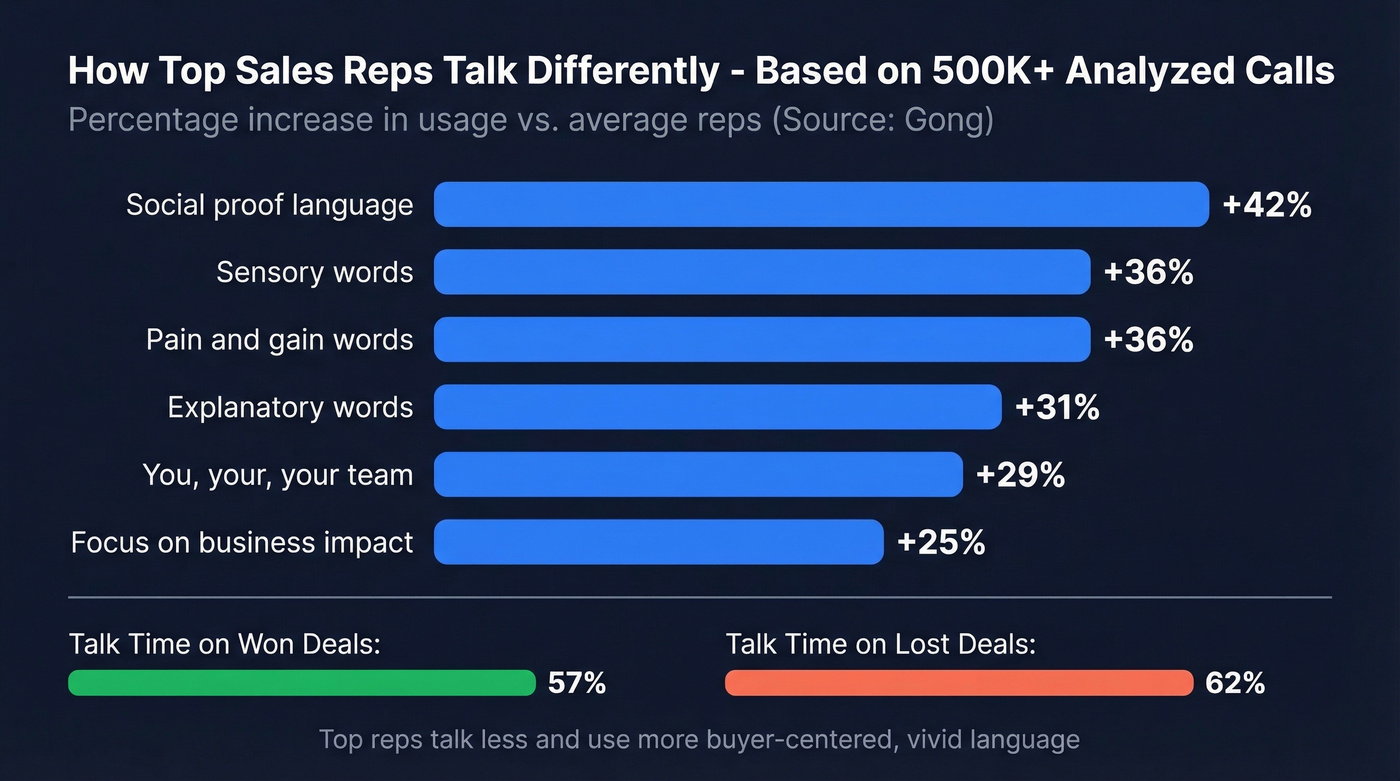
| Language Pattern | Top Reps vs. Average | Source |
|---|---|---|
| "You/your/your team" | +29% usage | Gong, 500K calls |
| Social proof language | +42% usage | Gong, 500K calls |
| Explanatory words | +31% usage | Gong, 500K calls |
| Sensory words | +36% usage | Gong, 500K calls |
| Pain/gain words | +36% usage | Gong, 500K calls |
| Talk time (won vs. lost) | 57% vs. 62% | Gong, 326K calls |
An average rep says: "Our clients use these insights to improve competitive win rates." A top rep says: "You'll improve competitive win rates with these insights." Same information. Completely different framing - direct, personal, buyer-centered. This is decisive language: choosing the active, buyer-focused construction every time instead of hiding behind passive corporate phrasing.
The talk-to-listen data from 326,000 calls is equally telling. Sellers who lost deals asked around 20 questions per call vs. 15-16 for winners. More questions doesn't mean better discovery - it means interrogation.
In our experience, the talk-time gap is the single easiest metric to coach. Top reps use "tell me more" to extend buyer monologues, then paraphrase back: "So what I'm hearing is that X is your top concern - does that sound right?" That's constructive framing in action. Not cheerful words, but precise ones that make the prospect feel heard.

Precise language gets deals. Precise data gets replies. Prospeo's 98% email accuracy and 7-day refresh cycle mean your carefully crafted word swaps reach real inboxes - not dead ends.
Stop perfecting copy that bounces. Start reaching real buyers.
10 Word Swaps That Lower Buyer Resistance
You've seen a dozen "power words" lists telling you to say "absolutely" more. That advice is surface-level at best. These swaps, pulled from what practitioners actually use on r/sales, target the specific moments where deals stall.
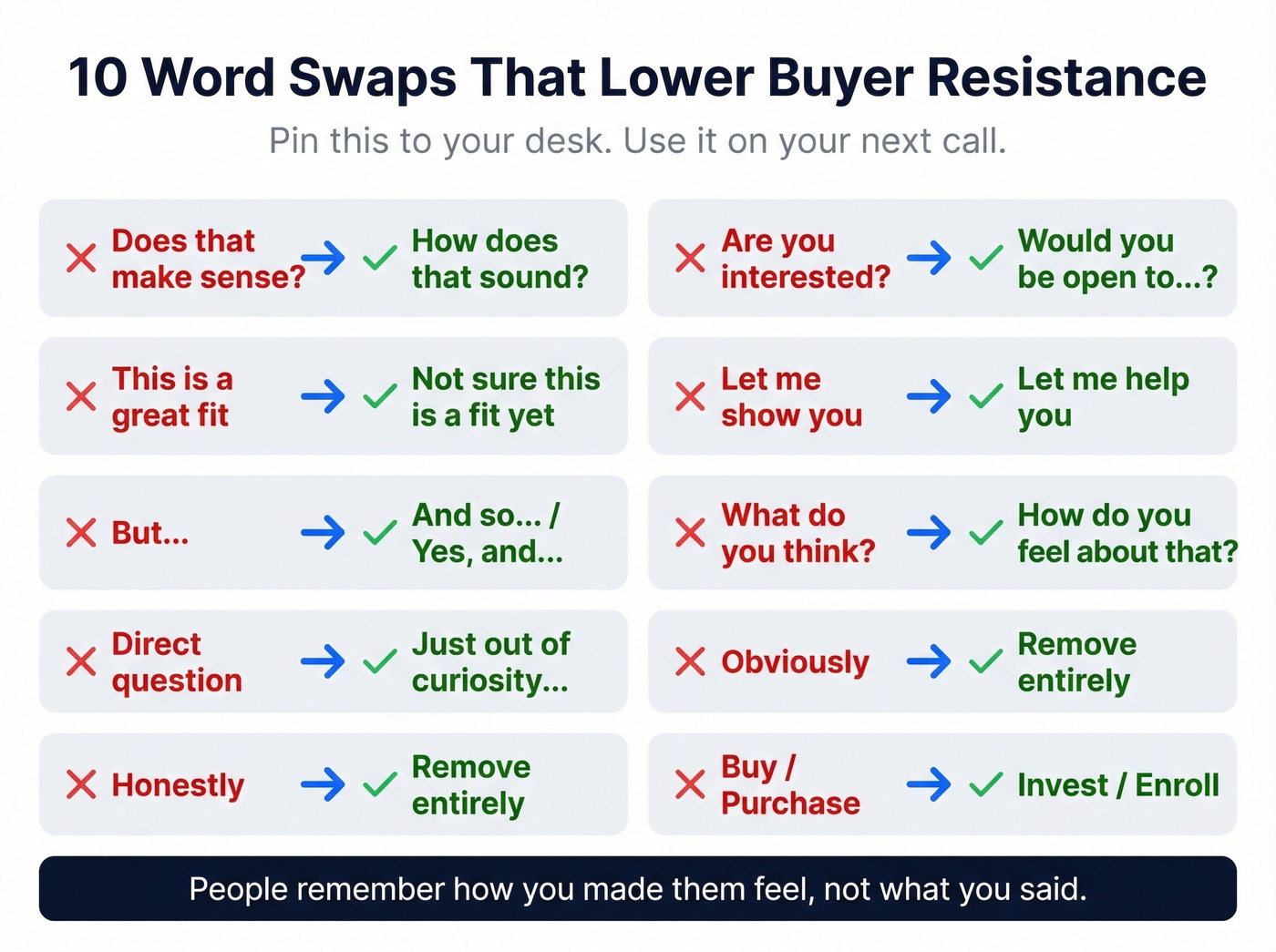
| Instead of... | Say... | Why It Works |
|---|---|---|
| "Does that make sense?" | "How does that sound?" | Stops implying confusion |
| "Are you interested?" | "Would you be open to...?" | Softer, less committal |
| "This is a great fit" | "Not sure this is a fit yet" | Takeaway lowers pressure |
| "Let me show you" | "Let me help you" | Service over demo-push |
| "But..." | "And so..." / "Yes, and..." | Avoids negating them |
| "What do you think?" | "How do you feel about that?" | Engages emotion |
| Direct question | Prefix: "Just out of curiosity..." | Disarms defensiveness |
| "Obviously" | Remove entirely | Insults or makes you redundant |
| "Honestly" | Remove entirely | Implies you weren't before |
| "Buy/purchase" | "Invest" or "enroll" | Less transactional framing |
As one r/sales commenter put it: "People don't remember exactly what you said. They remember exactly how you made them feel." That's the principle behind every swap above.
Notice how many of these address apologetic language - hedging phrases like "sorry to bother you" or "I know you're busy, but..." that signal low status before the conversation even starts. Over-apologizing trains the prospect to see you as an interruption rather than a resource. Cut the apology, lead with value.
Here's the thing: tonality matters as much as word choice. "Would you be open to...?" delivered in a monotone, scripted cadence still sounds like a sales trick. We've seen reps internalize these swaps in under a week of deliberate practice, but only when they understand why the new phrasing reduces friction - not just what to say.
Positive Framing in Cold Email
If your cold email opener is "Quick question about your pipeline challenges," the language is the problem.
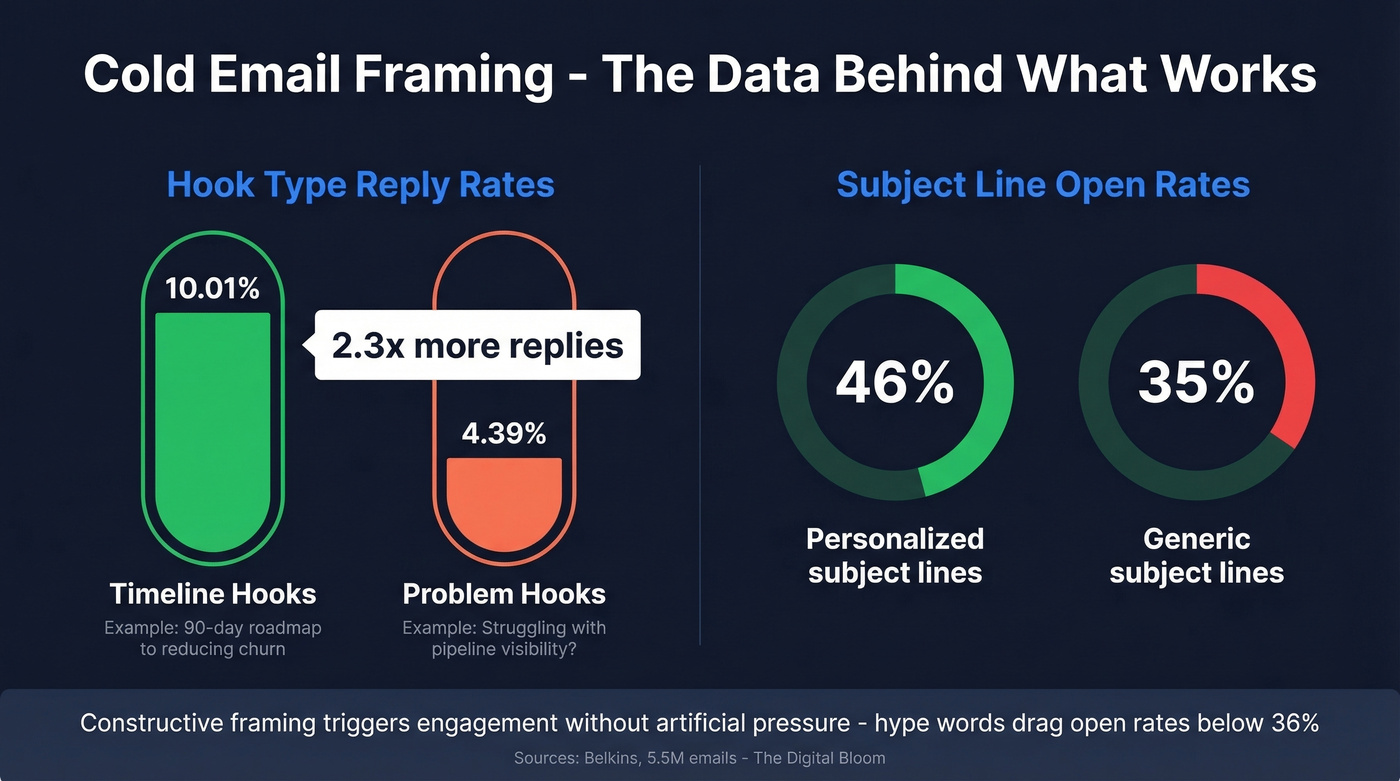
Belkins analyzed 5.5 million emails and found that personalized subject lines hit a 46% open rate vs. 35% without. Urgency and hype language - "ASAP," "now," generic marketing jargon - dragged open rates below 36%. Hype is a negative signal.
The bigger insight comes from hook type. Timeline-based hooks like "90-day roadmap to reducing churn" achieve a 10.01% reply rate. Problem-based hooks like "struggling with pipeline visibility?" land at 4.39%. That's a 2.3x gap, and it maps directly to the neuroscience: constructive framing triggers engagement without artificial pressure.
Hot take: If your deal size is above $5K, the frame inside the email matters more than your subject line. The subject line gets the open; the frame gets the reply. Most teams obsess over the wrong variable.
Of course, the best subject line in the world is worthless if it lands in a dead inbox. We've watched teams spend weeks perfecting copy only to discover 30% of their list was bouncing. Prospeo verifies emails in real time with 98% accuracy on a 7-day refresh cycle, so your carefully crafted outreach actually reaches a human.
If you want to go deeper on outreach structure, build a repeatable cold email follow-up sequence and tighten your B2B email format so the message reads like a human wrote it.
Risk Reversal and Objection Handling
Look, when a prospect pushes back, your language either escalates or resolves. There's no neutral.
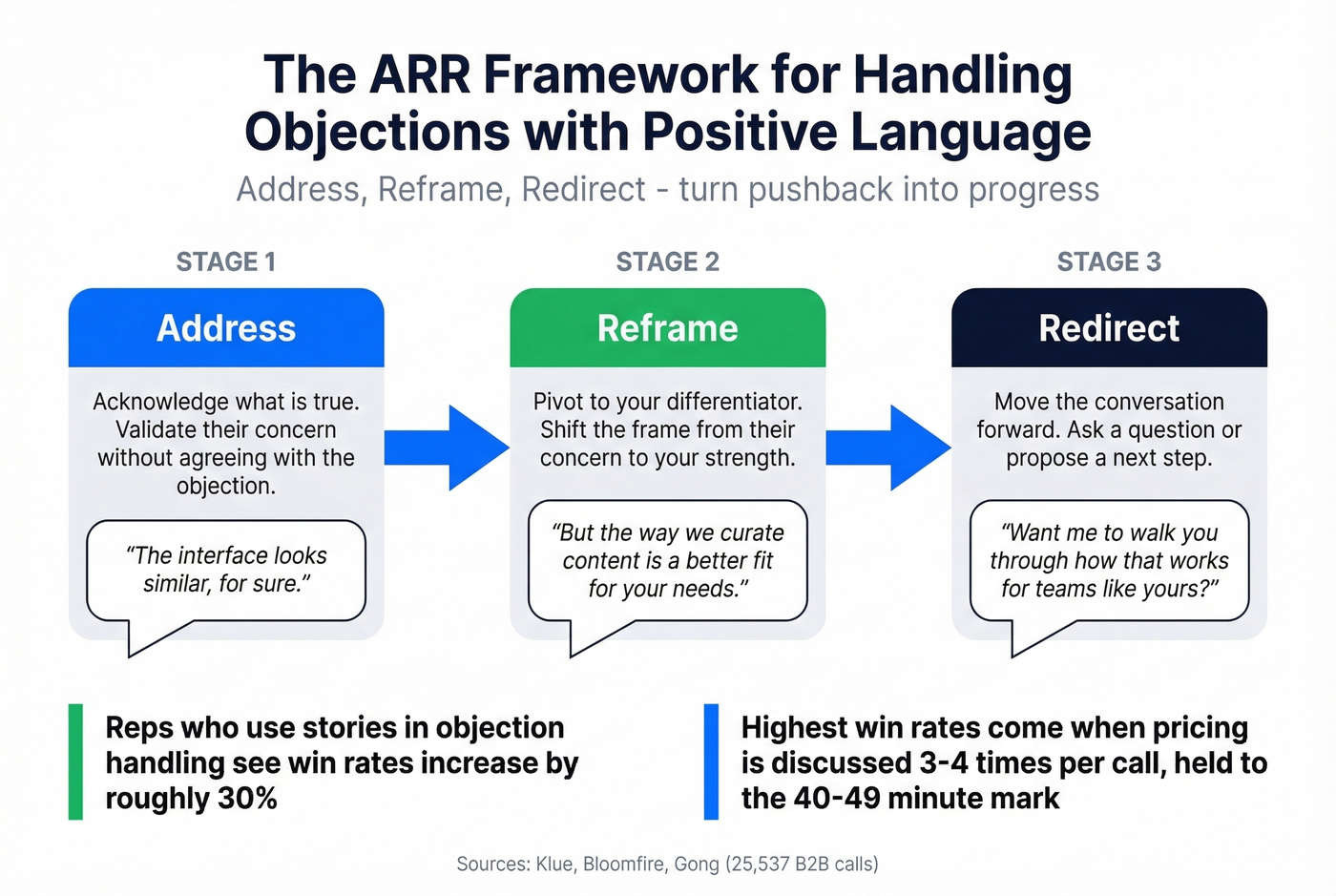
The ARR framework from Klue - Address, Reframe, Redirect - maps constructive phrasing to objection types. For a partly-true competitor claim: "The interface looks similar, for sure. But the way we curate content is a better fit for your needs." You acknowledge, then pivot. No defensiveness, no dismissal.
Risk reversal language - phrases like "try it for 30 days, and if you don't see results, we'll part as friends" - shifts the perceived downside away from the buyer. It's one of the most effective forms of positive framing because it directly addresses the fear behind the objection instead of arguing against it.
Storytelling is the sharpest tool here. Salespeople who handle objections with stories see win rates increase by roughly 30%. Stories bypass the logical defense mechanisms that kick in when you argue with data alone.
Analysis of 25,537 B2B sales calls found that the highest win rates come when pricing is mentioned 3-4 times per call, and top reps hold pricing discussions to the 40-49 minute mark. Frame value before price. Lead with what you can do. That's positive language applied to the moment that matters most - and it pairs well with a consistent objection handling system.
Making It Stick
Role-play with the word swap table above. Record calls and flag friction phrases. But don't over-script - the balance between scripted guidance and natural delivery is everything.
When you share industry identity with a prospect, you can be more technical, more casual. Match their register. Pay special attention to eliminating apologetic hedging in emails and voicemails - those are the easiest wins because reps often don't realize how much they hedge until they hear it played back. I've sat through call reviews where a rep said "sorry" four times in a 90-second voicemail and had no idea until we counted.
To operationalize this, track a few sales productivity metrics (like talk time and questions asked), and run tighter role-play sessions so reps practice the exact moments where language breaks deals.
Let's be honest: language training falls apart if your team is spending half their day chasing bad contact data instead of practicing their craft. Get the data quality right first, then invest the freed-up hours into the words that actually close deals. If you're auditing deliverability, start with email list scrubbing and a clear definition of what an unverified email actually means for bounce risk.
Timeline hooks pull 2.3x more replies than problem hooks - but only if your list is clean. Teams using Prospeo see under 4% bounce rates because every email is verified in real time across 143M+ contacts.
Make every word count by sending it to the right person.
FAQ
What's the most impactful word swap in sales?
Replace "does that make sense?" with "how does that sound to you?" It avoids implying confusion and invites opinion instead - one of the most commonly cited swaps among experienced reps on r/sales. It's a zero-effort change that immediately reduces friction.
Do timeline hooks outperform problem hooks in cold email?
Timeline hooks achieve a 10.01% reply rate vs. 4.39% for problem hooks - a 2.3x gap. Pair that with personalized subject lines, which hit 46% vs. 35% open rate, and you compound the advantage at every funnel stage.
How do I train my team on better sales language?
Role-play with before/after phrase swaps and record real calls. Flag friction phrases like "does that make sense?" or instances of over-apologizing. Balance scripted guidance with natural delivery - aim for understanding the why, not memorization.
Why does decisive language matter in sales?
Buyers mirror the confidence level of the seller. Clear recommendations, direct next steps, and active-voice framing signal competence and reduce cognitive load. Hedging and qualifiers like "maybe," "I think," or "sort of" erode trust even when the underlying information is strong.