

How to Prioritize Leads: The Scoring Template Your CRM Is Missing
It's Monday morning. Your CRM shows 127 new leads, 14 demo requests, and 40 outbound prospects from last week's campaign. Your rep has eight hours. The average B2B company takes 42 hours to respond to a new lead - by which point the buyer's already talking to your competitor.
Learning to prioritize leads isn't a nice-to-have. It's the difference between a pipeline and a graveyard.
What You Need (Quick Version)
- Under 500 leads/month? Skip scoring. Use the Now / Later / Not Now triage below.
- 500+ leads/month? Copy the scoring template in this guide into your CRM today.
- Before either approach works, verify your contact data. Scoring unreachable leads is wasted motion - the mistake we see teams make most often.
Why Speed Beats Precision
The data on response time is brutal. Leads contacted within one hour are 60x more likely to qualify than those contacted after 24 hours. Within five minutes, you're looking at 21x higher conversion rates.
And yet, 51% of leads are never contacted at all. The problem isn't that reps are lazy - it's that they're staring at an unsorted list and don't know where to start. A lead prioritization strategy doesn't need to be perfect. It needs to be fast enough that your best leads get touched before they go cold.
Here's the stat that should keep every sales leader up at night: 85% of B2B purchases go to a vendor already on the buyer's day-one shortlist. If you aren't ranking prospects fast enough to land in that initial consideration set, scoring precision is irrelevant.
Simple Triage for Small Teams
Before you build a scoring model, start with three buckets. This works for any team processing fewer than 500 leads a month.
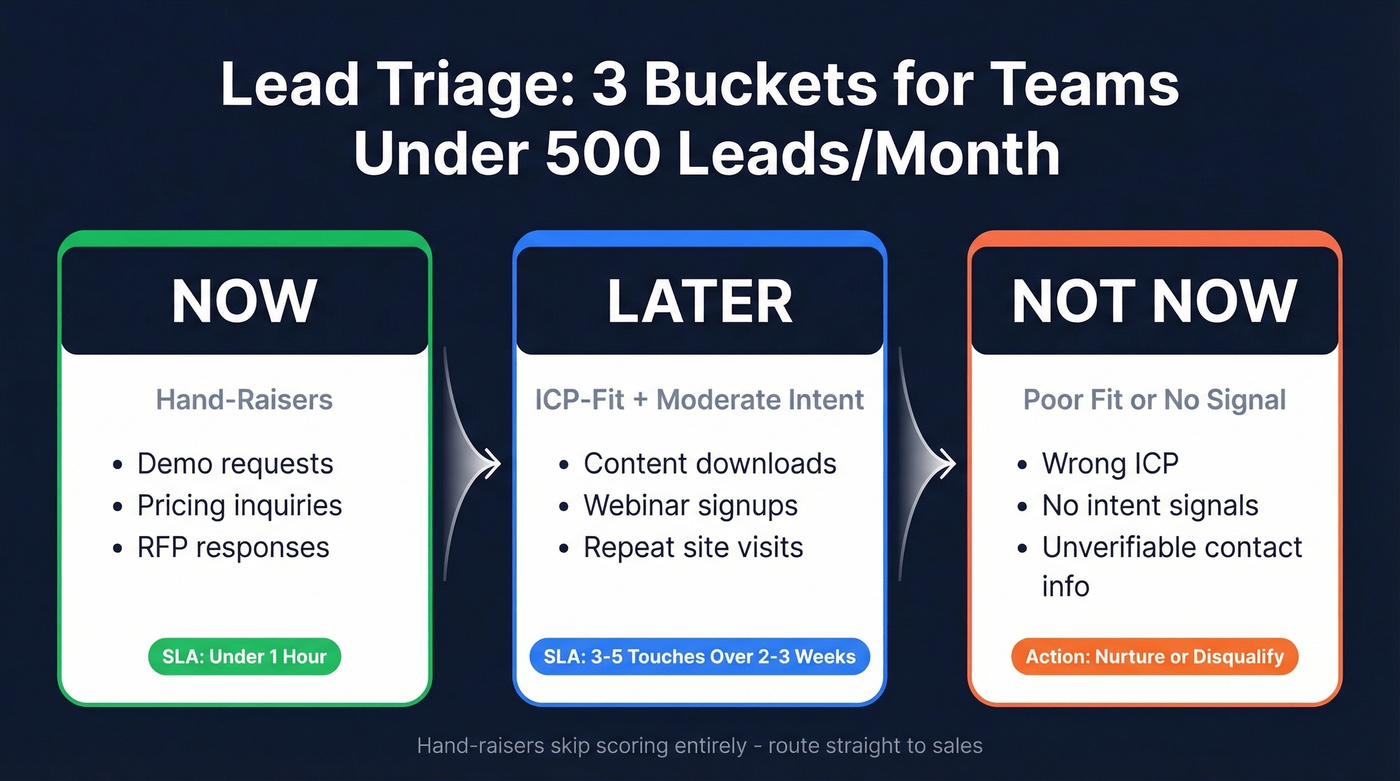
- Now - Hand-raisers: demo requests, pricing inquiries, RFP responses. These bypass scoring entirely. SLA: contact within 24 hours, ideally within the hour.
- Later - ICP-fit leads showing moderate intent like content downloads, webinar signups, or repeat site visits. Queue for 3-5 follow-up attempts over 2-3 weeks. (If you need copy, use these follow-up attempts.)
- Not Now - Poor fit, no intent signals, or unverifiable contact info. Nurture sequence or disqualify.
Hand-raisers should never sit in a scoring queue. If someone asks for a demo, route them to sales immediately. Scoring exists for everything else - it's how you handle leads that haven't explicitly raised their hand.
The Scoring Template
Most scoring articles give you theory. Here are actual numbers you can paste into your CRM today - HubSpot, Salesforce, Marketo, whatever you're running. This is the foundation of smart lead prioritization.
Positive and Negative Signals
| Signal | Points |
|---|---|
| RFP / proposal request | +40 |
| Referral from customer | +35 |
| Budget confirmed | +30 |
| VP+ job title | +25 |
| Company size fits ICP | +20 |
| Timeline under 90 days | +20 |
| Pricing page, 2+ visits | +15 |
| Competitor employee | -50 |
| Personal email domain | -40 |
| Wrong geographic location | -35 |
| Wrong company size | -30 |
| Unsubscribed from emails | -25 |
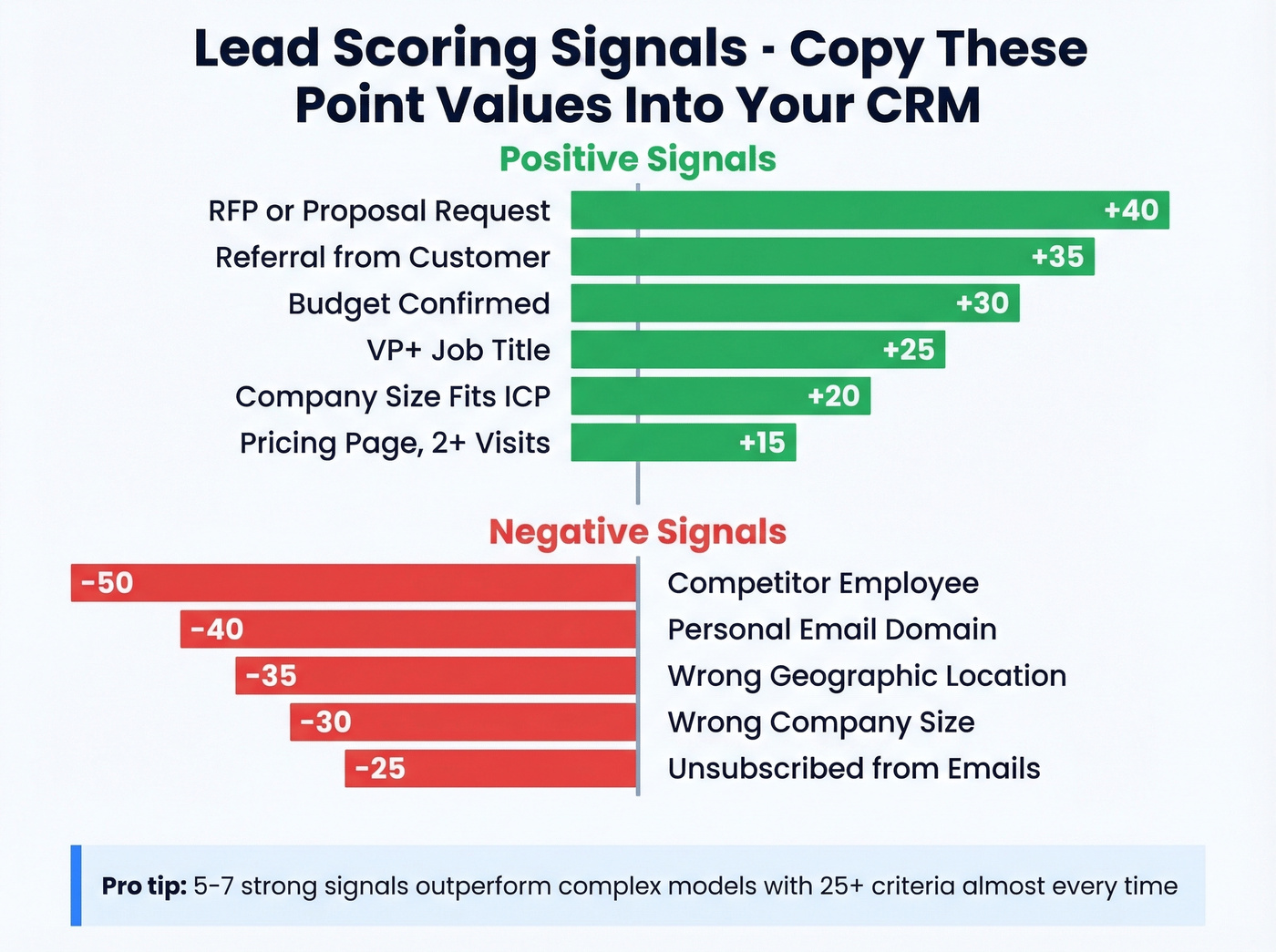
Negative scoring matters as much as positive. A VP at a competitor who downloads your whitepaper scores -25 net - that's not a lead, that's competitive intel. Don't let vanity metrics inflate your pipeline.
In our experience working with sales teams, five to seven strong signals outperform complex models almost every time. Pick the signals that correlate with closed-won deals and ignore the rest. Teams over-engineer scoring models with 25+ criteria when they should focus on response speed and ICP fit first.
Routing Bands and SLAs
| Score Range | Label | Action | SLA |
|---|---|---|---|
| 0-45 | Cold | Nurture sequence | Automated |
| 46-70 | Warm | BDM outreach | Within 1 week |
| 71-89 | Hot | Discovery call | Within 2 days |
| 90+ | Very Hot | Senior rep | Within 24 hours |
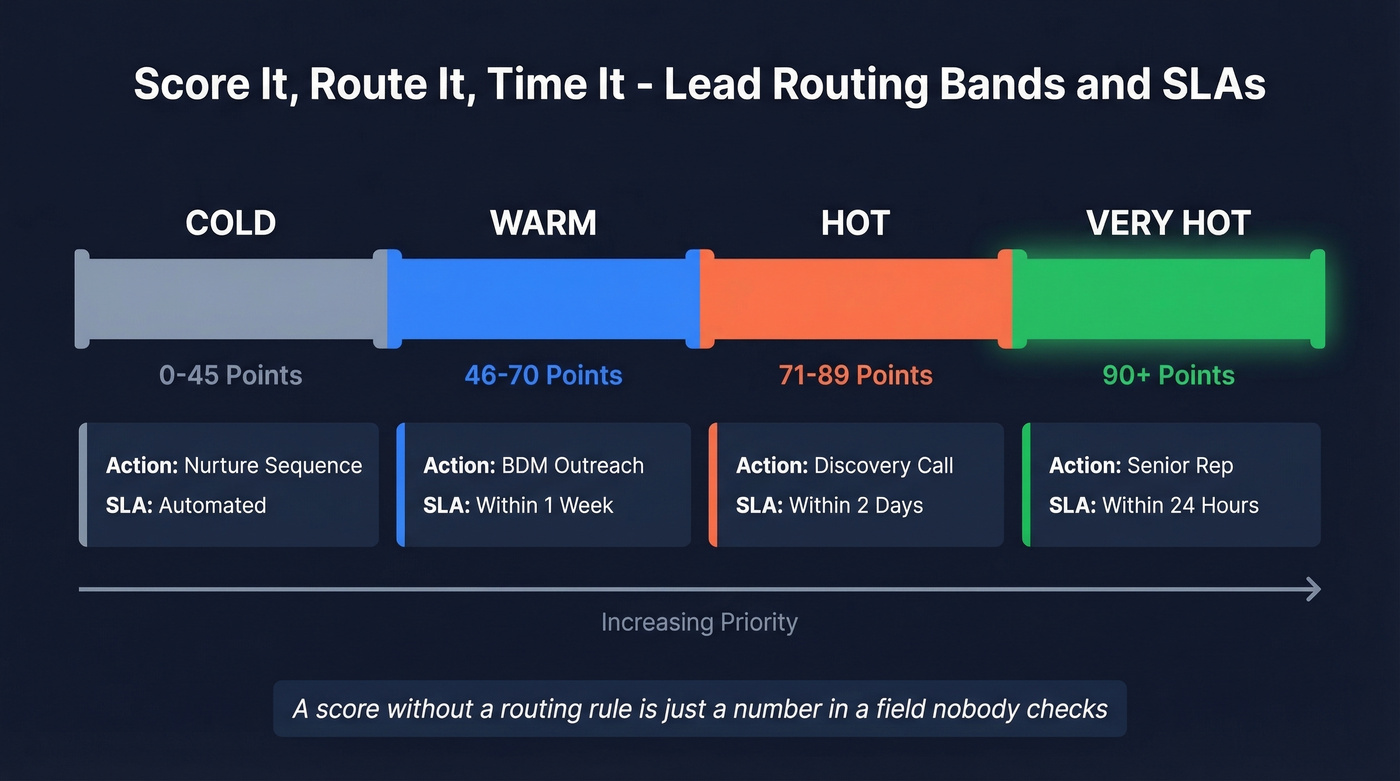
The SLAs are the part most teams skip - and the part that actually moves revenue. A score without a routing rule is just a number in a field nobody checks. Wire these into your CRM's assignment logic so leads auto-route to the right rep with a deadline attached.
Priority only matters when it triggers action.
Score Decay Rules
Reduce scores by 25% monthly when there's no new activity. After 365 days of zero engagement, delete them. A Databox benchmark found 40% of scored leads cluster in the 41-60 range - without decay, that middle band bloats until it's meaningless.

Your scoring model is only as good as the data behind it. Leads scored 90+ but bouncing at 35% mean your reps chase ghosts instead of revenue. Prospeo's 98% email accuracy and 7-day data refresh ensure every lead you route actually has a working contact attached.
Stop scoring leads you can't reach. Verify first, prioritize second.
Signals That Predict Conversion
Not all signals are equal. Stacking two or three intent indicators on the same account converts 5-10x better than cold outreach, pulling a 15-25% reply rate versus 3-5% for generic cold emails.
The signals worth tracking: leadership changes (new executives spend 70% of their budget in the first 100 days), pricing page visits, competitor technology shifts, and hiring patterns that suggest budget allocation. Layer in engagement scoring that tracks thousands of intent topics - Bombora-powered data, for instance - and you can score accounts showing active research behavior before they ever fill out a form.
One signal to avoid: email opens. Apple's Mail Privacy Protection inflates open rates to the point where they're noise, not signal. Don't score them. (If you're still using opens as a KPI, revisit email tracking and what it can/can’t tell you.)
How Real Companies Route Leads
Heap started with the outcome most teams want: reps matched to the right segment. Two firmographic data points - employee count and industry - bucketed leads into Low / Medium / High priority. SMB under 100 employees, mid-market 100-499, enterprise 500+. No behavioral scoring at all. It worked because they matched rep expertise to segment complexity rather than chasing a perfect model. Sometimes prospect prioritization is about fit, not fancy math.
LeanData solved a different problem: what happens when a lead belongs to an existing deal? Their framework assigns P1 status to hand raises and chat conversations with a 10-minute response SLA. P2 goes to webinar registrations with a 48-hour window. The critical rule: if there's an open opportunity, the lead routes to the AE, not an SDR.
Proposify combined Marketo scoring with Clearbit enrichment, blending firmographic fit with behavioral data like pricing page views and free trial activations. This is the pattern that scales - enrichment feeds scoring, scoring feeds routing, routing feeds SLAs.
Rules-Based vs. Predictive vs. AI
| Approach | Best For | Needs | Start Here? |
|---|---|---|---|
| Rules-based | <1,000 leads/mo | Manual setup, any CRM plan | Yes - every team's first move |
| Predictive (ML) | 1,000+ leads/mo | 6+ months clean data | Only after rules-based is running |
| ABM intent-driven | Enterprise/ABM | Intent data budget | Layer on top, don't replace |
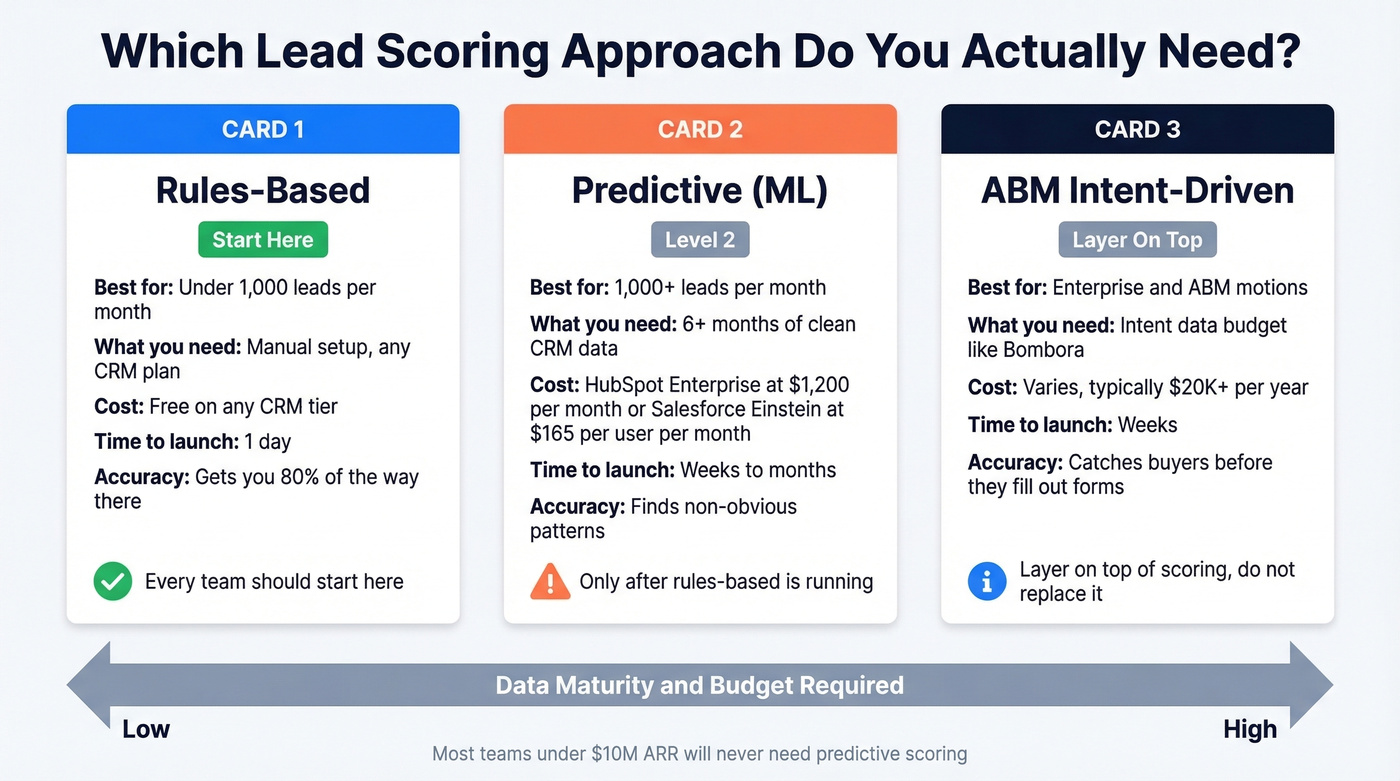
Rules-based scoring is where every team should start. You define the points, you control the weights, and you can launch in a day. Predictive scoring - including prospect similarity models that identify lookalikes of your best customers - finds non-obvious patterns, but it needs at least six months of clean CRM data to be useful.
Let's be honest: most teams under $10M ARR will never need predictive scoring. The gains are real - one case study roundup cites Grammarly seeing an 80% increase in conversions after implementing AI scoring through Salesforce Einstein, and Gartner reports a 30% lift in sales productivity from AI-driven lead scoring. But those gains require data maturity and expensive CRM tiers. HubSpot's predictive scoring requires Marketing Hub Enterprise at $1,200/month. Salesforce Einstein needs Enterprise tier at $165/user/month.
Rules-based scoring works on any CRM plan, costs nothing extra, and gets you 80% of the way there. For high-ticket deals where each conversion justifies the investment, predictive tools start to make more sense. (If you’re evaluating tooling, compare options in these contact management software roundups.)
The Data Quality Step Most Teams Skip
Here's the thing: we've watched this play out with teams running 300+ lead campaigns, and the pattern is always the same. They generate leads, feed them into a scoring model, and then discover 60 emails bounce, 40 are personal Gmail addresses, and 25 come from companies that don't match the ICP. The "Very Hot" lead with a score of 94 is useless if the email bounces and the phone number's disconnected.
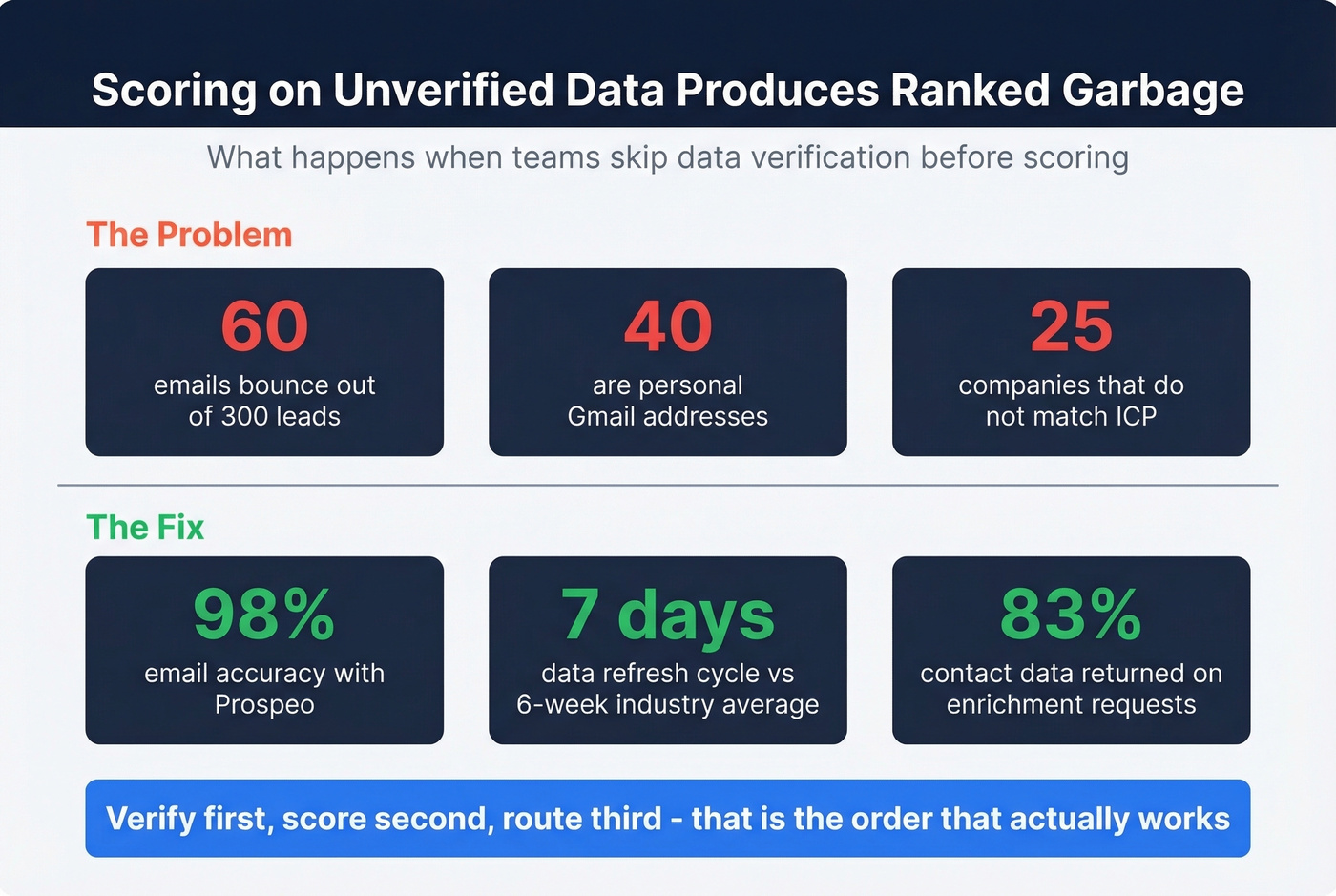
Scoring on unverified data produces ranked garbage.
Before you score a single lead, run your list through verification. Prospeo's 7-day data refresh cycle - compared to the six-week industry average - and 98% email accuracy mean you're scoring contacts that are actually reachable, returning contact data on 83% of enrichment requests. Upload a CSV, get results in minutes, and only score what's deliverable. The difference between a scoring model that works and one that wastes rep time is almost always data quality, not model sophistication. (If you’re shopping, start with these data enrichment services and email verification comparisons.)

Stacking intent signals on ICP-fit accounts converts 5-10x better than cold outreach - but only if your contact data connects. Prospeo layers Bombora intent data across 15,000 topics with 143M+ verified emails, so your highest-scored leads come with reachable contacts built in.
Turn your lead scores into booked meetings with data that actually connects.
FAQ
What's the difference between lead scoring and lead qualification?
Scoring assigns numerical points to rank leads automatically - it's the engine behind sales prospect prioritization. Qualification is the human judgment call, using BANT or MEDDIC, that happens during the sales conversation itself. Scoring tells reps who to call first; qualification determines whether the deal is real.
How many scoring criteria should I use?
Start with five to seven signals that correlate with your closed-won deals. Models with 25+ criteria create maintenance nightmares and rarely outperform simpler ones. Focus on ICP fit and high-intent behaviors like pricing page visits and demo requests before adding complexity.
How do I handle leads with outdated contact data?
You can't prioritize leads you can't reach. Verify your list before scoring - use a tool that checks emails in real time and refreshes data weekly, then score only what's actually deliverable. Routing stale contacts to reps is the fastest way to burn hours and kill morale.
Should I score inbound and outbound leads differently?
Yes. Inbound leads already showed intent by coming to you, so weight behavioral signals like page visits and content downloads more heavily. For outbound prospects, lean harder on firmographic fit - company size, industry, tech stack, job title - since you don't have behavioral data yet. Some teams run two parallel models; others use a single model with different signal weights. Either works as long as you're intentional about it.