

Product-Led Growth: The Operator's Playbook for 2026
A mid-market RevOps team we advise ran a three-tool bake-off last quarter. The tool with the biggest brand name had the worst activation rate - 11%. The scrappy startup with a free tier nobody had heard of converted at 38%. Product-led growth isn't about having a free plan. It's about whether your product can sell itself before a rep ever picks up the phone.
What Is Product-Led Growth?
Product-led growth (PLG) is a go-to-market strategy where the product itself drives acquisition, conversion, retention, and expansion. Instead of routing every prospect through a sales call or gated demo, you let people use the thing - and the experience does the selling.
Blake Bartlett at OpenView Partners coined the term in 2016 to describe a pattern he kept seeing in the fastest-growing SaaS companies. Slack, Dropbox, Calendly - they weren't winning because of bigger sales teams. They were winning because users loved the product, told colleagues, and pulled out credit cards without anyone asking.
The distinction matters. In a sales-led model, revenue depends on headcount - more reps, more pipeline. In a marketing-led model, demand gen fills the top of funnel and hands off to sales. In PLG, the product is the primary growth engine across the entire customer lifecycle. Reps still exist in most PLG companies, but they're accelerants, not the engine.
Here's the thing: PLG isn't "just have a free trial." It's a distribution model where the product handles onboarding, demonstrates value, and creates natural upgrade moments. A common frustration on Reddit PLG threads captures it well - if your free tier requires 30 minutes of setup before anyone sees value, you don't have PLG. You have a free trial with extra steps.
Readiness Check Before You Commit
Before you invest six months and a cross-functional team into a PLG motion, answer three questions honestly:
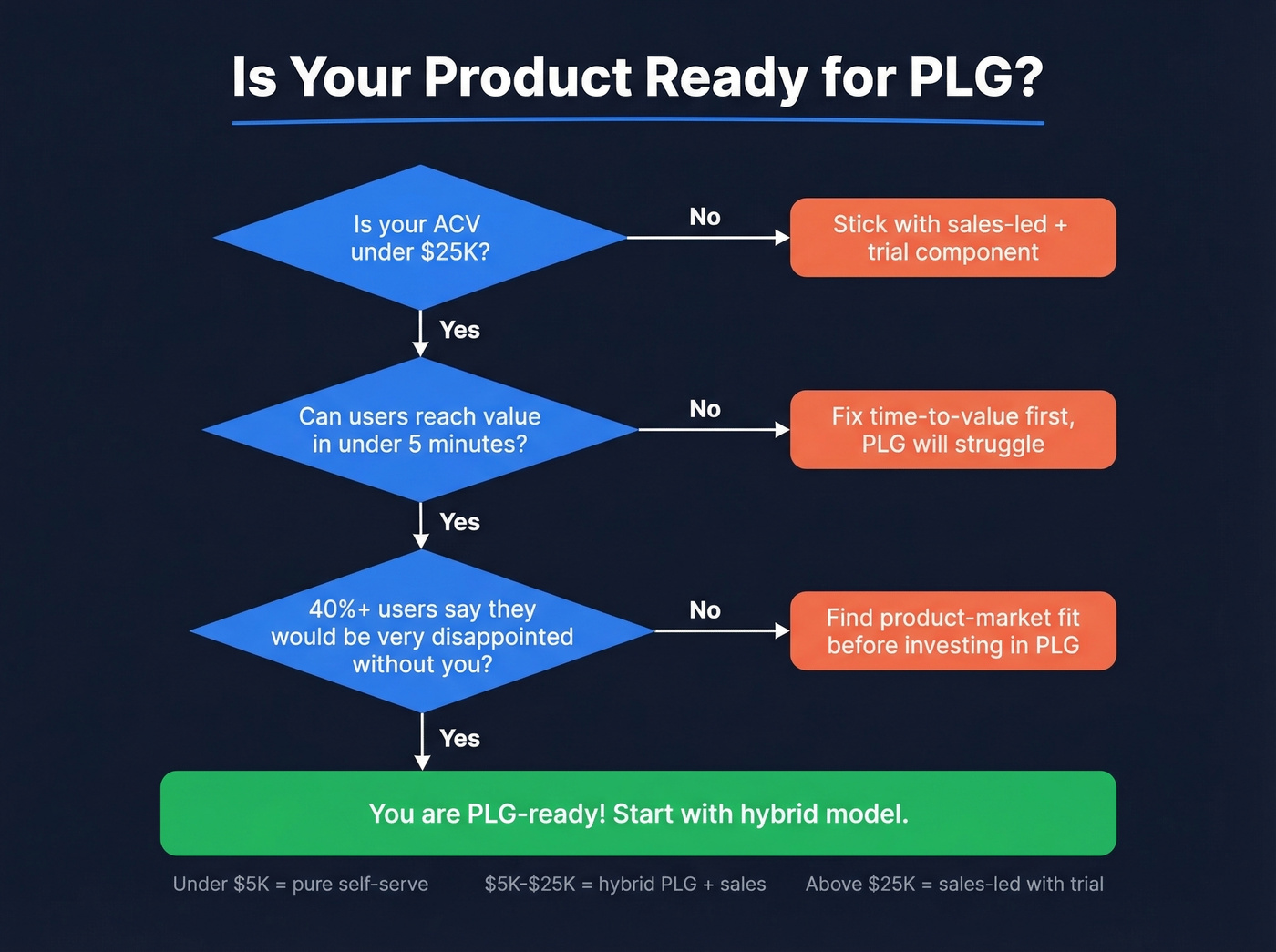
1. Is your ACV under $25K? Pure self-serve works best below $5K. Between $5K and $25K, hybrid PLG + sales is the sweet spot. Above $25K, sales-led with a trial component is more realistic.
2. Can users reach value in under 5 minutes? If your product requires complex implementation, multiple stakeholders, or a long migration, PLG will struggle.
3. Do 40%+ of users say they'd be "very disappointed" without your product? That's the Sean Ellis PMF threshold. Without it, PLG just accelerates churn.
The single most important metric is activation rate. If users don't hit the "aha moment," nothing downstream works. 20-40% is normal, 40-60% is good, 70%+ is elite. Only 34% of PLG companies even track it.
And the 2026 reality? Pure PLG is a myth above $5K ACV. Hybrid product-led sales - self-serve for acquisition, reps layered in for expansion - is the default model. Plan for it from day one.
Why PLG Matters Now
Buyers don't want to talk to your sales team. That's not an opinion - 53% of B2B buyers prefer to purchase without any sales interaction at all.
The urgency comes from three directions. First, attention is brutally scarce. 71% of app users churn within 90 days - if your product can't demonstrate value fast enough, users disappear before your nurture sequence even fires. Second, budgets are tighter. 67% of companies had software budgets cut in recent cycles, which means buyers scrutinize every dollar and want to try before they commit. Third, the companies that have already adopted PLG aren't looking back. 58% of B2B SaaS companies now run a PLG motion, and 91% plan to increase their investment. Nearly half plan to double it. That's not experimentation. That's conviction.
The startup data tells the same story. A scan of 474 Series A companies found 39% enable self-serve and 25% offer a free tier. In DevTools specifically, those numbers jump to 50% PLG and 34% with free plans. This isn't a trend anymore - it's table stakes for an entire generation of software companies.
Benchmarks That Actually Help
The biggest problem with PLG advice is that everyone says "measure activation" but nobody tells you what good looks like. Here are the numbers from a survey of 600+ SaaS businesses and operator benchmarks we've validated across multiple sources.
Free-to-Paid Conversion by Model
| Model | Avg Conversion | Notes |
|---|---|---|
| Opt-out trial (card required) | ~49% | Highest conversion, highest friction |
| Opt-in trial (no card) | ~18% | Lower conversion, larger top of funnel |
| Freemium | 2-5% | Volume play - needs massive user base |
| All models blended | ~9% | The number most teams should benchmark against |
Key PLG Metric Benchmarks
| Metric | Average | Good | Elite |
|---|---|---|---|
| Activation rate | 20-40% | 40-60% | 70%+ |
| Free-to-paid (all) | ~9% | 15-20% | 25%+ |
| PQL-to-paid conversion | ~25% | 30-39% | 40%+ |
| Net dollar retention | 100-110% | 120-130% | 130-150% |
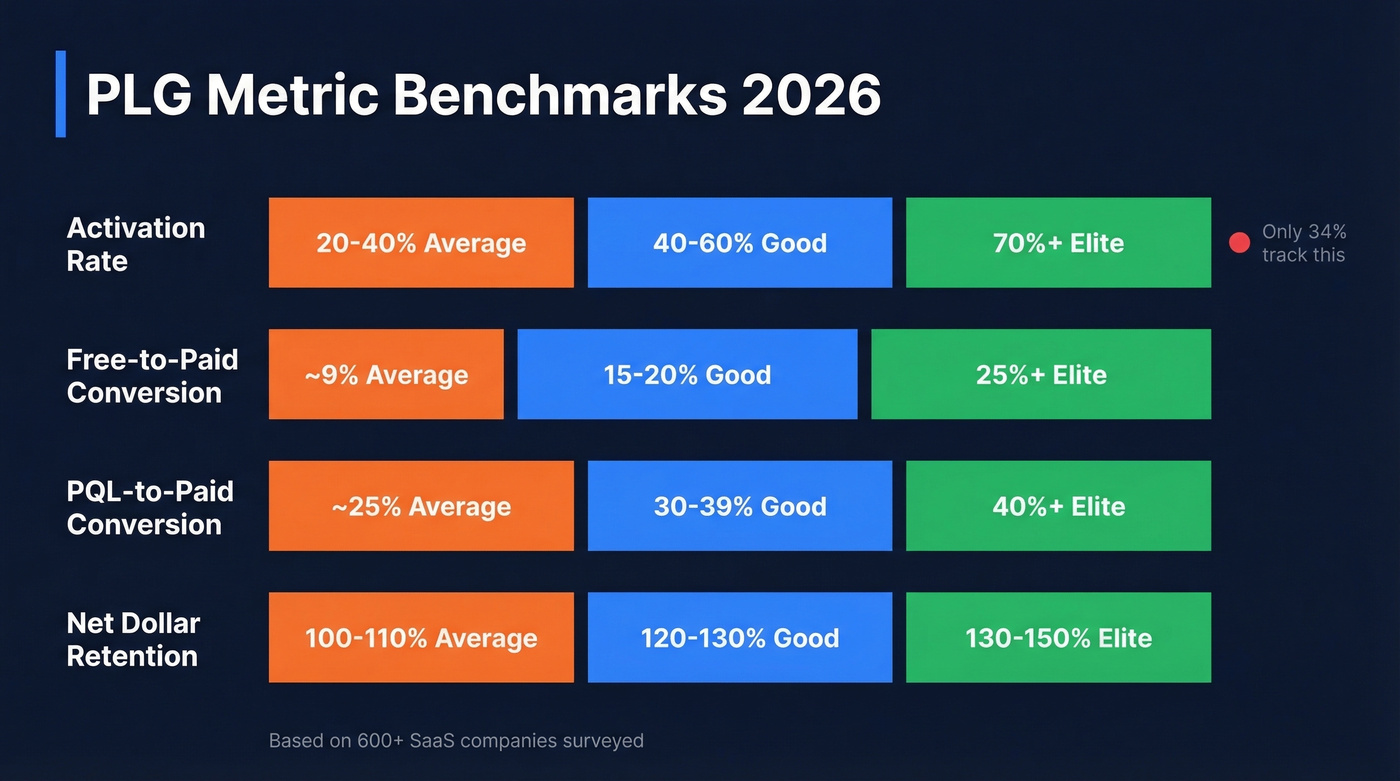
The activation numbers deserve extra attention. Most PLG companies hover in the 20-40% range, meaning 60-80% of users who sign up never reach the moment where the product clicks. That's an enormous leak, and it's fixable - which is why activation is the single highest-leverage metric in any product-led motion.
Look, if you're running PLG without tracking activation rate, you're flying blind.
PQL conversion varies significantly by deal size too. Companies with $1K-$5K ACV see about 30% PQL-to-paid conversion. At $5K-$10K, it jumps to 39%. The larger the deal, the more a PQL signal matters because it represents genuine buying intent, not casual exploration.
The hidden opportunity: only 24-25% of PLG companies actually use PQLs. The rest are still routing leads based on form fills and page visits. If you're running a self-serve motion without a lead scoring framework, you're leaving the highest-converting lead source on the table.
How PLG Actually Works
PLG isn't one playbook - it's a set of interlocking mechanics. Here are the four that matter most.
Freemium, Trials, and Reverse Trials
These three models get conflated constantly, and the differences matter. Freemium gives users permanent access to a limited version - Slack's limited message history, Calendly's single event type. Free trials give full access for a limited time. Reverse trials start users on the premium tier and downgrade them after the trial window, so they feel the loss of features they've already adopted.
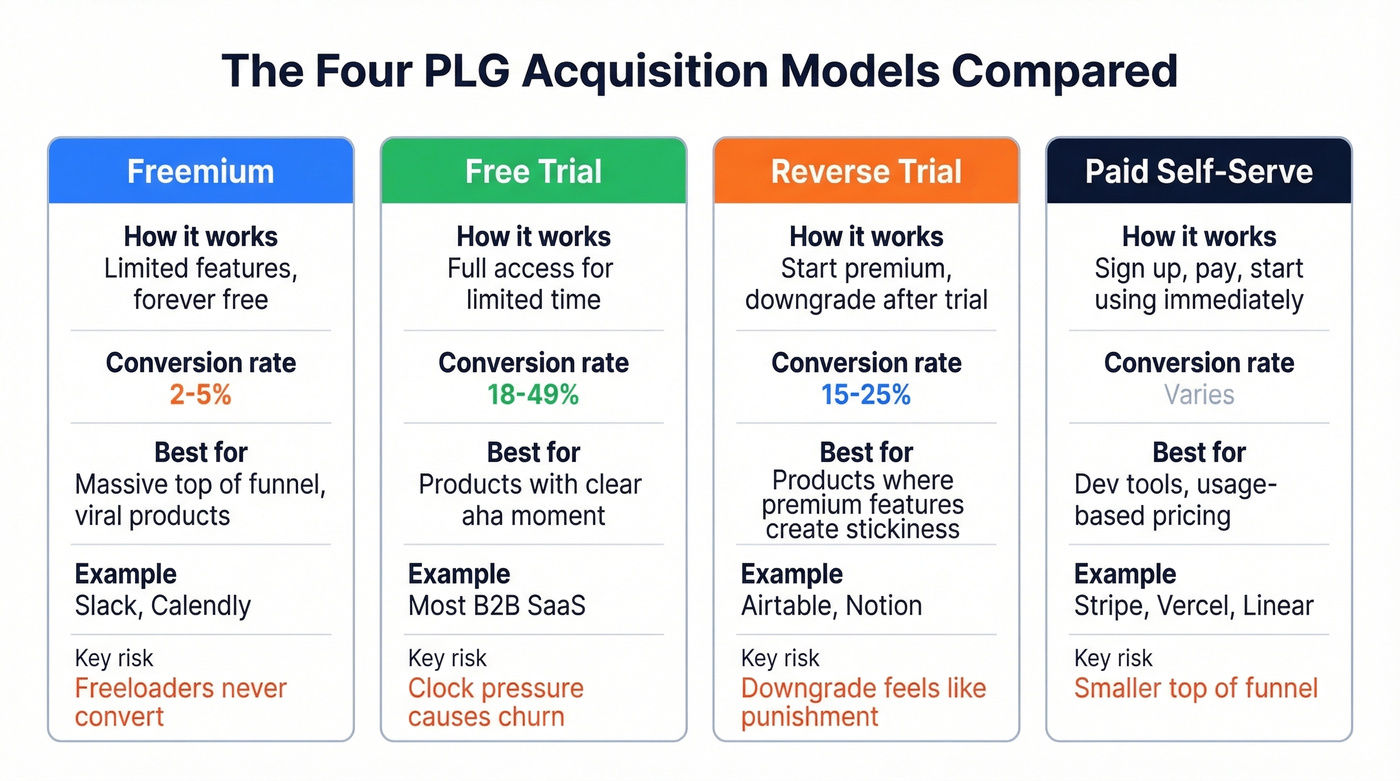
There's also a fourth model that gets overlooked: charge from day one. Stripe, Vercel, and Linear all run PLG without a free tier. Self-serve doesn't mean free. These companies let you sign up, enter payment details, and start using the product in minutes - the product still drives acquisition and activation, but there's no free ride.
Time-to-Value and Activation
Top PLG companies deliver value in under five minutes. That's the benchmark. We've watched teams spend months building elaborate onboarding flows when the real problem was their product required too many steps to reach value. No amount of tooltips fixes a fundamentally slow time-to-value.
The 2026 expectation is compressing further - practitioners are pushing toward value in under 60 seconds. Activation rate is the metric that captures this: it measures the percentage of new users who complete the key action that correlates with long-term retention. Find that action, measure it obsessively, and optimize everything upstream of it.
Product-Qualified Leads
A PQL is a user who's demonstrated buying intent through product behavior - not by downloading a whitepaper, but by actually using the thing. They've hit activation, invited teammates, or bumped into a paywall.
PQL programs convert dramatically better than lead scoring based on clicks. When PLG companies implement PQLs, conversion runs about 3x higher than teams that don't. The opportunity is massive because adoption is still low - only about 25% of PLG companies have implemented PQL scoring. The rest are sitting on behavioral data that could triple their conversion rates and not using it. Expect 6-12 months from your first free users to a working PQL framework; it takes time to identify the behavioral signals that actually predict conversion.
Network Effects and Expansion
The best PLG products don't just acquire users - they turn users into distribution channels. Every Calendly link is a product demo. Every Slack channel invitation pulls another organization closer to the paid tier. Every shared Airtable base introduces the product to a new team.
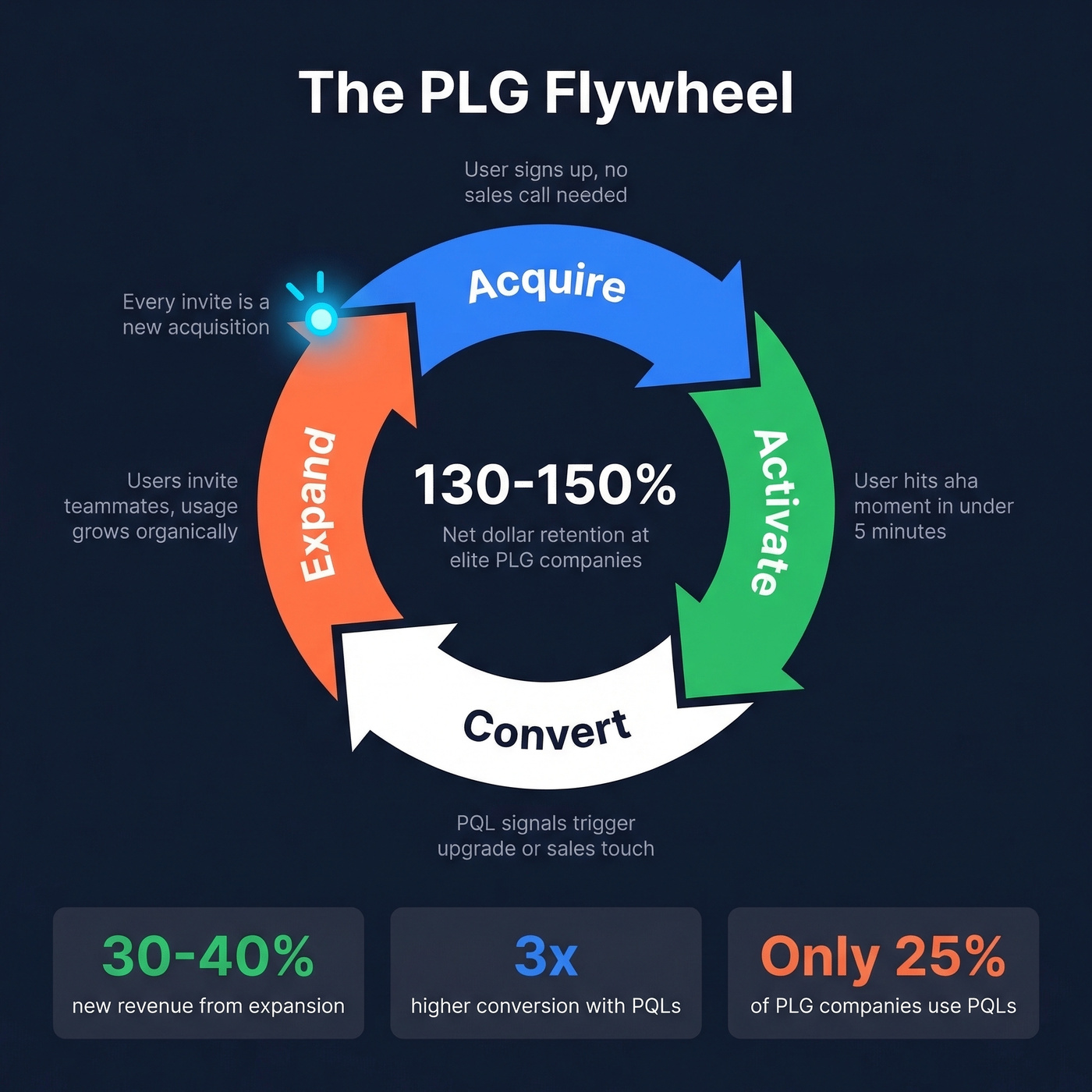
Top PLG companies generate 30-40% of new revenue from expansion within existing accounts. That's not upselling - it's the product naturally growing its footprint as more people use it. Net dollar retention of 130-150% at best-in-class companies means the product is literally growing revenue without the sales team touching the account.

You just read that 60-80% of PLG users never activate. Prospeo beats that - 40,000+ Chrome extension users hit value in one click. 98% email accuracy, 75 free emails/month, no sales call required.
Experience product-led growth the way it's supposed to work.
Is PLG Right for You?
Not every product should be product-led. Let's break down where it works and where it doesn't.
ACV Decision Framework
| Annual Contract Value | Recommended Model |
|---|---|
| Under $5K | Self-serve / PLG |
| $5K-$25K | Hybrid PLG + sales-assist |
| Above $25K | Sales-led with trial |
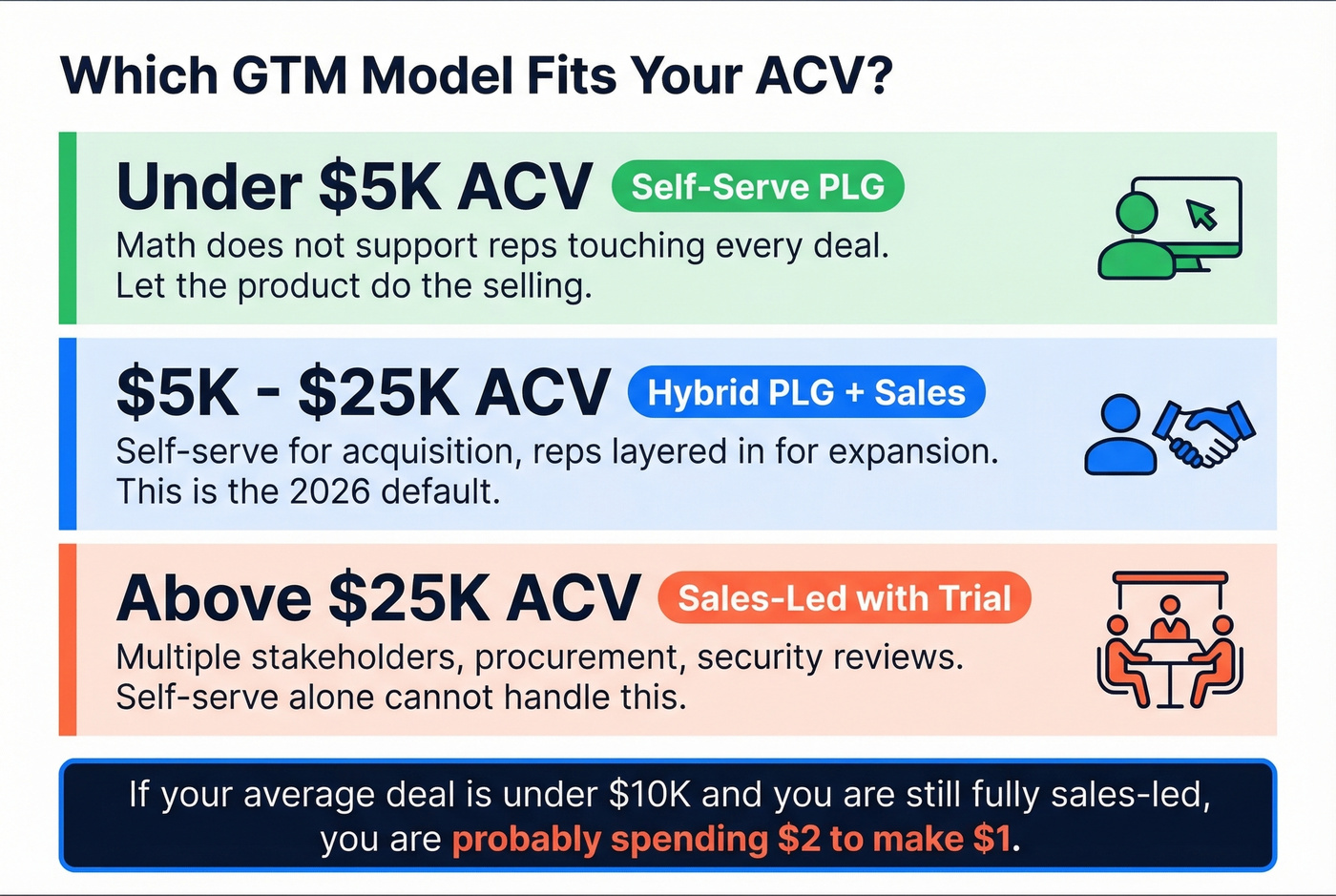
The ACV threshold isn't arbitrary. Below $5K, the math doesn't support a sales team touching every deal. A rep closing $3K deals needs enormous volume to hit quota, and PLG provides that volume at a fraction of the cost. Above $25K, deals involve multiple stakeholders, procurement processes, and security reviews that a self-serve flow can't handle alone.
If your average deal is under $10K and you're still running a fully sales-led motion, you're probably spending $2 to make $1. The unit economics just don't work. A self-serve acquisition layer isn't optional at that price point - it's survival.
Prerequisites
Product-market fit is non-negotiable. The Sean Ellis benchmark - 40% of users saying they'd be "very disappointed" without your product - needs to be true for your ideal customer profile segment before you invest in PLG. In our experience, the companies that struggle most with a product-led motion are the ones that skip this validation step and try to growth-hack their way past a product that doesn't retain.
Unit economics need to work too. Target LTV:CAC of at least 3:1 and CAC payback under 12 months. PLG typically improves both metrics over time because acquisition costs drop as the product compounds, but you need a viable starting point.
Where PLG Struggles
Skip PLG if your product requires complex implementations with long migration paths. Same goes for products requiring multiple stakeholder buy-in before a single user can get value, or heavy compliance environments where IT needs to approve before anyone touches the tool. If your median time-to-value exceeds 30 minutes for the core job-to-be-done, a self-serve motion will underperform.
The readiness signals are practical: your activation-to-paid conversion should stabilize across cohorts, and support questions should shift from "how do I use this?" to "can it also do X?" When users are pulling the product forward instead of being pushed through onboarding, you're ready.
When PLG Fails - The SurveyMonkey Lesson
SurveyMonkey had everything a PLG playbook calls for: viral loops, millions of users, integrations everywhere, brand recognition that made "SurveyMonkey" a verb in some offices. And it lost.
Around the time of Qualtrics' SAP acquisition in 2018, SurveyMonkey was valued at roughly $2.8B. Qualtrics - selling into the same survey software market - hit $17.6B. A 6x gap. How?
Qualtrics didn't sell surveys. It sold "Experience Management" - a strategic category that justified C-suite conversations and six-figure contracts. It built a professional services arm that accounted for roughly a third of revenue, creating switching costs that no self-serve product could match. Every implementation deepened the lock-in.
The lesson isn't that PLG is bad. It's that PLG loses in three specific situations: when the buyer isn't the user, when the sale is strategic rather than functional, and when services create switching costs that product simplicity can't overcome. If your competitor is selling outcomes to executives while you're selling features to practitioners, PLG alone won't save you.
How to Implement PLG
Sequential North Star Metrics
The biggest implementation mistake is trying to optimize everything at once. Stage 2 Capital's framework lays out four sequential stages, each with its own North Star metric:
Stage 1: Flow of free users. Measure new signups per day. Don't optimize conversion yet - you need volume to experiment with.
Stage 2: Prove retention. Track new user to weekly active user percentage. If free users aren't sticking around, nothing downstream matters.
Stage 3: Prove scalable acquisition. Measure cost per quality user. "Quality" means ICP-fit users who activate, not just anyone who signs up.
Stage 4: Prove monetization. Track quality user to paid conversion and average contract value.
The critical nuance: measure these metrics for your ICP segment, not all users. A 25% activation rate across all signups might mask a 55% activation rate among your target persona and a 5% rate among everyone else. Segment ruthlessly.
Onboarding That Activates
Your onboarding flow is the single biggest lever for activation rate. Feature walkthroughs should be minimal and friction-removing - not product tours that show every button. Feature nudges catch users at the moment of need with a CTA into a deeper walkthrough. Help hotspots provide contextual guidance without interrupting flow.
The targeting matters as much as the content. Build segments using user properties and behavioral events, and use "created at" targeting so existing users don't get bombarded with new-user flows.
The 2026 frontier is AI-driven adaptive onboarding - flows that adjust in real time based on what each user has and hasn't done, rather than forcing everyone through the same linear sequence. It's early, but the teams investing here are seeing measurable lifts in activation within their first few cohorts.
Org Design - Who Owns PLG?
PLG doesn't fit neatly into any existing department. Survey data shows fragmented ownership: Product is involved 49% of the time, Marketing 42%, Sales owns free-to-paid conversion 23% of the time, CS supports free users 26%, and Product Ops is rarely responsible at just 6%.
That fragmentation is the problem. We've seen teams where marketing drives signups, product owns onboarding, sales handles conversion, and nobody owns the full journey. Activation falls through the cracks because it sits at the intersection of all three.
The teams that get this right usually have a single person - often a Head of Growth or VP Product - who owns the activation metric and has authority to pull resources from product, engineering, and marketing. Without that single throat to choke, PLG becomes everyone's side project.
Hybrid PLG + Sales - The 2026 Default
Pure PLG is a beautiful theory. In practice, almost every company above $5K ACV ends up layering in sales. The question isn't whether to go hybrid - it's when and how.
The pattern looks like this: PLG handles acquisition and activation. Users sign up, experience value, and hit natural expansion triggers - more seats, higher usage, premium features. At that point, a sales rep engages the account. Not cold, but warm, armed with product usage data that tells them exactly what the user cares about.
Companies are spending $2 for every $1 of new ARR, a ratio that's climbed 14% since 2024. That spend is increasingly going toward sales-assisted expansion rather than pure outbound acquisition. The "GTM pendulum" describes how companies like Equals and Superhuman swing between self-serve and sales-led before settling into a hybrid equilibrium.
The infrastructure challenge is real. When your product generates PQLs and sales needs to reach those accounts, data quality becomes the bottleneck. One sales team we worked with saw 35% of their outbound emails bounce before switching to verified data - their sales-assisted expansion motion was dead on arrival. When a PQL fires and a rep needs to reach the VP who approved the free tier, verified contact data from a platform like Prospeo is the difference between a timely conversation and a bounced email that goes nowhere.
If you're seeing bounce issues, start with email bounce rate benchmarks and fixes, then tighten your email deliverability stack before you scale volume.
PLG Examples That Prove the Model
Slack - Paywalled History
Slack's PLG mechanic is elegant: free usage is genuinely valuable, but message history, search depth, and collaboration features live behind paid tiers. As teams grow and conversations accumulate, the pain of losing access drives upgrades. The real engine is the network effect - every channel invitation pulls another person into the product, and every cross-team channel makes it stickier.
Calendly - Every Meeting Is a Demo
Every time someone receives a Calendly link, they experience the scheduling flow firsthand, think "I want this," and sign up. It's one of the purest viral loops in SaaS. The freemium model limits event types, so power users who need multiple meeting formats naturally upgrade. Simple, repeatable, and almost impossible to replicate without a product that's inherently shareable.
Datadog - Usage-Based Expansion
Datadog's expansion math is what makes it a PLG masterclass. Infrastructure monitoring naturally grows as companies add servers, containers, and services. One team starts monitoring their stack, proves the value, and adjacent teams adopt it for their own infrastructure. Usage-based pricing means revenue scales with the customer's own growth - no upsell conversation needed.
Airtable - Loss Aversion as Conversion
Airtable is the textbook reverse-trial example. New users start with premium features and get downgraded after the trial window. By the time the trial ends, teams have built workflows around features they now can't access. That loss aversion drives conversion more effectively than any feature comparison page. Airtable hit $142M in revenue in 2022 largely through this self-serve motion.
2026 Trends Shaping PLG
Hybrid product-led sales is the default, not the exception. The ICONIQ 2026 GTM report shows AI-native companies converting free trials and POCs at 56% versus 32% for non-AI-native peers. That gap will only widen as AI reshapes every stage of the PLG funnel.
The most interesting shift is who the "user" is. As AI agents become buyers and users of software - booking meetings, running queries, managing workflows - activation metrics need to evolve. An agent doesn't need an onboarding walkthrough. It needs an API that returns value in milliseconds. Companies building for agent-as-user will have fundamentally different PLG mechanics than those building for humans.
Time-to-value expectations are compressing toward under 60 seconds. That sounds aggressive, but think about it: Cursor lets you start coding with AI assistance the moment you open the editor. Lovable generates a working app from a prompt in seconds. The bar for "fast enough" keeps dropping, and products that require multi-step setup will feel increasingly archaic.
Pricing is evolving in parallel. The per-seat model is giving way to per-task and per-outcome pricing where outputs are measurable. About one-third of companies already use hybrid pricing models, and that number is climbing fast among AI-native firms. Roughly 70% of companies report moderate to full AI adoption in their GTM workflows.
On r/SaaS and r/ProductManagement, the practitioner conversation has shifted to real-time adaptive onboarding and predictive friction detection - using AI to identify where individual users are about to drop off and intervening before they do. The teams that figure this out will have a structural advantage in activation rates that compounds over every cohort.
Hybrid PLG + sales is the 2026 default. Prospeo gives your reps the data layer they need - 300M+ profiles, 125M+ verified mobiles, and intent signals across 15,000 topics. Self-serve from day one at $0.01/email.
Stop gating your pipeline behind bad data and slow onboarding.
FAQ
Who coined "product-led growth"?
Blake Bartlett at OpenView Partners coined the term in 2016 to describe the pattern where the product itself - not sales or marketing - drove acquisition, retention, and expansion. The concept existed before the label, but Bartlett's framing gave the movement a name.
What's a good free-to-paid conversion rate?
About 9% across all free models. Opt-out trials with a card required convert at ~49%, opt-in trials at ~18%, and freemium at 2-5%. Benchmark against your own model type, not the blended average.
Is PLG dead in 2026?
No - 91% of PLG companies are increasing investment this year. What's dying is pure self-serve without sales involvement. Hybrid product-led sales is the model that's winning above $5K ACV.
What's the most important PLG metric?
Activation rate. It measures whether users reach the moment where the product clicks. Target 40-60% for your ICP segment specifically. Only 34% of PLG companies track it, which means most are optimizing blind.
How do you reach decision-makers in a hybrid PLG motion?
Upload your PQL list to a B2B data platform, enrich with verified contact data, and push to your sequencer. Prospeo's free tier lets you start with 75 verified emails per month at 98% accuracy - no contracts required, and you can validate data quality before scaling.