

Professional Way to Say "Checking In" - Without Killing Your Reply Rate
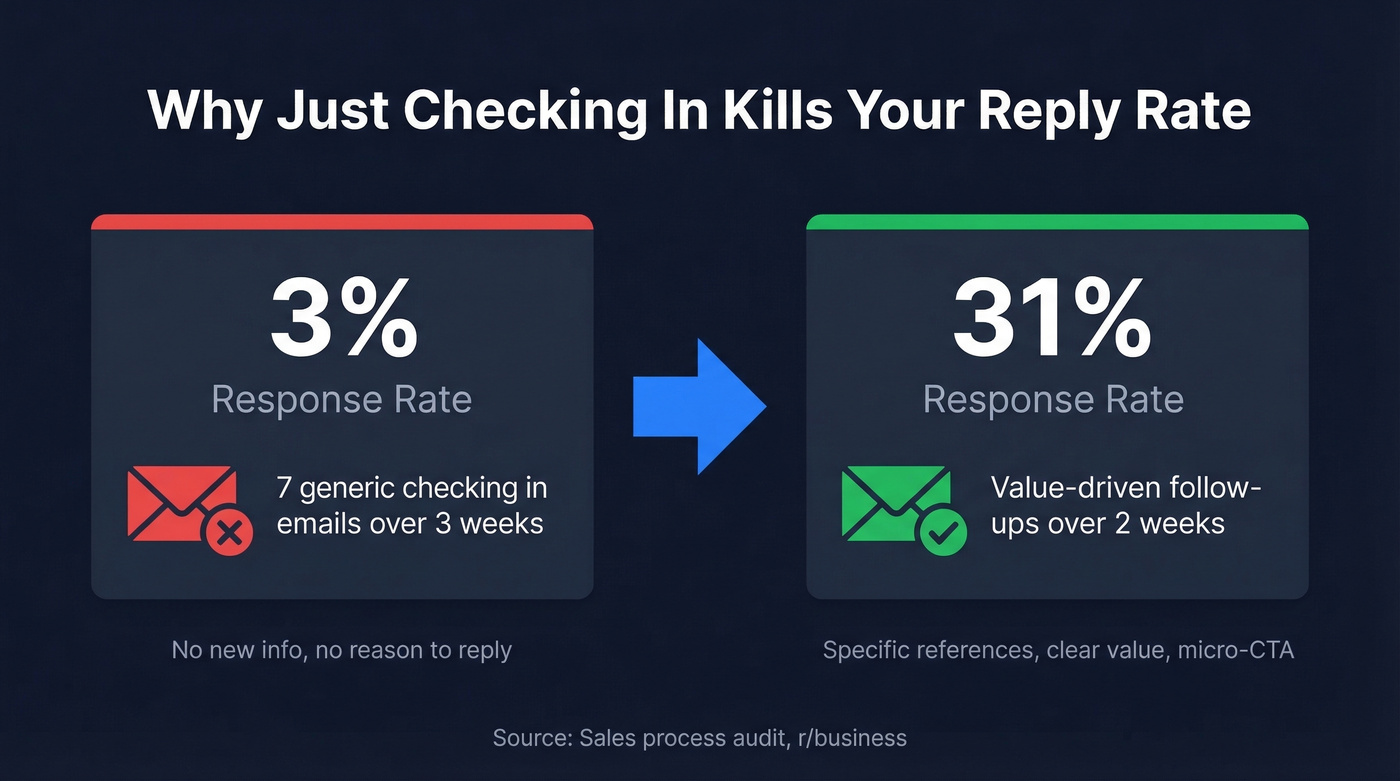
Your cursor's blinking after "Hey [Name]," and you're about to type the four words that kill reply rates: "just checking in." If you're looking for a professional way to say checking in, you're already ahead of most senders. One sales-process auditor on r/business shared a telling comparison - seven generic "checking in" emails over three weeks pulled a 3% response rate. Switching to value-driven follow-ups over two weeks? 31%.
Why "Just Checking In" Fails
Three reasons this phrase tanks your emails:
It says nothing. "Just checking in," "touching base," and "circling back" are equally empty phrases that signal zero new information. Recipients read them as "I want something from you but brought nothing for you." Prospects feel like just another number in your CRM when the email contains no new detail. Most senders actually mean "Is this still relevant, or should I close the loop?" - say that directly.
It sounds passive-aggressive. In remote and async work, tone is already ambiguous. In one workplace story we heard, "Just checking if there's an update" triggered a full meeting about email tone. Without vocal cues, these messages land as pressure, not politeness.
It accelerates spam fatigue. In Belkins' Jan-Dec 2024 dataset of 16.5M cold emails, sending 4+ emails in a sequence more than tripled unsubscribe and spam complaint rates. Generic check-ins hit that threshold faster because recipients see no reason to engage.
Better Alternatives by Scenario
The fix isn't finding a fancier synonym. It's replacing the empty phrase with a reason to reply. Below are other ways to say checking in that actually earn responses, organized by the situation you're writing for.
| Scenario | Instead of "Checking In," Say | Why It Works |
|---|---|---|
| Sales follow-up | "Saw [trigger] - does it change your timeline for [project]?" | References something real; gives them a reason to re-engage |
| Job application | "Wanted to reiterate my interest in [role] and share [new detail]" | Adds new info; send ~2 weeks after applying if no timeline was given |
| Post-interview | "Thanks for the conversation about [specific topic] - one thing I wanted to add..." | Shows you listened; send within 24-48 hours |
| Internal/team | "Quick status update on [project]: here's where we are and what I need from you" | Replaces vague check-in with a clear ask |
| Networking | "Our conversation about [topic] stuck with me - [relevant article/idea]" | Provides value; send within 24-48 hours of meeting |
| Customer check-in | "Noticed [usage pattern/milestone] - wanted to flag [opportunity or tip]" | Makes it about them, not your renewal quota |
| Meeting recap | "Recap from [date]: here are the action items and owners" | Useful reference doc; send same day |
For general follow-ups where you haven't heard back, space them about a week apart. For job applications with no stated timeline, two weeks is the sweet spot before a polite nudge.
What You Really Mean by "Checking In"
Most "checking in" emails mask a specific intent. Name it directly and you'll get faster answers:
- You want a status update: "Where does [project/decision] stand as of this week?"
- You need a decision: "Do you have what you need to move forward, or is something blocking this?"
- You're asking about timeline: "Has the timeline for [X] shifted? Happy to adjust on my end."
- You suspect a blocker: "If something's changed on your side, no worries - just let me know so I can plan accordingly."
Finding another way to say just checking in starts with identifying which of these intents you actually have. Then write that instead.
The 3-Step Framework for Value-Driven Follow-Ups
In our audits of follow-up sequences, the fastest lift comes from doing three things:
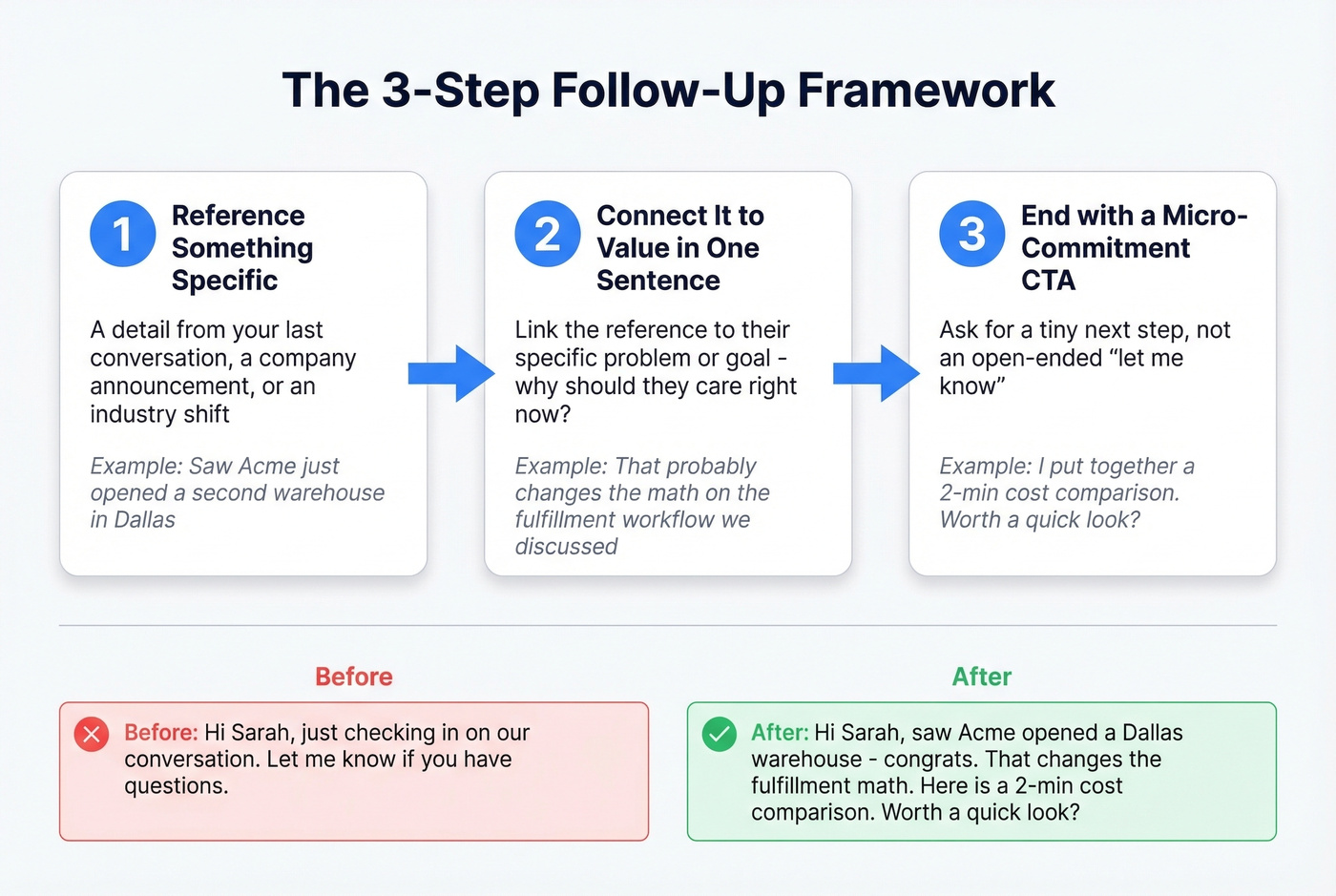
Reference something specific - a detail from your last conversation, a company announcement, an industry shift. This proves you're paying attention, not batch-sending. Connect it to value in one sentence - why should they care right now? Link the reference to their problem or goal. End with a micro-commitment CTA - "Worth a 10-minute call?" or "Would a quick demo make sense?" We've found the micro-commitment CTA beats open-ended "let me know" every single time, across every industry we've tested.
Here's what this looks like in practice:
Before:
Hi Sarah, just checking in on our conversation from last week. Let me know if you have any questions.
After:
Hi Sarah, saw Acme just opened a second warehouse in Dallas - congrats. That probably changes the math on the fulfillment workflow we discussed. I put together a 2-min cost comparison based on the new setup. Worth a quick look?
The second email gives Sarah a reason to reply. It references a real event, connects it to her problem, and asks for a tiny next step.
Let's be honest - your follow-up should look like a real email, not a marketing template. Plain text, short paragraphs, sent as a reply to your original thread. GMass's research confirms that emails looking like genuine 1:1 messages consistently outperform formatted ones. If you want plug-and-play options, start with proven sales follow-up templates.

A value-driven follow-up only works if it actually reaches someone's inbox. With 98% email accuracy and a 7-day data refresh cycle, Prospeo makes sure your carefully crafted follow-ups don't bounce.
Stop perfecting emails that land in the void. Start with verified data.
Subject Lines That Get Replies
Your phrasing inside the email doesn't matter if the subject line gets ignored. Belkins analyzed 5.5M emails and found clear patterns:
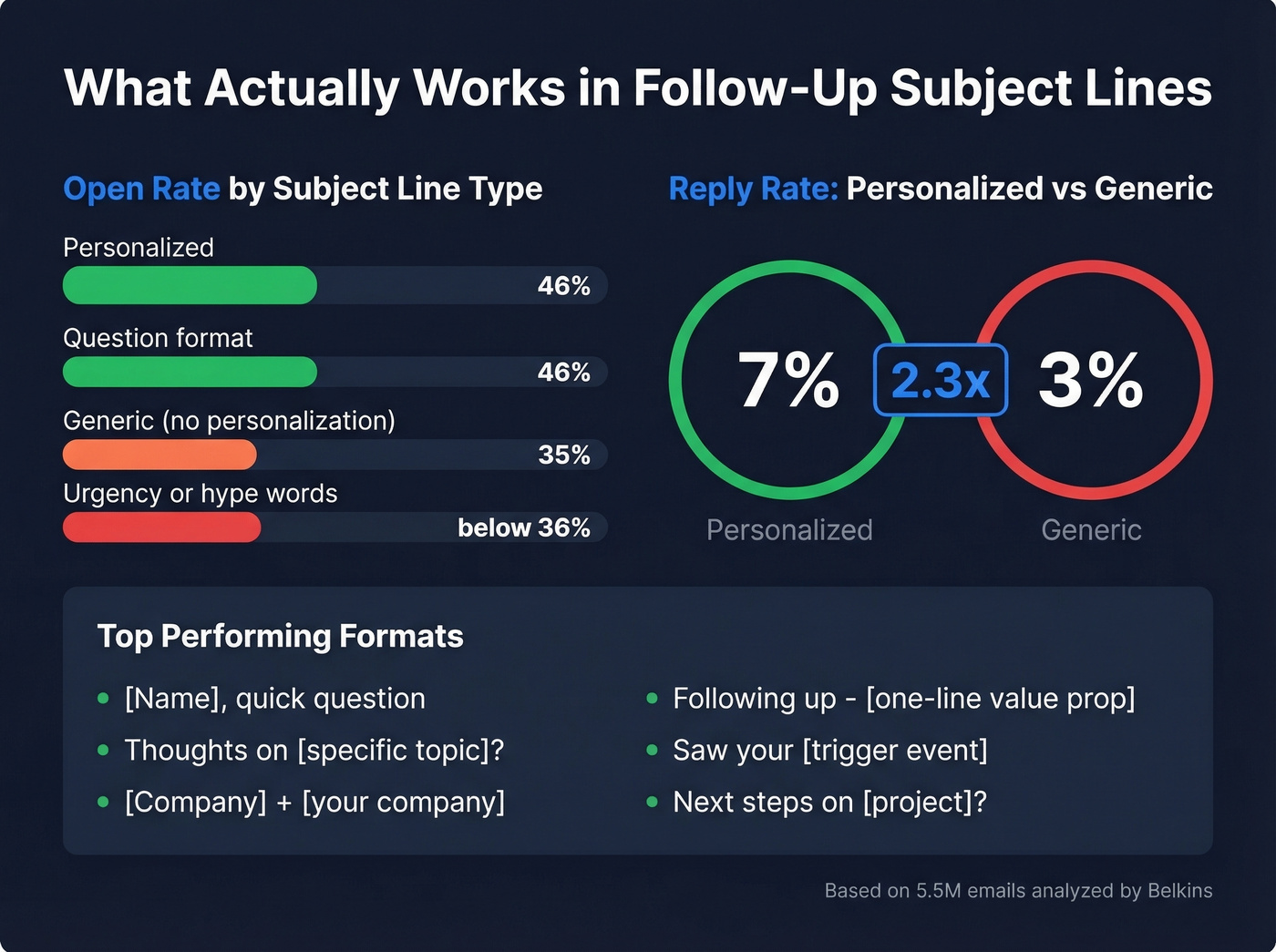
- Personalized subject lines: 46% open rate vs 35% without, and 7% reply rate vs 3%
- Question format: 46% open rate, the top-performing type
- 2-4 words: highest opens at 46%; 9-10 words drops to ~35%
- Urgency/hype words ("ASAP," "Don't miss"): below 36% opens
Ready-to-use subject lines:
- "[Name], quick question"
- "Thoughts on [specific topic]?"
- "[Company] + [your company]"
- "Following up - [one-line value prop]"
- "Saw your [trigger event]"
- "Next steps on [project]?"
Skip "Follow-up" as your entire subject line. NetHunt calls it out as weak and likely to get ignored - it tells the recipient nothing except that you emailed before. For more ideas, pull from a swipe file of email subject line examples.
Here's the thing: the subject line matters less than most people think. A mediocre subject line on a genuinely useful email still gets replies. A perfect subject line on a "just checking in" email just means more people open it, read nothing of value, and ignore you faster.
When to Stop Following Up
Here's a stat that should change your behavior: 48% of reps never send a second message, yet follow-ups generate 42% of all campaign replies. Most people quit too early. But there's a ceiling - Belkins' data shows 4+ emails more than triples unsubscribe and spam complaint rates. The sweet spot is 1-3 well-crafted follow-ups, each adding new information. If you're building a full sequence, use a structured B2B cold email sequence instead of improvising.
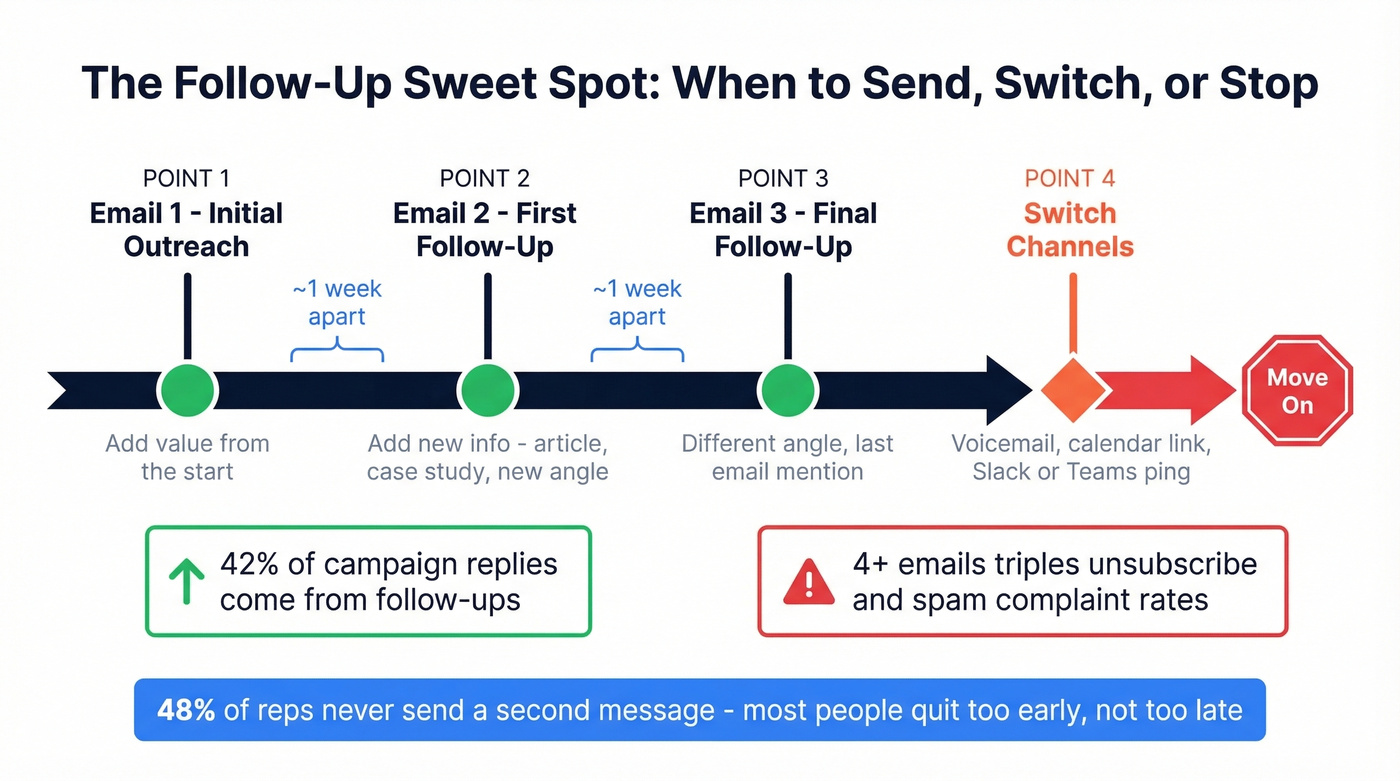
After three with no response, switch to a different channel: a short voicemail, a calendar link, or a Slack/Teams ping with a single question. If none of those work, move on. Persistence is good. Pestering isn't.
Before You Hit Send
Perfect wording gets a 0% reply rate if it hits a dead inbox. 17% of cold emails never reach the inbox at all. Before you spend time crafting value-driven follow-ups, make sure you're sending to verified addresses. Prospeo refreshes records every 7 days - the industry average is around 6 weeks - so you're less likely to chase dead inboxes. The free tier covers 75 verified emails plus 100 Chrome extension credits per month, enough to test whether your data is the bottleneck. If you're troubleshooting bounces and placement, start with an email deliverability guide and a quick email bounce rate check.
Trigger-based follow-ups need real triggers. Prospeo tracks 15,000 intent topics, job changes, and company growth signals - so you always have a reason to reach out that isn't "just checking in."
Replace empty check-ins with real buying signals at $0.01 per lead.
FAQ
Is "just checking in" unprofessional?
It's not rude, but it's ineffective - and often reads as pressure in async contexts. Recipients interpret it as "I have nothing useful to say but want something from you." Replace it with a specific reference and a clear reason for the email. That's the simplest way to follow up professionally without sounding like every other sender in their inbox.
How many follow-up emails is too many?
Belkins' 16.5M-email dataset shows that 4+ emails in a sequence more than triples unsubscribe and spam complaint rates. The sweet spot is 1-3 follow-ups, each adding genuinely new information - a relevant article, a case study, a new angle on their problem. After three with no reply, switch channels or let it go.
What's the best subject line for a follow-up email?
Keep it personalized, 2-4 words, and framed as a question. Personalized subject lines hit a 7% reply rate vs 3% for generic ones across 5.5M emails studied. Something like "[Name], quick question?" outperforms "Following up on my previous email" every time.
What's another way to say just checking in?
The best replacement depends on your intent. If you need a status update, try "Where does [project] stand?" If you're nurturing a relationship, lead with something valuable - a relevant article, a congratulations on a recent win, or a specific question. Swap the empty phrase for a sentence that gives the recipient a reason to respond.
If you can't point to a new detail, don't send the email. If you can, ask for a tiny next step - that's the whole game. The most professional way to say checking in is to never say it at all. Say something worth replying to instead.