

Proposal Follow-Up Email Templates: The Only 4 You Need
You sent the proposal Thursday afternoon. Now it's Monday, you're staring at an empty inbox, and the self-doubt is creeping in. Was the price too high? Did they even open it?
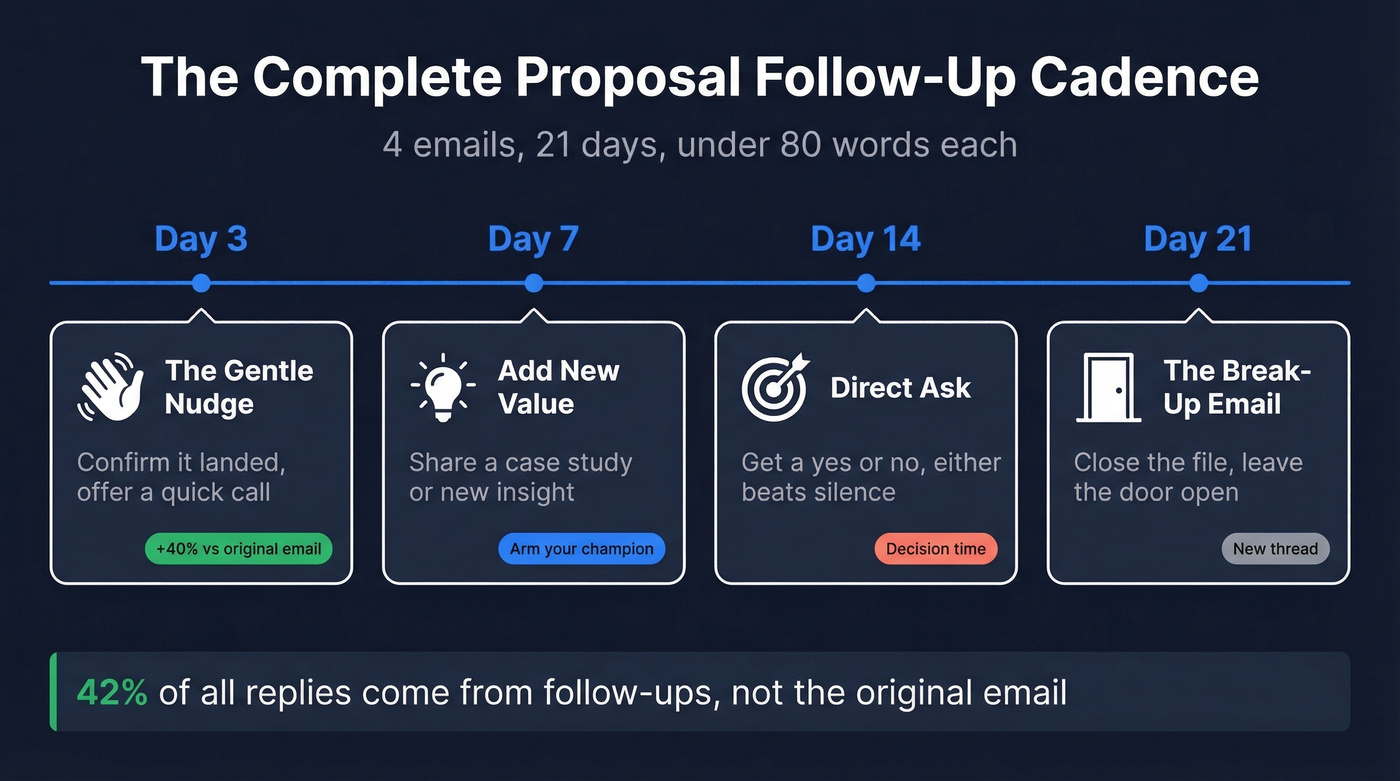
Here's what the data says: 42% of all replies come from follow-ups, not the original email. If you send one follow-up and quit, you're abandoning nearly half your potential replies. You don't need 18 templates. You need four good ones - a complete proposal follow-up email cadence - and the discipline to send them on schedule.
What You Need (Quick Version)
Four emails. Days 3, 7, 14, and 21 after sending the proposal. Each under 80 words. Personalized subject line, two to four words. One clear CTA per email. That's the entire system, and every template is below.
Subject Lines That Get Opened
69% of recipients decide whether to flag an email as spam based on the subject line alone, so a lazy opener isn't just ineffective - it's risky.
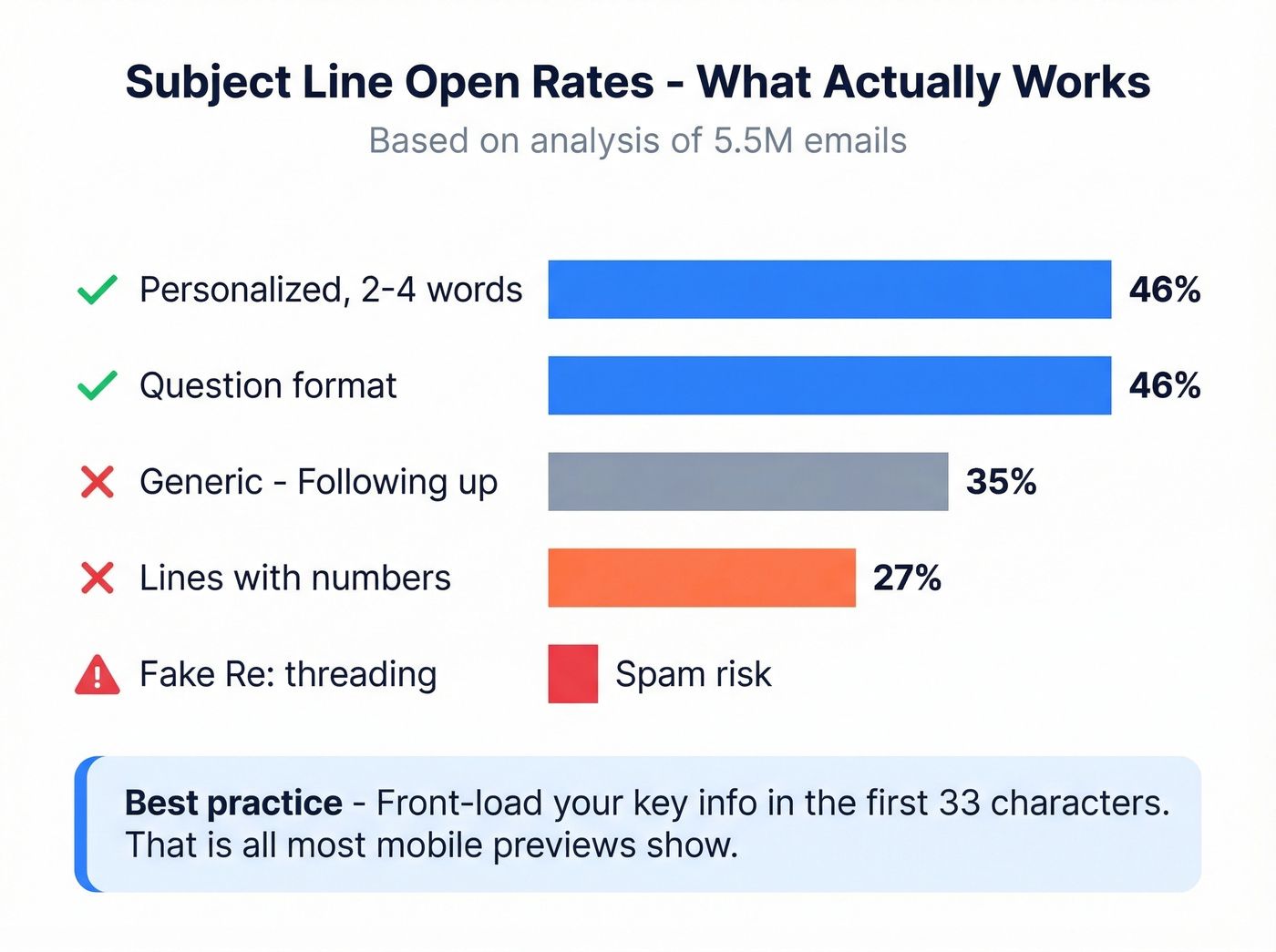
A Belkins analysis of 5.5M emails found that personalized, two-to-four-word subject lines hit a 46% open rate versus roughly 35% for generic ones. Question-format lines performed equally well. Lines with numbers? Just 27%.
For more ideas, pull from these subject lines and adapt them to your deal stage.
| ✅ Do this | Open rate | ❌ Not this | Open rate |
|---|---|---|---|
| Personalized, 2-4 words | ~46% | Generic "Following up" | ~35% |
| Question format | ~46% | Lines with numbers | ~27% |
| Front-load first 33 chars | - | Fake "Re:" threading | Spam risk |
Proposal-specific subject lines that work: "Questions on the proposal?" / "Feedback on the scope?" / "{Company} proposal - one update" / "The {$X}k quote expires Friday" / "Quick update on {project}" / "Worth revisiting?" / "{First Name}, any blockers?"

Great subject lines won't matter if you're emailing the wrong person. Prospeo's 30+ search filters let you find the actual decision-maker by title, company, and seniority - so your proposal follow-up lands with whoever signs the check, not the gatekeeper who requested it.
Find the decision-maker your proposal is stuck with.
4 Follow-Up Email Templates (Full Cadence)
These aren't cold emails. The prospect already engaged with you, asked for a proposal, and reviewed your offer. Your tone should reflect that familiarity.
If you want a broader library beyond proposals, use these sales follow-up templates as a starting point.
One more thing worth knowing: bump-style follow-ups - short replies to your original thread that feel conversational, not templated - outperform formal follow-ups by about 30%. Waiting three days increases replies by 31%, while next-day follow-ups actually reduce them by 11%. Give people time to circulate the proposal internally.
Email 1 - Day 3: The Gentle Nudge
Your first follow-up performs roughly 40% better than the initial email. We've seen the Day 3 nudge pull responses that the original proposal couldn't. Don't skip it.
Subject: Questions on the proposal?
Hi {First Name},
Wanted to make sure the {project/service} proposal landed. The {specific value point - e.g., "60-day implementation timeline"} is something we've seen move the needle for teams like yours.
Any questions, or would a 15-minute call this week help clarify scope?
Best, {Your name}
Email 2 - Day 7: Add New Value
By Day 7, your proposal is sitting in a shared drive somewhere while two VPs argue about budget. Don't just "check in." Bring something new that arms your internal champion.
If you need help with the “new value” part, borrow a few patterns from email copywriting.
Subject: {Company} + quick insight
Hi {First Name},
One thing I didn't include in the proposal: we recently helped {similar company/industry} cut {specific metric} by {X%} using the same approach.
Happy to share the details if it's useful for your internal conversations. Would Thursday or Friday work for a quick call?
{Your name}
Email 3 - Day 14: Direct Ask
The longer a proposal sits, the harder it is to get it back to the top of someone's list. This email exists to get a yes or a no. Either one beats silence.
If you're struggling to get a clean yes/no, tighten your email call to action.
Subject: Still on your radar?
Hi {First Name},
I know things get busy. If priorities have shifted or the timing isn't right, totally understand - just let me know either way so I can plan accordingly.
Is a 10-minute call this week realistic?
{Your name}
Email 4 - Day 21: The Break-Up Email
The "can I close your file?" framing creates gentle urgency without being pushy, and it leaves the door open.
Subject: Should I close this out?
Hi {First Name},
Haven't heard back, so I'll assume the timing isn't right. I'll close out your file for now and circle back in a few months.
If anything changes before then, I'm a quick reply away.
{Your name}
What to Do When They Ghost Your Proposal
This one stings. They reached out, asked for the proposal, you spent hours on it - then nothing. Reddit threads on r/freelance and r/consulting are full of people calling this "beyond frustrating and rude." They're right.
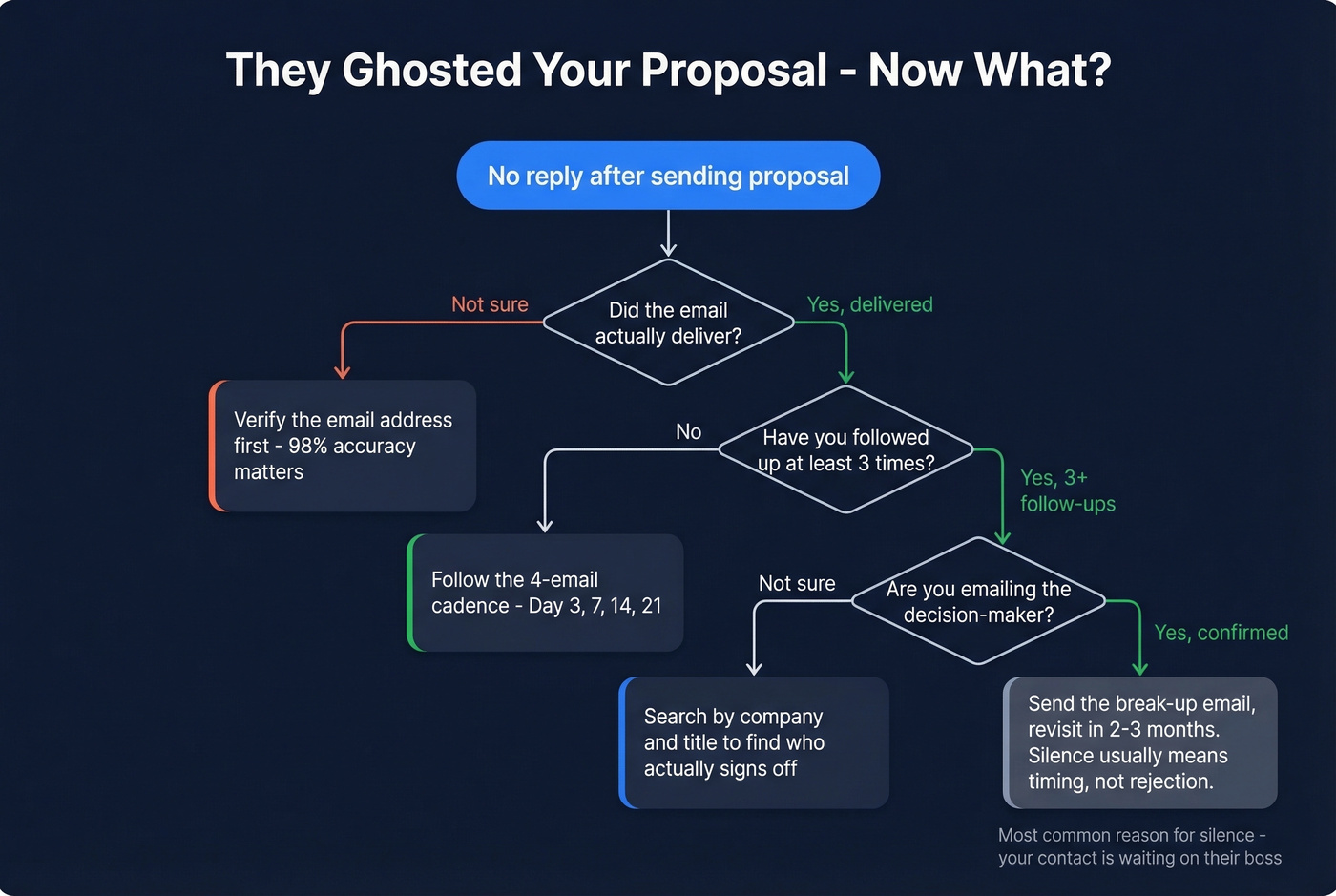
But I've watched freelancers abandon deals that were still alive - just stuck in procurement. Silence usually means busy, not rejection. Let's be honest: most of the time, your contact doesn't have the authority to say yes, and they're too embarrassed to say "I'm still waiting on my boss."
If you want a more systematic approach to timing and touchpoints, this guide on when should you follow up helps.
Subject: What concern came up?
Hi {First Name},
Since you initially reached out about {project}, I'm guessing something came up internally. Budgets shift, priorities change.
Is there a specific concern I can address? Sometimes a quick conversation clears the path faster than another email.
{Your name}
Before You Hit Send
Run through this checklist before every follow-up:
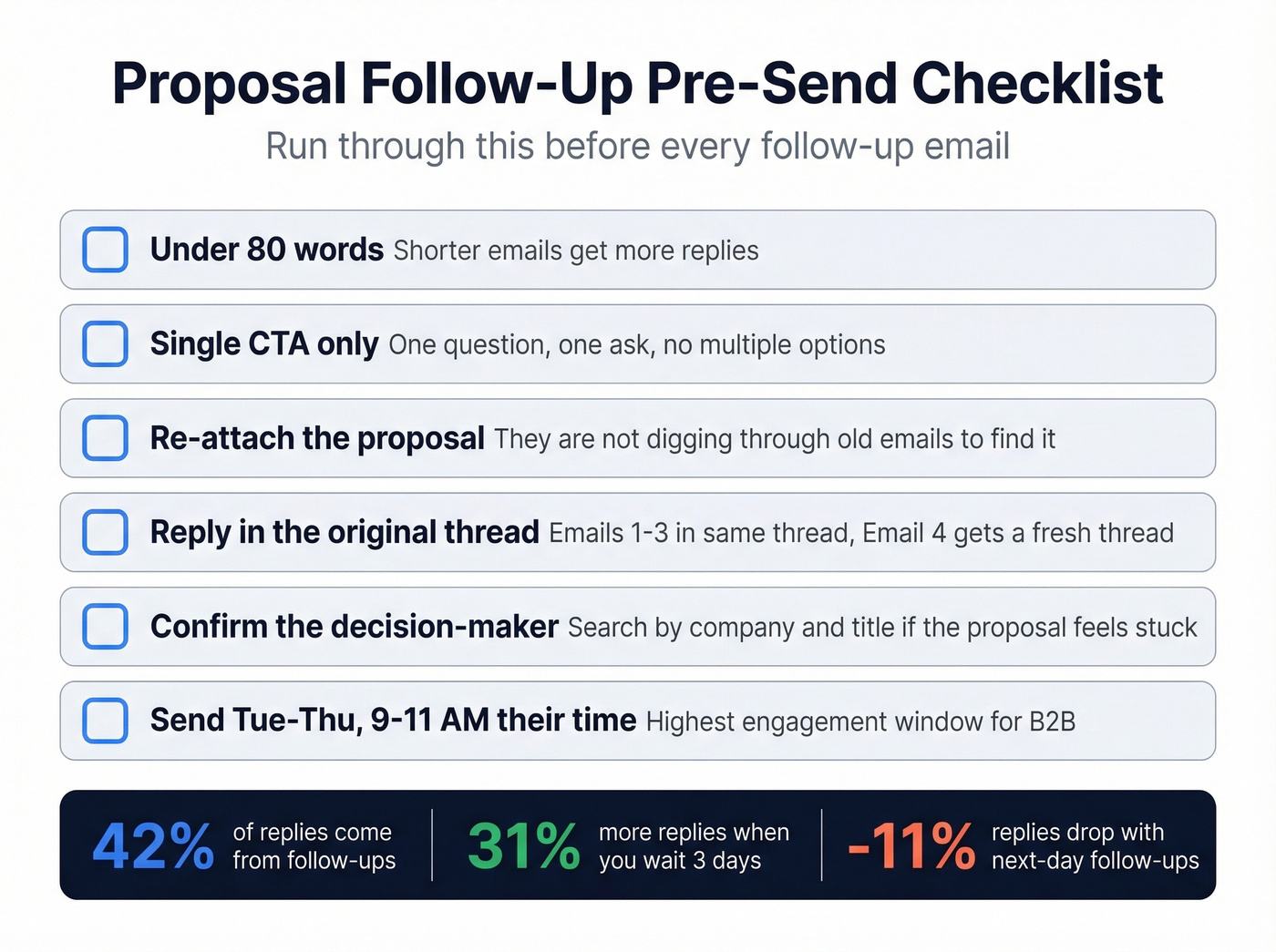
- Under 80 words. Shorter emails get more replies. Period.
- Single CTA. One question, one ask. Don't give them three options.
- Re-attach or link the proposal. They're not digging through old emails to find it.
- Reply to your original thread for follow-ups 1-3 so the prospect has full context. Start a fresh thread for Email 4 - a new subject line in their inbox gets a second chance at attention.
- Confirm you're emailing the decision-maker. If you suspect the proposal is stuck with a gatekeeper, search by company and title to find who actually signs off.
- Send Tuesday-Thursday, 9-11 AM recipient time. That's the highest-engagement window for B2B. (More detail: best time to send cold emails.)
If you're seeing bounces or low engagement, fix the root cause with an email deliverability guide before you scale follow-ups.

Here's the thing most people miss: the best follow-up email in the world won't save you if it bounces or lands in the wrong inbox. Finding and looping in the actual decision-maker saves more deals than any proposal follow-up email template ever will.
If you need a workflow for finding the right inbox, start with name to email.
42% of replies come from follow-ups - but 0% come from bounced emails. Prospeo's 5-step verification delivers 98% email accuracy at ~$0.01 per email. Run your prospect list through Prospeo before sending a single follow-up so every message hits a real inbox.
Stop following up into the void. Verify first.
FAQ
How many follow-up emails should I send after a proposal?
Two to four. The first follow-up performs about 40% better than the initial email. A cadence covering Days 3, 7, 14, and 21 spans the full decision window without becoming annoying. Skip the Day 7 email if you're working a smaller deal where the decision cycle is short - for enterprise proposals with multiple stakeholders, we'd send all four every time.
How long should I wait before following up on a proposal?
Three days. Next-day follow-ups reduce replies by 11%; waiting three days increases them by 31%. Use any template above as a starting point, then personalize the value point and CTA to your specific deal.
What if none of my follow-ups get a response?
Verify the email actually delivered first - tools like Prospeo catch invalid addresses before they bounce and hurt your sender reputation. After three follow-ups with no response, send the break-up email and revisit in a few months. Silence after four touches usually means timing, not rejection.
Should I send the break-up email as a reply or a new thread?
New thread, fresh subject line. By Day 21, your original thread is buried. Something like "Should I close this out?" gets a second chance in their inbox and often triggers a response from prospects who ignored earlier messages.