

How to Build a Prospect Evaluation Sheet That Actually Works
Your SDR spent three hours filling out a prospect evaluation sheet last Tuesday. Half the phone numbers were disconnected. Two of the "decision-makers" had left the company months ago. The sheet looked thorough - it just wasn't accurate.
That's the core problem: 40% of salespeople say prospecting is the hardest part of their job, and most of that difficulty comes from working off bad data, not from a lack of process. A beautiful spreadsheet full of stale contacts is organized waste.
What Is a Prospect Evaluation Sheet?
It's a structured document for scoring and qualifying prospects before you commit real resources - time, money, or political capital - to pursuing them. A qualification process is the procedure behind it; the sheet is its physical artifact, the rubric that forces consistency so you're not relying on gut feel.
Three very different worlds use these sheets. B2B sales teams score leads on fit and intent before passing them to reps. Nonprofit fundraisers evaluate donor capacity, affinity, and access before making an ask. Athletic recruiters grade measurables, film, and character before offering a scholarship. The fields change, but the principle doesn't: qualify before you invest.
Quick Version - What You Need
If you're short on time, here's the one-line recommendation per context:
- B2B sales: Pick a qualification framework (BANT, MEDDIC, or CHAMP), then score every prospect on fit and intent signals.
- Nonprofit fundraising: Use the 3 As - Ability, Affinity, Access - and track cultivation stage for every prospect.
- Athletic recruiting: Combine measurables, film grades, position-specific traits, and academics into a single evaluation form.
Across all three, data accuracy is the foundation. For B2B sheets especially, an email verification step before data enters your scoring rubric prevents you from grading ghosts.
B2B Sales Scoring Template
Pick Your Qualification Framework
The framework you choose determines which fields belong on your sheet. Here's how the three major options compare:
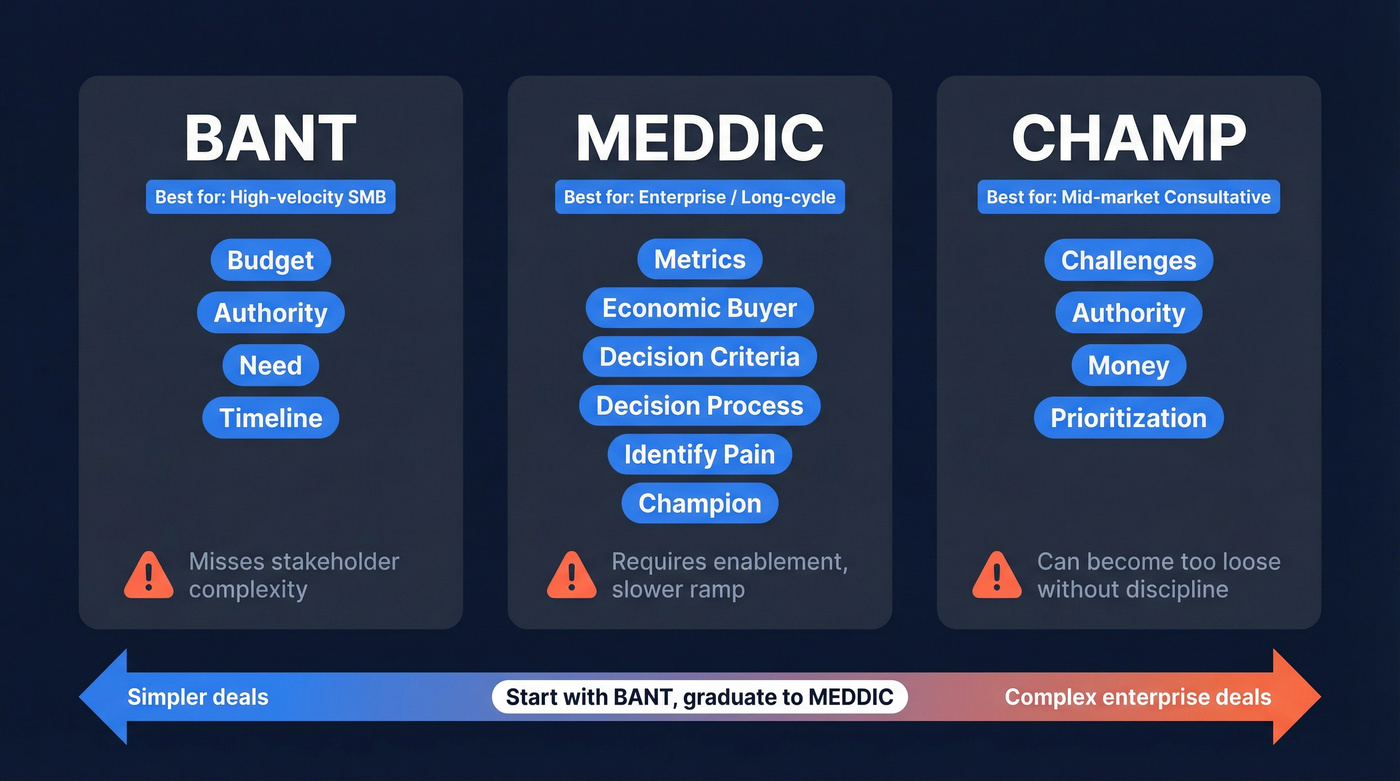
| Framework | Best For | Core Criteria | Weakness |
|---|---|---|---|
| BANT | High-velocity SMB | Budget, Authority, Need, Timeline | Misses stakeholder complexity |
| MEDDIC | Enterprise / long-cycle | Metrics, Economic Buyer, Decision Criteria, Process, Pain, Champion | Requires enablement; slower |
| CHAMP | Mid-market consultative | Challenges, Authority, Money, Prioritization | Can become too loose |
The decision rule is straightforward: start with BANT, then graduate to MEDDIC as your deals get more complex and multi-stakeholder.
One sales qualification guide cites an example where switching from BANT to MEDDIC improved forecast accuracy from 62% to 89% on an enterprise pipeline. CHAMP sits in the middle - it's pain-first and buyer-centric, which works well for consultative mid-market motions where reps need to lead with empathy rather than budget questions. Consistency matters more than the framework itself. Pick one and enforce it across the team.
Essential Fields and Scoring
Here's a template structure that works for most B2B teams. Copy this into a Google Sheet or your CRM and customize the weights:
| Criteria | Weight (1-3) | Score (0-5) | Weighted Total | Next Step & Date |
|---|---|---|---|---|
| ICP Fit | 3 | - | - | - |
| Budget Confirmed | 3 | - | - | - |
| Decision Authority | 2 | - | - | - |
| Intent Signals | 2 | - | - | - |
| Timeline | 1 | - | - | - |
A lead score is a numeric value based on behavior like page visits, email opens, and demo requests. A lead grade is a letter rating (A-F) based on fit - firmographics like job title and company size. An A95 prospect (great fit, high engagement) gets immediate attention. A C25 (mediocre fit, low engagement) goes to nurture. You need both dimensions on your sheet.

Your field categories should cover contact data with verified emails and direct dials, firmographics including industry, headcount, and revenue, interest signals like pricing page visits and content downloads, budget indicators, timeline, and whether you're speaking to a qualified decision maker. Modern teams also layer AI-based lead scoring and lead-to-account matching to avoid duplicate outreach across the same buying committee. Verify contact data before it hits your sheet - tools like Prospeo's email finder catch invalid addresses before they waste your team's time.
How to Qualify Leads with Benchmarks
Typical MQL-to-SQL conversion runs 25-35%. High-alignment RevOps orgs push that to 40-50%. If you're below 20%, your evaluation criteria are probably too loose.
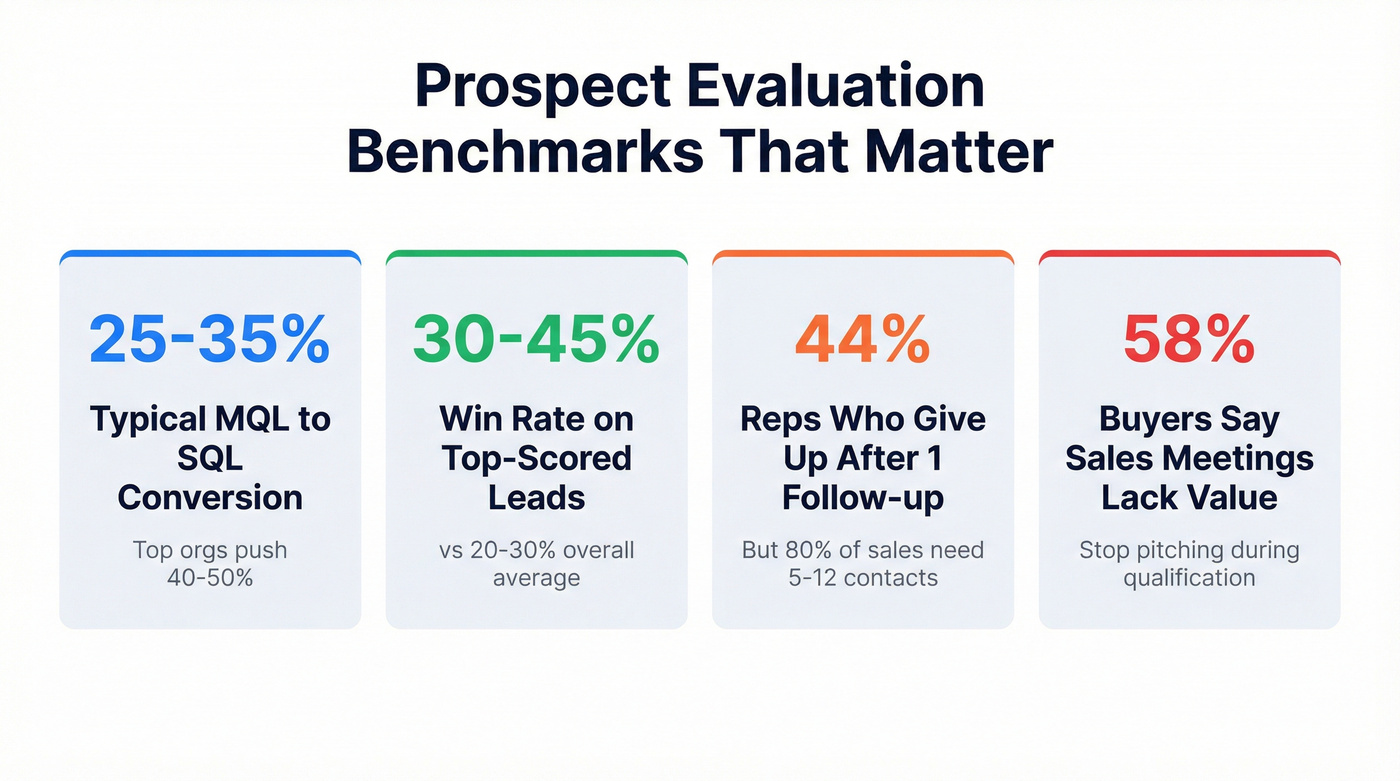
Win rates tell a similar story: 20-30% is healthy overall, but top-scored leads convert at 30-45%. That gap is the whole argument for rigorous scoring.
Here's the thing - 44% of salespeople give up after one follow-up, but 80% of sales happen between the 5th and 12th contact. That's why the template above has a "Next Step & Date" column, not just a score.
Nonprofit Prospect Research Sheet
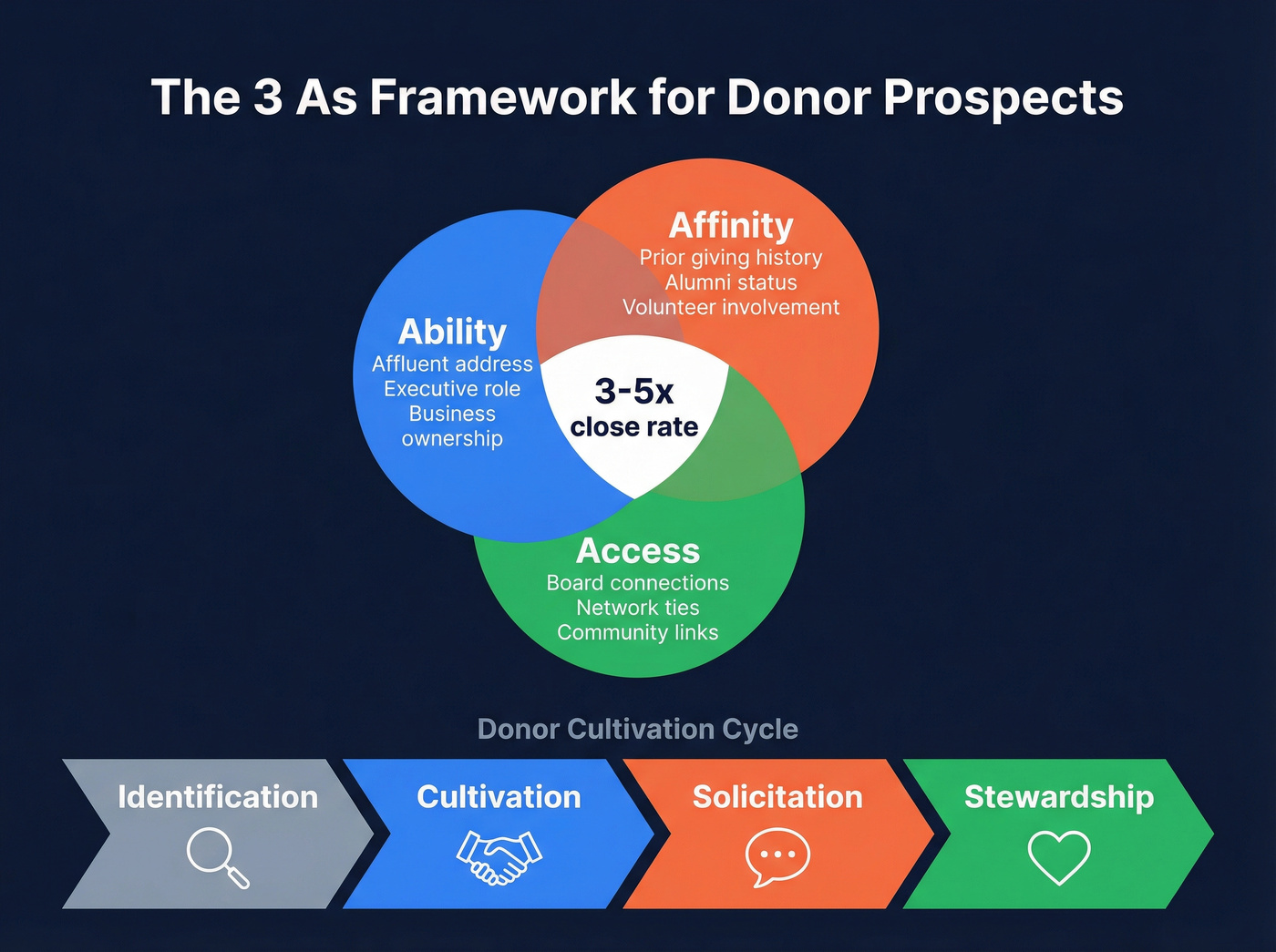
Nonprofit prospect evaluation runs on the 3 As framework: Ability, Affinity, and Access. Ability means capacity to give - affluent address, executive role, business ownership. Affinity means connection to your mission - prior giving history, alumni status, volunteer involvement. Access means you have a path to reach them through networks, board connections, or community ties. In our experience, prospects with all three As close at 3-5x the rate of those with only one.
Your pipeline fields should track:
- Name and solicitation status (Ask / Brief / Cultivate)
- Target ask amount and designated project
- Key relationships - who on your team or board has the connection
- Affiliations - alumni groups, religious communities, professional networks
- Strategy and concrete next steps
The donor cultivation cycle moves through four stages: Identification, Cultivation, Solicitation, Stewardship. Your sheet should reflect which stage each prospect sits in. Research markers to populate it include prior nonprofit donations, political gifts, board service, real estate holdings, and employer matching gift programs. For institutional funders, Candid recommends tracking funder contact details, financials, giving priorities, and mission alignment on a separate worksheet.

Half your evaluation sheet is wasted if the contacts are wrong. Prospeo's 5-step verification delivers 98% email accuracy and 125M+ verified mobile numbers - refreshed every 7 days, not every 6 weeks. Score prospects who actually exist.
Stop grading ghosts. Verify every contact before it hits your sheet.
Athletic Recruiting Evaluation
Athletic prospect evaluation sheets need a standard field set. Before getting into position-specific detail, here's the baseline checklist every scout's "big board" should include:
- Measurables (height, weight, verified speed times)
- Academics and eligibility status
- Position-specific trait grades
- Coachability and character assessment
- Film evaluation scores
- Overall composite rating
- Recruitability notes (interest level, competing offers, family situation)
Position-specific traits are where the sheet gets useful. For a running back, you're grading burst, speed, lateral movement, power, and vision. For a quarterback: footwork, release speed, ability to read defenses, ball placement. For a wide receiver: acceleration off the line, route-break sharpness, and hands.
Film evaluation has its own heuristics. Pursuit angles are your best speed verification - if defenders can't close the angle, the speed is real. Scouts say "tape don't lie" for a reason: be skeptical of highlight reels. They can be sped up, and they only show the plays a recruit wants you to see. Game film tells the truth.
Common Mistakes to Avoid
Targeting quantity over quality. A 200-prospect sheet with no scoring is just a contact list. Prioritize ruthlessly.
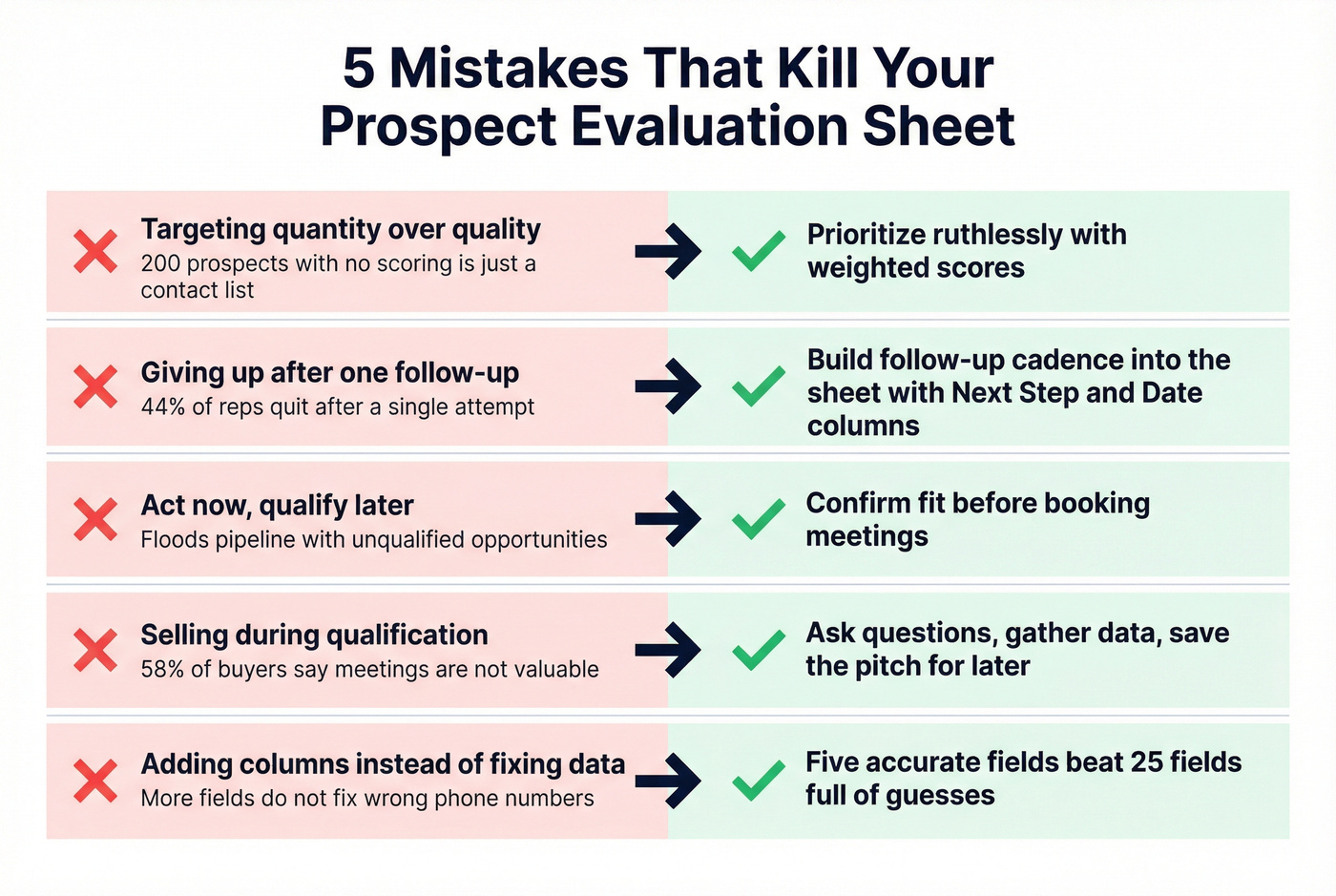
Giving up too early. We've watched teams abandon prospects after a single unanswered email. Build follow-up cadence directly into the sheet - the "Next Step & Date" column exists for this reason.
Adopting an "act now, qualify later" mindset. Some teams rush to book meetings before confirming fit, thinking speed trumps rigor. This floods the pipeline with unqualified opportunities that waste AE time and distort forecasting.
Selling during qualification. 58% of buyers say sales meetings aren't valuable. If your evaluation call turns into a pitch, you've lost the prospect and the data.
Adding columns instead of fixing data. Look, a 5-field sheet with verified data beats a 25-field sheet full of guesses. More columns don't compensate for wrong phone numbers. If your average deal size is modest, you probably don't need 20 qualification fields - you need five accurate ones and fast follow-up.
Qualifying Prospects in a Downturn
Economic contractions don't eliminate buying - they shift priorities. When budgets tighten, your scoring rubric needs to reflect new realities.
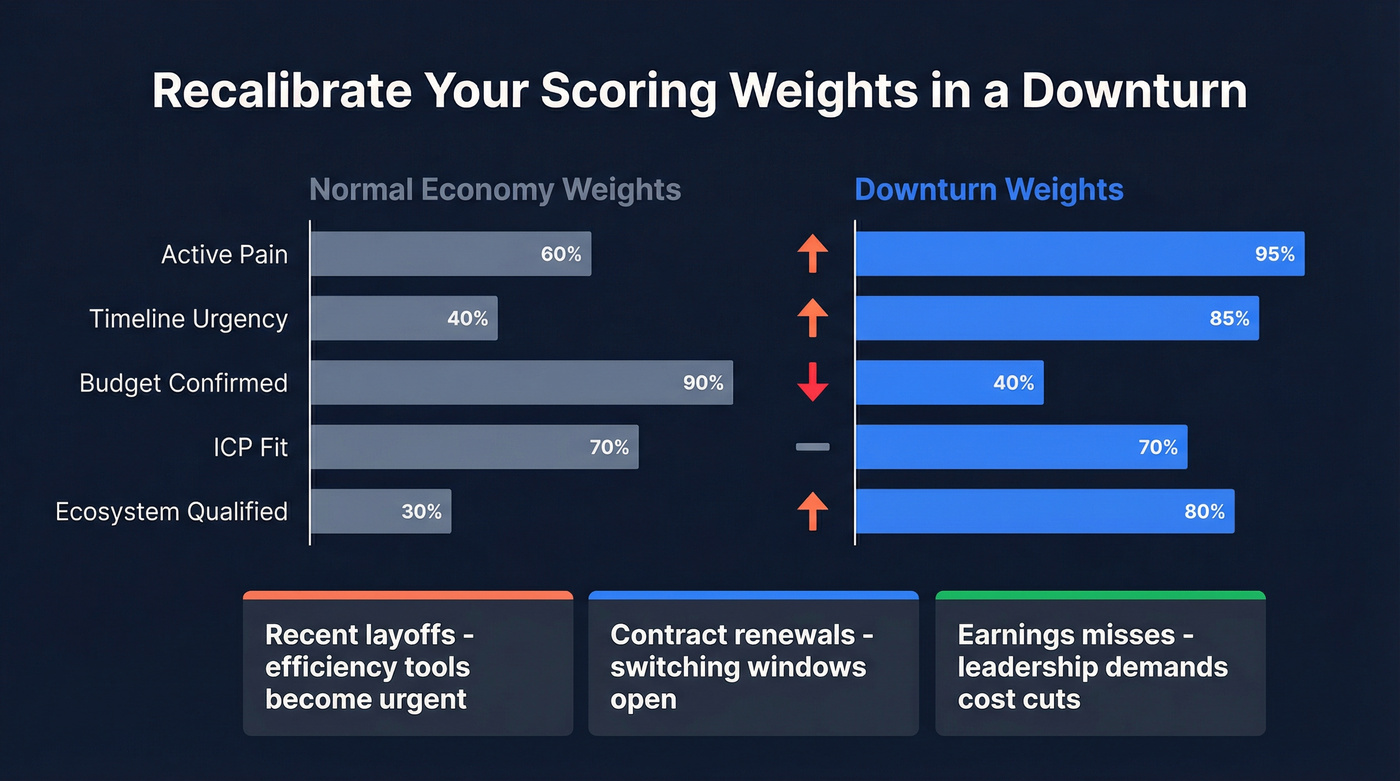
Weight "active pain" and "timeline urgency" higher than "budget confirmed," because approved budgets shrink but urgent problems still get funded. Focus on ecosystem qualified leads - prospects who already use complementary tools in your integration ecosystem, since they face lower switching costs and shorter implementation timelines. For teams that sell into mid-market, look for signals like recent layoffs (efficiency tools become urgent), contract renewals with competitors (switching windows open), and public earnings misses (leadership demands cost cuts). The sheet itself doesn't change structurally. You just recalibrate the weights.
Keep Your Evaluation Sheet Accurate
A prospect evaluation sheet is only as good as its underlying data. Stale emails, disconnected numbers, and outdated firmographics make even the best scoring rubric worthless. We've seen teams spend weeks building elaborate qualification frameworks only to fill them with contact records that were already dead on arrival.
Prospeo solves this at the source. With 98% email accuracy and a 7-day data refresh cycle - compared to the six-week industry average - contact data stays current between the moment it hits your sheet and the moment your rep picks up the phone. You can upload a CSV to verify emails in bulk, or run enrichment to get 50+ data points per contact. Meritt cut their bounce rate from 35% to under 4% after switching, and their pipeline tripled from $100K to $300K per week.
If you're fighting decay across your CRM, start with CRM hygiene and a clear data quality scorecard. If you want to quantify the problem, use B2B contact data decay benchmarks and track hard bounce rates as a leading indicator.
Your scoring template covers ICP fit, budget, and intent - but none of that matters when 35% of your emails bounce. Prospeo catches invalid addresses at $0.01/email so every row on your prospect evaluation sheet connects to a real decision-maker.
Fill your evaluation sheet with data that actually converts.
FAQ
What's the difference between a lead score and a lead grade?
A lead score tracks behavior (page visits, demo bookings) while a lead grade rates firmographic fit on an A-F scale. You need both columns on your sheet - a high score with a low grade means interest without qualification, and vice versa.
Which qualification framework should I use?
BANT for high-velocity SMB sales, MEDDIC for enterprise deals with multiple stakeholders, and CHAMP for mid-market consultative selling. Pick one and enforce it - switching frameworks mid-quarter causes more damage than choosing the "wrong" one.
How often should I refresh prospect data?
Verify emails and phone numbers before every new outreach campaign at minimum. Industry best practice is a weekly refresh cycle. Prospeo refreshes its 300M+ profiles every 7 days, compared to the 6-week industry average - preventing the slow data decay that turns solid sheets into lists of dead ends.