

Sales Coaching Playbook: Frameworks, Templates, and Techniques That Work
It's Thursday afternoon. A rep just lost a deal they'd been forecasting at 90% for six weeks. Your instinct is to pull up the CRM, dissect the timeline, and ask what went wrong. That's not coaching - that's an autopsy.
Here's the gap nobody talks about: 90% of sales leaders say they coach at least monthly. But 38% of reps say they rarely or never receive sales coaching, and 14% say they get none at all. CSO Insights found that managers spend less than 20% of their time actually coaching. The average frontline manager now oversees 12.1 direct reports, up from 10.9 the year before, and the trend hasn't reversed. More reps, less time, and most of what passes for development is pipeline inspection with a motivational quote stapled on.
We wrote this to fix that. Frameworks you can implement this week, a 1:1 template you can copy-paste into your calendar, and the techniques that actually move quota.
Why Coaching Isn't a Pipeline Review
Browse r/sales for five minutes and you'll see the same complaint: "My manager's idea of coaching is asking when deals close." That's forecasting, not development. As Sandler puts it: "Sales training builds skills. Sales coaching builds behavior." Training teaches a rep how to run a discovery call. Coaching makes sure they actually do it - consistently, under pressure, with real prospects.
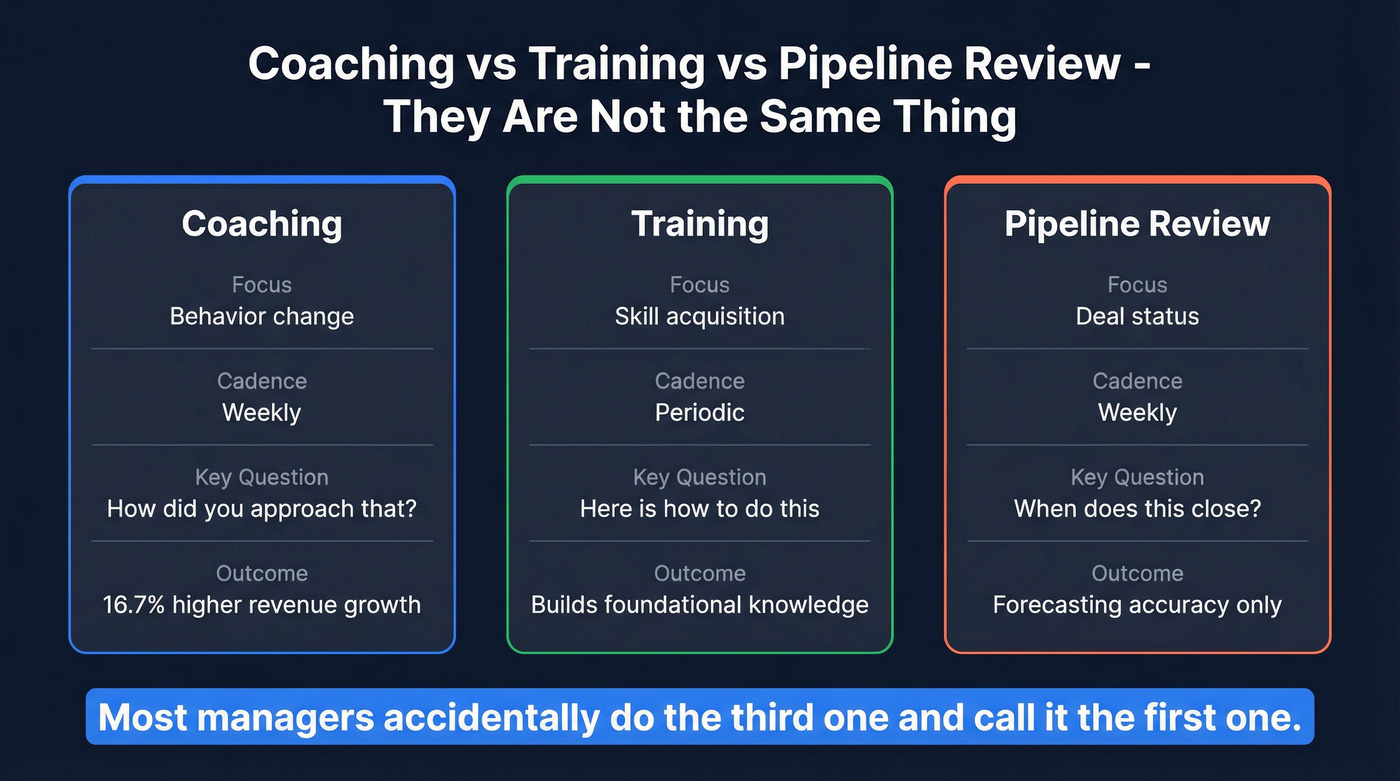
Most managers conflate three things that aren't the same.
| Coaching | Training | Pipeline Review | |
|---|---|---|---|
| Focus | Behavior change | Skill acquisition | Deal status |
| Cadence | Weekly | Periodic | Weekly |
| Key question | "How did you approach that?" | "Here's how to do this" | "When does this close?" |
Asking "when does this close?" is forecasting. Asking "walk me through how you qualified the economic buyer" is coaching. The difference matters because reps who receive dedicated coaching see 16.7% higher revenue growth than teams who don't. CSO Insights found that supporting coaching generates roughly a 20% improvement in sales objective attainment. These aren't marginal gains - they're the difference between a team that hits plan and one that misses it consistently.
Proven Sales Coaching Frameworks
Not every framework fits every team.
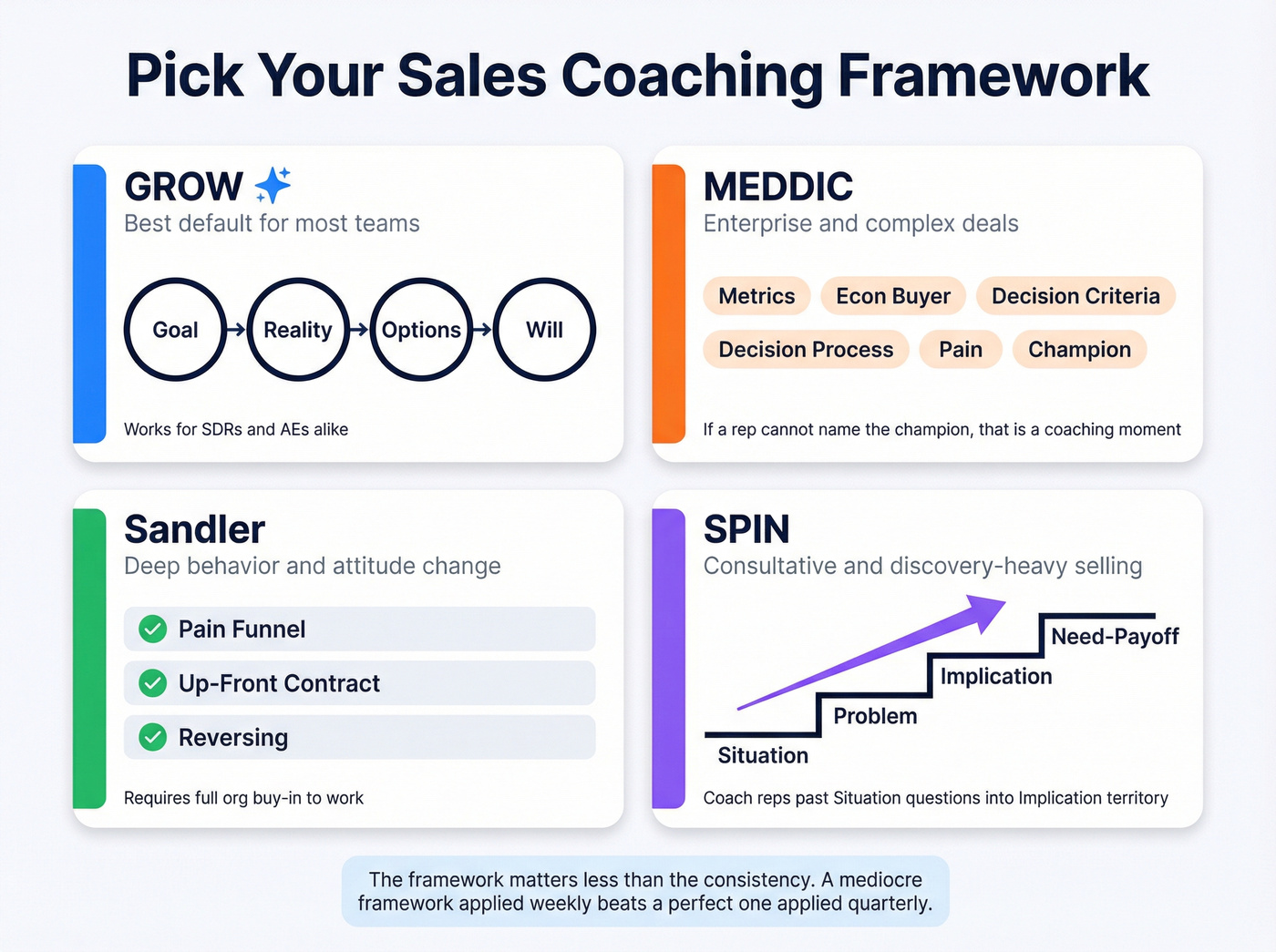
| Framework | Best For | Core Steps | When to Use |
|---|---|---|---|
| GROW | Most teams | Goal, Reality, Options, Will | Default starting point |
| MEDDIC | Enterprise deals | Metrics, Econ Buyer, Decision Criteria/Process, Pain, Champion | Complex, multi-stakeholder cycles |
| Sandler | Behavior change | Pain Funnel, Up-Front Contract, Reversing | Teams with cultural buy-in |
| SPIN | Discovery-heavy | Situation, Problem, Implication, Need-Payoff | Consultative/solution selling |
GROW is the best default for most teams. It doesn't require certification, it works for SDRs and AEs alike, and a manager can learn it in an afternoon. Define the Goal for the session, explore the current Reality with the rep, brainstorm Options together, then lock in the Will - what the rep commits to doing before the next session. In our experience, the Will step is where most managers drop the ball. They run a great conversation, then end with a vague "keep at it." That kills momentum.
MEDDIC is the right call for enterprise and complex deal cycles where forecast accuracy matters. Integrate the six elements as CRM fields, then coach through deal reviews by asking reps to walk through each component. If a rep can't name the champion, that's a coaching moment - not a pipeline update.
Sandler goes deeper on behavior and attitude. It's powerful, but it requires organizational buy-in. You can't Sandler-coach one rep while the rest of the team runs a different playbook. Role-play the Pain Funnel weekly, practice the Up-Front Contract in every 1:1, and master Reversing. It works best when the whole org commits.
SPIN shines in consultative environments where discovery is the bottleneck. Coach reps to move beyond Situation and Problem questions into Implication and Need-Payoff territory - that's where deals accelerate.
The framework matters less than the consistency. A mediocre framework applied weekly beats a perfect framework applied quarterly.
Your Weekly 1:1 Template
Monthly coaching is useless. By the time you review a lost deal from three weeks ago, the rep has already internalized the wrong lesson. Weekly is non-negotiable - and it doesn't need to take an hour. Twenty-five minutes with structure beats sixty minutes of rambling.
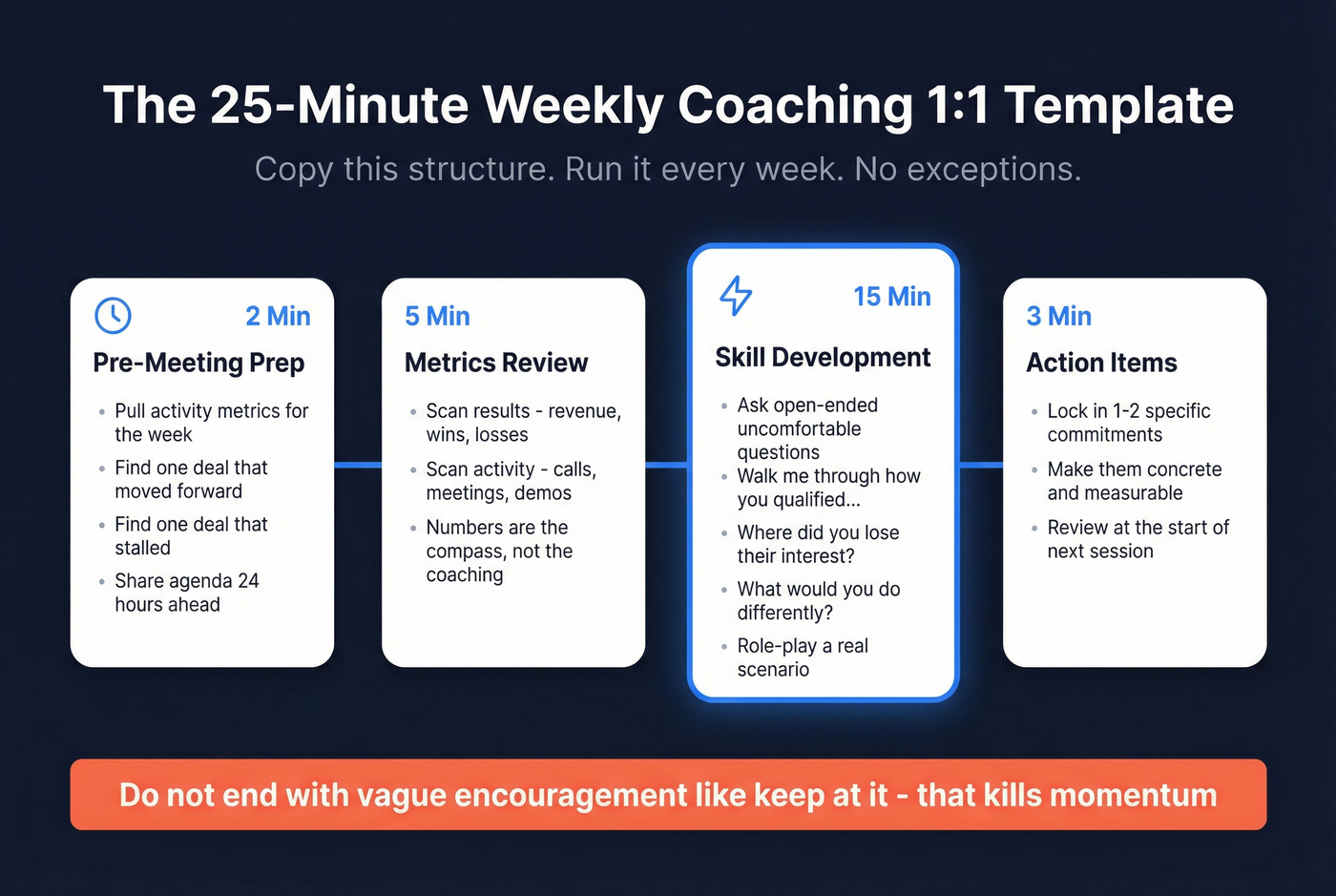
Pre-Meeting Prep (2 Min)
Pull three data points before the session: the rep's activity metrics for the week, one deal that moved forward, and one that stalled. Share the agenda with the rep 24 hours ahead so they come prepared too. This tiny step changes the entire dynamic - reps show up ready to discuss specifics instead of scrambling to remember what happened.
Metrics Review (5 Min)
Don't dwell here. Scan results metrics like revenue, deals won or lost, and pipeline created alongside activity metrics such as calls made, meetings held, and demos delivered. The numbers aren't the coaching - they're the compass that tells you where to coach.
Skill Development (15 Min)
This is where the work happens. Use questions that force reflection, not interrogation:
- "Walk me through how you qualified the economic buyer on the Acme deal."
- "Where do you think you lost the customer's interest?"
- "What would you do differently if you ran that discovery call again?"
- "Explain our product to me like I'm the prospect. Go."
- "What's blocking you right now - and what do you need from me?"
The best coaching questions are open-ended and uncomfortable. If the rep can answer in one sentence, the question isn't doing its job.
Action Items (3 Min)
Lock in one or two specific commitments. Not "do better discovery" - that's meaningless. Try "on your next three discovery calls, ask at least two Implication questions and log them in the CRM." Concrete, measurable, reviewable next week.
Techniques That Move the Needle
Make Role-Play Weekly
Role-play isn't just for onboarding. The best teams we've worked with run 10-minute role-plays in every 1:1 - objection handling, discovery openers, negotiation scenarios. It feels awkward. It works anyway.
Review Calls With Specific Feedback
"Good call" is not feedback. Pull a 90-second clip, note the exact moment the rep lost control, and coach on that moment. A common target is roughly a 60/40 listen-to-talk ratio - if your rep is at 80/20, that's the priority. One manager on r/salesengineers described it well: "I timestamp three moments per call. One thing they nailed, one thing to fix, one thing to try. That's it."
Coach Real-Time and Async
Real-time coaching through live call shadowing or whisper mode catches behaviors in the moment. Async review via recorded calls and scorecards scales better. Use both - real-time for newer reps, async for experienced ones who need refinement.
Differentiate by Role
SDR coaching focuses on messaging, objection handling, and activity volume. AE coaching focuses on deal strategy, multi-threading, and negotiation. Don't run the same playbook for both.
Coach the Prospecting Layer
Before you coach the call, make sure the call connects. If 30% of your reps' dials go to disconnected numbers, confidence tanks before coaching even starts. Prospeo verifies contacts in real time with 98% email accuracy and a 30% mobile pickup rate, so coaching time goes toward skills - not chasing dead numbers.
Use Scorecards, Not Gut Feel
Build a simple rubric - five criteria, scored 1-5 - and apply it consistently across call reviews. It removes bias, creates a baseline, and gives reps something concrete to improve against.
Celebrate Behavior, Not Just Outcomes
When a rep runs a textbook discovery call but the deal still dies, coach the behavior as a win. Focusing only on outcomes produces the 82% negative feedback problem - managers unconsciously skew toward criticism when they're results-obsessed. Let's be honest: most reps already know when they've lost a deal. What they need is someone pointing out what they did right so they do it again.
Don't Ignore Rep Wellbeing
Burnout kills performance faster than bad technique. If a rep's energy is tanking, no framework will save them. Check in on workload and mental state before diving into deal strategy.

Great coaching means nothing if reps are calling wrong numbers and bouncing emails. Prospeo gives your team 98% verified emails and 125M+ direct dials with a 30% pickup rate - so the skills you coach actually reach real buyers.
Stop coaching reps through bad data. Give them contacts that connect.
Mistakes That Kill Coaching Programs
Pipeline inspection disguised as coaching. Managers spend less than 20% of their time actually coaching. The rest goes to forecasting, admin, and firefighting. If every 1:1 is "walk me through your pipeline," you're not coaching - you're auditing. Spend the first five minutes on pipeline. Spend the next fifteen on one specific skill.
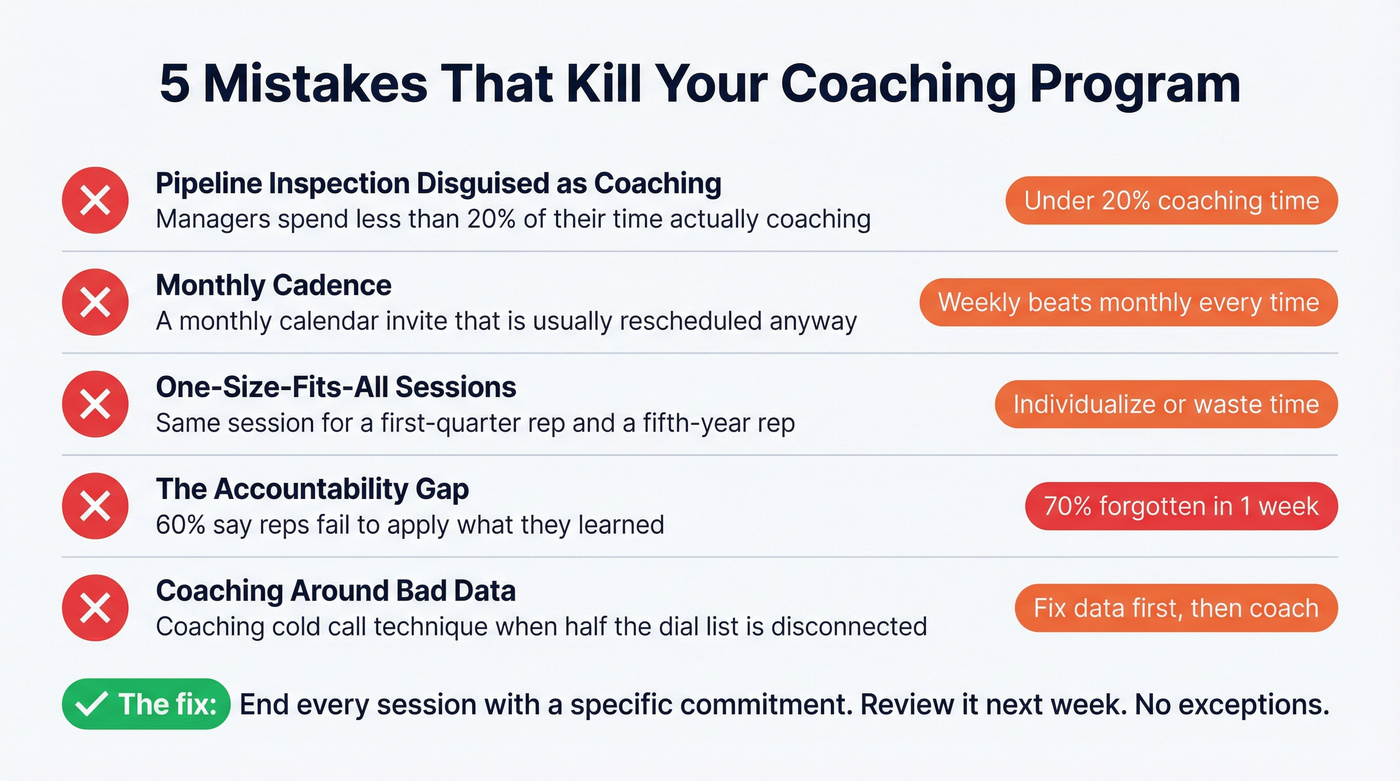
Monthly cadence. A calendar invite that says "coaching" once a month, usually rescheduled. Weekly is non-negotiable. Even 20 minutes moves the needle more than a monthly hour.
One-size-fits-all sessions. Running the same session for a rep in their first quarter and a rep in their fifth year doesn't work. New reps need activity coaching. Tenured reps need deal strategy coaching. Individualize or waste everyone's time.
The accountability gap. Great coaching sessions, zero follow-through. 60% of organizations say the number one barrier to effective training is reps failing to apply what they've learned. Gartner found that 70% of training is forgotten within a week without reinforcement. End every session with a specific commitment. Review it at the start of the next session. No exceptions.
Coaching around bad data. Here's one that frustrates us: a manager spends 30 minutes coaching a rep's cold call technique when half their dial list is disconnected numbers. Fix the data first, then coach the skills.
AI-Powered Coaching in 2026
81% of sales teams now use AI in some capacity. Teams using AI report 83% revenue growth versus 66% for non-AI teams. Buyers now ask an average of 18 questions per sales call, up from 13 in 2022 - reps need real-time support to keep up.
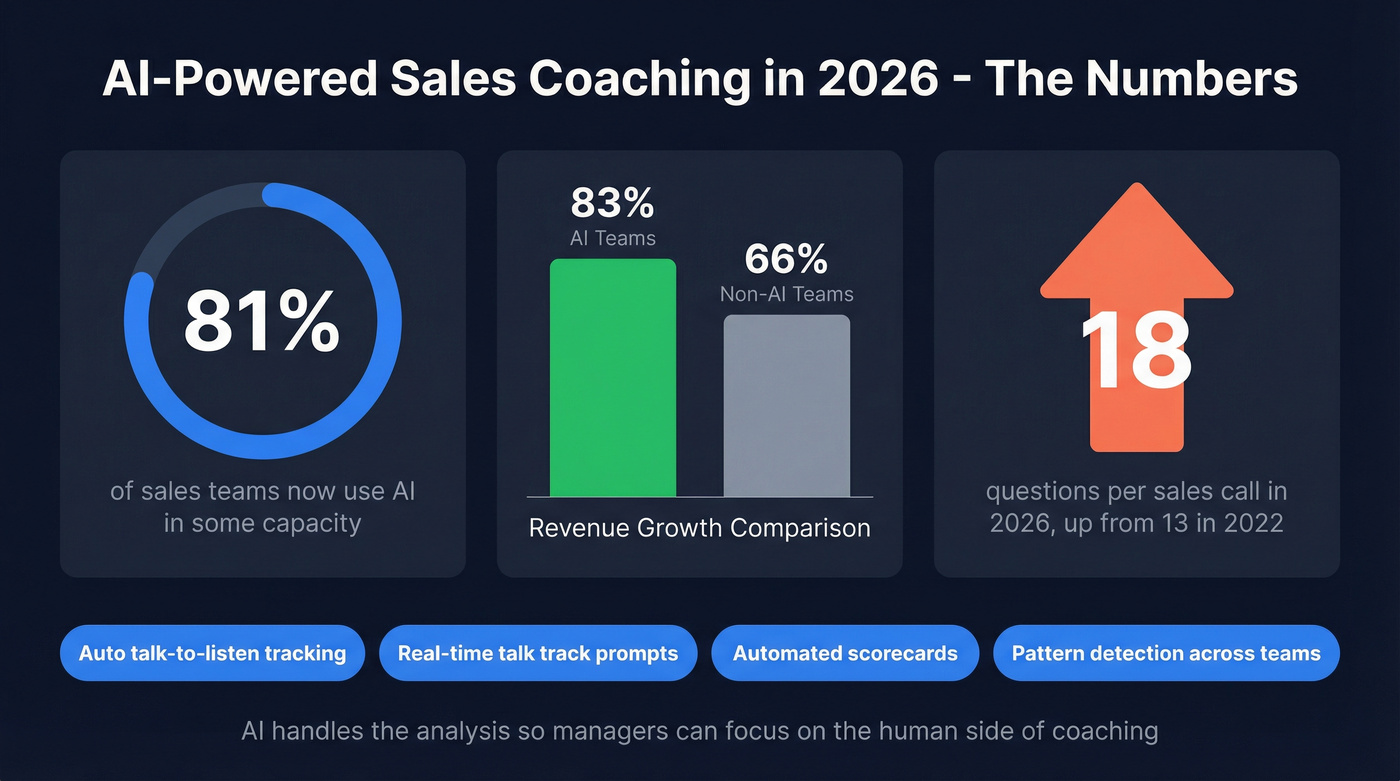
The tools have gotten genuinely useful: automated talk-to-listen ratio tracking across every call, real-time prompts suggesting talk tracks mid-conversation, scorecards that flag missed questions and risky language, pattern detection surfacing coaching moments across the whole team, and conversation summaries that cut manager review time by 30-50%.
The corporate training market runs $400 billion annually, and early adopters of AI-native learning platforms are seeing 40-50% reductions in L&D spend. That's real money freed up for frontline enablement.
But here's the contrarian take: stop buying coaching software before you fix your coaching cadence. A $45/user/month Saleshood license with weekly 1:1s beats a ~$92K/year Mindtickle deployment where managers log in twice a month. The tool amplifies the habit. It doesn't replace it.
For teams with an average deal size under $25K and fewer than 30 reps, you probably don't need a dedicated coaching platform. You need a manager who blocks 25 minutes per rep per week and actually shows up. The software comes later.
Tools Compared
| Tool | Best For | Pricing | Key Feature | Verdict |
|---|---|---|---|---|
| Gong | Conversation intelligence | ~$1,600/user/yr + $5-50K platform | AI call analysis | Best-in-class, pricey |
| Saleshood | SMB coaching | $45/user/mo | All-in-one enablement | Best value |
| Mindtickle | Enterprise readiness | ~$92K/yr avg | Full readiness suite | Enterprise-only |
| Highspot | Content + coaching | ~$91K/yr enterprise | Content management | Bundled play |
| Outreach (Kaia) | Sequencing teams | Custom pricing | Real-time assist | Best if on Outreach |
| 360Learning | Collaborative L&D | $8/user/mo | Peer learning | Budget pick |
| Dialpad | Call-heavy teams | ~$25/user/mo | Built-in AI coaching | Telephony-first |
| HubSpot Sales Hub | HubSpot shops | ~$90-$120/seat/mo | CRM-native coaching | Limited depth |

Gong is the gold standard for conversation intelligence. The AI analysis surfaces patterns across thousands of calls that no manager could catch manually. The problem is cost - at ~$1,600/user/year plus a platform fee that can hit $50K, it's hard to justify for teams under 50 reps. We've seen mid-market teams get 80% of the value from cheaper alternatives. But if budget isn't the constraint, Gong earns it.
Saleshood is the tool we'd recommend to any team under 100 reps that wants coaching, content, and training in one platform. At $45/user/month, it's a fraction of the enterprise options, and the coaching workflow is surprisingly deep - video practice, scorecards, and micro-learning built in.
Skip Mindtickle unless you have 200+ reps and a dedicated enablement team. The average cost runs around $92K annually, and the platform's depth only pays off at scale. Same story with Highspot at ~$91K/year - it leans heavier on content management with coaching layered on top.
Outreach's Kaia provides real-time AI assistance during calls. If you're already on Outreach for sequencing, adding Kaia is a natural extension. Don't buy Outreach just for coaching, though.
360Learning offers collaborative, peer-driven learning at $8/user/month - solid for L&D-heavy orgs. Dialpad bakes AI coaching into its telephony platform, making it a natural fit for call-heavy inside sales teams. HubSpot Sales Hub includes basic coaching features for teams already in the ecosystem, but it's not a coaching-first tool.
Measuring Coaching Effectiveness
Track these metrics on two timelines.
Leading indicators should show movement in 4-6 weeks: call quality scores from your scorecard rubric, talk-to-listen ratio improvement, rep confidence on a simple 1-5 scale you ask about directly, and coachability index tracking how quickly reps implement feedback.
Lagging indicators take 1-2 quarters: call-to-meeting conversion rate, win rate, quota attainment, ramp time for new hires - coaching-driven teams see 30-50% faster ramp - and forecast accuracy.
Gartner pegs the average performance increase from sales coaching at ~8%. That sounds modest until you multiply it across a 50-person team. The compounding effect is real - coached reps don't just sell more, they ramp faster, stay longer, and develop into the managers who coach the next cohort. Hiring a dedicated coach for teams of 50 or more often pays for itself within two quarters through reduced ramp time alone.
You're spending 15 minutes per 1:1 on skill development. Don't let reps waste the other 35 hours prospecting with stale data. Prospeo refreshes every 7 days - not 6 weeks - so your coached behaviors hit live, verified contacts.
Coaching builds the skill. Accurate data builds the pipeline.
FAQ
How often should managers coach their reps?
Weekly, minimum - even a structured 20-minute session outperforms a monthly hour. By the time you review a deal from three weeks ago, the rep has already internalized the wrong lesson. Teams with weekly cadences see measurably higher quota attainment than those coaching monthly or ad hoc.
What's the difference between coaching and training?
Training builds skills; coaching builds behavior. Training teaches a rep how to handle objections. Coaching ensures they actually use those techniques on live calls, consistently, under pressure. Without reinforcement, reps forget 70% of what they learned within a week.
What's the best framework for small teams?
GROW - it requires no certification, takes an afternoon to learn, and works for SDRs and AEs alike. Run through Goal, Reality, Options, and Will in every 1:1 and you've got a structured session without the overhead of MEDDIC or Sandler.
How do you measure coaching ROI?
Track call quality scores and ramp time as 4-6 week leading indicators, then measure quota attainment and win rate over 1-2 quarters. Coached reps see 16.7% higher revenue growth, and the compounding effect - faster ramp, lower attrition, better forecasting - makes it one of the highest-ROI investments a sales org can make.
How does data quality affect coaching outcomes?
Bad contact data wastes coaching time and tanks rep confidence. If reps are dialing disconnected numbers, you're coaching around a data problem, not a skills gap. Clean your data first, then coach the technique - that order matters more than most managers realize.