

Lead vs Prospect vs Opportunity: The Operational Guide Your Sales Team Will Actually Bookmark
It's Thursday afternoon. Your pipeline review just went sideways. The VP asks why 40% of "opportunities" have no close date, no champion, and no budget confirmed. The SDR team insists they're qualified. The AEs disagree. Nobody can explain why the forecast shifted $200K since Monday.
The lead vs prospect vs opportunity confusion isn't academic - it's the root cause. In 2026, the majority of sales reps miss quota, and a huge chunk of that failure traces back to one thing: your team doesn't agree on what these three terms actually mean.
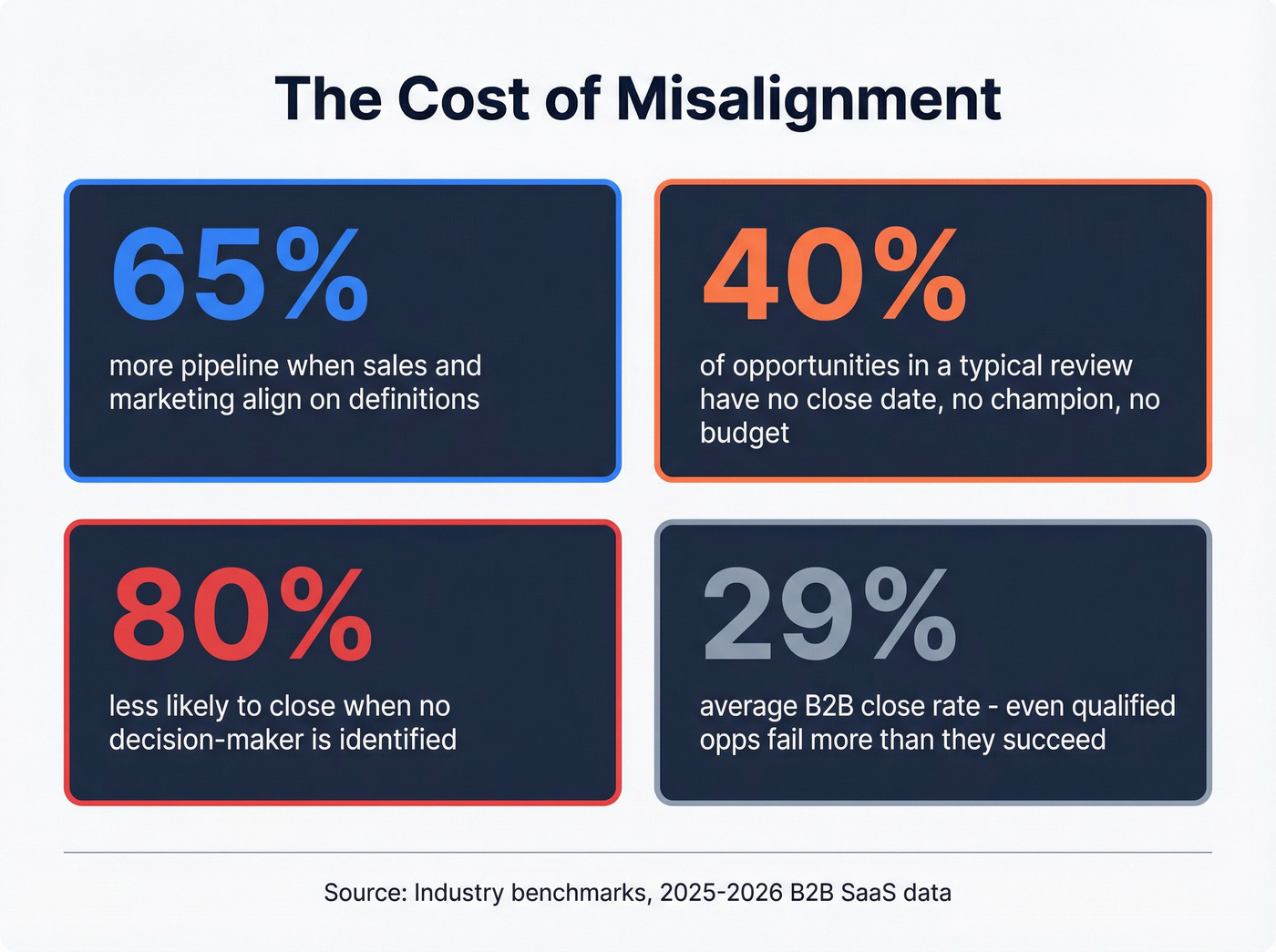
Companies where sales and marketing align on these definitions convert 65% more prospects into pipeline. That's the difference between a predictable revenue engine and a forecast built on vibes. Let's fix the definitions, then make them operational.
Quick Reference
| Term | One-Line Definition |
|---|---|
| Lead | Unvetted name - captured, not qualified |
| Prospect | Qualified fit - matches ICP + shows intent |
| Opportunity | Active deal - budget, timeline, champion, next step |
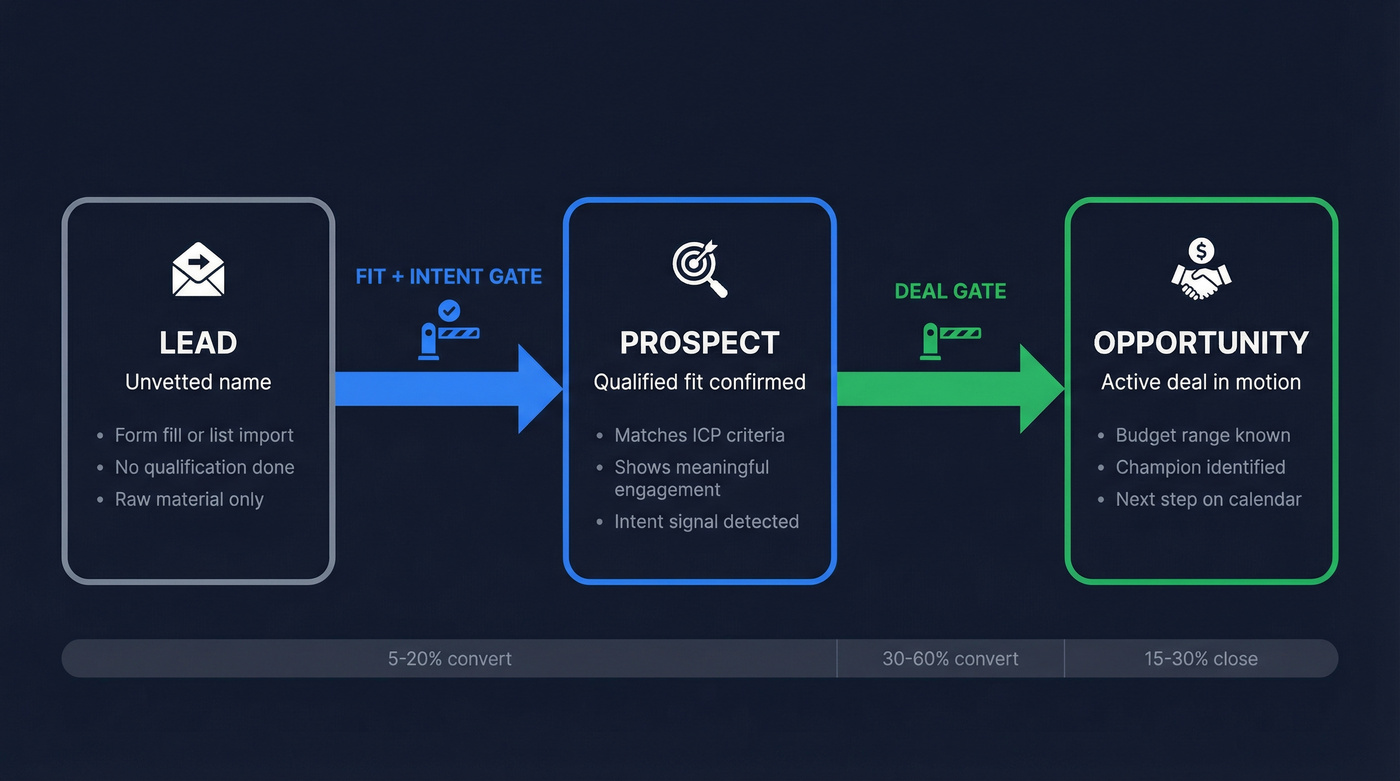
If your team can't agree on these three definitions, your forecast is fiction. The stage-gate checklists below make them enforceable.
Definitions That Actually Matter
Lead
A lead is any person or company that's entered your orbit. They filled out a form, attended a webinar, downloaded a PDF, or got scraped into a list. That's it. No vetting has happened. No one's confirmed they're a real buyer at a real company with a real problem.
Here's the sobering part: B2B SaaS websites convert at just 1.1%. For every 1,000 visitors, you get about 11 leads. Most won't be worth a phone call. Leads are raw material - nothing more.
Prospect
A prospect is a lead that's been vetted and passed a qualification gate. They match your ICP, they've shown meaningful engagement beyond a single form fill, and there's a signal of intent. The SDR has confirmed fit. The conversation has started.
The key distinction: a prospect is a person worth your AE's time. Not every lead earns that status. The gate between lead and prospect is where most pipeline discipline breaks down - and where the real work of building a trustworthy forecast begins.
Opportunity
An opportunity is an active deal. Budget range is known. Timeline exists. A champion inside the account is pushing for your solution. A next step is agreed upon - not "we'll circle back," but an actual calendar event.
The average B2B close rate sits around 29%. Even well-qualified opportunities fail more often than they succeed. If you're letting unqualified conversations into this stage, you're poisoning your forecast and wasting your best reps' time.
| Lead | Prospect | Opportunity | |
|---|---|---|---|
| Definition | Captured contact, not vetted | ICP fit + intent confirmed | Active deal in motion |
| Qualification | None | ICP fit + intent | Budget + timeline + champion |
| CRM owner | Marketing / SDR | SDR / AE | AE |
| Typical conversion | 5-20% to MQL | 30-60% MQL to SQL | 40-70% SQL to Opp; 15-30% Opp to Won |
Why Misalignment Kills Your Pipeline
We've seen this scenario play out dozens of times. An SDR team passes 30 "qualified leads" to AEs in a single week. The AEs work them for two weeks. Twenty-five get bounced back to nurture because they were never qualified - no budget, wrong persona, or just someone who downloaded a whitepaper out of curiosity.
That's not a lead quality problem. It's a definition problem.
The SDR thought "engaged" meant "qualified." The AE thought "qualified" meant "ready to buy." Nobody wrote down the actual gate criteria, so everyone used their own. Forecasts inflate because unqualified conversations get logged as opportunities. Attribution breaks because marketing takes credit for "pipeline" that never had a chance. Rep morale tanks because AEs spend half their week on dead ends instead of real deals. And the 65% pipeline lift that comes from alignment? You leave it on the table.
Ask any sales ops manager what their biggest CRM headache is, and "premature opportunity creation" comes up constantly - the consensus on r/sales and r/salesoperations backs this up. The pattern is always the same: reps rely on gut feeling instead of data, skip qualification steps under pressure, and ignore stage definitions because nobody enforces them. Pipeline reviews become theater.
The real problem isn't that your team doesn't know these terms. The problem is that your CRM doesn't enforce the difference.
Stage Gates: When Each Transition Happens
Understanding the difference between sales pipeline stages and deal stages is critical. Lead stages track a contact's qualification journey (Open, Working, Nurturing, Converted), while deal stages track the commercial progression of an opportunity (Discovery, Proposal, Negotiation, Closed). Conflating the two is one of the most common CRM mistakes.
Lead to Prospect: The Fit-Interest-Intent Gate
This gate is binary. All three criteria must be true before a lead becomes a prospect:
- ICP fit confirmed. Right industry, right company size, right persona. If they're a student, a competitor, or a company with 3 employees and you sell enterprise software - they don't pass.
- Meaningful engagement beyond a form fill. A single whitepaper download isn't engagement. It's curiosity. You need a second signal: a reply to an email, a return visit, a conversation.
- Intent signal present. They visited your pricing page. They searched for your category. They're hiring for a role that signals they're building the function you serve.
Downloaded a whitepaper doesn't equal prospect. Downloaded a whitepaper + visited the pricing page + matches your ICP = prospect. The gate isn't subjective. Write it down. Put it in your CRM. Make it non-negotiable.
Prospect to Opportunity: The Deal Gate
This is where forecast discipline lives or dies. In our experience, the prospect-to-opportunity gate is where 80% of forecast problems originate. Before a prospect becomes an opportunity, your AE must confirm five things:
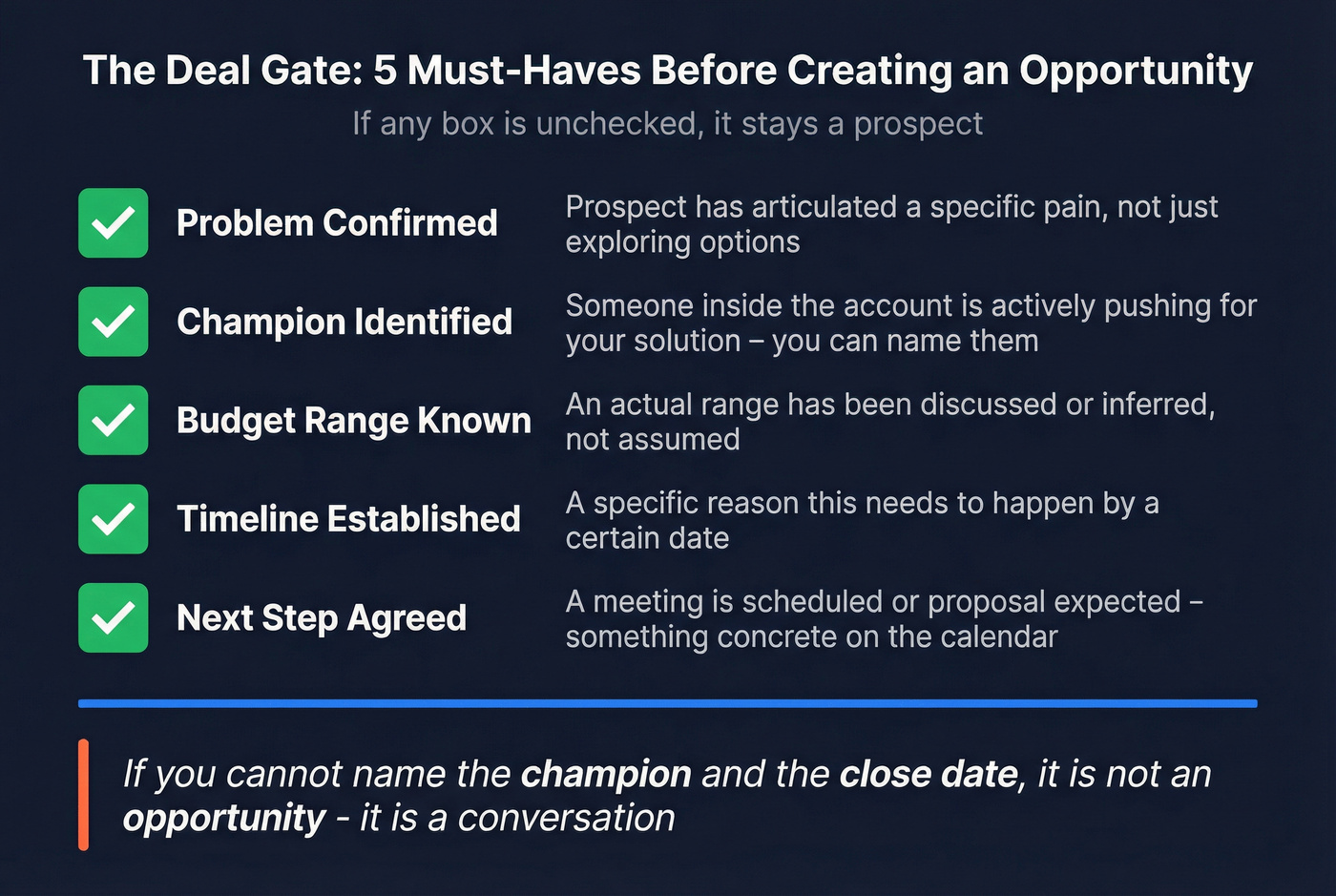
- Problem confirmed. The prospect has articulated a specific pain, not a vague "we're exploring options."
- Champion identified. Someone inside the account is actively advocating for your solution. You can name them.
- Budget range known. Not "they probably have budget" - an actual range has been discussed or inferred from context.
- Timeline established. There's a reason this needs to happen by a specific date. No timeline = no urgency = not an opportunity.
- Next step agreed. A meeting is scheduled. A proposal is expected. Something concrete is on the calendar.
If you can't name the champion and the close date, it's not an opportunity - it's a conversation. Deals without a decision-maker identified are 80% less likely to close. That stat alone should make you ruthless about this gate.

Your stage gates are only as good as the data behind them. Prospeo gives you 300M+ profiles with 98% email accuracy and intent signals across 15,000 topics - so your SDRs pass real prospects, not guesses, to AEs.
Fill your pipeline with prospects that actually convert.
Picking a Qualification Framework
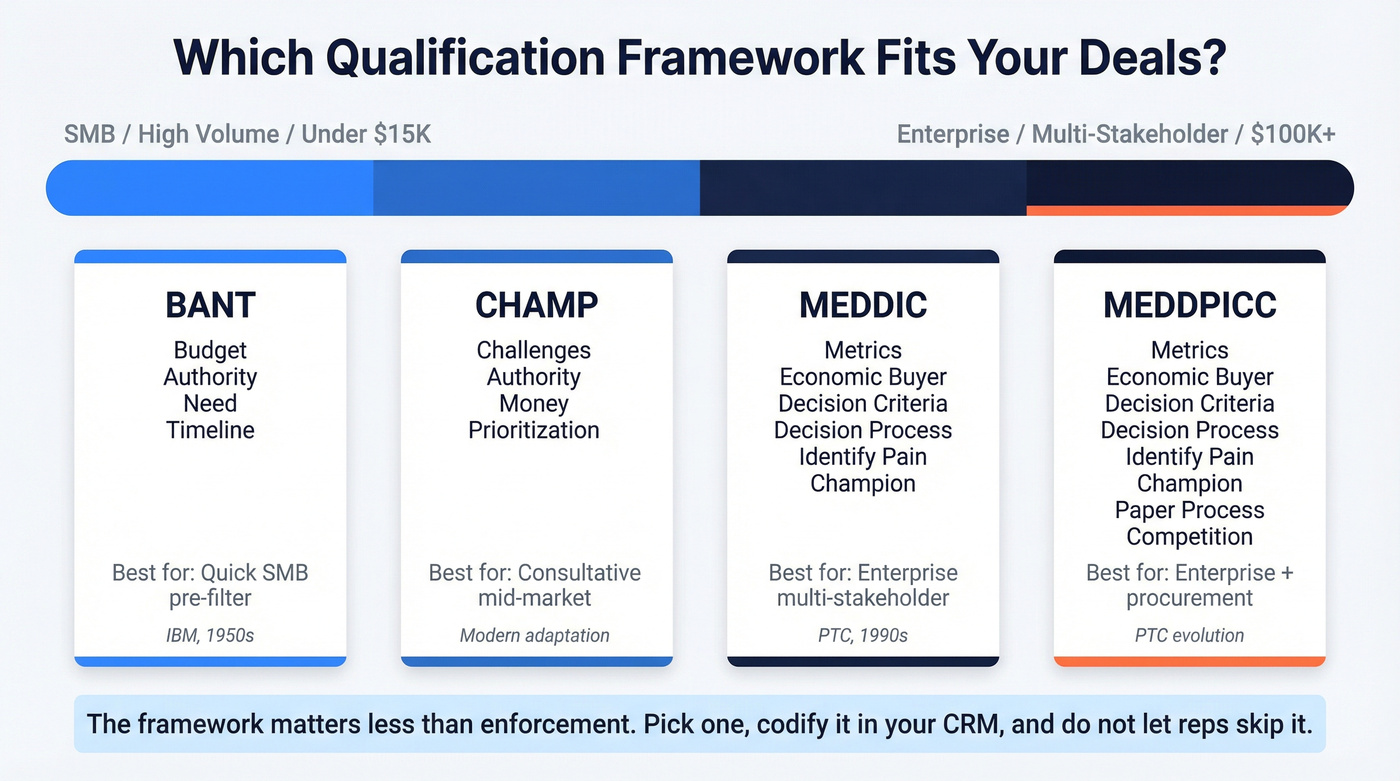
Not every deal needs the same qualification rigor. A $5K annual contract doesn't need MEDDPICC. A $500K enterprise deal shouldn't rely on BANT. If you want a deeper breakdown, use a lead qualification framework that matches deal size and complexity.
| Framework | Criteria | Best For | Origin |
|---|---|---|---|
| BANT | Budget, Authority, Need, Timeline | High-volume SMB pre-filter | IBM, 1950s |
| CHAMP | Challenges, Authority, Money, Prioritization | Buyer-centric consultative | Modern adaptation |
| MEDDIC | Metrics, Economic Buyer, Decision Criteria, Decision Process, Identify Pain, Champion | Enterprise multi-stakeholder | PTC, 1990s |
| MEDDPICC | MEDDIC + Paper Process + Competition | Enterprise + procurement | PTC evolution |
BANT works as a quick pre-filter for high-volume, lower-ticket sales. It was built at IBM in the 1950s, and it shows - it's seller-centric and assumes the buyer will volunteer budget and authority early. For teams closing deals under $15K at volume, it's still effective as a first pass.
CHAMP flips the script by leading with challenges instead of budget. If you're running consultative mid-market sales where the buyer doesn't know their budget until you've helped them frame the problem, CHAMP is the better fit.
MEDDIC is the heavyweight. Developed at PTC in the 1990s, it roughly tripled PTC's revenue in four years. Modern B2B deals routinely involve 6-10+ stakeholders, and MEDDIC forces you to map the decision process, identify the economic buyer, and confirm you have a champion. MEDDPICC adds Paper Process and Competition tracking - essential for enterprise deals where procurement can kill a deal that sales already "won." For a head-to-head, see MEDDIC vs MEDDPICC.
We've seen teams try to run MEDDPICC on $5K deals. It kills velocity. And we've seen teams run BANT on six-figure enterprise contracts. It misses everything that matters. The framework matters less than the enforcement. Pick one that matches your deal size, codify it in your CRM as required fields, and don't let reps advance deals without completing it.
Skip MEDDPICC entirely if your average deal closes in under two weeks and involves a single decision-maker. You'll spend more time filling out fields than selling.
How to Map This in Your CRM
Salesforce
In Salesforce, the Lead object is isolated. A Lead isn't connected to an Account, a Contact, or an Opportunity. Think of it as a fishbowl of business cards - unorganized, unrelated, and impossible to report on in a meaningful pipeline context.
When you convert a Lead, Salesforce creates or links to an Account and a Contact, and can optionally create an Opportunity. This is the moment your contacts enter the real pipeline. Before conversion, they're floating in limbo. Use Lead Status stages - Open, Working, Nurturing, Converted - to triage before conversion. And watch for orphaned Opportunities: if Contact roles aren't connected after conversion, your attribution and reporting will silently break.
HubSpot
HubSpot ships with eight default lifecycle stages: Subscriber, Lead, MQL, SQL, Opportunity, Customer, Evangelist, and Other. These map cleanly to the definitions above - Lead is your unvetted contact, SQL is your prospect, and Opportunity is your active deal.
Many outbound and ABM teams rename "Lead" to "Prospect" in HubSpot, since their workflow starts with targeted outreach rather than inbound form fills. That's fine - just make sure everyone agrees on what each stage means and that your automation rules reflect the rename. Lifecycle stages are fully customizable, and they're the backbone of your reporting. Get them wrong and every dashboard lies to you.
Enrichment tools can fill missing contact data across your CRM so lifecycle stages reflect reality, not guesswork. Prospeo, for example, returns 50+ data points per record with an 83% enrichment match rate, which means your stage gates actually have data to check against. If you’re systematizing this, start with CRM hygiene and a repeatable data quality scorecard.
Clean Data Makes Qualification Work
Look, definitions and frameworks are useless if your contact data is garbage. When 35% of your emails bounce, your SDRs aren't qualifying anyone - they're playing detective, hunting for working contact info instead of having conversations. Every bounced email is a qualification attempt that never happened.
This isn't hypothetical. Meritt, a sales agency, was running a 35% bounce rate before switching to verified data. After the switch, bounces dropped under 4% and their pipeline tripled from $100K to $300K per week. Snyk saw similar results - 50 AEs went from 35-40% bounce rates to under 5%, generating 200+ new opportunities per month. The data quality problem is the pipeline problem.

Every unqualified lead that sneaks into your opportunity stage costs AE time and wrecks your forecast. Prospeo's 30+ filters - buyer intent, job changes, headcount growth, technographics - let you confirm ICP fit before a lead ever touches your CRM. At $0.01 per email, bad data is no longer an excuse.
Turn your lead-to-opportunity gate from gut feeling into verified data.
A Lead Scoring Model You Can Copy
Lead scoring puts a number on gut feeling. Here's a point-based template adapted from Belkins' internal model that you can drop into HubSpot or Salesforce today:
| Signal | Points | Rationale |
|---|---|---|
| Pricing page view | +10 | High buying intent |
| Form / demo request | +15 | Active engagement |
| 10+ marketing email clicks | +10 | Sustained interest |
| ICP firmographic match | +20 | Right company profile |
| Email bounced | -25 | Bad data - disqualify |
| No activity 30+ days | -15 | Gone cold |
Set your threshold at 70+ points to trigger a handoff to sales. Below that, keep nurturing. Above it, route immediately - speed matters once intent is confirmed. For a full build, see how to build a lead scoring system and the RevOps view on lead scoring systems.
Two things worth internalizing. First, email open rates are unreliable thanks to Apple's Mail Privacy Protection and similar changes. Weight on-site behavior - pricing page visits, form submissions, return visits - instead of opens. Second, recalibrate monthly. Pull your conversion data, see which signals actually predicted closed deals, and adjust the points. Lead scoring without monthly recalibration is just astrology with spreadsheets.
Make Next Thursday's Pipeline Review Different
The Thursday pipeline review from the intro doesn't have to go sideways every week. Write down the definitions. Codify the gates. Enforce them in your CRM as required fields, not optional notes.
The distinction between lead vs prospect vs opportunity isn't semantic - it's the foundation of every forecast, every attribution report, and every rep's quota attainment. The 65% pipeline lift is real, and it starts with your team agreeing on three words. If you want to pressure-test your process, audit your sales pipeline challenges and tighten deal forecast accuracy.
FAQ
What's the difference between MQL and SQL?
An MQL hit a marketing engagement threshold - demo request, pricing page visit, content downloads. An SQL is an MQL that sales has vetted and confirmed as a real prospect worth pursuing. MQL is marketing's call; SQL is sales' call. The handoff between them is where most pipeline friction lives, and HubSpot's lifecycle documentation maps this well.
Can a lead skip the prospect stage?
Yes. If an inbound lead requests a demo, matches your ICP, and has budget authority, they can jump straight to opportunity. Stage gates matter more than sequential progression - if all five deal-gate criteria are met, advance them immediately.
When should you disqualify an opportunity?
Disqualify when the champion leaves, budget gets cut, timeline pushes past your sales cycle, or the prospect goes dark for 30+ days. Dead opportunities poison your forecast - remove them ruthlessly. Teams that audit stale deals monthly see 20-30% more accurate forecasts.
How does data quality affect lead qualification?
If 35% of your emails bounce, your SDRs can't qualify anyone - they're stuck hunting for working contact info. Verified data with a weekly refresh cycle eliminates this problem, while tools with stale data refreshed every 4-6 weeks keep bounce rates high. Clean data is the foundation every qualification framework depends on.