

Cold Calling for Outbound Sales: 2026 Playbook
Your SDR manager pulls the monthly numbers: 800 dials, 6 conversations, 0 meetings. The team isn't lazy - they're calling dead numbers with a generic pitch and no structure. A dataset of 300M+ cold calls tells a clear story: top reps book 9x more meetings than average reps from the same dial volume. The difference isn't talent. It's process, timing, and data.
Quick version: Cold calling works when you combine a tight 3-minute call structure, verified contact data, and two daily call blocks (8-11 AM and 4-5 PM local time). Teams that adopt a phone-first outbound approach alongside email sequences see reply rates jump from 1.81% to 3.44%, nearly double, even when the call doesn't connect.
The Numbers Behind Outbound Calls
The benchmarks below come from Gong's analysis of 300M+ calls, supplemented by Bridge Group research.
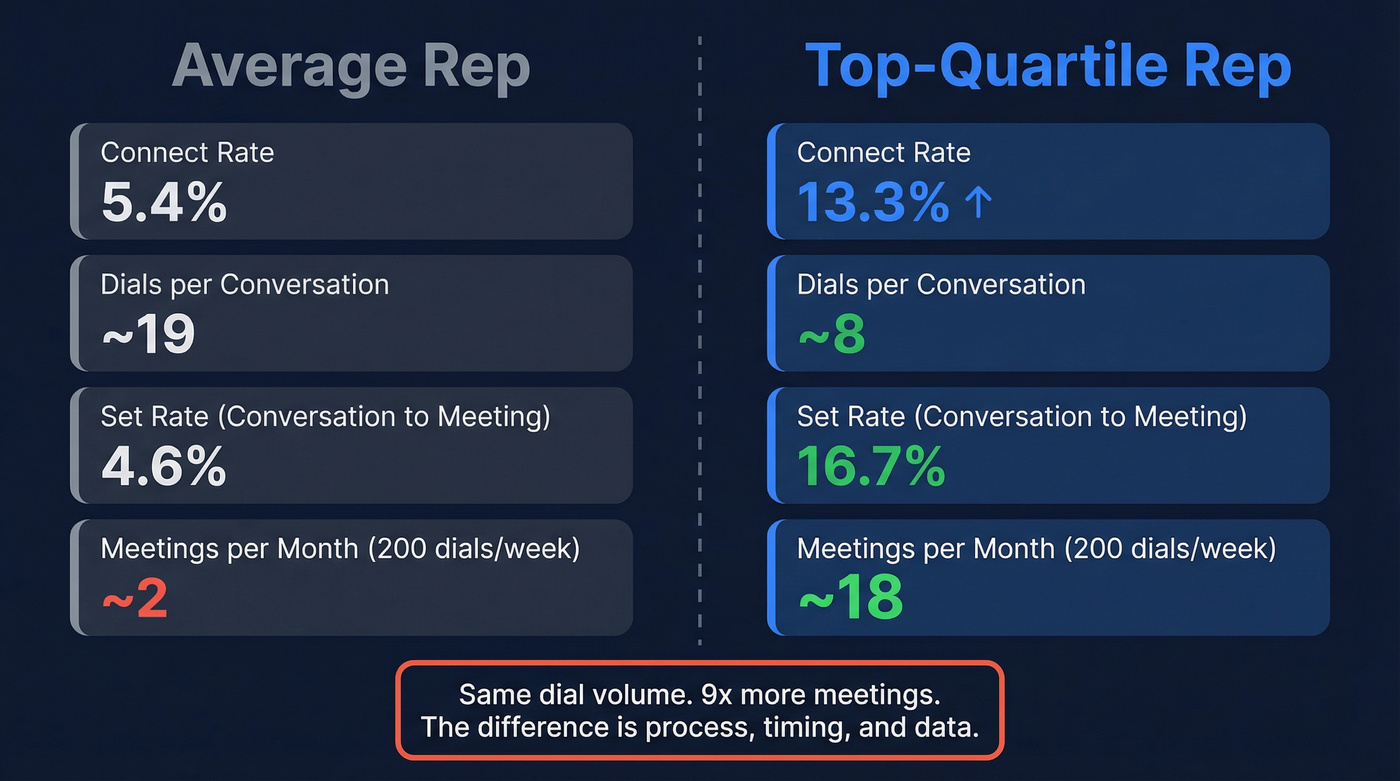
| Metric | Average Rep | Top-Quartile Rep |
|---|---|---|
| Connect rate | 5.4% | 13.3% |
| Dials per conversation | ~19 | ~8 |
| Set rate (conversation to meeting) | 4.6% | 16.7% |
| Meetings/month (200 dials/week) | ~2 | ~18 |
At 200 dials per week - roughly an hour a day of calling - an average rep books about 2 meetings per month. A top-quartile rep, same dial volume, books 18. That's not a marginal improvement. That's a completely different business.
Two more numbers worth memorizing: successful cold calls average 5 minutes 50 seconds, while failed calls die at 3:14. The Bridge Group pegs the average at 209 dials per booked appointment. Top reps cut that to 45-50 dials per meeting by stacking better data, better timing, and better structure.
When to Call
Timing isn't everything, but it's the easiest lever to pull. Revenue.io's analysis and the InsideSales dataset both point to the same windows.
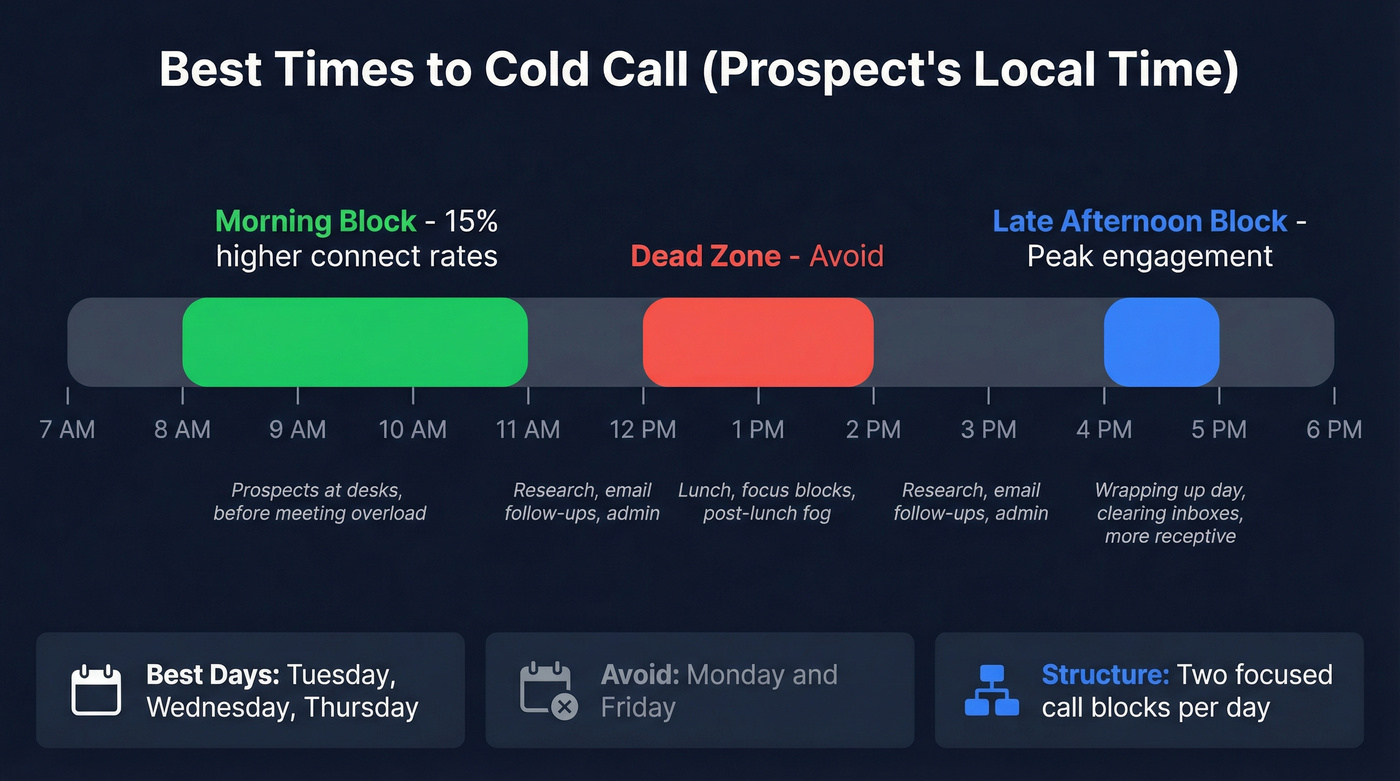
Morning block (8-11 AM local time): Connection rates run 15% higher than midday. Prospects are at their desks, haven't hit meeting overload yet, and are more likely to pick up an unknown number.
Late afternoon block (4-5 PM): The second peak. People are wrapping up their day, clearing inboxes, and more receptive to a quick conversation. A 90-day internal analysis found peak engagement here, especially for SaaS buyers.
The dead zone (1 PM): Lunch, focus blocks, post-lunch fog. Don't waste dials here.
Structure your day around two call blocks: 8-10:30 AM and 4-5 PM. Use the gaps for pre-call research, email follow-ups, and admin. Mid-week days - Tuesday through Thursday - consistently outperform Monday and Friday.
The 3-Minute Cold Call Structure
Every cold call should fit inside three minutes. Not because prospects won't give you more time, but because a tight structure forces clarity and keeps you from rambling into a pitch the prospect didn't ask for.
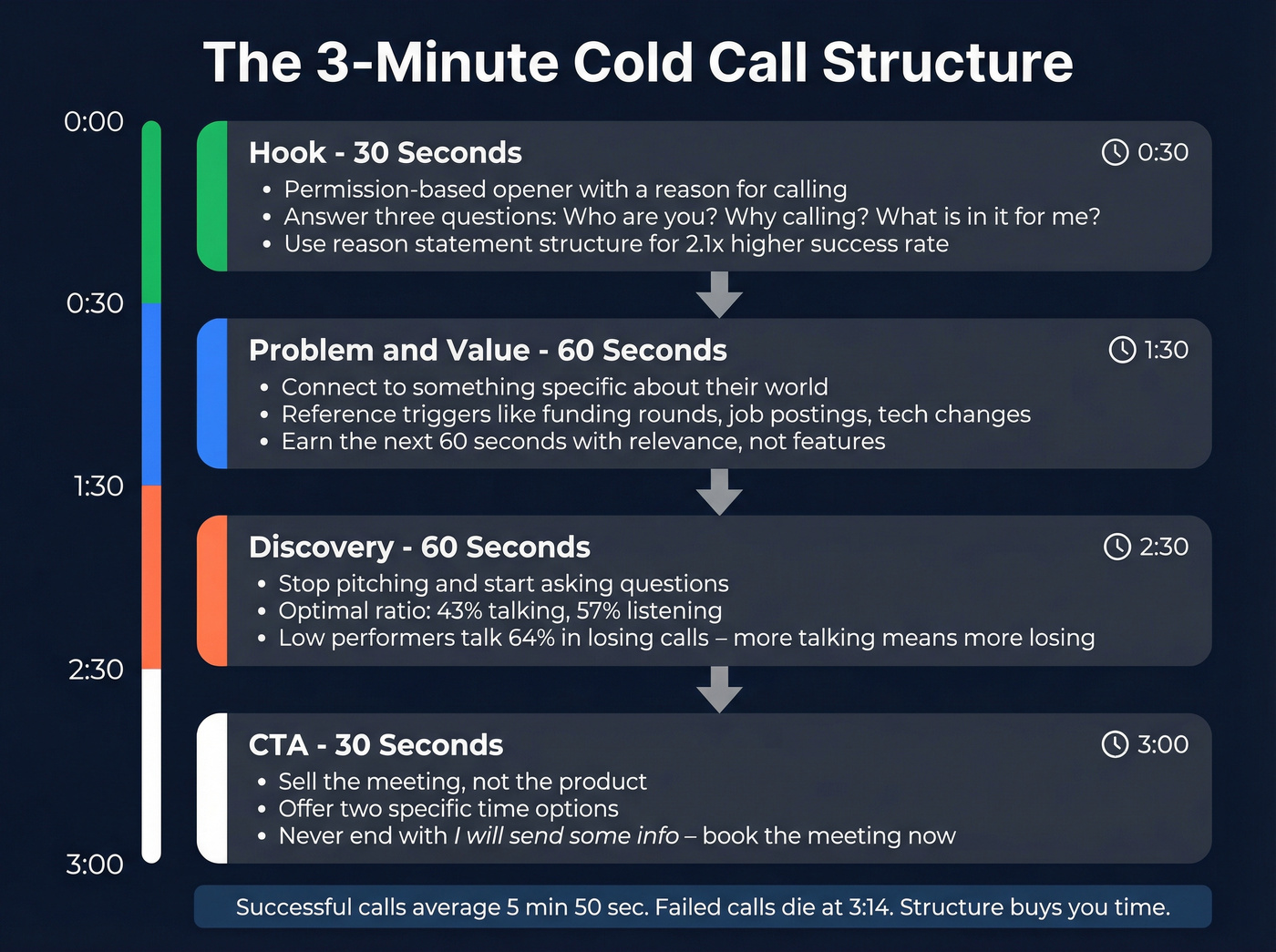
Hook (~30 Seconds)
Open with a permission-based statement and a reason for calling. "Hi Sarah, this is Alex from [Company]. The reason I'm calling is..." That "reason statement" structure drives a 2.1x higher success rate than jumping straight into a pitch.
You're answering the three questions every prospect has in the first five seconds: Who are you? Why are you calling? What's in it for me?
Problem and Value (~60 Seconds)
Connect your reason for calling to something specific about their world. A recent funding round, a job posting for a role that signals a pain you solve, a technology change you spotted. Trigger-based relevance - "I noticed you're hiring three SDRs, which usually means outbound is a priority" - earns the next 60 seconds.
Discovery (~60 Seconds)
This is where most reps blow it. They keep pitching instead of asking.
The 300M-call dataset shows the optimal talk-to-listen ratio sits at 43% talk, 57% listen. But the real insight is about consistency: high performers maintain that ratio whether they're winning or losing. Low performers swing by ~10% - they talk 54% in deals they win and 64% in deals they lose. When they feel a deal slipping, they talk more. Which only accelerates the loss.
CTA (~30 Seconds)
Sell the meeting, not the product. Offer two specific time options: "Would Thursday at 2 PM or Friday at 10 AM work for a 20-minute call?" Vague endings like "I'll send some info" kill momentum. You called to book a meeting. Book it.
Scripts and Openers That Work
Openers to Use (and Avoid)
| Bad Opener | Why It Fails | Better Alternative |
|---|---|---|
| "Is this Bob?" | Triggers defensiveness | "Hi Bob, this is [Name] from [Company]." |
| "Is this a bad time?" | Decreases meeting chances 40% | "I know you're busy, so I'll be brief. I'm calling because..." |
| Generic product pitch | No relevance, no hook | Trigger-based: reference hiring, funding, or news |
| "How are you today?" | Feels transactional | "How have you been?" (6.6x higher success) |
That last one deserves attention. An analysis of 90,000 cold calls by Gong found that "How have you been?" - a subtle pattern interrupt that implies familiarity - produced 6.6x higher success rates than standard openers. One word changes the entire dynamic.
Voicemail Framework
You won't connect on 87-95% of dials, so your voicemail game matters. Keep it to 15-20 seconds: your name, one sentence on why you called tied to a specific trigger, and your callback number spoken slowly. No pitch, no feature dump. The goal isn't a callback - it's priming the prospect to recognize your name when the follow-up email lands.
Handling Objections with LARA
When a prospect pushes back, most reps either fold or argue. Neither works. The LARA framework gives you a better path: Listen, Acknowledge, Respond, Ask.
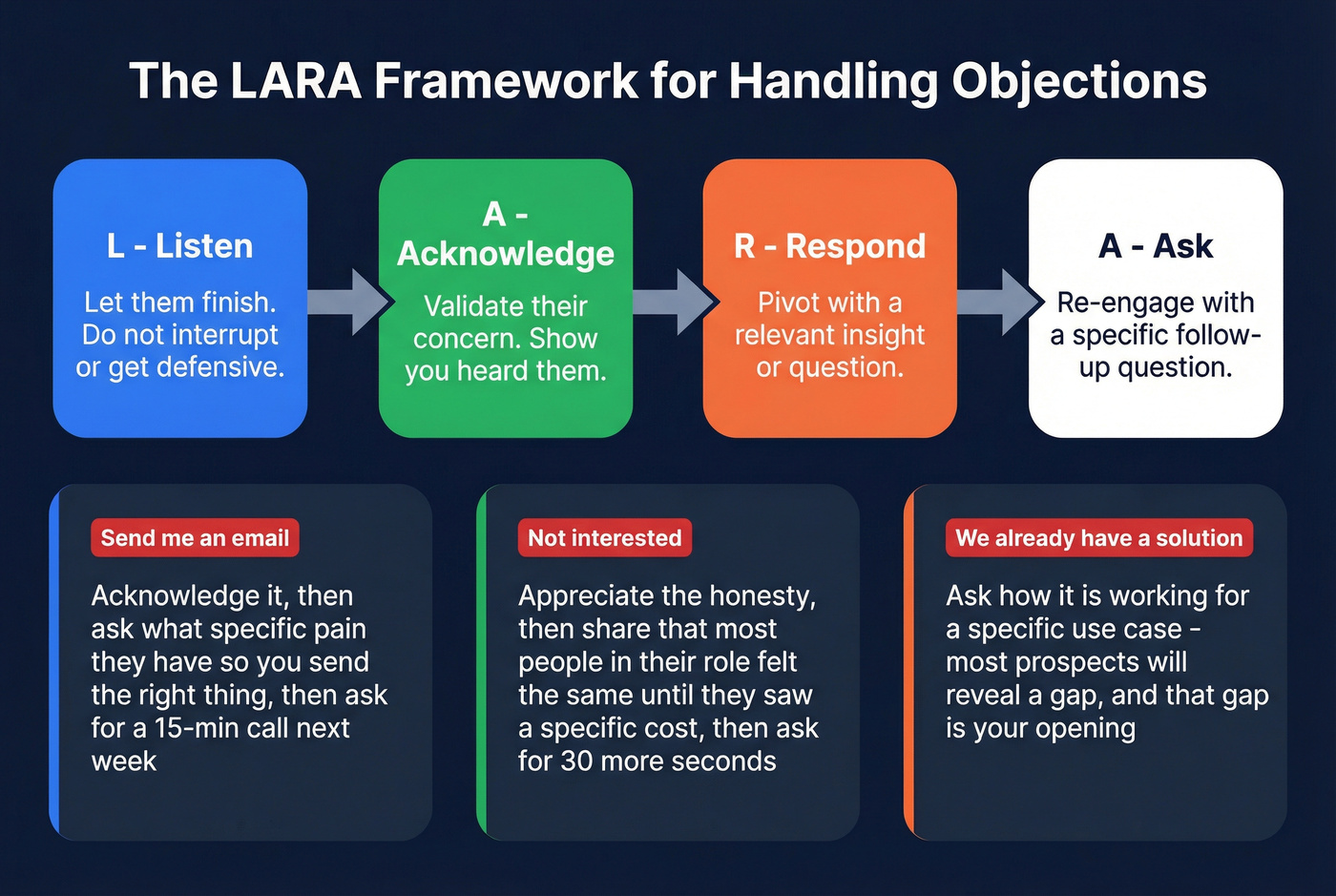
"Send me an email." Acknowledge it: "Totally fair - I'll send something over. Quick question so I send the right thing - are you currently dealing with [specific pain]? If what I send is relevant, would you be open to a 15-minute call next week?"
"Not interested." Acknowledge: "I appreciate the honesty." Then pivot: "Most [title] I talk to weren't interested either - until they realized [specific problem] was costing them [specific impact]. Is that something you're seeing?" Ask for 30 more seconds.
"We already have a solution." Don't compete head-on. Ask: "That's great - how's it working for [specific use case]?" Most prospects will reveal a gap. That gap is your opening.

Top-quartile reps book 18 meetings a month because they call numbers that actually connect. Prospeo gives you 125M+ verified mobile numbers with a 30% pickup rate - while competitors sit at 11-12%. At $0.10 per mobile, you pay only when a number is found.
Stop burning dials on dead numbers. Start connecting with decision-makers.
Fix Your Data Before You Dial
Here's the thing: most teams don't have a cold calling problem. They have a data quality problem wearing a cold calling costume.
We've seen this pattern over and over. A team invests in a $750/month dialer, builds elaborate call scripts, runs coaching sessions - and still books 2 meetings a month. Then they fix their data and connect rates triple overnight. The dialer didn't change. The scripts didn't change. The numbers they were calling changed.
Snyk's team of 50 AEs was running a bounce rate of 35-40% before switching their data source. After moving to verified contact data, bounces dropped under 5%, AE-sourced pipeline jumped 180%, and they were generating 200+ new opportunities per month. Meritt saw similar results - pipeline tripled from $100K to $300K per week, and connect rates went from single digits to 20-25%.
Before you spend another dollar on dialer software or call coaching, fix the upstream problem. Verified mobile numbers with a 30% pickup rate beat a fancy dialer calling dead lines every time.
Snyk's 50 AEs cut bounce rates from 35-40% to under 5% and generated 200+ new opportunities per month - because they fixed their data first. Prospeo's 7-day refresh cycle and 98% email accuracy mean your multi-channel sequences hit real inboxes and real phone lines.
Fix your data and watch your connect rates triple overnight.
Compliance You Can't Ignore in 2026
TCPA litigation surged roughly 95% in 2025, and 2026 is shaping up to be even more complex.
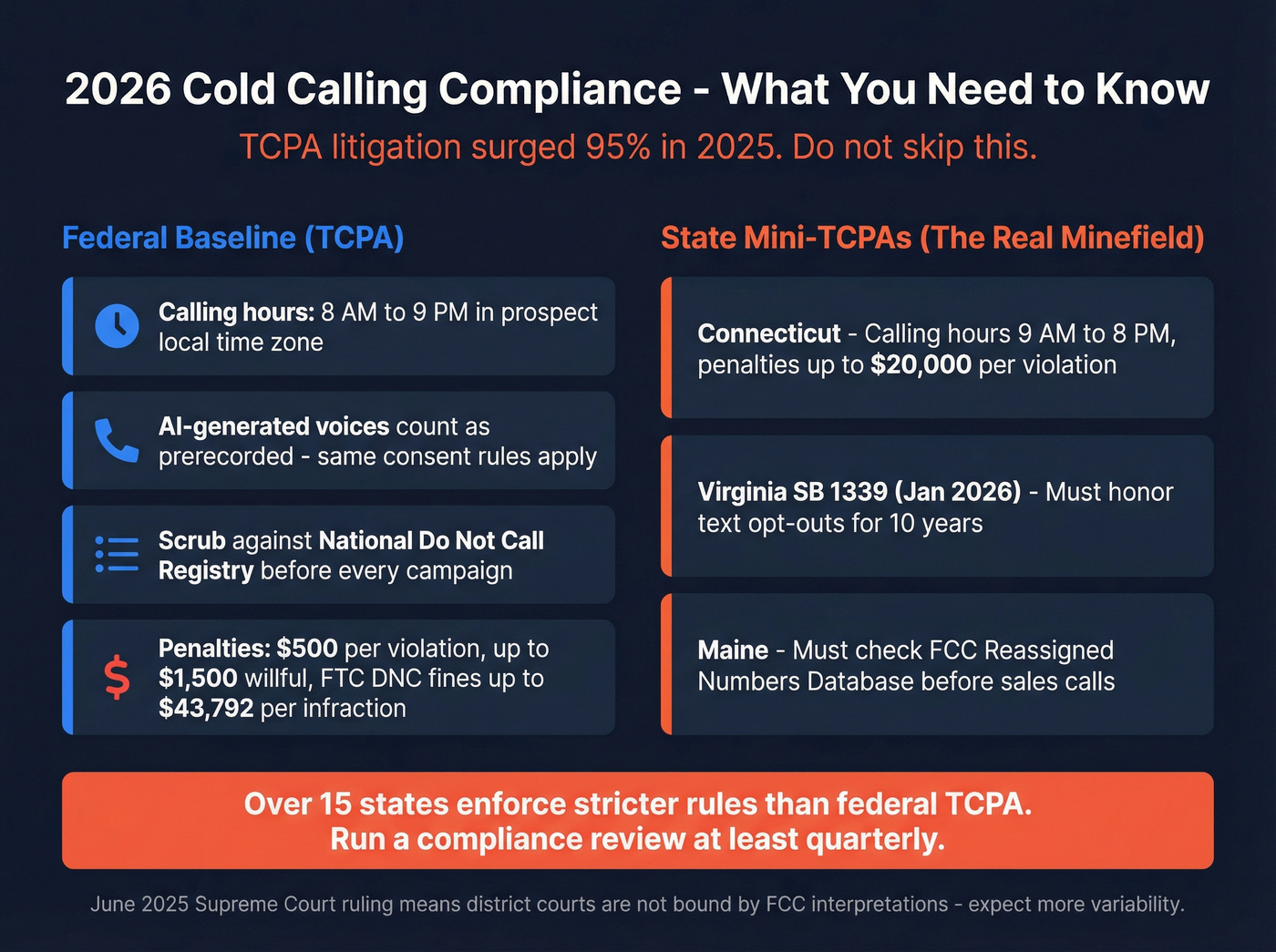
Federal baseline (TCPA): Calls must fall between 8 AM and 9 PM in the prospect's local time zone. Automated or prerecorded calls to mobile numbers require prior express written consent. AI-generated voices count as "prerecorded" under the FCC's February 2024 ruling - same consent rules apply. Scrub against the National Do Not Call Registry before every campaign. Penalties run $500 per violation, up to $1,500 for willful violations; FTC DNC penalties can hit $43,792 per infraction.
State mini-TCPAs are the real minefield. Over 15 states now enforce stricter telemarketing laws than federal TCPA. Connecticut restricts calling hours to 9 AM-8 PM with penalties up to $20,000 per violation. Virginia's SB 1339, effective January 2026, requires honoring text opt-outs for 10 years. Maine requires checking the FCC Reassigned Numbers Database before sales calls. The June 2025 Supreme Court decision in McLaughlin v. McKesson means district courts aren't bound by FCC interpretations in civil TCPA cases, adding more jurisdiction variability.
If you're running outbound at any scale, you need a compliance review at least quarterly. Skip this if you enjoy writing six-figure checks to plaintiff's attorneys.
Tools That Power Outbound Sales Calls
Dialer Types
Five categories matter for outbound teams. Parallel dialers call multiple numbers simultaneously - fastest, but they create abandoned calls that can trigger compliance issues. Power dialers auto-advance through a list one call at a time. Progressive dialers wait for agent availability before dialing. Predictive dialers use algorithms to optimize dial timing. Preview dialers show prospect info before each call.
For most B2B teams, power or progressive is the sweet spot - fast enough to maintain volume, compliant enough to avoid trouble.
Dialer Pricing
| Dialer | Monthly Price | Best For |
|---|---|---|
| CloudTalk | ~$53/mo | Budget SMB teams |
| Dialpad | ~$137/mo | AI-first teams |
| Mojo | ~$149/mo | Real estate / high-volume |
| PhoneBurner | ~$165/mo | Mid-market sweet spot |
| Aircall | ~$237/mo | Support + sales hybrid |
| Nooks | ~$330/mo | Virtual sales floors |
| Orum | ~$750/mo | Enterprise parallel dialing |
CloudTalk is the budget pick for SMB teams just getting started. PhoneBurner hits the mid-market sweet spot with solid power dialing and CRM integrations. Orum and Nooks are enterprise plays - Orum for raw parallel dialing speed, Nooks for the collaborative virtual sales floor experience. Common complaints across all dialers include call drops, audio quality issues, and hidden charges, so always run a trial before committing.
The Data Layer
The dialer is the engine; the data is the fuel. Pair any dialer with verified contact data - Prospeo integrates natively with Salesforce, HubSpot, and most sequencing tools, with 98% email accuracy, a 30% mobile pickup rate, and data refreshed every 7 days. Credit-based pricing starts at ~$0.01 per email, a fraction of what enterprise data providers charge.
What Top SDR Calls Actually Look Like
The gap between average and top-quartile reps isn't one big thing. It's a stack of small disciplines executed consistently.
Top reps spend 2-3 minutes on pre-call research - not writing a biography, but scanning for three things: the prospect's title, one recent company event, and one trigger that connects to the value prop. Enough to sound relevant, not enough to burn half the call block on prep. We've found that reps who timebox research to exactly 2 minutes per prospect hit the best balance between personalization and volume.
Let's be honest about the "call vs. email" debate: it's a false choice. The 300M-call dataset settles it. Cold calls lift email reply rates from 1.81% to 3.44% even when the call doesn't connect. The voicemail or missed call creates familiarity that makes the follow-up email land differently. The best reps build multi-channel sequences where calls, emails, and touches on professional networks reinforce each other. Teams that lead with the phone before email often see faster pipeline velocity because live conversations surface objections and intent signals that text-based outreach simply can't.
The biggest mindset shift? Your cold call isn't a demo. It's a 3-minute audition for 20 minutes of the prospect's calendar. That's all.
FAQ
How many cold calls does it take to book a meeting?
The Bridge Group benchmarks 209 dials per booked appointment for average reps; top-quartile reps need just 45-50 dials. The gap comes down to data quality, call structure, and timing - verified numbers vs. stale lists, a repeatable framework vs. winging it, and peak windows vs. dead zones.
Is B2B cold calling still legal in 2026?
Yes, but compliance rules are significantly tighter. Federal TCPA requires calls between 8 AM-9 PM local time and DNC scrubbing before every campaign. Over 15 states enforce stricter mini-TCPA laws with penalties up to $43,792 per violation. Always scrub lists and honor opt-outs immediately.
What's a good connect rate for outbound calls?
Average connect rate is 5.4% across the 300M-call dataset; top-quartile reps hit 13.3%. If you're consistently below 5%, your contact data is the bottleneck - Meritt jumped from single-digit rates to 20-25% after switching to weekly-refreshed, verified mobile numbers.
Should I call or email first in an outbound sequence?
Lead with the phone. Cold calls lift email reply rates from 1.81% to 3.44% even when you don't connect, because a missed call or voicemail primes name recognition. The highest-performing sequences layer calls, emails, and social touches simultaneously rather than choosing one channel.