

Lead Conversion Strategies: Benchmarks, Templates, and the 3 Tactics That Actually Move the Needle
Your SDR team ran a 500-lead sequence last quarter. 180 emails bounced, 40 phone numbers were disconnected, and you got 12 replies - three of which were "please remove me from your list." The problem isn't your messaging. It's not your offer. It's that most of your leads never actually received your outreach.
You don't need 22 tactics from a listicle. You need three that work, plus the data infrastructure to execute them.
What Is Lead Conversion?
Lead conversion is the percentage of leads that become paying customers. The formula: (New Customers / Total Leads) x 100. A 2% rate means two out of every hundred leads eventually buy.
But the useful version of this metric isn't top-of-funnel to closed-won - it's stage by stage. If you expect 60% of demo requests to schedule a call but you're seeing 30%, that's your bottleneck. Measuring conversion at each handoff - traffic to lead, lead to MQL, MQL to SQL, SQL to opportunity, opportunity to close - tells you exactly where the funnel leaks. One aggregate number hides everything.
The Short Version
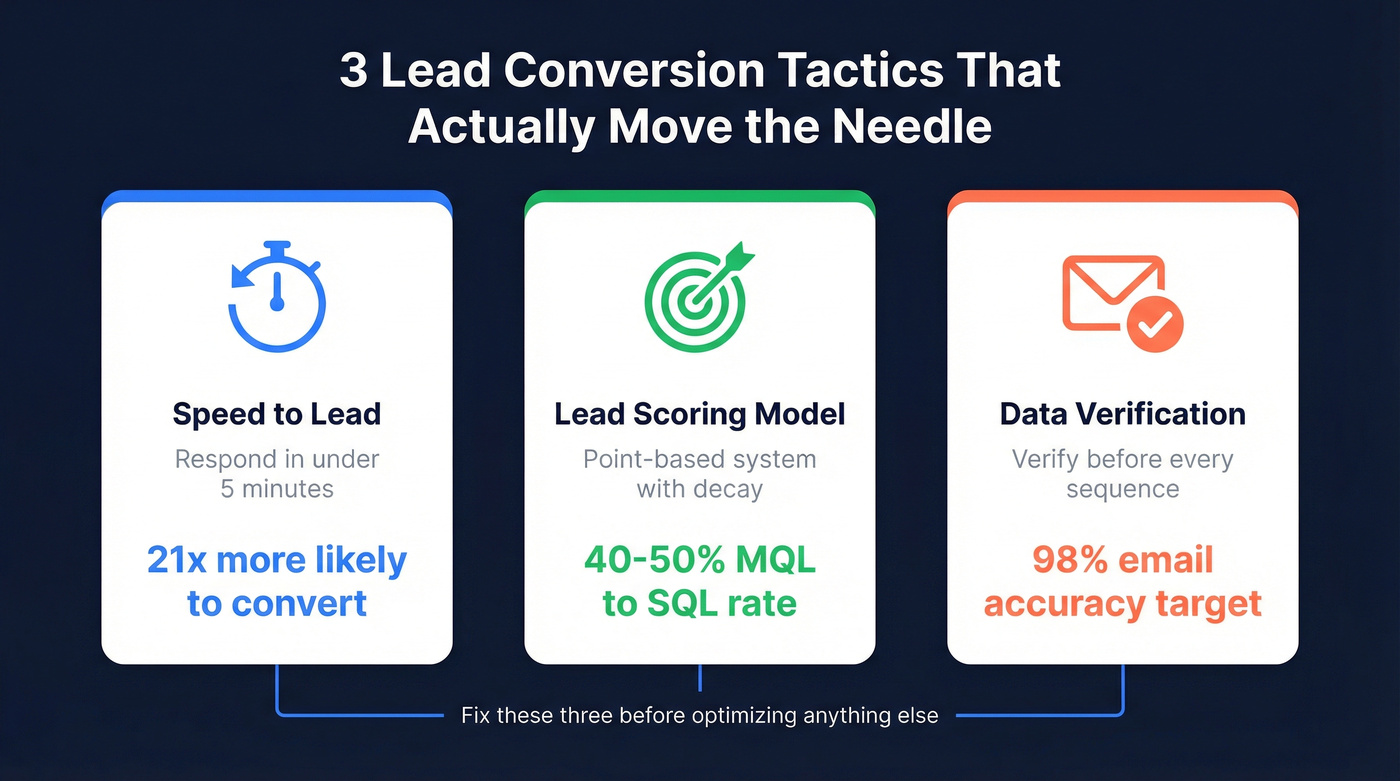
- Automate speed-to-lead to under 5 minutes. Auto-routing, instant scheduling, chatbots - whatever gets a qualified response in front of the lead before they tab away.
- Build a real scoring model. Not "hot/warm/cold" in a spreadsheet. A point-based system with positive and negative signals, a defined MQL threshold, and monthly decay. Template below.
- Verify contact data before running any sequence. If 15-20% of your emails bounce, your cadence is wasted effort. Verified data with 98% email accuracy means your sequences actually reach real inboxes.

A 35% bounce rate doesn't just waste sequences - it kills your conversion rate at the source. Prospeo's 5-step verification delivers 98% email accuracy, refreshed every 7 days. Meritt cut bounces from 35% to under 4% and tripled pipeline to $300K/week.
Stop optimizing cadences that never reach real inboxes.
Conversion Benchmarks by Industry
Conversion rates vary wildly by vertical. Comparing your B2B SaaS funnel to a legal services firm is meaningless.
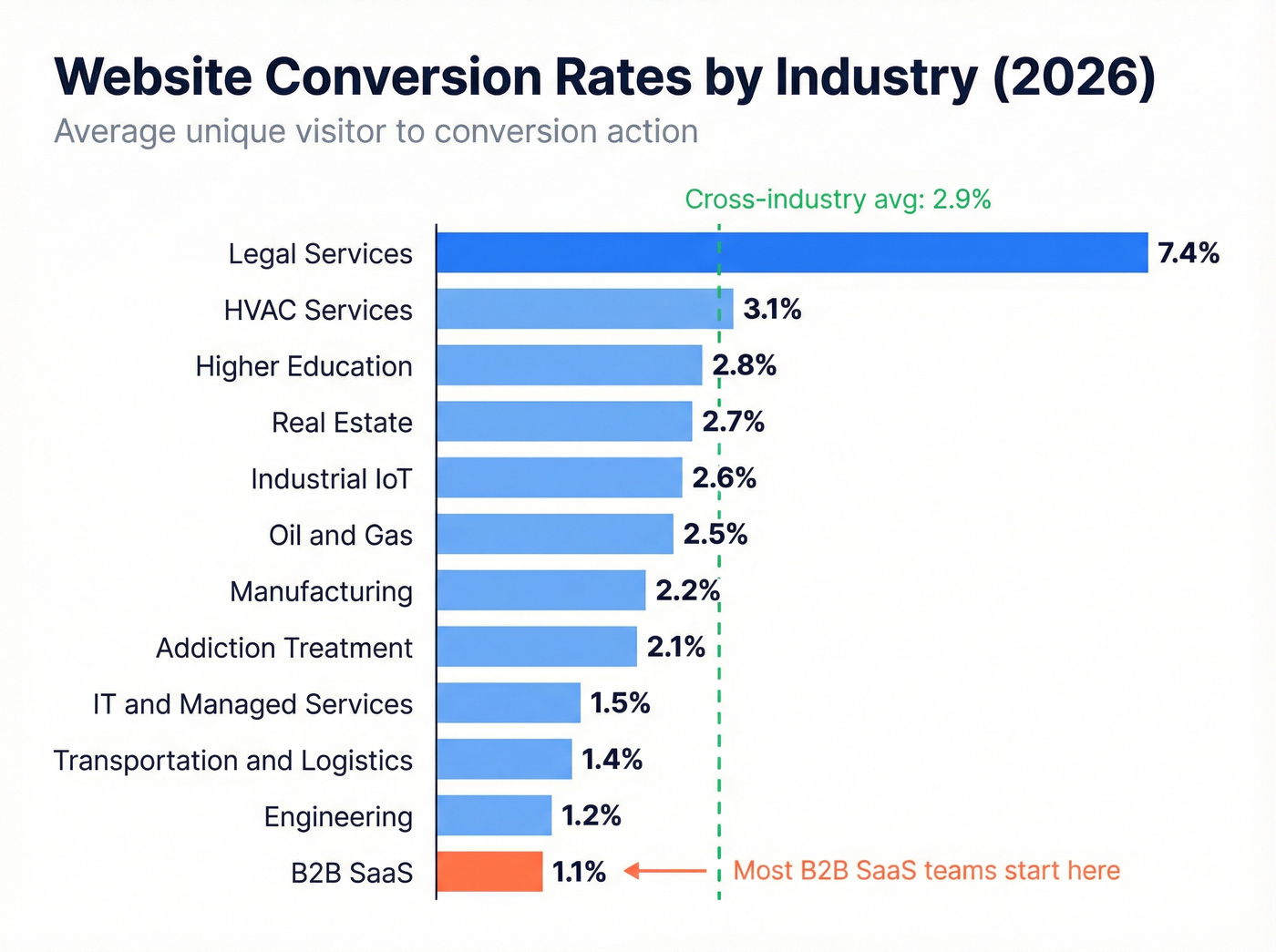
The benchmarks below are website conversion rates (unique visitor to conversion action), pulled from First Page Sage's 2026 industry report:
| Industry | Avg. Website Conversion Rate |
|---|---|
| Legal Services | 7.4% |
| HVAC Services | 3.1% |
| Higher Education | 2.8% |
| Real Estate | 2.7% |
| Industrial IoT | 2.6% |
| Oil & Gas | 2.5% |
| Manufacturing | 2.2% |
| Addiction Treatment | 2.1% |
| IT & Managed Services | 1.5% |
| Transportation & Logistics | 1.4% |
| Engineering | 1.2% |
| B2B SaaS | 1.1% |
The cross-industry average is 2.9% across 100M+ datapoints. When you break it down by channel, forms convert at 1.7%, phone calls at 1.2%, and direct traffic at 3.3%. That direct traffic number matters - people who type your URL or click a bookmark are already warm.
One common pitfall: teams with 6-12 month sales cycles miscalculate conversion by counting closes that started in a prior measurement period. Track cohort-based conversion to avoid this.
For MQL-to-SQL conversion, typical teams land between 25-35% (and if you're building the model from scratch, use a proper RevOps lead scoring process). High-alignment RevOps orgs - where sales and marketing share definitions and scoring criteria - hit 40-50%. That gap is enormous, and it's almost entirely an operational problem, not a demand problem.
10 Proven Tactics to Convert More Leads
Speed-to-Lead
This is the single highest-leverage tactic most teams underinvest in. Responding within 5 minutes makes leads 21x more likely to convert compared to waiting 30 minutes. Wait longer and qualification likelihood craters - leads that sit untouched for 24+ hours are 60x less likely to qualify than those contacted within the first hour.
And 78% of customers buy from the business that responds first.
The math is brutal and simple. Ask any SDR manager what kills their conversion rate and you'll hear the same two answers: bad data and slow follow-up. We've seen teams obsess over email copy and subject lines while their average response time sits at 4 hours. Fix the response time first - everything else is optimization on top.
Here's the implementation path: auto-route inbound leads to the right rep instantly via your CRM, use tools like Chili Piper for instant scheduling, and deploy chatbots for after-hours coverage. The goal isn't perfection. It's getting something useful in front of the lead within five minutes, because speed-to-lead capitalizes on intent at its peak, and intent decays fast (especially if you don't have a tight inbound lead qualification handoff).
Lead Scoring (With Template)
Use this if: your MQL-to-SQL rate is below 25%, reps complain about lead quality, or you're passing everything to sales and hoping for the best.
Skip this if: you're getting fewer than 50 leads per month - at that volume, just call everyone.
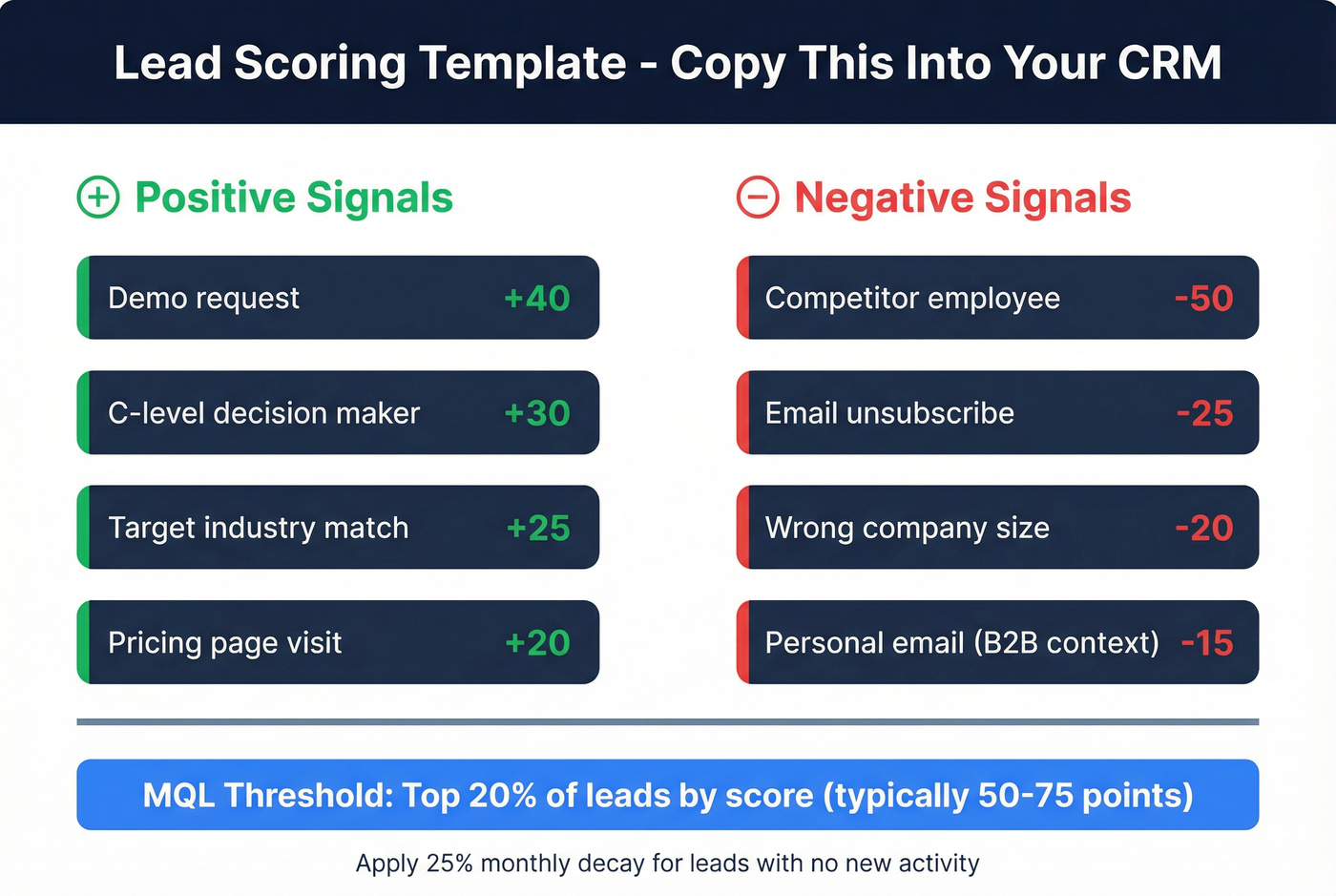
Here's a scoring template adapted from Monday.com's framework that you can copy directly into HubSpot or Salesforce (or follow a full lead scoring system build):
| Signal | Points |
|---|---|
| C-level decision maker | +30 |
| Target industry match | +25 |
| Pricing page visit | +20 |
| Demo request | +40 |
| Personal email (B2B context) | -15 |
| Competitor employee | -50 |
| Email unsubscribe | -25 |
| Wrong company size | -20 |
| Single page bounce | -10 |
Set your MQL threshold to capture the top 20% of leads by score - typically 50-75 points on a 100-point scale. Teams using this threshold approach report 15-25% conversion rates from qualified leads to closed deals. Build in time-based decay: reduce scores by 25% monthly without new activity. A lead who visited your pricing page six months ago isn't the same lead today.
Some RevOps teams split this further - score for intent (behavioral signals) and grade for fit (A-F based on ICP match). If you're running both, the MQL threshold should require a minimum grade plus a minimum score. This dual-scoring approach is especially useful when you need to prioritize high-value prospects who match your ICP and show active buying signals at the same time (see ABM lead scoring for account-level weighting).
The diagnostic is simple. If your MQL-to-SQL rate is below 25%, your scoring criteria are too broad. If it's above 50% but volume is low, you're being too strict. Adjust quarterly.
Data Quality and Verification
Here's the thing: this is the silent conversion killer. If your email bounce rate is above 5%, your follow-up cadence is reaching fewer leads than you think. Every bounced email is a wasted touch, a hit to your sender reputation, and inflated CPL that makes your funnel metrics lie to you (and it usually traces back to B2B contact data decay).
Meritt was running a 35% bounce rate - pipeline sat at $100K/week. After switching to verified data, bounce rate dropped under 4% and pipeline tripled to $300K/week. Snyk had 50 AEs prospecting 4-6 hours per week with 35-40% bounce rates. Once they cleaned up their data, bounce rate fell under 5%, AE-sourced pipeline jumped 180%, and they were generating 200+ new opportunities per month.
In our experience, teams that clean their data before launching sequences see conversion lifts within the first week - not because the messaging changed, but because the emails actually landed. Prospeo checks emails in real-time with 98% accuracy and refreshes data every 7 days, compared to the 6-week industry average refresh cycle. When your scoring model and cadence depend on reaching real people, that accuracy gap compounds at every stage of the funnel (use a dedicated email checker tool or an email ID validator to keep lists clean).
Follow-Up Cadence
80% of sales require at least five follow-ups, yet 44% of reps quit after one attempt. That's not a strategy problem - it's a discipline problem. The optimal cadence runs 8-12 touches over 17-21 days across multiple channels.
Here's a cadence you can steal (or plug into a proven sales cadence example):
| Day | Action |
|---|---|
| Day 1 | Email within 2 hours of trigger |
| Day 3 | Value email + social connection |
| Day 5 | Phone call |
| Day 8 | Social proof email (case study) |
| Day 10-14 | Breakup email with final CTA |
Before Day 1, verify your list. If 15% of your emails bounce, you're burning 15% of every touch in your cadence - and tanking your sender reputation in the process. The reps who persist past touch five are working the same leads everyone else abandoned.
Lead Nurturing
Not every lead is ready to buy today. Full-funnel nurturing generates 50% more sales-qualified leads at 33% lower cost than skipping straight to the pitch.
Map content to funnel stages: top-of-funnel builds trust with educational content, mid-funnel addresses purchase barriers with comparison guides and ROI calculators, and bottom-of-funnel deploys social proof, demos, and limited-time offers. One SaaS team running a multi-channel nurturing sequence saw a 37% increase in qualified conversations in 30 days and shortened their sales cycle by nearly two weeks. The takeaway isn't "nurture more" - it's "nurture with stage-appropriate content instead of blasting the same pitch at every lead." (If you need sequences, start with lead nurturing emails.)
Multi-Channel Outreach
Email alone isn't enough. 67% of buyers prefer self-service over talking to a rep. So offer forms, chat, and async options alongside direct rep outreach. Meet the buyer where they want to be met - not where it's most convenient for your SDR workflow (a modern B2B sales stack makes this easier to operationalize).
Landing Page and CTA Optimization
One CTA per page. Fewer form fields. A/B test headlines before anything else.
Teams still run landing pages with three competing CTAs and a 12-field form, and then wonder why conversion is low. Every additional field drops your conversion rate. Simplify ruthlessly.
Social Proof
79% of marketing leads never convert into sales. Social proof closes the trust gap that generic nurturing can't. Where to place it for maximum impact:
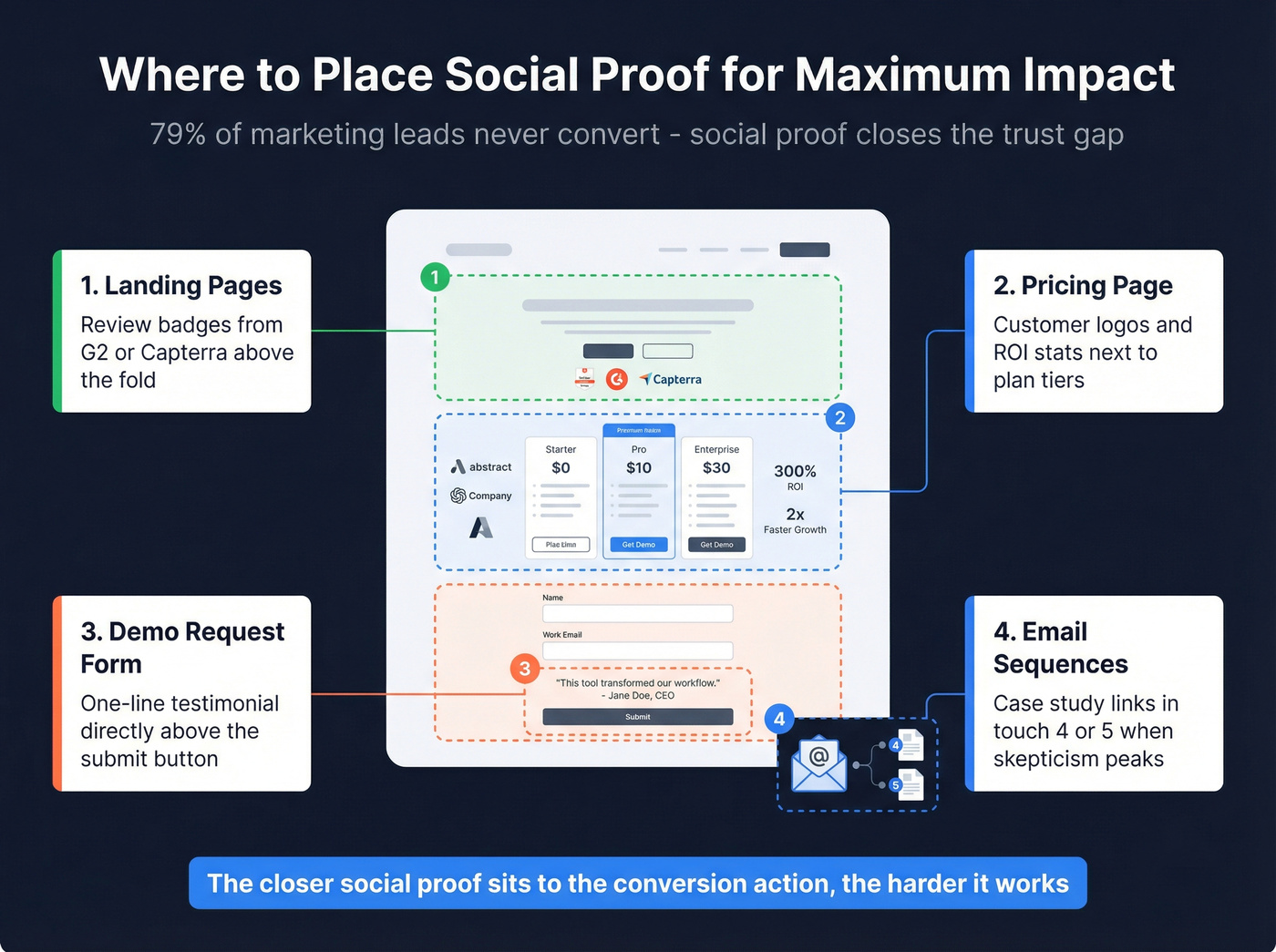
- Pricing page: customer logos and ROI stats next to plan tiers
- Demo request form: one-line testimonial directly above the submit button
- Email sequences: case study links in touch 4 or 5, when skepticism peaks
- Landing pages: review badges from G2 or Capterra above the fold
The closer social proof sits to the conversion action, the harder it works. Burying case studies in a resources section is a waste.
Sales-Marketing Alignment
High-alignment organizations hit 40-50% MQL-to-SQL conversion versus 25-35% for typical teams. The fix isn't cultural - it's operational.
Let's be honest about the diagnostic here. Can your sales team define an MQL without checking the wiki? Does marketing know the top three objections reps hear on calls? When was the last time both teams reviewed scoring criteria together? If any answer is "no" or "never," that's your conversion leak. Shared definitions, joint scoring reviews, and CRM integration across the RevOps stack close this gap faster than any demand gen campaign (this is the core of revenue operations alignment).
AI and Automation
If your average deal size is under $10K, you probably don't need a full-stack AI sales platform. But you absolutely need AI handling the grunt work.
71% of organizations already use generative AI in sales. AI scoring models reduce qualification time by up to 30%. Sales reps spend roughly 72% of their time on non-selling work, and automation reclaims 18-22 hours per week per rep. The teams winning right now aren't replacing reps with AI - they're using AI to handle scoring, routing, initial outreach, and data enrichment so reps spend their time on actual selling conversations (see AI lead qualification and AI CRM data entry automation). The human handoff still matters. But everything before it should be automated.
Lead scoring only works when your contact data connects reps to real buyers. Prospeo gives you 300M+ verified profiles with 30+ filters - buyer intent, job changes, technographics - so every lead that hits your scoring model is reachable. At $0.01 per email, bad data isn't a budget problem. It's a choice.
Score leads that actually pick up the phone.
Lead Conversion FAQ
What's a good lead conversion rate?
The cross-industry average is 2.9% across 100M+ datapoints, but benchmarks vary sharply by vertical - legal services average 7.4% while B2B SaaS averages 1.1%. Always compare against your specific industry, not a generic number.
How many follow-ups does it take to convert a lead?
Research shows 80% of sales require at least five follow-ups, yet 44% of reps stop after one attempt. Run 8-12 touches over 17-21 days across email, phone, and social. The reps who persist past touch five are working leads everyone else abandoned.
How does data quality affect conversion rates?
Bounce rates above 5% mean your cadence is reaching fewer prospects than you think while damaging sender reputation. A 7-day data refresh cycle and 98% email accuracy keep sequences hitting real inboxes - compared to 87% accuracy at ZoomInfo and 79% at Apollo, where stale data silently kills pipeline.