


Prospeo vs Reoon: Full Platform or Standalone Verifier?
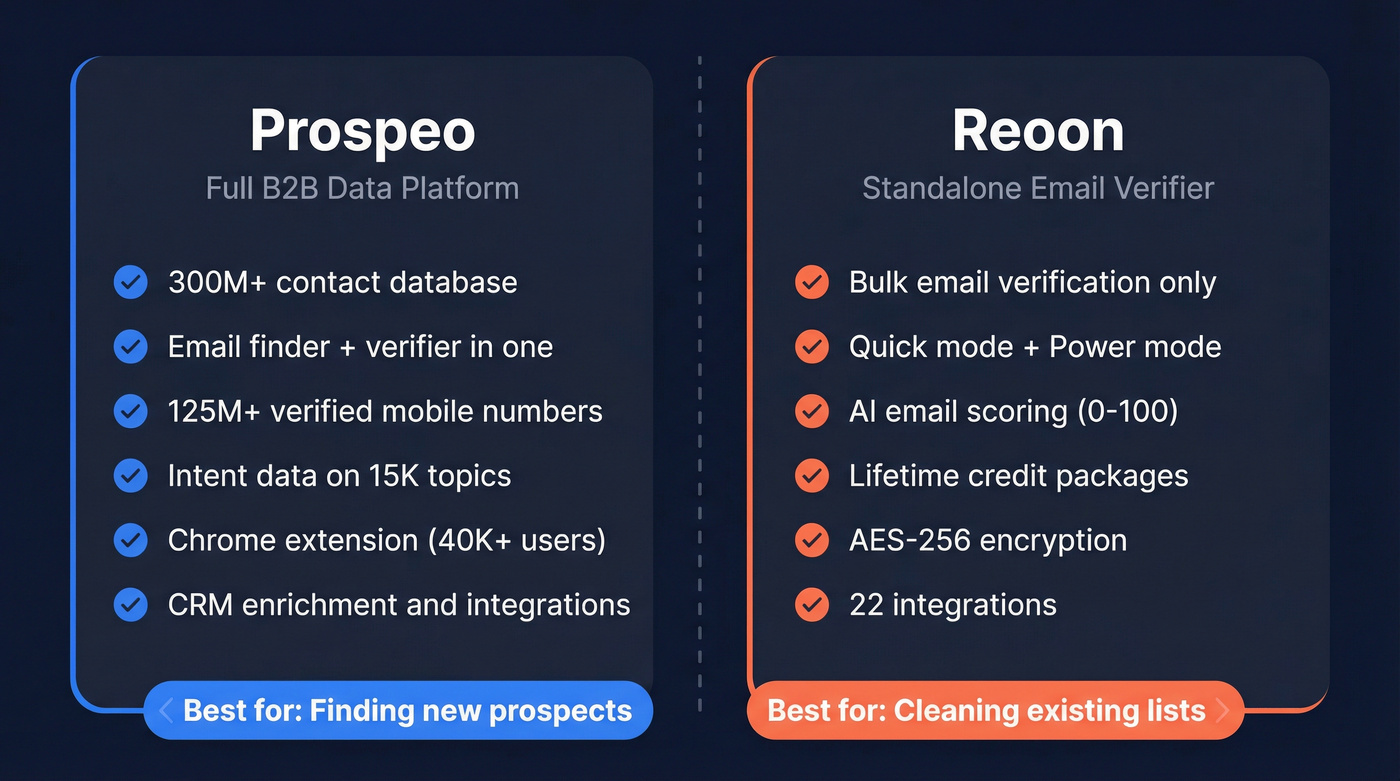
Most Prospeo vs Reoon comparisons pretend these tools are interchangeable. They aren't. Reoon is a standalone email verifier. Prospeo is a full B2B data platform that finds, verifies, and enriches contacts from scratch. Lumping them into the same category is how teams end up paying for two tools when one would've covered the job, or worse, shipping dirty data straight into their sequencer because a verifier alone couldn't fix what was broken upstream.
Yes, both touch verification. That's where the overlap ends.
30-Second Verdict
- Pick Prospeo if your SDR team needs 500 new prospects this week and you're starting from zero. It finds, verifies, and enriches in one workflow (more on sales prospecting techniques that scale).
- Pick Reoon if you exported 5,000 trade-show leads and need to clean the list before Monday. Bulk verification is fast and dirt cheap (see business email validation basics).
- Need both? Use Reoon to clean legacy lists, and Prospeo for everything else - new list building, enrichment, and mobile numbers.
Feature Comparison
| Feature | Prospeo | Reoon | Edge |
|---|---|---|---|
| Product type | Data platform | Email verifier | Prospeo |
| Database size | 300M+ profiles | N/A | Prospeo |
| Email verification | 5-step, 98% accuracy | 99%+ (published claim) | Tie |
| Mobile numbers | 125M+ | No | Prospeo |
| Catch-all handling | Yes | Yes (Power mode) | Tie |
| AI email scoring | No | Score out of 100 | Reoon |
| Security | GDPR compliant | AES-256 + GDPR | Tie |
| API modes | Search API + Enrich API | Quick + Power | Prospeo (broader) |
| CRM integrations | Salesforce, HubSpot, Smartlead, Instantly, Lemlist, Clay, Zapier, Make | 22 integrations | Reoon (quantity) |
| Intent data | 15K topics via Bombora | No | Prospeo |
| Chrome extension | Yes (40K+ users) | No | Prospeo |
| Data refresh cycle | 7 days | N/A | Prospeo |
Verification Accuracy
Reoon's API has two modes, and the difference matters more than most buyers realize.
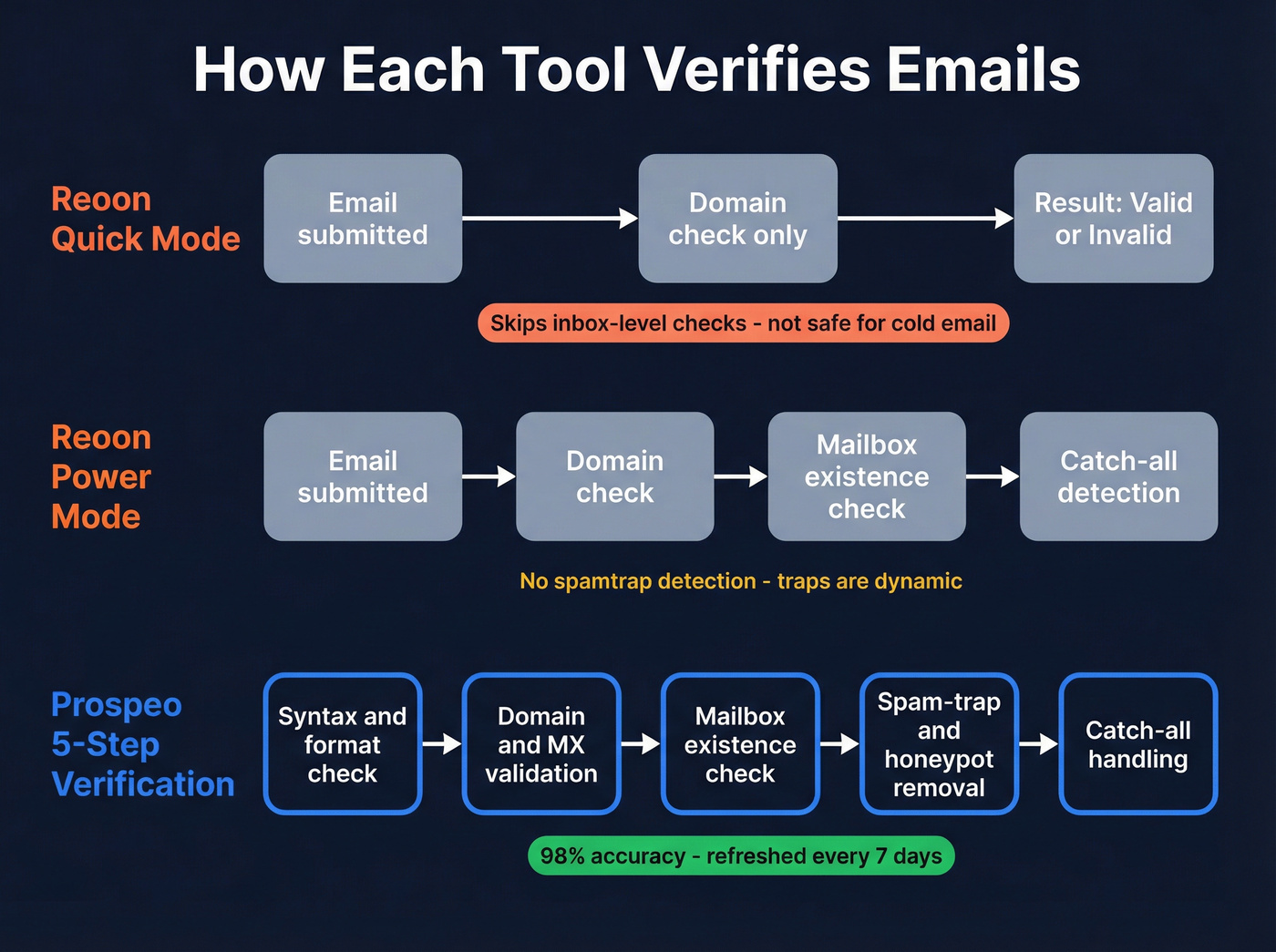
Quick mode returns results in under 0.5 seconds but doesn't check individual inbox status. An address on a valid domain can get marked "valid" even when the mailbox doesn't exist. That's fine for real-time form validation. Skip it for cold email campaigns (use a proper cold email setup instead).
Power mode is the real verifier: it checks mailbox existence and catch-all behavior, though it can take seconds to over a minute per address. One caveat straight from Reoon's own documentation - there's no guarantee on spamtrap detection because traps are dynamic and constantly shifting.
Prospeo takes a different approach with 5-step verification that includes dedicated spam-trap removal and honeypot filtering as standard, plus a 7-day refresh cycle so you're not re-verifying stale records. We've found that the freshness angle matters more than people expect; a "verified" email from six weeks ago can bounce today if someone changed jobs, and with the average data refresh in this industry sitting around six weeks, that's a real problem.
Here's the thing about published accuracy claims: they rarely match real-world results. Hunter ran a test of 15 verifiers and top accuracy landed around 67-70%, while Icypeas' benchmark reported results as high as 97%. The deliverability rule of thumb stays the same regardless: keep hard bounces under 1%, total bounces under 2% (see average bounce rate for email campaigns).


Why pay for a verifier and a separate data source? Prospeo's 5-step verification is built into every search across 300M+ profiles - 98% email accuracy, spam-trap removal, and a 7-day refresh cycle included. No bolting tools together.
Replace your finder + verifier stack with one platform at $0.01/email.
Pricing Breakdown
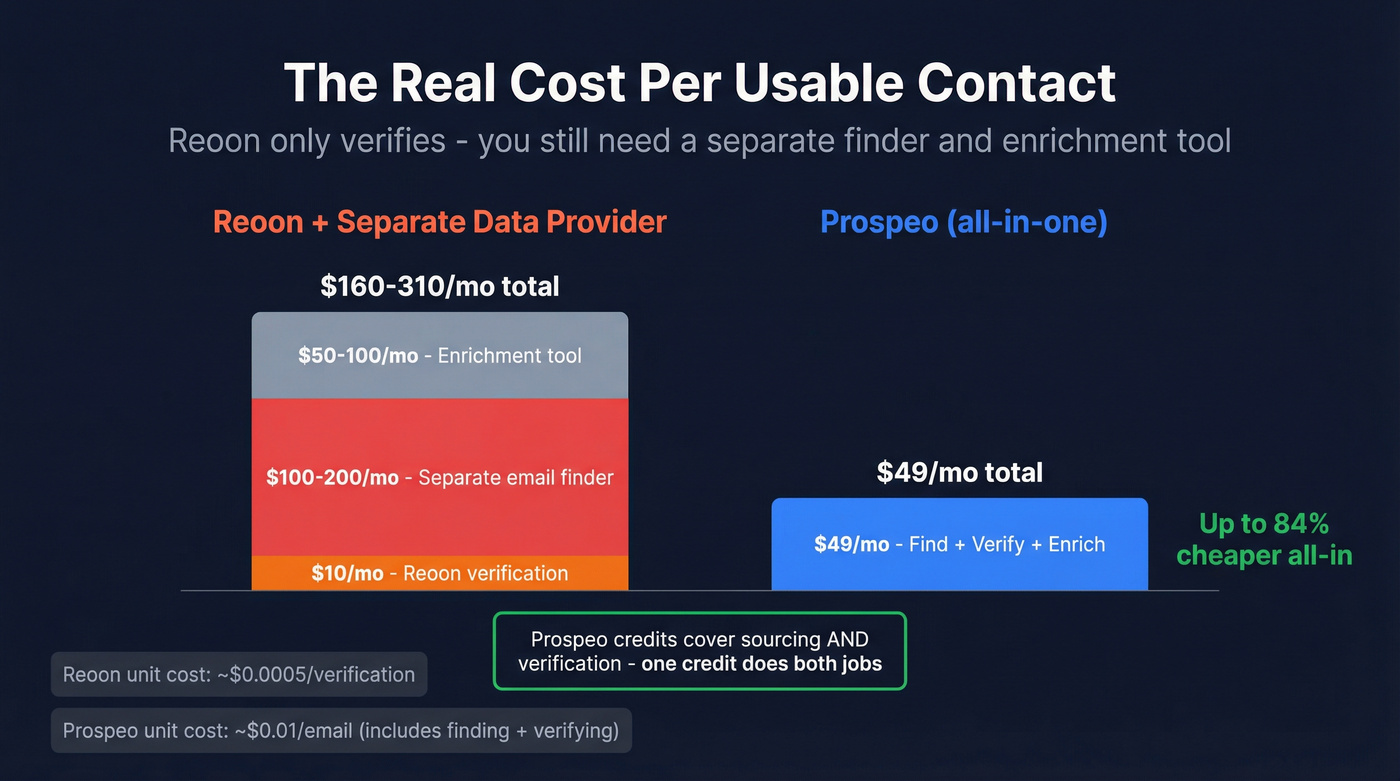
Reoon is priced like a utility. Prospeo is priced like a platform - you're paying for finding + verifying + enriching, not just checking SMTP.
| Pricing | Prospeo | Reoon |
|---|---|---|
| Free tier | 75 emails + 100 Chrome credits/month | 600 credits/month |
| Entry paid plan | $49/month (2,000 credits) | $9.95/month (15,000 credits) |
| Unit cost | ~$0.01/email | ~$0.0005-0.0007 per verification |
| Credit logic | Pay only for valid results | 1 credit per successful verification (valid, invalid, catch-all); unknown refunded |
Reoon also offers lifetime credits that don't expire, scaling up to 1M credits for $960. That's attractive for agencies doing volume.
The gotcha teams miss: Reoon charges credits for valid, invalid, and catch-all results. Only "unknown" gets refunded - this shows up as a recurring point of confusion in Trustpilot reviews. Prospeo's credit model is apples-to-oranges: a single credit can source the contact and verify it, which often replaces a separate "finder + verifier" stack entirely. When you factor in the sourcing tools you'd otherwise need, the all-in cost per usable contact often comes out lower with Prospeo despite the higher per-unit price (compare broader pay-as-you-go B2B data options).
When to Use Each Tool
Reoon Fits List-Cleaning Workflows
Reoon is one of the cheapest ways to clean a list. Period. It holds a 4.8/5 on G2 with over 1,000 reviews, and it's a frequent recommendation in cold email communities - threads on r/coldemail regularly mention it as the budget pick for agencies. The recurring praise centers on speed and accuracy; the recurring gripe is a basic dashboard and slow email-only support.
If you already have lists from trade shows, webinar signups, or old CRM exports and just need to scrub them before loading into your sequencer, Reoon does that job well for very little money (especially if you're investing in data hygiene upstream).
Prospeo Fits End-to-End Prospecting
Let's be honest: most teams comparing these two don't actually need a standalone verifier. They need better data upstream. We've run bake-offs where the "cheap verifier + random list source" combo looked great on paper, then fell apart when reps needed mobiles, enrichment fields, and dedupe control. One team we worked with was spending $10/month on Reoon and $150/month on a separate data provider, plus hours of manual cleanup - and still bouncing at 8%.
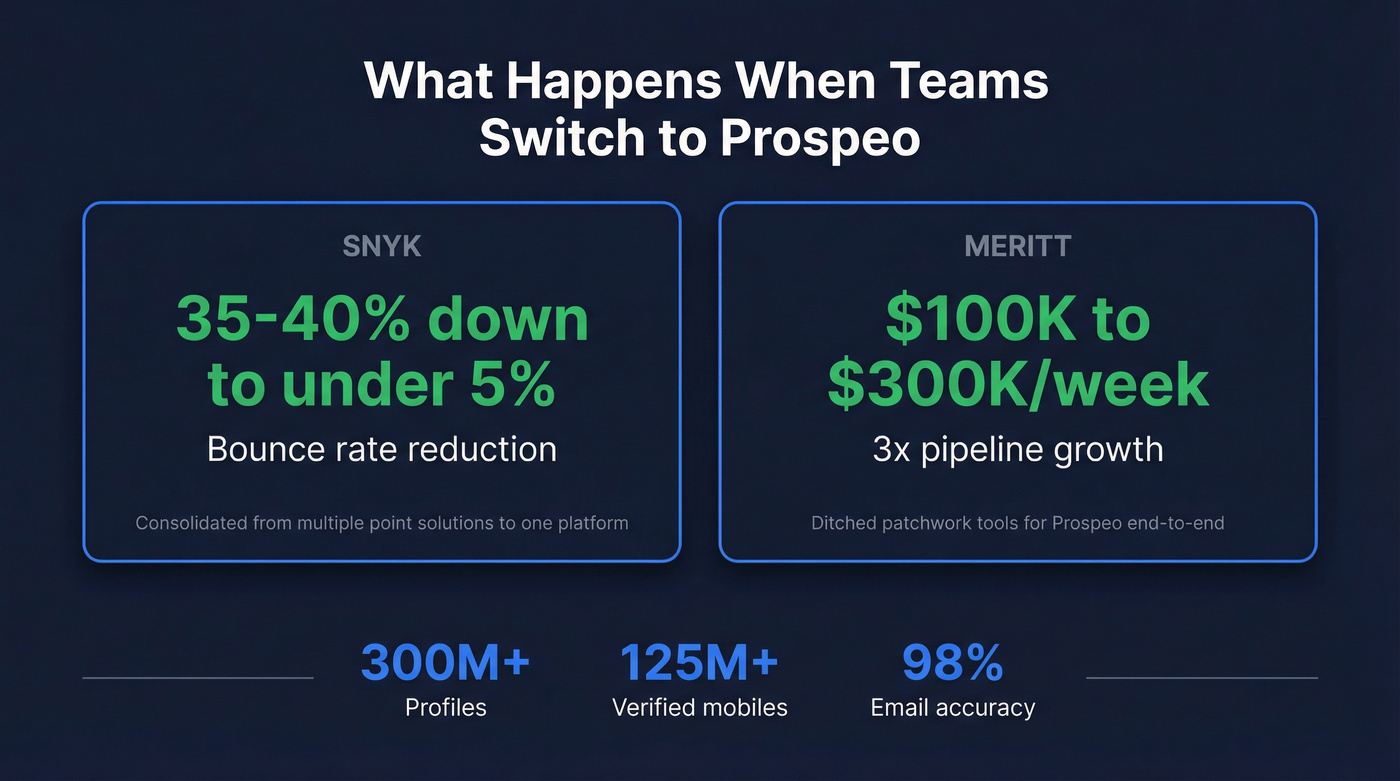
Prospeo's 300M+ profiles and 125M+ verified mobile numbers solve the sourcing problem, and the built-in 5-step verification means you aren't bolting on a second tool. Snyk cut bounce rates from 35-40% to under 5%, and Meritt tripled pipeline from $100K to $300K per week - both by consolidating onto one platform instead of stitching together point solutions (see how this fits into a modern sales prospecting playbook).

Final Verdict
The real question isn't Prospeo vs Reoon - it's whether you need a verifier or a data platform. Reoon is excellent at its niche: cheap, fast bulk verification for lists you already have. But if your problem is "we don't have enough good contacts and our CRM is stale," a verifier alone won't fix that (you likely need a sales data platform).
For most outbound teams building pipeline in 2026, Prospeo is the more complete answer.
Meritt tripled pipeline from $100K to $300K/week and cut bounces from 35% to under 4% - by ditching their patchwork of point solutions for Prospeo. 125M+ verified mobiles, intent data on 15K topics, and CRM enrichment included.
Find, verify, and enrich contacts in one click - no second tool needed.
FAQ
Can I use Prospeo and Reoon together?
Yes - use Prospeo to build new lists and Reoon to re-verify old imported lists before sending. In practice, Prospeo's built-in 5-step verification makes the extra verifier step redundant for most teams sourcing fresh contacts, but if you're sitting on a massive legacy database, the combo works.
Is Reoon's Quick mode accurate enough for cold email?
No. Use Power mode for outbound. Quick mode skips inbox-level checks and can mark non-existing mailboxes as valid when the domain checks pass - that's exactly how bounce rates creep above 2%.
What's the real cost difference?
Reoon costs as low as ~$0.0005 per verification but only verifies emails you already have. Prospeo costs ~$0.01 per email but finds, verifies, and enriches contacts - so the all-in cost is often lower once you factor in the sourcing tools you'd otherwise need separately.