

The Sales Prospecting Playbook Your Team Will Actually Use
84% of reps missed quota last year. 92% of buyers already have a vendor in mind before your rep even picks up the phone. The problem isn't effort - it's that most sales prospecting playbooks are 50-page PDFs nobody opens after onboarding week.
This one's different. Four components, one page each, templates and benchmarks baked in. If a new rep can't run this from memory after a week, you've overbuilt it. (If you need a ramp plan to match, use a 30-60-90 day plan.)
What Goes in the Playbook
Your entire playbook fits into four pieces:
- Scored ICP rubric so reps stop wasting time on accounts that'll never close (use an ideal customer profile template if you want a starting point)
- 7-touch multi-channel cadence with the day-by-day sequence and channel mix (more sales prospecting techniques here)
- 2-3 email templates under 75 words - copy/paste, not "customize extensively" (see sales follow-up templates)
- 3-tool stack covering verified data, enrichment, and sequencing (browse SDR tools)
Everything else is optional.
Build Your ICP Scoring Rubric
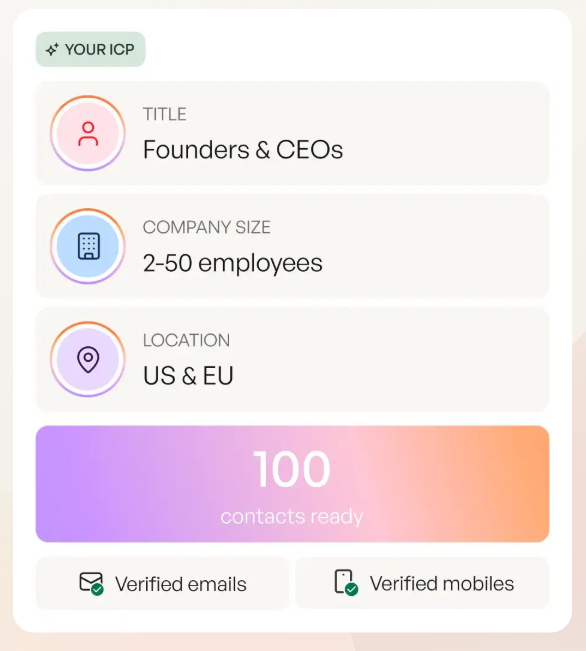
Start with your last 50-100 closed-won deals. 70-80% of wins share 3-5 common traits - industry, headcount range, tech stack, or a specific trigger event. Those traits become your rubric.
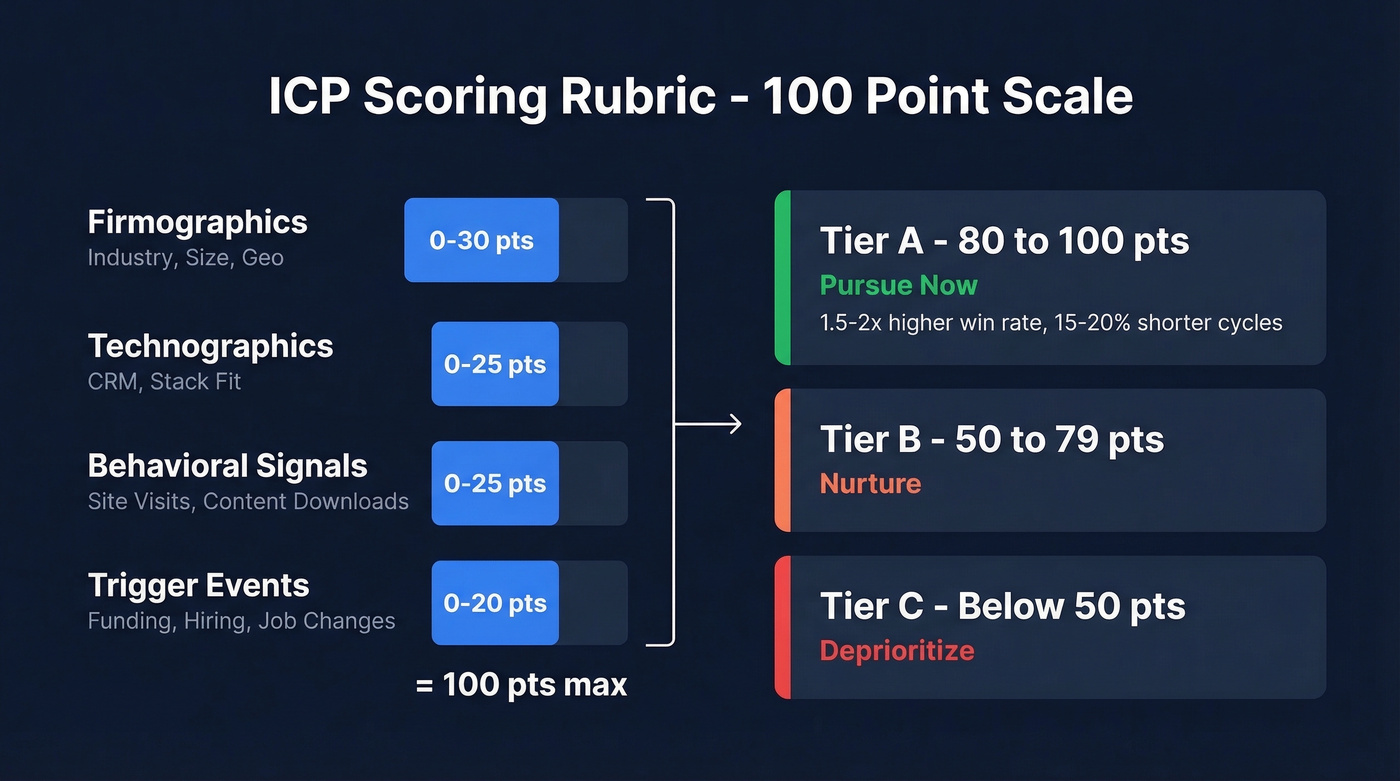
One distinction most teams get wrong: ICP scoring evaluates accounts on structural fit, while lead scoring evaluates contacts on behavior. Don't confuse the two. Your rubric should score the company first, then find the right people inside it.
Score accounts on a 100-point scale:
| Category | What to Score | Points |
|---|---|---|
| Firmographics | Industry, size, geo | 0-30 |
| Technographics | CRM, stack fit | 0-25 |
| Behavioral signals | Site visits, content | 0-25 |
| Trigger events | Funding, hiring, job change | 0-20 |
Tier your accounts: A (80-100) pursue now, B (50-79) nurture, C (below 50) deprioritize. Tier A win rates run 1.5-2x higher than Tier B, with 15-20% shorter sales cycles. That math is the entire reason this rubric exists.
Today's buying decisions involve roughly 13 internal stakeholders plus 9 external influencers, which means your rubric needs to account for that complexity - score the account, then map the buying committee inside it.
The 7-Touch Outbound Cadence
This is the centerpiece. Benchmark data shows top BDRs average 21 attempts per contact across about 8 calls, 8 emails, and 5 social touches. You don't need all 21 on day one. Here's the baseline 7-touch cadence over 10 business days:
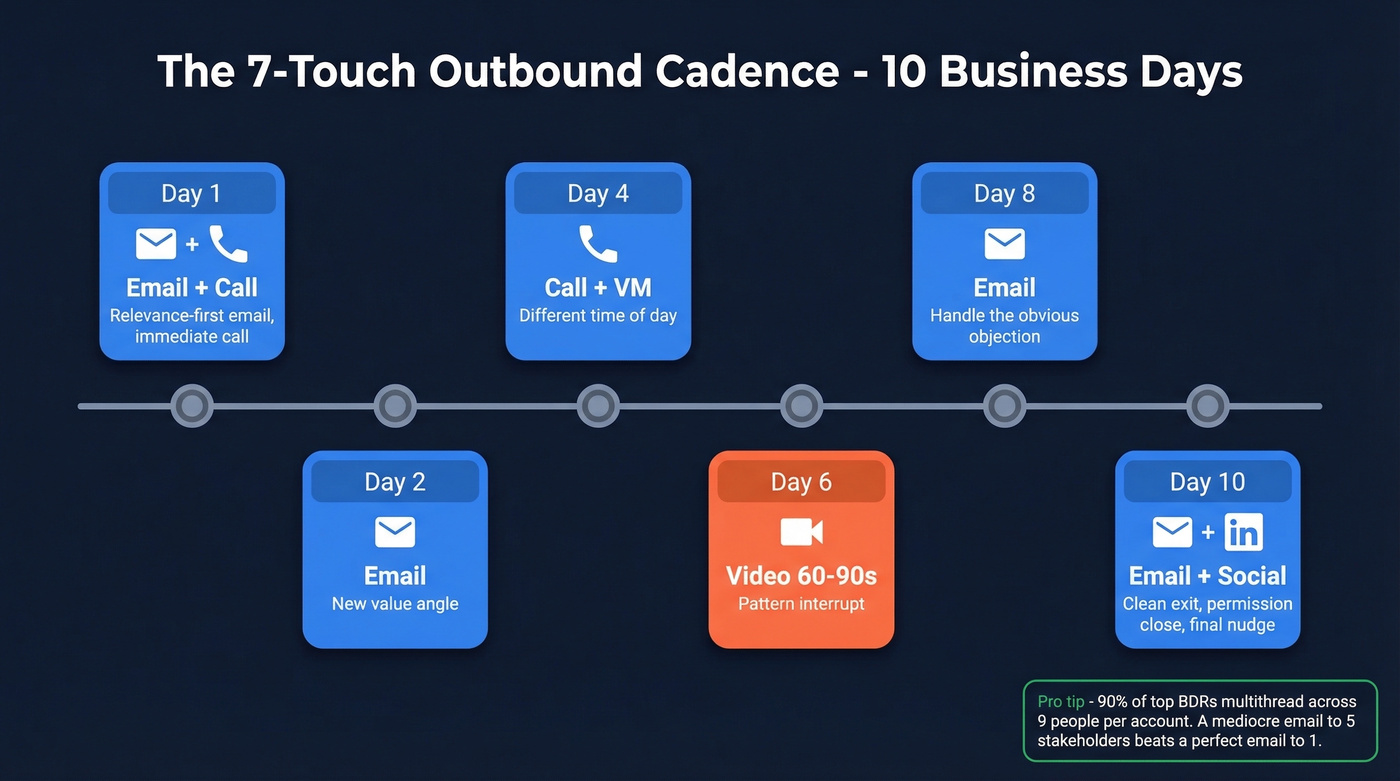
| Day | Channel | Purpose |
|---|---|---|
| 1 | Email + Call | Relevance-first email; immediate call |
| 2 | New value angle | |
| 4 | Call + VM | Different time of day |
| 6 | Video (60-90s) | Pattern interrupt |
| 8 | Handle the obvious objection | |
| 10 | Clean exit / permission close | |
| 10 | Social touch | Final nudge, same day or next business day |
Stretch the total cadence to 14-21 days when you need room to multithread, test angles, or work multiple time zones. There's a hard cliff after that - win rates hit 47% for opportunities closed within 50 days, then drop to around 20%. Speed matters more than persistence past a point.
Here's the thing: most teams obsess over email copy when the real difference-maker is multithreading. 90% of top BDRs multithread, reaching about 9 people per account. A mediocre email sent to five stakeholders outperforms a perfect email sent to one. Build multithreading into your cadence from day one.
Regional nuances matter. APAC and EMEA prospects respond to fewer touches. In DACH markets, triple-touching on day one feels intrusive. Adjust cadence density, not structure.
Signal-Based Variant
When an intent signal fires - a pricing page visit, a competitor evaluation, a relevant job posting - compress the cadence. First touch within 24 hours of the signal lifts response rates 2-3x. Calendar-driven cadences are the baseline; signal-driven cadences are where real conversion happens. (If you want a system for this, see how to track sales triggers.)

Your 7-touch cadence dies the moment a bad email bounces. Prospeo's 5-step verification delivers 98% email accuracy and 125M+ verified mobiles - so every touch in your playbook actually reaches a real buyer. At $0.01 per email, even a 50-rep team scales without enterprise contracts.
Stop building playbooks on data that burns your domains.
Email Templates That Get Replies
35% of recipients open based on the subject line alone](https://clearout.io/blog/cold-email-templates/). Keep subject lines under 50 characters. Keep body copy under 75 words. Here's the Touch 1 structure:
Subject: [Trigger] at [Company]
Hi [Name],
Saw [specific trigger - funding round, new hire, tech adoption]. Teams in [their role] usually hit [specific pain] when that happens.
[One-line proof: "We helped [similar company] cut [metric] by X%."]
Worth a quick look, or should I close the loop?
Trigger, role pain, proof, low-friction CTA. That's it. The breakup email on Day 10 follows the same structure but with a permission close: "Should I check back next quarter, or is this a dead end?"
Deliverability Checklist
Run through this before any cadence goes live:
- Warm new domains for 21+ days minimum
- Avoid spam-trigger words (FREE, GUARANTEED, all caps)
- Include an opt-out mechanism and clear sender details
- Verify your list before it touches a sequencer - spam traps, honeypots, and catch-all domains will tank your sender reputation fast (use an email deliverability guide and track your email bounce rate)
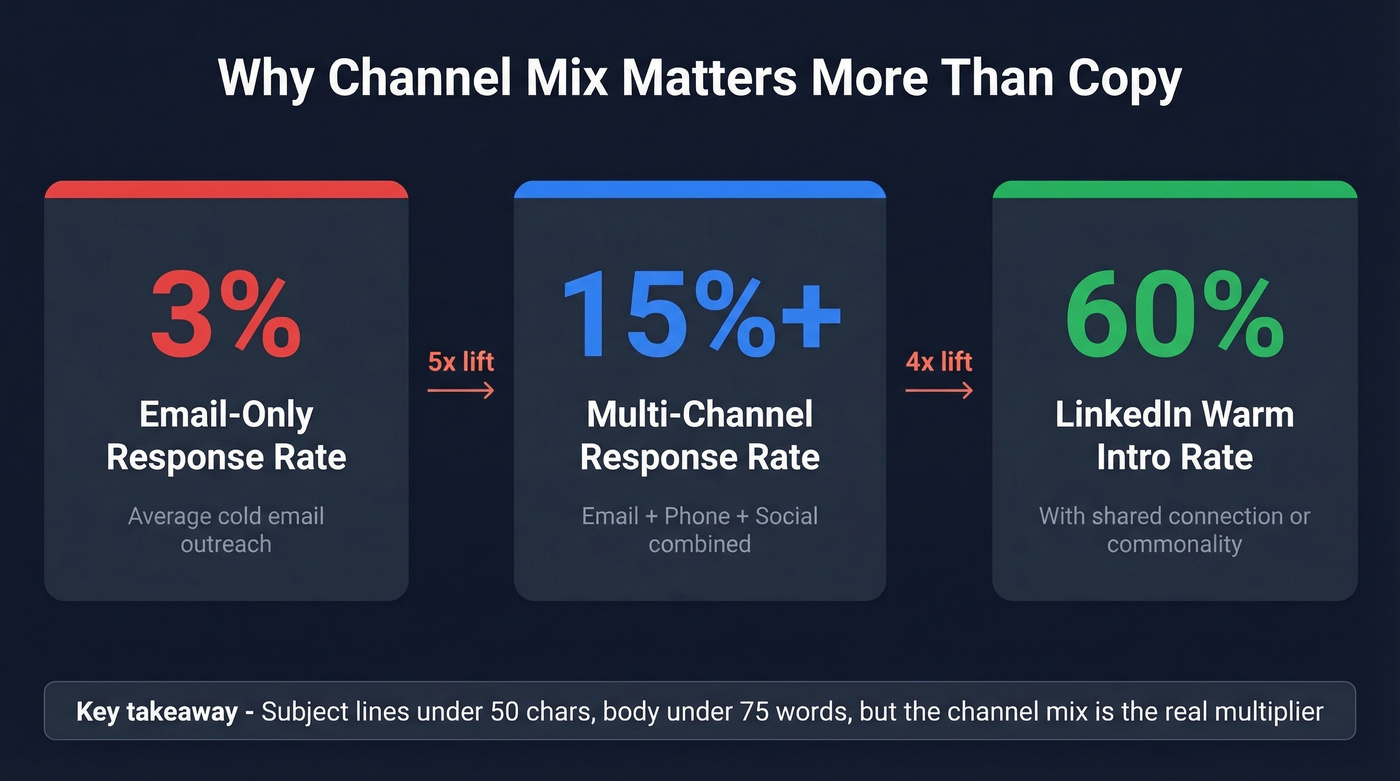
Email-only outreach averages around 3% response rates. Multi-channel cadences push that to 15%+. LinkedIn warm intros lift response rates up to 60%. The templates matter, but the channel mix matters more.
Mistakes That Kill Pipeline
Giving up at 2-3 touches. 43% of buyers who accept meetings say it's fine to contact them five or more times. Most reps quit before the prospect even notices them.

Sending to bad data. We've seen teams burn entire domains because they skipped list verification. A 35% bounce rate doesn't just kill one campaign - it poisons your sender reputation for months. One of our customers, Snyk, had bounce rates of 35-40% before switching to verified data; after, they dropped under 5% and AE-sourced pipeline jumped 180%. (If you're troubleshooting, start with how to improve sender reputation.)
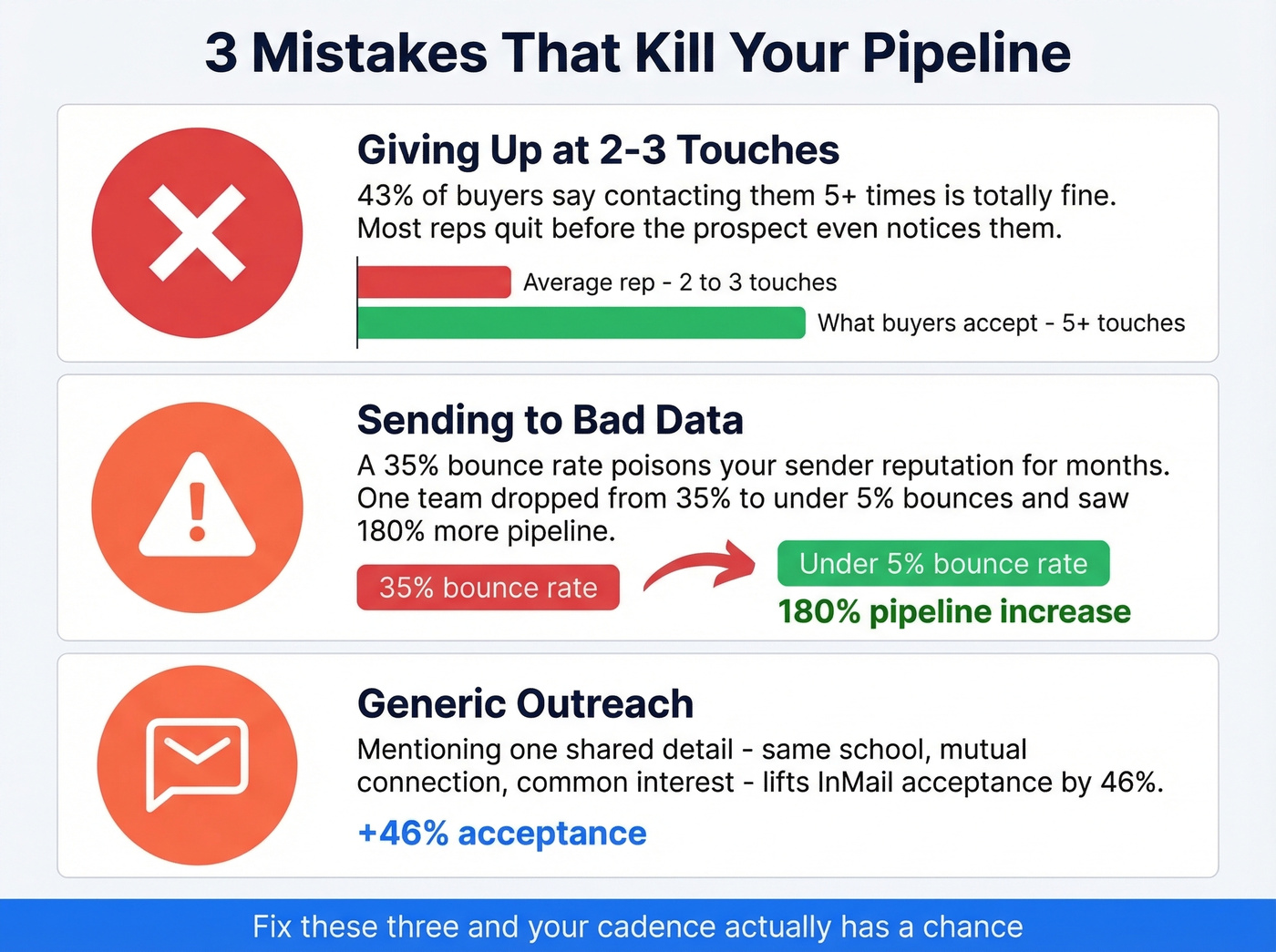
Generic outreach. A 46% lift in InMail acceptance comes from mentioning a single commonality - shared connections, same school, mutual interest. One specific detail beats three paragraphs of "I noticed your company..."
Your 2026 Prospecting Tool Stack
45% of teams already run a hybrid AI-SDR model, and reps using AI tools cut research time by 90%. But the stack doesn't need to be complicated. Three categories, one tool each. (If you're comparing options, start with best sales prospecting databases.)
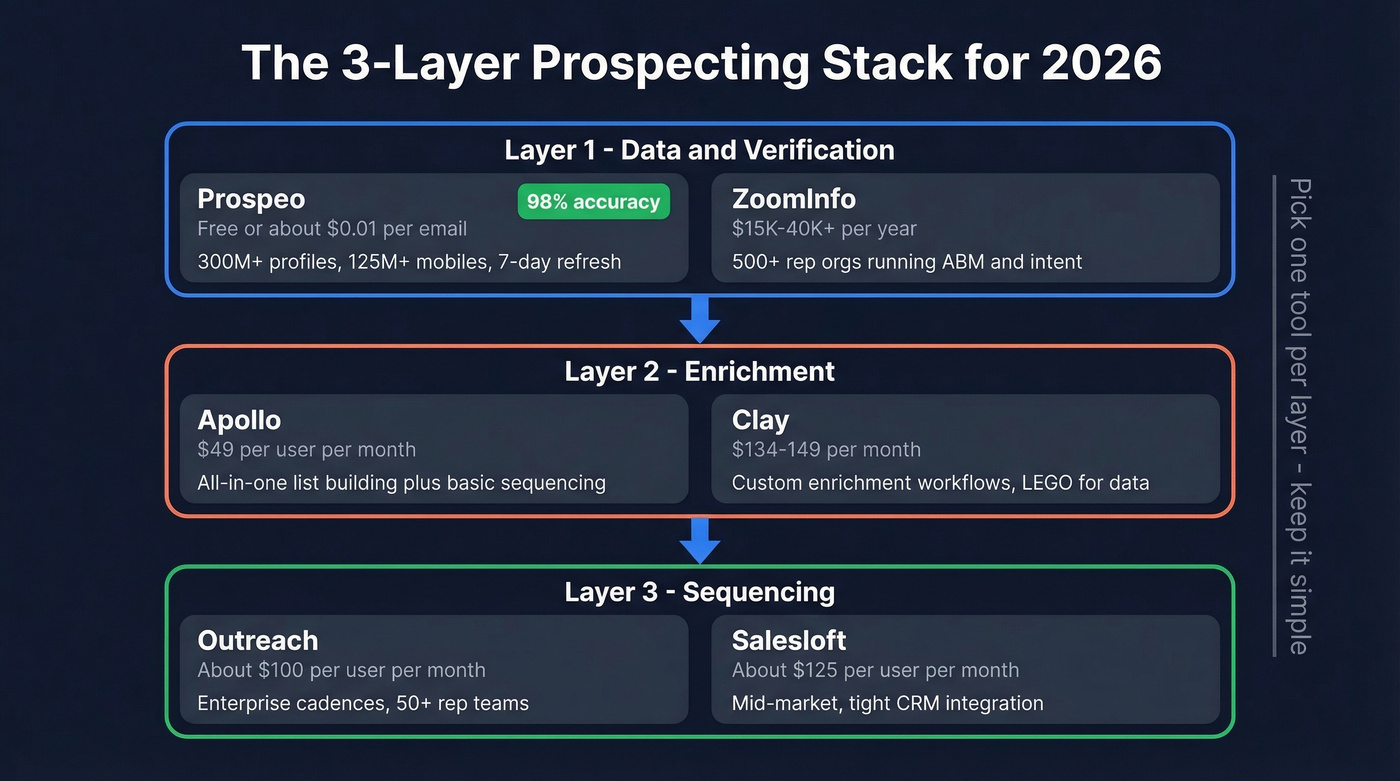
| Tool | Category | Starting Price | Pick This If... |
|---|---|---|---|
| Prospeo | Data & verification | Free / ~$0.01/email | You need accurate emails + mobiles without enterprise pricing |
| Apollo | All-in-one prospecting | $49/user/mo | You want list building + basic sequencing in one tool |
| Clay | Enrichment | ~$134-149/mo | You build custom enrichment workflows |
| Outreach | Sequencing | ~$100/user/mo | You're 50+ reps running enterprise cadences |
| Salesloft | Sequencing | ~$125/user/mo | You want tight CRM integration at mid-market scale |
| ZoomInfo | Enterprise data | ~$15K-40K+/yr | You're 500+ reps running ABM, intent, and outbound from one platform |
Prospeo is what we'd pair with any sequencer for the data layer. It covers 300M+ professional profiles with 98% email accuracy and 125M+ verified mobile numbers on a 7-day refresh cycle - the industry average is 6 weeks. Integrates natively with Outreach, Salesloft, HubSpot, Salesforce, Clay, Instantly, and Lemlist. Meritt tripled their pipeline from $100K to $300K/week after switching, with bounce rates dropping from 35% to under 4%.

Apollo is the easiest default for teams going from zero to a working outbound motion. Broad coverage, built-in sequencing, and a free tier that's genuinely usable. Paid plans start at $49/user/mo. The tradeoff is email accuracy - it's not as tight as a dedicated verification platform.
Clay gets called "LEGO pieces for data" on r/salestechniques, and that's accurate. Flexible enrichment chains let you build weirdly specific prospect lists by pulling technographic signals and cross-referencing hiring data. It's setup-heavy, but nothing else matches the flexibility for teams that need custom workflows. Starts around $134-149/mo on a credit model. (If you're evaluating vendors, see data enrichment services.)
Outreach skews enterprise at ~$100/user/mo. Salesloft fits mid-market well at ~$125/user/mo. Both do the job - pick based on your CRM and team size. ZoomInfo makes sense for 500-person sales orgs running ABM, intent, and outbound from one platform at $15K-40K+/year. For everyone else, skip it. You're paying for modules you'll never activate.
Signal-based cadences only work when you can act on triggers in real time. Prospeo tracks 15,000 intent topics, refreshes data every 7 days, and layers job changes, funding events, and technographics across 300M+ profiles - so your ICP rubric scores itself and your reps reach the right 9 stakeholders per account.
Turn your ICP rubric into a live prospecting engine.
Keep Your Playbook Alive
Review cadence metrics quarterly - reply rates, bounce rates, meetings booked per 100 contacts. When reply rates drop, update templates first, then cadence structure. Do a full playbook overhaul annually.
Let's be honest: if your sales prospecting playbook is longer than four pages, it's a reference doc, not a playbook. Nobody executes from a reference doc.
FAQ
How many touches should a prospecting cadence have?
Plan for 7-12 touchpoints across 14-21 days, mixing email, phone, and social. Top BDRs average 21 attempts per contact, but that includes multithreading across multiple stakeholders. Start with 7-10 per contact and scale based on reply data.
What's the difference between a cadence and a playbook?
A cadence is one sequence of touches aimed at getting a reply. A playbook is the full system - ICP rubric, cadences, templates, tool stack, and review process. The cadence lives inside the playbook.
How do I validate my ICP scoring rubric?
Analyze 50-100 closed-won deals from the last 12 months. If 70-80% share 3-5 common traits, those traits define your ICP. Validate by comparing Tier A vs Tier B win rates - Tier A should convert 1.5-2x higher with 15-20% shorter cycles.
What's a good free tool for building a prospecting stack?
Prospeo's free tier includes 75 verified emails and 100 Chrome extension credits per month, which is enough to test a full cadence. Apollo also offers a free plan with basic sequencing, though email accuracy is lower than dedicated verification platforms.
How often should I update my prospecting playbook?
Review metrics quarterly and refresh templates when reply rates drop below your rolling baseline. Run a full overhaul once a year or when your market, product, or ICP shifts significantly.