

Purchase Intent Data: What Works in 2026 (And What Doesn't)
A sales leader with 20+ years of experience put it bluntly on r/sales: "90% of the intent triggers are useless." Over on r/b2bmarketing, another practitioner called intent data "80% smoke and mirrors" - months of chasing ghosts who had no idea they'd been flagged as "in-market."
And yet, 91% of B2B marketers use purchase intent data to prioritize accounts. Only 24% report exceptional ROI. That gap is exactly what we're going to close here.
What Purchase Intent Data Actually Means
Buyer intent data, behavioral intent data, purchase intelligence - most vendors use these labels interchangeably. The real difference is usually stage (active decision vs. early awareness), not the term on the slide deck. What they all describe is the same thing: digital signals suggesting a company or person is actively researching a solution like yours.
The B2B intent data market hit $4.49B in 2026, projected to reach $20.89B by 2035 at a 16.6% CAGR. That growth is why every ABM suite now bundles "intent" - and why you need to know what kind you're actually buying. Here's the urgency: 94% of buying groups have already ranked their preferred vendors before ever talking to sales. If you're not in the consideration set early, you're fighting uphill.
How B2B Intent Signals Work
Intent data comes from two places. First-party signals originate from your own properties - website visits, email engagement, content downloads. They're precise but narrow; you only see what happens on your turf. Third-party signals come from external publisher networks, review sites, and content co-ops. Broader, but noisier.
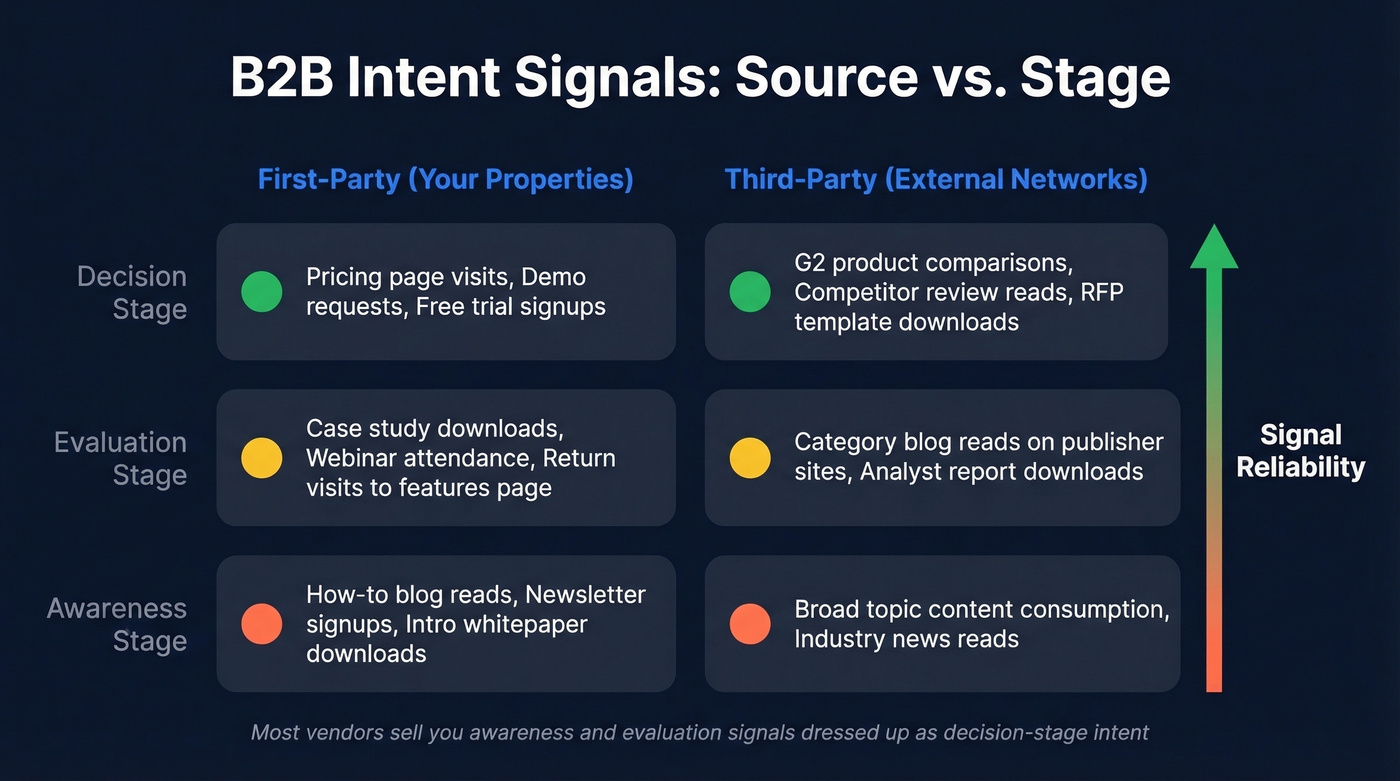
Within those sources, signals split into explicit intent (demo requests, pricing-page visits, product comparisons) and implicit intent (reading a how-to blog, downloading an intro whitepaper). Platforms score these using three dimensions: frequency, recency, and relevance. Someone who visited three competitor comparison pages this week scores higher than someone who read a category blog post last month.
Intent Sourcing Models
Not all third-party intent is created equal. The sourcing model determines signal quality:
- Co-op networks (Bombora-style): Publishers voluntarily share anonymized content-consumption data. Cleaner signals, but narrower reach.
- Bidstream / ad data (ZoomInfo-style): Captures browsing behavior from programmatic ad exchanges. Broad coverage, but noisy and increasingly restricted by privacy regulations.
- Owned-and-operated publisher networks: Vendors like TechTarget own the sites generating signals. High relevance, limited scale.
- Review-site intent (G2, TrustRadius): Tracks product comparison and review activity. Strong decision-stage signal, narrow to in-category buyers.
Bidstream data tends to be broad and noisy; co-ops tend to be cleaner but narrower. Know which model your vendor uses before signing anything.
Data Types and Privacy
Cookie deprecation, GDPR enforcement, and CCPA have fundamentally changed what third-party intent vendors can legally collect. If your provider can't explain their consent framework in plain language, that's a red flag. Transparent, consent-based sourcing like Bombora's co-op model is becoming table stakes. Any vendor still relying heavily on third-party cookies or unregulated bidstream data is building on a shrinking foundation.
| Stage | Signal Type | Examples | Reliability |
|---|---|---|---|
| Active (Decision) | Explicit | Pricing pages, demos, comparisons | Highest |
| Passive (Evaluation) | Mixed | Competitor case studies, webinars | Medium |
| Awareness (Problem) | Implicit | How-to blogs, intro whitepapers | Lowest |
The problem is that most of what vendors sell you is awareness-stage and passive-stage signals dressed up as buying intent.
Why Most Intent Programs Fail
The failure modes repeat across teams. We've seen every one of these firsthand.
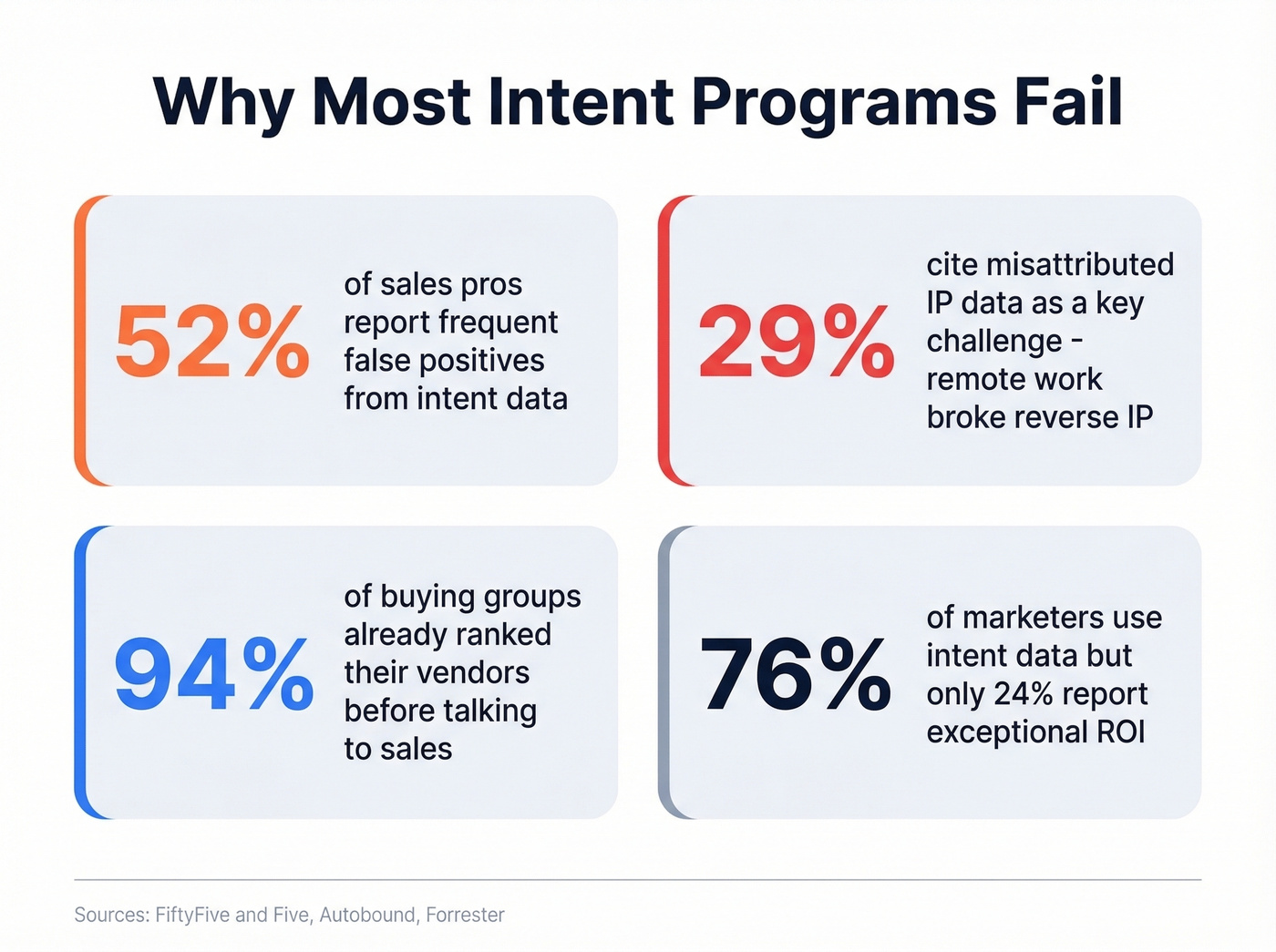
False positives are the norm. 52% of sales professionals report frequent false positives from intent data. You call someone flagged as "in-market" and they've never heard of your category. Plan for 30-60% of third-party signals to be noise until validated against first-party behavior.
IP misattribution undermines the foundation. 29% of practitioners cite misattributed IP data as a key challenge. Remote work and VPNs have made reverse-IP lookups dramatically less reliable since 2020.
Account-level data hides the actual buyer. Most intent platforms tell you "someone at Acme Corp" is researching your category. That someone could be an intern writing a report. Without person-level resolution, you're guessing. The fix: weight signals by seniority and department relevance, and require 2+ engaged roles before calling an account "in-market."
The dark funnel is invisible. Buyers research in Slack communities, Reddit threads, peer conversations, and private channels that no intent vendor can track. The signals you're paying for represent a fraction of actual buying behavior. Monitor community mentions, capture self-reported intent through forms and surveys, use conversational intel from sales calls, and treat third-party intent as triage - not truth.
In our experience, the fastest way to kill intent ROI is letting alerts pile up for a week. Signals decay. Speed is the entire point.

52% of sales pros get burned by false positives because intent data alone isn't enough. Prospeo layers Bombora intent signals across 15,000 topics with 98% verified emails, job change alerts, and hiring triggers - so you reach real buyers, not ghosts. No annual contract. Starts free.
Turn intent signals into verified contacts for $0.01 per email.
What Signals Actually Convert
The Reddit consensus - and our own testing backs this up - is that concrete trigger events outperform generic topic-level intent every time. Here's what practitioners actually trust, ranked by reliability:
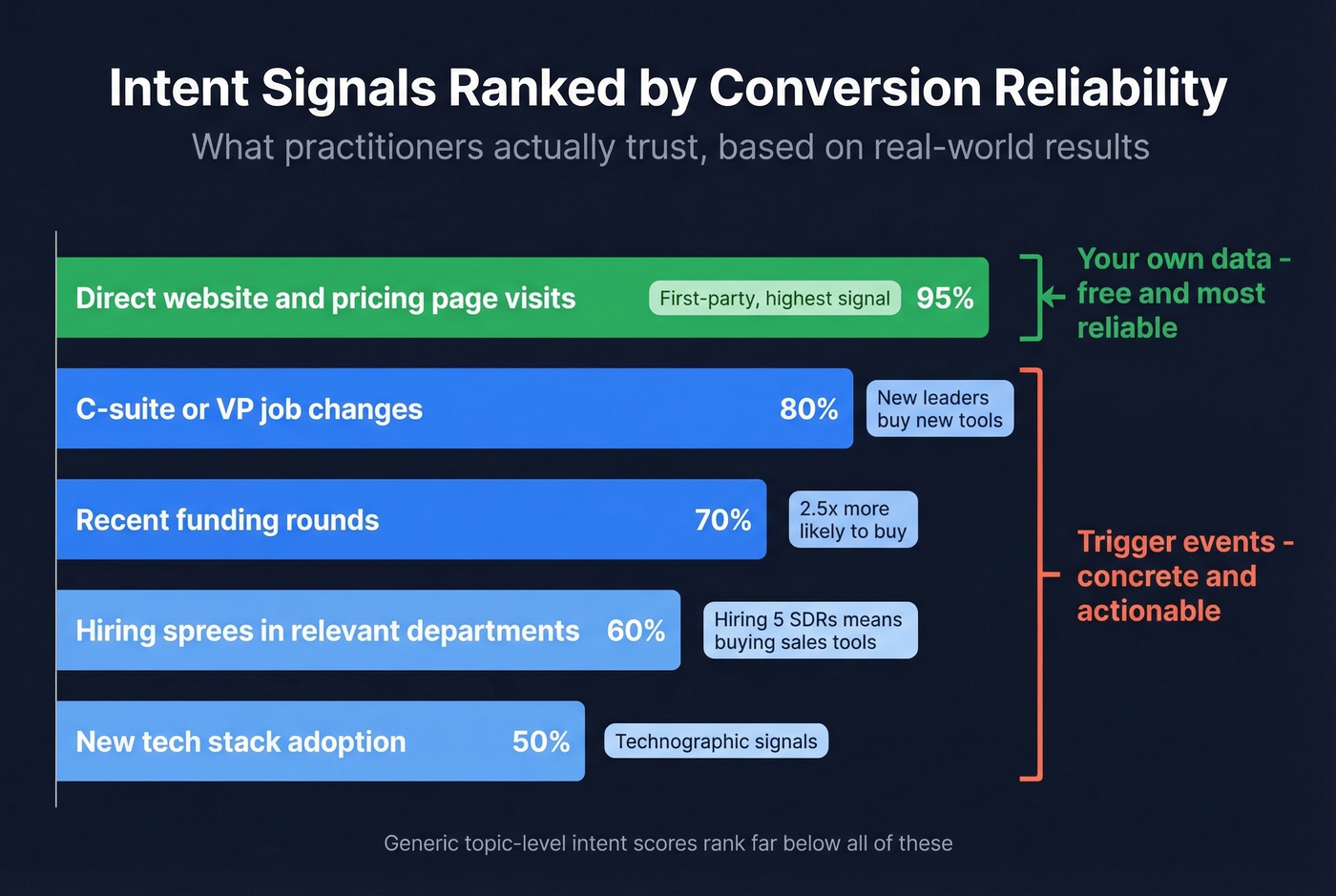
- Direct website/pricing-page visits (first-party, highest signal)
- C-suite or VP job changes (new leaders buy new tools)
- Recent funding rounds - companies that just raised are 2.5x more likely to buy new solutions
- Hiring sprees in relevant departments (hiring 5 SDRs = buying sales tools)
- New tech stack adoption (technographic signals)
What It Actually Costs
Here's the thing nobody in the intent data space wants to be transparent about: pricing. Let's fix that.
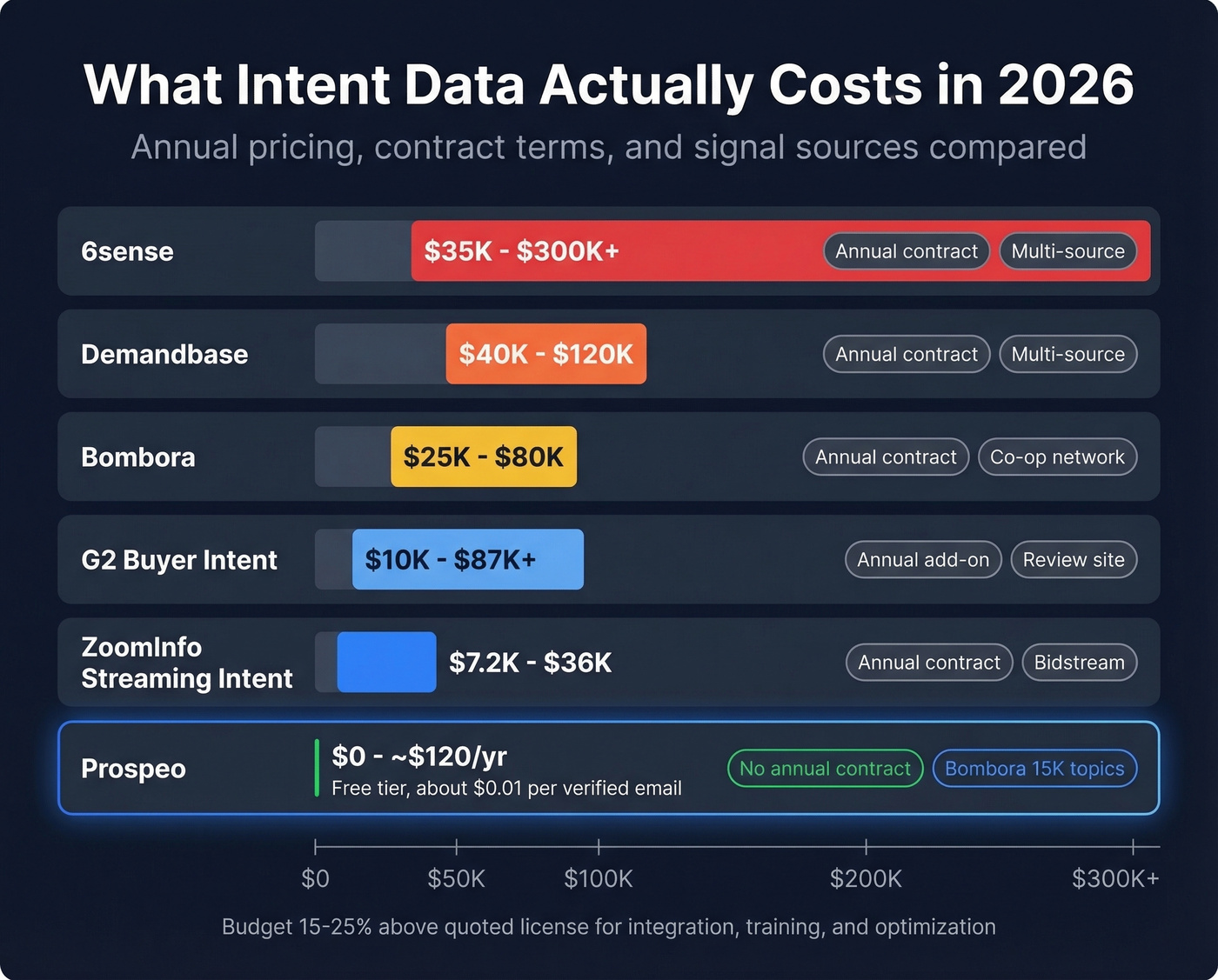
| Provider | Annual Cost | Contract | Intent Source |
|---|---|---|---|
| Bombora | $25K-$80K | Annual | Co-op |
| 6sense | $35K-$300K+ | Annual | Multi |
| Demandbase | $40K-$120K | Annual | Multi |
| ZoomInfo Streaming Intent | $7.2K-$36K | Annual | Bidstream |
| G2 Buyer Intent | $10K-$87K+ | Annual add-on | Reviews |
| Prospeo | Free tier; ~$0.01/verified email | No contract | Bombora (15K topics) |
Bombora's co-op draws from 5,000+ B2B websites. Enterprise rollouts at the top end - think full 6sense or Demandbase deployments - can run $200K-$300K+/year. At the other end, tools like Apollo and Dealfront offer free tiers for testing basic signals. Budget 15-25% above any quoted license for integration, training, and optimization. A $40K Demandbase license often behaves like ~$46K-$50K once you include enablement and ops time.
Forrester's most recent Intent Data Providers Wave evaluated 15 providers across 21 criteria - and even among leaders, pricing opacity remains the norm.
How to Use Buying Signals Without Wasting Money
Three Playbooks That Work
1. Hot account to SDR in under 24 hours. When a target account surges on intent topics, auto-route to the assigned SDR via Slack alert. Enrich the account with the right buyer persona, drop them into a 3-step sequence. The window is days, not weeks.
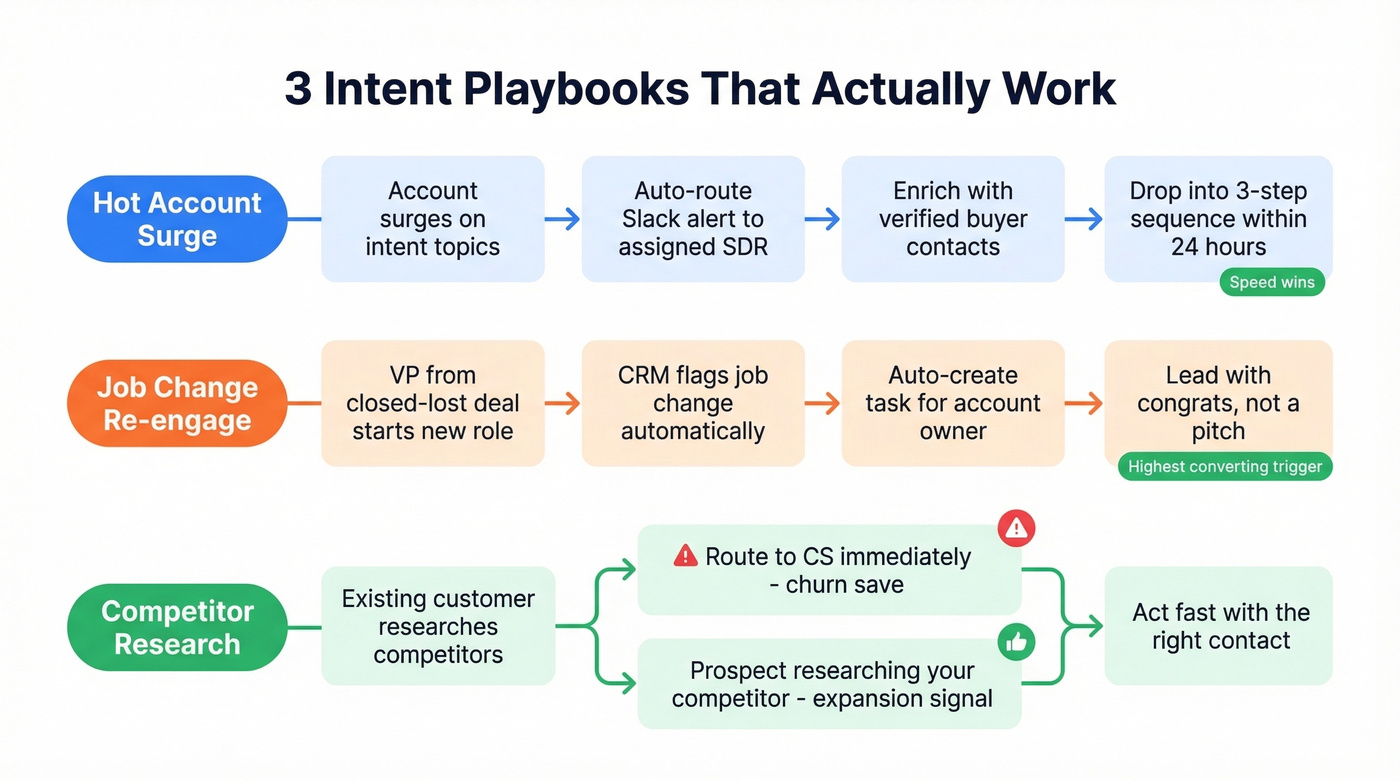
2. Job change to re-engage closed-lost. A VP who ghosted you at their old company just started at a new one. That's the highest-converting trigger in B2B. Flag job changes in your CRM, auto-create a task for the account owner, and lead with "congrats on the new role" - not a pitch.
3. Competitor research to expansion or churn-save. When an existing customer starts researching competitors, that's a churn signal. Route to CS immediately. When a prospect researches your competitor, that's an expansion signal - they're actively evaluating. Both require speed and the right contact.
Do This
- Start with first-party website analytics before buying any third-party intent. If you can't act on your own visitor data, you won't act on Bombora signals either.
- Use trigger events (funding, job changes, hiring) as a filter layer on top of your ICP, not as a standalone prospecting strategy. (If you need a system, see sales triggers.)
- Act fast. Intent signals decay within days.
- Validate with a small, free or low-cost tool before committing $25K+ annually. (A good starting point is free lead generation tools.)
- Layer buying intelligence from multiple signal types - technographic changes, hiring patterns, funding events - rather than relying on a single content-consumption score.
Skip This
- Don't buy enterprise intent platforms ($35K-$300K) before proving the workflow with first-party data and affordable signals.
- Don't trust account-level signals without person-level contact data. Knowing "Acme Corp is in-market" is useless if you can't reach the VP making the decision. (This is where data enrichment services and lead enrichment matter.)
- Don't stack multiple intent sources hoping more data equals better results. It usually equals more noise. (If you're scoring, use a clear lead scoring model.)
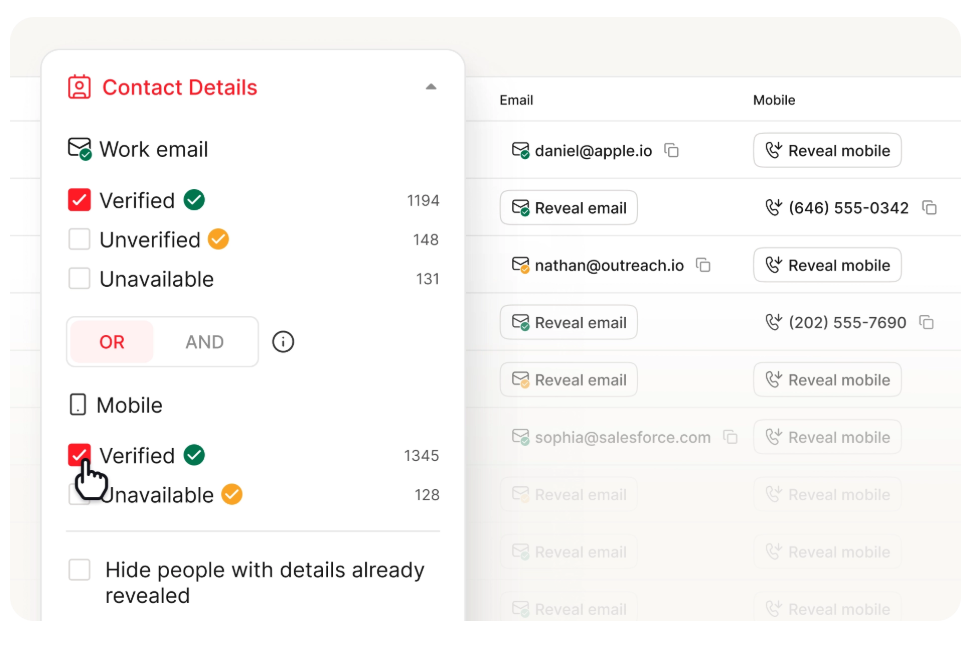
Account-level intent is useless without the right contact. Prospeo resolves in-market accounts to decision-makers with verified emails and 125M+ direct dials - filtered by seniority, department, and 30+ signals like funding, tech stack, and headcount growth. Data refreshed every 7 days, not 6 weeks.
Stop guessing who at the account is actually buying.
What to Do Next
Start with your own website analytics and one trigger event. Prove the workflow converts before spending $25K+ on enterprise intent. The teams that win with purchase intent data aren't the ones with the most signals - they're the ones that act on the right signal within 24 hours.
If you remember nothing else: speed and specificity beat volume and dashboards, every single time. (For more outbound execution ideas, see sales prospecting techniques.)
FAQ
Is purchase intent data worth the investment?
For most teams, standalone intent platforms at $25K-$300K/year deliver disappointing ROI - only 24% of users report exceptional results. Start with first-party website analytics and a tool that combines intent signals with verified contact data before committing to an enterprise contract. Prove the workflow cheaply first.
What's the difference between first-party and third-party intent?
First-party intent comes from your own website and emails - precise but narrow, since you only see activity on your properties. Third-party intent comes from external publisher networks and review sites - broader reach but noisier signals. Best practice is blending both for coverage and accuracy.
How do I reduce false positives?
Validate third-party signals against first-party behavior before routing to sales. Weight signals by seniority and department relevance. Require multiple engaged contacts at an account before flagging it as "in-market." Act within days - stale intent is worse than no intent.
How is B2B intent data different from B2C?
B2B intent tracks account-level, multi-stakeholder buying behavior across longer sales cycles, while B2C intent focuses on individual actions like cart additions or product page views. In B2B, you need consensus signals across a buying committee - not a single browsing session - making person-level resolution and multi-touch validation far more critical.