

QuickEnrich vs Apollo.io: Which Wins in 2026?
QuickEnrich verifies emails. Apollo does everything. Comparing QuickEnrich vs Apollo.io really comes down to one question: is "everything" worth 3x the cost when a chunk of the data bounces?
30-Second Verdict
Choose QuickEnrich if you need a pure enrichment layer - double-verified emails, per-email pricing, no bloat. It's best for teams already running sequences elsewhere.
Choose Apollo.io if you need an all-in-one platform with sequences, a dialer, and a prospecting database - and you're willing to re-verify the data before sending.
Feature Comparison at a Glance
| Feature | QuickEnrich | Apollo.io | Winner |
|---|---|---|---|
| Database size | 130M+ contacts | 275M+ contacts | Apollo |
| Verification | Double-verified (SMTP + catch-all handling) | 7-step process, 91% claimed | QuickEnrich |
| Pricing model | Per-email | Per-seat + credits | QuickEnrich |
| Mobile numbers | Free when available (~25%) | Uses mobile credits (capped by plan) | QuickEnrich |
| Integrations | API, Clay | Engagement suite (sequences, dialer) + integrations | Apollo |
| Best for | Enrichment-first workflows | All-in-one prospecting | Depends on stack |
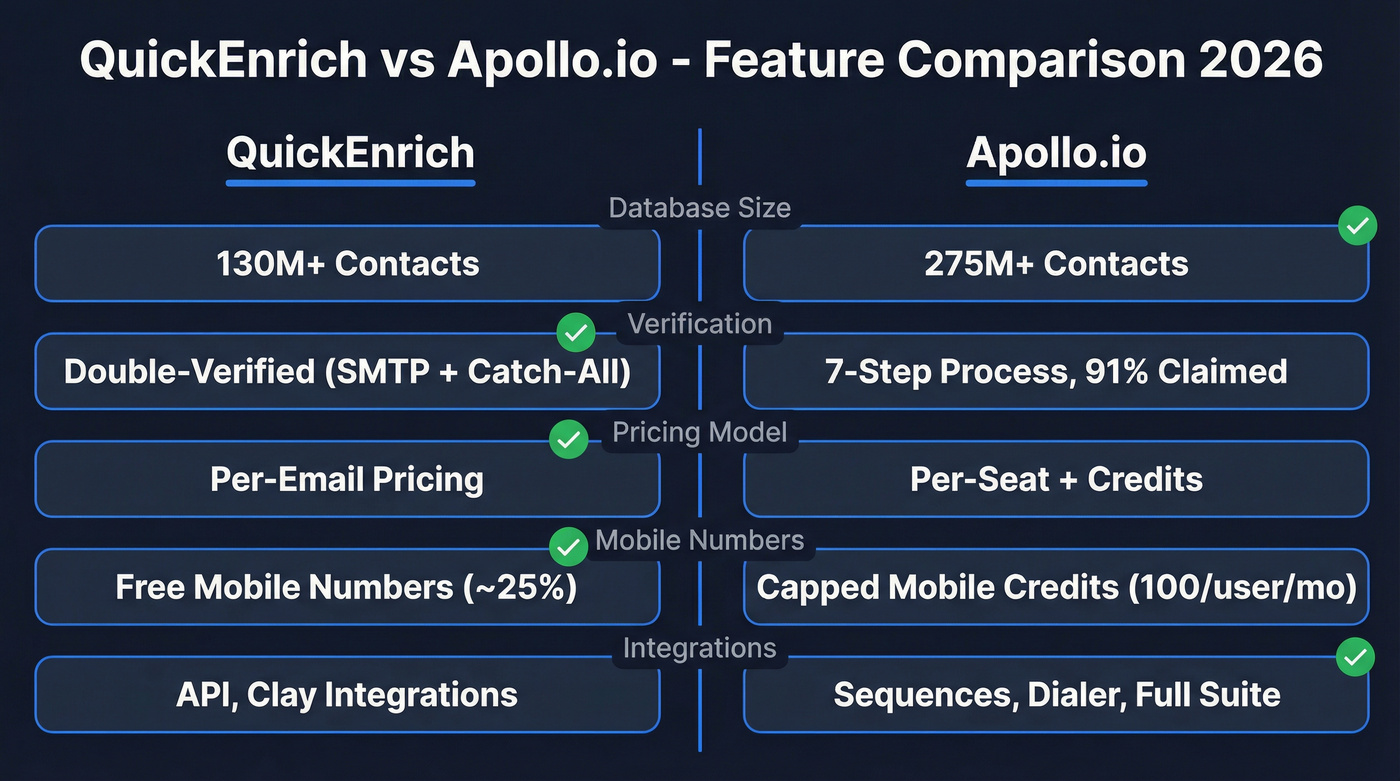
QuickEnrich doesn't have meaningful G2 or Capterra coverage, so this comparison focuses on product mechanics and verification methodology. Apollo, by contrast, has extensive market adoption - practitioners consistently praise its search filters but flag data accuracy as the top complaint.
Data Quality
Apollo publishes a 91% accuracy rate through its 7-step verification. On paper, solid. In practice, practitioners on r/coldemail report bounce rates of 32-38% when running Apollo exports through NeverBounce. Threads on r/sales going back to 2022 flag the same pattern. The industry benchmark is under 2% total bounces - a 32% rate doesn't just hurt replies, it torches your sender domain. If you want the deeper benchmarks and fixes, start with an email bounce rate breakdown.
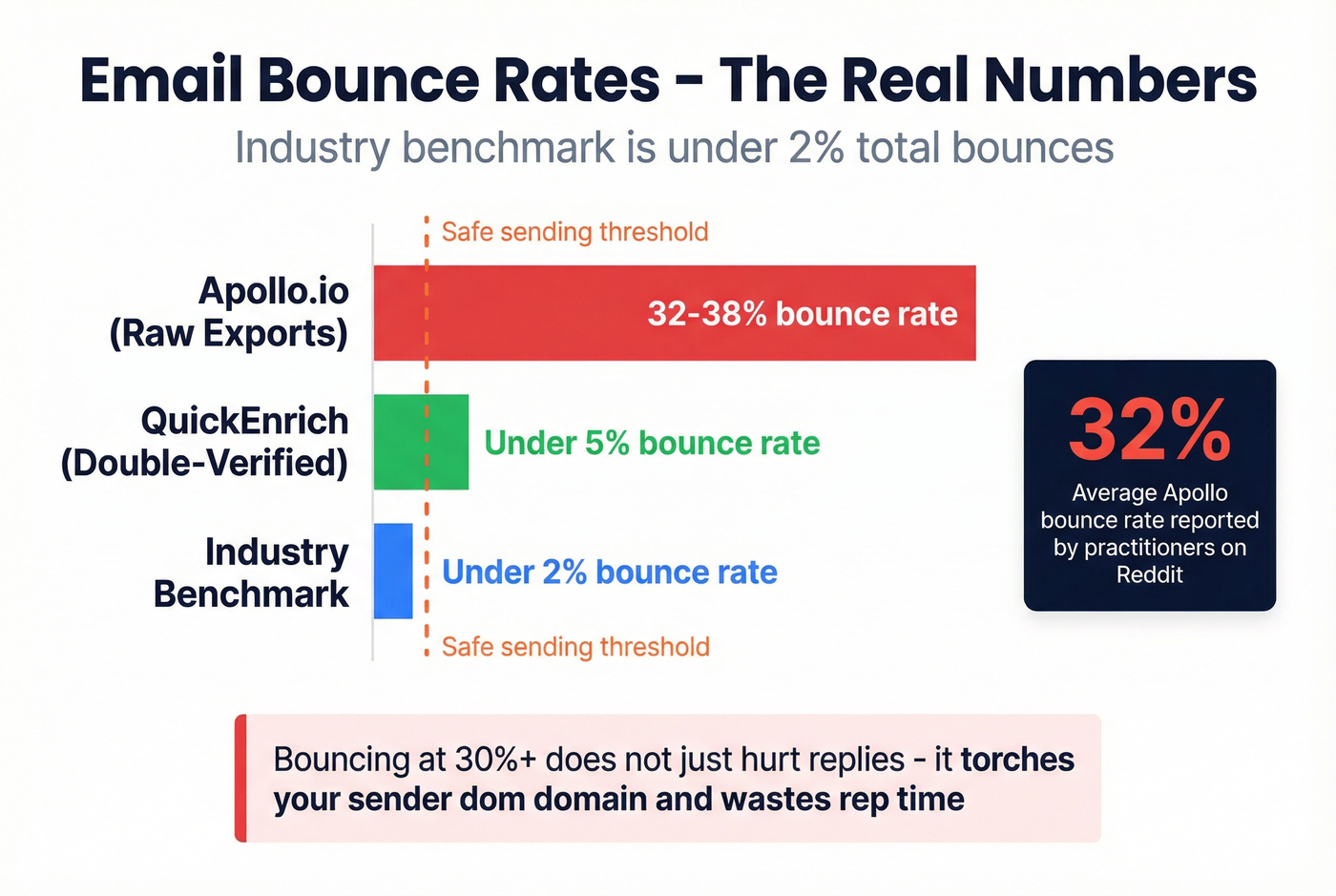
QuickEnrich takes a more conservative path. It verifies emails using multiple verification tools, including catch-all handling and SMTP verification, and it never includes risky emails. Each email gets stamped with a verification date so you know exactly how fresh the data is. We've seen teams cut bounce rates in half just by adding a second verification pass - QuickEnrich bakes that in by default. If you're tightening deliverability, pair this with an email deliverability guide and a checklist to improve sender reputation.
Here's the thing: if you're spending money on outbound sequences and your data is bouncing at 30%+, you're not saving money with a cheaper tool. You're burning domains and wasting rep time.

QuickEnrich double-verifies. Apollo needs NeverBounce on top. Prospeo's 5-step verification delivers 98% email accuracy out of the box - no extra tools, no extra cost. At $0.01/email with a 7-day data refresh cycle, you get fresher data than either option without the re-verification tax.
Stop paying twice for clean data. Get it right the first time.
Pricing Breakdown
Real scenario: a 3-person team needing 10,000 verified emails per month. If you're comparing vendors beyond these two, this list of data enrichment services helps frame the real cost per usable contact.
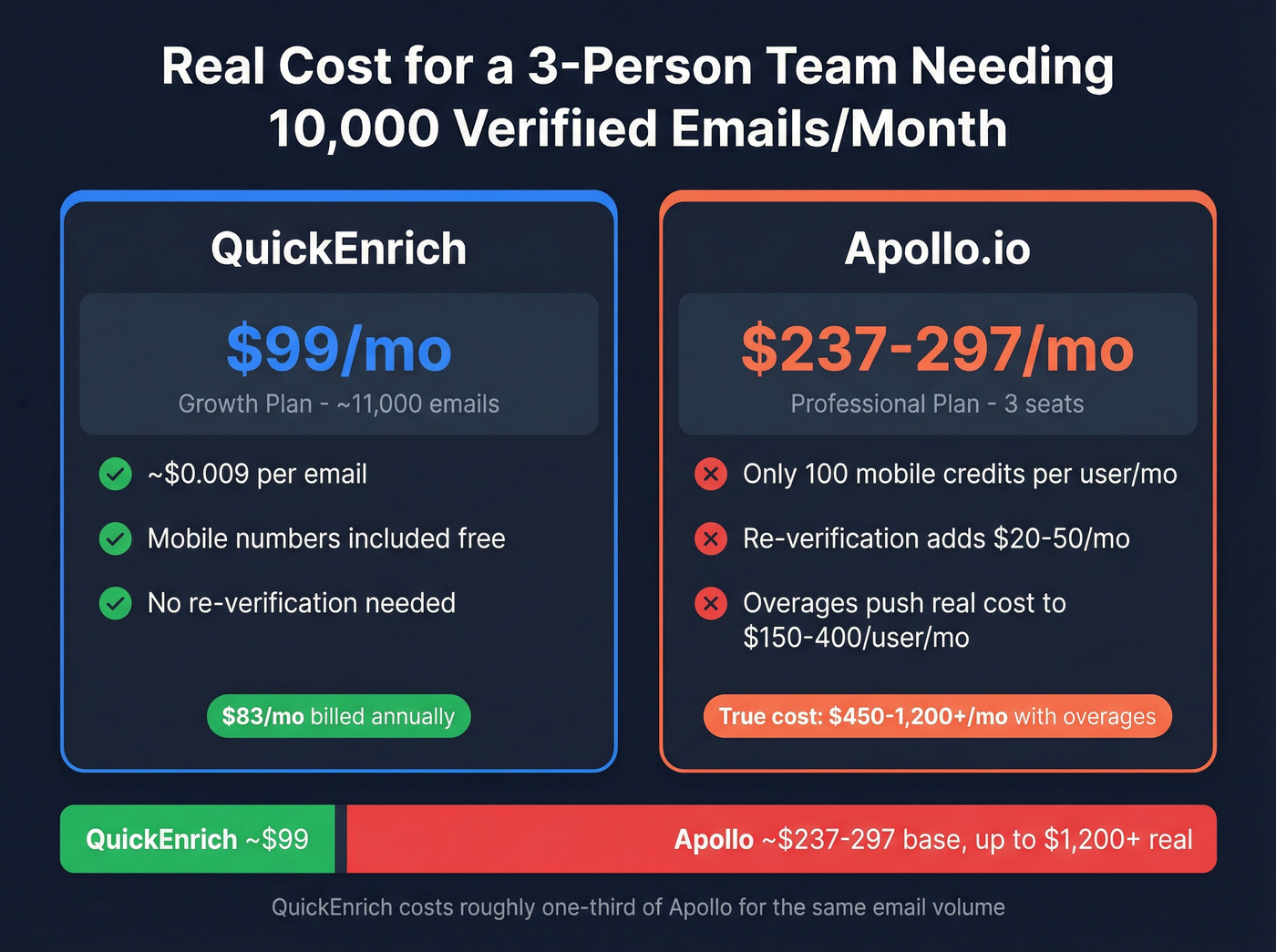
QuickEnrich runs approximately $99/month on its Growth plan for around 11,000 emails - roughly $0.009 each. Mobile numbers are included free when available. Annual billing drops it to about $83/month.
Apollo Professional costs $79-99/user/month depending on billing cycle. For three seats, that's $237-297/month within credit caps. The Professional plan only gives 100 mobile credits per user per month. Once overages kick in, Apollo's real cost for outbound-heavy teams lands closer to $150-400/user/month - a number that surprises people who signed up expecting the sticker price.
The math is stark. QuickEnrich costs roughly a third of Apollo for the same email volume, and you don't have to budget for a separate verification step on top of it. If you're auditing your stack, it helps to map this against your lead enrichment workflow.
When to Pick Each Tool
Pick QuickEnrich if you already have a sequencer like Instantly or Lemlist and just need clean data feeding into it. It's built for enrichment-first workflows through Clay or custom APIs, and per-email pricing means no seat-based math surprises. For more ways to keep pipeline full without bloating tools, see these sales prospecting techniques.
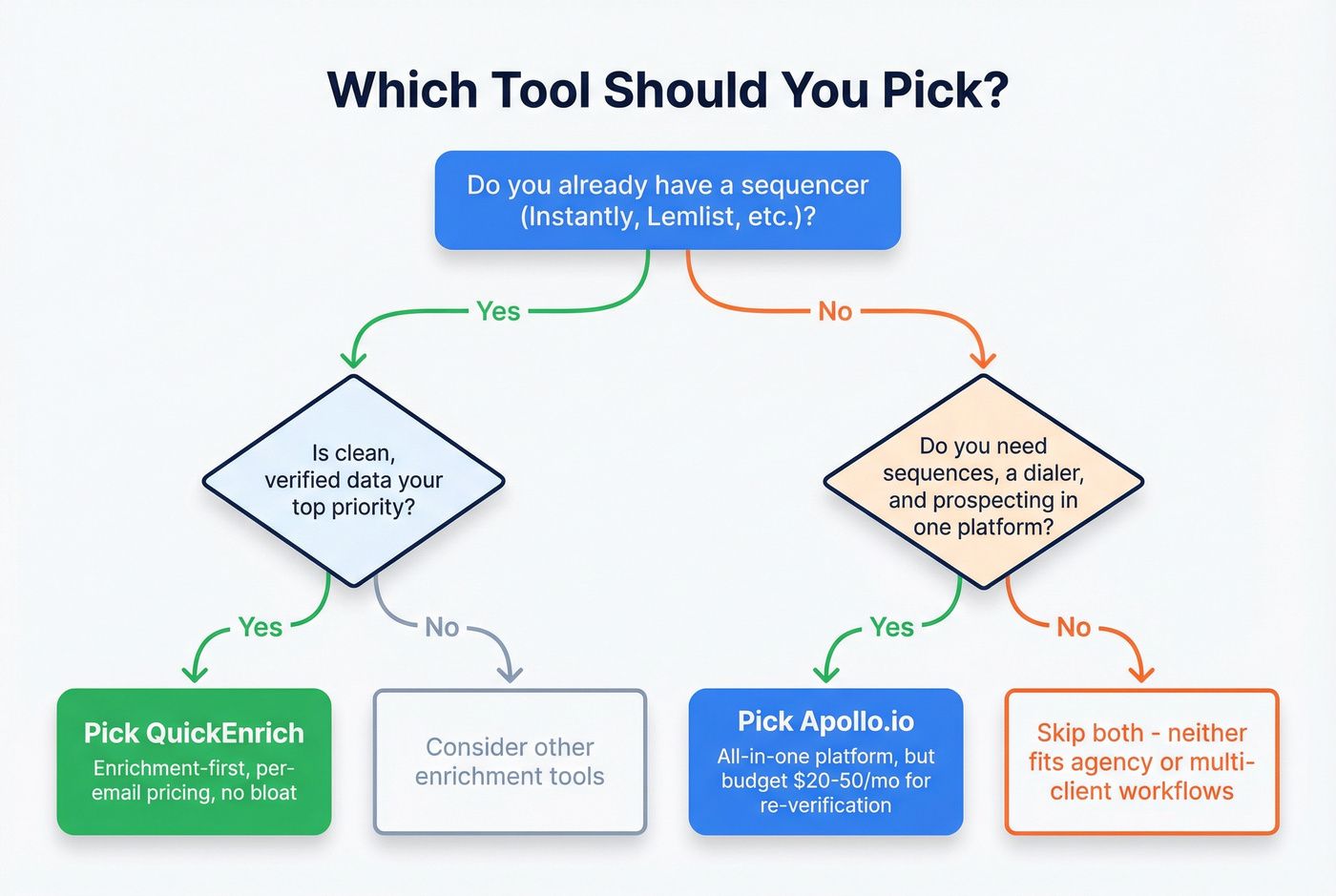
Look, if you need sequences and a dialer in one platform, pick Apollo. Its 275M+ database and search filters are genuinely useful for initial prospecting. Just budget an extra $20-50/month for re-verification through NeverBounce or ZeroBounce before you send anything. If you're building a broader outbound stack, this roundup of SDR tools is a good next step.
Skip both if you're an agency running multiple client campaigns. Neither tool is built for that use case, and the credit math gets ugly fast.
A Stronger Hybrid Option
Let's talk results. Snyk's 50-AE team saw bounce rates drop from 35-40% to under 5%, with AE-sourced pipeline up 180%. Stack Optimize built to $1M ARR while maintaining 94%+ deliverability and zero domain flags across all clients. Those aren't hypotheticals - they're what happens when your data doesn't need a second verification pass. If you're scaling outbound safely, align this with email velocity limits.

Apollo caps mobiles at 100/user/month. QuickEnrich covers ~25% of contacts. Prospeo gives you 125M+ verified mobile numbers with a 30% pickup rate - nearly 3x Apollo's 11% - plus 300M+ profiles and native integrations with Instantly, Lemlist, Clay, and your CRM.
More mobiles, better emails, zero credit math surprises.
FAQ
Is QuickEnrich more accurate than Apollo.io?
QuickEnrich double-verifies with SMTP and catch-all handling, excluding risky emails entirely. Apollo claims 91% accuracy, but independent tests show 32-38% bounce rates on raw exports. For deliverability-sensitive outbound, QuickEnrich is the safer choice.
Does Apollo.io include mobile numbers?
Yes, but mobile access is capped by plan-specific mobile credits - 100/user/month on Professional. QuickEnrich includes mobile numbers free when available for roughly 25% of contacts. Prospeo offers 125M+ verified mobiles at 10 credits per number with a 30% pickup rate.
Can I use Apollo and a verification tool together?
Many teams do exactly this. Use Apollo for prospecting and sequences, then run contacts through a dedicated verification tool before sending. This protects your sender reputation but adds $20-50/month to your stack cost - and it's an extra step that tools with built-in verification don't require.