

QuickMail vs Apollo.io: Sending Power vs Data Platform
Apollo's been "pretty disappointing for doing outreach" - that's not our line, it's a direct quote from a frustrated user on r/agency. QuickMail, meanwhile, doesn't have a single contact in its database. This QuickMail vs Apollo.io matchup comes down to a simple question: do you need a data platform that also sends, or a sending engine that does nothing else?
Pick wrong and you're looking at spiked bounces and spam placement that takes weeks to recover.
30-Second Verdict
Pick Apollo if you need a contact database with built-in sequences and don't want to manage multiple tools. Its 275M+ contacts and multichannel sequences - email, calls, LinkedIn tasks - make it a genuine all-in-one. That said, Apollo's built-in sending is where teams most often run into deliverability frustration, so many use it for data and send from a dedicated sequencer.
Pick QuickMail if deliverability is your top priority and you already have a lead source. Free auto-warmer on every plan, inbox rotation, and Gmail API for sending make it best-in-class for actually landing in inboxes.
Here's the thing: if your average deal size stays below five figures, you probably don't need Apollo's all-in-one platform. A dedicated sender plus a clean data source will outperform it at half the cost.
Side-by-Side Comparison
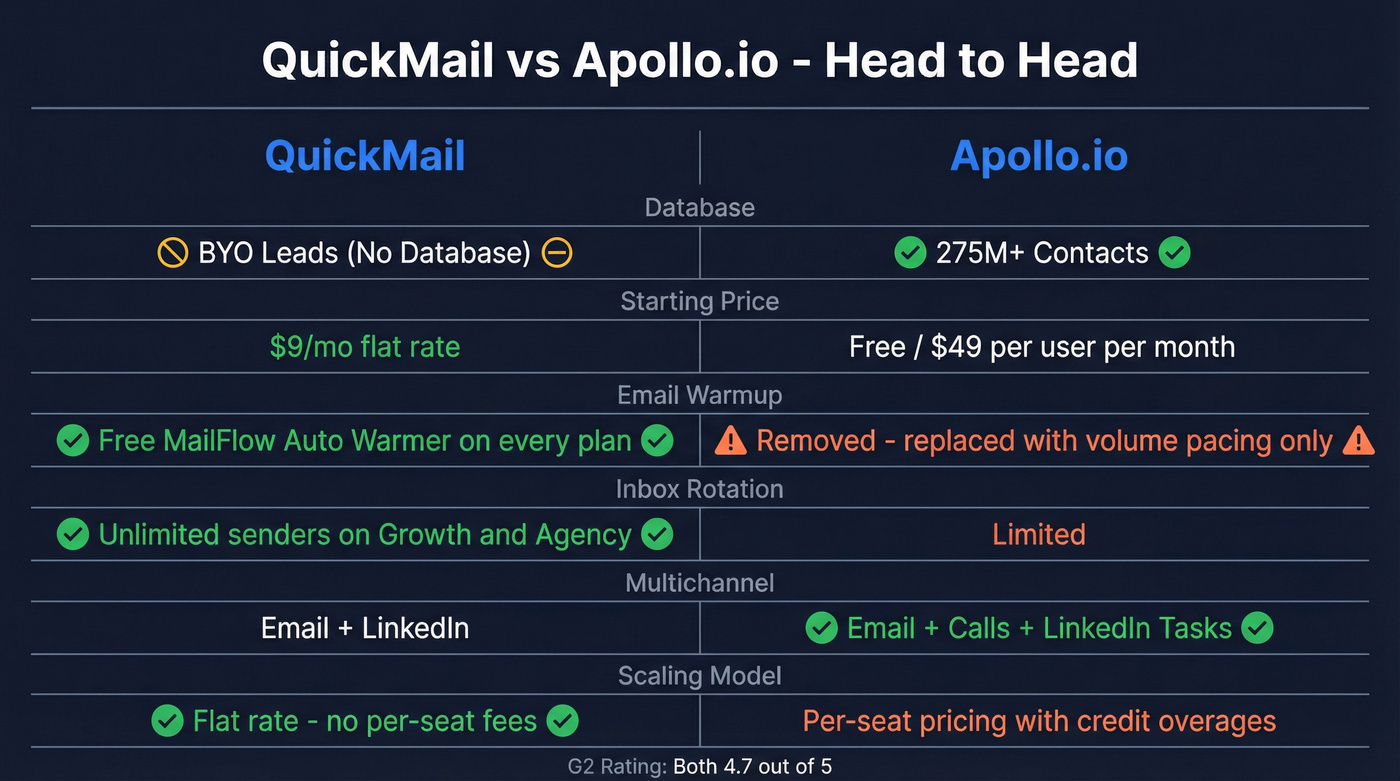
| Feature | Apollo.io | QuickMail | Edge |
|---|---|---|---|
| Database | 275M+ contacts | None - BYO leads | Apollo |
| Starting price | Free / $49/user/mo (annual) | $9/mo | QuickMail |
| Scaling model | Per-seat | Flat rate | QuickMail |
| Email warmup | Removed - replaced with volume pacing | Free MailFlow on every plan | QuickMail |
| Inbox rotation | Limited | Unlimited senders on Growth/Agency | QuickMail |
| Multichannel | Email + calls + LinkedIn tasks (manual) | Email + LinkedIn | Apollo |
| G2 rating | 4.7/5 (9,514 reviews) | 4.7/5 (116 reviews) | Tie |
| Support score | 8.8 | 9.4 | QuickMail |
| Ease of Use | 9.0 | 8.9 | Apollo (marginal) |
| Product Direction | 9.4 | 8.7 | Apollo |
QuickMail's support score is higher, but it's based on roughly 80x fewer reviews - take that with a grain of salt. Apollo wins on product direction per G2, which makes sense given how broad the platform is. But shipping features doesn't help if your emails land in spam.
One G2 pattern worth noting: QuickMail reviewers occasionally flag a learning curve for campaign setup. Not a dealbreaker, but don't expect a drag-and-drop experience on day one.
Deliverability Head-to-Head
This is where the comparison gets interesting - and where we've spent the most time testing.
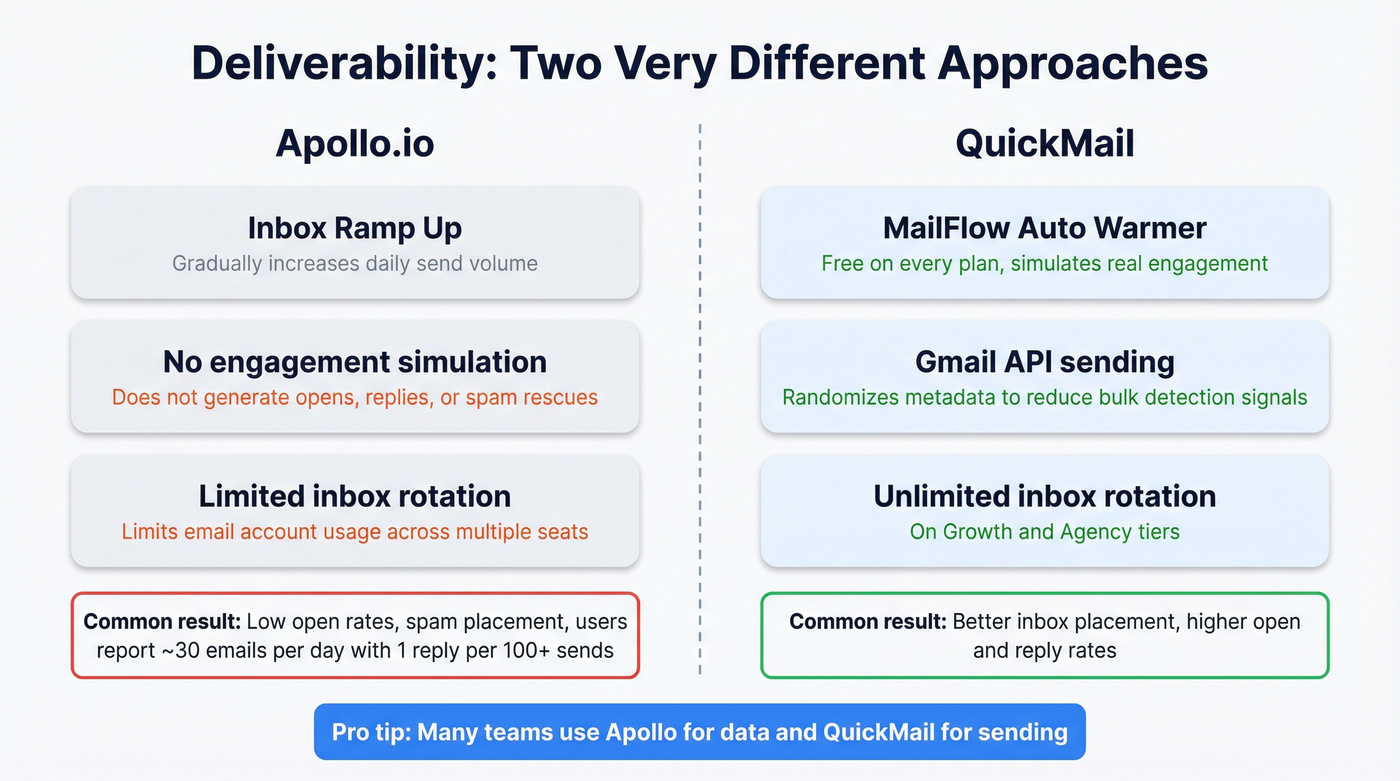
Apollo uses "Inbox Ramp Up," which is volume pacing that gradually increases daily sends. It doesn't simulate opens, replies, or rescue emails from spam folders. That's a critical gap compared to engagement-based warmup.
QuickMail includes MailFlow Auto Warmer free on every plan, uses the Gmail API for sending, and randomizes email metadata to reduce bulk-detection signals. It also supports inbox rotation, with unlimited senders on Growth and Agency tiers.
The Reddit evidence backs this up. One user on r/coldemail reported sending just ~30 emails per day via Apollo with terrible open rates and 1 reply after 100+ emails. The consensus in that thread was clear: use Apollo for scraping leads, not for sending them. Dedicated senders like Instantly, Smartlead, and Lemlist kept coming up as alternatives.
We've seen teams keep Apollo for list building and move sending to a dedicated sequencer once they scale past a few inboxes. That hybrid approach consistently outperforms trying to do everything inside Apollo.
Before you send anything, run through this checklist: SPF/DKIM/DMARC configured, inbox placement monitoring active, blacklist checks running, bounce suppression enabled, reply detection on, and domain rotation if you're sending at volume. Neither tool covers all of these natively. For deeper infrastructure guidance, see our cold email server setup checklist.
Apollo does have a strong counter-argument on the engagement side. Across 100,000+ campaigns, they report that adding one non-email touchpoint lifts meeting booking odds by up to 14%, and multiple touchpoints push that to 24%. If your playbook is truly multichannel, that's hard to ignore.

Apollo's bounce rates damage sender reputation. QuickMail can't help if your list is dirty. Prospeo's 5-step verification delivers 98% email accuracy with catch-all handling and spam-trap removal - on a 7-day refresh cycle. Meritt dropped from 35% bounces to under 4%.
Feed QuickMail verified data and watch your reply rates climb.
Data Quality - The Upstream Problem
Let's be honest about the numbers here. Independent reviews peg Apollo's email accuracy around 70-80%. Some users report 15-20% bounce rates on unverified exports, and one user reported a 50% bounce rate on a raw list. For context, healthy cold email bounce rates should stay under 5% - anything above 7-8% actively damages your sender reputation.
QuickMail has no built-in database at all. You bring your own leads, which means data quality is entirely on you.
In our experience, the fastest way to kill deliverability is exporting unverified data and blasting it from a new domain. The fix is straightforward: run every list through a dedicated verification layer before it touches your sequencer. Prospeo delivers 98% email accuracy with a 7-day data refresh cycle and 5-step verification that includes catch-all handling and spam-trap removal - one customer, Meritt, saw their bounce rate drop from 35% to under 4% after switching. If you want a broader view of options, compare business contact databases and B2B data platforms.

Pricing at Scale
Here's where the models diverge sharply.
Apollo.io tiers (2026):
- Free: Limited credits, basic sequences
- Basic: $49/user/mo annual ($59 monthly)
- Professional: $79/user/mo annual ($99 monthly)
- Organization: $119/user/mo annual ($149 monthly), 3-user minimum - required for API access and advanced security
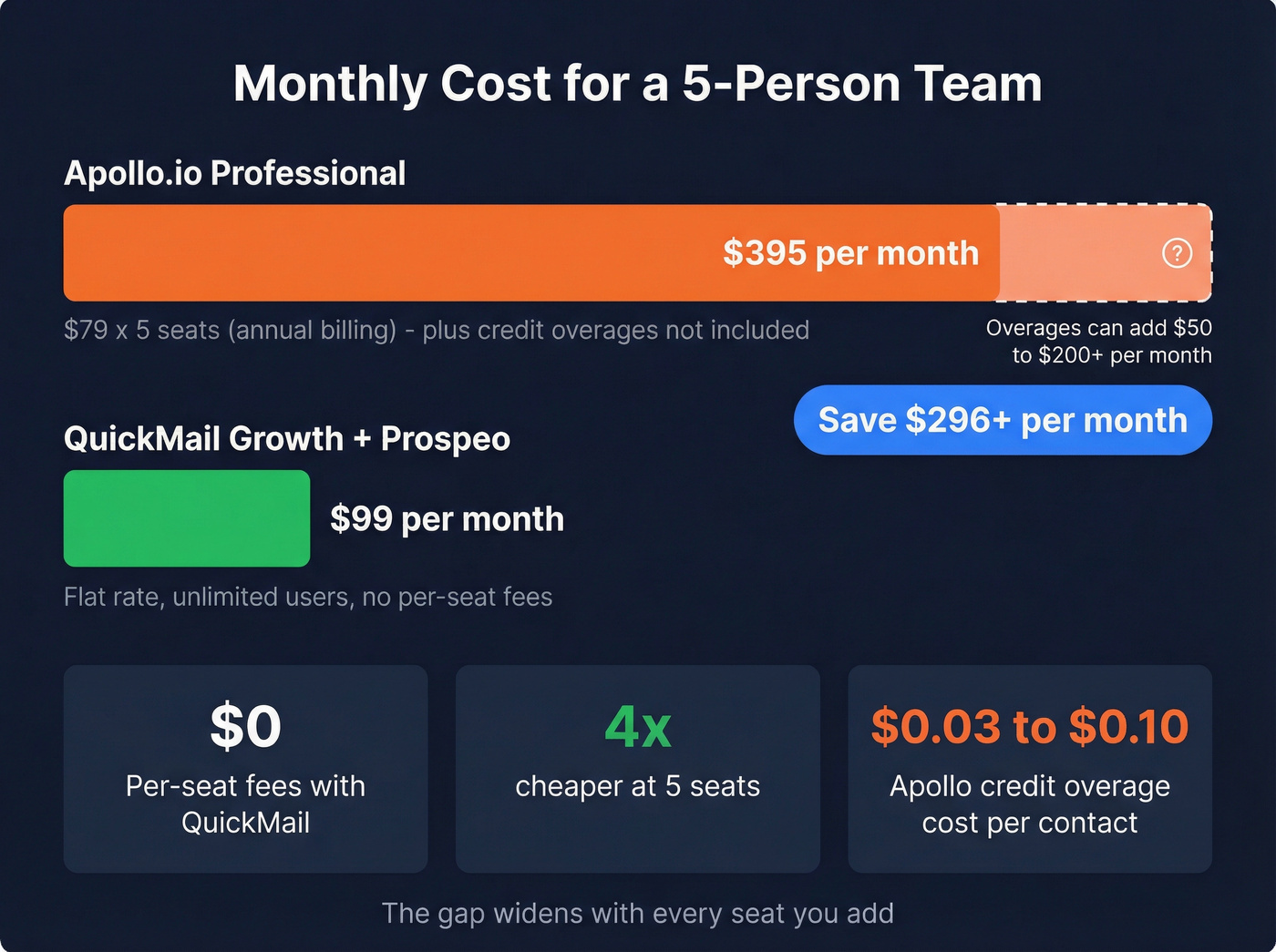
Once you blow through your credit allocation, export and mobile credits run $0.03-$0.10 each. Active teams hit overages fast.
QuickMail tiers: Starter at $9/mo, Growth at $99/mo, Agency at $299/mo. No per-seat fees. Growth and Agency include unlimited users.
For a 5-person team on Apollo Professional (annual): $79 x 5 = $395/mo before credit overages. QuickMail Growth: $99/mo. That's a $296/mo gap, and it widens every time you add a seat.
We've run this math with dozens of outbound teams. The stack approach - a flat-rate sender plus a dedicated data source - almost always costs less than Apollo alone while delivering better results at each layer. If you're pressure-testing your outreach economics, use a bounce rate calculator and track sales ROI by channel.
Who Should Pick What
You want one tool for everything. Go Apollo. It works for teams that value simplicity over optimization, especially if you'll actually use the dialer and LinkedIn task features. Just verify your exports before sending.
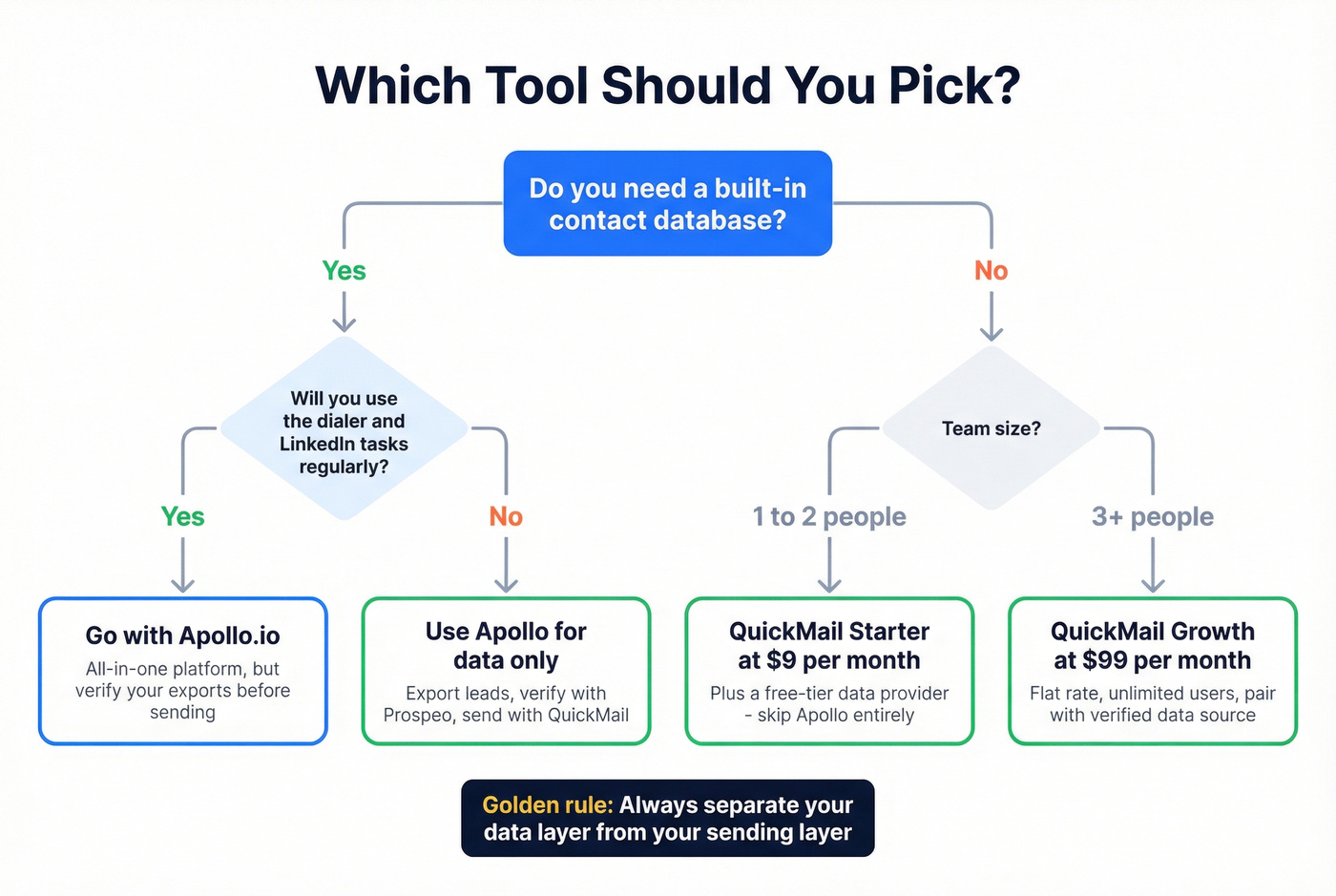
Deliverability is non-negotiable. QuickMail plus a dedicated data provider. Cold email benchmarks sit at 27-35% open rates and 5-6% reply rates - you won't hit those numbers if half your emails land in spam. If you're troubleshooting, start with an email reputation check and an email deliverability checker.
You're building a proper outreach stack. A verified data source for leads, QuickMail or a similar dedicated sender for delivery. This is the setup we see the most successful outbound teams running in 2026. It costs less than Apollo alone and performs better at every layer. Whether you're weighing QuickMail vs Apollo.io or any other combination, the principle holds: separate your data layer from your sending layer. For the full playbook, see our guide to outbound cold email.
Skip Apollo entirely if you're a solo founder or two-person team doing pure email outreach. The per-seat pricing and credit overages will eat your budget before you see ROI. A $9/mo QuickMail Starter plan paired with a free-tier data provider gets you further, faster.
A 5-person Apollo team costs $395/mo before overages - and you still need to verify exports. Prospeo gives you 300M+ contacts at $0.01/email with 98% accuracy. Pair it with QuickMail's $99/mo Growth plan and you outperform Apollo's all-in-one at a fraction of the cost.
Stop paying per seat for data you can't trust.
FAQ
Can I use Apollo just for data and send with QuickMail?
Yes - many teams do exactly this. Export leads from Apollo, run them through a verification layer to catch the 20-30% that'll bounce, then load clean contacts into QuickMail for sending. It's more steps, but your deliverability will thank you.
Does QuickMail include email warmup?
Every QuickMail plan includes MailFlow Auto Warmer at no extra cost. Apollo removed its warmup feature and replaced it with volume pacing ("Inbox Ramp Up"), which doesn't simulate engagement or rescue emails from spam folders.
What's a healthy bounce rate for cold email?
Keep it under 5%. Anything above 7-8% signals a data quality problem that'll damage your sender reputation over time. If you're seeing double-digit bounces, fix your data source before touching your sending setup.
Is Apollo worth it for small teams?
For teams under 3 people, Apollo's free tier or Basic plan can work as a lead source. But the per-seat pricing starts to sting once you scale. If you're primarily doing email outreach, a flat-rate sender like QuickMail paired with a verified data provider will save you money and deliver better inbox placement.