

Quote to Close Ratio: Formula, Benchmarks & Fixes (2026)
Your VP just pulled up the dashboard and asked why only 18% of quotes are converting. You're not sure if that's bad, average, or a rounding error - because a lot of content out there mixes up quote-to-close ratio with close rate or win rate. Meanwhile, Salesforce research shows 84% of sales reps missed quota last year. The math on your proposals matters more than ever.
Quick Version
- The formula: Closed deals / Quotes sent x 100
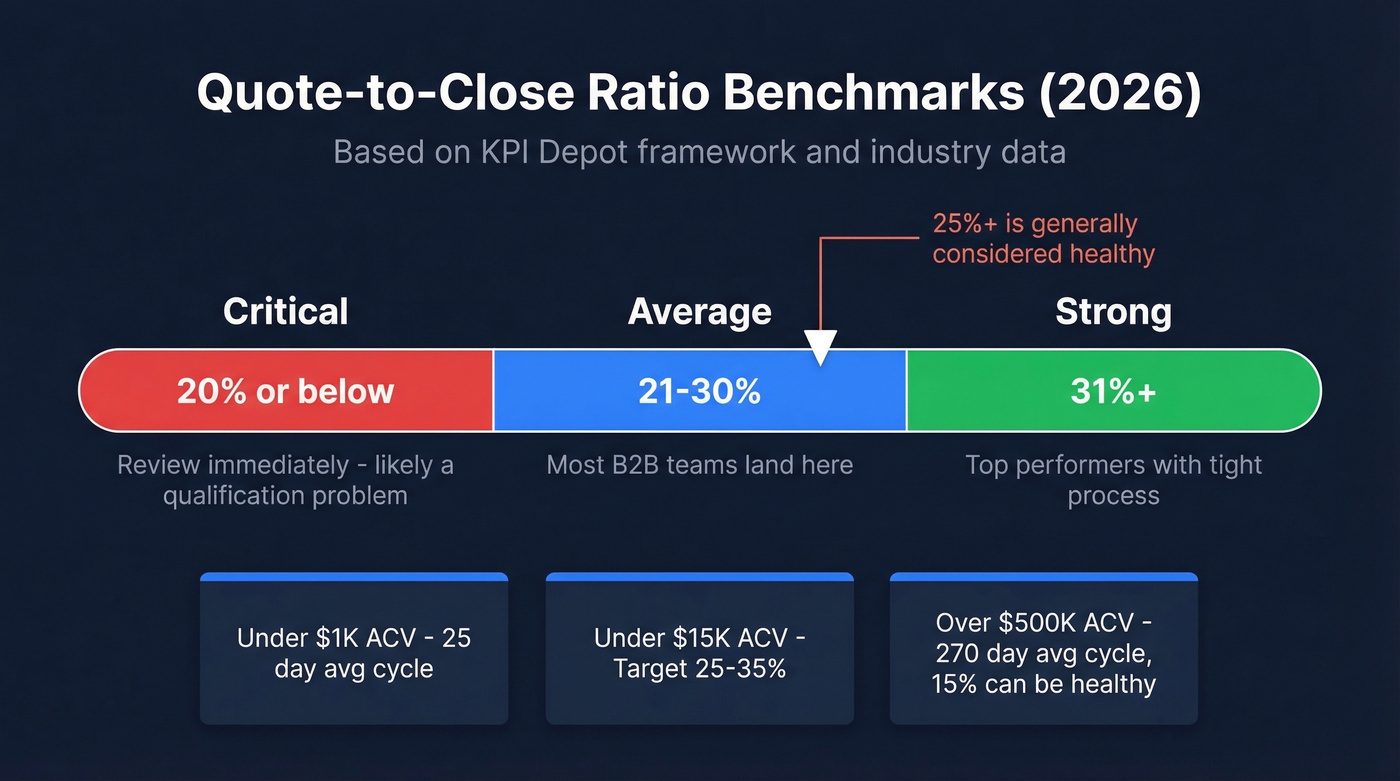
- What "good" looks like: 20% or below needs immediate review, 21-30% is average, 31%+ is strong - and 25%+ is generally considered healthy
- The #1 fix if your ratio is low: Stop emailing proposals into the void. Schedule a live review before you send.
The Formula (And Why Teams Get It Wrong)
The math is simple:
Quote-to-Close Ratio = (Closed Deals / Quotes Sent) x 100
If your team sent 40 quotes last month and closed 6, that's a 15% conversion rate on proposals.
The problem isn't the formula - it's what people leave out of the denominator. The Sales Blog documented a team reporting 95%+ win rates until someone realized reps were omitting deals that went dark or stalled. They were only counting deals that progressed to final negotiation, which is like measuring your free-throw percentage by only counting the shots that went in.
Every quote you send counts. Won, lost, ghosted, stalled for six months - all of it goes in the denominator. The moment you start cherry-picking, the metric becomes useless.
Close Ratio vs. Win Rate: The Denominator Debate
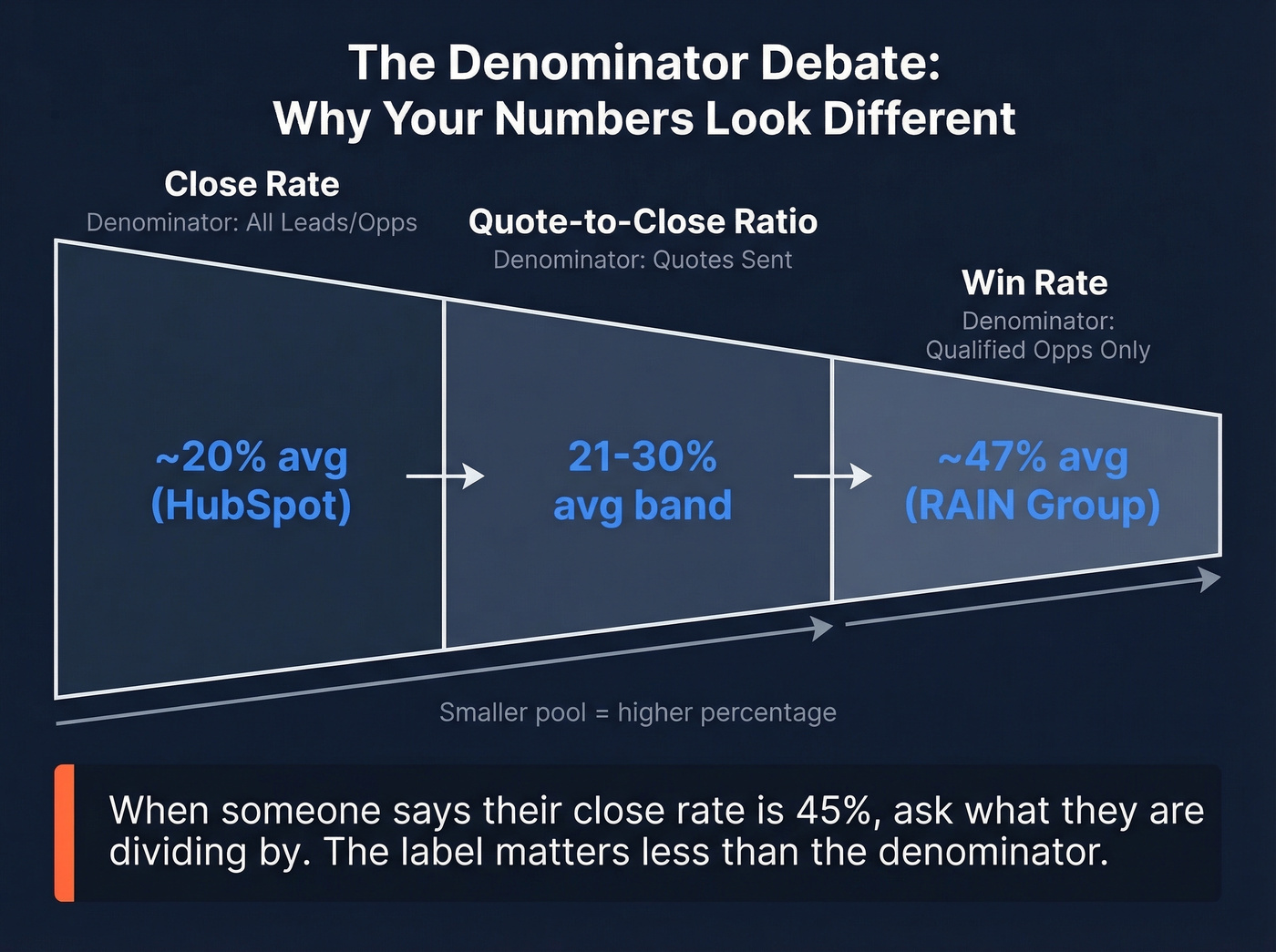
These three metrics get used interchangeably, and they shouldn't. The difference is the denominator - what Outreach calls the "denominator debate." Where you start counting changes the number dramatically.
| Metric | Denominator starts at | Typical range |
|---|---|---|
| Quote-to-close | Quotes sent | 21-30% (average band) |
| Close rate | All leads/opps | ~20% average (HubSpot) |
| Win rate | Qualified opps only | ~47% average (RAIN Group) |
RAIN Group studied 472 sellers and found an average win rate of 47%, with the top 7% hitting roughly 75%. That sounds incredible until you realize win rate only counts qualified opportunities - a much smaller, filtered pool that naturally produces higher numbers. The quote-to-close ratio casts a wider net, so the numbers run lower. Your calls-to-close ratio starts even earlier at initial outreach, producing the lowest percentage of the three.
When someone tells you their "close rate" is 45%, ask what they're dividing by. If it's qualified opportunities, that's a win rate. If it's quotes sent, that's genuinely impressive. The label matters less than the denominator.

Most low quote-to-close ratios aren't a sales problem - they're a data problem. Proposals land in dead inboxes, reach departed employees, or hit the wrong decision-maker entirely. Prospeo's 300M+ profiles refresh every 7 days with 98% email accuracy, so every quote you send reaches someone who can actually sign.
Stop wasting proposals on contacts who left six months ago.
2026 Benchmarks: What "Good" Actually Looks Like
The KPI Depot bands are the most useful framework we've found for this specific metric:
| Range | Assessment |
|---|---|
| 20% or below | Critical - review immediately |
| 21-30% | Average |
| 31%+ | Strong |
For broader context, HubSpot's survey of 1,000+ sales pros puts average close rates at roughly 20% across industries. Note that HubSpot measures opportunity-to-close, not quote-to-close, so your numbers won't map directly - but the industry spread is instructive:
| Industry | Avg. close rate |
|---|---|
| Biotech | 15% |
| Finance | 19% |
| Software | 22% |
In a r/sales thread, one poster shared a ~32% closed-won rate on a mix of inbound and outbound and pushed back on "influencer backed percentages defining a narrative." Fair point.
That's why deal size matters more than any universal number. Focus Digital's ACV data shows deals under $1K close in 25 days while deals over $500K take 270 days. A 15% ratio on $200K enterprise deals can be perfectly healthy - those cycles are long, stakeholders are many, and procurement is involved. A 15% ratio on $5K SMB deals means something is broken.
Here's the thing: if your average contract value is under $15K and your proposal conversion sits below 20%, you don't have a sales problem. You have a qualification problem. Enterprise teams can afford long cycles and low conversion. SMB teams can't.
And the numbers back this up. One team improved from 15% to 28% in six months by adding CRM tracking, follow-up reminders, and streamlined proposal templates - a 20% revenue lift. No new tools, no new hires. Just process discipline applied to the right bottleneck.
Why Your Ratio Is Low
Check these in order. Most teams jump to #3 when the real problem is #1.
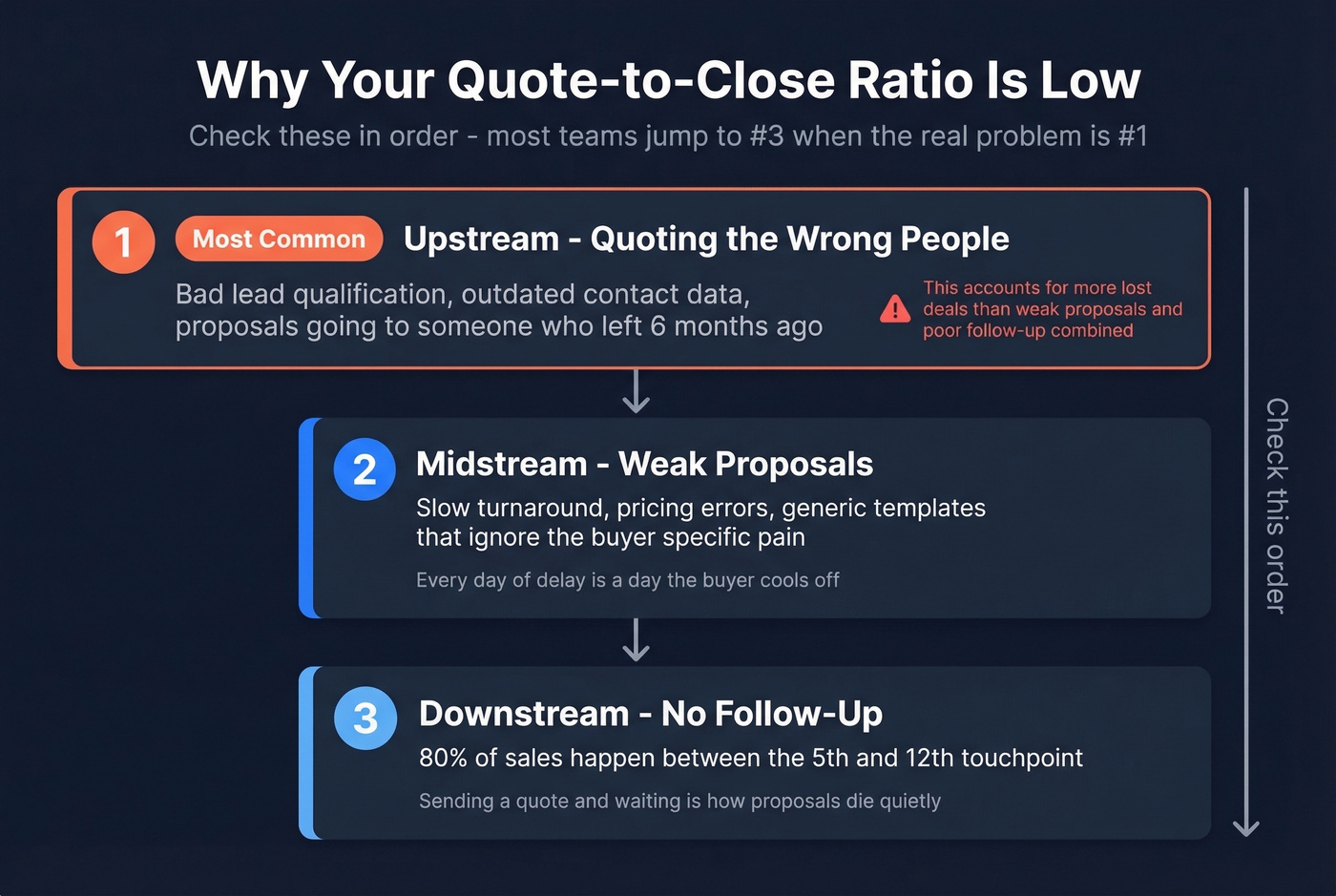
1. Upstream - you're quoting the wrong people. Bad lead qualification, outdated contact data, or proposals going to someone who left the company six months ago. In our experience, this upstream problem accounts for more lost deals than weak proposals and poor follow-up combined. It's the most common root cause and the easiest to miss because it doesn't feel like a "sales" problem - it feels like a data problem. (If you need a tighter definition of who should get a quote, start with an ideal customer profile and scoring.)
2. Midstream - your proposals are weak. Slow turnaround, pricing errors, generic templates that don't address the buyer's specific pain. Every day between "send me a quote" and receiving one is a day the buyer cools off.
3. Downstream - you're not following up. 80% of sales happen between the 5th and 12th touchpoint. If your reps send a quote and wait, they're leaving money on the table. Use proven sales follow-up templates and a consistent sequence management process.
Three Fixes That Move the Needle
1. Stop emailing proposals blind
This is the single highest-leverage change we've seen teams make. When a prospect says "just send me the proposal," don't comply - redirect. Use something like: "Happy to send it over. Let's schedule 15 minutes to walk through it together so I can answer questions live."
A live review lets you trial close, handle objections in real time, and set concrete next steps. Emailing a PDF into the void is how proposals die quietly. Teams that adopt this approach often see a dramatic improvement in their first-call close rate because objections get resolved before they fester into reasons to ghost. (If you want a tighter process, map this into your steps to close a sale.)
2. Speed up quoting
An Aberdeen Group study on CPQ tools found a 49% increase in rep productivity, 28% reduction in sales cycle length, and 26% increase in average deal size.
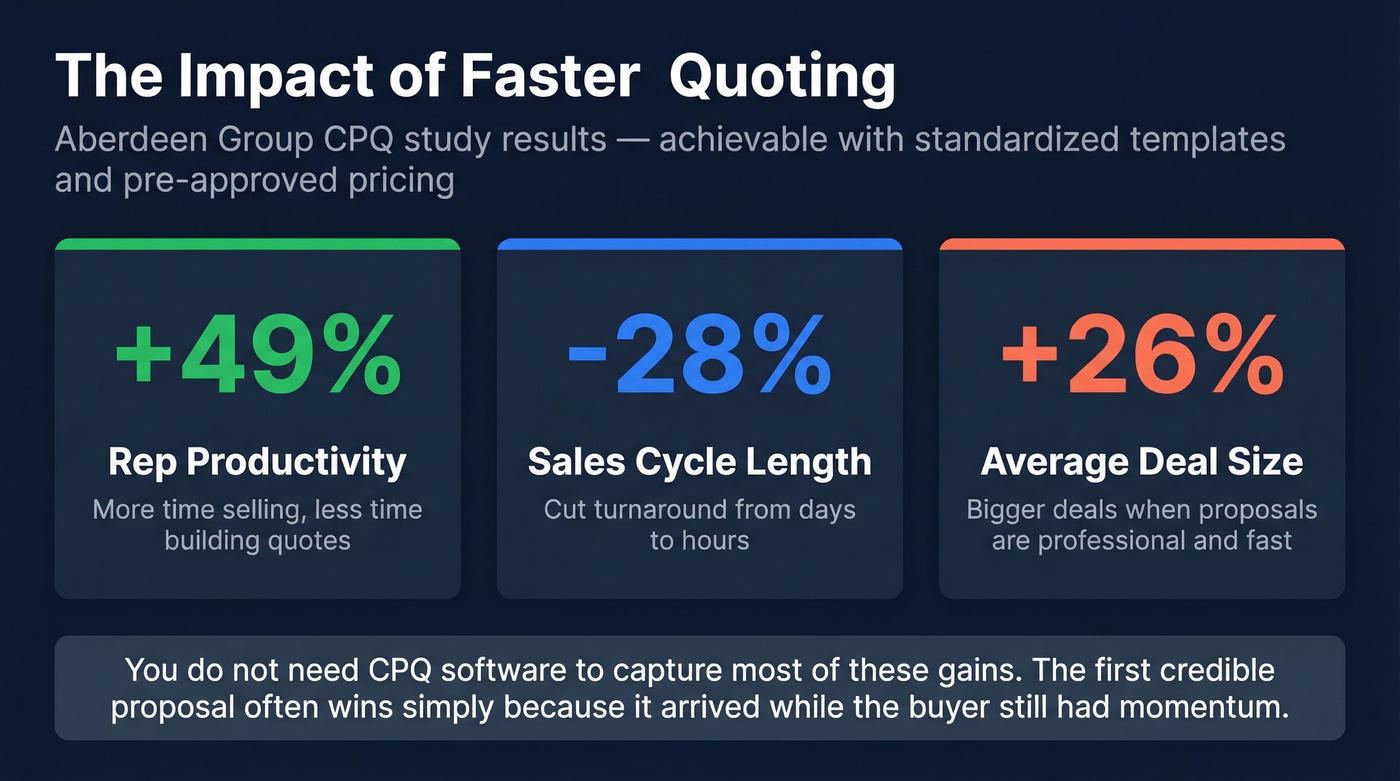
You don't need CPQ software to capture most of those gains. Standardized templates and pre-approved pricing tiers cut turnaround from days to hours - and hours matter when a buyer is comparing three vendors simultaneously. When we've talked to teams running competitive SMB deals, the first credible proposal often wins simply because it arrived while the buyer still had momentum.
3. Fix your contact data
If quotes land in dead inboxes or reach someone who changed roles, nothing else matters. A single wasted enterprise proposal costs more in rep time than a month of email verification. Prospeo runs real-time verification at 98% accuracy on a 7-day data refresh cycle, so every quote reaches an actual decision-maker - not a bounced inbox or a departed employee.
Skip this fix if your CRM data is already clean and your bounce rate sits below 3%. For everyone else, it's the fastest win on this list. (If you're diagnosing deliverability, start with email bounce rate and an email deliverability guide.)

You just read that fixing contact data is the fastest win for improving your quote-to-close ratio. Prospeo makes it concrete: real-time verification, 92% CRM enrichment match rate, and emails at roughly $0.01 each. One team cut their bounce rate from 35% to under 4% and tripled pipeline.
Clean data closes more quotes. Start with 75 free verified emails.
FAQ
What's a good quote-to-close ratio?
Above 25% is generally healthy for most B2B teams. 31%+ is strong, and anything at or below 20% warrants an immediate review of qualification criteria, proposal quality, and follow-up cadence. SMB teams with deal sizes under $15K should target 25-35%.
How is it different from win rate?
Quote-to-close counts every proposal sent as the denominator. Win rate only counts qualified opportunities - a smaller, filtered pool that produces higher numbers (47% average per RAIN Group). Your calls-to-close ratio starts even earlier at initial outreach, producing the lowest percentage of the three.
How do I track this in my CRM?
Define "quote sent" as a distinct pipeline stage in Salesforce or HubSpot. Include all outcomes - won, lost, stalled. Cohort by sent date, not close date, so you're measuring true conversion speed rather than inflating recent months with deals that took a year to close.
Can bad contact data lower my close ratio?
Significantly. Proposals sent to bounced emails, departed employees, or wrong stakeholders inflate your denominator without any chance of closing. Cleaning your data before quoting is the simplest way to remove dead weight from the metric and give your reps a fair shot at every deal in the pipeline.