

Real Estate Pipeline Stages: The Complete 2026 Guide for Agents and Investors
Most agents build their pipeline backward. They obsess over closing - offer accepted, escrow, funding - and ignore the early real estate pipeline stages where leads quietly die. Then they wonder why their CRM feels useless and their pipeline report is fiction.
Your pipeline only works when every stage has a clear entry trigger and exit criteria. If you can't define both, the stage doesn't belong.
What Is a Real Estate Pipeline?
A pipeline isn't a funnel. Your funnel tracks marketing awareness - how strangers become leads. Your pipeline tracks deal stages with specific actions and deadlines attached to each one. Think of the funnel as "where did they come from?" and the pipeline as "what do I do next?"
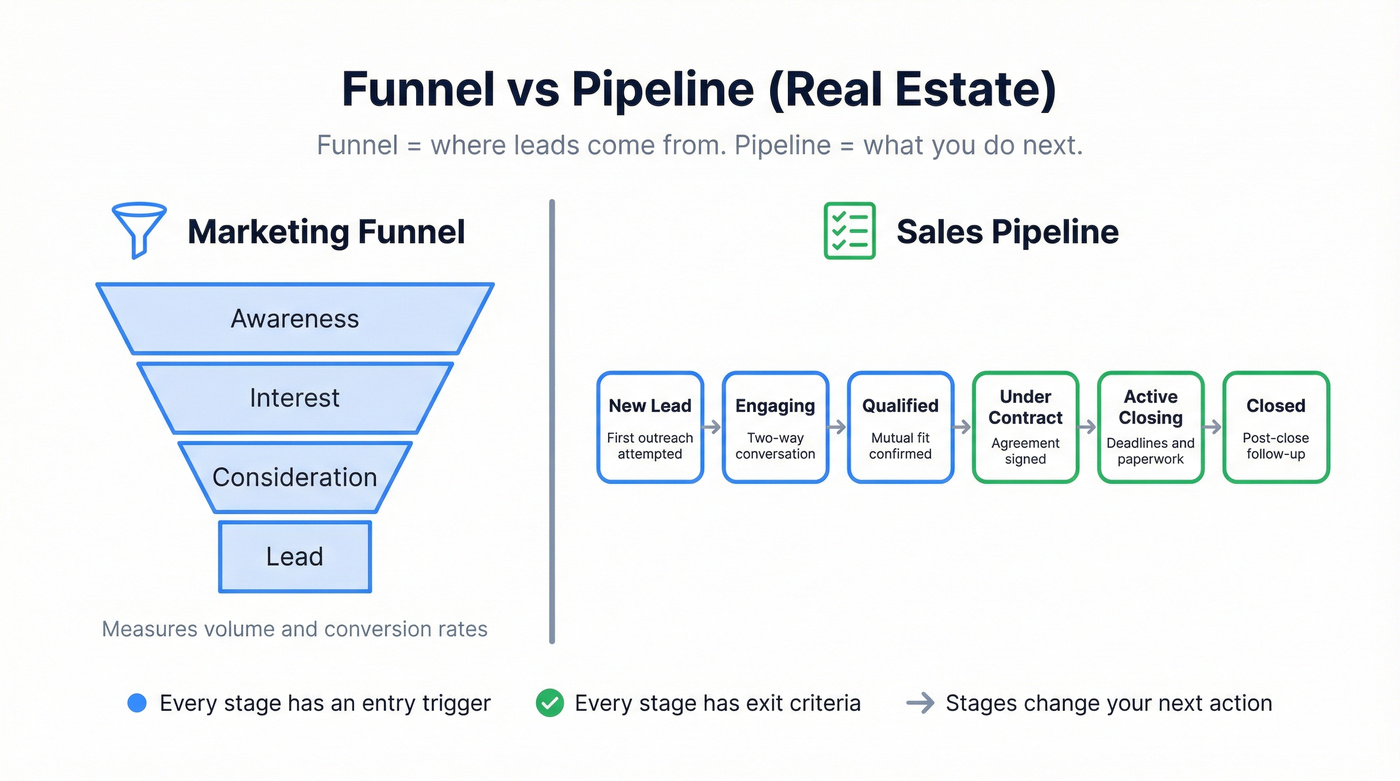
Every stage represents a commitment milestone, something the buyer, seller, or agent has done that moves the deal forward. If a stage doesn't have a clear action tied to it, delete it.
Pipeline Design Rules
Before mapping stages, nail these principles.
5-7 stages is the sweet spot for any single pipeline. More than that and agents stop updating them. Fewer and you lose visibility into where deals stall.
Every stage needs an entry trigger and exit criteria. Entry trigger = what happened to move the deal here. Exit criteria = what must happen before it moves forward. No exceptions.
Separate lead status from deal stage. Lead status (New, Contacted, Qualified) tracks engagement. Deal stage (Under Contract, Listed, Closing) tracks a specific transaction. Mixing them in one pipeline creates reporting chaos - your CRM can't produce an accurate forecast if "Contacted" and "Under Contract" live on the same board. (If you need a clean setup, start with lead status.)
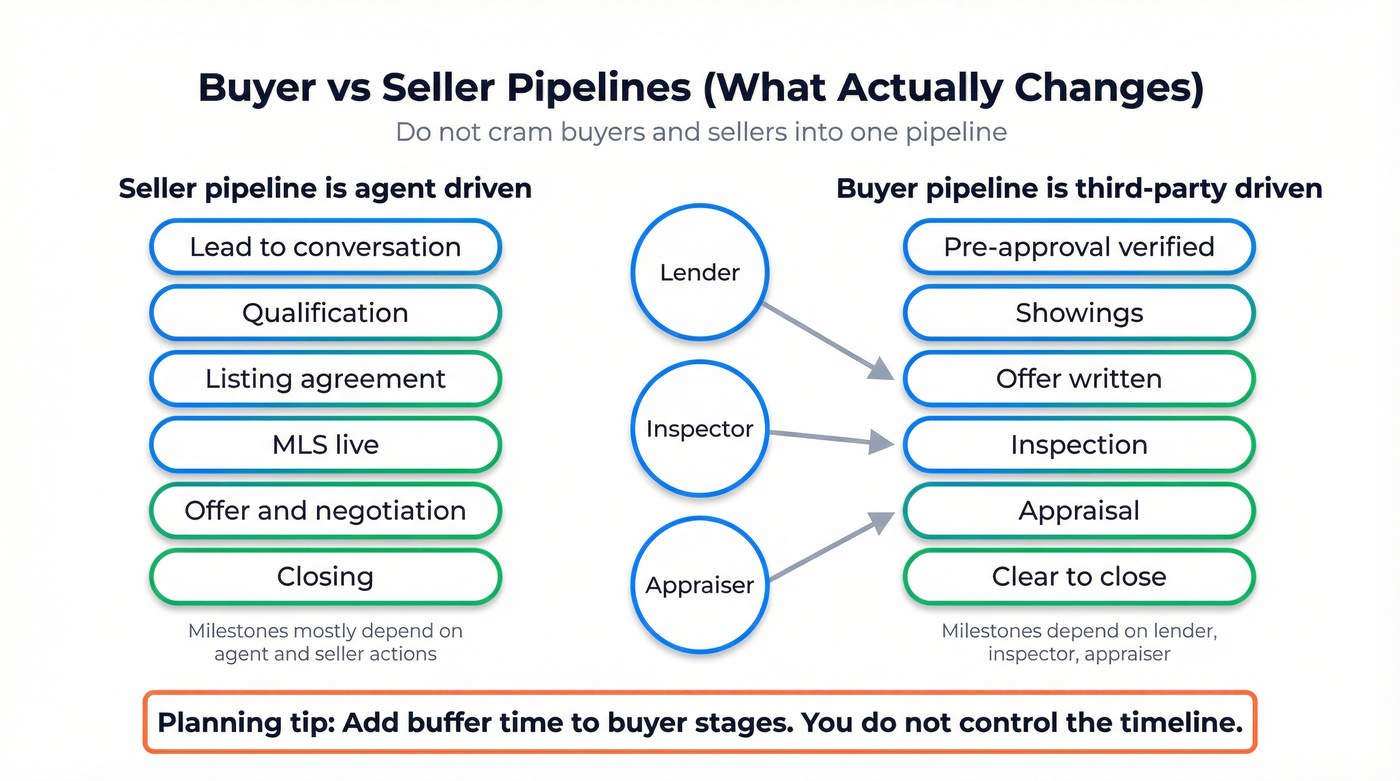
Don't cram buyers and sellers into one pipeline. The milestone sequences are completely different. Build separate pipelines or accept that half your stages won't apply to half your deals.
Seller/Listing Pipeline Stages
This is the pipeline most agents need and most agents build wrong. Most real estate sales pipelines start in what's actually the middle of the process, skipping early-stage leads that aren't hot yet.
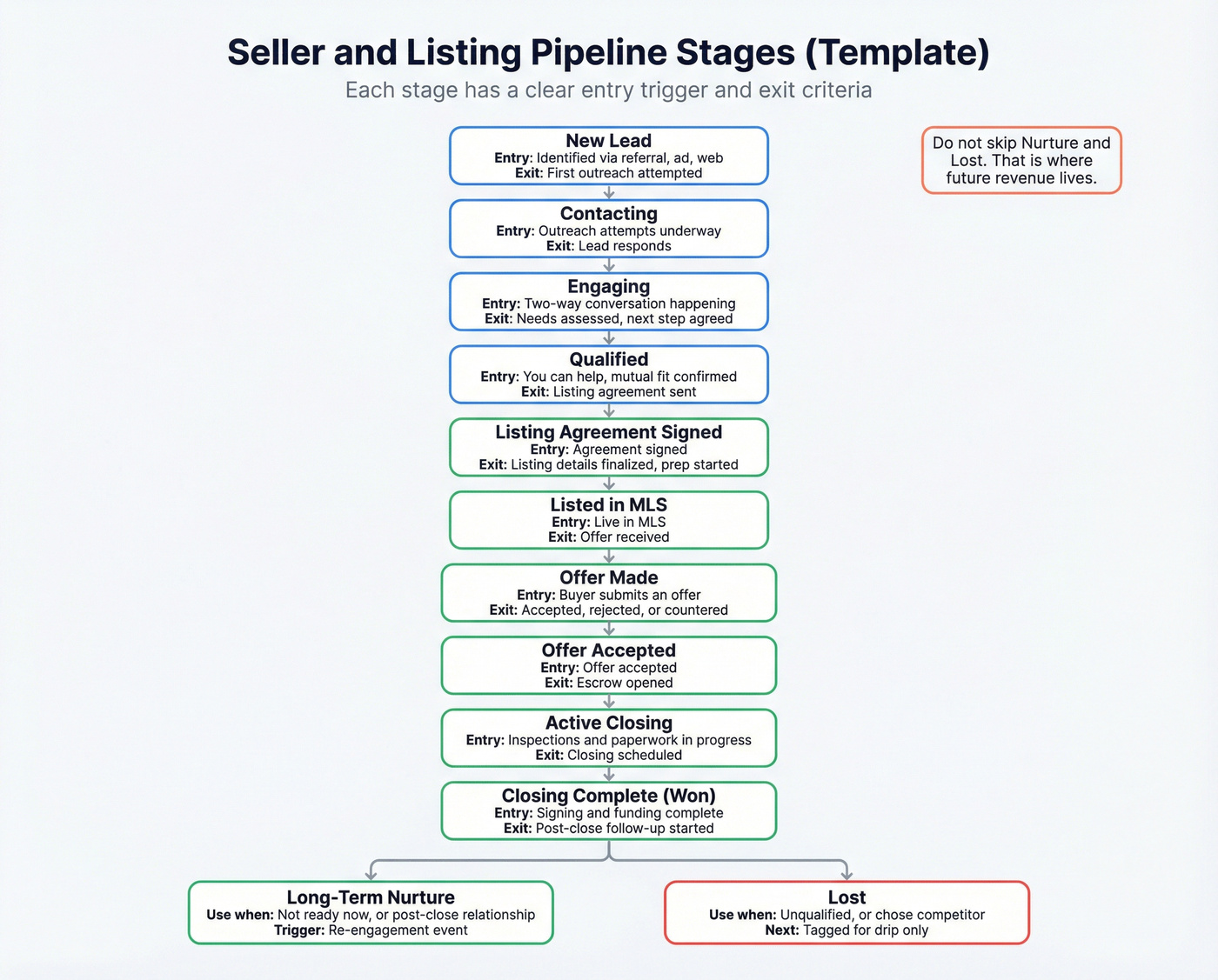
The early stages - New Lead through Qualified - are where lead leakage happens. Contacting leads within five minutes increases conversion likelihood by 21x compared to waiting 30 minutes. But speed only matters if the contact data is real. We've watched agents burn entire afternoons calling disconnected numbers pulled from portal imports, which is why verifying data before it enters your pipeline matters more than any automation you'll bolt on later. (If you're cleaning lists at scale, data enrichment services can help.)

Here's a listing-focused pipeline based on Keap's tested stage set, with clear early-funnel and post-close stages:
| Stage | Entry Trigger | Exit Criteria |
|---|---|---|
| New Lead | Identified via referral, ad, web | First outreach attempted |
| Contacting | Outreach attempts underway | Lead responds |
| Engaging | Two-way conversation happening | Needs assessed, next step agreed |
| Qualified | You can help + mutual fit confirmed | Listing agreement sent |
| Under Contract (Listing Agreement Signed) | Listing agreement signed | Listing details finalized, prep started |
| Listed in MLS | Live in MLS | Offer received |
| Offer Made | Buyer submits an offer | Offer accepted or rejected/countered |
| Offer Accepted | Offer accepted | Escrow opened |
| Active Closing | Paperwork + inspections + final details in progress | Closing scheduled |
| Closing Scheduled | Closing date/time set | Closing completed |
| Closing Complete (Won) | Signing + funding complete | Post-close follow-up started |
| Long-Term Nurture | Not ready now or post-close relationship | Re-engagement trigger hit |
| Lost | Unqualified or chose competitor | Tagged for drip only |
Don't skip the Nurture and Lost stages. That's where future revenue lives. If you want plug-and-play messaging for those follow-ups, use these sales follow-up templates.
Buyer Pipeline Stages
Buyer pipelines follow a different milestone sequence entirely. Pre-approval is commonly expected, and it makes showings and offers dramatically more productive.
| Stage | Entry Trigger | Exit Criteria |
|---|---|---|
| New Lead | Inquiry or referral received | Initial consultation done |
| Pre-Approval Verified | Lender letter confirmed | Search criteria defined |
| Showing Scheduled | Properties matched to criteria | Showing completed |
| Offer Written | Buyer selects property | Offer submitted |
| Under Contract | Offer accepted by seller | Escrow opened |
| Inspection Complete | Inspector report delivered | Repair negotiation resolved |
| Appraisal Complete | Lender appraisal received | Value confirmed or renegotiated |
| Clear to Close | All contingencies removed | Closing date confirmed |
| Closed | Signing + funding + keys | Post-close nurture begins |
The key difference from the seller pipeline: buyer stages are driven by third-party milestones - lender, inspector, appraiser - that the agent doesn't control. Build buffer time into every stage transition, because you'll need it when the appraiser takes 10 days instead of 5. (For a broader view of what breaks pipelines, see sales pipeline challenges.)

Your pipeline stages are only as good as the data inside them. Agents lose hours chasing dead numbers and bounced emails - leads that look active but were dead on arrival. Prospeo verifies emails at 98% accuracy and delivers 125M+ verified mobile numbers, so every contact entering your pipeline is real.
Fill your pipeline with verified contacts, not ghost leads.
Investor Pipeline Stages
Investors need simplicity. REsimpli's 7-stage model is one of the cleanest frameworks for wholesalers and fix-and-flip operators:
| Stage | Action |
|---|---|
| New Lead | Call, text, or email immediately |
| Contacted | Any communication made; set follow-up |
| Qualified | Motivation + timeline + realistic price confirmed |
| Follow-Up | Not ready yet; drip sequence active |
| Offer Made | Submitted; follow up aggressively |
| Under Contract | In escrow or prepped for assignment |
| Closed | Deal done; request testimonials |
If you're running multiple lead sources - probate, preforeclosure, driving for dollars - use parallel pipelines or tags rather than cramming everything into one. Keep it to seven stages max. In investor deals, speed is the entire game. To keep outreach consistent, borrow a few sales prospecting techniques.
Here's our honest take: if your average deal profit is under $50K, you don't need a 12-stage pipeline or a $500/month CRM. Seven stages in a spreadsheet will outperform a bloated system that nobody updates.
Contract-to-Close Timeline
Once an offer is accepted, the clock starts. Most purchase agreements establish a 30-45 day escrow window, though complex deals can stretch to 60 days.
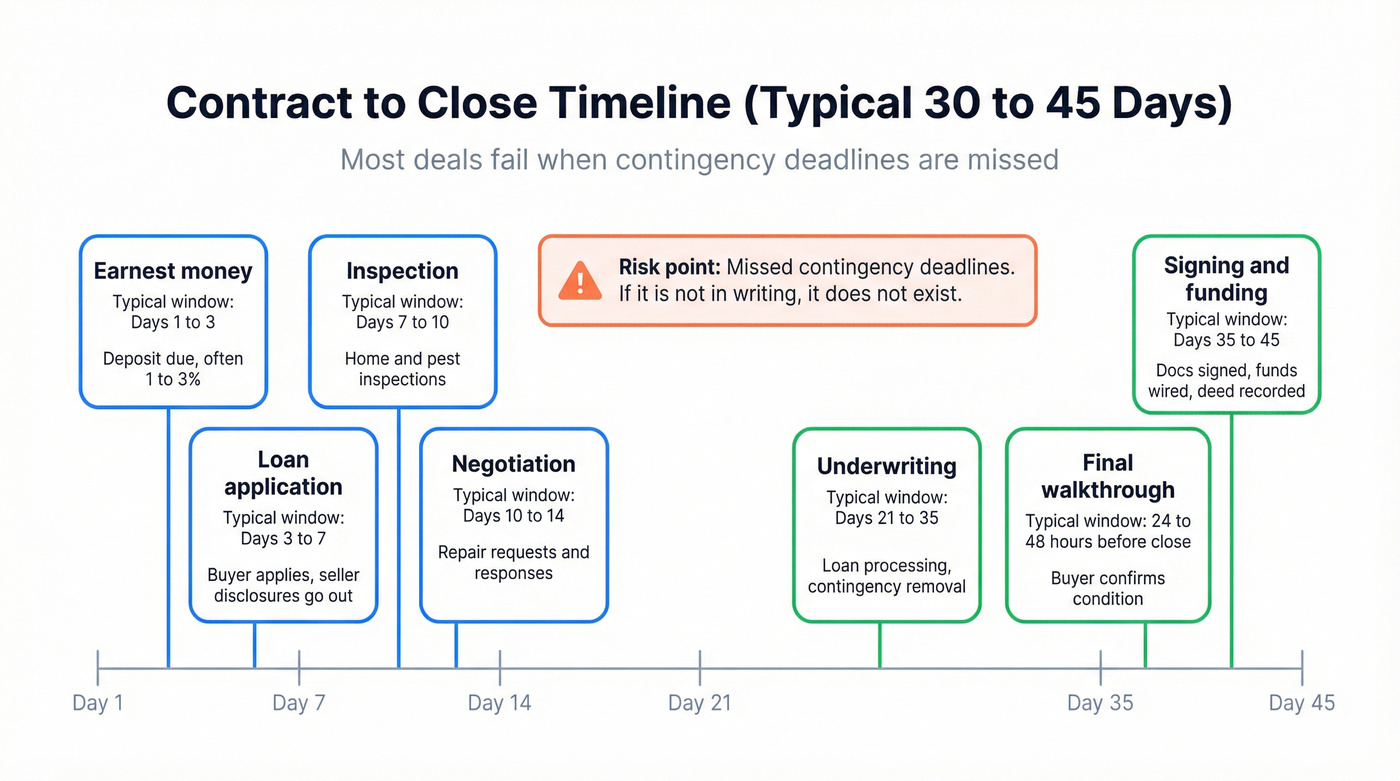
| Milestone | Typical Window | What Happens |
|---|---|---|
| Earnest money | Days 1-3 | Deposit due, typically 1-3% of purchase price |
| Loan application | Days 3-7 | Buyer submits; seller delivers disclosures |
| Inspection | Days 7-10 | Home + pest inspection within a 7-10 day window |
| Negotiation | Days 10-14 | Repair requests; seller responds in 3-5 days |
| Underwriting | Days 21-35 | Loan processing; contingency removal |
| Final walkthrough | 24-48 hrs before close | Buyer confirms property condition |
| Signing + funding | Days 35-45 | Documents signed, funds wired, deed recorded |
The most common failure point: missed contingency deadlines. If an extension isn't in writing, it doesn't exist. We've seen deals collapse in the final week because someone assumed a verbal agreement to extend the inspection window would hold. It won't.
Common Pipeline Mistakes
Too Many Stages
If your pipeline has 15+ stages, agents won't update it. That's not a discipline problem - it's a design failure. Trim to the milestones that actually change what you do next. (If you want a quick diagnostic, use these pipeline health metrics.)
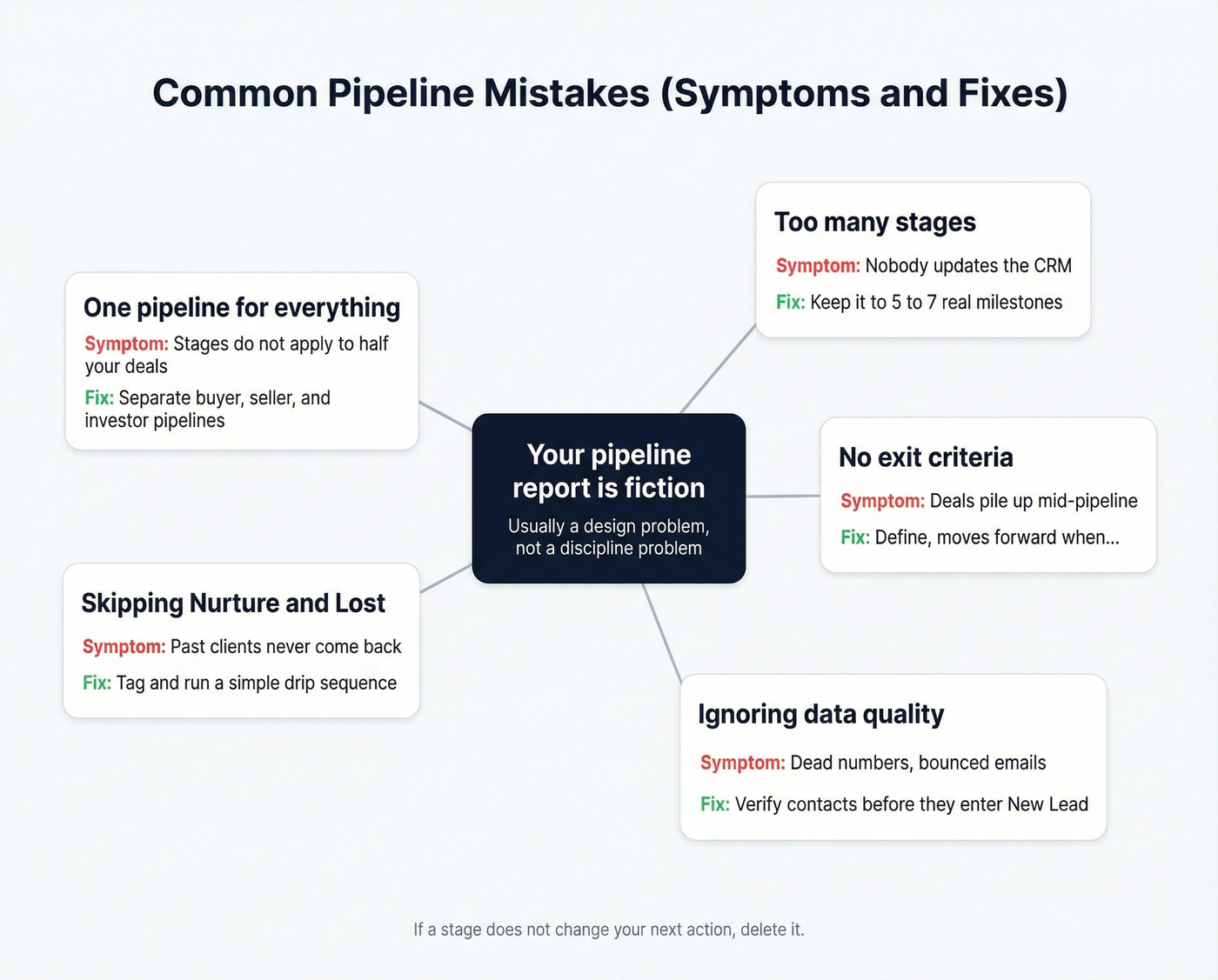
No Exit Criteria
Every stage needs a clear "this deal moves forward when ___." Without exit criteria, leads pile up in mid-pipeline stages and your forecast becomes meaningless. Threads in r/CRMSoftware are full of agents complaining that pipeline visibility is nonexistent, and it's almost always because stages are poorly defined, not because the CRM is bad. If forecasting is the goal, compare sales forecasting solutions.
Ignoring Data Quality
Duplicate leads from portal imports, wrong phone numbers, unverified emails - garbage data entering your New Lead stage poisons everything downstream. Tools like Prospeo verify emails at 98% accuracy on a 7-day refresh cycle, which means your pipeline starts with contacts that actually connect instead of dead ends. Clean your data before it enters the pipeline, not after. (If you're evaluating options, start with Bouncer alternatives.)
Skipping Nurture and Lost
These aren't optional. Around 90% of buyers and sellers say they'd use their agent again, but only about 12% actually do - almost entirely because agents stop following up after closing. Tag every closed deal and every lost lead so your drip sequences can work. If you need a system for timing, see importance of follow-up in sales.
One Pipeline for Everything
Buyers and sellers follow different milestone sequences. Investors have a completely different workflow. Build separate pipelines. Your reporting and forecasting depend on it.
Getting Your Stages Right
Well-defined real estate pipeline stages are the difference between a CRM that drives revenue and one that collects dust. Start with the templates above, customize the entry triggers and exit criteria for your market, and resist the urge to over-engineer. Five to seven stages per pipeline, clear milestones, clean data at the top - that's the entire formula.
Investor deals move fast - you said it yourself, speed is the entire game. Prospeo finds verified emails and direct dials for property owners, decision-makers, and stakeholders at $0.01 per email. No annual contracts, no wasted credits on bad data.
Close more deals when every number in your pipeline actually picks up.
FAQ
How many stages should a real estate pipeline have?
Five to seven stages per pipeline is the proven sweet spot - enough granularity to spot stalled deals, few enough that agents actually update them. Listing-specific pipelines can stretch to 10-13 stages (including Nurture and Lost) because the seller transaction has more distinct milestones.
What's the difference between a pipeline and a funnel?
A funnel is a marketing model tracking awareness, interest, and decision. A pipeline is an operational tool with stages tied to specific actions and deadlines. They're complementary - the funnel feeds leads into the pipeline - but they aren't interchangeable.
Should I use separate pipelines for buyers and sellers?
Yes. Buyer transactions hinge on third-party milestones like pre-approval, inspection, and appraisal. Seller transactions revolve around listing agreements, MLS activity, and offer negotiation. One combined pipeline guarantees stages that don't apply to half your deals.
What tools help keep pipeline data clean?
Any CRM with custom stages works - HubSpot, Pipedrive, Follow Up Boss, or REsimpli for investors. For contact data quality specifically, email verification tools catch bad records before they enter your pipeline. Verify on import, not after leads have already stalled.