

Rebuttal in Sales: What 2.5 Million Calls Reveal About Handling Objections
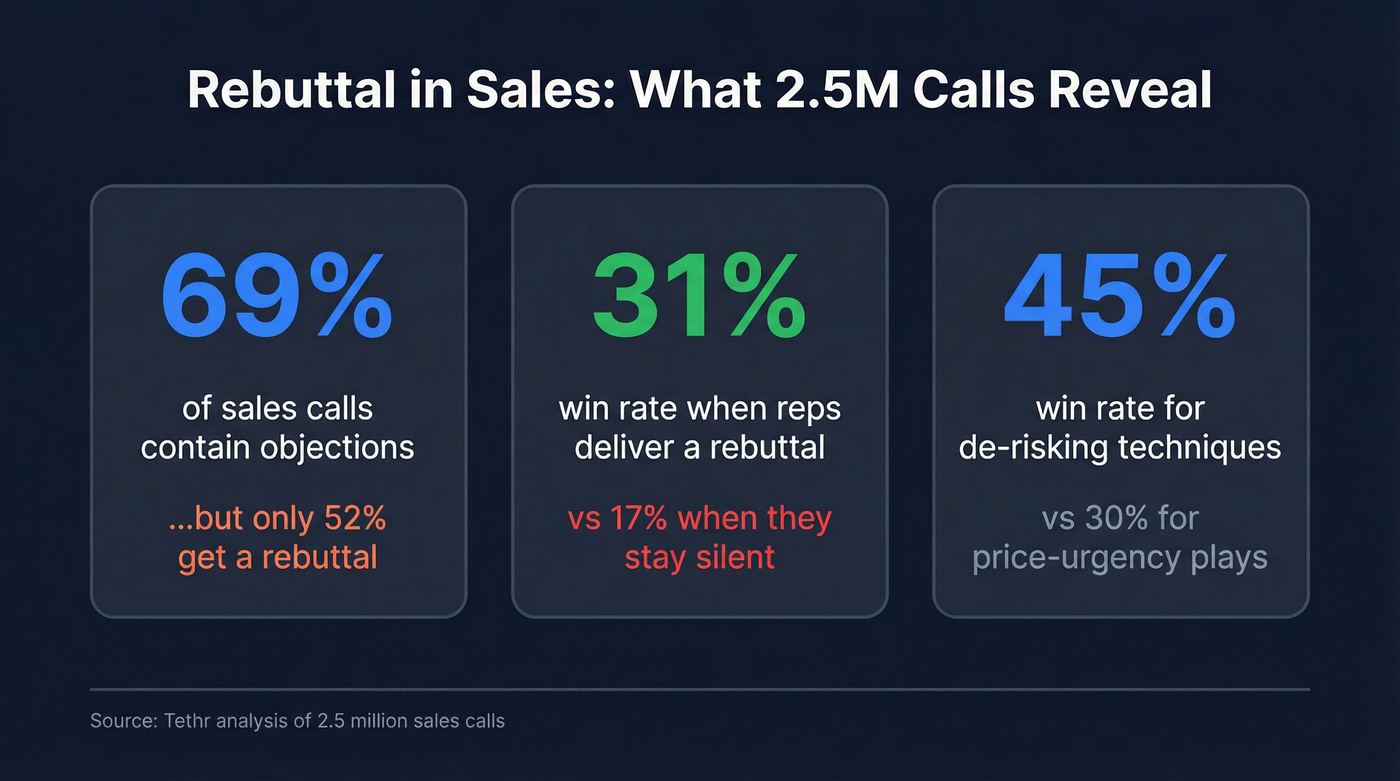
Objections show up in 69% of sales calls. Rebuttals only happen in 52%. That 17-point gap is where deals die - not because the prospect said no, but because the rep said nothing.
A rebuttal in sales is the structured, intentional response that keeps a deal alive after pushback. Tethr's analysis of 2.5 million calls found that reps who deliver one win at 31% versus 17% for those who stay silent. The difference isn't talent. It's preparation.
The Short Version
- Learn one framework first: LAER (Listen, Acknowledge, Explore, Respond).
- Change one behavior today: Pause after an objection. Average reps launch into a 21-second monologue. Top reps ask a question instead.
- Know the highest-converting rebuttal type: De-risking techniques carry a 45% average win rate, beating price-urgency plays (30%) and delay tactics (29%).
Three Rebuttal Frameworks Worth Knowing
A framework doesn't make you sound scripted - it keeps you from panicking and monologuing. Each of these suits a different selling motion in B2B deals.
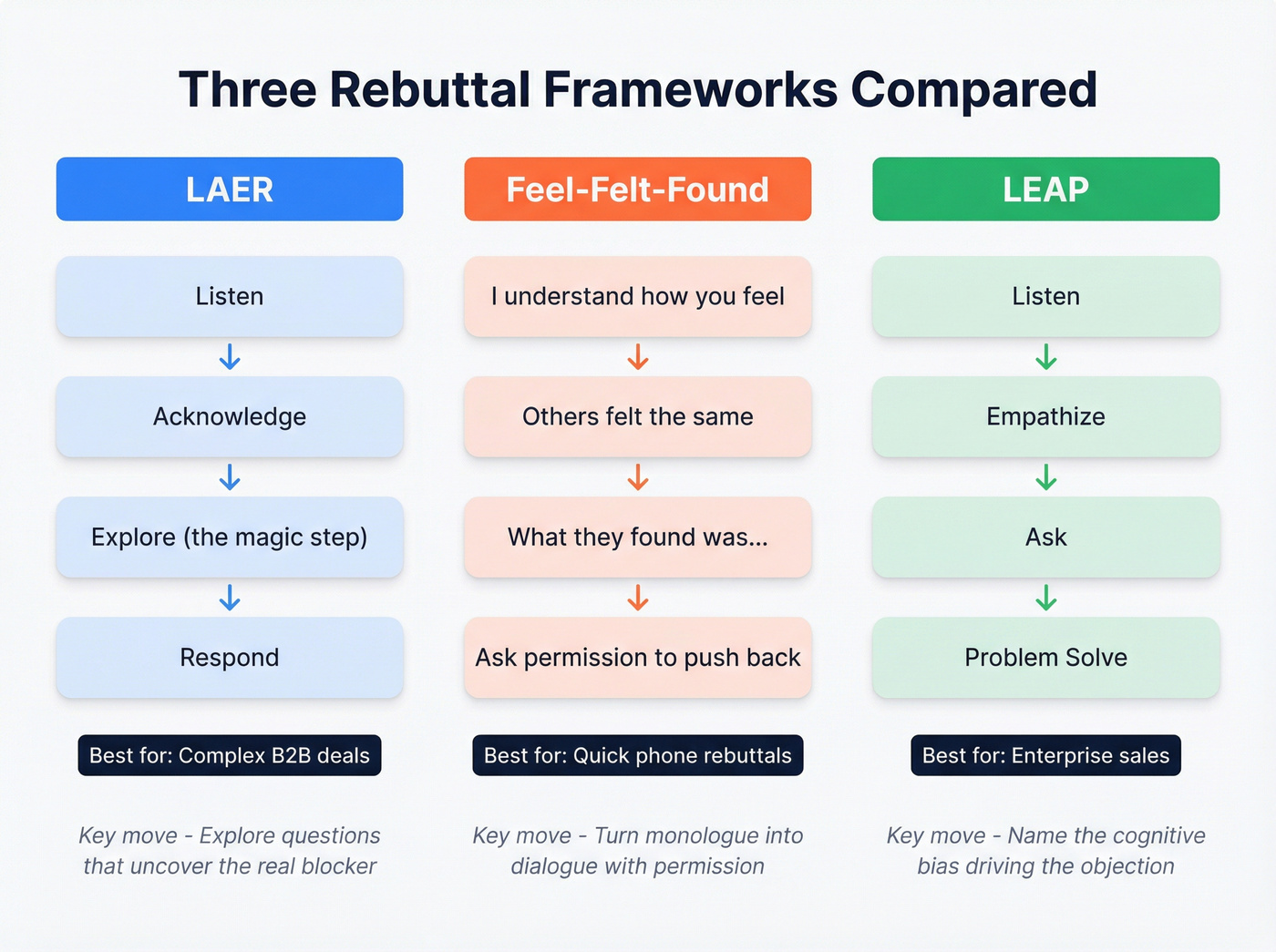
| Framework | Best For | Key Move |
|---|---|---|
| LAER | Complex B2B deals | "Explore" questions |
| Feel-Felt-Found | Quick phone rebuttals | Empathy + social proof |
| LEAP | Enterprise sales | Naming the bias |
LAER (Complex B2B)
Listen. Acknowledge. Explore. Respond.
The magic is step three - Explore - because that's where most reps skip straight to defending their product. Ask: "Can you expand on what's driving that concern?" (More on question design in discovery questions.)
A high six-figure deal was saved because a rep explored a CTO's objection instead of answering it. The surface issue was technical. The real blocker was a small integration concern that took ten minutes to resolve.
Feel-Felt-Found (Phone Rebuttals)
"I understand how you feel. Other [role] felt the same way. What they found was..."
Here's the modern upgrade: ask permission to push back after the empathy step. "Would it be helpful if I walked you through how they solved that?" One sentence turns a monologue into a dialogue.
LEAP (Enterprise Psychology)
Listen, Empathize, Ask, Problem Solve. LEAP explicitly accounts for loss aversion, status quo bias, and the ambiguity effect - the three cognitive forces that kill enterprise deals before they start.
When a VP says "we're happy with our current solution," they're expressing status quo bias, not satisfaction. LEAP trains you to name the underlying driver and address it head-on.
Scripts for the Six Most Common Objections
"Too Expensive"
Don't discount. De-risk.
"What if we started with a pilot on one team, measured results over 30 days, and you could cancel with zero penalty if the numbers don't work?"
The 2.5M-call study puts de-risking at a 45% win rate. Price-urgency plays sit at 30%. That's not a marginal difference - it's a completely different outcome distribution. (If you want more leverage here, study anchor in negotiation.)
"Not the Right Time"
This usually means "I'm worried about change management."
Try: "What would need to be true for the timing to feel right?" Then share how similar teams started with a small rollout and found the transition easier than expected. You're not arguing with their timeline - you're helping them think through it.
"We Already Use [Competitor]"
Don't trash the competitor. Ever.
Instead: "That makes sense - [competitor] does X well. Most teams I talk to who use them want better [specific gap]. Is that something you've run into?"
Let them sell themselves on the switch.
"I Need to Check With My Boss"
This is a buying signal, not a rejection.
"Who else should be involved? I'd love to send a one-pager that addresses the questions they'll ask. What's their biggest concern likely to be?"
You're coaching your champion, not waiting for a callback that never comes. (This fits neatly into a tighter steps to close a sale process.)
"I'm Not Interested"
Ask any rep on r/sales about their worst cold call and you'll hear a version of this. But we've watched teams cut their "wrong person" rate in half just by switching to verified contact data - because many "not interested" responses are really data problems, not objection problems. If you're rebuilding your outbound motion, start with sales prospecting techniques.
When you do reach the right person, try: "Most people say that because they assume I'll waste 20 minutes. I noticed [specific trigger]. Would five minutes be worth it to see if there's a fit?"
"Just Send Me an Email"
Often a brush-off. Don't just comply.
"Happy to - quick question first: is [specific pain point] something your team's dealing with right now?"
You've turned a dead-end into a qualifying question. If they give you a real answer, you've earned the next 60 seconds. When they do say yes, use a tight follow-up from your sales follow-up templates.

The article says it plainly: bad contact data creates more objections than bad selling ever will. When you reach the wrong person, every rebuttal framework in the world won't save the deal. Prospeo's 98% verified email accuracy and 125M+ direct dials mean your reps spend time rebutting real objections - not dialing dead numbers.
Stop rehearsing rebuttals for people who were never your buyer.
What Top Reps Do Differently
An analysis of 67,149 sales calls revealed a pattern that separates closers from everyone else.
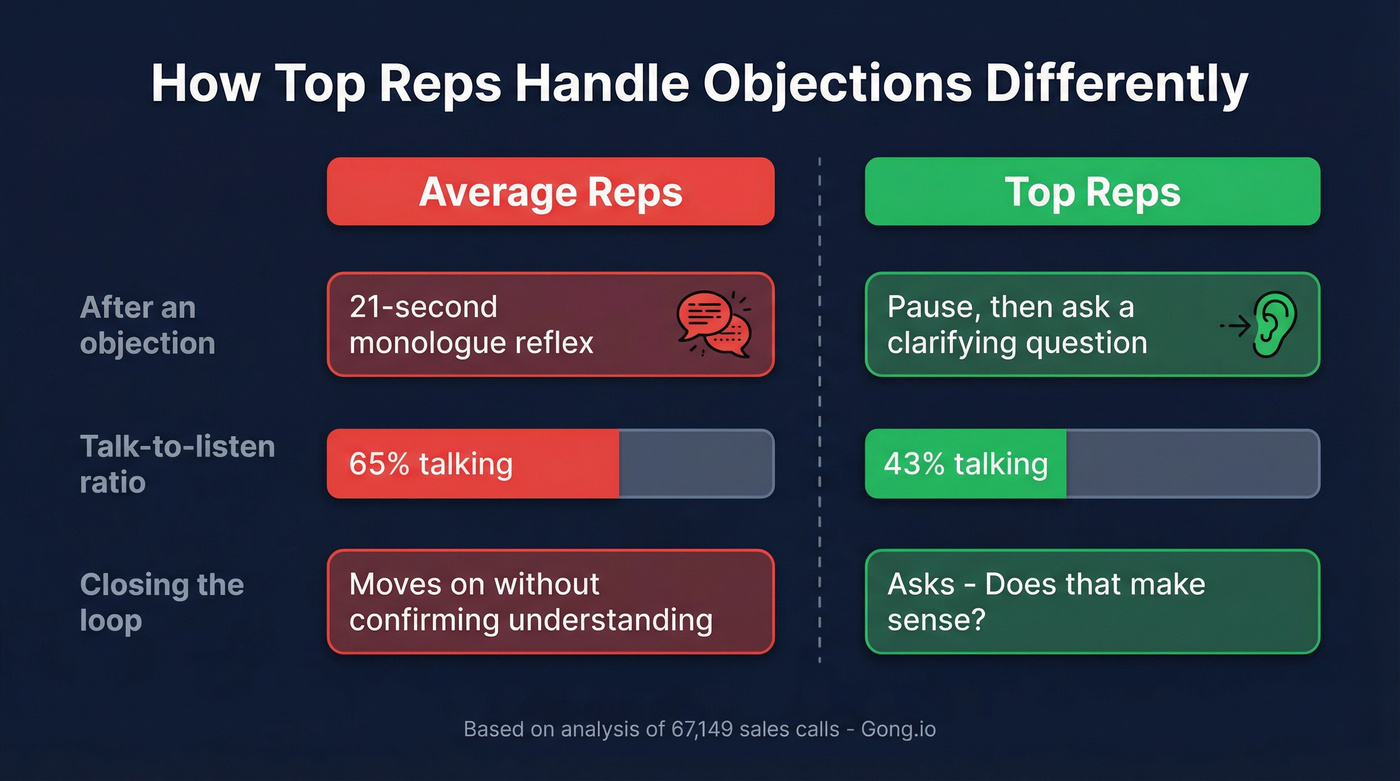
Average reps respond to objections with a 21.45-second monologue. Top reps pause, then ask a clarifying question. That's it. No secret technique - just the discipline to shut up for two seconds.
The difference shows up in talk-to-listen ratios: top closers speak 43% of the time versus 65% for average performers. They also maintain rapid back-and-forth speaker switches during objection moments and close the loop with "Does that make sense?"
Let's be honest: if your average deal size is under five figures, you don't need a sophisticated multi-step framework. You need to reach the right person on the first call. In our experience, bad contact data creates more "objections" than bad selling ever will. (If you're systematizing this, build a cold calling system.)
Five Rebuttal Mistakes That Kill Deals
Monologuing after the objection. That 21-second reflex response is the most measurable mistake in sales calls. Pause. Ask. Then respond.
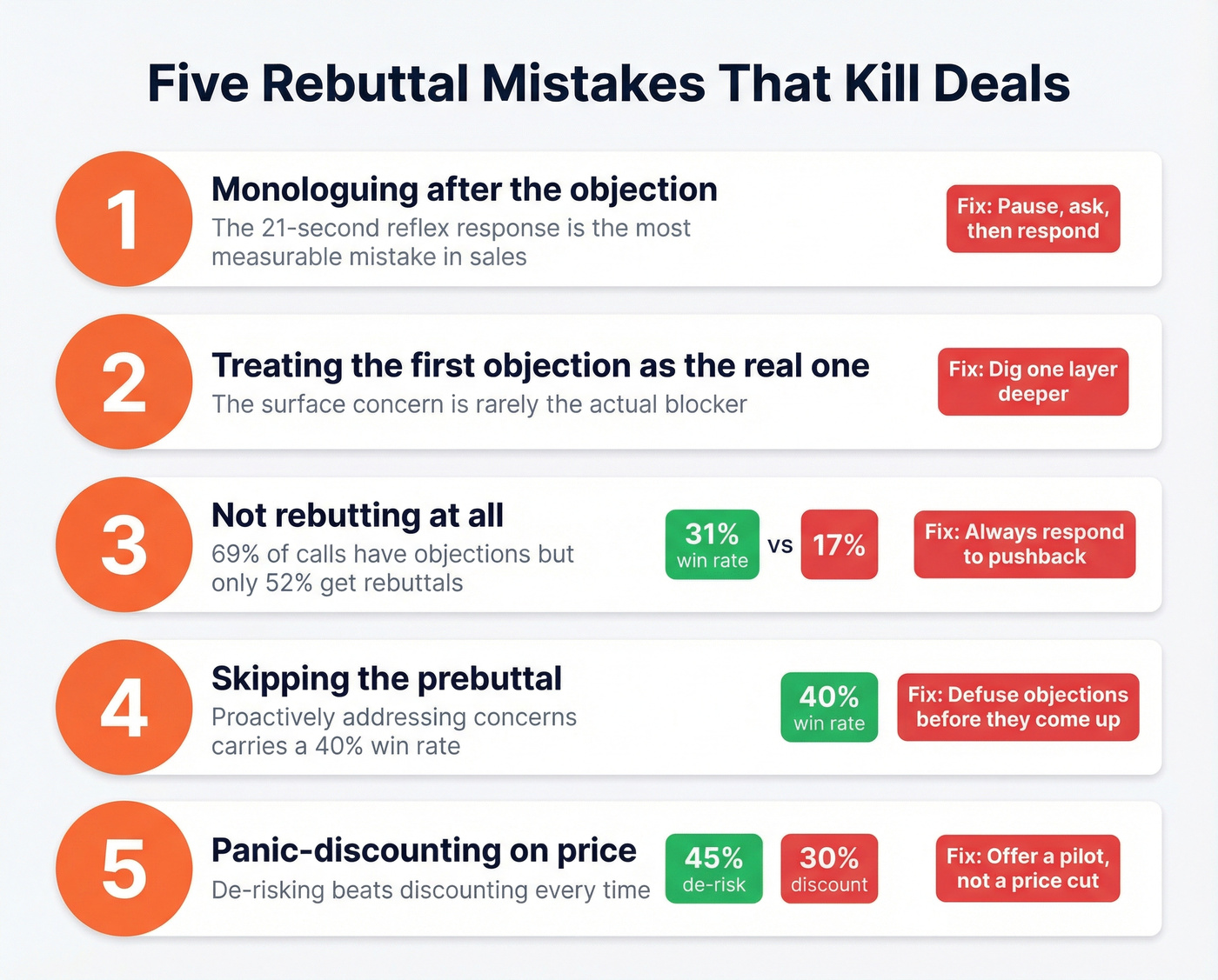
Treating the first objection as the real one. As Richard Harris puts it, we should be "marinating in objections" - the surface concern is rarely the actual blocker. Dig one layer deeper before you start solving.
Not rebutting at all. Objections appear in 69% of interactions but rebuttals show up in only 52%. That means a big chunk of objections go completely undefended, and the win-rate gap is 31% vs 17%.
Skipping the prebuttal. Proactively addressing common concerns before the prospect raises them carries a 40% win rate. Most reps wait for the objection instead of defusing it early - a missed opportunity that costs nothing to fix. (For a full system, see how to reduce sales objection rate.)
Panic-discounting on price. De-risking beats discounting: 45% vs 30% win rate. Offer a pilot, not a price cut. Your margin will thank you.
How to Practice
Gartner's data is brutal: B2B sellers forget 70% of training within a week. Reading this article won't change your close rate. Drilling will.
AI roleplay tools make this practical - Yoodli runs $11/mo, Kendo AI starts at $55/mo, and Mindtickle covers roleplay as part of a broader enablement suite at $30-50/user. The best way to internalize the objection-and-response cycle is to simulate it repeatedly until the right answer becomes instinct rather than improvisation, which means running through scenarios three or four times a week until the patterns feel automatic.
Build a simple playbook: objection verbatim, what it really means, qualifying questions, response, proof points. Update it quarterly. We've seen teams go from scattered objection handling to consistent 30%+ win rates in under 90 days just by drilling from a shared doc.
Skip the expensive enablement platforms if your team is under ten reps. A shared Google Doc with recorded call snippets works fine until you outgrow it.
Teams using Prospeo book 35% more meetings than Apollo users and 26% more than ZoomInfo - because reps connect with actual decision-makers on the first attempt. Fewer wrong-person calls means fewer fake objections and more real conversations worth rebutting.
Cut your "not interested" rate in half by reaching the right person first.
Sales Rebuttal FAQ
What's the difference between an objection and a rebuttal?
An objection is the prospect's pushback - on price, timing, need, or authority. A rebuttal is the rep's structured response designed to keep the deal moving. The 2.5M-call study shows reps who deliver rebuttals win at 31% versus 17% for those who let objections go unaddressed.
Which rebuttal framework works best?
LAER is the most versatile for complex B2B deals because its "Explore" step uncovers the real blocker. Feel-Felt-Found works best for fast phone conversations, and LEAP adds a behavioral-psychology layer for enterprise cycles. Start with LAER - most deals are lost at the step reps skip.
How do you reduce objections before they happen?
Use prebuttals - proactively address common concerns before the prospect raises them. The 2.5M-call study shows a 40% win rate for this approach. Second, improve your contact data so reps reach actual decision-makers instead of gatekeepers. When your connect rate doubles, your "not interested" rate drops by half.
Can bad data cause more objections than bad selling?
Yes. When reps dial wrong numbers or email outdated contacts, they reach gatekeepers or disinterested parties whose "not interested" isn't a real objection - it's a data failure. Teams that switch to verified, weekly-refreshed contact data routinely see connect rates jump 2-3x and objection volume drop significantly.