

The Best Recruiter Tools in 2026 (and How to Build Your Stack)
Your head of talent just told you the team spends eight hours a week on manual sourcing, and half the emails bounce. SHRM's 2026 benchmarking data puts the [average cost-per-hire at $5,475](https://www.shrm.org/about/press-room/shrm-releases-2025-benchmarking-reports - how-does-your-organizat) for nonexecutive roles - before you factor in the recruiting budget eating [26% of total HR spend](https://www.shrm.org/about/press-room/shrm-releases-2025-benchmarking-reports - how-does-your-organizat). Every bad tool in your stack compounds that cost.
Choosing the right recruiter tools isn't optional anymore. It's the difference between a lean hiring machine and a money pit. We've tested dozens of these platforms, and most roundups list 50+ options - that's a product catalog, not advice. This one covers fewer tools with more depth, real pricing, stack blueprints by budget, and the AI compliance landscape you can't ignore.
Our Picks (TL;DR)
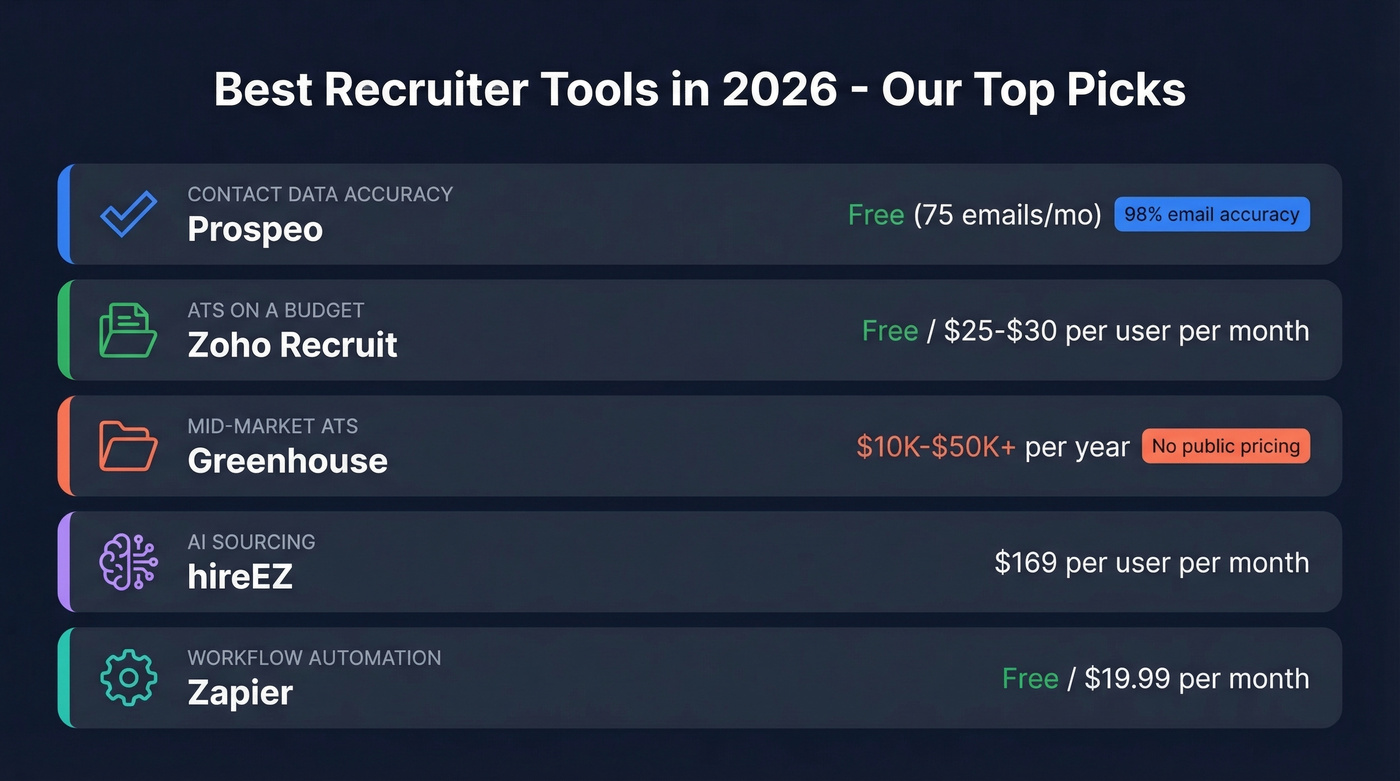
| Best For | Tool | Starting Price |
|---|---|---|
| Contact data accuracy | Prospeo | Free (75 emails/mo) |
| ATS on a budget | Zoho Recruit | Free / $25-$30/user/mo |
| Mid-market ATS | Greenhouse | Typically $10K-$50K+/yr |
| AI sourcing | hireEZ | $169/user/mo |
| Workflow automation | Zapier | Free / $19.99/mo |
Applicant Tracking Systems
Every recruiting stack starts here. The ATS is the foundation everything else plugs into - sourcing, scheduling, offer management. Get this wrong and you're building on sand.
Greenhouse
Use this if: You're a mid-market or enterprise company (200+ employees) that needs structured hiring workflows, advanced reporting, and deep integrations. Greenhouse's strength is process rigor - scorecards, interview kits, approval chains. It's the ATS that forces discipline on teams that would otherwise wing it, and for high-volume hiring orgs, that discipline pays for itself.
Skip this if: Your team is under 200 people. You're overpaying for structure you don't need yet. Greenhouse typically runs $10K-$50K+/year on annual contracts, and they still don't publish pricing publicly - which tells you something about their sales process.
Zoho Recruit
Zoho Recruit is the most underrated ATS on the market. The free plan covers basic applicant tracking for solo recruiters. Paid plans start at $25-$30/user/month - absurdly reasonable for custom pipelines, resume parsing, career page hosting, and integrations with the broader Zoho ecosystem. We've seen three-person teams run their entire hiring process on the free plan without hitting a wall.
The tradeoff: if you need enterprise-grade compliance reporting or granular permissions for a 50-person TA team, you'll outgrow it. The UI can also feel cluttered compared to more polished products like Lever. That said, for talent agencies that need a capable ATS without enterprise pricing, it's one of the strongest options available.
Workable
Workable sits in the sweet spot for SMBs hiring 5-20 roles per year. Pricing starts at $299/month with a 15-day free trial, and built-in sourcing features are decent for teams that don't want a separate tool. Fair warning: the per-job pricing model gets expensive fast once you're running lots of roles simultaneously.
Manatal
Starting at $15/user/month, Manatal is one of the cheapest capable ATS platforms you'll find. The Kanban-style pipeline is intuitive enough that most teams are productive within a day. It won't replace Greenhouse for a 500-person company, but for agencies and lean in-house teams, it punches well above its price point.
AI Sourcing Tools
Every vendor claims AI-powered sourcing with 800M+ profiles. Here's the thing: most of these platforms pull from the same open-web data sources. The differentiator isn't the AI - it's data quality, freshness, and workflow fit. If you're building outbound sequences, it also helps to borrow proven sales prospecting techniques so your sourcing doesn't turn into spam.
hireEZ
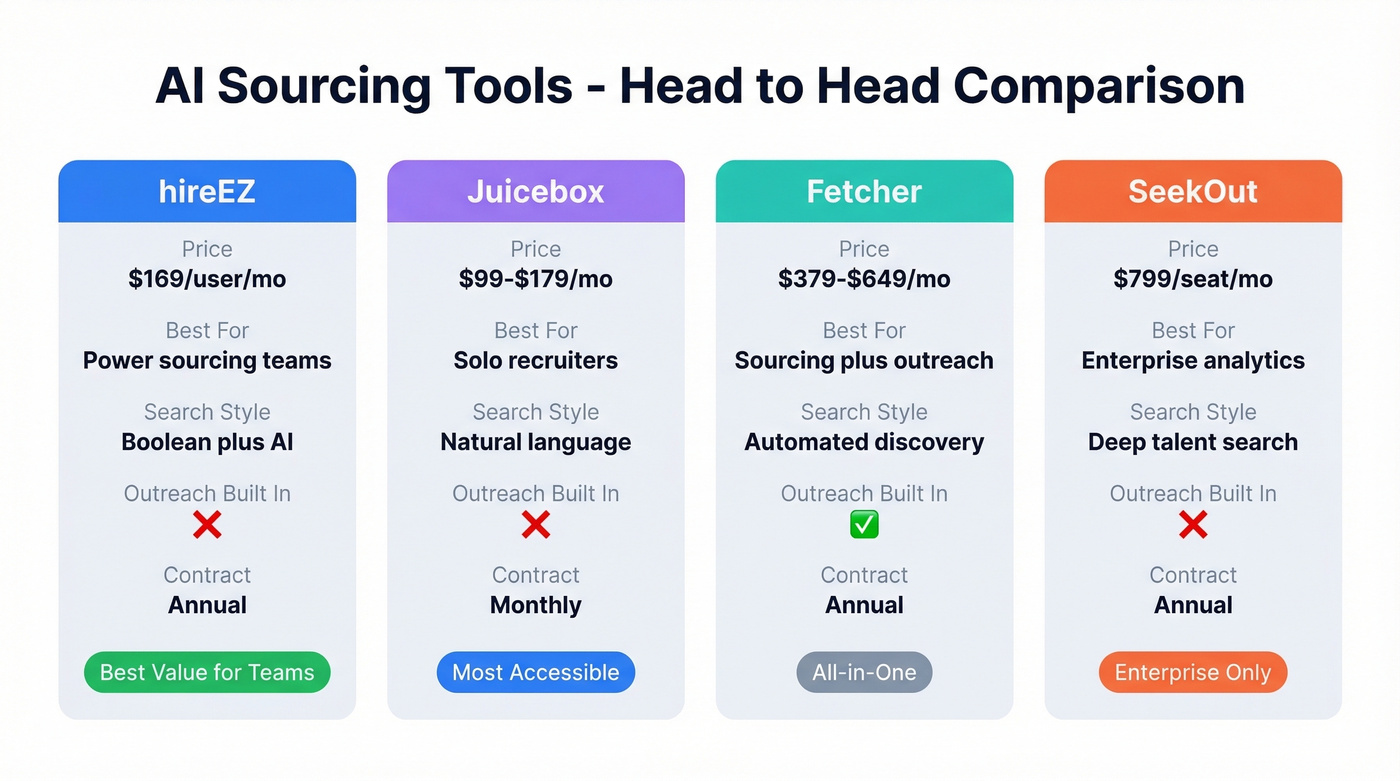
Use this if: You're a dedicated sourcing team running complex Boolean-style searches across a massive candidate pool. hireEZ's 800M+ profile database is genuinely deep, and the AI-assisted search saves real time. At $169/user/month, it's a fraction of what SeekOut typically runs at around $799/seat/month.
Skip this if: You're a solo recruiter. The per-seat cost adds up fast, and you'll pay for power you don't use. If your primary bottleneck is contact data accuracy rather than candidate discovery, a sourcing tool alone won't fix your bounce rates.
Juicebox (PeopleGPT)
Juicebox takes a different approach: natural-language search. Describe the candidate you want in plain English and the AI translates it into a search across their database. At $99-$179/month, it's accessible for solo recruiters who don't want to learn Boolean syntax. The tradeoff is less granular control than hireEZ for power users.
Fetcher
Fetcher combines sourcing with automated outreach sequences - discovery and first-touch emails in one tool. Pricing runs $379-$649/month on annual plans. Steep for small teams, but the time savings justify it if you're sourcing at volume and don't want to stitch together three separate tools.
Contact Data & Verification
You can have the best ATS and smartest sourcing tool, but if the emails bounce and the phone numbers are dead, none of it matters. Recruiters consistently cite data quality as their number-one frustration with sourcing platforms. We've watched teams waste $50K/year on tools with 60% bounce rates. This is the category most recruiting teams underinvest in. If bounce is a recurring issue, it’s worth tracking your email bounce rate and fixing deliverability at the source with an email deliverability guide.
Prospeo
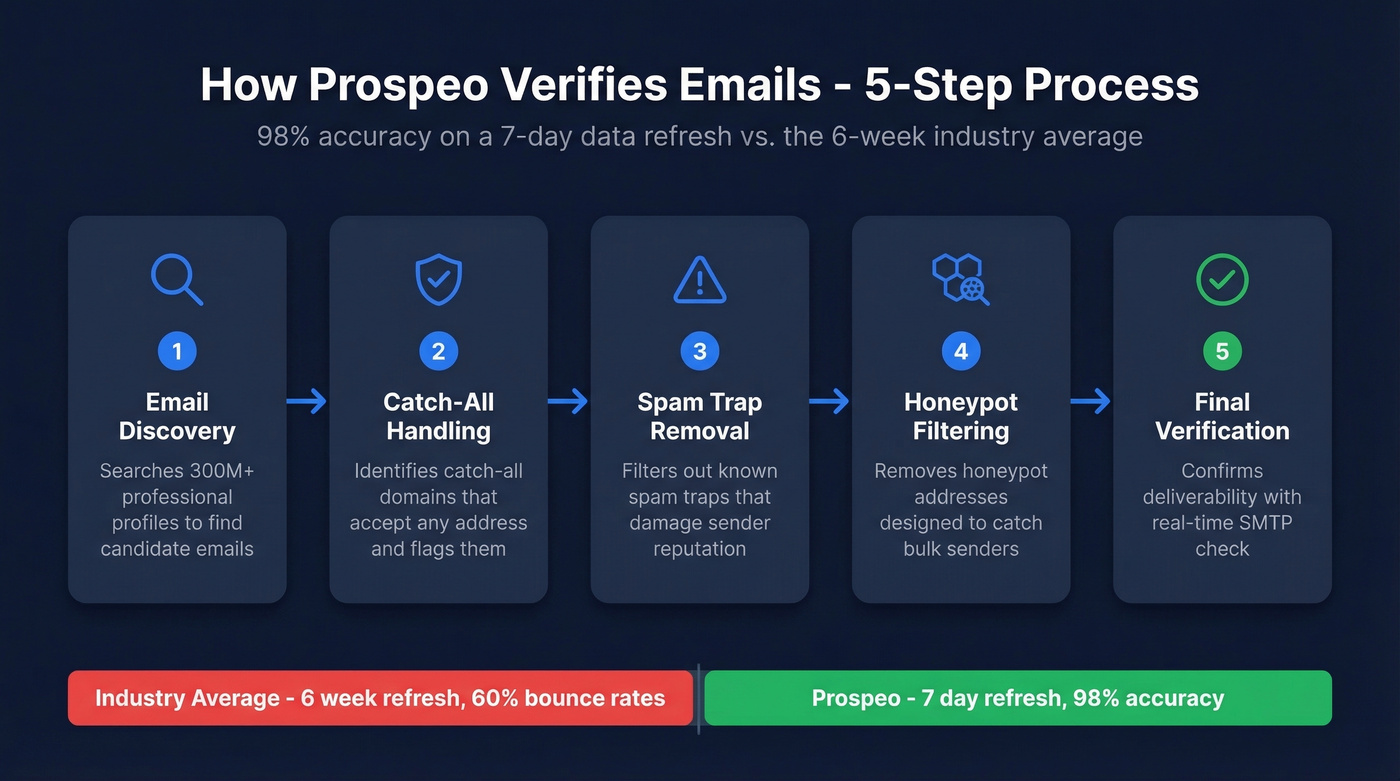
Prospeo delivers 98% email accuracy on a 7-day data refresh cycle - compared to the 6-week industry average. The platform runs a 5-step verification process with catch-all handling, spam-trap removal, and honeypot filtering across 300M+ professional profiles, 143M+ verified emails, and 125M+ verified mobile numbers. If you're comparing vendors, our breakdown of data enrichment services can help you separate “finder” features from true verification.
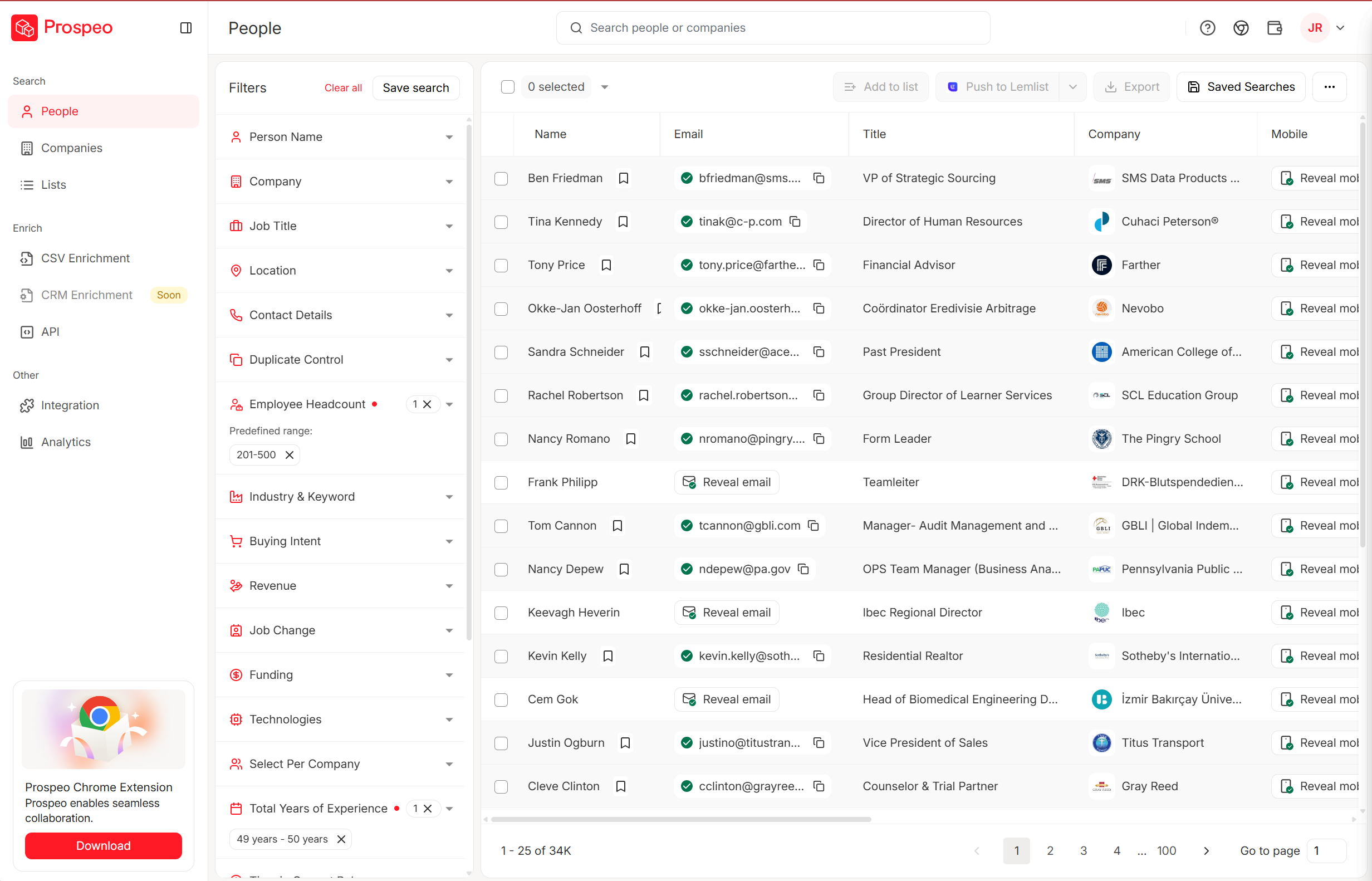
The Chrome extension (40,000+ users) pulls verified emails and phone numbers from professional profiles and company websites in one click. API enrichment delivers a 92% match rate across 50+ data points per contact. Pricing starts free - 75 emails and 100 Chrome extension credits per month - with paid plans at roughly $0.01 per email. No contracts, no sales calls required. If you’re evaluating alternatives, see our guide to Bouncer alternatives for email verification.
Interview & Assessment
Metaview
Metaview records and transcribes interviews, then generates structured notes automatically. One recruiter on r/recruiting called integrating it "life changing" - after watching teams spend 20+ minutes writing up notes after every interview, we get why. Pricing is custom, typically $200-$500/month for small teams.
Ezra
Ezra's AI conducts the entire first-round interview. Starting at $250/month for 2 seats and 50 interviews, it's built for teams drowning in screening calls. The AI asks structured questions, evaluates responses, and passes qualified candidates forward. It won't replace human judgment for final rounds, but it reclaims dozens of hours per month on initial screens.
Automation & Outreach
Zapier
Zapier is the connective tissue that makes your hiring tools talk to each other. With 8,000+ app connections, it handles automations that would otherwise require a developer. Free plan available, paid from $19.99/month.
JBGoodwin REALTORS built an automated recruiting pipeline with Zapier and reported a 37% year-over-year increase in recruiting with a 20-25% reduction in manual workload. Common recruiting automations include pushing new applicants from job boards into your ATS, triggering Slack notifications for hiring managers, and syncing candidate data across tools. Teams that pair Zapier with email drip sequences - triggered by candidate stage changes - see the biggest time savings. If you’re building those sequences, keep a swipe file of email subject lines examples to improve reply rates without increasing volume.

Recruiters waste thousands on sourcing tools that deliver dead emails. Prospeo's 5-step verification and 7-day data refresh give you 98% email accuracy across 300M+ profiles - so every outreach actually lands. Free tier included, no contracts.
Stop paying $5,475 per hire on top of a 60% bounce rate.
Also Worth Knowing
Paradox (Olivia) handles conversational AI for high-volume hiring - scheduling, screening, FAQ responses. Custom pricing, typically $1,000+/month. Textio optimizes job descriptions for inclusivity at $5K-$15K/year. HireVue runs AI-powered video interviews at enterprise scale, typically $35K+/year. Recruit CRM is a solid agency-focused option at $85-$165/user/month if you need invoicing and client management alongside recruiting. SeekOut targets enterprise sourcing with deep talent analytics at around $799/seat/month. Gem runs typically around $24K/year and targets sourcing plus talent engagement with deeper analytics.
Master Pricing Comparison
Every tool in one view. The fact that Greenhouse, Lever, and most enterprise ATS platforms still won't publish pricing tells you everything about how they think about the buyer relationship.
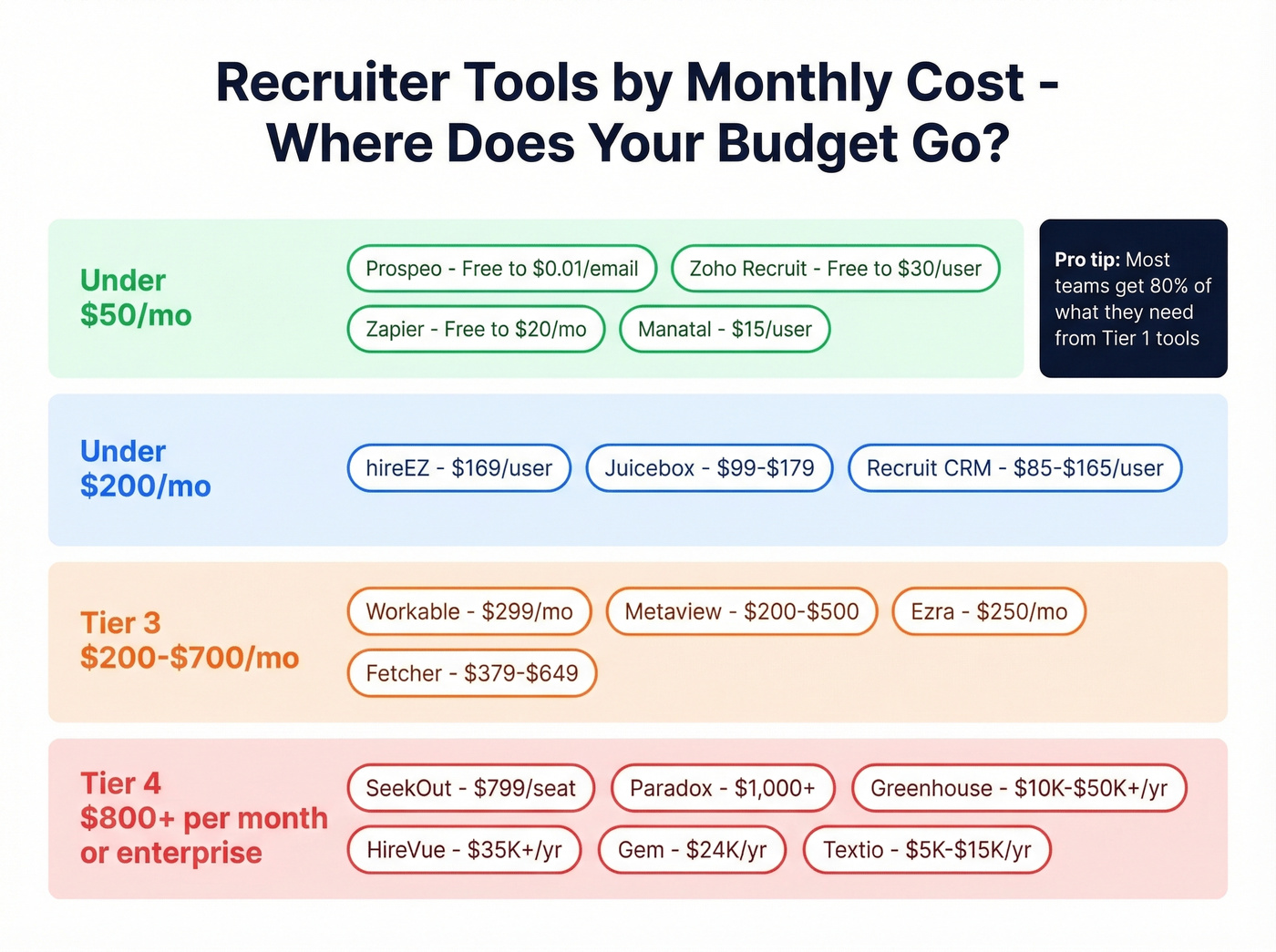
| Tool | Category | Starting Price | Free Tier? | Contract |
|---|---|---|---|---|
| Zoho Recruit | ATS | $25-$30/user/mo | Yes | Monthly |
| Greenhouse | ATS | ~$10K-$50K+/yr | No | Annual |
| Workable | ATS | $299/mo | 15-day trial | Monthly |
| Manatal | ATS | From $15/user/mo | 14-day trial | Monthly |
| hireEZ | AI Sourcing | $169/user/mo | No | Annual |
| Juicebox | AI Sourcing | $99-$179/mo | No | Monthly |
| Fetcher | Sourcing+Outreach | $379-$649/mo | No | Annual |
| SeekOut | Enterprise Sourcing | ~$799/seat/mo | No | Annual |
| Gem | Sourcing/CRM | ~$24K/yr | No | Annual |
| Metaview | Interview Notes | ~$200-$500/mo | No | Custom |
| Ezra | AI Interviews | $250/mo | No | Monthly |
| Zapier | Automation | $19.99/mo | Yes | Monthly |
| Paradox | Conversational AI | ~$1,000+/mo | No | Annual |
| HireVue | Video Interviews | ~$35K+/yr | No | Annual |
AI Compliance in 2026
If you're using AI in any part of your hiring process - sourcing, screening, scoring, ranking - the legal landscape shifted hard in late 2025 and early 2026.
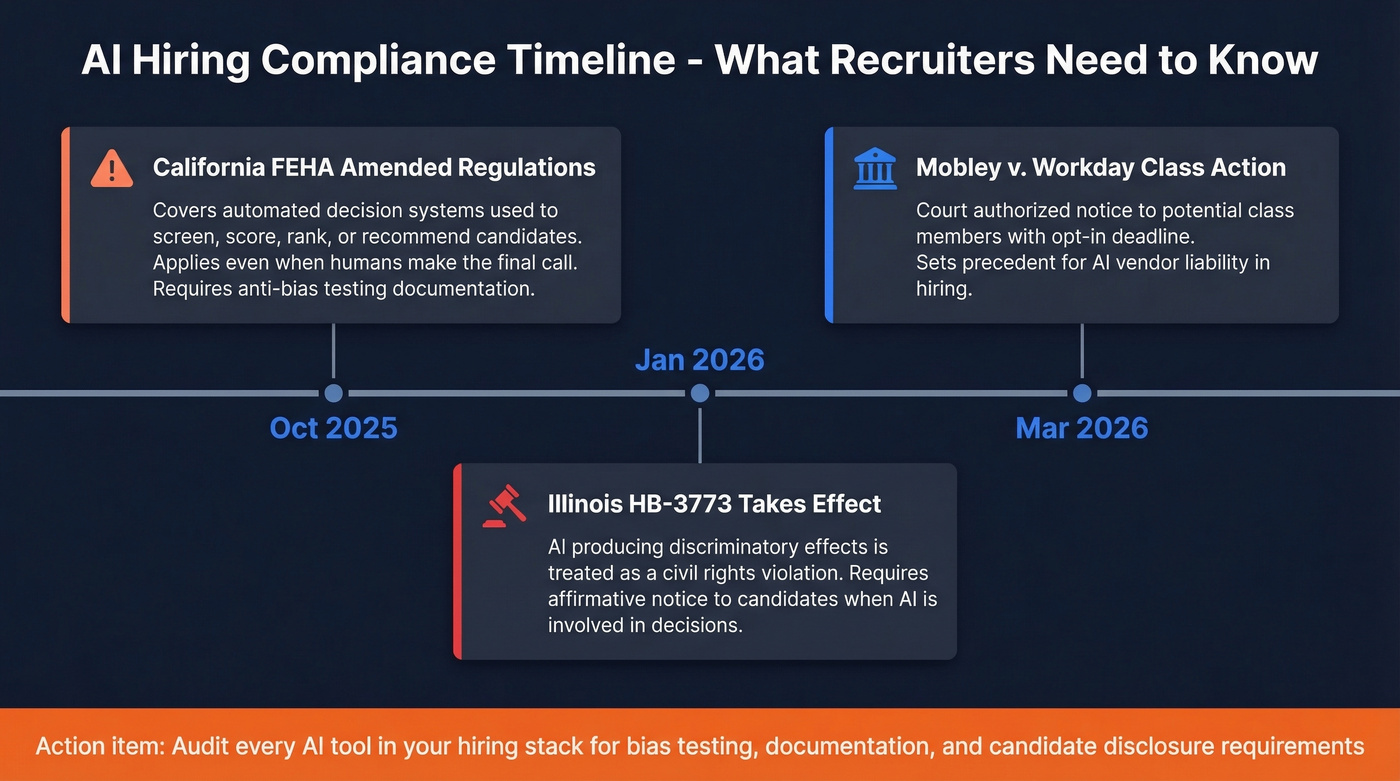
California's FEHA amended regulations (effective October 2025) explicitly cover automated decision systems used to screen, score, rank, or recommend candidates. These rules apply even when humans make the final decision. Regulators now evaluate whether you conducted anti-bias testing, how recent it was, and what you did with the results. One risk that gets overlooked: AI screening can reinforce homogeneity by pattern-matching against your existing workforce, so periodically reviewing non-surfaced resumes is a smart safeguard.
Illinois HB-3773 (effective January 2026) goes further - using AI that produces discriminatory effects is treated as a civil rights violation, with affirmative notice obligations when AI is involved.
The litigation wave is real. The Mobley v. Workday class action authorized notice to potential class members with a March 2026 opt-in deadline, proceeding on an agency theory that makes vendors liable as the employer's agent. Eightfold AI faces a January 2026 FCRA lawsuit alleging its AI scoring uses external data without review or dispute rights. The iTutorGroup EEOC settlement ($365K) already proved that AI automatically rejecting older applicants creates financial liability.
Before you buy any AI recruiting tool, ask three questions: Has the vendor conducted independent bias audits - and will they share results? Does the tool support your notice obligations under state law? Can you produce compliance documentation if regulators come knocking?
Stack Blueprints by Budget
Let's be honest: if your average cost-per-hire is under $3,000, you don't need an enterprise sourcing platform. A tight three-tool stack will outperform a bloated seven-tool mess every time. Whatever sourcing tool you pick, run the data through a verification layer before outreach - bad contact data is the silent killer of recruiting pipelines.
Startup (Under 50 Employees, Under $500/mo)
| Role | Tool | Monthly Cost |
|---|---|---|
| ATS | Zoho Recruit (free) | $0 |
| Contact Data | Prospeo (free tier) | $0 |
| Automation | Zapier (free) | $0 |
| Total | $0-$100 |
This stack is enough to cut sourcing time dramatically compared to manual profile trawling and spreadsheet tracking.
SMB (50-500 Employees, Under $2K/mo)
| Role | Tool | Monthly Cost |
|---|---|---|
| ATS | Workable or Manatal | $299+ / $15+ per user |
| Sourcing | hireEZ or Juicebox | $99-$169 |
| Contact Data | Prospeo (paid) | ~$39-$99 |
| Automation | Zapier | $19.99 |
| Interview Notes | Metaview | ~$200-$500 |
| Total | ~$640-$1,390 |
Mid-Market (500+ Employees, $5K+/mo)
| Role | Tool | Monthly Cost |
|---|---|---|
| ATS | Greenhouse | ~$830-$4,170 |
| Sourcing | hireEZ (multi-seat) | $500+ |
| Conversational AI | Paradox | ~$1,000+ |
| Automation | Zapier (team) | $69+ |
| Total | ~$2,400-$5,700 |

Your ATS and AI sourcing tools are only as good as the contact data feeding them. Prospeo delivers 143M+ verified emails and 125M+ mobile numbers with a 92% API match rate - plug it into your existing stack and watch bounce rates drop below 4%.
One click. Verified email. Verified phone. From any profile or company page.
Measuring Your Recruiter Tools
Only [20% of organizations track quality of hire](https://www.shrm.org/about/press-room/shrm-releases-2025-benchmarking-reports - how-does-your-organizat). That means 80% of recruiting teams are spending thousands per month on tools with no idea whether they're working.
A worked example from RecruiterFlow illustrates the gap: a "good search" with $60K in fees and $8,555 in total cost delivers 601% ROI, while a "bad search" with zero fees but $6,495 in wasted internal time delivers -100% ROI. The tool isn't always the expensive part - the time your team wastes on bad data and broken workflows is.
Track three metrics by tool: cost-per-hire, time-to-fill, and source-of-hire. Then track candidate drop-off rates at each stage. If 60% abandon your application, the problem is your career page or ATS, not your sourcing. If you want a tighter measurement framework, borrow a few funnel metrics concepts and apply them to your hiring stages.
Five Mistakes That Kill Your Stack
Over-tooling. The average recruiting team juggles 7-12 tools with minimal integration. Every disconnected tool is a manual data transfer waiting to break.
Ignoring data quality. Sourcing 1,000 candidates with 60% valid emails is worse than sourcing 200 with 98%. Volume without accuracy is noise. If you're cleaning lists, make sure you understand spam trap removal so you don't fix bounces but tank deliverability.
Skipping compliance due diligence. California and Illinois didn't pass those laws for fun. If your AI sourcing tool can't produce a bias audit, that's a liability, not a feature gap.
Neglecting candidate experience. Impersonal chatbots and robotic video screens create a terrible first impression. Automation should make the process faster, not colder.
No ROI tracking. Look, if you can't tell which tool generated your last five hires, you're guessing with your budget.
FAQ
What's the best free recruiting tool?
Zoho Recruit offers the most complete free ATS - custom pipelines, resume parsing, and career page hosting at zero cost. Pair it with Prospeo's free tier (75 verified emails/month) and Zapier's free plan for a functional three-tool stack without spending a dollar.
Do I actually need an ATS?
Yes, if you're hiring more than 5 roles per year. An ATS prevents candidate data from living in spreadsheets and gives every other tool in your stack - sourcing, scheduling, outreach - something to plug into.
How many recruiter tools does a team need?
Most teams need 3-5: an ATS, a sourcing tool, a data verification layer, and an automation connector. Startups can run a full stack for under $500/month; mid-market teams typically spend $2,400-$5,700/month across all categories.
Are AI recruiting tools legal in 2026?
Yes, but with new obligations in key states. California and Illinois now require bias testing, documentation, and candidate notice when AI is used in hiring decisions. The Mobley v. Workday class action is actively testing vendor liability under agency theory.
What's the biggest waste of money in recruiting tech?
Enterprise sourcing platforms with overlapping databases. Most claim 800M+ profiles from the same open-web sources. Pay for data accuracy and freshness instead - a 7-day refresh cycle and 98% email verification rate matter far more than an extra 100M stale profiles.