

How to Build a Referral Network That Actually Sends You Business
Your highest-LTV clients, your fastest closes, your lowest-drama deals - trace them back and most started with someone saying "you should talk to..." The problem isn't belief. It's that you don't have a system for building a referral network that consistently delivers.
89% of consumers trust recommendations from people they know more than any other channel. That trust is the most valuable asset in your pipeline, and you're leaving it unmanaged.
The Framework (Quick Version)
- Define your ideal referral. A specific company size, problem, and buying trigger your partners can spot - not "anyone who needs help."
- Use the 30-15-10 method. Identify 30 potential partners, qualify to 15, activate 8-10.
- Give referrals before asking. Send business to partners first. Reciprocity is the foundation.
- Set operating rules. How introductions happen, response times, what a good referral looks like. Write it down.
- Track everything. Referrals sent, received, converted, and the revenue they generate.
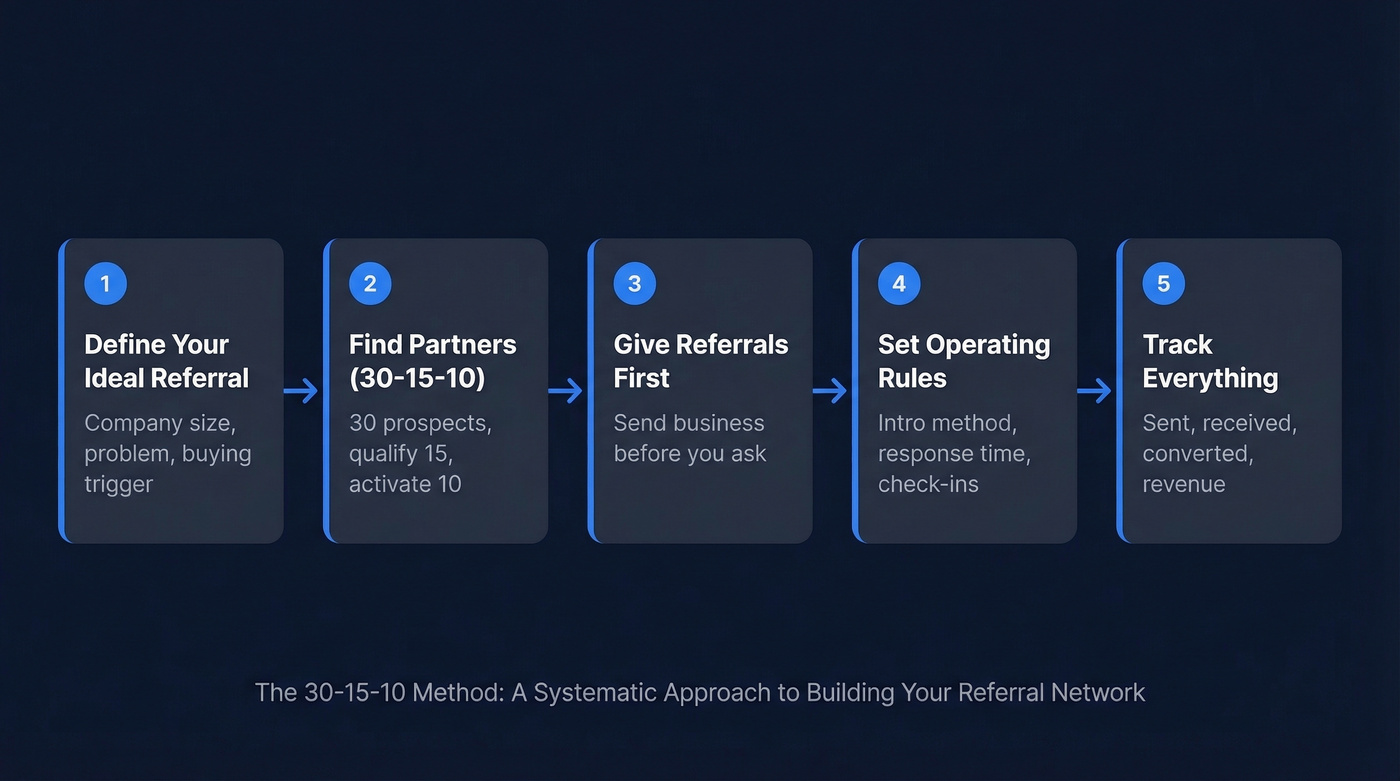
84% of B2B conversions start from a referral. Most people fail not because referrals don't work, but because they network without a system.
What Is a Referral Network?
A referral network is a group of professionals who actively send qualified business to each other based on mutual trust and complementary services. It's not a referral program - that's a structured incentive system for customers - and it's not an affiliate program, which is performance-based commission marketing.
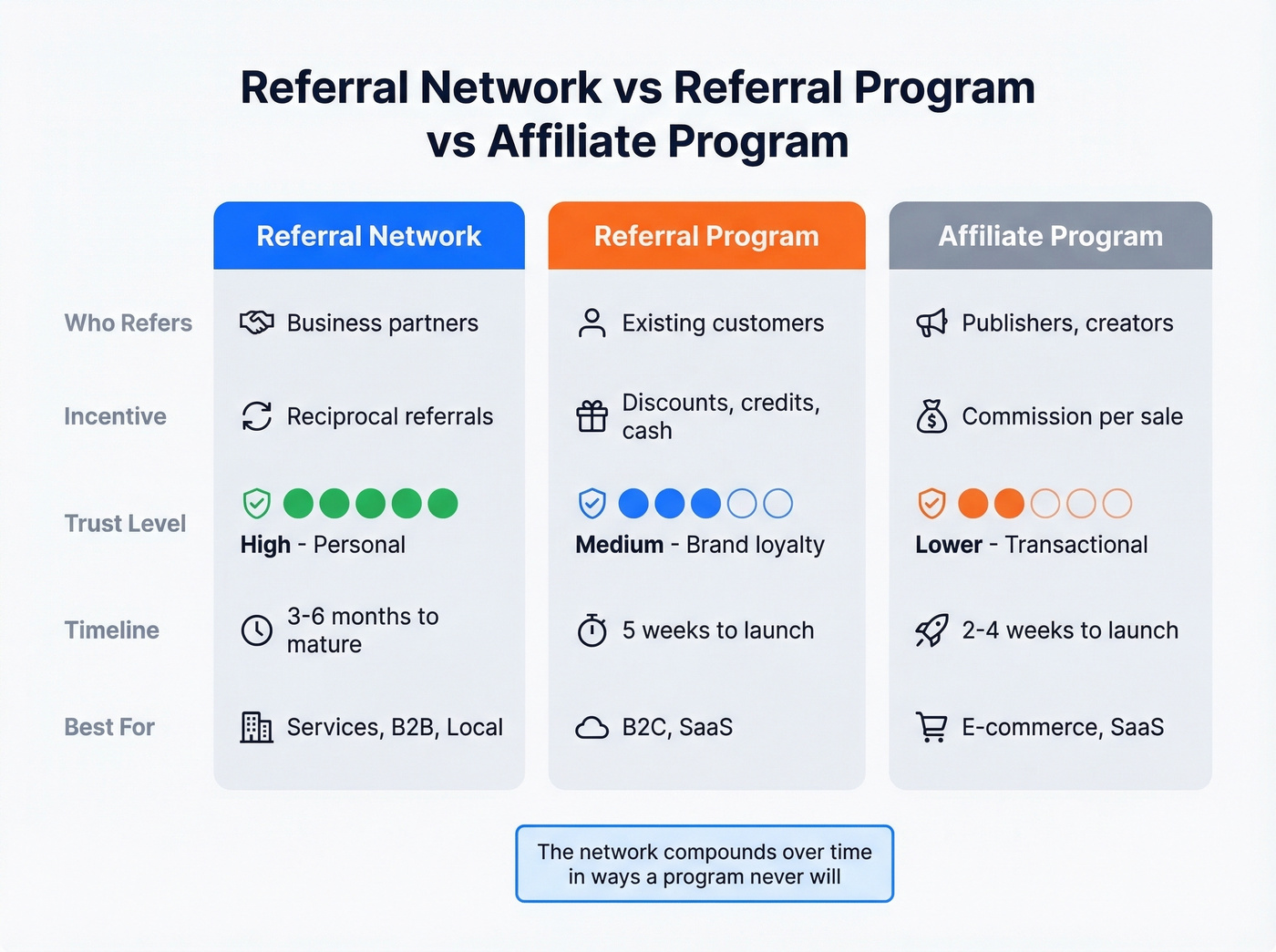
| Referral Network | Referral Program | Affiliate Program | |
|---|---|---|---|
| Who refers | Business partners | Existing customers | Publishers, creators |
| Incentive | Reciprocal referrals | Discounts, credits, cash | Commission (% of sale) |
| Tracking | CRM or PRM | Referral software | Cookies (often 60-90 days for software; e-commerce can be 24-48 hours) |
| Trust level | High (personal) | Medium (brand loyalty) | Lower (transactional) |
| Best for | Services, B2B, local | B2C, SaaS | E-commerce, SaaS |
One timeline difference worth calling out: a referral program can launch in about five weeks with the right software and a simple implementation plan. A partner-based network takes 3-6 months to mature - but it compounds in ways a program never will. The network comes first.
Why Referral Networks Outperform Paid Channels
The economics aren't subtle. Referred customers have a 16% higher lifetime value and 18% lower churn. Referral programs deliver 4x higher ROI than digital advertising and lower customer acquisition cost by 24%.
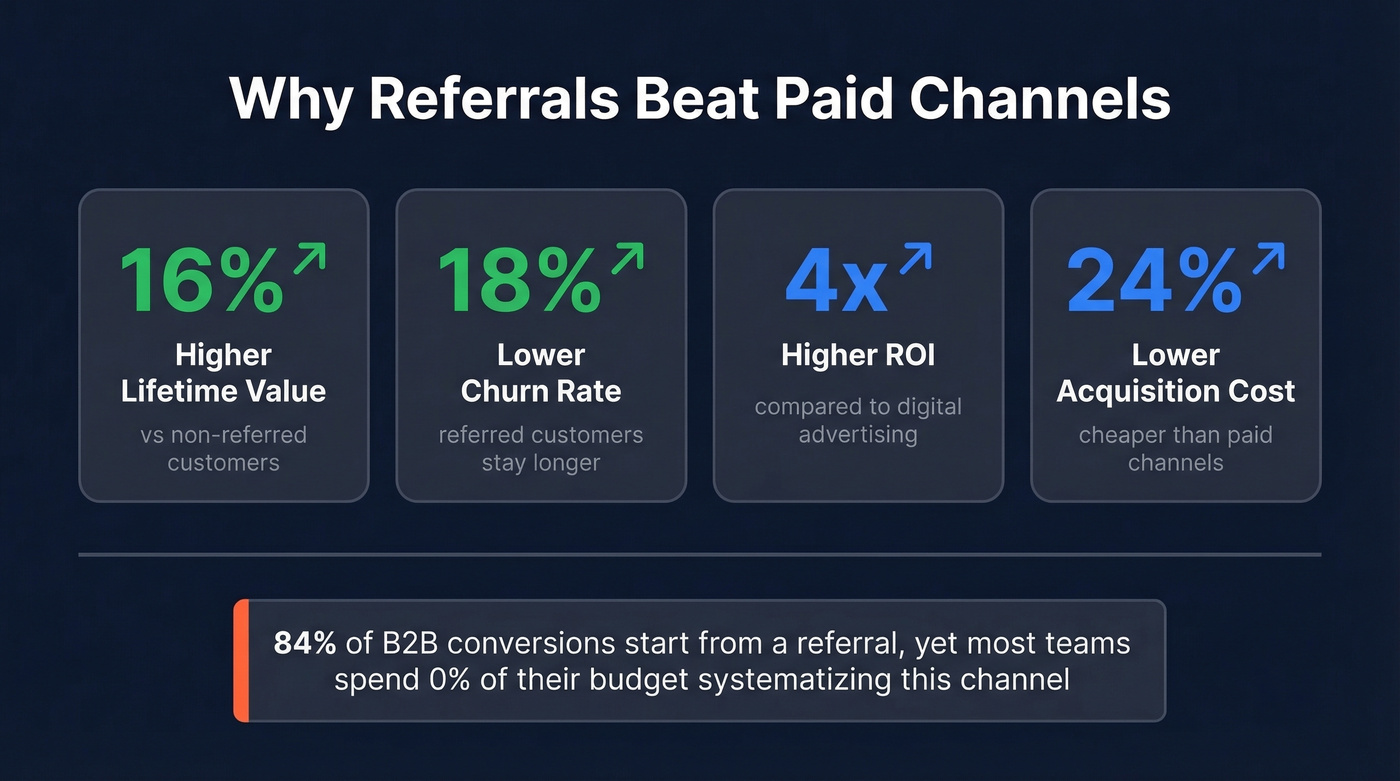
This makes intuitive sense. When someone you trust says "call this person," you skip the skepticism phase entirely. No ad to ignore, no cold email to delete. The trust transfers instantly.
We've watched this play out across dozens of sales teams. The referral pipeline is always smaller in volume but dramatically higher in close rate and deal size. It's the channel most teams underinvest in because it feels unscalable. With the right system, it absolutely scales.
Here's the thing: most B2B teams spend 70% of their budget on paid channels that produce their worst leads, and 0% systematizing the channel that produces their best ones. If your average deal size clears $5k, building a structured partner ecosystem should be your second-highest priority after your existing customer base.
How to Build a Strategic Referral Network
Define Your Ideal Referral
"Anyone who needs accounting help" isn't a referral brief - it's a prayer. Write a one-paragraph description that includes company size, industry, the specific problem they're facing, and the buying trigger that makes them ready now. Share it with every partner. Update it quarterly.
In our experience, partners who receive a written ideal-referral brief send 3x better-quality leads than those who get a vague "just send anyone my way."
Find Partners (30-15-10)
Identify 30 potential referral partners - complementary, non-competing businesses that serve the same customer at a different stage or with a different solution. Think in four categories: upstream providers who serve them before you, downstream providers who serve them after, adjacent solutions that solve a related problem, and trusted advisors like accountants, attorneys, and consultants.
If you need a tighter definition of company size and industry filters, use an Ideal Customer Profile template to standardize it across partners.
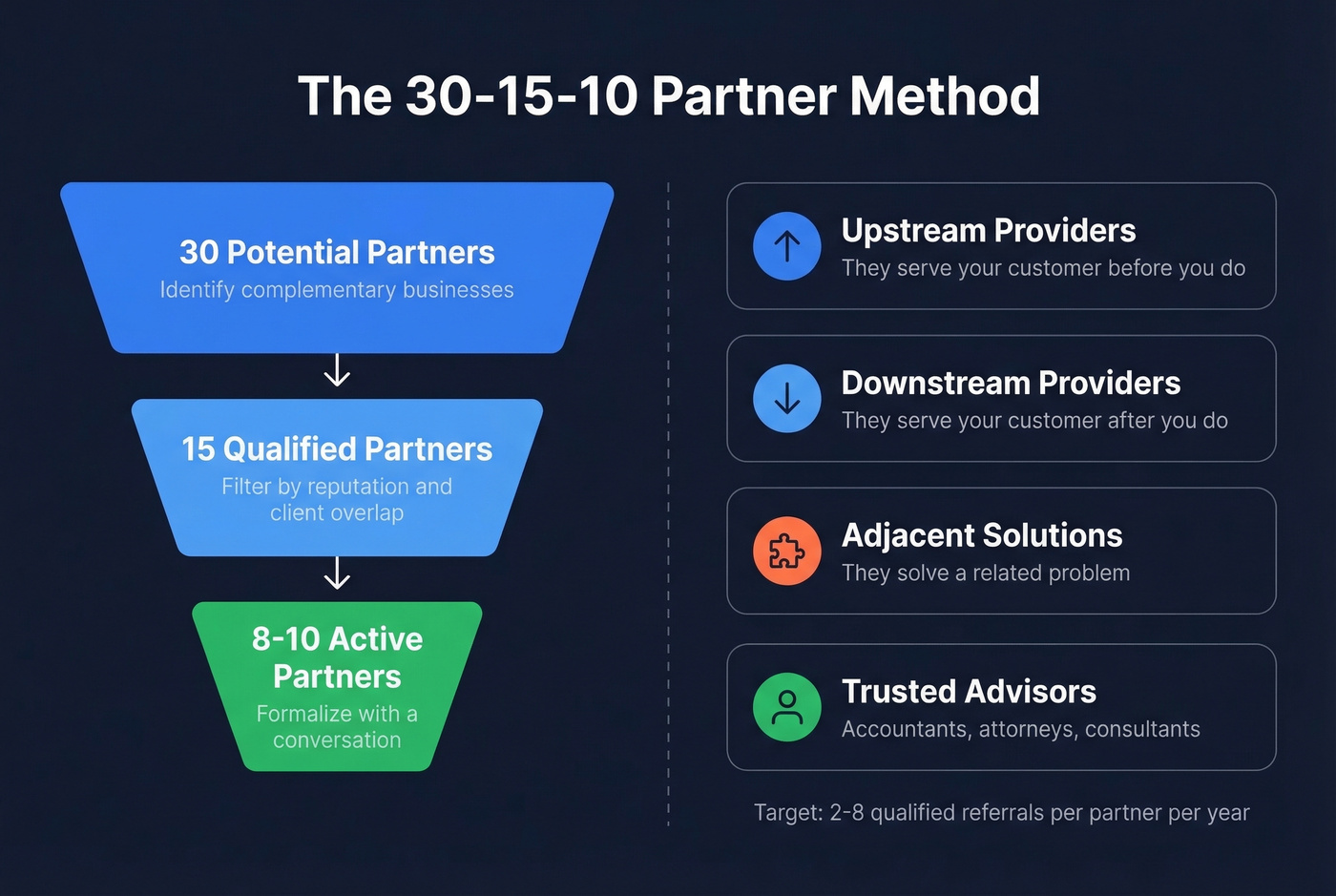
Qualify to 15 based on reputation and client overlap. Activate 8-10 with a formal conversation. For local businesses, 10-20 active partners generating 2-8 qualified referrals each per year is a realistic target.
Give First
Don't approach partners like a cold sales pitch. Leading with "I'd love to swap referrals" is transactional, and people smell it immediately.
Send them a referral before you ask for anything. Introduce them to someone who needs their service. After you've demonstrated value, the formalization conversation happens naturally - the partners who give first end up receiving 2-3x more referrals than those who lead with the ask.
Set Operating Rules
Every partnership needs lightweight rules. Define four things in writing: what your ideal referral looks like, how introductions happen (warm email, call, or text - pick a default), expected response time of 24-48 hours, and how you'll measure success through monthly or quarterly check-ins. A one-page shared note is plenty.
If you're formalizing check-ins, a simple QBR structure keeps partner conversations focused on outcomes.
Track and Measure
If you aren't tracking referrals sent, received, and conversion rates per partner, you don't have a system - you have a hope. Aim for a 3-5% referral rate from your customer base, 12-20% conversion on referred leads, and a cost per referral under $10.
The 20/80 rule applies hard here. 20% of your partners will drive 80% of your referrals. Identify top performers early and invest more in those relationships. Stop spreading energy across 30 lukewarm partners - find your top 5-6 and go deep.
One practical gap most teams hit: a partner sends you a name and company but no contact details. You need a verified email fast before the referral goes cold. Prospeo finds verified emails from a name and company in seconds with 98% accuracy, and that speed matters when a warm intro is still fresh - think the first 1-2 days.
If you're doing this at scale, a name to email workflow prevents warm intros from turning into cold outreach.

Your referral partner just sent you a name and company. The intro is warm - but only for 24-48 hours. Prospeo finds verified emails from a name and company with 98% accuracy at $0.01 per lead, so you can follow up before the window closes.
Don't let warm referrals go cold over missing contact data.
BNI and Formal Networks
BNI (Business Network International) is the largest structured referral organization with 10,000+ chapters worldwide. The model: weekly meetings, industry exclusivity - only one accountant, one plumber, one designer per chapter - and a "Givers Gain" culture.
The case for BNI: Industry exclusivity is genuinely valuable. Members who maintain 3+ touchpoints per month double their referral volume.
The case against: Membership fees typically run $600-$1,200/year depending on region, but the real cost is time. BNI demands roughly 6.3 hours per week - that's 327 hours a year. And 40-60% of members drop out in year one. The consensus across entrepreneur communities on Reddit is pretty consistent: "BNI works if you have the time, but the early morning meetings and referral pressure burned me out."
Skip BNI if your average deal is under $5,000. The math just doesn't work. For digital businesses or SaaS companies, informal networks built through Slack communities and industry events outperform formal chapters almost every time.
Industry-Specific Approaches
Legal
Divorce attorney + financial planner + estate planning attorney = a referral triangle serving the same client through a life transition. One case study showed a divorce attorney increasing referral cases by 40% in six months using monthly networking plus a dedicated referral page.
Healthcare
Healthcare referral networks are the most legally constrained. Under the Anti-Kickback Statute, it's a felony to offer remuneration to induce referrals for federally funded services. Stark Law adds physician self-referral restrictions. Build around clinical quality and patient outcomes - never financial incentives. Get compliance counsel before formalizing anything.
Financial Advisory
Advisors thrive on centers of influence: CPAs, estate attorneys, insurance agents. Those who co-host educational events with COI partners report the strongest pipelines. The relationship takes 6-12 months to mature, but once it does, it's the most reliable growth channel in the business.
B2B and SaaS
Instead of weekly breakfast meetings, B2B companies build referral partnerships through technology integrations, co-marketing, and Slack communities. A CRM vendor partnering with an email platform, a design agency partnering with a dev shop - same logic, asynchronous execution. For many SaaS teams, partner-driven lead generation outperforms paid acquisition once the ecosystem reaches critical mass.
If you're building partner-driven lead gen, borrow a few modern sales prospecting techniques to keep outreach consistent.
Mistakes That Kill Referral Networks
Five mistakes we see repeatedly:
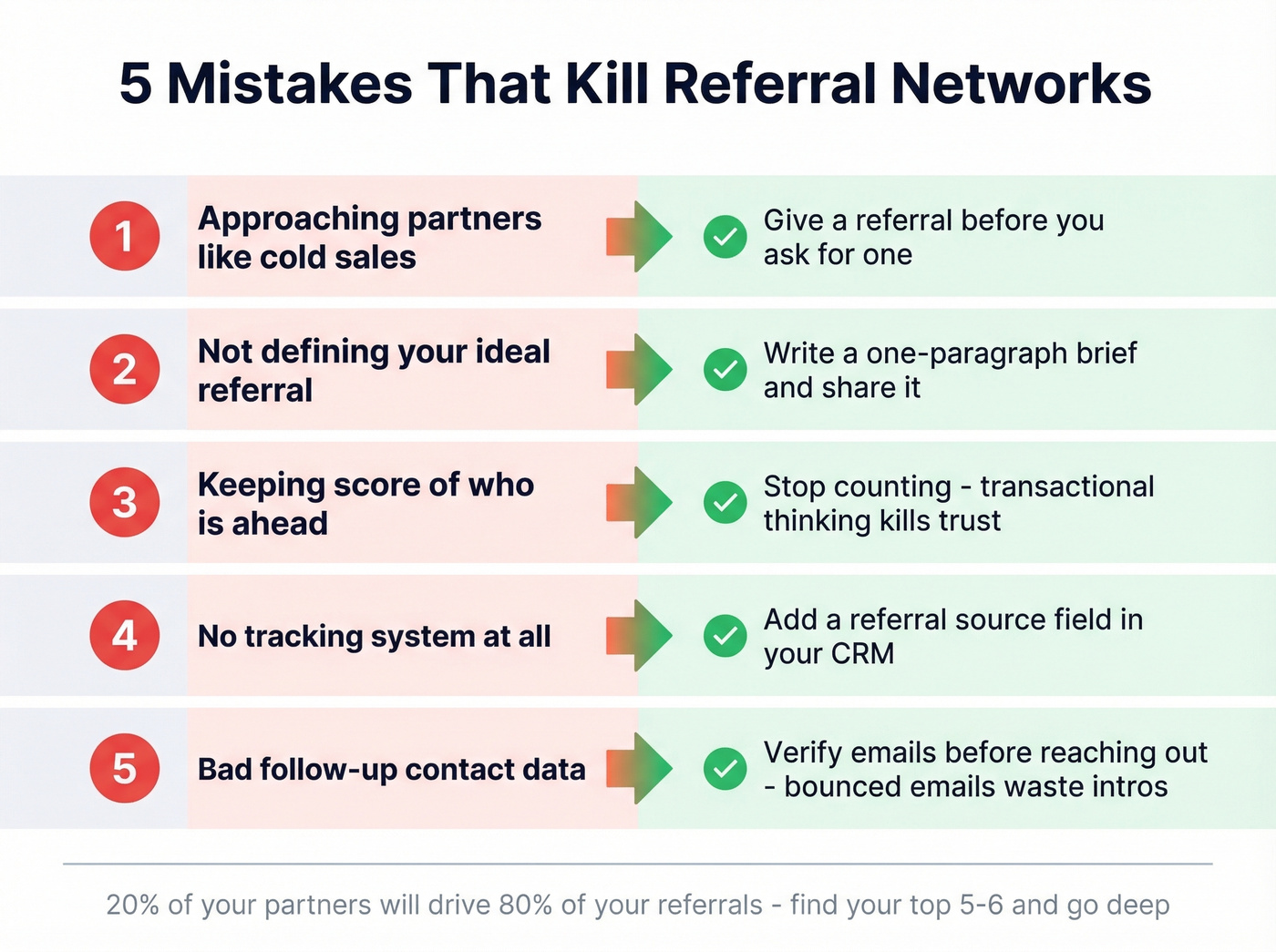
- Approaching partners like cold sales. Give a referral before you ask for one.
- Not defining your ideal referral. Write a one-paragraph brief and share it with every partner.
- Scorekeeping. Stop counting who's "ahead." Transactional thinking kills trust.
- No tracking system. Even a CRM pipeline with "referral source" as a field works.
- Bad follow-up data. Verify contact information before reaching out. A bounced email on a warm referral is a wasted introduction - and it makes your partner look bad.
If your follow-up is inconsistent, keep a set of sales follow-up templates ready for warm intros.
Tools for Managing Your Network
A CRM like HubSpot or Salesforce manages direct customer relationships. A PRM (Partner Relationship Management tool) manages your partner ecosystem - deal registration, lead distribution, partner dashboards. Most teams under 50 referrals per month don't need a PRM. A CRM pipeline with a "referral" stage is enough.
If you're evaluating options, start with a shortlist of contact management software before you overbuy a PRM.
For teams that want dedicated software:
| Tool | Starting Price | Best For |
|---|---|---|
| HelloReferrals | $39/mo | Small teams, basic tracking |
| Rewardful | $49/mo | SaaS referral programs |
| ReferralCandy | $59/mo | E-commerce referral programs |
| Referral Rock | $200/mo | Mid-market, multi-channel |
| GrowSurf | $450/mo | Tech companies, API-first |
| SaaSquatch | $1,750/mo | Enterprise |
| Friendbuy | $2,000/mo | Enterprise e-commerce |
| monday CRM | Free-$19/seat/mo | PRM/CRM hybrid |
When budget is tight, start with your existing CRM and a spreadsheet. You can always upgrade later - the system matters more than the software.
If you're sourcing partner contacts, a list of free lead generation tools can help you start without new spend.
Building your 30-15-10 partner list means researching decision-makers at complementary businesses. Prospeo's 300M+ profile database with 30+ filters - industry, company size, job title - lets you identify and reach ideal referral partners with verified contact data in minutes.
Find your top referral partners before your competitors do.
FAQ
How long does it take to build a productive referral network?
Expect 3-6 months before referrals flow consistently. A 90-day pilot benchmark: 150 referrals from 5,000 customers at a 3% rate. Don't judge the system before day 90.
How many referral partners do I need?
Start with 5-10 active partners. The 20/80 rule means 2-3 strong partners will generate the vast majority of your qualified introductions. Go deep with a few rather than wide with many.
Is BNI worth the cost?
For high-ticket local services - attorneys, advisors, contractors with $10k+ deals - yes. At roughly $600-$1,200/year plus 6+ hours weekly, lower-ticket or digital businesses rarely see positive ROI.
What's the difference between a referral network and a referral program?
A network is business partners sending each other leads based on trust and reciprocity. A program is customers earning rewards for referring new buyers. Networks are relationship-driven; programs are incentive-driven. Most B2B companies benefit from running both simultaneously.
How do I follow up on a referral with only a name and company?
Use a contact verification tool to find a verified email instantly. Speed matters: the introduction stays warm for the first 1-2 days. After that, you're effectively running cold outreach with extra steps.