

The Complete Guide to Remote Sales in 2026
It's 8:47 AM. You're at your desk - the one in your spare bedroom - and you've just loaded 200 contacts into your outbound sequence. By 9:15, forty-three emails have bounced. Your dialer connects to a fax machine, a disconnected number, and someone who left the company eight months ago. You haven't sold anything. You've burned an hour and a chunk of your sender reputation.
That's not a remote sales problem. That's a process problem. And it's fixable.
Selling remotely is the default B2B model now. [80% of B2B sales interactions](https://www.gartner.com/en/digital-markets/insights/hybrid-sales-model) happen at least partly through digital channels, and [70-80% of B2B buyers](https://www.mckinsey.com/capabilities/growth-marketing-and-sales/our-insights/the-future-of-b2b-sales-is-hybrid) actively prefer virtual interaction over face-to-face meetings. The question isn't whether remote selling works - it's whether you're set up to do it well.
The short version: OTE ranges from $85K (SDR) to $300K+ (Strategic AE). Your tech stack matters more than your talent in the early days. Start with a CRM, a verified data source, and a sequencing tool. Everything else is optional until you're closing consistently.
What Is Remote Sales?
Remote sales means prospecting, engaging, and closing deals entirely through digital channels - phone, email, video, chat - without meeting buyers in person. You could be working from Denver or Dubrovnik. The buyer doesn't care.
Many job listings tagged "remote" are actually territory-based field roles that expect you on-site with clients three days a week. Inside sales and virtual selling overlap heavily, but they aren't identical. Inside sales historically meant office-based phone selling. Remote selling means you can do it from anywhere, using any digital channel. The distinction matters when you're evaluating offers, because a "remote" role with a Midwest territory and quarterly on-sites is a very different lifestyle than a fully distributed SDR position with no travel expectations.
| Dimension | Remote Sales | Inside Sales | Field Sales |
|---|---|---|---|
| Location | Anywhere | Office-based | Client sites |
| Channels | Digital-only | Digital-primary | In-person |
| Travel | None/minimal | None | Frequent |
| Cost per rep | Lower | Medium | Higher |
If a listing mentions a territory or travel expectations, it's a field role wearing a remote label. Read the fine print.
Is Remote Selling Still Growing?
Yes, and it's accelerating.
FlexJobs data shows remote sales postings nearly doubled in 2025, making it one of the fastest-growing remote career categories. Robert Half's research puts the current picture at 88% of employers offering some hybrid option, with 11% of new postings fully remote and 24% hybrid.
The BLS reports 22.8% of U.S. employees work remotely at least part-time, and 47% of professionals who aren't actively job searching say they'd stay put specifically to keep their flexibility. That's a retention signal employers can't ignore.
On the buyer side, 92% of B2B buyers prefer digital engagement. When your customers don't want you in their office, the argument for field sales gets thin fast.
Types of Remote Sales Roles
Not every role looks the same. Here are the main positions, ordered by seniority:
- SDR/BDR - Entry-level prospecting. High volume, mostly outbound. Almost always fully remote-eligible.
- SMB Account Executive - Closing smaller deals, shorter cycles. Commonly fully remote.
- Mid-Market AE - Larger deals, more complex sales cycles. Usually remote with occasional travel.
- Enterprise AE - Six-figure+ deals, multi-stakeholder. Often hybrid, but fully remote roles exist.
- Strategic AE - The biggest deals. Some travel expected, but day-to-day is remote.
- Sales Engineer - Technical pre-sales support. Highly remote-friendly given the demo-heavy workflow.
- Account Manager - Post-sale relationship management. Almost always remote-eligible.
- Sales Manager - Leading distributed teams. Requires strong async communication skills.
- Sales Ops / RevOps - The infrastructure people. Fully remote is standard.
SDR, SMB AE, Sales Engineer, and Sales Ops roles are the most consistently fully remote. Enterprise and Strategic AE roles tend to be hybrid, with quarterly on-sites baked in. If you want zero travel, skip anything with "enterprise" or "strategic" in the title unless the listing explicitly says otherwise.
Remote Sales Salary Guide (2026)
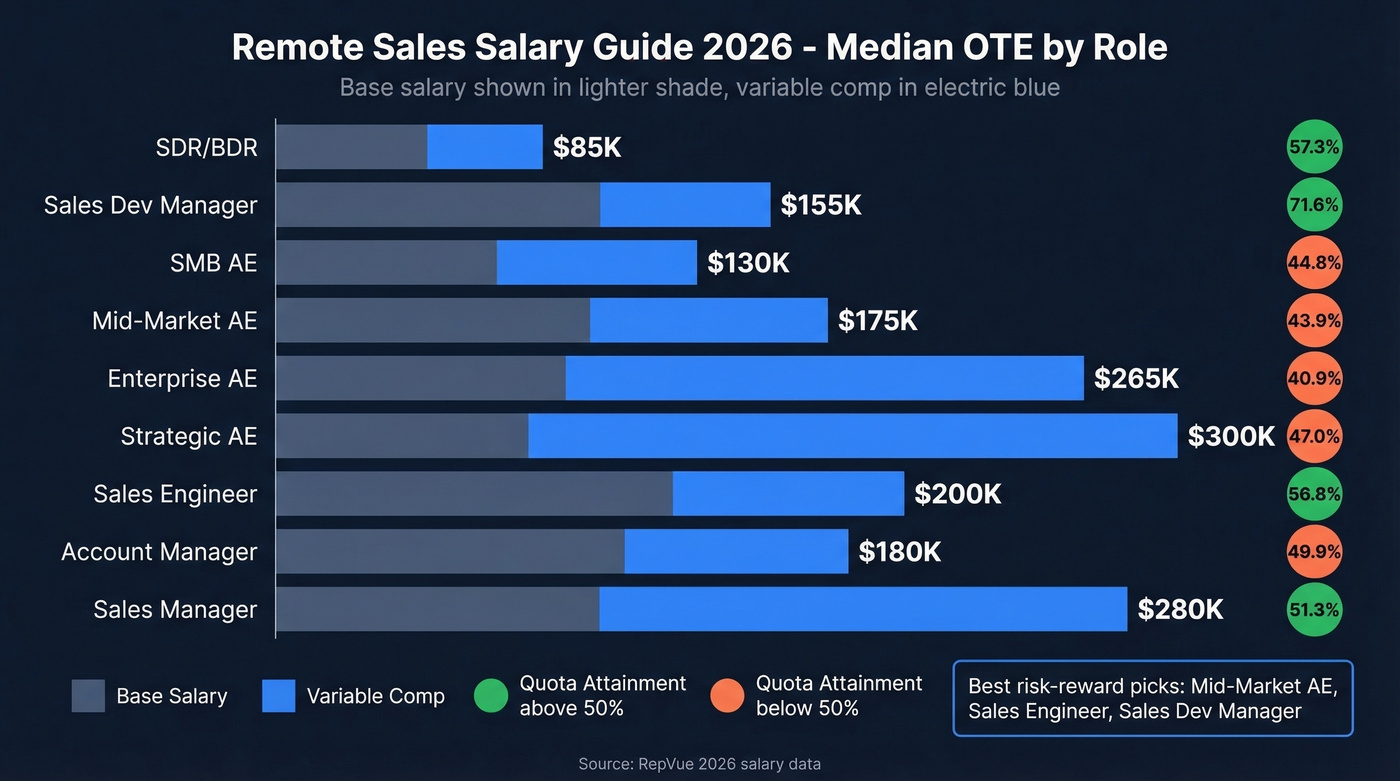
These benchmarks come from RepVue's salary data, based on compensation shared by thousands of sales professionals.
| Role | Median Base | Median OTE | Top Performers | Quota Attainment |
|---|---|---|---|---|
| SDR/BDR | $60K | $85K | $128K | 57.3% |
| Sales Dev Manager | $100K | $155K | $205K | 71.6% |
| SMB AE | $70K | $130K | $269K | 44.8% |
| Mid-Market AE | $90K | $175K | $391K | 43.9% |
| Enterprise AE | $135K | $265K | $628K | 40.9% |
| Strategic AE | $150K | $300K | $705K | 47.0% |
| Sales Engineer | $145K | $200K | $327K | 56.8% |
| Account Manager | $100K | $180K | $409K | 49.9% |
| Sales Manager | $150K | $280K | $508K | 51.3% |
Three roles with the best risk-reward ratio right now: Mid-Market AE ($175K OTE with massive top-performer upside), Sales Engineer ($200K OTE with the highest quota attainment among senior roles at 56.8%), and Sales Development Manager ($155K OTE with 71.6% quota attainment - the best odds of actually hitting your number).
Look at that quota attainment column. Less than half of SMB and Mid-Market AEs hit quota. That's an industry-wide reality, not a work-from-home problem. Your variable comp is genuinely variable. If you're risk-averse, Sales Engineer and Sales Dev Manager roles offer more predictable earnings. Candidates with demonstrable AI fluency are commanding premium offers - more on that in the trends section below.

You read the numbers: 43 bounced emails out of 200 kills your morning and your sender reputation. Prospeo's 98% email accuracy and 125M+ verified mobile numbers mean your outbound block actually produces pipeline - not bounces. At $0.01 per email, bad data is no longer an acceptable cost of remote selling.
Fix your process before you blame the remote model.
What a Day Looks Like
Remote selling requires deliberate structure, not just a laptop on the couch. The reps who thrive treat their day like a series of focused blocks, not an open-ended to-do list.
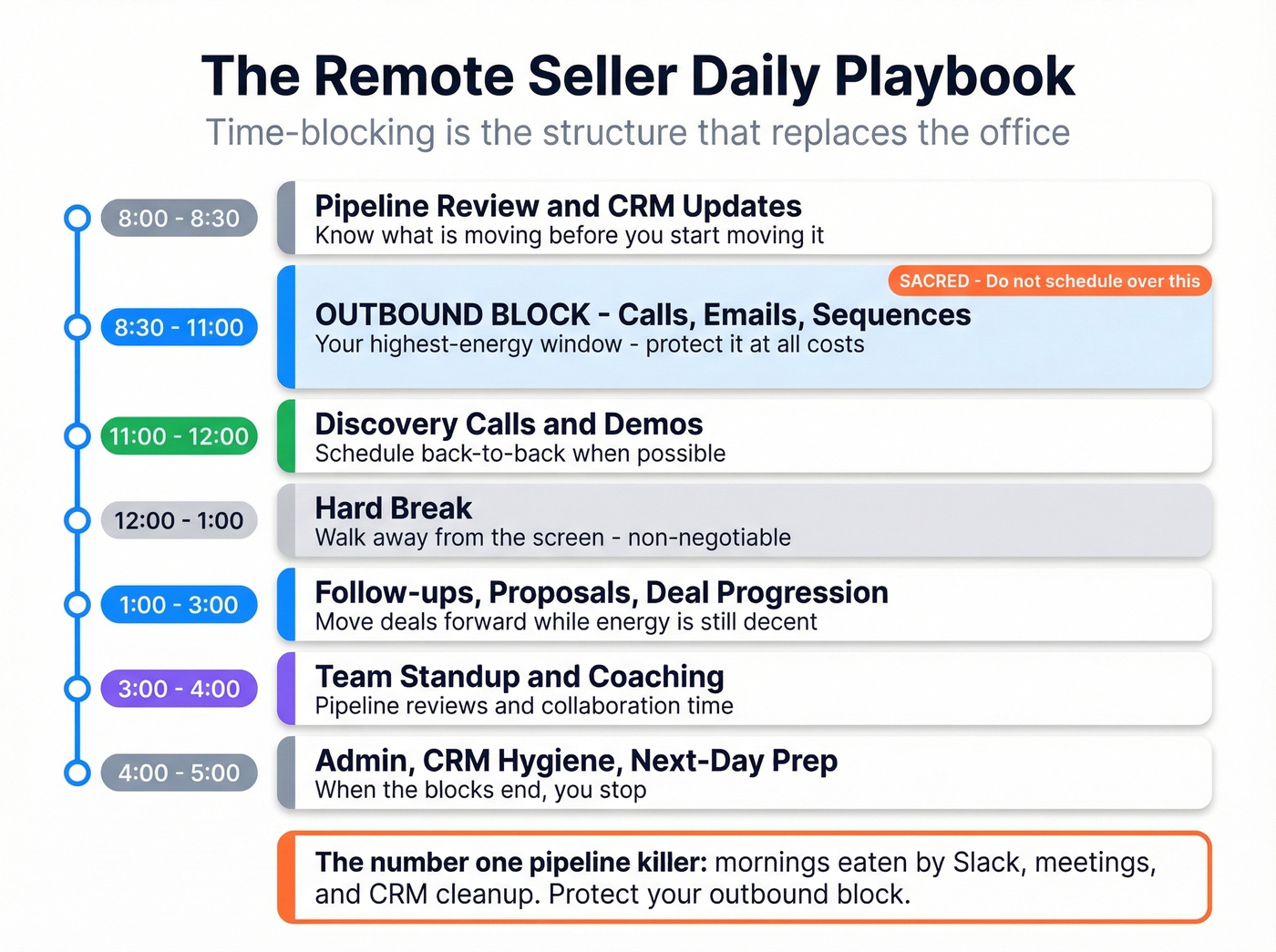
Here's a framework that works for most outbound-heavy roles:
- 8:00-8:30 - Pipeline review and CRM updates. Know what's moving before you start moving it.
- 8:30-11:00 - Outbound block. Calls, emails, sequences. This is your highest-energy window. Protect it.
- 11:00-12:00 - Discovery calls and demos. Schedule these back-to-back when possible.
- 12:00-1:00 - Break. Hard stop. Walk away from the screen.
- 1:00-3:00 - Follow-ups, proposals, contract reviews, deal progression.
- 3:00-4:00 - Team standup, coaching sessions, pipeline reviews.
- 4:00-5:00 - Admin, CRM hygiene, next-day prep.
The outbound block is sacred. In our experience, every remote seller who struggles with pipeline has the same root cause: mornings get eaten by Slack, internal meetings, and "quick" CRM cleanups. By the time they start prospecting, it's 2 PM and their energy is gone.
Two challenges sellers run into fast: isolation eroding motivation, and the temptation to work 12-hour days because the office never "closes." Time-blocking solves both. When the blocks end, you stop.
Use video for every external call where the prospect agrees. Quality audio matters more than a ring light - invest in a decent headset before anything else.
The Essential Tech Stack
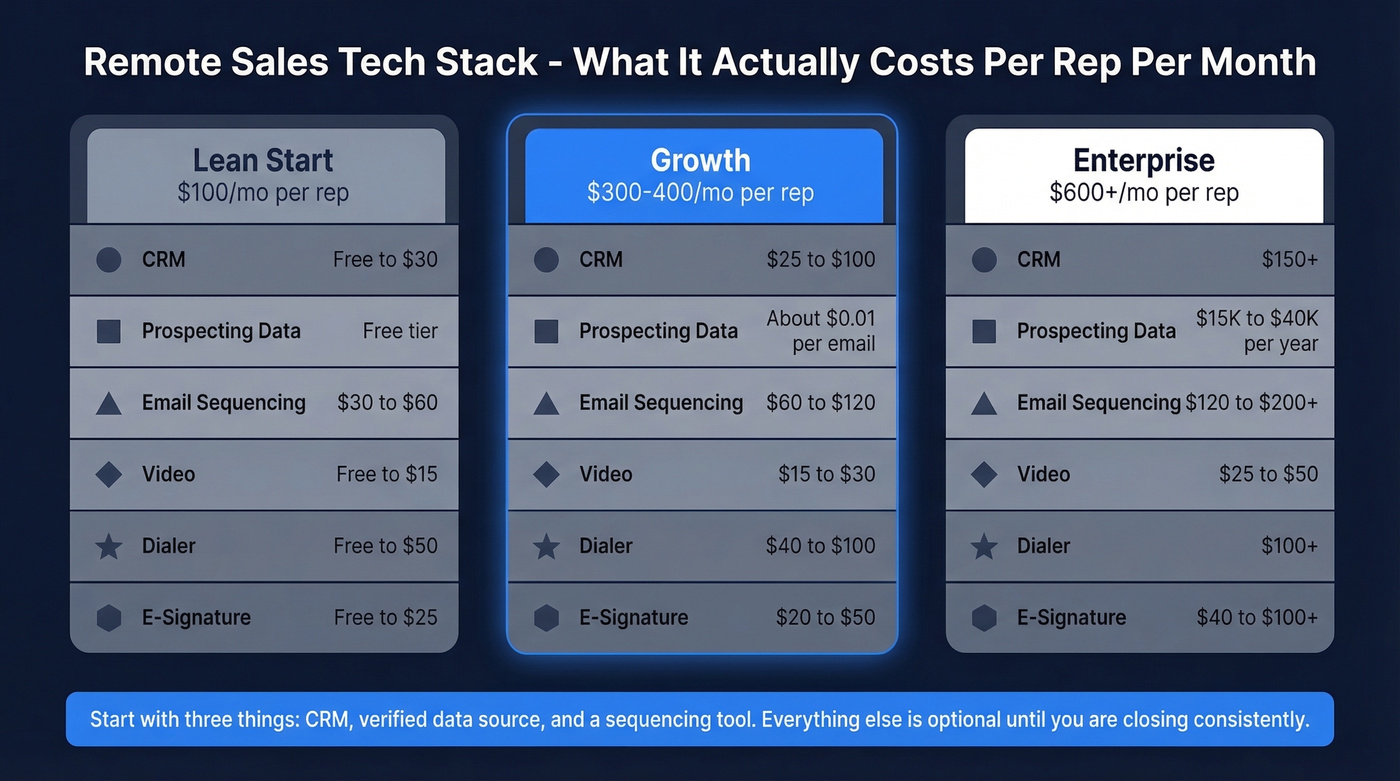
If you're building from scratch, start with three things: a CRM, a verified data source, and a sequencing tool. Everything else is optional until you're closing consistently.
What It Costs
Exact pricing shifts by plan, seats, and billing frequency, but these ranges are realistic for most teams:
| Category | Budget | Mid-Market | Enterprise |
|---|---|---|---|
| CRM | Free-$30/user/mo | $25-$100/user/mo | $150+/user/mo |
| Prospecting Data | Free tier | ~$0.01/email | $15K-$40K/yr |
| Email Sequencing | $30-$60/user/mo | $60-$120/user/mo | $120-$200+/user/mo |
| Video | Free-$15/user/mo | $15-$30/user/mo | $25-$50/user/mo |
| Dialer | $0-$50/user/mo | $40-$100/user/mo | $100+/user/mo |
| E-Signature | Free-$25/user/mo | $20-$50/user/mo | $40-$100+/user/mo |
Total cost ranges from roughly $100/rep/month on the lean end to $400-600+/rep/month at enterprise scale - and that's before large annual data contracts, which can blow up the budget on their own.
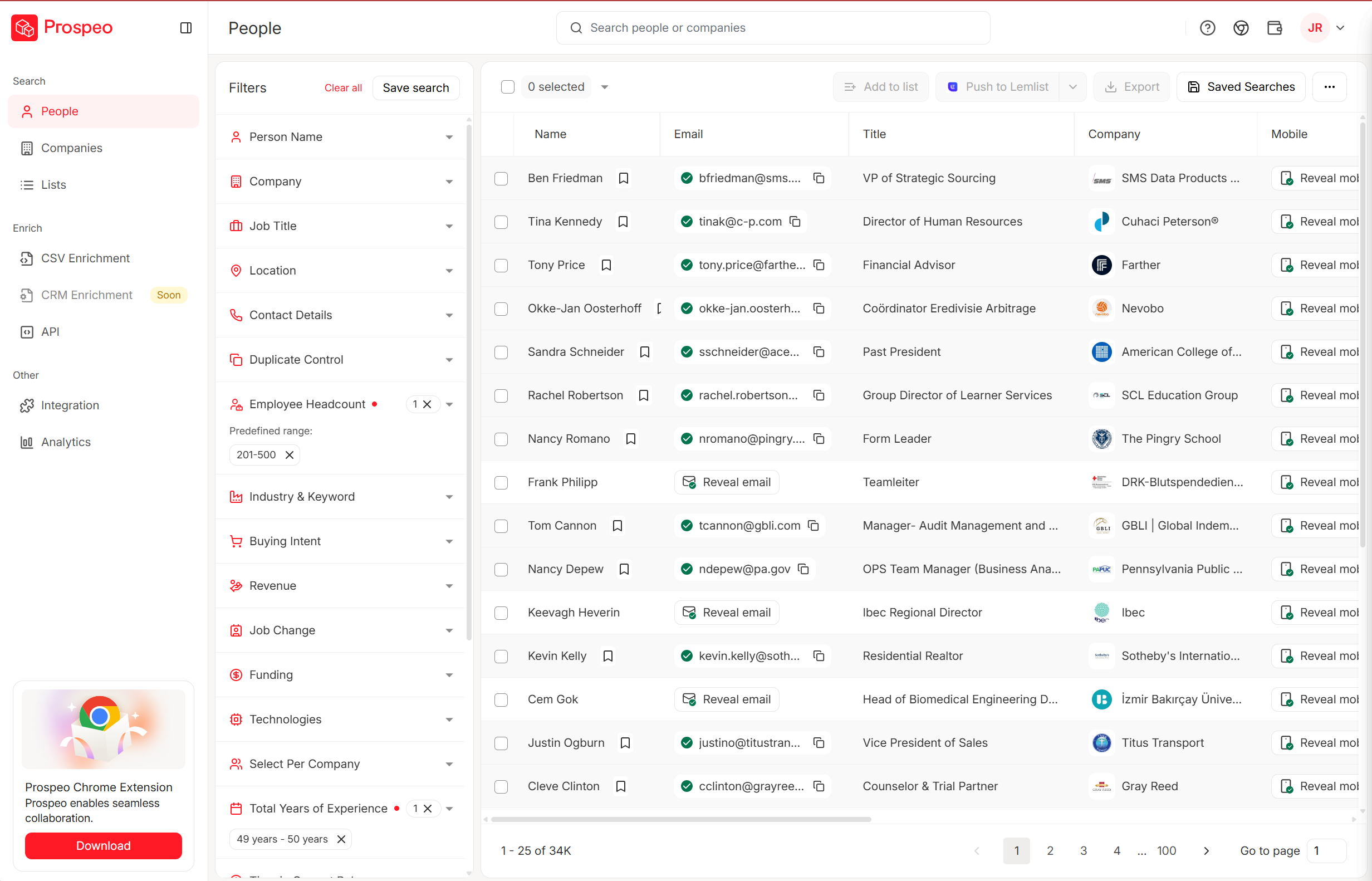
For prospecting data, you need verified emails and direct dials refreshed regularly. Prospeo covers 300M+ professional profiles with 143M+ verified emails at 98% accuracy, plus 125M+ verified mobile numbers on a 7-day refresh cycle. The free tier gives you 75 emails plus 100 Chrome extension credits per month - enough to test your outbound motion before committing budget. It integrates natively with Salesforce, HubSpot, Lemlist, Instantly, Smartlead, Clay, Zapier, and Make. At roughly $0.01 per email, it's a fraction of what legacy providers charge for comparable data quality.
HubSpot's free tier is genuinely good for solo reps and small teams. Salesforce is the standard once you need workflow complexity and reporting depth. For sequencing, Instantly and Lemlist dominate the budget-to-mid-market range. Outreach and Salesloft are the enterprise defaults, but they're overkill for teams under 20 reps.
Mistakes That Kill Remote Sales Careers
1. No dedicated workspace or routine. Working from the couch in pajamas sounds great for a week. By month two, your pipeline is empty and your back hurts. Consistent start times, a real desk, and time-blocked days aren't optional - they're the infrastructure that replaces the office.
2. Skipping the tech check before calls. Audio drops, screen-share failures, frozen video - these are credibility killers. Test your setup before every important call. It takes 90 seconds.
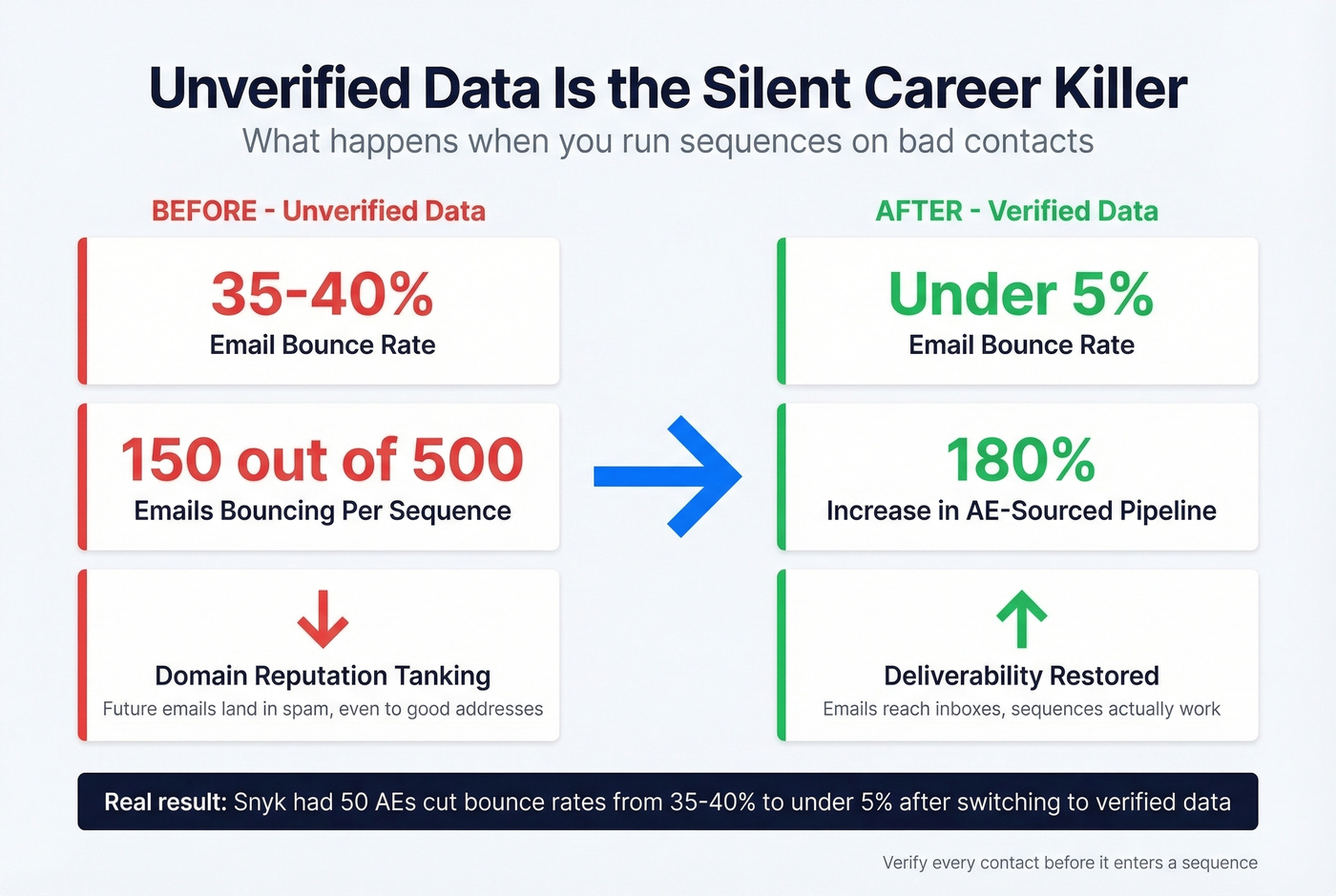
3. Running sequences on unverified data. This is the silent career killer. You load 500 contacts, launch a sequence, and 150 emails bounce. Your domain reputation tanks. Your deliverability craters. Future emails - even to good addresses - land in spam. We've seen teams cut bounce rates from 35% to under 4% just by switching to verified data. One of our customers, Snyk, had 50 AEs whose bounce rate dropped from 35-40% to under 5% after making that switch, and their AE-sourced pipeline jumped 180%. Verify every contact before it enters a sequence. (If you want the benchmarks and fixes, start with bounce rates and then work through an email deliverability guide.)
4. Back-to-back meetings with no breaks. 85% of leaders struggle to trust that remote employees are productive, per Microsoft's Work Trend Index. So reps overcompensate by stacking calls wall-to-wall. The result is worse performance, not better. Build 15-minute buffers between calls.
5. Ignoring social selling. Social sellers are 51% more likely to hit quota, per LinkedIn research. That doesn't mean posting motivational quotes. It means engaging with prospects' content, sharing relevant insights, and building visibility before the cold outreach lands.
2026 Trends Shaping Virtual Selling
Here's the thing: if you're not using AI in your sales workflow by mid-2026, you're already behind. Betts Recruiting's 2026 compensation guide shows entirely new AI-native titles emerging - Head of AI Enablement, AI Sales Strategist, GTM Automation Lead, RevOps AI Integrator. These aren't future roles. They're being hired for right now.
The fractional leadership trend is accelerating too. Companies are hiring part-time VPs of Sales on retainer-plus-success-bonus structures instead of committing to $300K+ full-time packages. For senior sellers considering their next move, fractional work is worth exploring seriously.
High-performing sales teams are 2.8x more likely to use a CRM extensively, per Salesforce research. That stat matters more in distributed environments where there's no manager walking the floor. Your CRM isn't just a system of record - it's the visibility layer that replaces in-person oversight. If you're still evaluating options, start with a few examples of a CRM and then map your must-have workflows.
One counter-trend worth watching: companies pushing return-to-office mandates are paying roughly 10% more for on-site roles. Fully remote roles pay slightly less but eliminate commute costs, wardrobe expenses, and geographic constraints. For most people, that trade is worth making.
Let's be honest about tool spend. If your deals average under $15K, you don't need a $40K/year data provider or a $150/seat sequencing tool. A CRM, verified contact data, and a $30/month sequencer will get you to your first $500K in pipeline. Overinvesting in tools before you've nailed your process is the most expensive mistake in distributed selling. (If you're building the stack, use a ranked list of SDR tools to sanity-check what you actually need.)
Sales-marketing alignment remains the highest-impact investment most companies ignore. Aligned teams see up to 67% improvement in close rates. If your marketing team generates content you've never seen and your sales team writes emails that contradict the website, you've got a revenue leak no tool can fix.
Where to Find Remote Sales Jobs
Stop applying to 50 jobs a week. Treat the job hunt like a sales process - because it is one.
The best remote-specific job boards: Wellfound (strongest for startups), WeWorkRemotely, Remotive, Remote.co, Dynamite Jobs, JustRemote, and Adzuna. For broader searches, Indeed, LinkedIn Jobs, ZipRecruiter, and FlexJobs all have solid remote filters. One caveat worth repeating: some listings tagged "remote" still require periodic travel or are tied to specific time zones. If it mentions a territory, it's not fully remote.
The best jobs aren't posted. They're at companies that don't know they need you yet. Find companies in your target industry that are hiring SDRs or AEs, identify the hiring manager's verified email, and send a 3-touch sequence that demonstrates exactly the skills they're hiring for. Mirror the outbound motion they'd expect you to run on the job. You'll stand out more than any Indeed application ever could. If you need a starting point, borrow proven sales prospecting techniques and keep a few sales follow-up templates ready.
FAQ
What is remote sales, and is it a real career?
Yes. It's prospecting, engaging, and closing deals entirely through digital channels, and it's one of the fastest-growing career categories. Postings nearly doubled in 2025, 88% of employers offer hybrid options, and career paths run from SDR ($85K OTE) through VP of Sales - all remote-eligible.
How much do remote sellers earn in 2026?
OTE ranges from $85K for SDRs to $300K+ for Strategic AEs. Top enterprise performers exceed $600K. Sales Engineers offer the best stability at $200K OTE with 56.8% quota attainment - the highest among senior roles.
What tools do I need to start selling remotely?
Three essentials: a CRM (HubSpot Free works), a verified data source like Prospeo (free tier includes 75 emails/month at 98% accuracy), and an email sequencer like Instantly or Lemlist. Total cost can be under $100/month.
Do I need prior experience?
SDR/BDR roles are the standard entry point and often don't require prior experience - just coachability, discipline, and comfort with rejection. Demonstrating hustle in your application matters more than a resume line.
What's the biggest mistake new remote sellers make?
Running outbound sequences on unverified contact data. Bounce rates above 10% destroy domain reputation and tank deliverability for every future campaign. Teams switching to verified data routinely cut bounces from 35% to under 4%.
Less than half of AEs hit quota. The difference isn't talent - it's reaching real buyers with real contact data. Prospeo refreshes 300M+ profiles every 7 days, so you're never dialing someone who left the company eight months ago. That's how remote teams book 35% more meetings than Apollo users.
Your quota attainment starts with data that's actually current.