

The Remote Sales Strategy Guide That Actually Gives You Numbers
Remote selling didn't kill revenue - vague process did. Industry estimates put quota miss rates as high as ~70%, and Gartner found 61% of B2B buyers prefer a rep-free buying experience. Translation: your remote sales strategy doesn't win by "being more available on Zoom." It wins by making buying easier and your execution tighter.
What You Need (Quick Version)
Do these three things and you'll be ahead of most remote teams:
- Document a 5-stage process with conversion benchmarks and clear exit criteria.
- Track three leading KPIs: Pipeline Velocity, Meaningful Conversation Rate, and Time-to-First-Action.
- Run a minimum viable stack (CRM + data/verification + video + chat). Skip the shiny stuff until your average deal exceeds $15K.
The 5-Stage Remote Sales Process
A remote team without shared stages is just a group of individuals with calendars. Here's the thing - we've seen teams argue about pipeline health for months because nobody agreed on what "Stage 3" meant. Use this five-stage framework and hold the line on exit criteria.
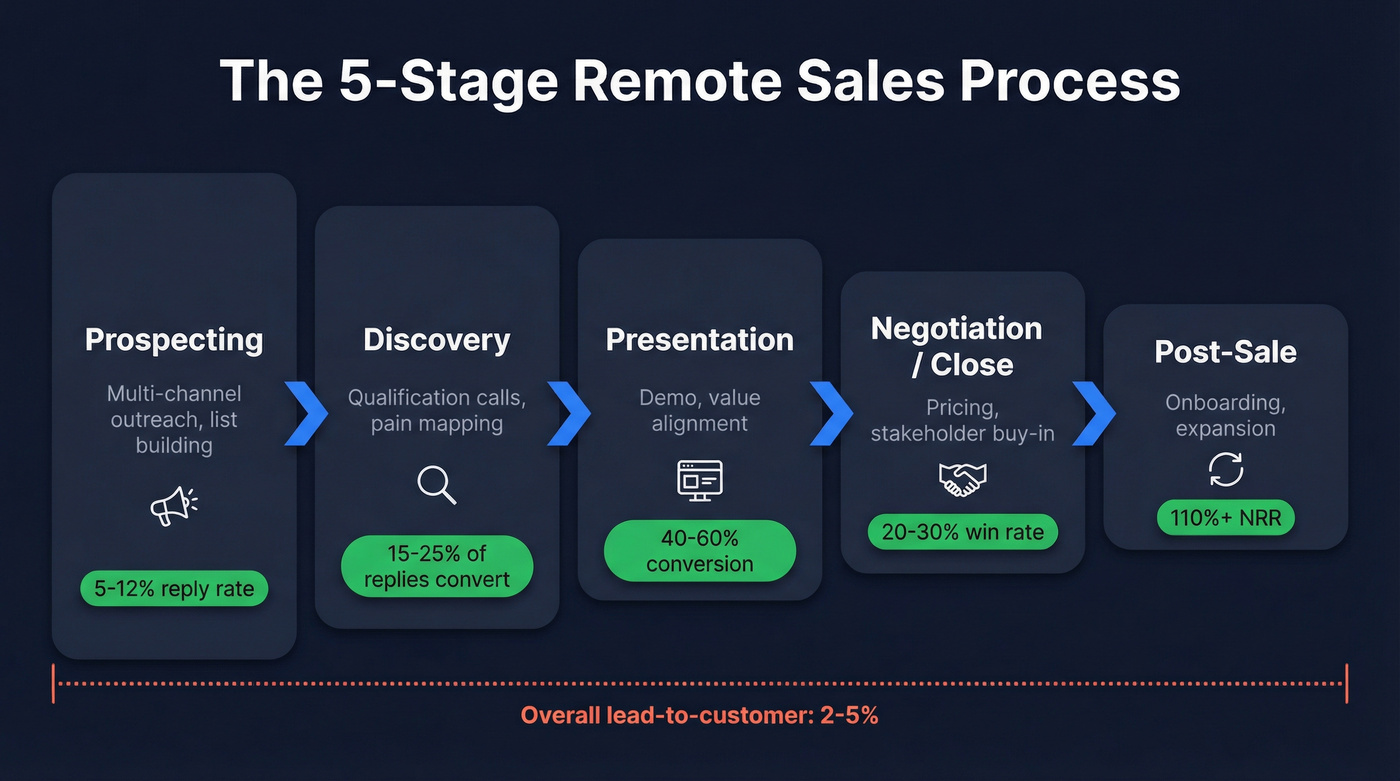
| Stage | Key Activities | Exit Criteria | Benchmark |
|---|---|---|---|
| Prospecting | Multi-channel outreach, list building | Reply received | 5-12% reply rate |
| Discovery | Qualification calls, pain mapping | Meeting booked | 15-25% of replies |
| Presentation | Demo, value alignment | Proposal requested | 40-60% conversion |
| Negotiation/Close | Pricing, stakeholder buy-in | Signed deal | 50-70% to proposal, 20-30% win rate |
| Post-Sale | Onboarding, expansion | Renewal/upsell | 110%+ NRR |
Overall lead-to-customer typically lands at 2-5%. That's not pessimism - it's the baseline math of B2B funnels.
Two behaviors decide whether you hit those benchmarks: talk-to-listen ratio and follow-up cadence. If you're talking more than 60% of discovery, you're pitching, not diagnosing. And yes - 5-7 touches is the standard before you move on. Remote selling punishes "one email + one call" laziness harder than any other channel.
Three KPIs That Actually Matter
Most dashboards worship lagging indicators. Remote teams need leading indicators that tell you what to fix this week.
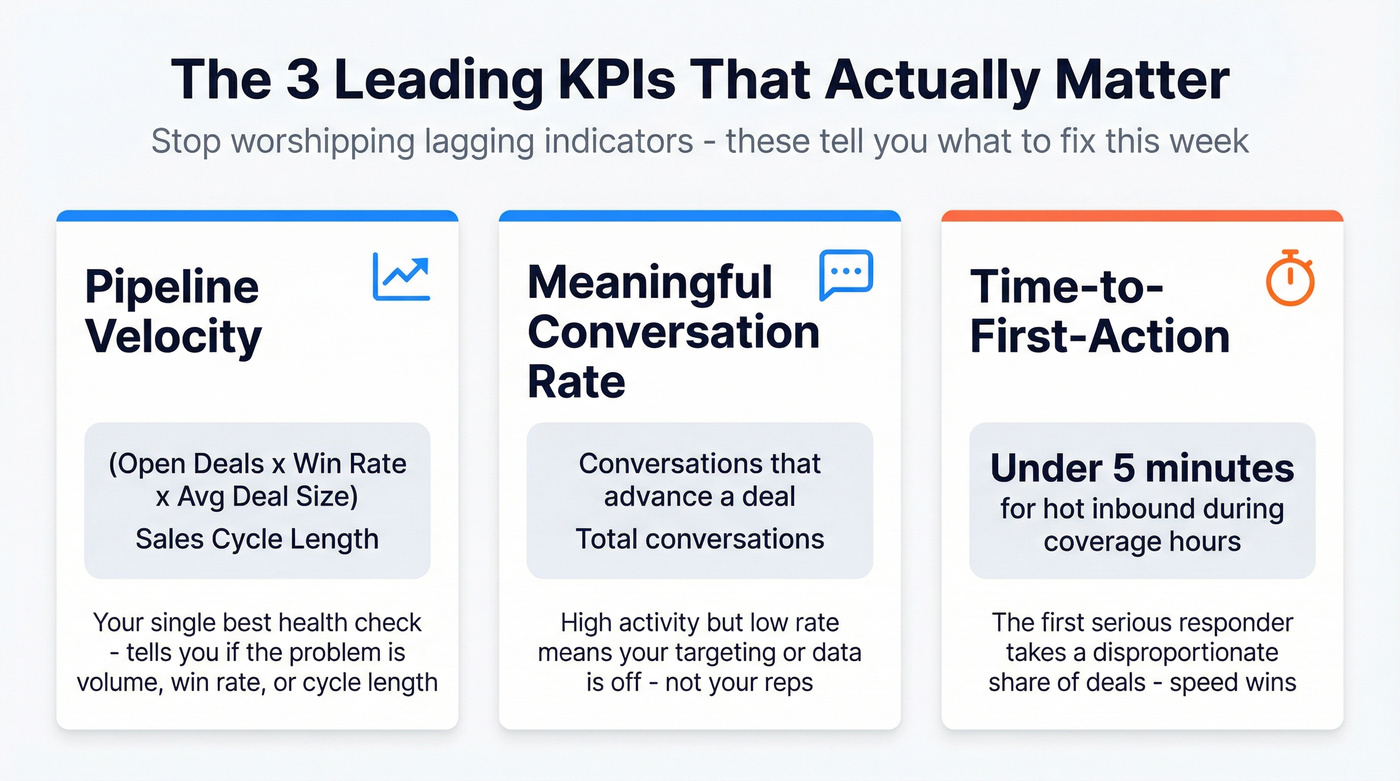
1) Pipeline Velocity
Pipeline Velocity = (Open Deals x Win Rate x Avg Deal Size) / Sales Cycle Length
This is the best single "are we on track?" number. When it drops, you can pinpoint whether you have an opportunity volume problem, a win-rate problem, or a cycle-length problem. We track this weekly across our own pipeline and it's the first thing that surfaces trouble before the quarter goes sideways.
2) Meaningful Conversation Rate
Count conversations that advance a deal - booked meeting, confirmed pain, stakeholder added. If activity is high but this rate is low, your targeting and messaging are off. Or your data is dirty, which is a whole separate problem we'll get to in the tech stack section.
3) Time-to-First-Action (Inbound)
Speed wins. The first serious responder takes a disproportionate share of deals. Set a hard SLA - under 5 minutes for hot demo requests during coverage hours - and measure it. If you're not tracking this, start today.

Dirty data tanks your Meaningful Conversation Rate before your reps even pick up the phone. Prospeo delivers 98% email accuracy and 125M+ verified mobiles on a 7-day refresh cycle - so your remote team spends time selling, not chasing bounced emails and dead numbers.
Fix your data layer and watch pipeline velocity climb.
Five Failure Modes That Kill Results
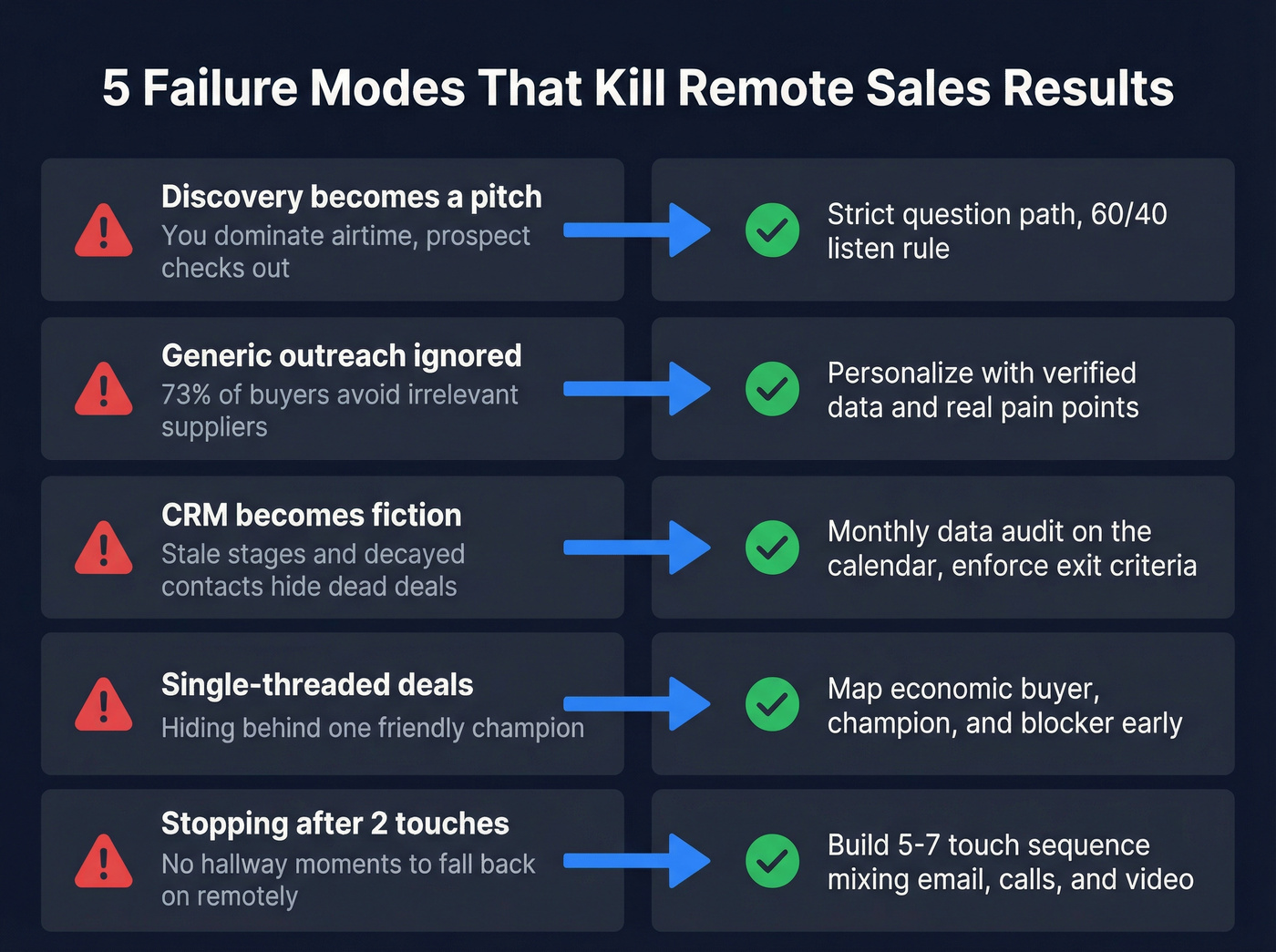
Here's the pattern we see over and over: teams blame "remote" when the real issue is undisciplined execution.
If your average deal is under $10K, you don't need a complicated playbook. You need a simple one you actually follow.
1) You turn discovery into a presentation. Remote calls already reduce trust signals. If you dominate the airtime, prospects go camera-off and mentally check out. Fix this with a strict question path and a 60/40 listen rule - use a tighter set of discovery questions.
2) Your outreach is generic, so buyers ignore it. Gartner research shows 73% of buyers avoid suppliers who send irrelevant outreach. Selling virtually doesn't change that - it just removes the in-person charm that used to cover for weak targeting.
3) Your CRM becomes fiction. Stale stages and decayed contacts create a funnel that looks healthy until the quarter ends. We've watched teams burn weeks "working deals" that were dead two months ago because nobody enforced hygiene. Skip this failure mode by running a monthly data audit - seriously, put it on the calendar.
4) You single-thread and hope for the best. Remote makes it easier to hide behind one friendly champion. Don't. Identify the economic buyer, champion, and blocker early, then earn multi-threaded access - this is classic MEDDPICC discipline.
5) You stop after two touches. Virtual selling rewards persistence because you can't rely on hallway moments or conference drive-bys. Build a sequence that mixes email, calls, and short video - then run it consistently. If you need copy, steal proven sales follow-up templates.
Remote Sales Team Management
Surveillance doesn't scale. Visibility does, and it's built with fixed weekly rhythms. The best remote sales team tactics center on coaching and accountability, not micromanagement.
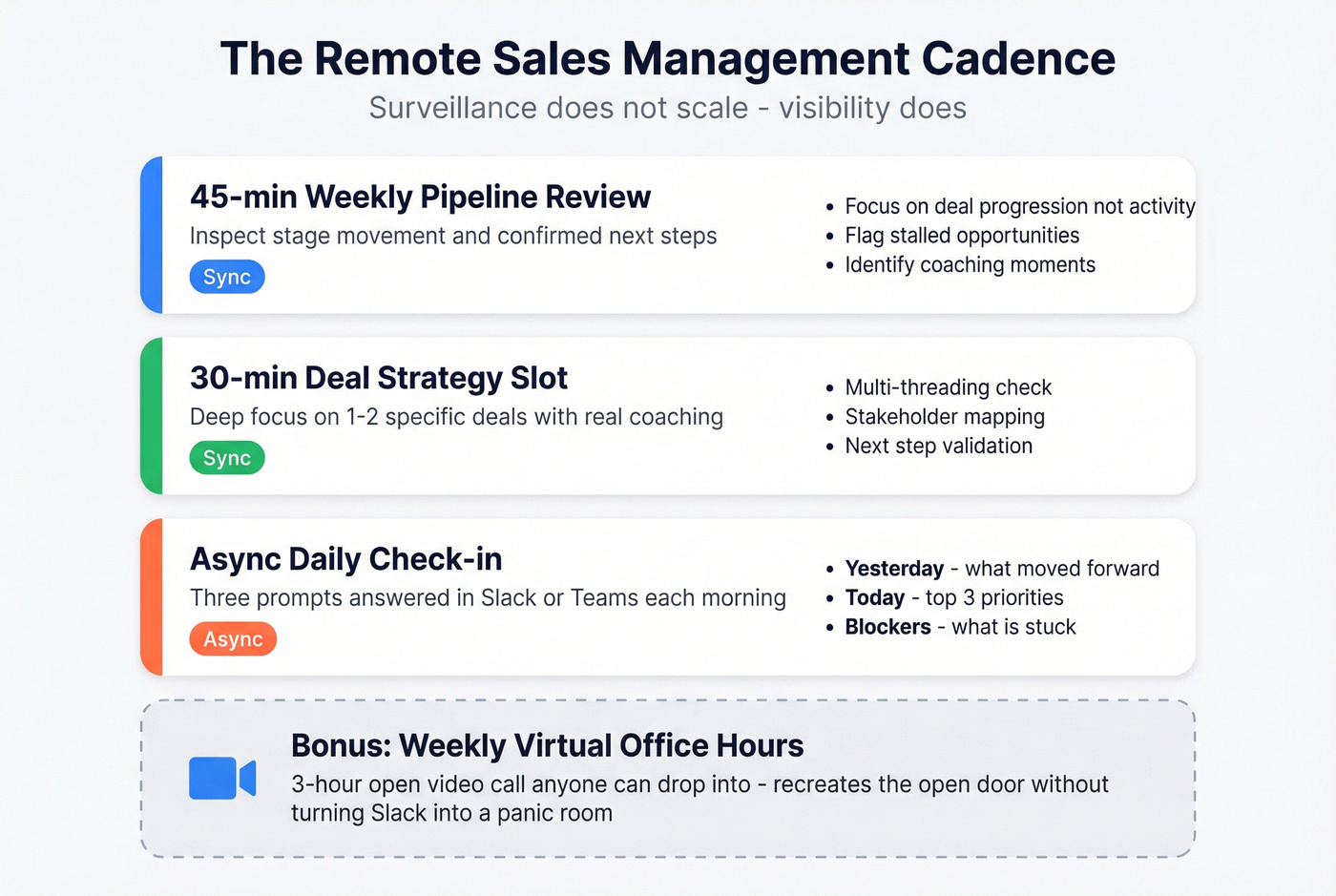
- Weekly pipeline review (45 min): inspect stage movement and next steps, not "activity."
- Deal strategy slot (30 min): one or two deals, deep focus, real coaching.
- Async daily check-in: yesterday's progress, today's plan, one blocker.
A FinTech manager on r/managers shared a tactic I love: weekly virtual office hours on a 3-hour open Teams call so anyone can drop in. It recreates the "open door" without turning Slack into a panic room.
One more advantage most teams waste: time-zone coverage. A distributed team can respond to inbound and run outbound across more buyer hours - but only if you assign coverage intentionally instead of letting it happen randomly. Map your team's hours against your top-3 buyer geographies and build a rotation. It's free pipeline acceleration.
The Minimum Viable Tech Stack
Let's be honest: most teams are over-tooled and under-coached. Start with the basics and earn the right to add more.
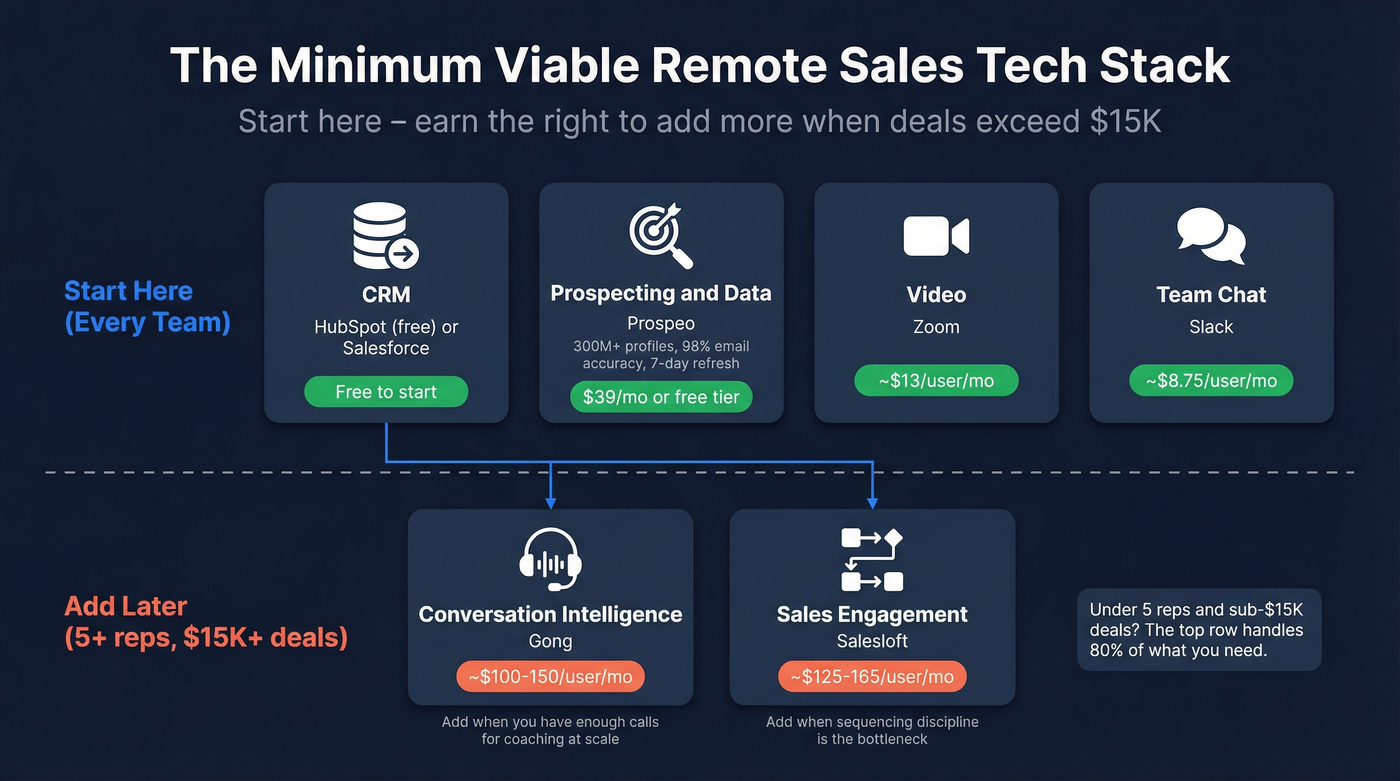
| Category | Tool | Starting Price |
|---|---|---|
| CRM | HubSpot (free) or Salesforce | Free / paid plans vary |
| Prospecting & Data | Prospeo | Free tier, paid ~$39/mo |
| Video | Zoom | ~$13/user/mo |
| Team Chat | Slack | ~$8.75/user/mo |
For prospecting data, Prospeo is the cleanest choice when accuracy and freshness matter most: 300M+ professional profiles, 143M+ verified emails, 125M+ verified mobile numbers, 98% email accuracy, and a 7-day refresh cycle. It's self-serve with no contracts, and the free tier includes 75 verified emails per month plus 100 Chrome extension credits per month - enough for a solo rep or founder running early outbound. When your deal size supports it, add:
- Gong (~$100-150/user/mo) once you have enough calls to justify coaching at scale.
- Salesloft (~$125-165/user/mo) once sequencing discipline is your bottleneck, not messaging.
If your team is under 5 reps and deals are below $15K, skip both for now. The CRM + verified data combo handles 80% of what you need.
If you're still evaluating CRMs, start with a few examples of a CRM to match your workflow.
A minimum viable stack only works when the data layer is bulletproof. Prospeo gives remote teams 300M+ profiles with 30+ filters - buyer intent, technographics, job changes, headcount growth - at roughly $0.01 per email. No contracts, no sales calls, no stale records.
Build targeted prospect lists in minutes, not hours.
Making It Stick
Remote selling isn't harder - it's less forgiving. Document the stages, measure the leading indicators, and keep your data clean. The numbers will tell you exactly what to fix next, and a sound remote sales strategy turns these fundamentals into repeatable revenue instead of quarterly scrambles. If you want more benchmarks to sanity-check your funnel, compare against current sales pipeline benchmarks.
FAQ
What KPIs should a remote sales team track?
Track Pipeline Velocity, Meaningful Conversation Rate, and Time-to-First-Action on inbound leads. These leading indicators surface problems within days - before the quarter is gone - so you can adjust targeting, messaging, or speed-to-lead in real time.
How do you keep remote reps accountable?
Use fixed cadences: a 45-minute weekly pipeline review, a 30-minute deal coaching slot, and async daily check-ins. Hold reps to stage movement and confirmed next steps, not vanity activity metrics like dials logged or emails sent.
How many touches does remote outreach need?
Plan for 5-7 touches across email, phone, and short video before moving on. Remote selling removes casual in-person touchpoints, so structured multi-channel sequences are essential to earn a reply at the 5-12% benchmark rate.
What's the biggest mistake remote sales teams make?
Treating CRM data as optional. Decayed contacts and fictional pipeline stages waste more remote selling hours than any other problem we've seen. Run a monthly data hygiene audit and enforce stage exit criteria - it's boring work that pays off every quarter.