

Revenue Acceleration: The Operator's Playbook for 2026
Your CRO just came back from a board meeting where investors asked why CAC is up 14% while growth is flat. Someone said "we need a revenue acceleration program." Now you need to figure out what that actually means - and build one in 90 days.
The median SaaS company now spends $2.00 in sales and marketing for every $1.00 of new customer ARR, and AE quota attainment sits at a stubborn 58%. Companies aren't failing because they lack effort. They're failing because effort without alignment is just expensive motion.
The Short Version
Revenue acceleration is the measurable outcome of aligning marketing, sales, and customer success around shared metrics - it's not a synonym for RevOps. Three metrics matter: pipeline velocity, net revenue retention, and forecast accuracy. If you can't calculate your pipeline velocity right now, you don't have an acceleration program. You have a hope program.
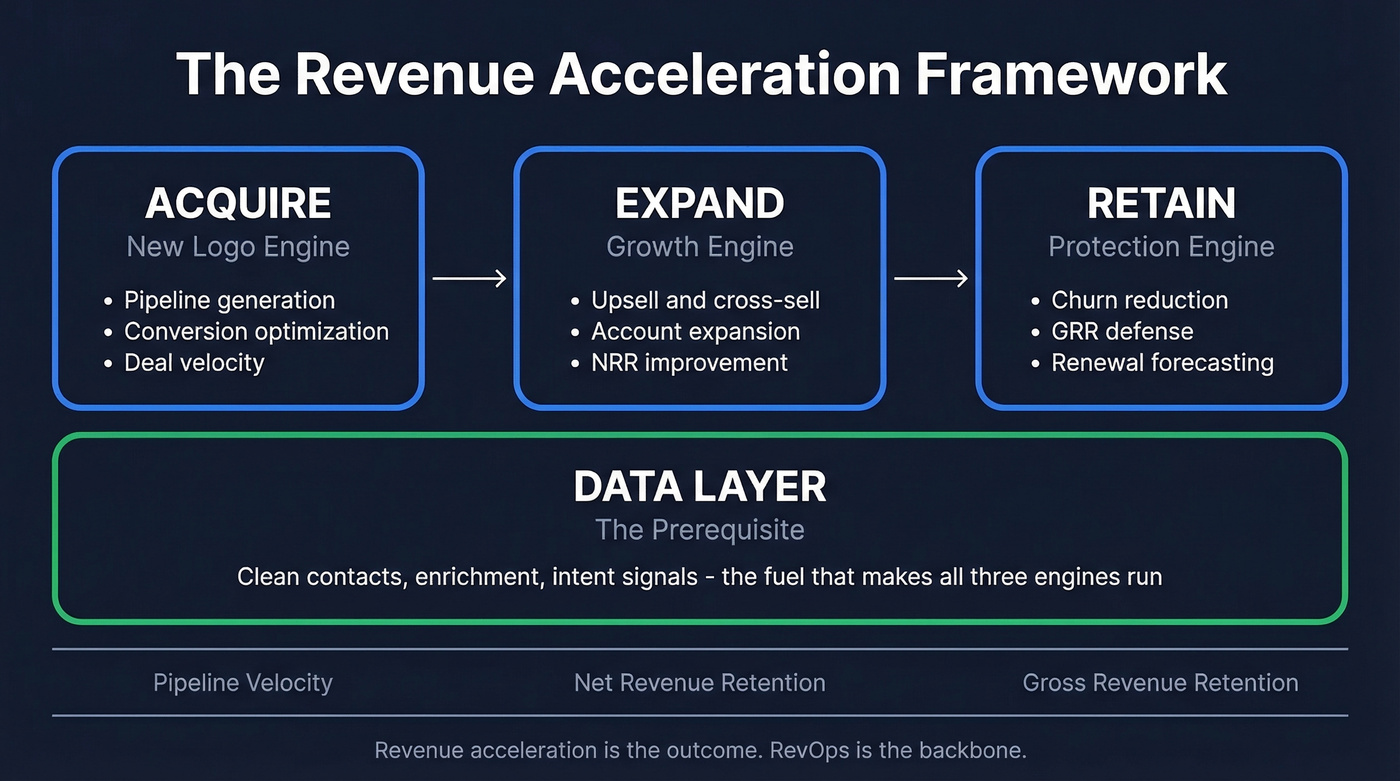
The framework breaks into four parts:
- Acquire - new logo engine covering pipeline generation, conversion, and deal velocity
- Expand - growth engine driving upsell, cross-sell, and NRR
- Retain - protection engine focused on churn reduction, GRR, and renewal forecasting
- Data layer - the prerequisite that makes all three engines run on clean fuel
What Is Revenue Acceleration?
It's the practice of aligning marketing, sales, and customer success to shorten the time from prospect to revenue - and from revenue to expansion. Not a tool. Not a department. An operating model.
That operating model rests on three principles: alignment, visibility, and optimization. As Stephen Diorio writes, growth is now a "digital, data-driven, technology-enabled team sport" where customer data is the core asset. The lone-wolf AE closing deals on charisma alone isn't the growth engine anymore.
Here's the thing most articles miss: this isn't about going faster. It's about wasting less. Less spend on leads that don't convert. Less time on deals that won't close. Less churn from customers who never should've signed. In our experience, the companies that treat this as a permanent operating model - a proactive revenue strategy rather than a quarterly project - are the ones that actually move the needle.
Search Reddit for "revenue acceleration" and you'll find stock analysts, not RevOps practitioners. That tells you something. The people doing this work call it pipeline velocity optimization, GTM alignment, or just "fixing the funnel." The label matters less than the operating model behind it.
Revenue Acceleration vs. RevOps vs. Sales Acceleration
These three terms get used interchangeably, and that confusion kills execution.
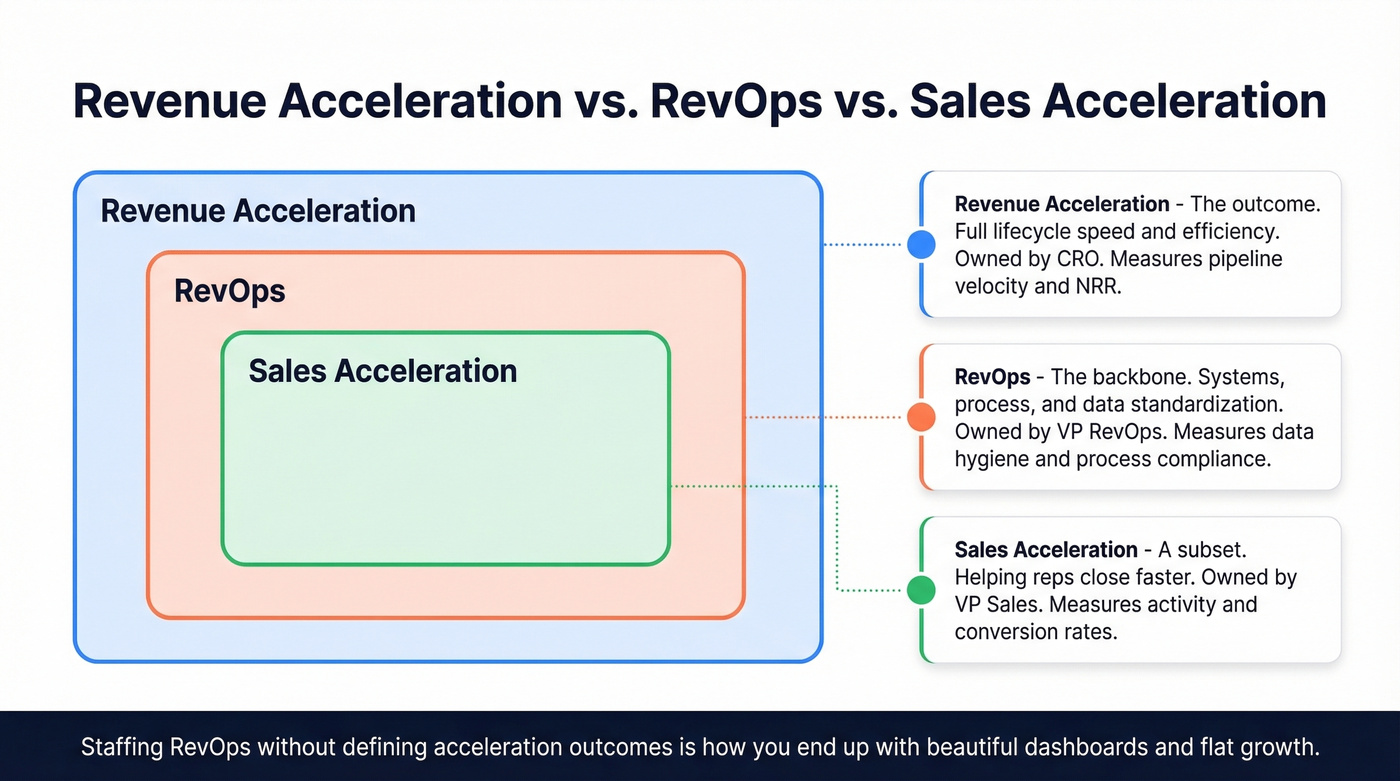
| Revenue Acceleration | RevOps | Sales Acceleration | |
|---|---|---|---|
| Scope | Full lifecycle | Systems & process | Sales-specific |
| Goal | Speed + efficiency | Standardization | Quota attainment |
| Who Owns It | CRO / cross-functional | VP RevOps | VP Sales / Sales Ops |
| Key Metrics | Pipeline velocity, NRR | Data hygiene, process | Activity, conversion |
| Relationship | The outcome | The backbone | A subset |
RevOps rests on four pillars - People, Process, Technology, and Data - and its job is to standardize how those pillars work across Sales Ops, Marketing Ops, and CS Ops. Revenue acceleration is the outcome that system produces when it's working. Sales acceleration is one piece of the puzzle, focused narrowly on helping reps close faster.
The cleanest way to think about it: RevOps is the backbone. Acceleration is what happens when that backbone works end-to-end. You need both, but they aren't the same thing, and staffing a RevOps team without defining the acceleration outcomes you're targeting is how you end up with beautiful dashboards and flat growth.
Why It Matters in 2026
Three pressures are converging that make this operating model non-optional.
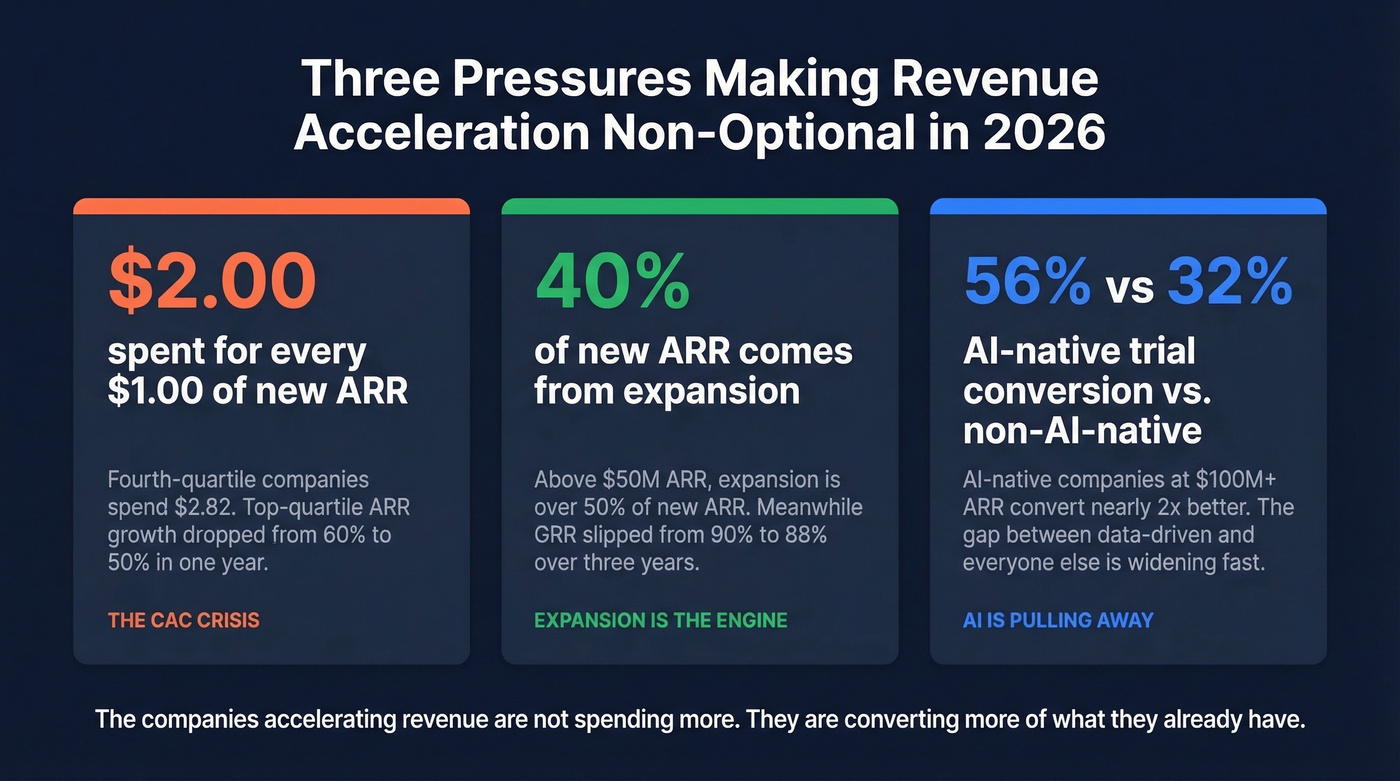
The CAC crisis is real. That $2.00 CAC ratio isn't just a median - fourth-quartile companies are spending $2.82 per $1.00 of new ARR. Top growth quartile ARR growth declined from 60% in 2023 to 50% in 2024. Companies are spending more and growing less. The math doesn't work unless you fundamentally change how you convert - scaling revenue efficiently means doing more with what you already have, not just adding headcount.
Expansion is now the dominant growth engine. Expansion ARR accounts for 40% of total new ARR across the board, and for companies above $50M, it's over 50%. Meanwhile, gross revenue retention has slipped from 90% to 88% over three years. The companies winning aren't just acquiring - they're expanding existing accounts while plugging retention leaks. Expansion is the single highest-ROI lever for any company above $10M ARR, and it's criminally underfunded at most.
AI-native companies are pulling away. Among $100M+ ARR companies, AI-native firms convert free trial and POC to next stage at 56% vs. 32% for non-AI-native peers. Edstellar's shift to context-first AI lead intelligence drove enterprise conversion from 18% to 27% and compressed the sales cycle by 12 days. The gap between companies that operationalize their data and those that don't is widening fast.
The companies accelerating revenue aren't spending more. They're converting more of what they already have.

You can't accelerate revenue on bad data. When 42% of reps miss quota, the problem isn't effort - it's fuel. Prospeo's 300M+ profiles with 98% email accuracy and 7-day refresh cycles give your acquire engine clean pipeline from day one. At $0.01 per email, fixing your CAC ratio starts here.
Stop spending $2.00 to earn $1.00. Start with data that actually converts.
The Three Engines That Drive Results
Acquire - New Logo Engine
Do this: Shift from high-volume spray-and-pray to insight-first prospecting - using intent signals to prioritize accounts and personalizing outreach based on trigger events like funding rounds, leadership changes, and tech stack shifts. Nextiva's CMO reported that moving to this model drove closed-won rates from 12% to 19%, average deal size up 14%, and revenue per rep up 22%, all within 90 days.
Skip this if you're measuring top-of-funnel volume as a success metric. A thousand MQLs that sales can't convert isn't pipeline - it's noise. Measure SQLs, win rate, ACV, and cycle length. Those four variables are the ones that move pipeline velocity.
Expand - Growth Engine
Expansion is the most underrated lever in the entire playbook. With NRR benchmarking at 101% as the median, most companies are barely treading water on their existing base. The best operators treat every closed deal as the starting line, not the finish.
We've watched teams pour 80% of their GTM budget into new logos while their existing base quietly erodes. The math is simple: expanding a $50K account to $75K costs a fraction of acquiring a new $50K logo. If expansion ARR is already 40% of total new ARR at the median, imagine what happens when you actually invest in it. A customer-centric revenue strategy - one that maps expansion plays to actual usage patterns and business outcomes - is what separates companies surpassing targets from those treading water.
Retain - The $400K Math Problem
Start with the numbers. GRR has declined from 90% to 88% over three years. On $20M ARR, that's $400K in additional annual churn - money that has to be replaced before you can grow.
| GRR | Annual Churn on $20M ARR | Annual Churn on $50M ARR |
|---|---|---|
| 90% | $2.0M | $5.0M |
| 88% | $2.4M | $6.0M |
| 85% | $3.0M | $7.5M |
Every point of GRR you recover is money you don't have to re-earn. Retention-adjacent tactics compound fast - Invensis Technologies reported that their "micro-proof" approach increased closed-won ratio from 21% to 29% and compressed the sales cycle by two weeks. Shorter cycles and higher win rates don't just accelerate new revenue; they free up capacity that protects existing accounts from neglect.
How to Measure Revenue Acceleration
You can't accelerate what you can't measure. Here are the four formulas that matter - and 73% of RevOps leaders now sit in the C-suite, which means these numbers are landing on executive dashboards, not buried in ops reports.
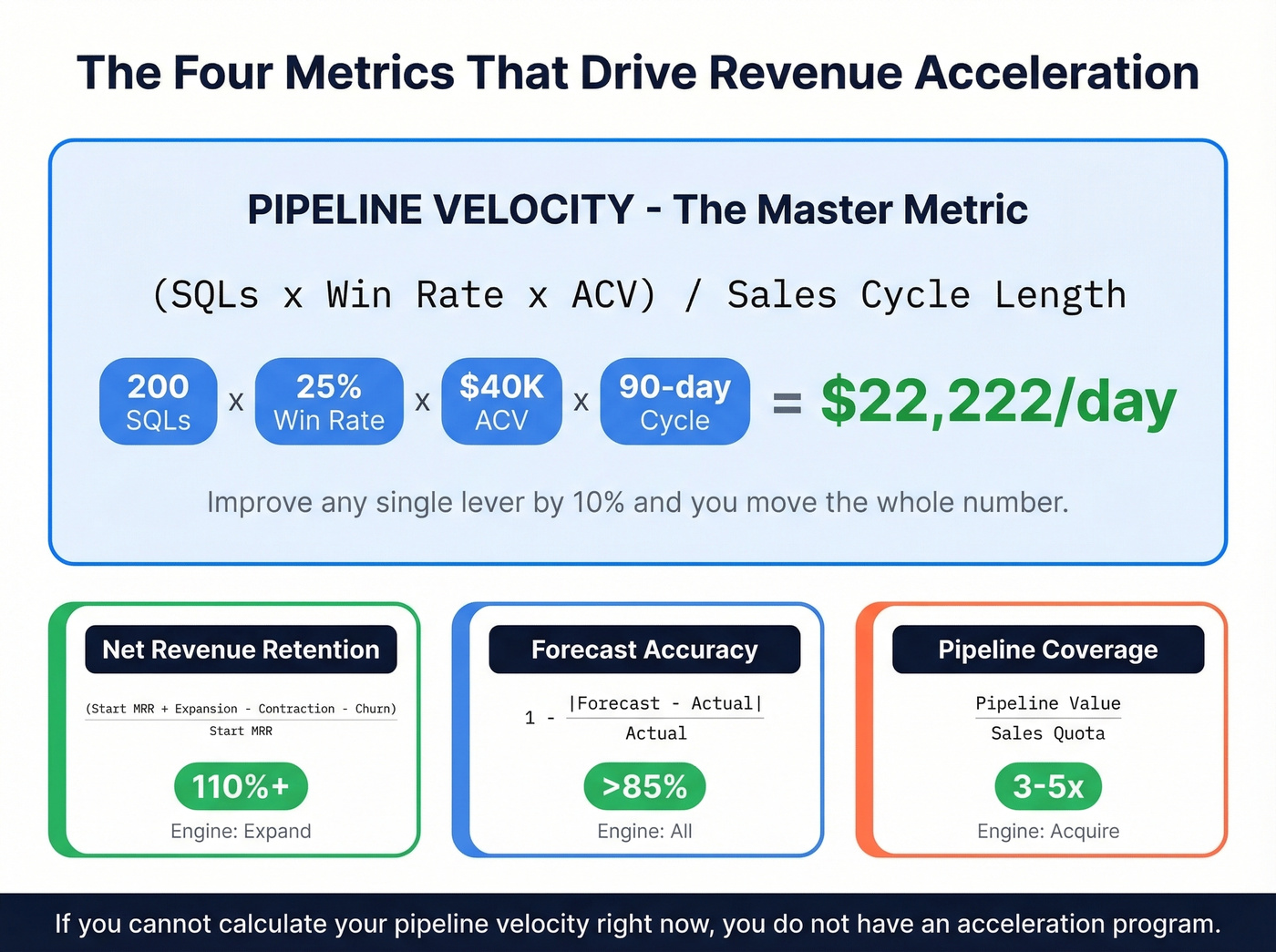
Pipeline velocity is the master metric:
(Number of SQLs x Win Rate x ACV) / Sales Cycle Length
Worked example: 200 SQLs x 25% win rate x $40K ACV / 90-day cycle = $22,222/day in pipeline velocity. Improve any single lever by 10% and you move the whole number.
Net revenue retention tells you if your base is growing or shrinking:
(Starting MRR + Expansion - Contraction - Churn) / Starting MRR
Benchmark: 110%+ for mature SaaS. Below 100% means you're leaking faster than you're filling.
Forecast accuracy measures operational maturity:
1 - |(Forecast - Actual)| / Actual
If you're off by more than 10%, your forecast isn't reliable. The tools exist to get this right - 97% of executives in a recent Wakefield study saw measurable ROI from AI in forecasting and analytics. But if your forecast accuracy is below 85%, stop buying new tools and fix your data first.
Pipeline coverage is the health check:
Total Pipeline Value / Sales Quota
Healthy coverage is typically 3-5x by segment, with 3-4x as a common baseline contextual to your win rate.
KPI Cheat Sheet
| Metric | Formula | Benchmark | Engine |
|---|---|---|---|
| Pipeline Velocity | (SQLs x Win% x ACV) / Cycle | Higher = better | Acquire |
| NRR | (Start MRR + Exp - Contr - Churn) / Start MRR | 110%+ | Expand |
| Forecast Accuracy | 1 - |Forecast - Actual| / Actual | >85% | All |
| Pipeline Coverage | Pipeline / Quota | 3-5x | Acquire |
| GRR | (Start MRR - Contr - Churn) / Start MRR | >88% | Retain |
The Tech Stack That Supports It
Forrester now calls this category "Revenue Orchestration Platforms" - the convergence of sales engagement, conversation intelligence, and revenue ops into a unified buying layer. PitchBook reported 10x sales efficiency gains, and Upwork hit 95% forecast accuracy after consolidating their stack.
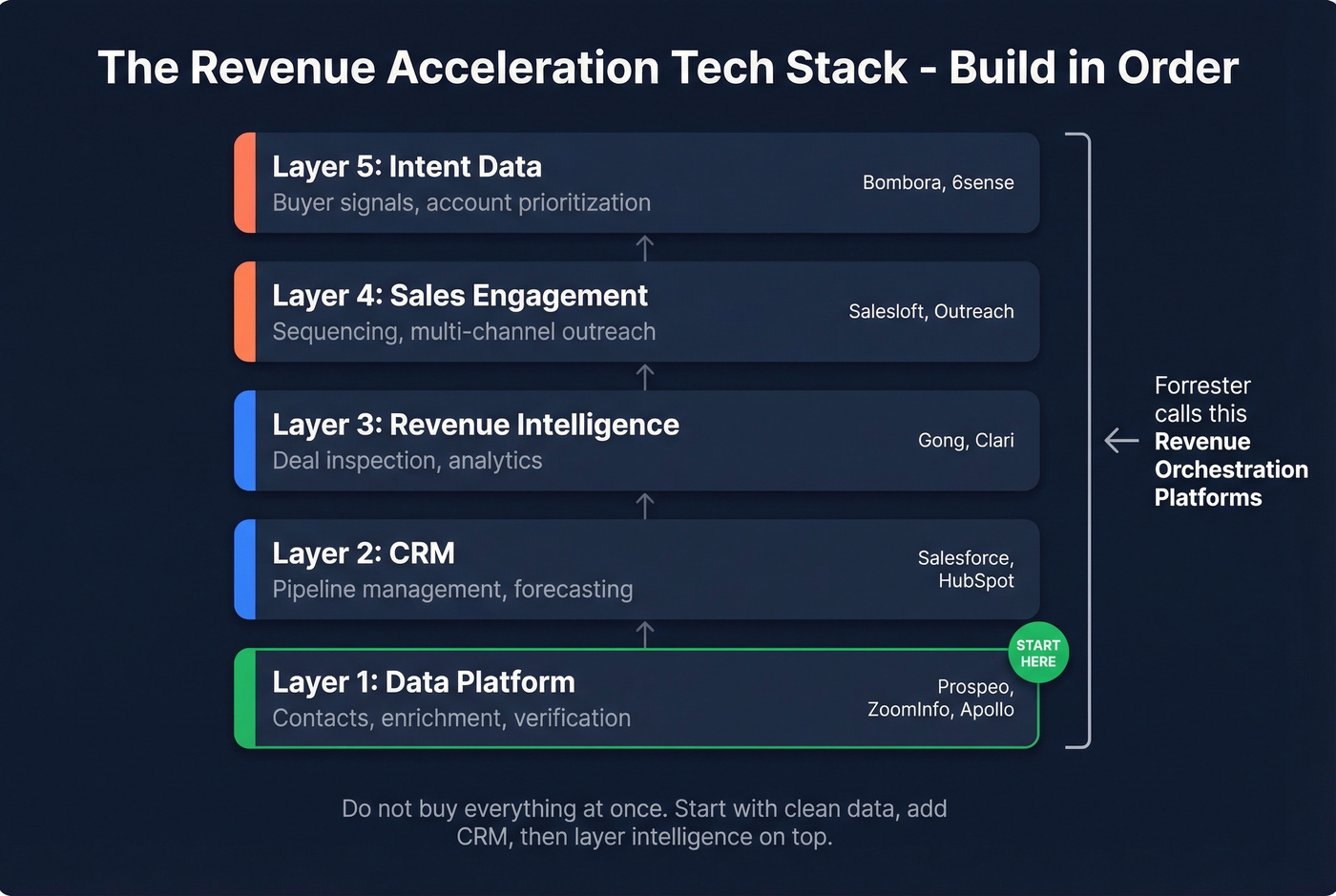
You don't need to buy everything at once. Start with three layers: a clean data platform, a CRM, and a revenue intelligence tool. Add intent data and sales engagement after those are working.
| Layer | Purpose | Tools | Cost Range |
|---|---|---|---|
| Data Platform | Contacts, enrichment | Prospeo, ZoomInfo, Apollo | Prospeo: ~$0.01/email, free tier; ZoomInfo: $15-40K/yr; Apollo: free-$99/user/mo |
| CRM | Pipeline, forecasting | Salesforce, HubSpot | Salesforce: $25-300/user/mo; HubSpot: free-$150/user/mo |
| Revenue Intel | Deal inspection | Gong, Clari | Gong: ~$1,200-$1,600/user/yr; Clari: ~$20K-$60K+/yr |
| Sales Engagement | Sequencing, outreach | Salesloft, Outreach | ~$100-$200/user/mo |
| Intent Data | Buyer signals | Bombora, 6sense | Bombora: ~$10K-$60K+/yr; 6sense: ~$30K-$150K+/yr |
Let's be honest about intent data: it's overhyped when you don't have enough pipeline volume to operationalize the signals. The spend is usually better allocated to cleaning your contact data and tightening your ICP. Once you have consistent opportunity volume and a team that can act on intent quickly, intent data becomes a force multiplier. Before that, it's an expensive distraction.
Your data layer is the bottleneck nobody wants to talk about. Teams invest in Gong, Clari, and Salesloft, then feed them stale contact data with 20%+ bounce rates. It's like putting a turbocharger on an engine with a clogged fuel line - which is why we always recommend starting with the data layer before anything else.
Why Acceleration Programs Fail
We've seen these initiatives die for the same five reasons, over and over.
Siloed execution. Marketing generates leads that sales can't convert. Sales blames marketing for lead quality. Nobody shares a dashboard. Without cross-functional alignment on shared KPIs, you're running three separate programs and calling it "acceleration."
Bad data upstream. This is the silent killer. When your contact database has 20%+ bounce rates, every downstream tool underperforms - your sequences, your scoring models, your forecasts. Snyk's 50-person AE team was running bounce rates of 35-40% before overhauling their data layer. After the switch, bounce rates dropped under 5%, AE-sourced pipeline jumped 180%, and the team generated 200+ new opportunities per month.
Wrong metrics. Tracking activity like calls made and emails sent instead of acceleration metrics like pipeline velocity, NRR, and forecast accuracy. Activity metrics tell you people are busy. Acceleration metrics tell you the business is moving.
No iteration. "Set-and-forget" programs that launch with fanfare and never get optimized. This work requires continuous tuning - weekly pipeline reviews, monthly metric recalibration, quarterly playbook updates. Replanning your strategy each quarter based on what the data actually shows is what separates operators from optimists.
Generic messaging. 77% of buyers expect different content at different research stages. If your SDRs send the same cold email to a first-touch prospect and a late-stage evaluator, you're burning pipeline at both ends.
90-Day Launch Playbook
Phase 1 - Weeks 1-4: Audit
Calculate your current pipeline velocity using the formula above. If you can't, that's your first problem. Audit data quality by measuring bounce rate, enrichment coverage, and duplicate rate across your CRM. Then identify your weakest engine. Most teams think it's acquisition. It's usually expansion or retention.
Phase 2 - Weeks 5-8: Pilot
Select 50-100 target accounts that match your ICP tightly. Deploy a clean data platform plus one intelligence tool - don't boil the ocean. Align sales and marketing on shared KPIs and a single dashboard. One source of truth, not two.
Real talk: if sales and marketing can't agree on what counts as an SQL during this phase, your acceleration program is dead on arrival.
Phase 3 - Weeks 9-12: Measure and Scale
Compare pipeline velocity before and after. This is the number that matters. Calculate ROI by measuring pipeline generated versus program cost. If velocity improved 10%+, expand to your full ICP and begin scaling across additional segments and geographies. If it didn't, diagnose which engine stalled and iterate before spending another dollar.
Your expansion engine runs on knowing who to reach and when. Prospeo combines intent data across 15,000 Bombora topics with technographics, headcount growth, and funding signals - so your team targets accounts showing real buying behavior, not just fit on paper.
Layer intent signals on your existing accounts and watch NRR climb.
FAQ
What does a revenue acceleration manager do?
A revenue acceleration manager owns cross-functional alignment between marketing, sales, and customer success, tracking pipeline velocity, NRR, and forecast accuracy - typically reporting to the CRO. Think of the role as the operator who makes the acquire, expand, and retain engines run together instead of in silos.
How is it different from demand generation?
Demand gen focuses on top-of-funnel awareness and lead volume. Revenue acceleration spans the full customer lifecycle - acquisition, expansion, and retention - and optimizes for velocity and efficiency, not just volume. Demand gen is one input to the acquire engine; this is the whole operating model.
What's the most important metric to track?
Pipeline velocity. It combines four levers - opportunities, win rate, deal size, and cycle length - into a single number showing how fast revenue moves through your funnel. Improving any one lever by 10% compounds across the entire formula.
How long until results show?
Most teams see measurable pipeline velocity improvement within 90 days of a focused pilot. Full organizational impact typically takes two to three quarters as processes, data quality, and cross-functional habits compound. Start with a tight account set rather than trying to transform everything at once.
What's the first tool to buy?
A clean data platform with 95%+ email accuracy, a weekly refresh cycle, and native CRM integration. Every other tool in your stack - engagement, intelligence, intent - depends on accurate contacts. Without that foundation, you're optimizing on top of bad data, and no amount of AI or orchestration fixes that.