

Revenue Operations Roles and Responsibilities: The 2026 Practitioner's Guide
Head of Revenue Operations was LinkedIn's #1 fastest-growing job title between 2018 and 2022. Gartner projects that by 2026, 75% of the highest-growth companies will adopt a RevOps model - up from less than 30%. And yet most companies still can't agree on what revenue operations roles and responsibilities actually look like in practice.
That gap between hype and execution is where things get expensive. Teams hire "RevOps" people who end up doing Sales Ops with a fancier title. Leadership expects strategic transformation but funds a single analyst buried in Jira tickets. The role has real teeth - but only when the scope, seniority ladder, and operating model are defined clearly from the start.
What Is Revenue Operations?
Think of RevOps as the central nervous system for your GTM motion. It connects sales, marketing, and customer success through unified data, shared processes, and a coherent tech stack so the entire revenue lifecycle operates as one system instead of three departments with competing dashboards.
Here's the thing: if your RevOps team only supports sales, you have Sales Ops with a trendy title. Real RevOps owns the handoffs between marketing and sales, between sales and CS, and between CS and expansion. That cross-functional scope is what makes the role valuable - and what makes it hard to hire for.
RevOps vs. Functional Ops Boundaries
This is the boundary that trips up most orgs. Drawing it clearly prevents turf wars and duplicate work.
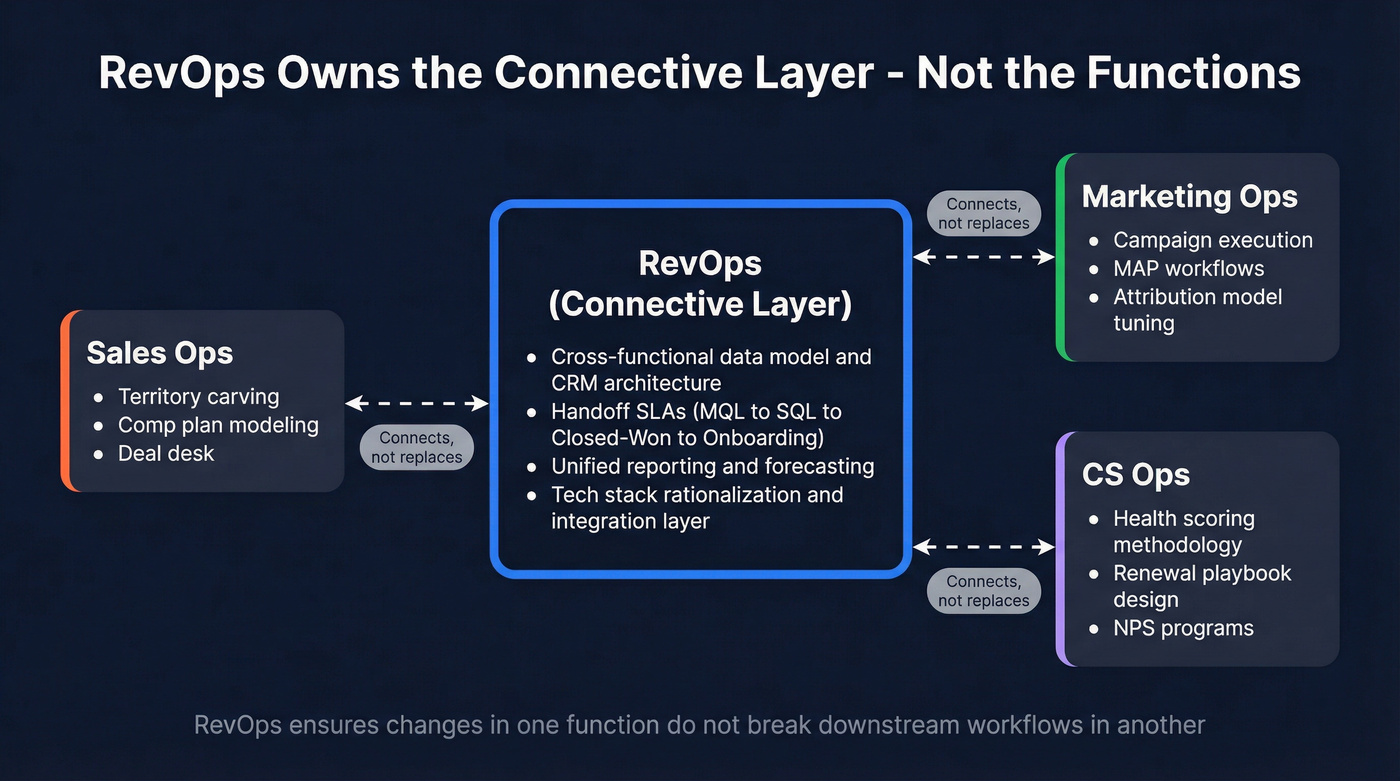
RevOps owns:
- Cross-functional data model, CRM architecture, and system-of-record governance
- Handoff SLAs between stages (MQL to SQL to Closed-Won to Onboarding)
- Unified reporting and forecasting across the full revenue lifecycle
- Tech stack rationalization and the integration layer
Functional ops still own:
- Sales Ops: territory carving, comp plan modeling, deal desk
- Marketing Ops: campaign execution, MAP workflows, attribution model tuning
- CS Ops: health scoring methodology, renewal playbook design, NPS programs
RevOps doesn't replace these functions. It connects them. When a Director of Marketing Ops changes a lead scoring model, RevOps makes sure the downstream routing rules, sales SLAs, and CS handoff triggers still work. Without that connective layer, every team optimizes locally and the revenue engine fragments.
The Four Pillars of RevOps Responsibilities
Every role from analyst to VP touches all four pillars - the mix just shifts with seniority. Understanding these core responsibilities is what separates a strategic ops function from a glorified help desk.
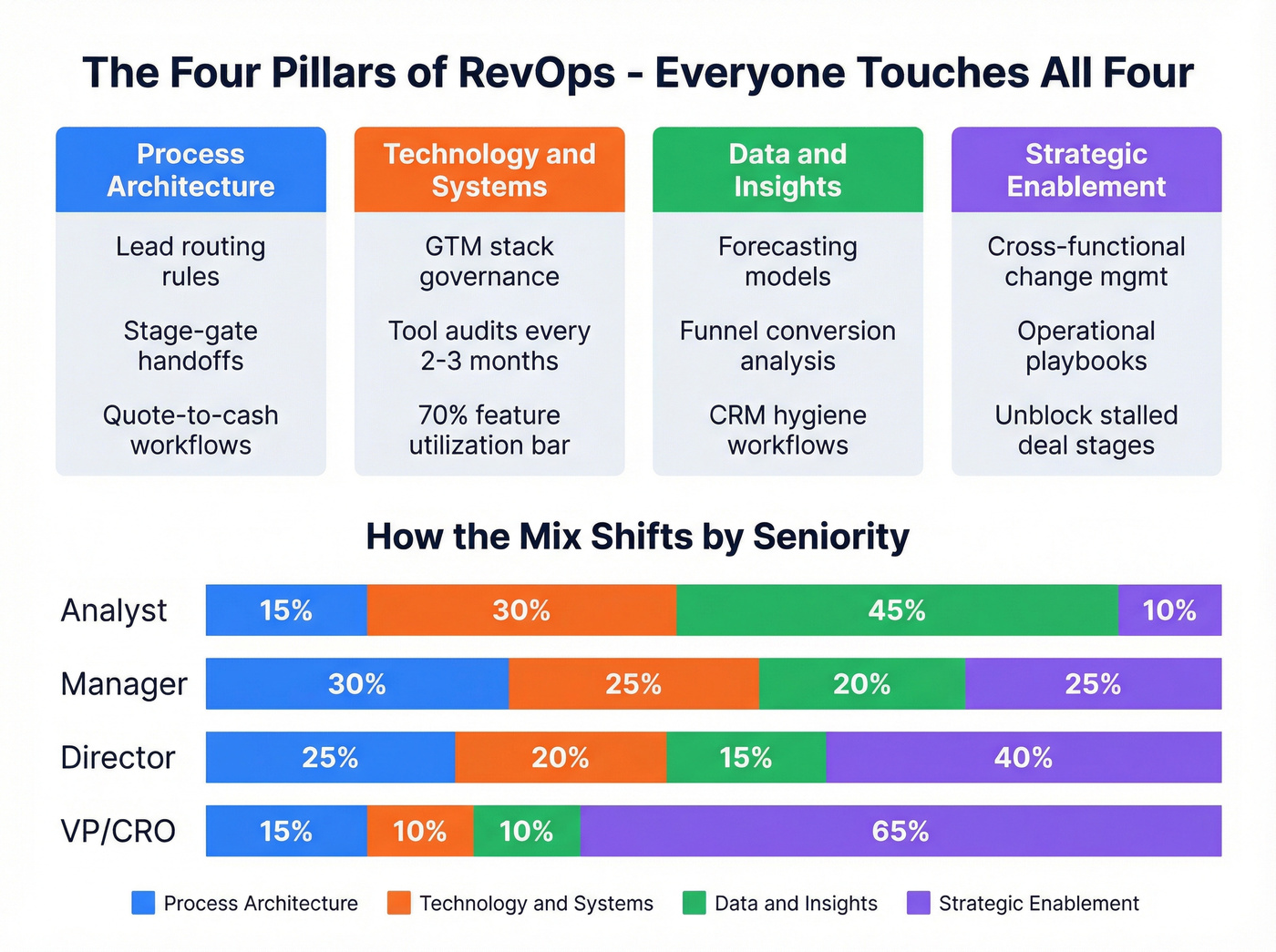
Process Architecture & Optimization. This means designing lead routing rules, stage-gate handoffs, and quote-to-cash workflows. It means defining and enforcing lifecycle stages so "MQL" means the same thing to marketing and sales. And it means saying no to requests that create workflow sprawl without measurable pipeline impact.
Technology & Systems Management. RevOps governs the integrated GTM stack - CRM, MAP, BI, sequencers, enrichment tools. Run tech stack audits every two to three months and cut tools unless the team uses 70%+ of features. The average AE touches 7-10 tools costing roughly 15-20% of OTE annually, so bloat adds up fast.
Data & Insights. Dashboards, forecasting models, funnel conversion analysis, CRM hygiene workflows. The data tax is real: 31% of admins say poor-quality data costs 20%+ of annual revenue. Stale contact records poison every metric downstream, which is why enrichment and verification workflows aren't optional - they're foundational. If you're evaluating vendors, start with a shortlist of data enrichment options.

Strategic Enablement. Build resources and processes that unblock stages where deals stall. Own cross-functional change management - changing an Opportunity Type in Salesforce ripples through attribution, CS workflows, and revenue reporting. Translate executive strategy into operational playbooks reps can actually follow.
How RevOps Work Shows Up Week-to-Week
In our experience, the teams that actually ship improvements instead of drowning in ad-hoc requests run a lightweight sprint cadence:
Intake, Jira backlog, bi-weekly sprint planning, sandbox testing, release notes in Confluence.
A stakeholder wants a new Opportunity field? It goes into the backlog, gets scoped against pipeline impact, tested in sandbox, and deployed with release notes so downstream teams know what changed. Without this discipline, RevOps becomes a ticket queue instead of a strategic function. We've seen teams go from 40+ open requests to a clean two-week sprint cycle in under a month just by enforcing intake criteria.
RevOps Roles by Seniority
Title and tenure drive pay more than people management. An experienced IC can out-earn a first-time manager.
| Role | Key Focus Areas | Operational KPIs | 2026 Salary Range (USD) |
|---|---|---|---|
| Analyst | Dashboards, data hygiene, CRM admin, ad-hoc reporting | Data quality score, report SLA, enrichment coverage | $70K-$100K |
| Manager | Process design, tool evaluation, cross-team projects | Cycle time reduction, automation coverage, forecast accuracy | $110K-$150K |
| Director | Strategy, headcount planning, stack architecture | Pipeline coverage ratio, sales velocity, routing speed | $150K-$200K |
| VP / Head of RevOps | GTM alignment, board reporting, revenue forecasting, capacity planning | Revenue growth, CLV, forecast variance | $200K-$300K |
| CRO (RevOps-led model) | Full P&L ownership, cross-functional executive alignment, investor reporting | ARR growth, net revenue retention, CAC payback | $250K-$400K+ |
Median across all RevOps roles is $129,155. Individual contributors average roughly $147,504. VP/SVP-level professionals with 10+ years of experience average $216,571.
Your First RevOps Hire: What the JD Should Say
If you're writing a job description for your first generalist, these are the bullets that matter:
- You will own CRM configuration, field hygiene, and integration maintenance from day one
- You will build and maintain dashboards for pipeline, forecast, and funnel conversion
- You will design lead routing and handoff SLAs between marketing, sales, and CS
- You will evaluate new tools against a 70%-feature-utilization bar before approving spend
- You will run a bi-weekly ops sprint and publish release notes to stakeholders
Skip the "5+ years of Salesforce experience" gatekeeping. What you actually need is someone who can context-switch between marketing attribution and sales comp questions before lunch.
Team Sizing by Stage
| Company Size | Sellers | RevOps Headcount | Notes |
|---|---|---|---|
| 0-10 FTE | 0-1 | None | Founder handles CRM setup |
| 11-25 FTE | 2-3 | None (outsource) | Fractional RevOps or agency |
| 26-50 FTE | ~6 | 1 generalist | First in-house hire |
| 51-100 FTE | 10-20 | 2-3 | Add a data/analytics specialist |
| 100-250 FTE | 20-50 | 4-12 | Specialists by pillar |
| 250-1,000 FTE | 50-200 | 13-100 | Segmented ops (SMB/Mid/Ent) |
| 1,000+ FTE | 200+ | 100+ | Regional + segment + channel ops |
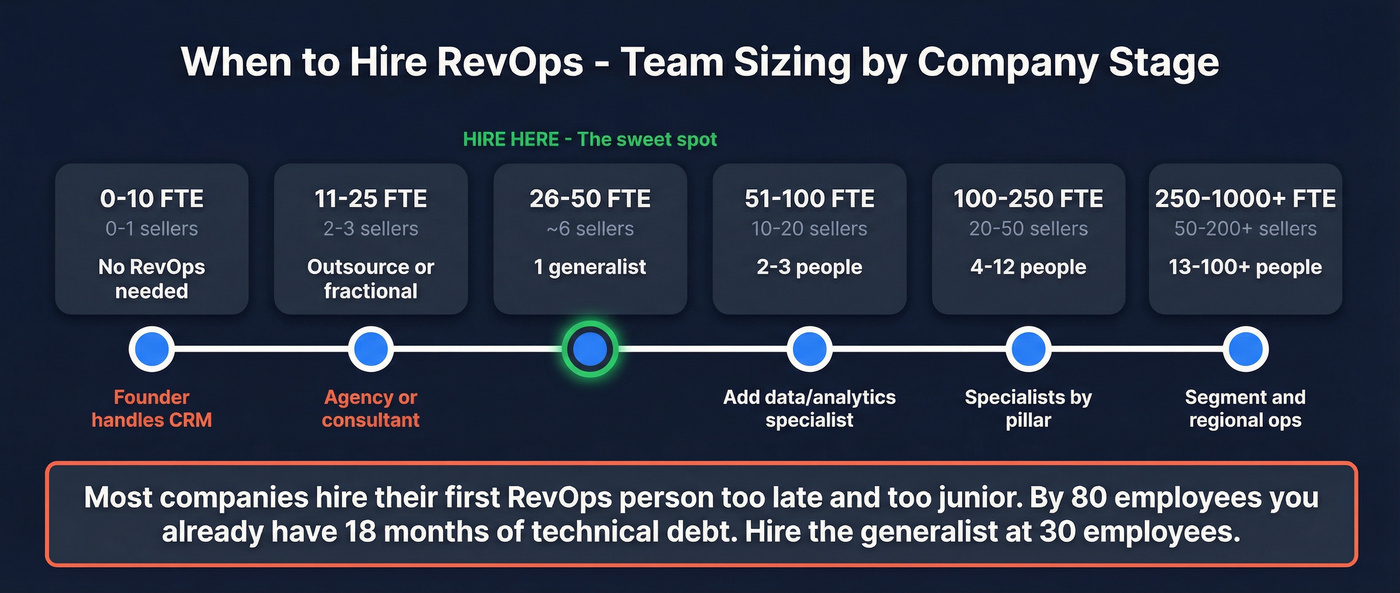
Look - the 26-50 FTE threshold isn't arbitrary. That's roughly when you have enough sellers that inconsistent processes start costing real deals, and enough data that a spreadsheet stops being a viable "CRM." Before that point, outsource CRM setup and light data hygiene to a fractional ops consultant.
Most companies hire their first RevOps person too late and too junior. By the time you feel the pain at 80 employees, you've already accumulated 18 months of technical debt from configuration decisions a founder made in month three. Hire the generalist at 30 employees, pay them well, and give them a seat at the leadership table. The ROI is asymmetric.
If you're hiring for this seat, it helps to benchmark against a dedicated RevOps Manager role profile.

You just read that 31% of admins say poor data costs 20%+ of revenue. Prospeo's CRM enrichment returns 50+ data points per contact at a 92% match rate - with 98% email accuracy and a 7-day refresh cycle. That's the enrichment layer RevOps teams actually need.
Stop asking analysts to manually fix what automation should handle.
Key RevOps Metrics
Two formulas every RevOps professional should have memorized:
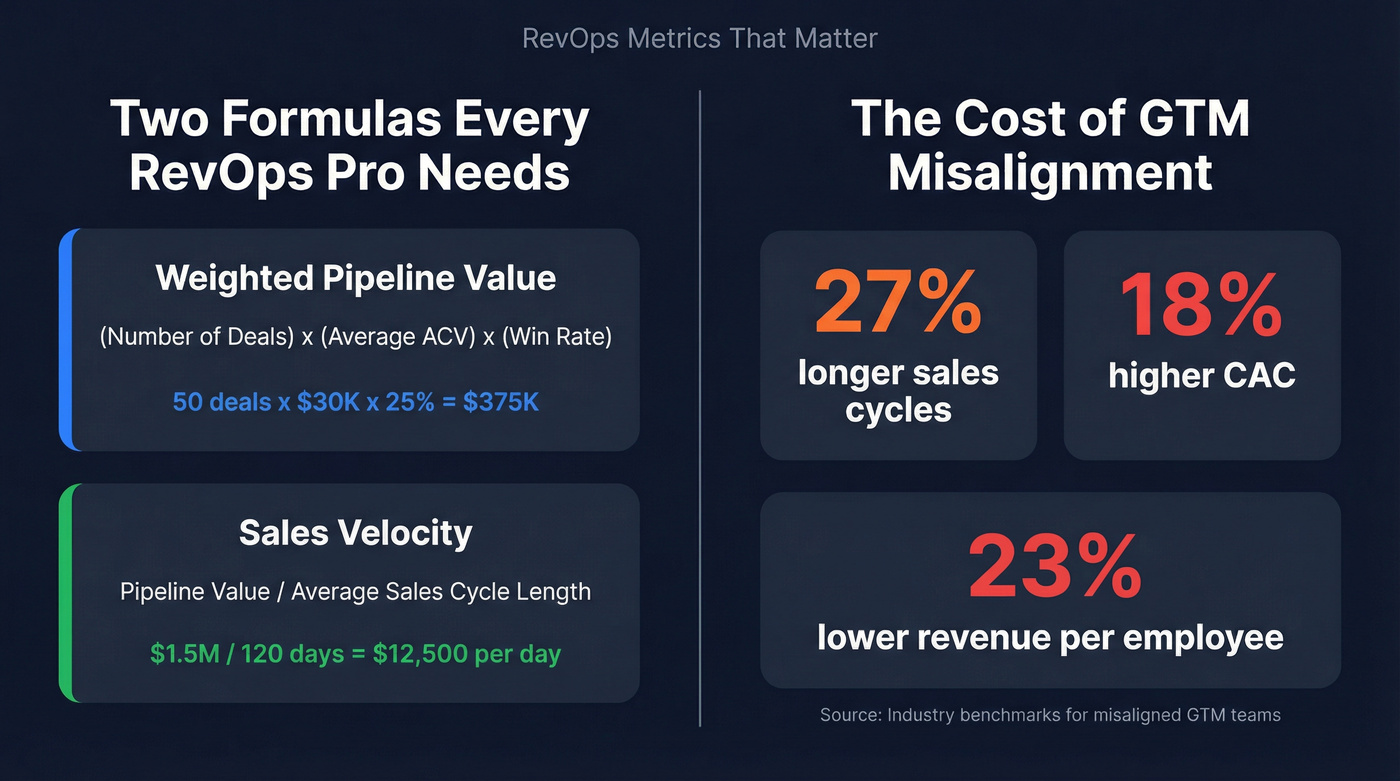
Weighted Pipeline Value = (number of deals) x (average ACV) x (win rate). Fifty deals at $30K ACV with a 25% win rate gives you $375K in weighted pipeline.
Sales Velocity = Pipeline Value / Average Sales Cycle Length. A $1.5M pipeline with a 120-day cycle produces $12,500/day in expected revenue. Compress the cycle or expand the pipe, and that number moves.
Who Owns Which Metric
| Metric | Primary Owner | Why It Matters |
|---|---|---|
| Data quality score | Analyst | Garbage in, garbage out - every downstream metric depends on this |
| Report SLA adherence | Analyst | Stakeholders lose trust when dashboards lag |
| Forecast accuracy | Manager | Directly measures ops rigor; boards notice when it drifts |
| Sales velocity | Director | Combines pipeline, win rate, and cycle time into one operational pulse |
| Pipeline coverage ratio | Director | Early warning system for next-quarter shortfalls |
| Revenue growth / CLV | VP / CRO | The outcome metrics that justify RevOps headcount |
The cost of getting alignment wrong is quantifiable: misaligned GTM teams see 27% longer sales cycles, 18% higher CAC, and 23% lower revenue per employee. If you want a tighter operating view, track pipeline health alongside velocity.
Tooling Cost Reality Check
RevOps governs the stack, so you need to know what "normal" spend looks like. These are typical per-seat annual ranges for mid-market teams:
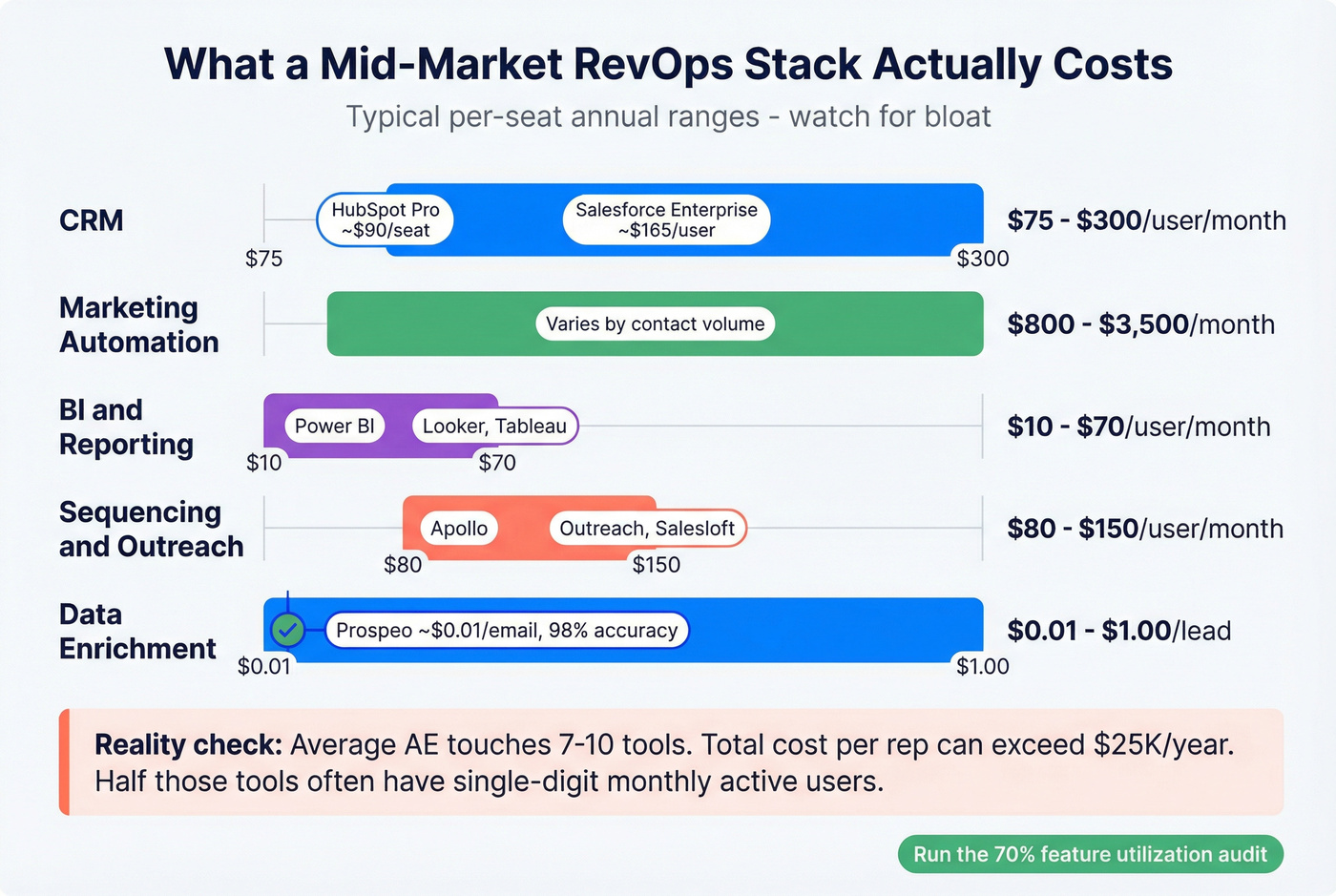
- CRM: $75-$300/user/month (Salesforce Enterprise runs ~$165/user; HubSpot Pro starts around $90/seat)
- Marketing Automation: $800-$3,500/month depending on contact volume
- BI / Reporting: $10-$70/user/month (Looker, Tableau, Power BI)
- Sequencing / Outreach: $80-$150/user/month (Outreach, Salesloft, Apollo)
- Data Enrichment: $0.01-$1.00/lead depending on vendor; Prospeo sits at the low end at ~$0.01/email while returning 50+ data points per enrichment with a 98% email accuracy rate, which makes it a strong fit for RevOps teams running CRM enrichment workflows at scale
When the average AE is touching 7-10 tools, those per-seat costs compound fast. We've seen stacks where total tooling cost per rep exceeded $25K/year - and half the tools had single-digit monthly active users. That's why the 70%-feature-utilization audit matters. If you're rationalizing your stack, compare categories like sales forecasting solutions before you renew.
Mistakes That Kill RevOps
The startup sin is switching CRMs early and under-hiring admin roles. I've watched teams lose entire quarters to CRM migrations that should have taken six weeks but stretched to six months because nobody scoped the data model properly. Thirty-one percent of admins report that poor-quality data costs 20%+ of annual revenue, and the average AE is juggling 7-10 tools at 15-20% of OTE. Technical debt from bad early decisions is the most expensive kind.
The growth-stage sin is reactive ops - accepting every stakeholder request instead of prioritizing by pipeline impact. If your RevOps team doesn't have a backlog with clear prioritization criteria, they're a service desk, not a strategic function. A simple way to pressure-test prioritization is to map requests to common sales pipeline challenges.
The enterprise sin is merging multiple CRM instances while over-locking permissions until nobody can actually use the system.
All three share a root cause: treating RevOps as support instead of strategy.
The 2026 sin nobody talks about is trusting AI forecasting on dirty data. Teams have seen AI-generated forecasts overestimate pipeline by roughly 20% when the underlying CRM data hasn't been cleaned. With only 43% of cloud software sales pros hitting quota in Q4 in recent benchmarks, forecast accuracy isn't academic - it's the difference between making the number and explaining a miss to the board.
What to Do Next
If you're a hiring manager, use the seniority table and JD bullets above to write your posting. If you're a new RevOps hire, start with the four pillars and audit which ones your company neglects - data quality and process documentation are almost always the weakest. For career-switchers, prioritize CRM fluency (a Salesforce or HubSpot admin cert), SQL/BI proficiency, and cross-functional communication. Those three skills cover 80% of what hiring managers screen for.
Let's be honest: understanding revenue operations roles and responsibilities at this level of detail is table stakes now, not a differentiator. The differentiator is execution - standing up the sprint cadence, enforcing data hygiene, and saying no to requests that don't move pipeline. If you need a practical framework for tightening handoffs, start with a documented lead generation workflow.
Your first RevOps hire shouldn't spend week one cleaning stale contacts. Prospeo verifies 143M+ emails through a 5-step process with catch-all handling, spam-trap removal, and honeypot filtering - at roughly $0.01 per email. Give your ops team clean data from day one.
Build your RevOps function on data that doesn't need fixing.
FAQ
How is RevOps different from Sales Ops?
Sales Ops focuses exclusively on the sales process - territories, comp plans, pipeline reporting. RevOps spans the full revenue lifecycle across sales, marketing, and customer success, owning cross-functional handoffs, shared data infrastructure, and end-to-end process design. The simplest test: does the role own handoffs between departments? If yes, it's RevOps.
When should a company hire its first RevOps person?
Hire at 26-50 FTE with roughly six sellers - that's when inconsistent processes start costing real deals. Before that, outsource CRM setup and data hygiene to a fractional consultant. Your first hire should be a generalist who can touch CRM config, build reports, and manage stakeholders across departments, not a specialist locked into one pillar.
What tools do RevOps teams manage daily?
The core stack includes CRM (Salesforce or HubSpot), project management (Jira), documentation (Confluence), BI/reporting tools, sequencers, and data enrichment platforms for keeping contact records verified and current. Most reps use 7-10 tools; RevOps decides what stays, what gets cut, and what gets integrated - enforcing a 70%-feature-utilization bar before any new tool gets approved.
What KPIs prove a RevOps function is working?
Track sales velocity ($12,500/day on a $1.5M pipeline with a 120-day cycle), forecast accuracy (plus or minus 5% variance is best-in-class), pipeline coverage ratio (3x minimum for next quarter), and data quality score. Misaligned GTM teams see 27% longer sales cycles and 18% higher CAC - those numbers should improve measurably within two quarters of standing up RevOps.