

RocketReach vs Apollo.io: Which One Actually Delivers Accurate Data?
The RocketReach vs Apollo.io debate usually comes down to database size. That's the wrong metric.
Apollo is a sequencing platform that happens to have a database. RocketReach is a database that bolted on light outreach. Neither is best-in-class at data accuracy - and that distinction matters more than feature count when your bounce rate is quietly killing your domain reputation.
30-Second Verdict
- Choose Apollo if you want sequences, a dialer, and a built-in database in one platform - and you're okay managing credit drain.
- Choose RocketReach if you need a large contact lookup tool to feed into your existing outreach stack and can tolerate pricing opacity.
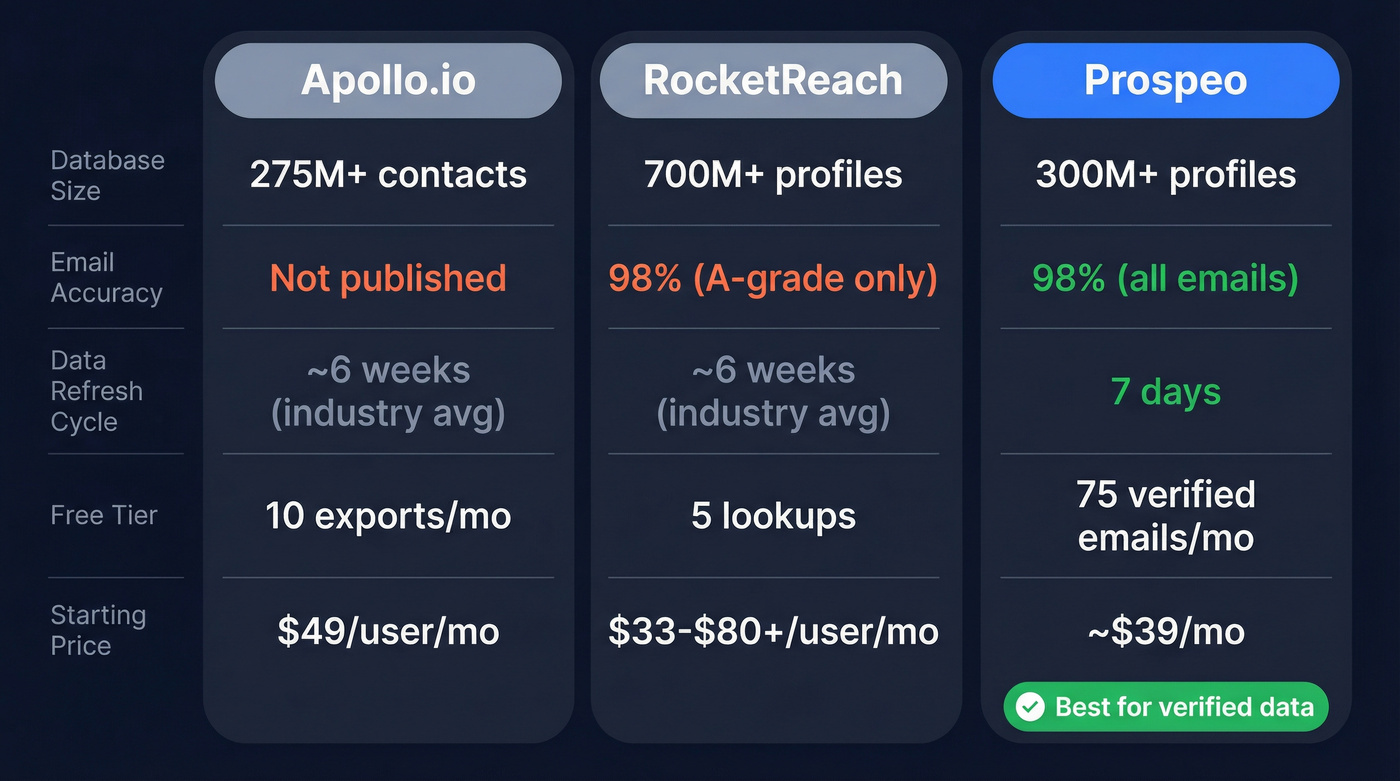
RocketReach vs Apollo.io: Quick Comparison
| Apollo.io | RocketReach | Prospeo | |
|---|---|---|---|
| Database | 275M+ contacts | 700M+ profiles | 300M+ profiles |
| G2 Rating | 4.7/5 | 4.4/5 | - |
| Free Tier | 10 exports/mo | 5 lookups | 75 verified emails/mo |
| Starting Price | $49/user/mo | $33-$80+/user/mo | ~$39/mo |
| Best For | All-in-one outbound | Large lookup database | Verified data accuracy |
How Apollo.io Charges You
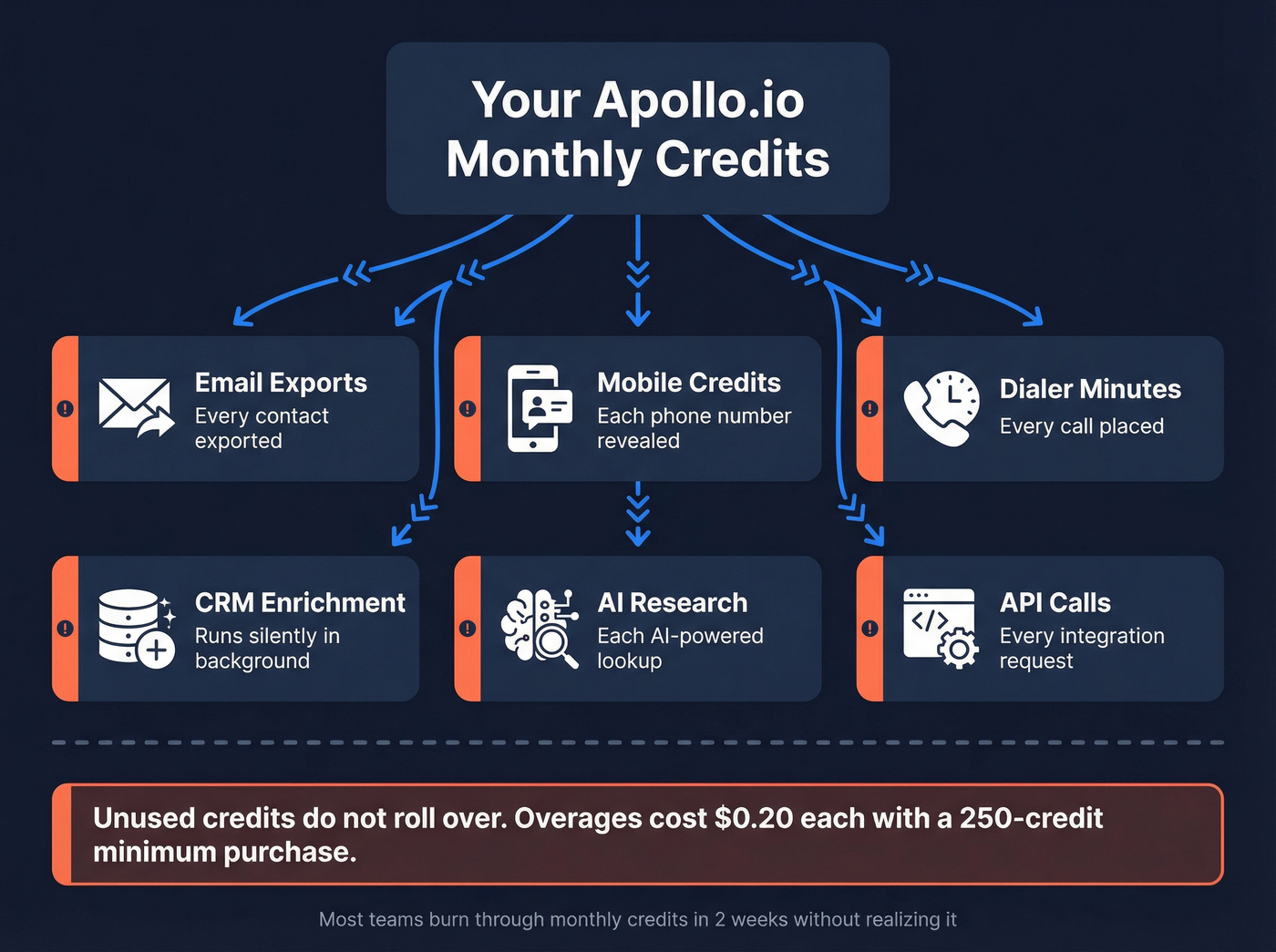
Apollo's pricing looks straightforward until you realize how many actions consume credits. The seat price is just the entry fee.
| Plan | Annual | Mobile Credits | Export Credits |
|---|---|---|---|
| Free | $0 | 5/mo | 10/mo |
| Basic | $49/user/mo | 75/mo | 1,000/mo |
| Professional | $79/user/mo | 100/mo | 2,000/mo |
| Organization | $119/user/mo | 200/mo | 4,000/mo |
On monthly billing, Basic jumps to $59, Professional to $99, and Organization to $149 with a 3-seat minimum.
Here's the thing: dialer minutes, AI research, waterfall enrichment, CRM enrichment, and API calls all eat credits - not just exports. Unused credits don't roll over and aren't refundable. Exceed your allocation and overage credits cost $0.20 each with a 250-credit minimum purchase. We've seen teams burn through their monthly allocation in two weeks because CRM enrichment was quietly consuming credits in the background.
The free plan sounds generous with unlimited email credits, but 10 exports per month, a 250-send daily cap, and a 2-sequence limit mean most teams outgrow it within a week of real prospecting.
Who Apollo works for
If you'll actually use sequences + dialing + basic data in one place, Apollo can be a clean single-login workflow. It's especially useful when you want reps living in one system and you're willing to police credit usage like it's a budget line item - because it is. If you're building a modern outbound motion, it also helps to benchmark against other outbound sales automation approaches.

Apollo and RocketReach punish you twice: credit drain and bounces. Prospeo gives 98% verified emails on a 7-day refresh, so your lists stay deliverable while you scale outreach.
Switch to data that protects your domain reputation.
How RocketReach Charges You
RocketReach's pricing is a mess. We found Essentials quoted at $33/mo, $39/mo, and $80/mo across different sources. That alone should tell you something.

Get a written quote before committing. Pricing varies by region, billing cycle, and whether you're buying an individual or team plan.
| Plan | Annual | Monthly | Credits/Lookups per month |
|---|---|---|---|
| Essentials | $19-$33/mo | $39-$80/mo | ~80-125 |
| Pro | $52-$83/mo | $99-$150/mo | ~200-375 |
| Ultimate | $140-$207/mo | $169-$833/mo | ~500-833 |
Lower end reflects annual billing; higher end is monthly. Team plans run $83-$207/user/mo (annual only), and overages typically cost $0.30-$0.45 per lookup.
RocketReach uses a dual credit system where lookup credits pull contact data into the platform and export credits let you download or sync via integrations. Once you look up a profile, you keep access - no double-charging. But RocketReach also enforces rate limits on searches, lookups, and API actions without publishing the actual thresholds. You'll just hit a wall that says "please wait to try again with fewer contacts," which is a frustrating way to discover your plan's real limits mid-campaign.
Who RocketReach works for
RocketReach makes sense when you already have a sequencer and CRM workflow you like, and you just need a big lookup database to feed it. The tradeoff is operational friction: unclear packaging, variable pricing, and throttles you only discover after you hit them. If you're comparing other lookup-first tools, see our breakdown of person email finder tools.
Data Accuracy Matters More Than Size
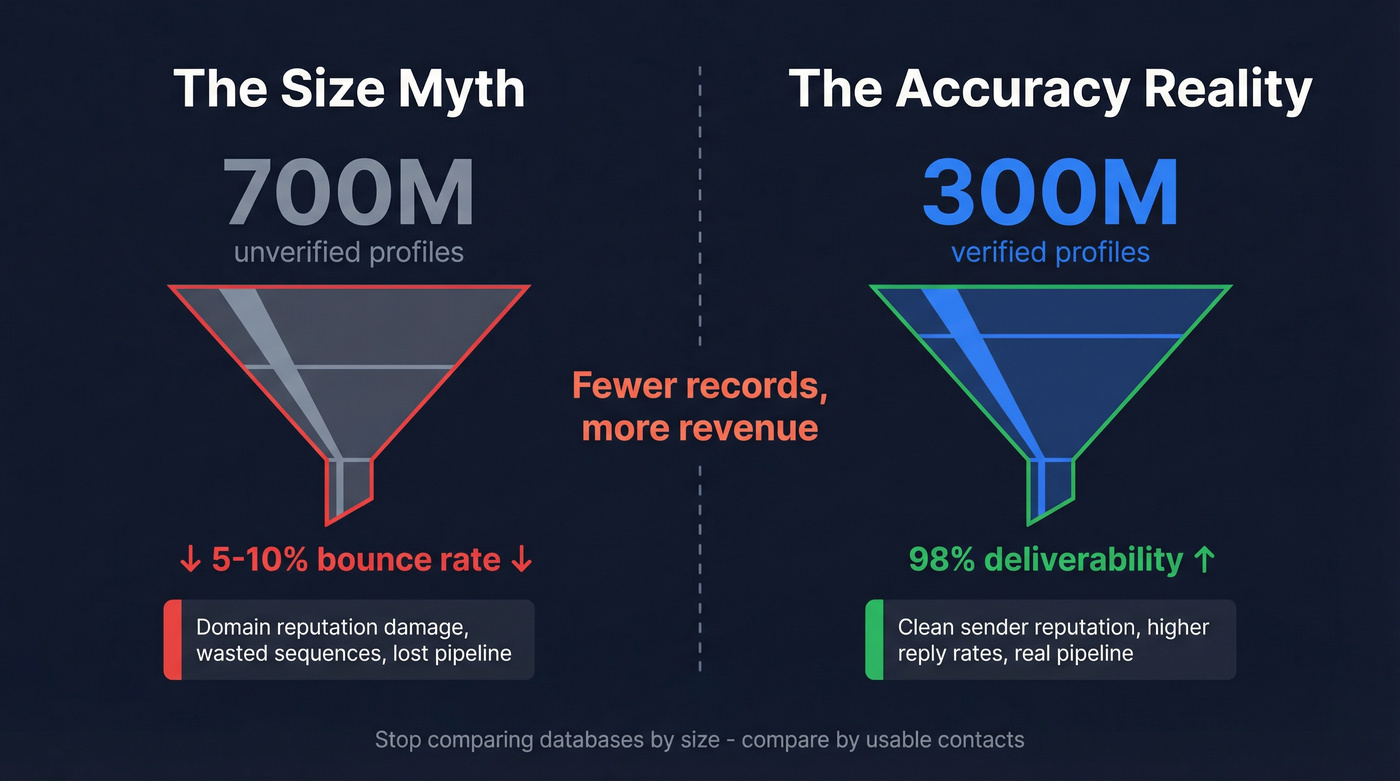
Stop comparing databases by size. 700M unverified profiles produce fewer usable contacts than 300M verified ones. Do the math.
Both tools have a data accuracy problem that shows up clearly on G2. "Inaccurate data" is a recurring negative theme across Apollo's 9,514 reviews and RocketReach's 1,212 reviews. The consensus on r/sales threads echoes this - users regularly complain about bounced emails from both platforms, especially for contacts outside the US.
RocketReach's own comparison page claims users see typical email bounce rates in the 5-10% range, and that "A-grade emails" have 98% deliverability. That qualifier is doing a lot of heavy lifting. What percentage of your results actually get that A grade? They don't say.

Let's be honest: if your average contract value is under $15k, you probably don't need Apollo's all-in-one platform or RocketReach's 700M-profile database. You need 500 verified contacts per month that actually land in inboxes. Overpaying for scale you'll never use is the most common mistake in this category. If bounces are a recurring issue, pair your sourcing with bulk email verification software or switch upstream to verified data.
When to Skip Both
- 98% email accuracy with a 7-day refresh cycle (industry average is 6 weeks)
- 300M+ profiles, including 143M+ verified emails and 125M+ verified mobiles
- 30% mobile pickup rate - useful when email deliverability is fragile
- CRM and CSV enrichment with 83% match rate and 50+ data points per contact
- Intent data across 15,000 topics powered by Bombora
- Self-serve, transparent pricing at roughly $0.01 per email, no contracts, GDPR compliant

Real results tell the story better than feature lists. Meritt cut bounce rates from 35% to under 4% after switching, and their pipeline tripled from $100K to $300K per week. Snyk's 50-AE team saw bounces drop from 35-40% to under 5%, and AE-sourced pipeline jumped 180% - generating 200+ new opportunities per month. Pair it with your existing sequencer (Instantly, Lemlist, Outreach, whatever) and you've got clean data feeding clean campaigns. If you're tightening your process, use a simple sales cadence example to keep volume consistent without spamming.
Need more than emails? Prospeo adds 125M verified mobiles with a 30% pickup rate - perfect when Apollo/RocketReach data misses and you need a second channel that connects.
Call the right buyers, not dead numbers.
The Verdict
If you're running a real RocketReach vs Apollo.io evaluation, don't let "more contacts" win the argument by default. Pricing mechanics and data quality decide whether your outbound program scales - or quietly bleeds money through bounces, throttles, and credit overages. For a deeper Apollo-specific breakdown, see our Apollo sales intelligence review.
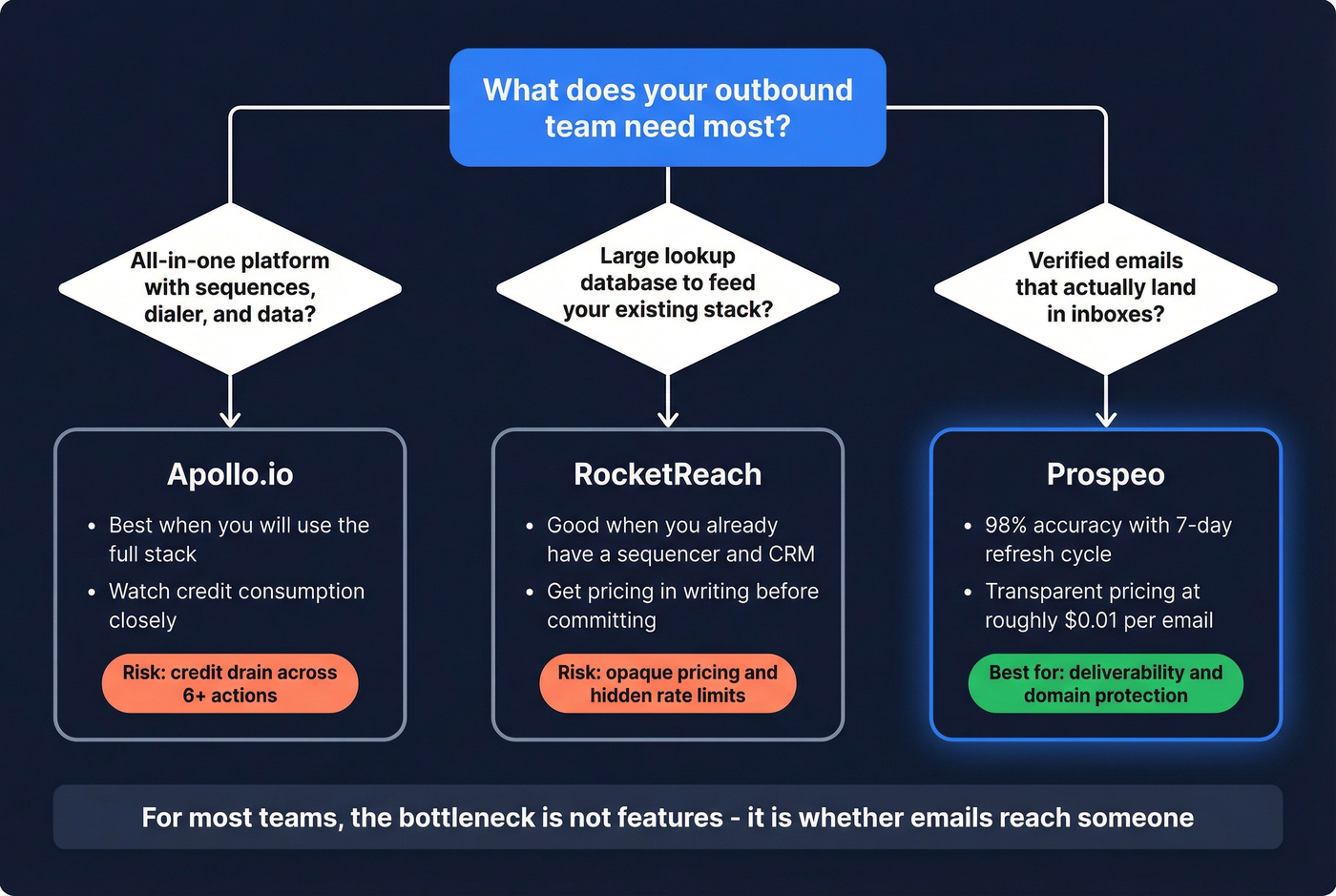
Apollo is the right call for teams that want one platform for sequences, dialing, and data - and have the operational discipline to monitor credit consumption across a dozen different actions. It's genuinely powerful if you'll use the full stack. If you only need the database, you're overpaying.
RocketReach fits when you already have an outreach stack and just need a large lookup database to feed it. Budget carefully - pricing shifts depending on when and where you check, and rate limits can throttle high-volume workflows without warning.
For most outbound teams, the real bottleneck isn't feature count. It's whether the emails you're sending actually reach someone. That's a data quality problem, and solving it upstream saves you from chasing metrics downstream. If you're building a repeatable motion, start with a clear Ideal Customer Profile (ICP) so you’re not enriching the wrong accounts.
FAQ
Is Apollo.io's free plan really free?
Yes, but it's capped hard: 10 exports/month, 5 mobile credits, 250 sends/day, and only 2 active sequences. Most teams doing weekly prospecting hit the Basic tier at $49/user/month within days.
Does RocketReach have a free trial?
RocketReach includes 5 free lookups, but that's not a full-feature trial of the Pro or Ultimate plans. If you need to evaluate exports, integrations, and higher-volume workflows, expect to commit to a paid plan and confirm limits in writing before you do.
Which is better for verified emails?
Prospeo is the safer pick at scale: 98% email accuracy, a 7-day refresh cycle, and 75 verified emails/month on the free tier. RocketReach cites 98% deliverability for "A-grade emails" only, while Apollo doesn't publish a single accuracy figure and gets frequent data quality complaints on G2.
Which tool has better European coverage?
For EU targeting, prioritize GDPR compliance and data freshness over raw database size - older records decay fast across European markets. Prospeo refreshes records every 7 days and enforces global opt-out. Both Apollo and RocketReach receive recurring G2 complaints about gaps and outdated contacts in certain regions.